


Identification of new molecular mechanism indicates new
ways to block uncontrolled cell division
&
Study reveals intricate mechanisms involved in enzyme that
governs DNA duplication
Julián Carvajal Fernández
Molecular Biology
Third semester – 2014-02
Teacher: Lina Maria Martinez Sanchez
Universidad Pontificia Bolivariana
INTRODUCTION
Every human cell has DNA
(Deoxyribonucleic acid). DNA is the
genetic material that contains all
information needed to create other cells
and be part of an organism.
All natural aspects of our bodies are
defined by DNA and it´s function can
explain lots of anormalities we suffer
when we get sick.
There lies the importance of the fact on
knowing it´s behavior.
-ORI
-MCM2-7 Helicase
-RNA Polymerase
-DNA Polymerase
-Primase
-Topoisomerase
-DNA ligase
-SSDBP
-RNAse H
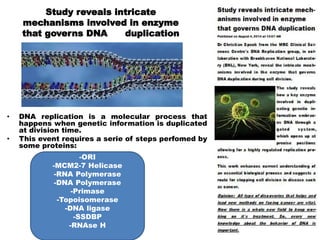
• DNA replication is a molecular process that
happens when genetic information is duplicated
at division time.
• This event requires a serie of steps perfomed by
some proteins:
Study reveals intricate
mechanisms involved in enzyme
that governs DNA duplication
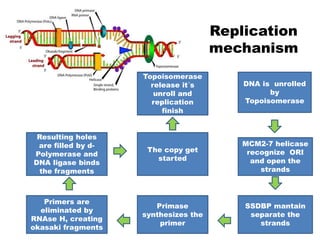
Replication
mechanism
DNA is unrolled
by
Topoisomerase
MCM2-7 helicase
recognize ORI
and open the
strands
SSDBP mantain
separate the
strands
Primase
synthesizes the
primer
Primers are
eliminated by
RNAse H, creating
okasaki fragments
Resulting holes
are filled by d-
Polymerase and
DNA ligase binds
the fragments
The copy get
started
Topoisomerase
release it´s
unroll and
replication
finish
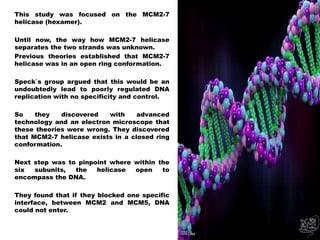
This study was focused on the MCM2-7
helicase (hexamer).
Until now, the way how MCM2-7 helicase
separates the two strands was unknown.
Previous theories established that MCM2-7
helicase was in an open ring conformation.
Speck`s group argued that this would be an
undoubtedly lead to poorly regulated DNA
replication with no specificity and control.
So they discovered with advanced
technology and an electron microscope that
these theories were wrong. They discovered
that MCM2-7 helicase exists in a closed ring
conformation.
Next step was to pinpoint where within the
six subunits, the helicase open to
encompass the DNA.
They found that if they blocked one specific
interface, between MCM2 and MCM5, DNA
could not enter.
"Our work is aimed at understanding the molecular mechanism of
DNA replication at a fundamental level. Yet our findings could also have important
implications, possibly pointing to new ways to fight cancer, because DNA
duplication is a prime target to inhibit cancer cell growth," says Christian.
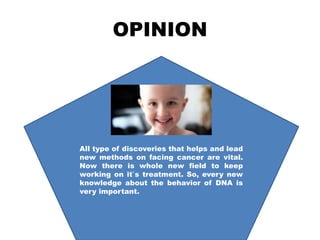
OPINION
All type of discoveries that helps and lead
new methods on facing cancer are vital.
Now there is whole new field to keep
working on it`s treatment. So, every new
knowledge about the behavior of DNA is
very important.
Identification of new
molecular mechanism
indicates new ways to block
uncontrolled cell division
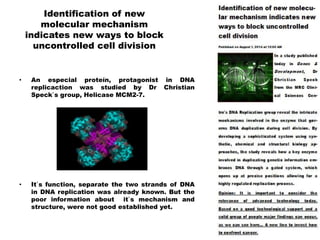
• An especial proteín, protagonist in DNA
replicaction was studied by Dr Christian
Speck`s group, Helicase MCM2-7.
• It`s function, separate the two strands of DNA
in DNA replication was already known. But the
poor information about it`s mechanism and
structure, were not good established yet.
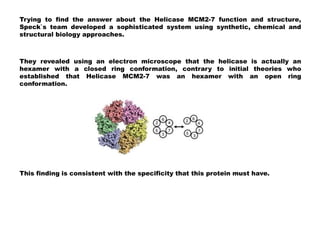
Trying to find the answer about the Helicase MCM2-7 function and structure,
Speck`s team developed a sophisticated system using synthetic, chemical and
structural biology approaches.
They revealed using an electron microscope that the helicase is actually an
hexamer with a closed ring conformation, contrary to initial theories who
established that Helicase MCM2-7 was an hexamer with an open ring
conformation.
This finding is consistent with the specificity that this protein must have.
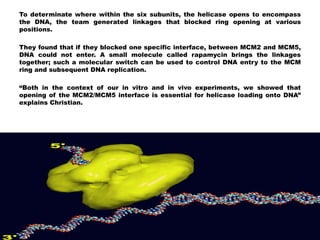
To determinate where within the six subunits, the helicase opens to encompass
the DNA, the team generated linkages that blocked ring opening at various
positions.
They found that if they blocked one specific interface, between MCM2 and MCM5,
DNA could not enter. A small molecule called rapamycin brings the linkages
together; such a molecular switch can be used to control DNA entry to the MCM
ring and subsequent DNA replication.
“Both in the context of our in vitro and in vivo experiments, we showed that
opening of the MCM2/MCM5 interface is essential for helicase loading onto DNA”
explains Christian.
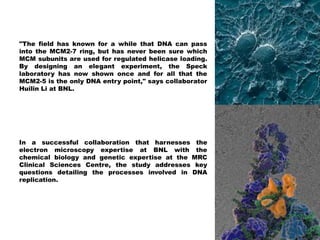
"The field has known for a while that DNA can pass
into the MCM2-7 ring, but has never been sure which
MCM subunits are used for regulated helicase loading.
By designing an elegant experiment, the Speck
laboratory has now shown once and for all that the
MCM2-5 is the only DNA entry point," says collaborator
Huilin Li at BNL.
In a successful collaboration that harnesses the
electron microscopy expertise at BNL with the
chemical biology and genetic expertise at the MRC
Clinical Sciences Centre, the study addresses key
questions detailing the processes involved in DNA
replication.
OPINION
It is important to consider the relevance
of advanced technology today. Based on
a good technological support and a solid
group of people, major findings can
occur, as we can see here… A new line to
invest how to confront cancer.
DNA controls all cellular processes, and that is
a fact that determinates our health.
That is why today, there are many efforts to
understand it`s functioning.
MEDICAL
UTILITY
MEDICAL
UTILITY
Cancer occurs when the growth of our cells is out of control and cells
divide too fast, or in fact, when they forget to die.
That is why, knowing the operation mechanism of DNA we can search
solutions to this disease.
MEDICAL
UTILITY
If we certainly know about all factors that acts on DNA replicaction, we
can search ways to stop it when it`s necesary, stoping cell growth on
situations like cancer.
MEDICAL
UTILITY
The most important think about this topic is never give up on fighting
cancer. Protagonist of this news are a perfect example of it. With this
finding they open lights to other researchers to keep trying, and they
showed that there is a lot to do against this disease.
• ¨Identification of a new molecular mechanism indicates new ways to block
unctrolled cell division”
http://www.news-medical.net/news/20140801/Identification-of-new-molecular-
mechanism-indicates-new-ways-to-block-uncontrolled-cell-division.aspx
(accesed 05/08/2014)
• ¨ Study reveals intricate mechanisms involved in enzyme that governs DNA
duplication.”
http://www.news-medical.net/news/20140804/Study-reveals-intricate-mechanisms-
involved-in-enzyme-that-governs-DNA-duplication.aspx
(accesed 05/08/2014)
• MARTINEZ SÁNCHEZ, Lina María. Biología molecular. 7. ed. Medellin: UPB
Fac. de Medicina, 2012. 78-83p.
• http://www.nlm.nih.gov/medlineplus/spanish/ency/article/001289.htm
(accesed 09/08/2014)
BIBLIOGRAPHY
“Limits are for those who do not know the power
of their minds”
Julián Carvajal Fernández

Molecular Biology folding

  • 1.
    Identification of newmolecular mechanism indicates new ways to block uncontrolled cell division & Study reveals intricate mechanisms involved in enzyme that governs DNA duplication Julián Carvajal Fernández Molecular Biology Third semester – 2014-02 Teacher: Lina Maria Martinez Sanchez Universidad Pontificia Bolivariana
  • 4.
    INTRODUCTION Every human cellhas DNA (Deoxyribonucleic acid). DNA is the genetic material that contains all information needed to create other cells and be part of an organism. All natural aspects of our bodies are defined by DNA and it´s function can explain lots of anormalities we suffer when we get sick. There lies the importance of the fact on knowing it´s behavior.
  • 5.
    -ORI -MCM2-7 Helicase -RNA Polymerase -DNAPolymerase -Primase -Topoisomerase -DNA ligase -SSDBP -RNAse H • DNA replication is a molecular process that happens when genetic information is duplicated at division time. • This event requires a serie of steps perfomed by some proteins: Study reveals intricate mechanisms involved in enzyme that governs DNA duplication
  • 6.
    Replication mechanism DNA is unrolled by Topoisomerase MCM2-7helicase recognize ORI and open the strands SSDBP mantain separate the strands Primase synthesizes the primer Primers are eliminated by RNAse H, creating okasaki fragments Resulting holes are filled by d- Polymerase and DNA ligase binds the fragments The copy get started Topoisomerase release it´s unroll and replication finish
  • 7.
    This study wasfocused on the MCM2-7 helicase (hexamer). Until now, the way how MCM2-7 helicase separates the two strands was unknown. Previous theories established that MCM2-7 helicase was in an open ring conformation. Speck`s group argued that this would be an undoubtedly lead to poorly regulated DNA replication with no specificity and control. So they discovered with advanced technology and an electron microscope that these theories were wrong. They discovered that MCM2-7 helicase exists in a closed ring conformation. Next step was to pinpoint where within the six subunits, the helicase open to encompass the DNA. They found that if they blocked one specific interface, between MCM2 and MCM5, DNA could not enter.
  • 8.
    "Our work isaimed at understanding the molecular mechanism of DNA replication at a fundamental level. Yet our findings could also have important implications, possibly pointing to new ways to fight cancer, because DNA duplication is a prime target to inhibit cancer cell growth," says Christian.
  • 9.
    OPINION All type ofdiscoveries that helps and lead new methods on facing cancer are vital. Now there is whole new field to keep working on it`s treatment. So, every new knowledge about the behavior of DNA is very important.
  • 10.
    Identification of new molecularmechanism indicates new ways to block uncontrolled cell division • An especial proteín, protagonist in DNA replicaction was studied by Dr Christian Speck`s group, Helicase MCM2-7. • It`s function, separate the two strands of DNA in DNA replication was already known. But the poor information about it`s mechanism and structure, were not good established yet.
  • 11.
    Trying to findthe answer about the Helicase MCM2-7 function and structure, Speck`s team developed a sophisticated system using synthetic, chemical and structural biology approaches. They revealed using an electron microscope that the helicase is actually an hexamer with a closed ring conformation, contrary to initial theories who established that Helicase MCM2-7 was an hexamer with an open ring conformation. This finding is consistent with the specificity that this protein must have.
  • 12.
    To determinate wherewithin the six subunits, the helicase opens to encompass the DNA, the team generated linkages that blocked ring opening at various positions. They found that if they blocked one specific interface, between MCM2 and MCM5, DNA could not enter. A small molecule called rapamycin brings the linkages together; such a molecular switch can be used to control DNA entry to the MCM ring and subsequent DNA replication. “Both in the context of our in vitro and in vivo experiments, we showed that opening of the MCM2/MCM5 interface is essential for helicase loading onto DNA” explains Christian.
  • 13.
    "The field hasknown for a while that DNA can pass into the MCM2-7 ring, but has never been sure which MCM subunits are used for regulated helicase loading. By designing an elegant experiment, the Speck laboratory has now shown once and for all that the MCM2-5 is the only DNA entry point," says collaborator Huilin Li at BNL. In a successful collaboration that harnesses the electron microscopy expertise at BNL with the chemical biology and genetic expertise at the MRC Clinical Sciences Centre, the study addresses key questions detailing the processes involved in DNA replication.
  • 14.
    OPINION It is importantto consider the relevance of advanced technology today. Based on a good technological support and a solid group of people, major findings can occur, as we can see here… A new line to invest how to confront cancer.
  • 15.
    DNA controls allcellular processes, and that is a fact that determinates our health. That is why today, there are many efforts to understand it`s functioning. MEDICAL UTILITY
  • 16.
    MEDICAL UTILITY Cancer occurs whenthe growth of our cells is out of control and cells divide too fast, or in fact, when they forget to die. That is why, knowing the operation mechanism of DNA we can search solutions to this disease.
  • 17.
    MEDICAL UTILITY If we certainlyknow about all factors that acts on DNA replicaction, we can search ways to stop it when it`s necesary, stoping cell growth on situations like cancer.
  • 18.
    MEDICAL UTILITY The most importantthink about this topic is never give up on fighting cancer. Protagonist of this news are a perfect example of it. With this finding they open lights to other researchers to keep trying, and they showed that there is a lot to do against this disease.
  • 19.
    • ¨Identification ofa new molecular mechanism indicates new ways to block unctrolled cell division” http://www.news-medical.net/news/20140801/Identification-of-new-molecular- mechanism-indicates-new-ways-to-block-uncontrolled-cell-division.aspx (accesed 05/08/2014) • ¨ Study reveals intricate mechanisms involved in enzyme that governs DNA duplication.” http://www.news-medical.net/news/20140804/Study-reveals-intricate-mechanisms- involved-in-enzyme-that-governs-DNA-duplication.aspx (accesed 05/08/2014) • MARTINEZ SÁNCHEZ, Lina María. Biología molecular. 7. ed. Medellin: UPB Fac. de Medicina, 2012. 78-83p. • http://www.nlm.nih.gov/medlineplus/spanish/ency/article/001289.htm (accesed 09/08/2014) BIBLIOGRAPHY
  • 20.
    “Limits are forthose who do not know the power of their minds” Julián Carvajal Fernández