Gene Therapy
Ruqaya Anani
Contents
Gene Therapy01
Genome Editing02
CRISPER03
Luxturna04
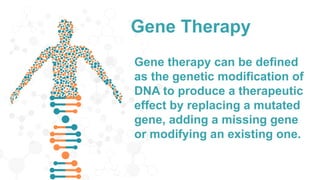
Gene Therapy
Gene therapy can be defined
as the genetic modification of
DNA to produce a therapeutic
effect by replacing a mutated
gene, adding a missing gene
or modifying an existing one.
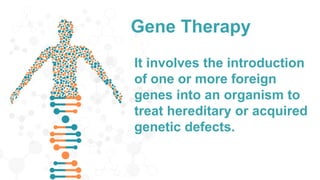
Gene Therapy
It involves the introduction
of one or more foreign
genes into an organism to
treat hereditary or acquired
genetic defects.
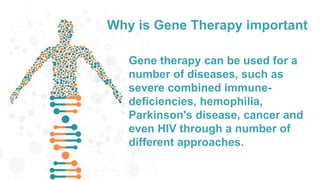
Why is Gene Therapy important
Gene therapy can be used for a
number of diseases, such as
severe combined immune-
deficiencies, hemophilia,
Parkinson's disease, cancer and
even HIV through a number of
different approaches.
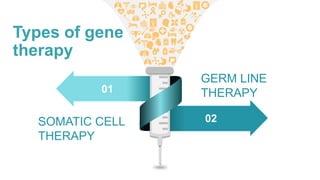
Types of gene
therapy
01
02SOMATIC CELL
THERAPY
GERM LINE
THERAPY
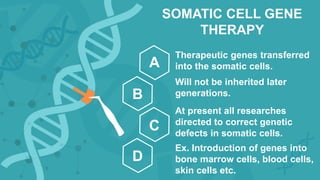
SOMATIC CELL GENE
THERAPY
Therapeutic genes transferred
into the somatic cells.
Will not be inherited later
generations.
At present all researches
directed to correct genetic
defects in somatic cells.
Ex. Introduction of genes into
bone marrow cells, blood cells,
skin cells etc.
A
B
C
D
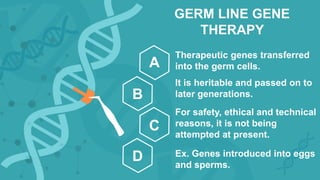
GERM LINE GENE
THERAPY
Therapeutic genes transferred
into the germ cells.
It is heritable and passed on to
later generations.
For safety, ethical and technical
reasons, it is not being
attempted at present.
Ex. Genes introduced into eggs
and sperms.
A
B
C
D
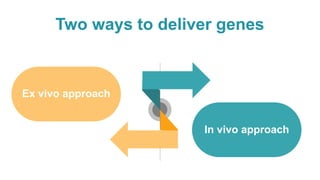
Two ways to deliver genes
In vivo approach
Ex vivo approach
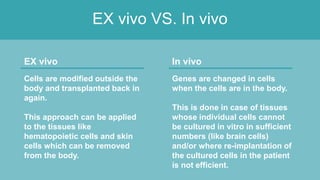
EX vivo VS. In vivo
EX vivo
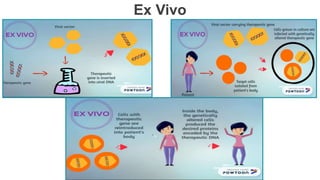
Cells are modified outside the
body and transplanted back in
again.
This approach can be applied
to the tissues like
hematopoietic cells and skin
cells which can be removed
from the body.
In vivo
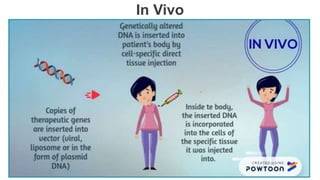
Genes are changed in cells
when the cells are in the body.
This is done in case of tissues
whose individual cells cannot
be cultured in vitro in sufficient
numbers (like brain cells)
and/or where re-implantation of
the cultured cells in the patient
is not efficient.
Ex Vivo
In Vivo
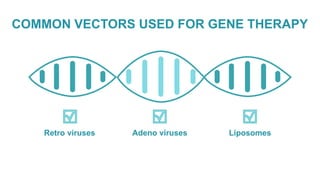
COMMON VECTORS USED FOR GENE THERAPY
Retro viruses Adeno viruses Liposomes
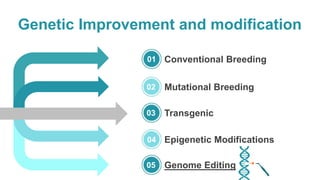
Genetic Improvement and modification
01
02
03
04
05
Conventional Breeding
Mutational Breeding
Transgenic
Epigenetic Modifications
Genome Editing
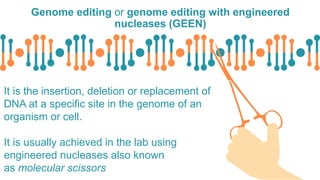
Genome editing or genome editing with engineered
nucleases (GEEN)
It is the insertion, deletion or replacement of
DNA at a specific site in the genome of an
organism or cell.
It is usually achieved in the lab using
engineered nucleases also known
as molecular scissors
02
01
03
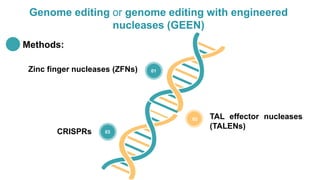
Genome editing or genome editing with engineered
nucleases (GEEN)
Zinc finger nucleases (ZFNs)
TAL effector nucleases
(TALENs)
CRISPRs
Methods:
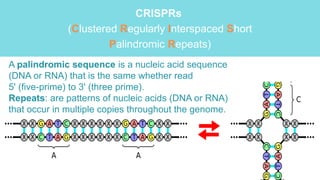
A palindromic sequence is a nucleic acid sequence
(DNA or RNA) that is the same whether read
5' (five-prime) to 3' (three prime).
Repeats: are patterns of nucleic acids (DNA or RNA)
that occur in multiple copies throughout the genome.
CRISPRs
(Clustered Regularly Interspaced Short
Palindromic Repeats)
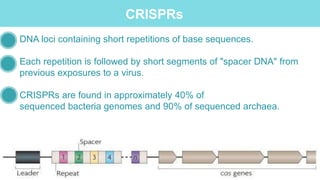
DNA loci containing short repetitions of base sequences.
Each repetition is followed by short segments of "spacer DNA" from
previous exposures to a virus.
CRISPRs are found in approximately 40% of
sequenced bacteria genomes and 90% of sequenced archaea.
CRISPRs
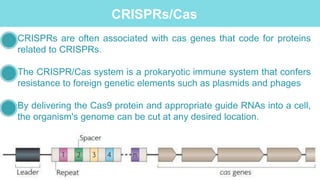
CRISPRs/Cas
CRISPRs are often associated with cas genes that code for proteins
related to CRISPRs.
The CRISPR/Cas system is a prokaryotic immune system that confers
resistance to foreign genetic elements such as plasmids and phages
By delivering the Cas9 protein and appropriate guide RNAs into a cell,
the organism's genome can be cut at any desired location.
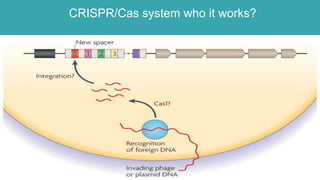
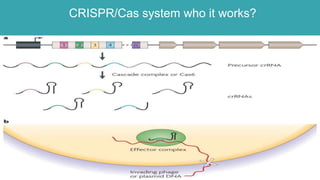
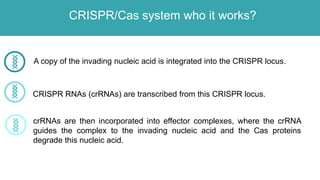
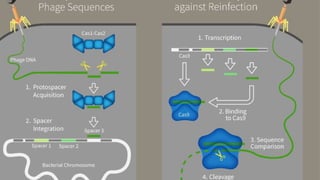
CRISPR/Cas system who it works?
A copy of the invading nucleic acid is integrated into the CRISPR locus.
CRISPR RNAs (crRNAs) are transcribed from this CRISPR locus.
crRNAs are then incorporated into effector complexes, where the crRNA
guides the complex to the invading nucleic acid and the Cas proteins
degrade this nucleic acid.
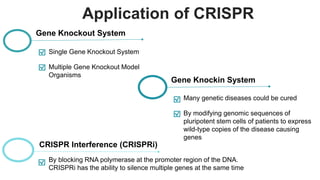
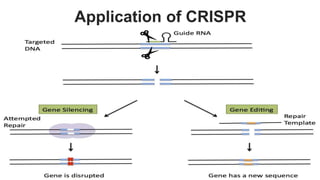
Application of CRISPR
By blocking RNA polymerase at the promoter region of the DNA.
CRISPRi has the ability to silence multiple genes at the same time
CRISPR Interference (CRISPRi)
Single Gene Knockout System
Multiple Gene Knockout Model
Organisms
Gene Knockout System
Many genetic diseases could be cured
By modifying genomic sequences of
pluripotent stem cells of patients to express
wild-type copies of the disease causing
genes
Gene Knockin System
Application of CRISPR
CRISPR/Cas9 is a novel technique with a bright future
in genomic editing.
CRISPR is still a young system and more research
must be completed in order to rectify its problems.
It has the potential to be useful in a broad range of
applications from simplifying research to acting as a
new form of gene therapy for patients with HIV and
genetic diseases.
Research in the area of CRISPR/Cas9 is gaining
speed and this system could very well be the
solution to many medical issues we face today
CRISPR
Introduction
LUXTURNATM (voretigene neparvovec-rzyl)
is a prescription gene therapy
product used for treatment of
patients with inherited retinal
disease due to mutations in both
copies of the RPE65 gene.
LUXTURNATM
RPE65 is a gene that is necessary to
make a protein needed for vision.
RPE65 gene mutations cause vision
to deteriorate and may progress to
complete blindness.
LUXTURNATM
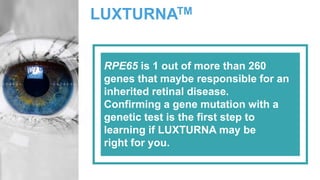
RPE65 is 1 out of more than 260
genes that maybe responsible for an
inherited retinal disease.
Confirming a gene mutation with a
genetic test is the first step to
learning if LUXTURNA may be
right for you.
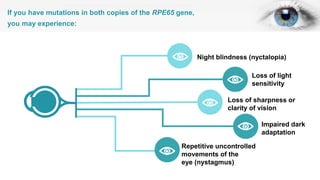
Night blindness (nyctalopia)
Loss of light
sensitivity
Loss of sharpness or
clarity of vision
Impaired dark
adaptation
Repetitive uncontrolled
movements of the
eye (nystagmus)
If you have mutations in both copies of the RPE65 gene,
you may experience:
Mechanism of action
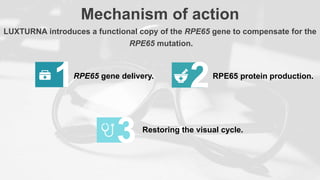
LUXTURNA introduces a functional copy of the RPE65 gene to compensate for the
RPE65 mutation.
1 2
3
RPE65 gene delivery. RPE65 protein production.
Restoring the visual cycle.
Adeno-Associated Virus
Mechanism of action
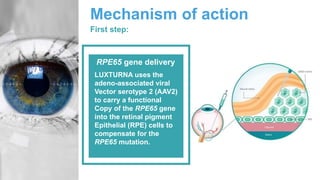
First step:
LUXTURNA uses the
adeno-associated viral
Vector serotype 2 (AAV2)
to carry a functional
Copy of the RPE65 gene
into the retinal pigment
Epithelial (RPE) cells to
compensate for the
RPE65 mutation.
RPE65 gene delivery
Mechanism of action
Second step:
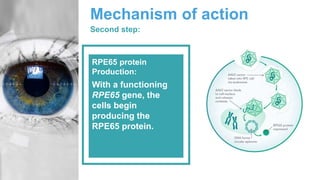
With a functioning
RPE65 gene, the
cells begin
producing the
RPE65 protein.
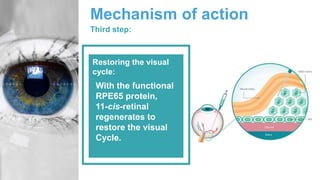
RPE65 protein
Production:
Mechanism of action
Third step:
With the functional
RPE65 protein,
11-cis-retinal
regenerates to
restore the visual
Cycle.
Restoring the visual
cycle:
How is LUXTURNA administered?
LUXTURNA is given by a healthcare
professional as a surgical injection
beneath the retina of each eye.
One eye is treated at a time. After the
first eye is treated, the second eye will
be treated at least 6 days later.
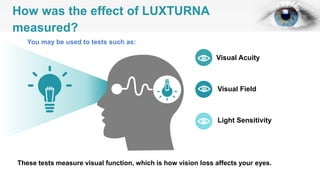
How was the effect of LUXTURNA
measured?
Visual Acuity
Visual Field
Light Sensitivity
You may be used to tests such as:
These tests measure visual function, which is how vision loss affects your eyes.
Multi–Luminance Mobility Test
A new test was created to
measure functional vision,
which is how vision loss affects
the ability to perform daily life
activities.
This test is called the Multi-
Luminance Mobility Test.
Multi–Luminance Mobility Test
In the Multi-Luminance Mobility
Test, participants had to
navigate a course of obstacles
under different light levels.
The light levels went from
bright to dark.
Multi–Luminance Mobility Test
• LUXTURNA was administered to
the participants' first eye, and 6-
18 days later, LUXTURNA was
administered to their second eye.
• Participants followed a
prescribed course of medication
to reduce risks related to an
immune response.
Multi–Luminance Mobility Test
• Each participant was evaluated 1
year after treatment to measure
the effect of LUXTURNA
• LUXTURNA has 9 years of safety
experience and has been studied
in a range of patients between 4
and 44 years old.
What were the results?
LUXTURNA improved functional vision. This
increased participants' ability to perform activities
of daily living.
One year after treatment, participants were able to
navigate through the Multi-Luminance Mobility Test
course using both eyes at 2 light levels
darker than before treatment.
What were the results?
A majority of participants
were able to complete the
course at the darkest light
level after treatment.
Thank you
Any Question ?

Genome editing, luxturna

  • 1.
  • 2.
  • 3.
    Gene Therapy Gene therapycan be defined as the genetic modification of DNA to produce a therapeutic effect by replacing a mutated gene, adding a missing gene or modifying an existing one.
  • 4.
    Gene Therapy It involvesthe introduction of one or more foreign genes into an organism to treat hereditary or acquired genetic defects.
  • 5.
    Why is GeneTherapy important Gene therapy can be used for a number of diseases, such as severe combined immune- deficiencies, hemophilia, Parkinson's disease, cancer and even HIV through a number of different approaches.
  • 6.
    Types of gene therapy 01 02SOMATICCELL THERAPY GERM LINE THERAPY
  • 7.
    SOMATIC CELL GENE THERAPY Therapeuticgenes transferred into the somatic cells. Will not be inherited later generations. At present all researches directed to correct genetic defects in somatic cells. Ex. Introduction of genes into bone marrow cells, blood cells, skin cells etc. A B C D
  • 8.
    GERM LINE GENE THERAPY Therapeuticgenes transferred into the germ cells. It is heritable and passed on to later generations. For safety, ethical and technical reasons, it is not being attempted at present. Ex. Genes introduced into eggs and sperms. A B C D
  • 9.
    Two ways todeliver genes In vivo approach Ex vivo approach
  • 10.
    EX vivo VS.In vivo EX vivo Cells are modified outside the body and transplanted back in again. This approach can be applied to the tissues like hematopoietic cells and skin cells which can be removed from the body. In vivo Genes are changed in cells when the cells are in the body. This is done in case of tissues whose individual cells cannot be cultured in vitro in sufficient numbers (like brain cells) and/or where re-implantation of the cultured cells in the patient is not efficient.
  • 11.
  • 12.
  • 13.
    COMMON VECTORS USEDFOR GENE THERAPY Retro viruses Adeno viruses Liposomes
  • 14.
    Genetic Improvement andmodification 01 02 03 04 05 Conventional Breeding Mutational Breeding Transgenic Epigenetic Modifications Genome Editing
  • 15.
    Genome editing orgenome editing with engineered nucleases (GEEN) It is the insertion, deletion or replacement of DNA at a specific site in the genome of an organism or cell. It is usually achieved in the lab using engineered nucleases also known as molecular scissors
  • 16.
    02 01 03 Genome editing orgenome editing with engineered nucleases (GEEN) Zinc finger nucleases (ZFNs) TAL effector nucleases (TALENs) CRISPRs Methods:
  • 17.
    A palindromic sequenceis a nucleic acid sequence (DNA or RNA) that is the same whether read 5' (five-prime) to 3' (three prime). Repeats: are patterns of nucleic acids (DNA or RNA) that occur in multiple copies throughout the genome. CRISPRs (Clustered Regularly Interspaced Short Palindromic Repeats)
  • 18.
    DNA loci containingshort repetitions of base sequences. Each repetition is followed by short segments of "spacer DNA" from previous exposures to a virus. CRISPRs are found in approximately 40% of sequenced bacteria genomes and 90% of sequenced archaea. CRISPRs
  • 19.
    CRISPRs/Cas CRISPRs are oftenassociated with cas genes that code for proteins related to CRISPRs. The CRISPR/Cas system is a prokaryotic immune system that confers resistance to foreign genetic elements such as plasmids and phages By delivering the Cas9 protein and appropriate guide RNAs into a cell, the organism's genome can be cut at any desired location.
  • 20.
  • 21.
  • 22.
    CRISPR/Cas system whoit works? A copy of the invading nucleic acid is integrated into the CRISPR locus. CRISPR RNAs (crRNAs) are transcribed from this CRISPR locus. crRNAs are then incorporated into effector complexes, where the crRNA guides the complex to the invading nucleic acid and the Cas proteins degrade this nucleic acid.
  • 24.
    Application of CRISPR Byblocking RNA polymerase at the promoter region of the DNA. CRISPRi has the ability to silence multiple genes at the same time CRISPR Interference (CRISPRi) Single Gene Knockout System Multiple Gene Knockout Model Organisms Gene Knockout System Many genetic diseases could be cured By modifying genomic sequences of pluripotent stem cells of patients to express wild-type copies of the disease causing genes Gene Knockin System
  • 25.
  • 26.
    CRISPR/Cas9 is anovel technique with a bright future in genomic editing. CRISPR is still a young system and more research must be completed in order to rectify its problems. It has the potential to be useful in a broad range of applications from simplifying research to acting as a new form of gene therapy for patients with HIV and genetic diseases. Research in the area of CRISPR/Cas9 is gaining speed and this system could very well be the solution to many medical issues we face today CRISPR
  • 28.
    Introduction LUXTURNATM (voretigene neparvovec-rzyl) isa prescription gene therapy product used for treatment of patients with inherited retinal disease due to mutations in both copies of the RPE65 gene.
  • 29.
    LUXTURNATM RPE65 is agene that is necessary to make a protein needed for vision. RPE65 gene mutations cause vision to deteriorate and may progress to complete blindness.
  • 30.
    LUXTURNATM RPE65 is 1out of more than 260 genes that maybe responsible for an inherited retinal disease. Confirming a gene mutation with a genetic test is the first step to learning if LUXTURNA may be right for you.
  • 31.
    Night blindness (nyctalopia) Lossof light sensitivity Loss of sharpness or clarity of vision Impaired dark adaptation Repetitive uncontrolled movements of the eye (nystagmus) If you have mutations in both copies of the RPE65 gene, you may experience:
  • 32.
    Mechanism of action LUXTURNAintroduces a functional copy of the RPE65 gene to compensate for the RPE65 mutation. 1 2 3 RPE65 gene delivery. RPE65 protein production. Restoring the visual cycle.
  • 33.
  • 34.
    Mechanism of action Firststep: LUXTURNA uses the adeno-associated viral Vector serotype 2 (AAV2) to carry a functional Copy of the RPE65 gene into the retinal pigment Epithelial (RPE) cells to compensate for the RPE65 mutation. RPE65 gene delivery
  • 35.
    Mechanism of action Secondstep: With a functioning RPE65 gene, the cells begin producing the RPE65 protein. RPE65 protein Production:
  • 36.
    Mechanism of action Thirdstep: With the functional RPE65 protein, 11-cis-retinal regenerates to restore the visual Cycle. Restoring the visual cycle:
  • 37.
    How is LUXTURNAadministered? LUXTURNA is given by a healthcare professional as a surgical injection beneath the retina of each eye. One eye is treated at a time. After the first eye is treated, the second eye will be treated at least 6 days later.
  • 38.
    How was theeffect of LUXTURNA measured? Visual Acuity Visual Field Light Sensitivity You may be used to tests such as: These tests measure visual function, which is how vision loss affects your eyes.
  • 39.
    Multi–Luminance Mobility Test Anew test was created to measure functional vision, which is how vision loss affects the ability to perform daily life activities. This test is called the Multi- Luminance Mobility Test.
  • 40.
    Multi–Luminance Mobility Test Inthe Multi-Luminance Mobility Test, participants had to navigate a course of obstacles under different light levels. The light levels went from bright to dark.
  • 41.
    Multi–Luminance Mobility Test •LUXTURNA was administered to the participants' first eye, and 6- 18 days later, LUXTURNA was administered to their second eye. • Participants followed a prescribed course of medication to reduce risks related to an immune response.
  • 42.
    Multi–Luminance Mobility Test •Each participant was evaluated 1 year after treatment to measure the effect of LUXTURNA • LUXTURNA has 9 years of safety experience and has been studied in a range of patients between 4 and 44 years old.
  • 43.
    What were theresults? LUXTURNA improved functional vision. This increased participants' ability to perform activities of daily living. One year after treatment, participants were able to navigate through the Multi-Luminance Mobility Test course using both eyes at 2 light levels darker than before treatment.
  • 44.
    What were theresults? A majority of participants were able to complete the course at the darkest light level after treatment.
  • 46.