DNA, GENES
    and
CHROMOSOMES


Ahmed Osman, Ph.D.
 Professor of Biochemistry, Faculty of Science,
             Ain Shams University
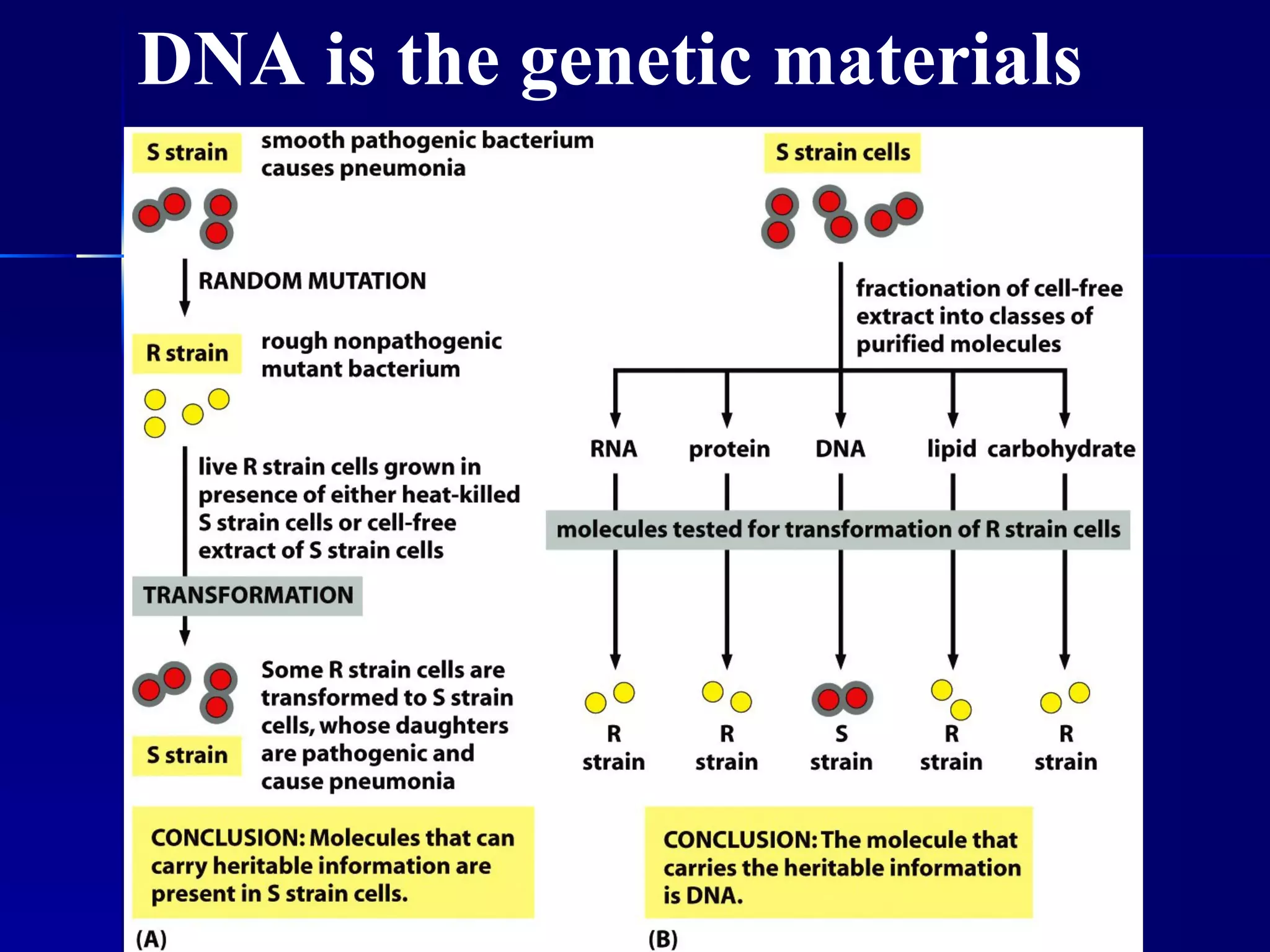
DNA is the genetic materials
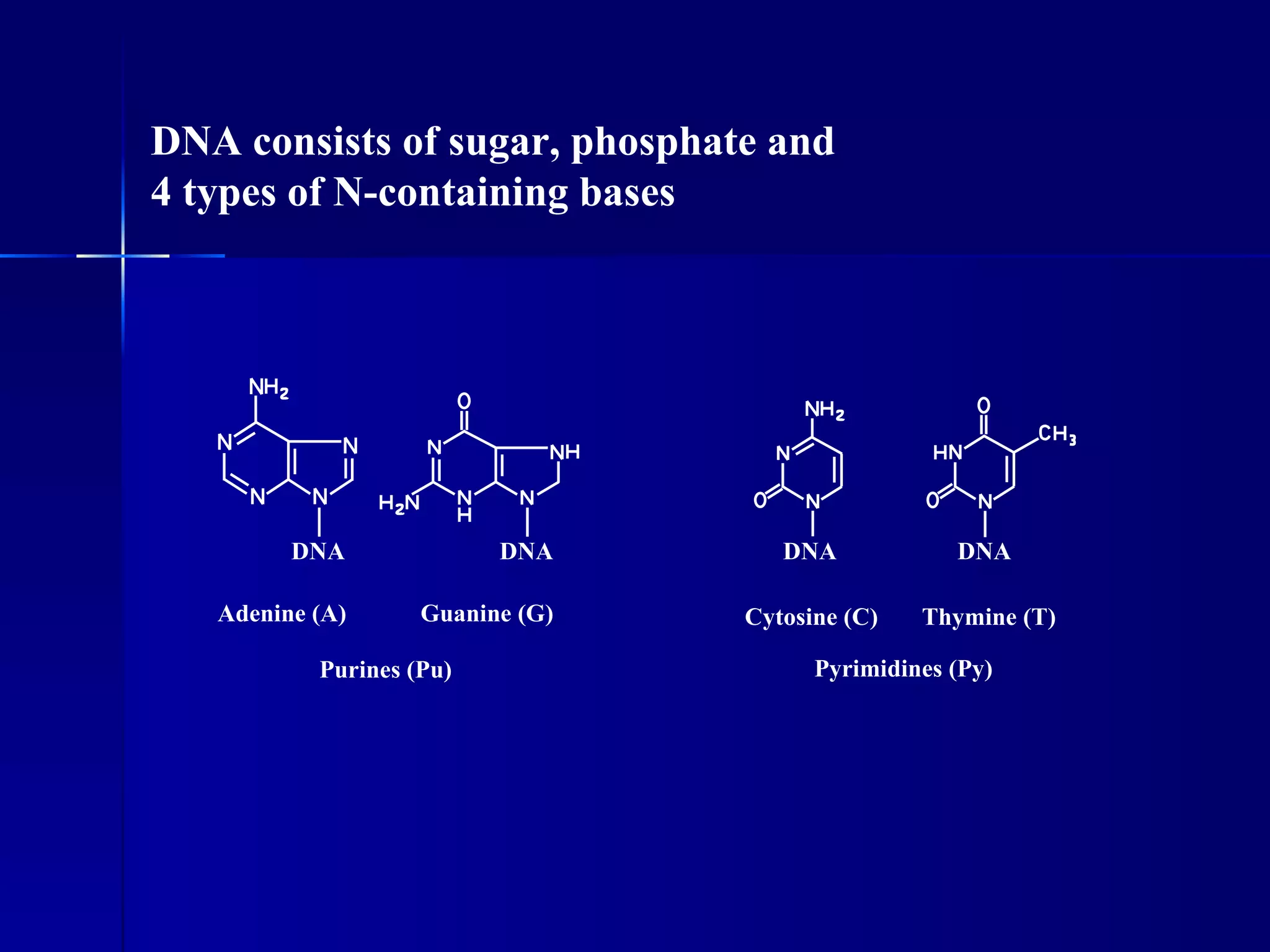
DNA consists of sugar, phosphate and
4 types of N-containing bases


         DNA              DNA        DNA            DNA

   Adenine (A)      Guanine (G)   Cytosine (C)   Thymine (T)

           Purines (Pu)                 Pyrimidines (Py)
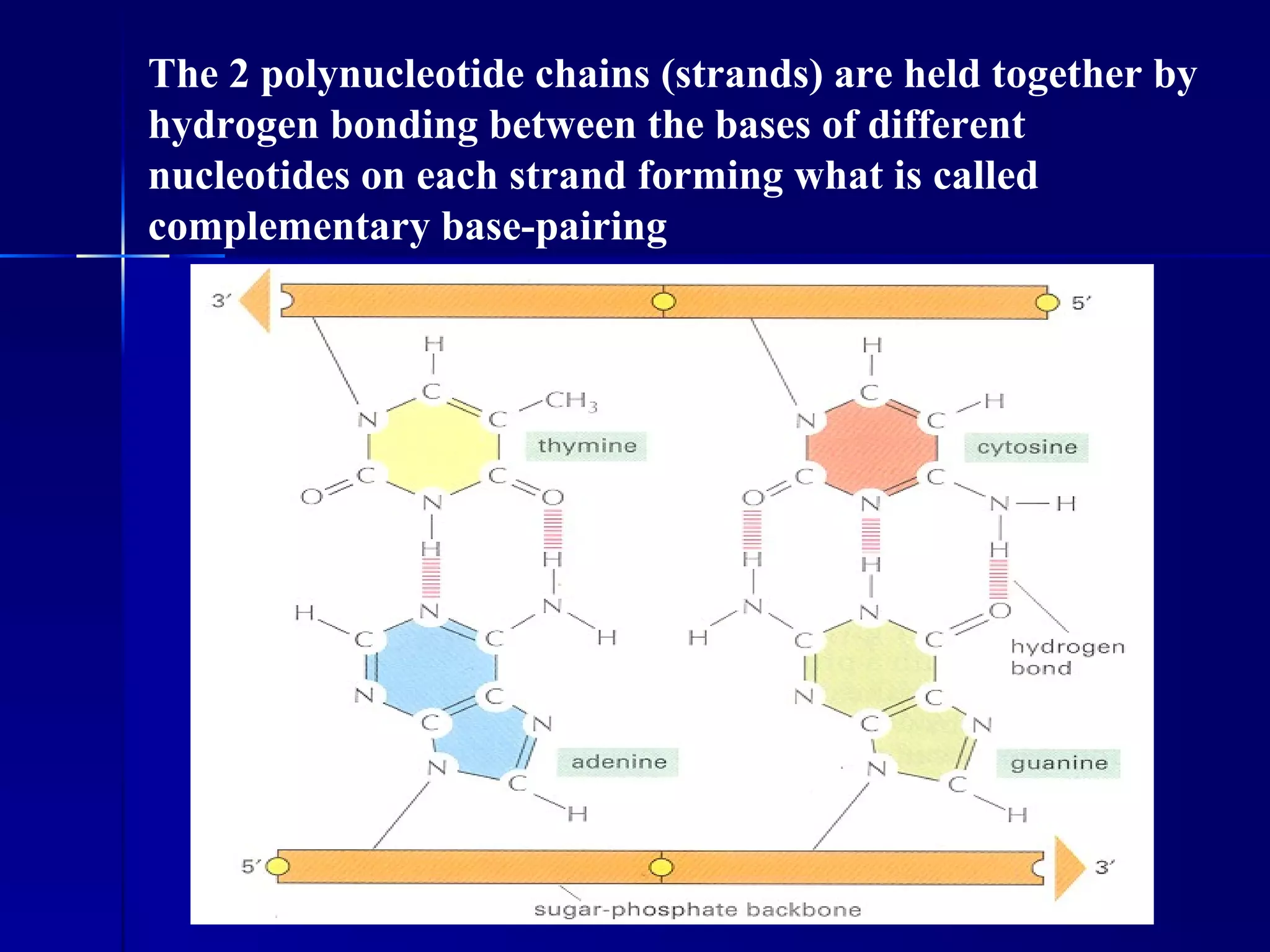
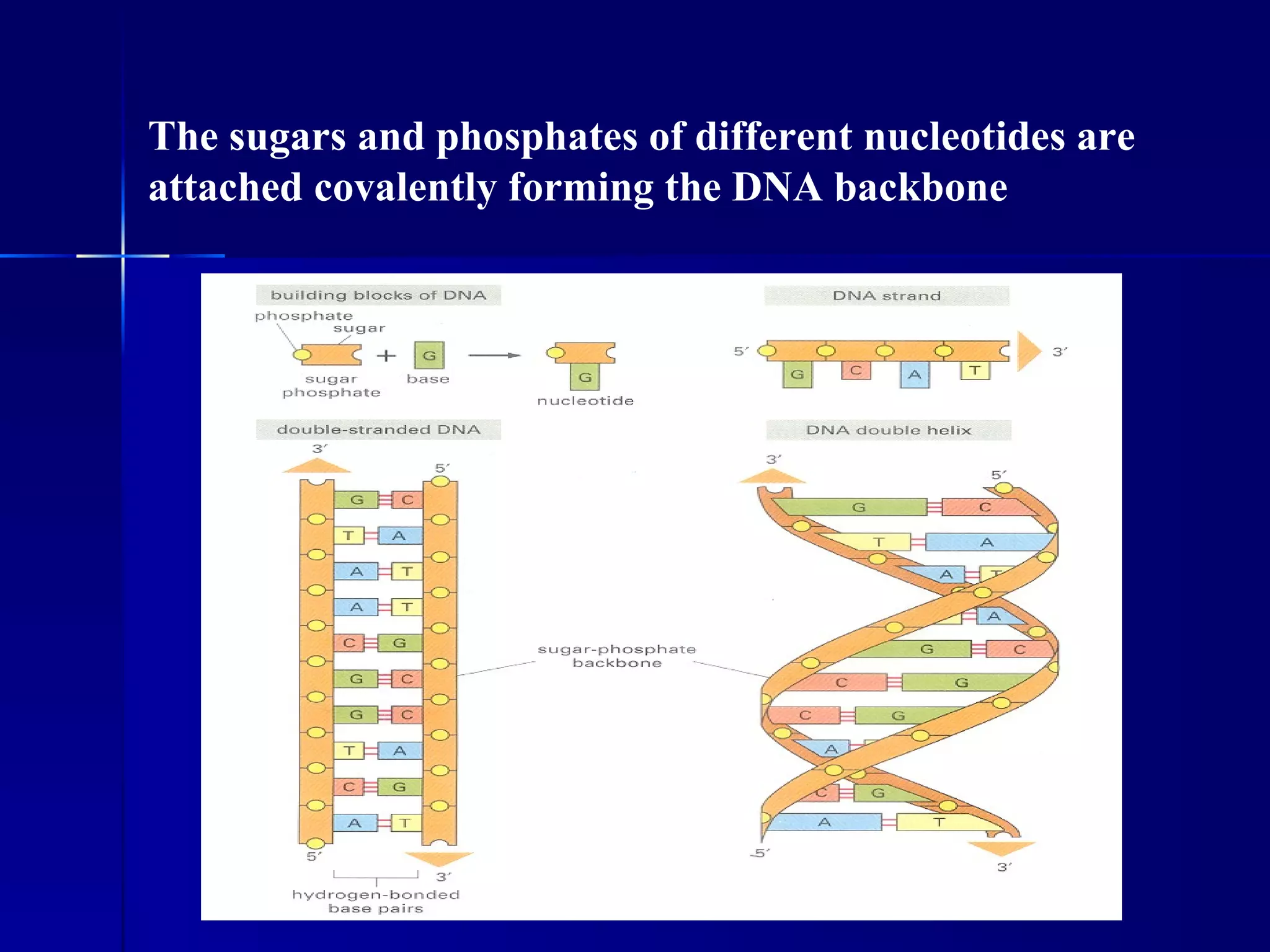
The 2 polynucleotide chains (strands) are held together by
hydrogen bonding between the bases of different
nucleotides on each strand forming what is called
complementary base-pairing
The sugars and phosphates of different nucleotides are
attached covalently forming the DNA backbone
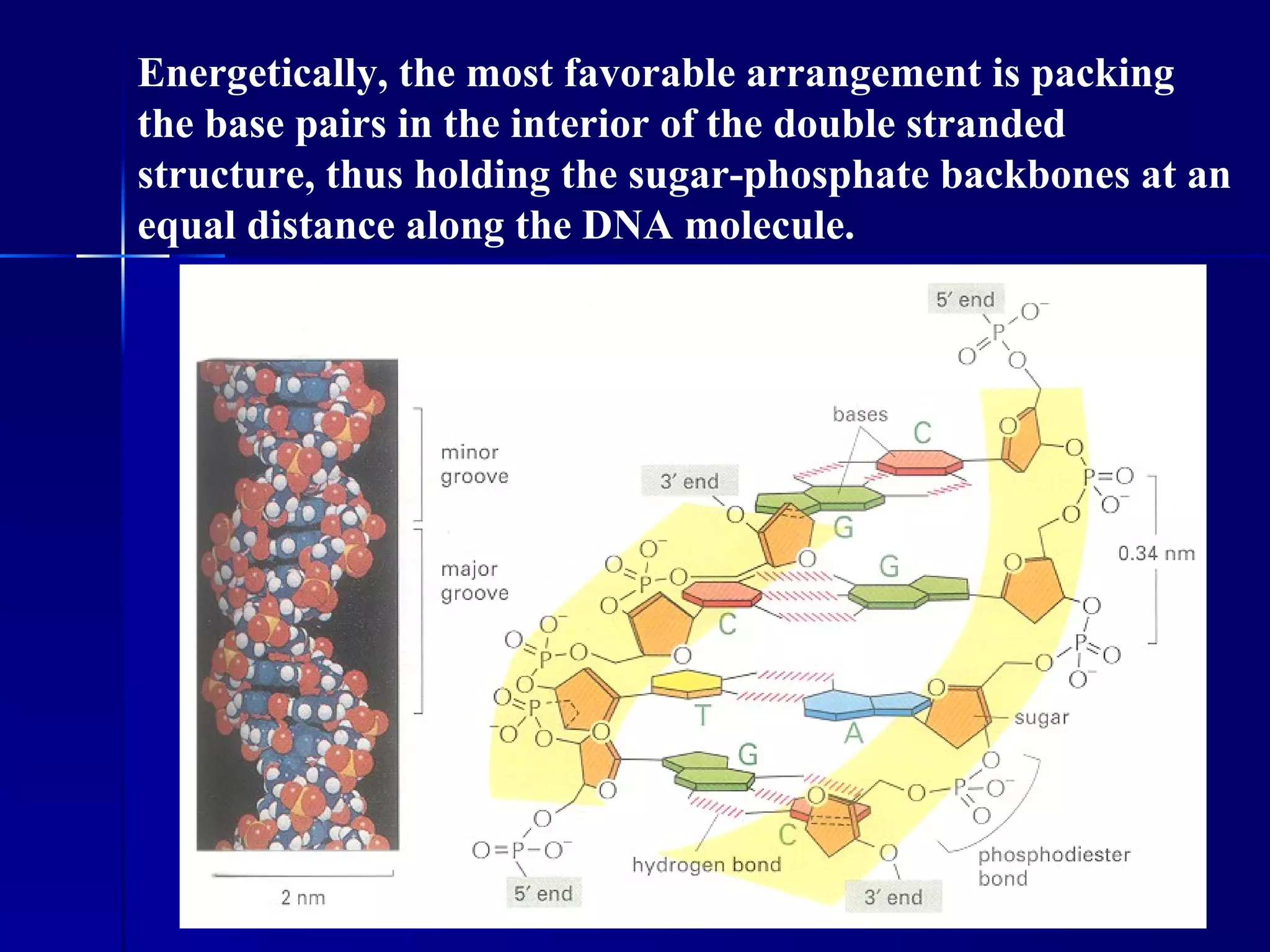
Energetically, the most favorable arrangement is packing
the base pairs in the interior of the double stranded
structure, thus holding the sugar-phosphate backbones at an
equal distance along the DNA molecule.
DNA and chromosomes:

 In eukaryotes, almost all DNA is sequestered in the
nucleus, where most biological processes dealing with DNA
take place.
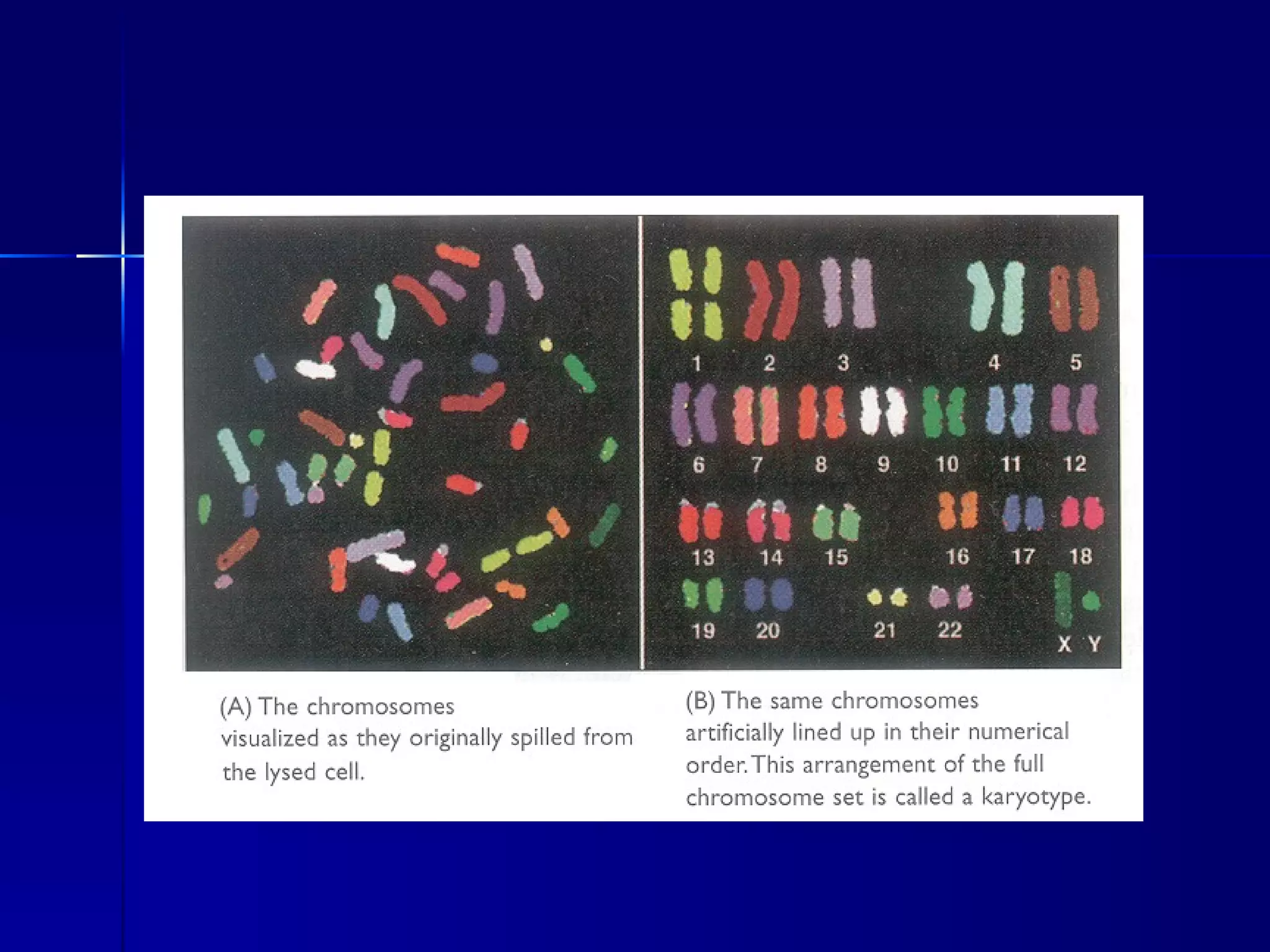
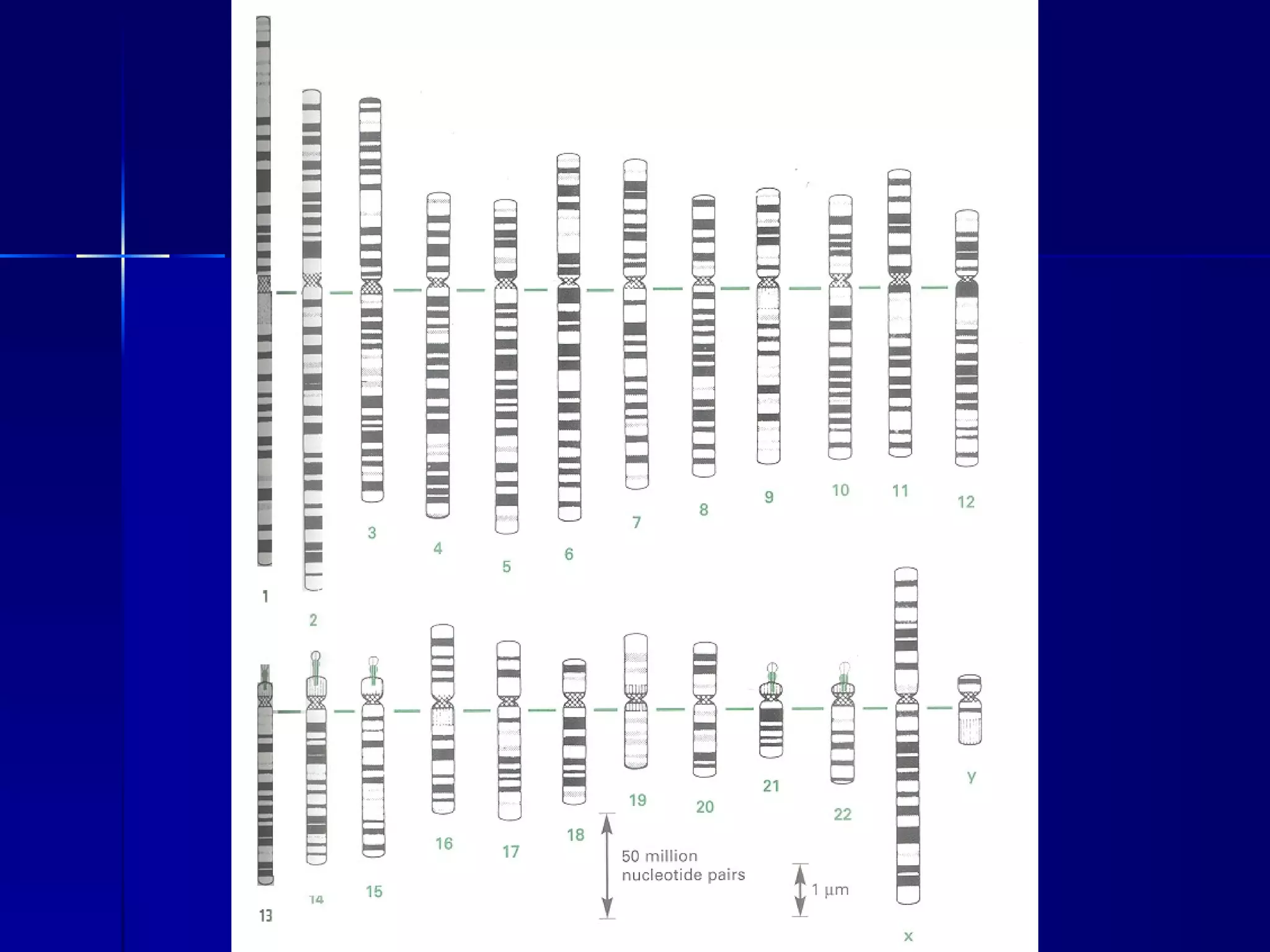
 The DNA is divided between a set of different
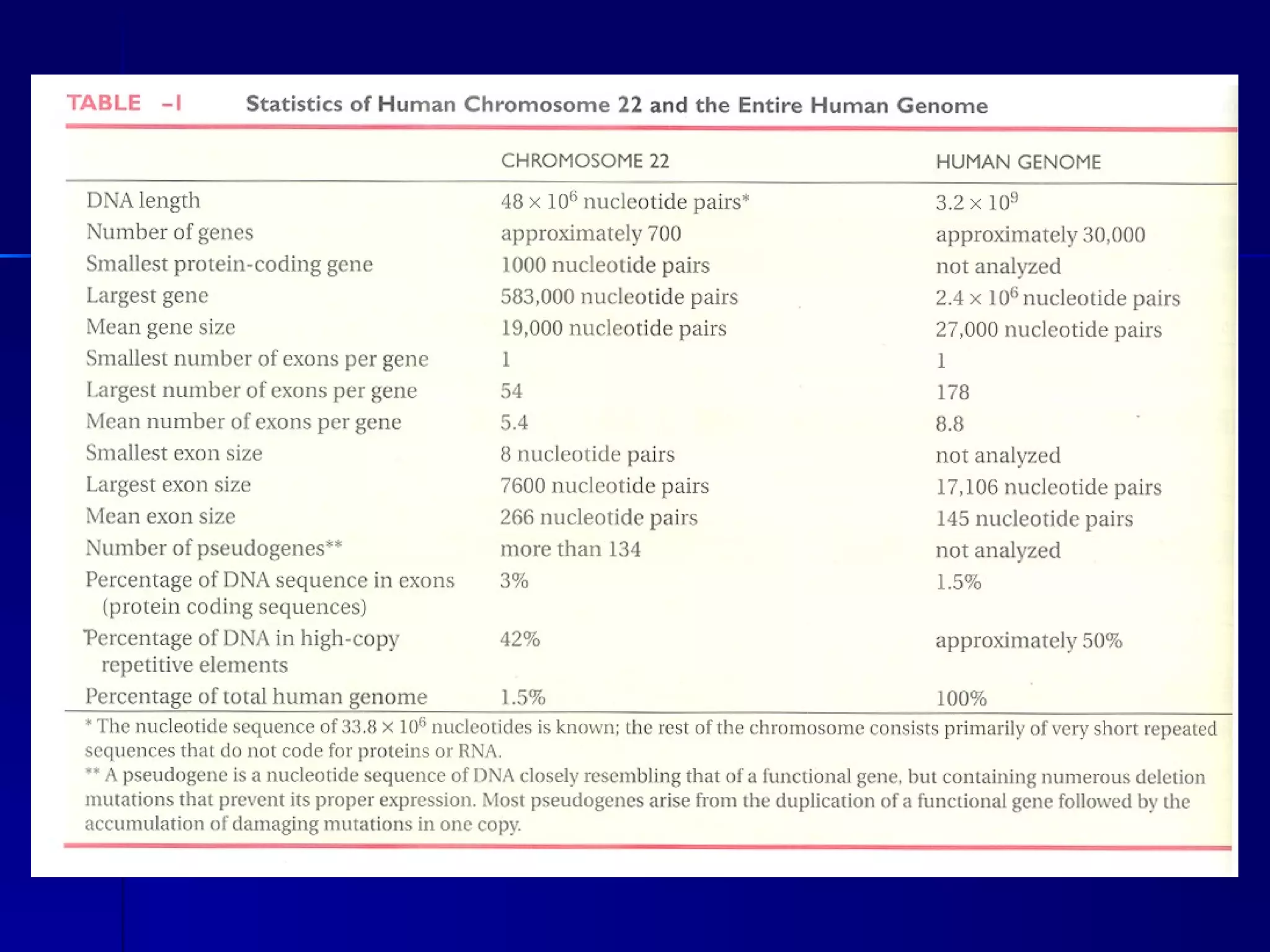
chromosomes, e.g. the human genome contains 3.2 X 10E9
nucleotide pairs distributed over 24 different
chromosomes.
 Each chromosome consists of a single, enormously long
linear DNA molecule associated with proteins that fold and
pack the fine DNA thread into a more compact structure.
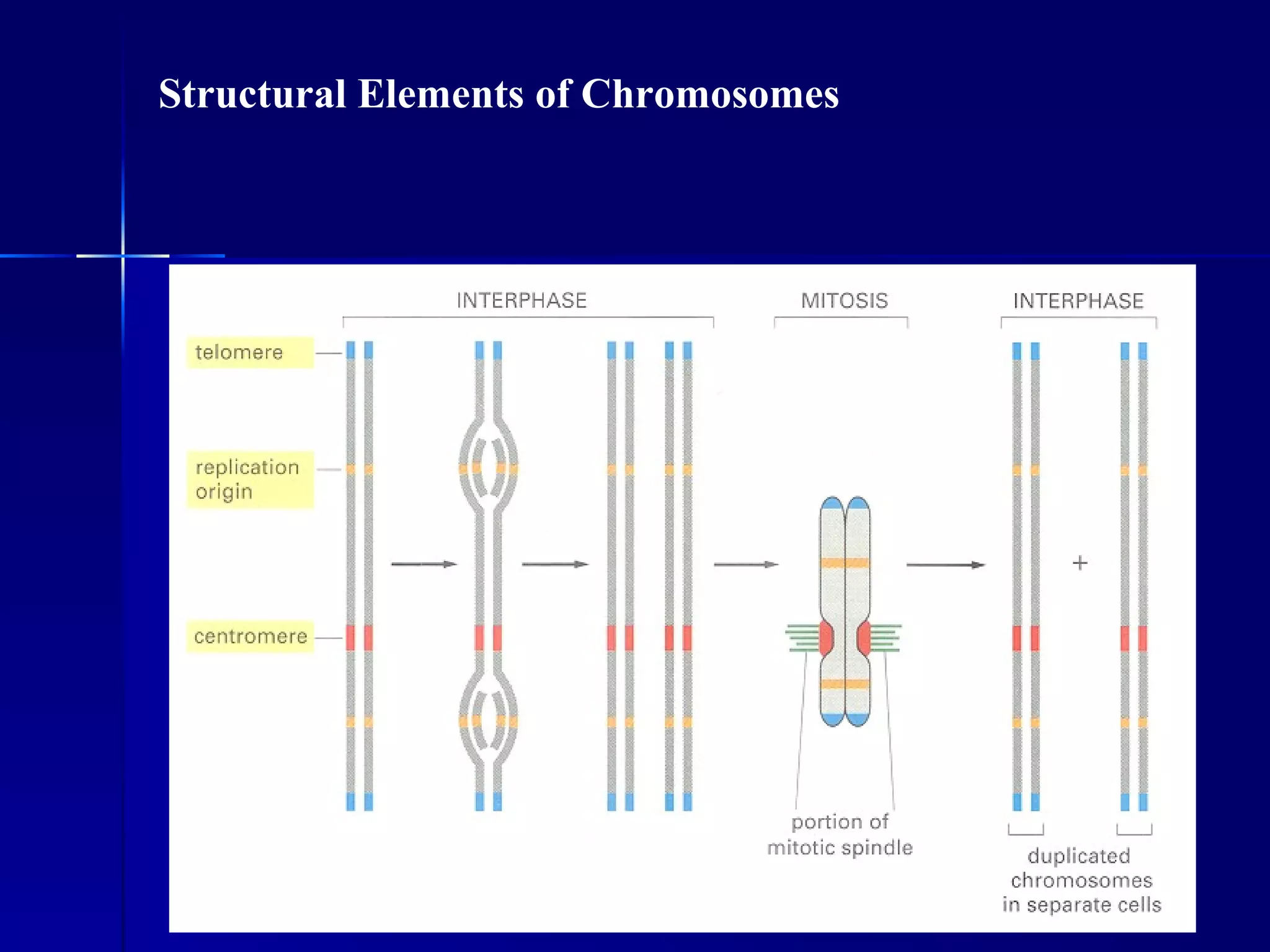
Structural Elements of Chromosomes
RNA & the
Transcriptome
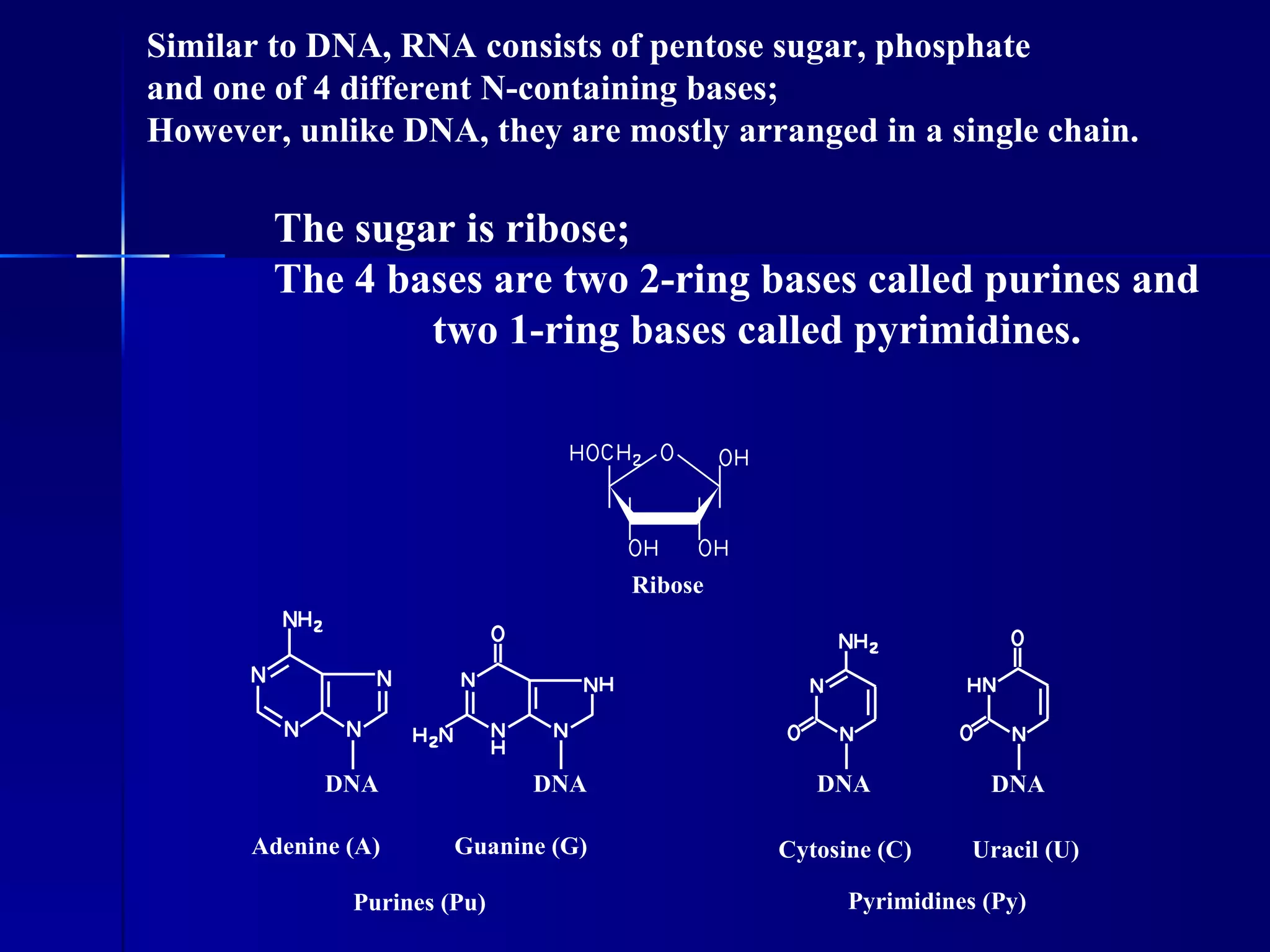
Similar to DNA, RNA consists of pentose sugar, phosphate
and one of 4 different N-containing bases;
However, unlike DNA, they are mostly arranged in a single chain.

        The sugar is ribose;
        The 4 bases are two 2-ring bases called purines and
                two 1-ring bases called pyrimidines.


                                     Ribose


            DNA              DNA                 DNA            DNA

      Adenine (A)      Guanine (G)            Cytosine (C)     Uracil (U)

              Purines (Pu)                          Pyrimidines (Py)
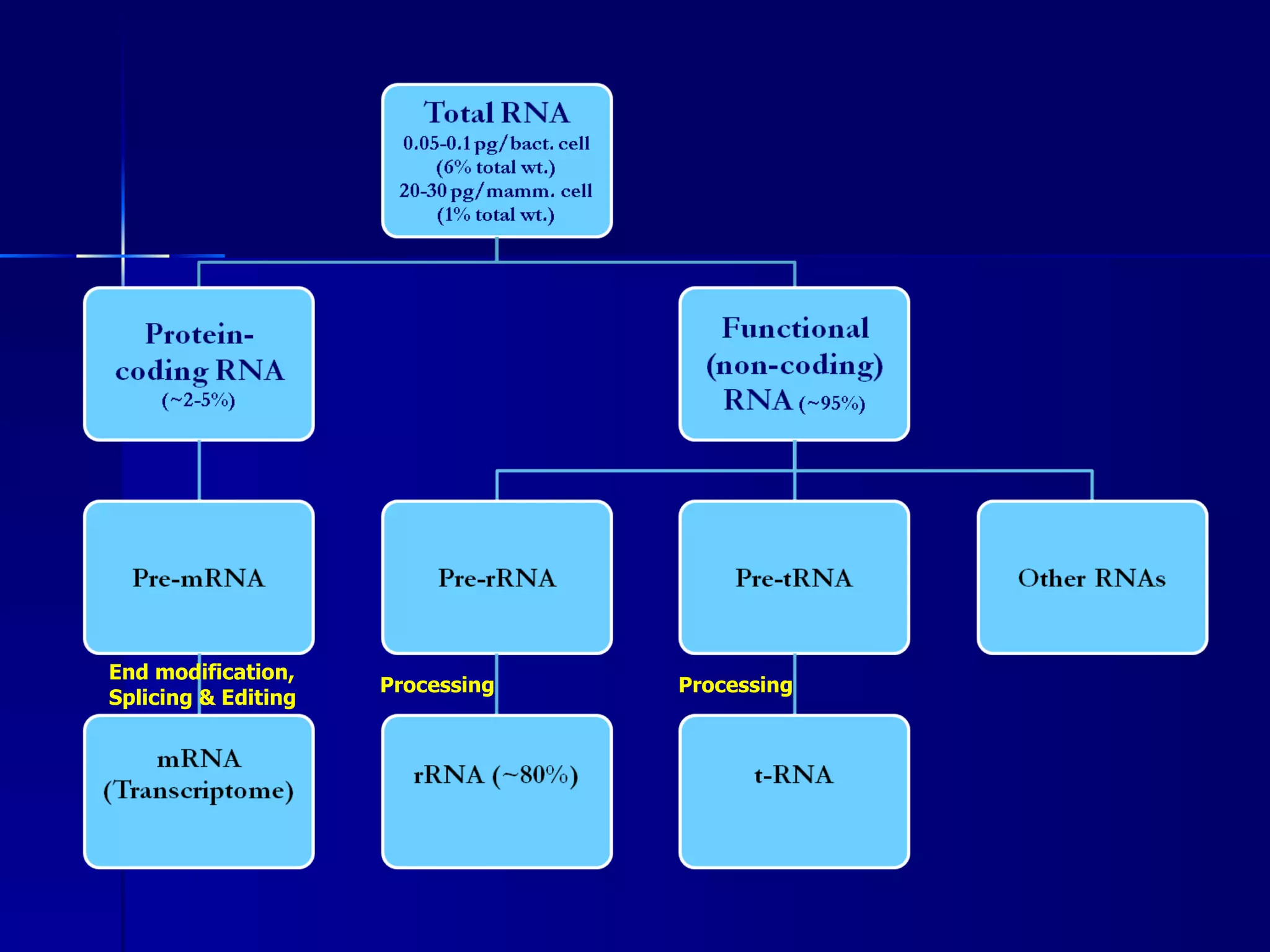
End modification,
                     Processing   Processing
Splicing & Editing
Proteins & the
  Proteome
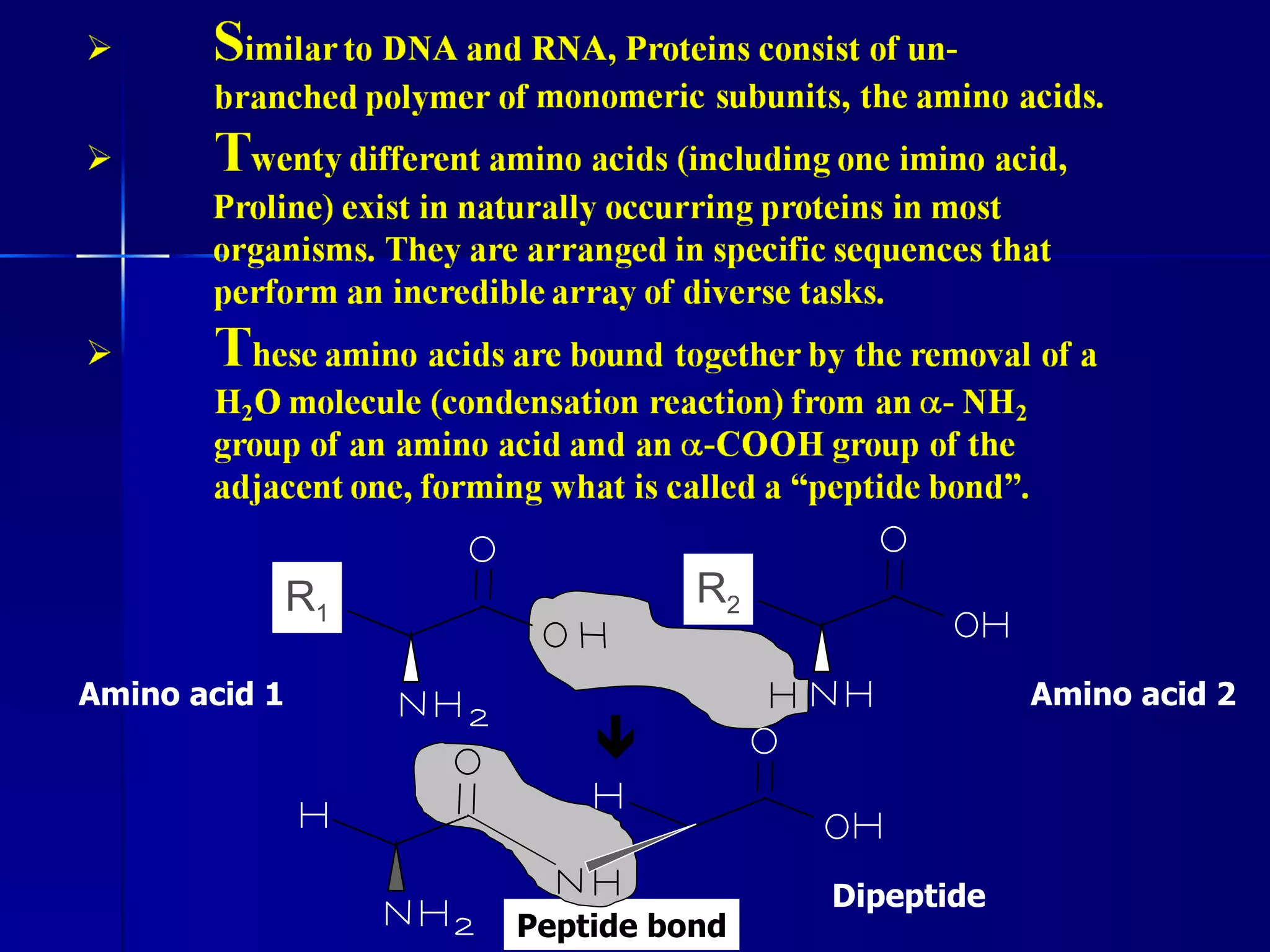
R1             R2

Amino acid 1                                   Amino acid 2
                        


                                   Dipeptide
                    Peptide bond
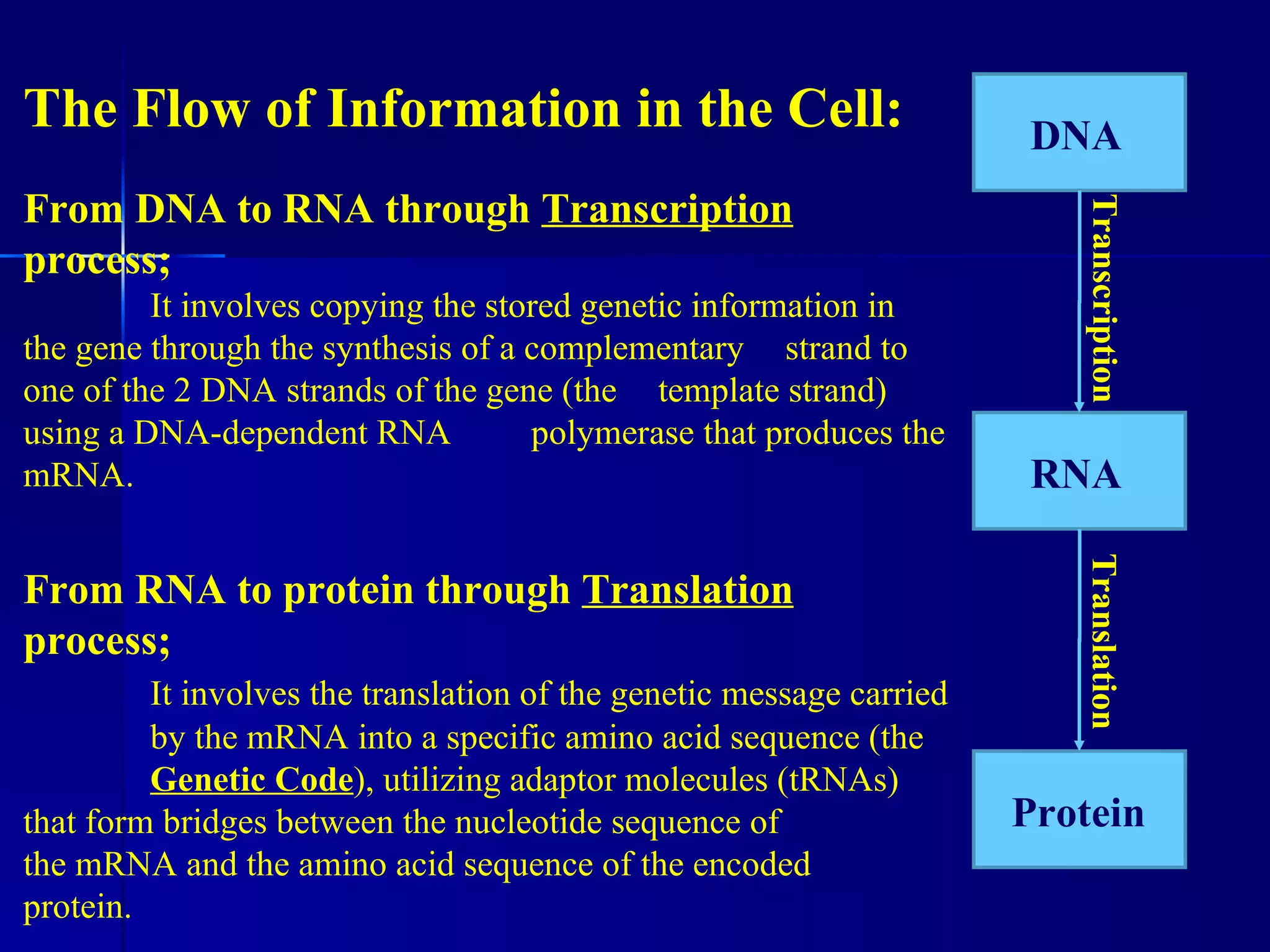
The Flow of Information in the Cell:                                  DNA
From DNA to RNA through Transcription


                                                                         Transcription
process;
         It involves copying the stored genetic information in
the gene through the synthesis of a complementary strand to
one of the 2 DNA strands of the gene (the template strand)
using a DNA-dependent RNA           polymerase that produces the
mRNA.                                                                 RNA


                                                                         Translation
From RNA to protein through Translation
process;
         It involves the translation of the genetic message carried
         by the mRNA into a specific amino acid sequence (the
         Genetic Code), utilizing adaptor molecules (tRNAs)
that form bridges between the nucleotide sequence of                  Protein
the mRNA and the amino acid sequence of the encoded
protein.
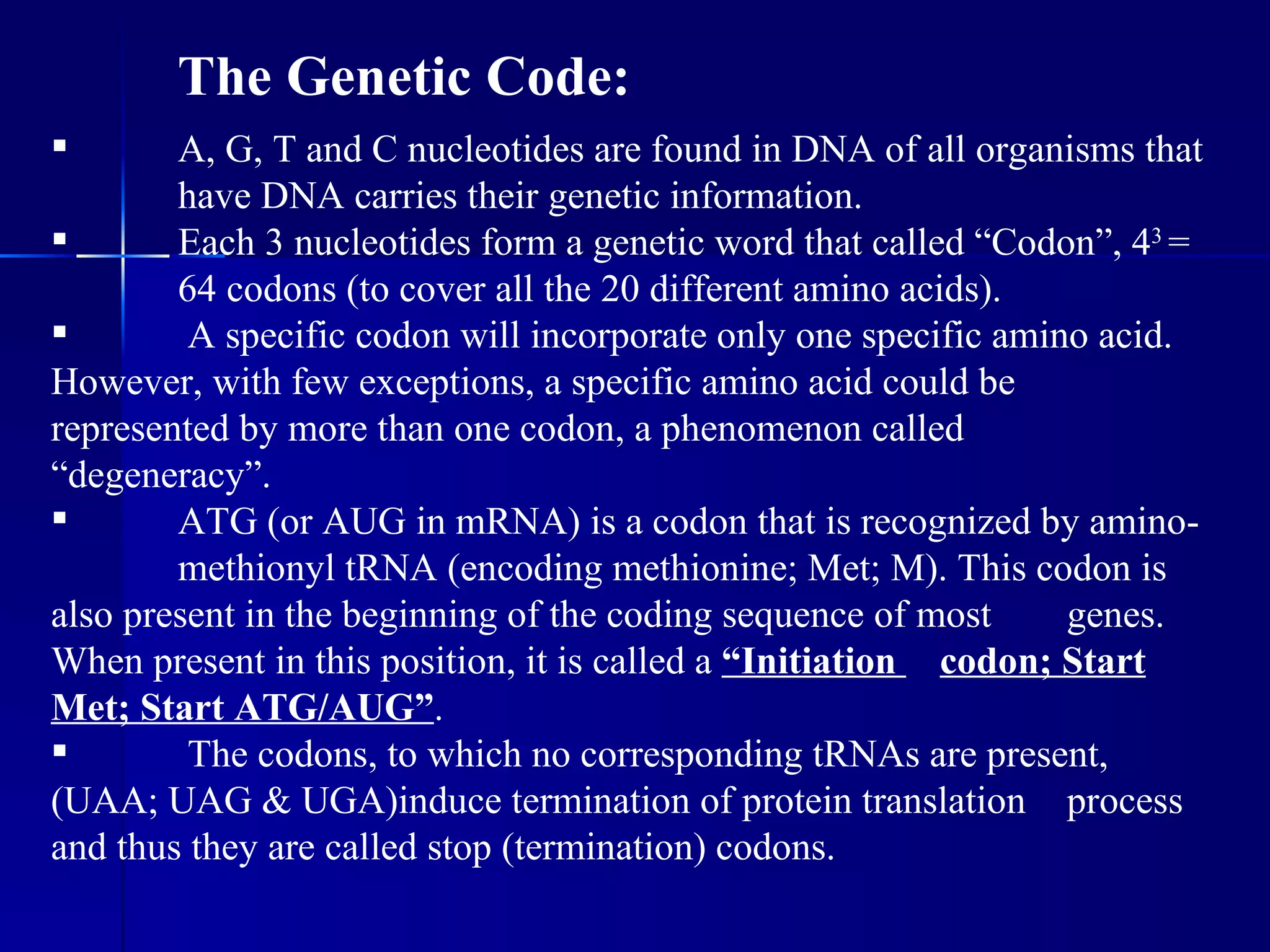
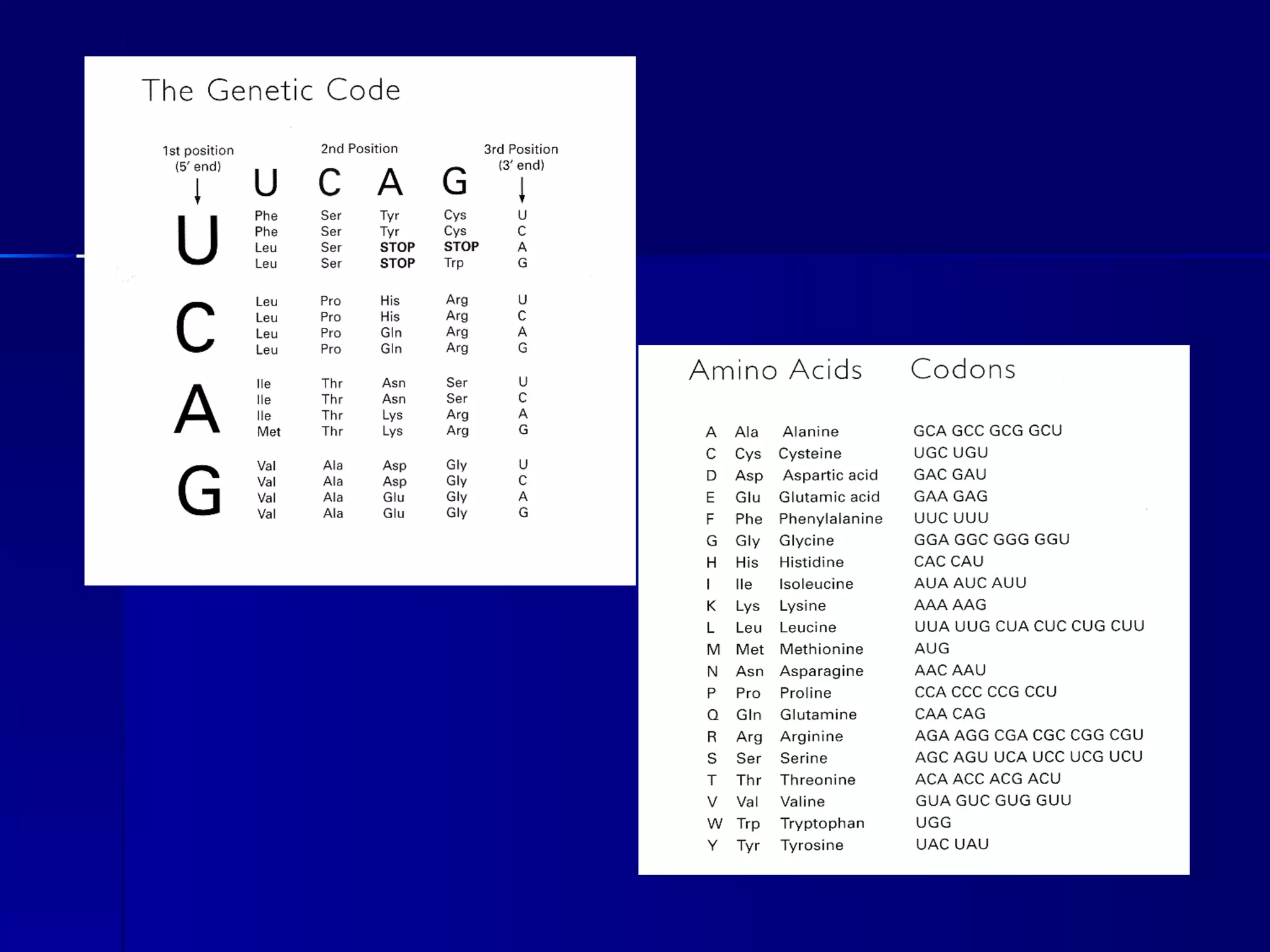
The Genetic Code:
       A, G, T and C nucleotides are found in DNA of all organisms that
        have DNA carries their genetic information.
       Each 3 nucleotides form a genetic word that called “Codon”, 43 =
        64 codons (to cover all the 20 different amino acids).
        A specific codon will incorporate only one specific amino acid.
However, with few exceptions, a specific amino acid could be
represented by more than one codon, a phenomenon called
“degeneracy”.
       ATG (or AUG in mRNA) is a codon that is recognized by amino-
        methionyl tRNA (encoding methionine; Met; M). This codon is
also present in the beginning of the coding sequence of most     genes.
When present in this position, it is called a “Initiation codon; Start
Met; Start ATG/AUG”.
        The codons, to which no corresponding tRNAs are present,
(UAA; UAG & UGA)induce termination of protein translation process
and thus they are called stop (termination) codons.
The Genetic Code, cont.:
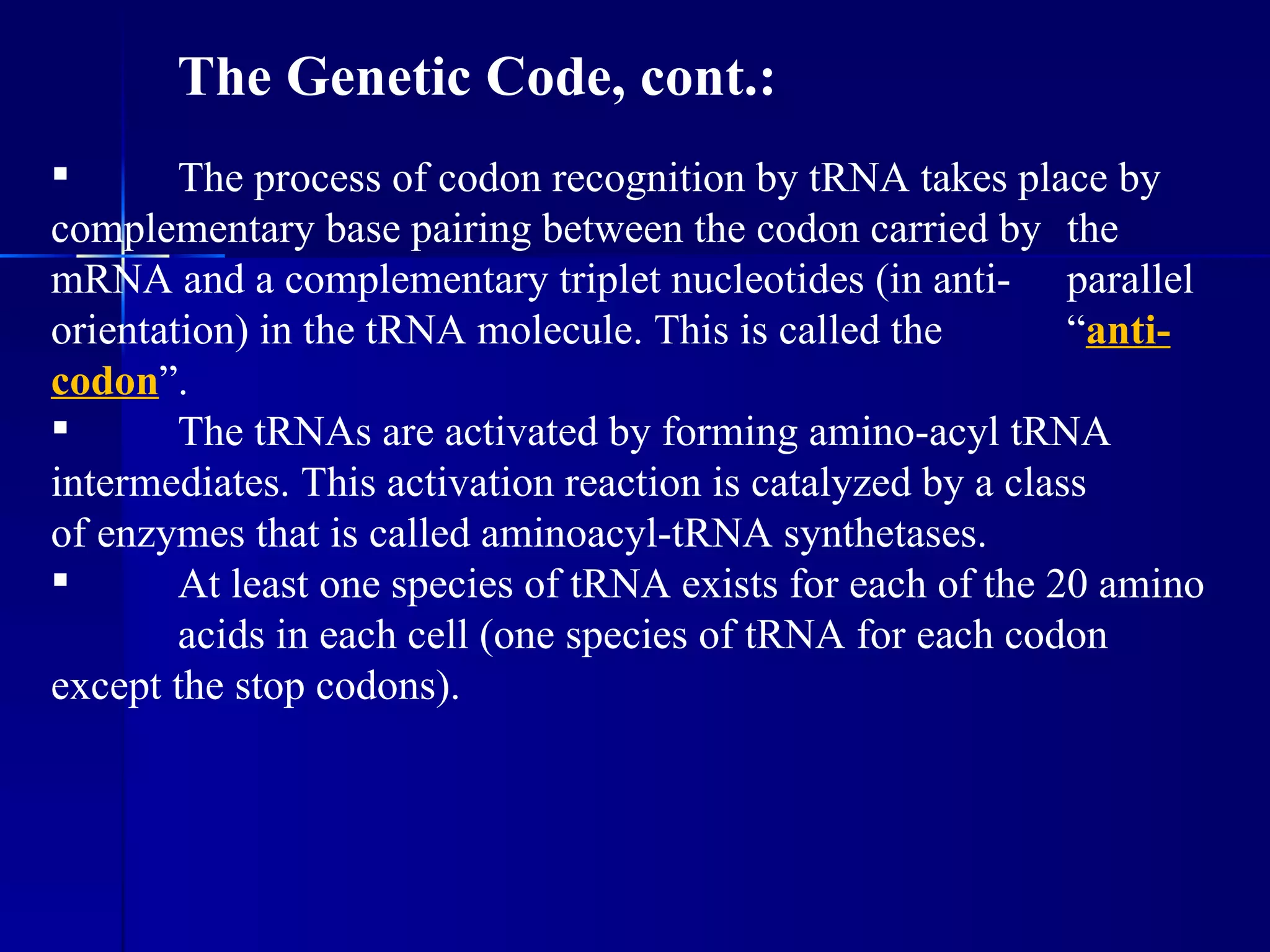
       The process of codon recognition by tRNA takes place by
complementary base pairing between the codon carried by the
mRNA and a complementary triplet nucleotides (in anti- parallel
orientation) in the tRNA molecule. This is called the         “anti-
codon”.
       The tRNAs are activated by forming amino-acyl tRNA
intermediates. This activation reaction is catalyzed by a class
of enzymes that is called aminoacyl-tRNA synthetases.
       At least one species of tRNA exists for each of the 20 amino
        acids in each cell (one species of tRNA for each codon
except the stop codons).
Genetic information flow;
       from DNA to proteins:
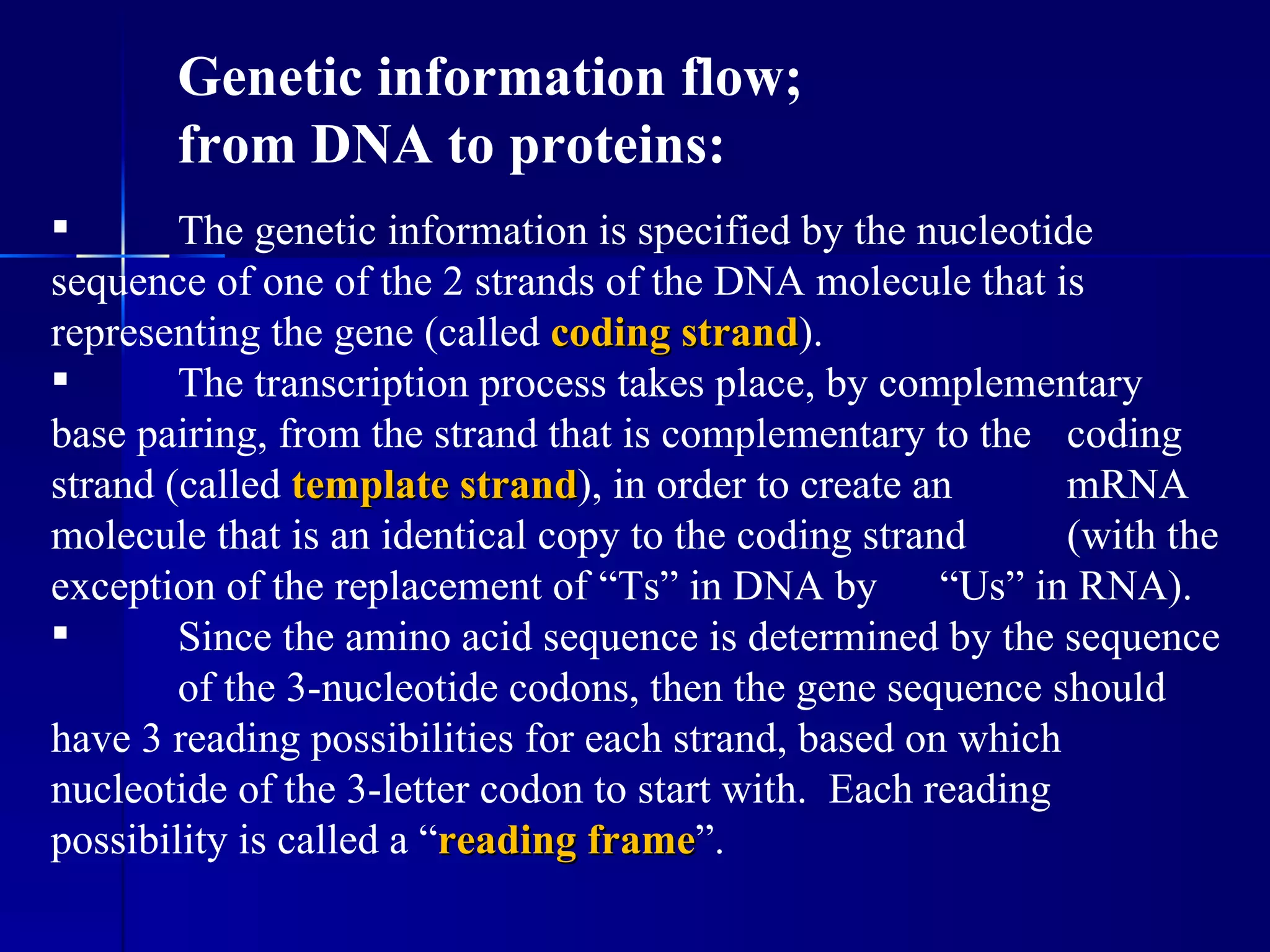
       The genetic information is specified by the nucleotide
sequence of one of the 2 strands of the DNA molecule that is
representing the gene (called coding strand).
                                       strand
       The transcription process takes place, by complementary
base pairing, from the strand that is complementary to the coding
strand (called template strand), in order to create an
                          strand                             mRNA
molecule that is an identical copy to the coding strand      (with the
exception of the replacement of “Ts” in DNA by “Us” in RNA).
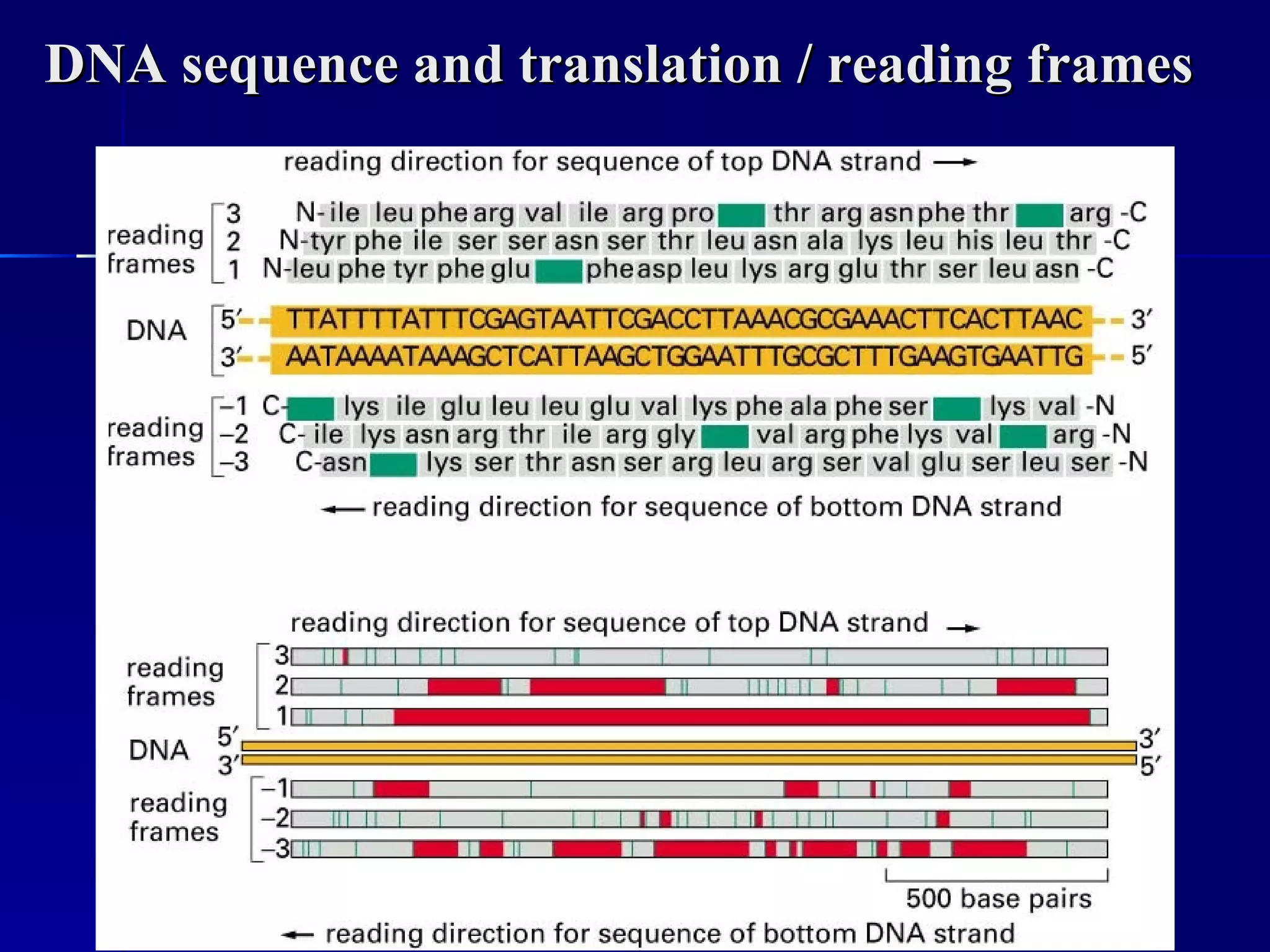
       Since the amino acid sequence is determined by the sequence
        of the 3-nucleotide codons, then the gene sequence should
have 3 reading possibilities for each strand, based on which
nucleotide of the 3-letter codon to start with. Each reading
possibility is called a “reading frame”.
                                 frame
Genetic information flow;
       from DNA to proteins, cont.:
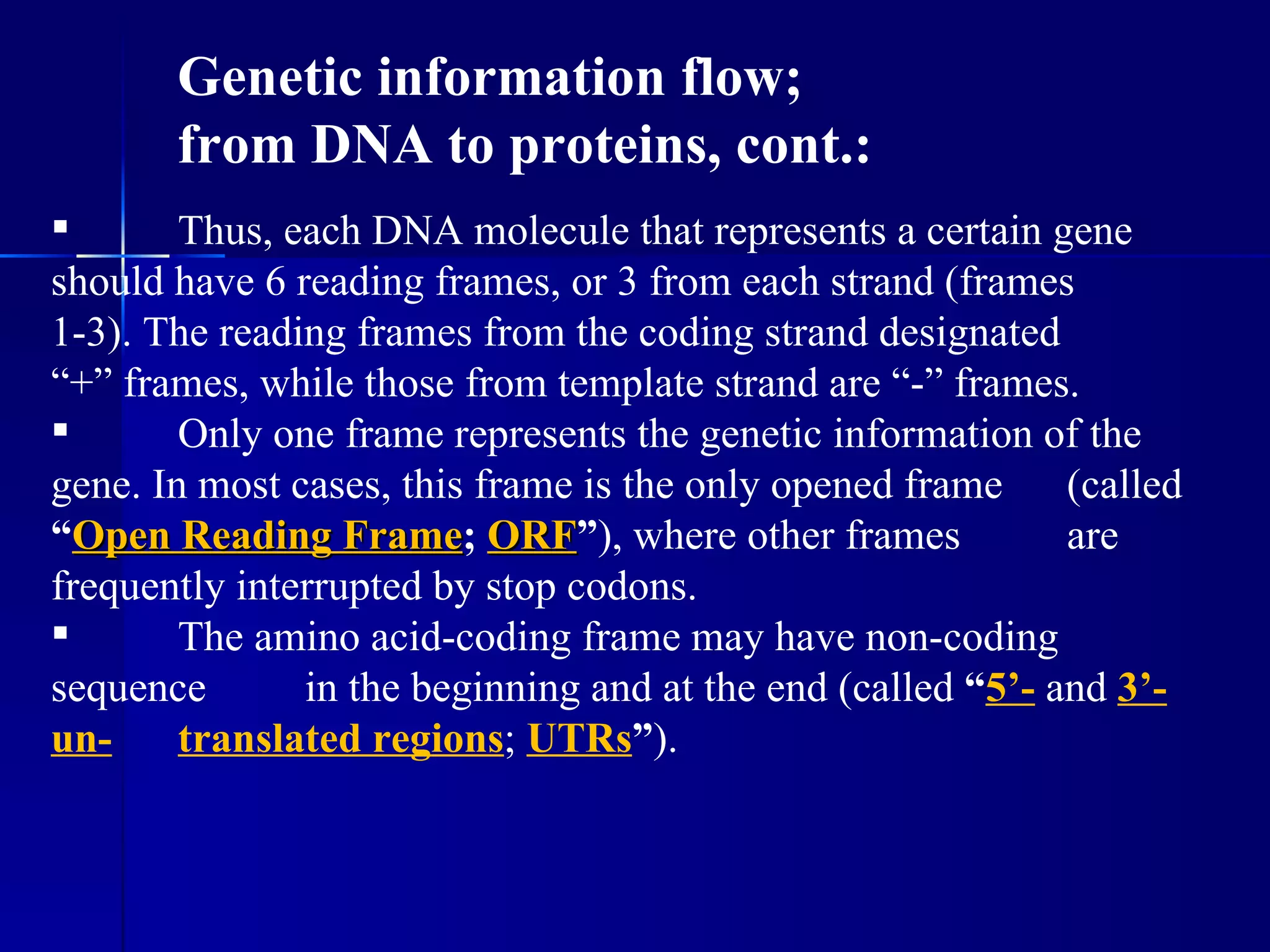
       Thus, each DNA molecule that represents a certain gene
should have 6 reading frames, or 3 from each strand (frames
1-3). The reading frames from the coding strand designated
“+” frames, while those from template strand are “-” frames.
       Only one frame represents the genetic information of the
gene. In most cases, this frame is the only opened frame     (called
“Open Reading Frame; ORF”), where other frames
                  Frame ORF                                  are
frequently interrupted by stop codons.
       The amino acid-coding frame may have non-coding
sequence       in the beginning and at the end (called “5’- and 3’-
un-     translated regions; UTRs”).
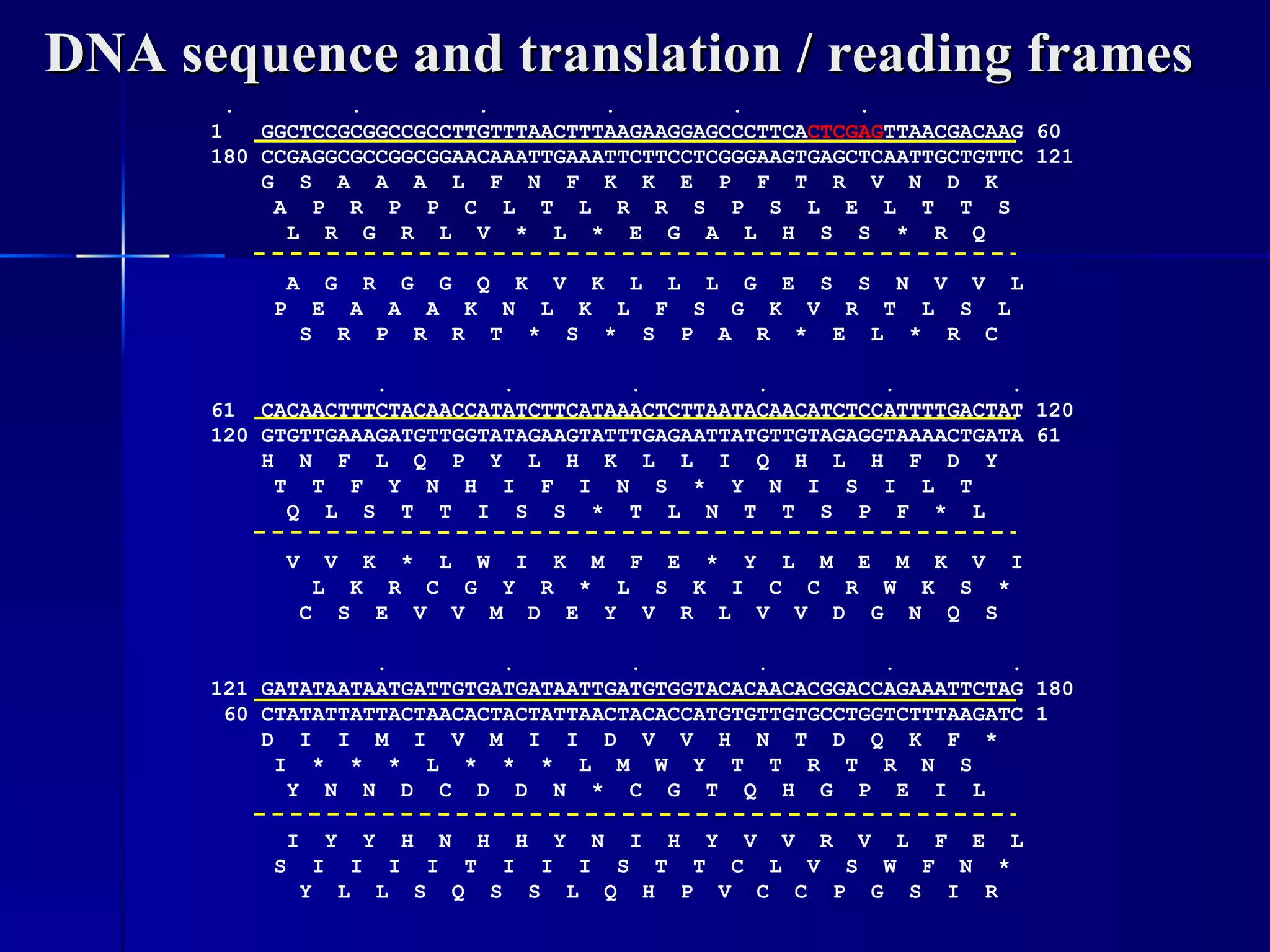
DNA sequence and translation / reading frames
       .         .         .         .         .         .
      1   GGCTCCGCGGCCGCCTTGTTTAACTTTAAGAAGGAGCCCTTCACTCGAGTTAACGACAAG 60
      180 CCGAGGCGCCGGCGGAACAAATTGAAATTCTTCCTCGGGAAGTGAGCTCAATTGCTGTTC 121
          G S A A A L F N F K K E P F T R V N D K
           A P R P P C L T L R R S P S L E L T T S
            L R G R L V * L * E G A L H S S * R Q

            A      G    R      G    G      Q    K      V    K      L    L      L    G      E    S      S    N      V    V      L
           P    E      A    A      A    K      N    L      K    L      F    S      G    K      V    R      T    L      S    L
               S    R      P    R      R    T      *    S      *    S      P    A      R    *      E    L      *    R      C

                   .         .         .         .         .         .
      61 CACAACTTTCTACAACCATATCTTCATAAACTCTTAATACAACATCTCCATTTTGACTAT 120
      120 GTGTTGAAAGATGTTGGTATAGAAGTATTTGAGAATTATGTTGTAGAGGTAAAACTGATA 61
          H N F L Q P Y L H K L L I Q H L H F D Y
           T T F Y N H I F I N S * Y N I S I L T
            Q L S T T I S S * T L N T T S P F * L

            V    V K * L W I K M F E * Y L M E M K V I
                L K R C G Y R * L S K I C C R W K S *
               C S E V V M D E Y V R L V V D G N Q S

                   .         .         .         .         .         .
      121 GATATAATAATGATTGTGATGATAATTGATGTGGTACACAACACGGACCAGAAATTCTAG 180
       60 CTATATTATTACTAACACTACTATTAACTACACCATGTGTTGTGCCTGGTCTTTAAGATC 1
          D I I M I V M I I D V V H N T D Q K F *
           I * * * L * * * L M W Y T T R T R N S
            Y N N D C D D N * C G T Q H G P E I L

            I      Y    Y      H    N      H    H      Y    N      I    H      Y    V      V    R      V    L      F    E      L
           S    I      I    I      I    T      I    I      I    S      T    T      C    L      V    S      W    F      N    *
               Y    L      L    S      Q    S      S    L      Q    H      P    V      C    C      P    G      S    I      R

Lecture 9 10 dna-genes_chromosomes

  • 1.
    DNA, GENES and CHROMOSOMES Ahmed Osman, Ph.D. Professor of Biochemistry, Faculty of Science, Ain Shams University
  • 2.
    DNA is thegenetic materials
  • 3.
    DNA consists ofsugar, phosphate and 4 types of N-containing bases DNA DNA DNA DNA Adenine (A) Guanine (G) Cytosine (C) Thymine (T) Purines (Pu) Pyrimidines (Py)
  • 4.
    The 2 polynucleotidechains (strands) are held together by hydrogen bonding between the bases of different nucleotides on each strand forming what is called complementary base-pairing
  • 5.
    The sugars andphosphates of different nucleotides are attached covalently forming the DNA backbone
  • 6.
    Energetically, the mostfavorable arrangement is packing the base pairs in the interior of the double stranded structure, thus holding the sugar-phosphate backbones at an equal distance along the DNA molecule.
  • 7.
    DNA and chromosomes: In eukaryotes, almost all DNA is sequestered in the nucleus, where most biological processes dealing with DNA take place.  The DNA is divided between a set of different chromosomes, e.g. the human genome contains 3.2 X 10E9 nucleotide pairs distributed over 24 different chromosomes.  Each chromosome consists of a single, enormously long linear DNA molecule associated with proteins that fold and pack the fine DNA thread into a more compact structure.
  • 11.
  • 12.
  • 13.
    Similar to DNA,RNA consists of pentose sugar, phosphate and one of 4 different N-containing bases; However, unlike DNA, they are mostly arranged in a single chain. The sugar is ribose; The 4 bases are two 2-ring bases called purines and two 1-ring bases called pyrimidines. Ribose DNA DNA DNA DNA Adenine (A) Guanine (G) Cytosine (C) Uracil (U) Purines (Pu) Pyrimidines (Py)
  • 14.
    End modification, Processing Processing Splicing & Editing
  • 15.
  • 17.
    R1 R2 Amino acid 1 Amino acid 2  Dipeptide Peptide bond
  • 18.
    The Flow ofInformation in the Cell: DNA From DNA to RNA through Transcription Transcription process; It involves copying the stored genetic information in the gene through the synthesis of a complementary strand to one of the 2 DNA strands of the gene (the template strand) using a DNA-dependent RNA polymerase that produces the mRNA. RNA Translation From RNA to protein through Translation process; It involves the translation of the genetic message carried by the mRNA into a specific amino acid sequence (the Genetic Code), utilizing adaptor molecules (tRNAs) that form bridges between the nucleotide sequence of Protein the mRNA and the amino acid sequence of the encoded protein.
  • 19.
    The Genetic Code:  A, G, T and C nucleotides are found in DNA of all organisms that have DNA carries their genetic information.  Each 3 nucleotides form a genetic word that called “Codon”, 43 = 64 codons (to cover all the 20 different amino acids).  A specific codon will incorporate only one specific amino acid. However, with few exceptions, a specific amino acid could be represented by more than one codon, a phenomenon called “degeneracy”.  ATG (or AUG in mRNA) is a codon that is recognized by amino- methionyl tRNA (encoding methionine; Met; M). This codon is also present in the beginning of the coding sequence of most genes. When present in this position, it is called a “Initiation codon; Start Met; Start ATG/AUG”.  The codons, to which no corresponding tRNAs are present, (UAA; UAG & UGA)induce termination of protein translation process and thus they are called stop (termination) codons.
  • 20.
    The Genetic Code,cont.:  The process of codon recognition by tRNA takes place by complementary base pairing between the codon carried by the mRNA and a complementary triplet nucleotides (in anti- parallel orientation) in the tRNA molecule. This is called the “anti- codon”.  The tRNAs are activated by forming amino-acyl tRNA intermediates. This activation reaction is catalyzed by a class of enzymes that is called aminoacyl-tRNA synthetases.  At least one species of tRNA exists for each of the 20 amino acids in each cell (one species of tRNA for each codon except the stop codons).
  • 22.
    Genetic information flow; from DNA to proteins:  The genetic information is specified by the nucleotide sequence of one of the 2 strands of the DNA molecule that is representing the gene (called coding strand). strand  The transcription process takes place, by complementary base pairing, from the strand that is complementary to the coding strand (called template strand), in order to create an strand mRNA molecule that is an identical copy to the coding strand (with the exception of the replacement of “Ts” in DNA by “Us” in RNA).  Since the amino acid sequence is determined by the sequence of the 3-nucleotide codons, then the gene sequence should have 3 reading possibilities for each strand, based on which nucleotide of the 3-letter codon to start with. Each reading possibility is called a “reading frame”. frame
  • 23.
    Genetic information flow; from DNA to proteins, cont.:  Thus, each DNA molecule that represents a certain gene should have 6 reading frames, or 3 from each strand (frames 1-3). The reading frames from the coding strand designated “+” frames, while those from template strand are “-” frames.  Only one frame represents the genetic information of the gene. In most cases, this frame is the only opened frame (called “Open Reading Frame; ORF”), where other frames Frame ORF are frequently interrupted by stop codons.  The amino acid-coding frame may have non-coding sequence in the beginning and at the end (called “5’- and 3’- un- translated regions; UTRs”).
  • 24.
    DNA sequence andtranslation / reading frames
  • 25.
    DNA sequence andtranslation / reading frames . . . . . . 1 GGCTCCGCGGCCGCCTTGTTTAACTTTAAGAAGGAGCCCTTCACTCGAGTTAACGACAAG 60 180 CCGAGGCGCCGGCGGAACAAATTGAAATTCTTCCTCGGGAAGTGAGCTCAATTGCTGTTC 121 G S A A A L F N F K K E P F T R V N D K A P R P P C L T L R R S P S L E L T T S L R G R L V * L * E G A L H S S * R Q A G R G G Q K V K L L L G E S S N V V L P E A A A K N L K L F S G K V R T L S L S R P R R T * S * S P A R * E L * R C . . . . . . 61 CACAACTTTCTACAACCATATCTTCATAAACTCTTAATACAACATCTCCATTTTGACTAT 120 120 GTGTTGAAAGATGTTGGTATAGAAGTATTTGAGAATTATGTTGTAGAGGTAAAACTGATA 61 H N F L Q P Y L H K L L I Q H L H F D Y T T F Y N H I F I N S * Y N I S I L T Q L S T T I S S * T L N T T S P F * L V V K * L W I K M F E * Y L M E M K V I L K R C G Y R * L S K I C C R W K S * C S E V V M D E Y V R L V V D G N Q S . . . . . . 121 GATATAATAATGATTGTGATGATAATTGATGTGGTACACAACACGGACCAGAAATTCTAG 180 60 CTATATTATTACTAACACTACTATTAACTACACCATGTGTTGTGCCTGGTCTTTAAGATC 1 D I I M I V M I I D V V H N T D Q K F * I * * * L * * * L M W Y T T R T R N S Y N N D C D D N * C G T Q H G P E I L I Y Y H N H H Y N I H Y V V R V L F E L S I I I I T I I I S T T C L V S W F N * Y L L S Q S S L Q H P V C C P G S I R