ABSTRACT
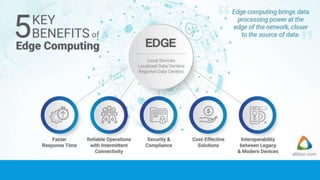
Edge computing is a “mesh network of micro datacentre that process or store critical data locally and push all
received data to a central datacentre or cloud storage repository. Edge computing is a method of optimizing cloud
computing systems by performing data processing at the edge of the network, near the source of the data. This
reduces the communications bandwidth needed between sensors and the central datacentre by performing analytics
and knowledge generation at or near the source of the data. This approach requires leveraging resources that may
not be continuously connected to a network such as laptops, smartphones, tablets and sensors.
OVERVIEW OF EDGE COMPUTING
 Edge Computing is a distributed computing paradigm in which processing and
computation are performed mainly on classified device nodes known as smart
devices or edge devices as opposed to processed in a centralized cloud environment
or data centers.
 It helps to provide server resources, data analysis, and artificial intelligence to data
collection sources and cyber-physical sources like smart sensors and actuators.
WHAT EXACTLY IS EDGE COMPUTING
ACCORDING TO RESEARCH FIRMS?
 A network of micro data centers that store or process critical data
locally and push received data to a centralized data center or
repository of cloud storage.
 Typically in IoT use cases, a massive chunk of data goes through the
data center, but edge computing processes the data locally results in
reduced traffic in the central repository.
 This is done by IoT devices, transferring the data to the local device,
which includes storage, compute, and network connectivity.
 After that, data is processed at the edge while another portion is sent
to storage repository or central processing in the data center.
WHY IS EDGE COMPUTING
IMPORTANT?
 New Functionalities are offered.
 Easier configurations.
 The load on the server is reduced.
 Load on Network is reduced.
 Application Programming Interface.
 Increases Extensibility.
 Centralized Management.
 Costs of Licensing.
 Support and Updates.
IS EDGE COMPUTING SEEN AS
NECESSARY?
 In the realization of physical computing, smart cities, computing,
multimedia applications such as augmented reality and cloud gaming,
and the Internet of Things (IoT).
 It is a way to streamline the movement of traffic from IoT devices and
implement real-time local data analysis.
 Data produced by the Internet of Things (IoT) devices to be processed
where it is created instead of taking away to the routes to data centers
with the help of edge computing.
 It also benefits Remote Office/Branch Office (ROBO) environments and
organizations that have dispersed user base geographically.
EDGE COMPUTING TERMS AND
DEFINITIONS
Edge
 Like in telecommunication, it may be a cell phone or cell tower.
 Similarly, in the automotive example, it could be a car.
 In manufacturing, it could be a machine, and
 In the Information Technology field, it could be a laptop.
Edge Devices
A device which produces data is edge devices like machines and
sensors, or any devices through which information is collected
and delivered.
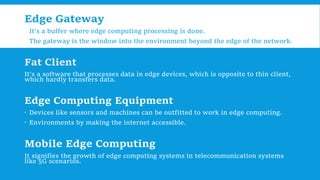
Edge Gateway
 It’s a buffer where edge computing processing is done.
 The gateway is the window into the environment beyond the edge of the network.
Fat Client
It’s a software that processes data in edge devices, which is opposite to thin client,
which hardly transfers data.
Edge Computing Equipment
 Devices like sensors and machines can be outfitted to work in edge computing.
 Environments by making the internet accessible.
Mobile Edge Computing
It signifies the growth of edge computing systems in telecommunication systems
like 5G scenarios.
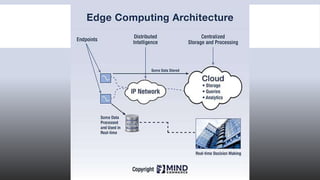
EDGE COMPUTING ARCHITECTURE
• Cloud Modules
• Legacy Cloud Apps
• Edge Run time
• Cognitive, Storage, Analytics
Cloud
• Edge Modules
• Gateway Services
Gateway
INTERNET OF THINGS (IOT) AND EDGE
COMPUTING
 In IoT, with the help of edge computing, intelligence moves to the
edge.
 There are various scenarios where speed and high-speed data are the
main components for management, power issues, analytics, and real-
time need, etc. helps to process data with edge computing in IoT.
BENEFITS OF ENABLING EDGE
COMPUTING FOR THE INTERNET OF
THINGS (IOT)
 Lesser Network Load
 Zero Latency
 Reduced Data Exposure
 Computational Efficient
 Costs and Autonomous Operation
 Security and Privacy
FUTURE DIRECTIONS OF COMPUTING
FOR THE INTERNET OF THINGS (IOT)
 Edge-to-Cloud data exchange capabilities
 Common-on-Edge data exchange capabilities
 Streaming Data Analytics and Batch frameworks and APIs
 Controlled rolling and Versioning upgrades of applications
 Status of application monitoring from an Ad-Hoc Cloud Dashboard
 Cloud-Based Deployments of Edge Computing Applications
ADVANTAGES OF ENABLING EDGE
COMPUTING
 Speed is increased.
 Reliability is increased.
 The random issue is reduced.
 The compliance issue is reduced.
 Hacking issues are reduced.
 Random issues are reduced.
EDGE GATEWAY SERVER
 Real-Time Analytics
 Transactional analytics
 Business Intelligence
 No Latency Issue
 Medium Latency Requirements
 Low Latency Requirements
CLOUD COMPUTING VS. EDGE COMPUTING VS. FOG COMPUTING
 Edge Computing and Fog Computing are the extensions of Cloud Networks, which are a collection of
servers comprising a distributed network.
 Such networks allow organizations to exceed the resources that would be otherwise available to
them.
 The main advantage of cloud networks is that they allowed data to be collected from multiple
sources, which is accessible anywhere over the internet.
 While Fog Computing and Edge Computing are almost similar, where the talk about intelligence and
processing of data at the time of creation.
 Fog Computing focus more on intelligence at local area network and this architecture transmits data
from endpoints to a gateway where it is sent to sources for processing and return to transmission
 while Edge Computing focus more on computing power and processing of data locally at the edge of
a network.
 It performs processing on embedded computing platforms interfacing to sensors and controllers.
Cloud Layer
 Big Data Processing
 Data Warehousing
 Business Logic
Fog Layer
 Local Network
 Data Analysis and Reduction
 Standardization
Edge LayerOn premises Data
Visualizati
 Embedded Systems
 Gateways
 Micro Data Storage
SECURITY IN EDGE COMPUTING
 There are two sides of security in edge computing –
 One of them is that the security in edge computing is better than any
other part of the data storage application because data is not traveling
over the network; it stays where it is created.
 The flip side of it is that security in edge computing is less secure
because the edge devices in themselves can be more vulnerable.
 In conclusion, data encryption, access control, and the use of virtual
private networks are crucial elements to protect the edge computing
system.
USE CASES WHERE EDGE
COMPUTING BECOMES CRITICAL
 Having low latency, e.g., Closed-loop interaction between machine insights.
 For real-time analytics, access to temporal data.
 Low connectivity, e.g., Remote Location.
 The high cost of transferring data to the cloud.
 Bandwidth.
 Cybersecurity constraints.
 Compliance and Regulation.
 The immediacy of Analysis, e.g., To check machine performance.
 Predictive Maintenance.
 Energy Efficiency Management.
 Flexible Device Replacement.
WHY EDGE COMPUTING MATTERS?
 When IoT devices have poor connectivity.
 Not efficient for IoT devices to be in constant touch with the central
cloud.
 The latency factor reduces latency because data doesn’t have to
traverse over a network to a central cloud for processing.
 Where latencies are untenable like manufacturing or financial
services.
 As soon as data is produced, it doesn’t need to send over a network;
instead, it compiles the data and sends daily reports to the cloud for
long term storage, i.e., reduces the data traversing.
 The buildout of the next-generation 5G cellular networks by
telecommunication companies.
 Direct access to gateway into the telecom provider’s network, which
connects to a public IaaS cloud provider.
USE OF EDGE COMPUTING
RELATED TO INDUSTRIES
 Smart applications and devices respond to data, instantly
eliminating lag time.
 Real-time data process with any latency where even milliseconds
in latency make a difference in the processing of data.
 Acceleration in the data stream.
 Efficient data processing in massive data.
 Effective use of the application in a remote location.
 Security for sensitive data even without putting in the public
cloud.
ROLE OF EDGE COMPUTING IN SOCIAL
GOOD
 Environmental factors like road traffic density, air quality, weather,
school holidays, and other open data sets give better results by the
processing of data with the help of edge computing and machine
learning.
 The computing power will apply these factors to the data collected from
healthcare at the point of admission, where data to be set where the
patient expected to be discharged.
 There is also a movement from businesses in all sectors to use edge
computing.
CONCLUSION
 As more and more devices are entering different networks, the existing networks are
becoming more prone to congestion.The overall network traffic has increased. Edge
computing offers a simple solution to this problem by enabling edge devices to me
manufactured with enough computational power so that these edge devices can carry out real-
time analytics without sending huge loads of data over the network to the cloud.
REFERENCE
 YOUTUBE https://youtu.be/R9P0C_E1yxQ
 GURU99
 CLOUD ACADEMY
THANK YOU
…………………………………………………………………………………………………………………

EDGE SEMINAR.pptx

  • 2.
    ABSTRACT Edge computing isa “mesh network of micro datacentre that process or store critical data locally and push all received data to a central datacentre or cloud storage repository. Edge computing is a method of optimizing cloud computing systems by performing data processing at the edge of the network, near the source of the data. This reduces the communications bandwidth needed between sensors and the central datacentre by performing analytics and knowledge generation at or near the source of the data. This approach requires leveraging resources that may not be continuously connected to a network such as laptops, smartphones, tablets and sensors.
  • 3.
    OVERVIEW OF EDGECOMPUTING  Edge Computing is a distributed computing paradigm in which processing and computation are performed mainly on classified device nodes known as smart devices or edge devices as opposed to processed in a centralized cloud environment or data centers.  It helps to provide server resources, data analysis, and artificial intelligence to data collection sources and cyber-physical sources like smart sensors and actuators.
  • 5.
    WHAT EXACTLY ISEDGE COMPUTING ACCORDING TO RESEARCH FIRMS?  A network of micro data centers that store or process critical data locally and push received data to a centralized data center or repository of cloud storage.  Typically in IoT use cases, a massive chunk of data goes through the data center, but edge computing processes the data locally results in reduced traffic in the central repository.  This is done by IoT devices, transferring the data to the local device, which includes storage, compute, and network connectivity.  After that, data is processed at the edge while another portion is sent to storage repository or central processing in the data center.
  • 6.
    WHY IS EDGECOMPUTING IMPORTANT?  New Functionalities are offered.  Easier configurations.  The load on the server is reduced.  Load on Network is reduced.  Application Programming Interface.  Increases Extensibility.  Centralized Management.  Costs of Licensing.  Support and Updates.
  • 7.
    IS EDGE COMPUTINGSEEN AS NECESSARY?  In the realization of physical computing, smart cities, computing, multimedia applications such as augmented reality and cloud gaming, and the Internet of Things (IoT).  It is a way to streamline the movement of traffic from IoT devices and implement real-time local data analysis.  Data produced by the Internet of Things (IoT) devices to be processed where it is created instead of taking away to the routes to data centers with the help of edge computing.  It also benefits Remote Office/Branch Office (ROBO) environments and organizations that have dispersed user base geographically.
  • 8.
    EDGE COMPUTING TERMSAND DEFINITIONS Edge  Like in telecommunication, it may be a cell phone or cell tower.  Similarly, in the automotive example, it could be a car.  In manufacturing, it could be a machine, and  In the Information Technology field, it could be a laptop. Edge Devices A device which produces data is edge devices like machines and sensors, or any devices through which information is collected and delivered.
  • 9.
    Edge Gateway  It’sa buffer where edge computing processing is done.  The gateway is the window into the environment beyond the edge of the network. Fat Client It’s a software that processes data in edge devices, which is opposite to thin client, which hardly transfers data. Edge Computing Equipment  Devices like sensors and machines can be outfitted to work in edge computing.  Environments by making the internet accessible. Mobile Edge Computing It signifies the growth of edge computing systems in telecommunication systems like 5G scenarios.
  • 10.
    EDGE COMPUTING ARCHITECTURE •Cloud Modules • Legacy Cloud Apps • Edge Run time • Cognitive, Storage, Analytics Cloud • Edge Modules • Gateway Services Gateway
  • 12.
    INTERNET OF THINGS(IOT) AND EDGE COMPUTING  In IoT, with the help of edge computing, intelligence moves to the edge.  There are various scenarios where speed and high-speed data are the main components for management, power issues, analytics, and real- time need, etc. helps to process data with edge computing in IoT.
  • 14.
    BENEFITS OF ENABLINGEDGE COMPUTING FOR THE INTERNET OF THINGS (IOT)  Lesser Network Load  Zero Latency  Reduced Data Exposure  Computational Efficient  Costs and Autonomous Operation  Security and Privacy
  • 15.
    FUTURE DIRECTIONS OFCOMPUTING FOR THE INTERNET OF THINGS (IOT)  Edge-to-Cloud data exchange capabilities  Common-on-Edge data exchange capabilities  Streaming Data Analytics and Batch frameworks and APIs  Controlled rolling and Versioning upgrades of applications  Status of application monitoring from an Ad-Hoc Cloud Dashboard  Cloud-Based Deployments of Edge Computing Applications
  • 17.
    ADVANTAGES OF ENABLINGEDGE COMPUTING  Speed is increased.  Reliability is increased.  The random issue is reduced.  The compliance issue is reduced.  Hacking issues are reduced.  Random issues are reduced.
  • 18.
    EDGE GATEWAY SERVER Real-Time Analytics  Transactional analytics  Business Intelligence  No Latency Issue  Medium Latency Requirements  Low Latency Requirements
  • 19.
    CLOUD COMPUTING VS.EDGE COMPUTING VS. FOG COMPUTING  Edge Computing and Fog Computing are the extensions of Cloud Networks, which are a collection of servers comprising a distributed network.  Such networks allow organizations to exceed the resources that would be otherwise available to them.  The main advantage of cloud networks is that they allowed data to be collected from multiple sources, which is accessible anywhere over the internet.  While Fog Computing and Edge Computing are almost similar, where the talk about intelligence and processing of data at the time of creation.  Fog Computing focus more on intelligence at local area network and this architecture transmits data from endpoints to a gateway where it is sent to sources for processing and return to transmission  while Edge Computing focus more on computing power and processing of data locally at the edge of a network.  It performs processing on embedded computing platforms interfacing to sensors and controllers.
  • 21.
    Cloud Layer  BigData Processing  Data Warehousing  Business Logic Fog Layer  Local Network  Data Analysis and Reduction  Standardization Edge LayerOn premises Data Visualizati  Embedded Systems  Gateways  Micro Data Storage
  • 22.
    SECURITY IN EDGECOMPUTING  There are two sides of security in edge computing –  One of them is that the security in edge computing is better than any other part of the data storage application because data is not traveling over the network; it stays where it is created.  The flip side of it is that security in edge computing is less secure because the edge devices in themselves can be more vulnerable.  In conclusion, data encryption, access control, and the use of virtual private networks are crucial elements to protect the edge computing system.
  • 23.
    USE CASES WHEREEDGE COMPUTING BECOMES CRITICAL  Having low latency, e.g., Closed-loop interaction between machine insights.  For real-time analytics, access to temporal data.  Low connectivity, e.g., Remote Location.  The high cost of transferring data to the cloud.  Bandwidth.  Cybersecurity constraints.  Compliance and Regulation.  The immediacy of Analysis, e.g., To check machine performance.  Predictive Maintenance.  Energy Efficiency Management.  Flexible Device Replacement.
  • 24.
    WHY EDGE COMPUTINGMATTERS?  When IoT devices have poor connectivity.  Not efficient for IoT devices to be in constant touch with the central cloud.  The latency factor reduces latency because data doesn’t have to traverse over a network to a central cloud for processing.  Where latencies are untenable like manufacturing or financial services.  As soon as data is produced, it doesn’t need to send over a network; instead, it compiles the data and sends daily reports to the cloud for long term storage, i.e., reduces the data traversing.  The buildout of the next-generation 5G cellular networks by telecommunication companies.  Direct access to gateway into the telecom provider’s network, which connects to a public IaaS cloud provider.
  • 25.
    USE OF EDGECOMPUTING RELATED TO INDUSTRIES  Smart applications and devices respond to data, instantly eliminating lag time.  Real-time data process with any latency where even milliseconds in latency make a difference in the processing of data.  Acceleration in the data stream.  Efficient data processing in massive data.  Effective use of the application in a remote location.  Security for sensitive data even without putting in the public cloud.
  • 26.
    ROLE OF EDGECOMPUTING IN SOCIAL GOOD  Environmental factors like road traffic density, air quality, weather, school holidays, and other open data sets give better results by the processing of data with the help of edge computing and machine learning.  The computing power will apply these factors to the data collected from healthcare at the point of admission, where data to be set where the patient expected to be discharged.  There is also a movement from businesses in all sectors to use edge computing.
  • 27.
    CONCLUSION  As moreand more devices are entering different networks, the existing networks are becoming more prone to congestion.The overall network traffic has increased. Edge computing offers a simple solution to this problem by enabling edge devices to me manufactured with enough computational power so that these edge devices can carry out real- time analytics without sending huge loads of data over the network to the cloud.
  • 28.
  • 29.