COMM 101
MEDIA PRESENTATION
• A look at “life on the virtual frontier”…
• This documentary takes a look at how media
convergence and digital media delivery channels are
impacting society in many areas including education,
social relationships, working environments, and even
the military.
• While made in 2010, the material covered is still very
relevant, even though some of the technology
discussed has evolved.
• As we established already, Mass Media is ALWAYS
shared via technology of some sort and Media
Convergence means that “everything” is now
coming to – and at – us on the same digital
platforms as Mass Media.
• Digital native is a term coined by Mark Prensky in 2001
used to describe the generation of people who grew up
in the digital age. Digital natives are comfortable with
technology and computers at an early age and consider
technology to be an integral and necessary part of their
lives. Teenagers and children today are generally
considered to be digital natives as they mainly
communicate and learn via digital technology
(Internet/Mobile). The opposite of digital natives is
digital immigrants – people who have had to adapt to
the new language of technology.
DIGITAL NATIVES
DIGITAL IMMIGRANTS
• “Digital Natives” are now
driving all aspects of culture –
commerce, politics,
entertainment, sports, fashion,
etc.
• “Digital Immigrants” are being
phased out but are still in the
mix
DIGITAL NATIVES
DIGITAL IMMIGRANTS
• 1.) What’s your personal
relationship with multitasking like?
Do you think you’re a good
multitasker? How often are you
multitasking with digital
technology/media in any given day?
REFLECTION QUESTIONS:
• MULTITASKING –
• Research conducted at Stanford University found that multitasking is
less productive than doing a single thing at a time. The researchers
also found that people who are regularly bombarded with several
streams of electronic information cannot pay attention, recall
information, or switch from one job to another as well as those who
complete one task at a time.
• Multitasking reduces your efficiency and performance because your
brain can only focus on one thing at a time. When you try to do two
things at once, your brain lacks the capacity to perform both tasks
successfully.
• Why do you think we’re creating a cultural environment for ourselves
that makes it so easy to do something that we know doesn’t really
work?
MULTITASKING
• ARE WE “SMARTER” THANKS TO THE DIGITAL REVOLUTION?
• You Haven't Gotten Smarter: The Internet Just Makes You
Think You Are. Access to information is apparently a blessing
and a curse, just because you can find information readily does
not mean you’re smarter or better equipped to make the right
decision. In fact, ready access to information might actually be
blinding you to gaps in your understanding.
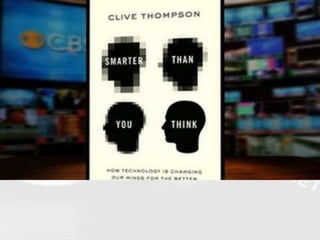
• But not everyone agrees…
MULTITASKING
IN-CLASS MEDIA PRESENTATION
UPDATE – Multitasking/Smarter?
•The truth is simply we don’t know what
living in a “digital world” is doing to us –
it’s an ongoing massive social experiment
with all of us as its (willing?) guinea pigs.
MULTITASKING
• 2.) Should our society recognize
that individuals become addicted to
the internet? If your answer is “no”,
how do you account for the fact
that a quickly growing number of
people report that they are
“addicted” to the internet? If your
answer is “yes”, should the internet
be regulated? If so, how and for
whom?
REFLECTION QUESTIONS:
• INTERNET ADDICTION
• The American Psychiatric Association does not recognize internet
addiction as a disorder, but a growing number of medical experts
has begun taking the condition seriously.
• DETROIT TREATMENT…
“The Digital Drug”
IN-CLASS MEDIA PRESENTATION
UPDATE – “The Digital Drug”
• “GAMING DISORDER” (World Health Organization)
• Gaming disorder, with its online and offline variants, has been
included in the 11th edition of the International Classification of
Diseases (ICD-11) as a clinically recognizable and clinically
significant syndrome, when the pattern of gaming behavior is of
such a nature and intensity that it results in marked distress or
significant impairment in personal, family, social, educational or
occupational functioning.
“The Digital Drug”
• 3.) How should teaching and
education change along with
technology? How does/did your
educational experience compare to
the ones seen in the film?
REFLECTION QUESTIONS:
• GAMIFICATION OF EDUCATION
• In the context of education, the trend of using game elements
in non-game contexts, termed otherwise gamification, aims at
increasing the engagement and motivation of students,
capturing their interest to continue learning and influencing
their classroom behavior.
• Gamification in education may optimize the brain’s processing
of new information. This may be facilitated by the general
aspects of gamified lessons, with the audio-visual presentation,
minimized bites of schematized information, short time lapses,
and often repetitive patterns.
EDUCATION
GAMIFICATION/FUN THEORY
•Using Game Concepts to make
everyday tasks, work, and schoolwork
fun – also sometimes known as “fun
theory” – another great paper topic!
•Here is a video compiling 10 examples
of gamification and fun theory in the
real world
GAMIFICATION OF EDUCATION
• 4.) How does your modern “digital
life” differ from what we see in the
documentary? What’s changed in
the past several years?
REFLECTION QUESTIONS:
• 5.) What specific parts of this documentary
were most interesting and/or surprising to
you? Please give examples of serious
reflection.
REFLECTION QUESTIONS:
•MANY THINK “VIRTUAL”
REALITY IS THE NEXT BIG
STEP IN DIGITAL
TECHNOLOY
WHAT’S NEXT?
WHAT’S NEXT?
•“AUGMENTED” REALITY IS
ALSO ALREADY ON THE
EXPERIENCE HORIZON
WHAT’S NEXT?
WHAT’S NEXT?
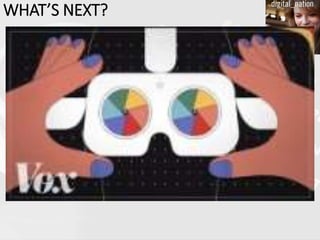
• Virtual reality (VR) implies a complete immersion
experience that shuts out the physical world. Using VR
devices such as HTC Vive, Oculus Rift or Google Cardboard,
users can be transported into a number of real-world and
imagined environments such as the middle of a squawking
penguin colony or even the back of a dragon.
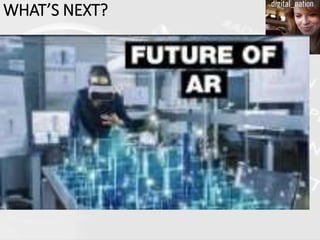
• Augmented reality (AR) adds digital elements to a live
view often by using the camera on a smartphone.
Examples of augmented reality experiences include
Snapchat lenses and the game Pokemon Go.
• In a mixed reality (MR) experience, which combines
elements of both AR and VR, real-world and digital objects
interact. Mixed reality technology is just now starting to
take off with Microsoft’s HoloLens one of the most notable
early mixed reality apparatuses.
WHAT’S NEXT?
WHAT’S NEXT?
How has Mass Media/Mass Media Technology impacted
culture in a significant way?
• Mass Media/Technology and Multitasking
• Mass Media/Technology and Addiction
• Mass Media/Technology and Social Lives
• Mass Media/Technology and Working Lives
• Mass Media/Technology and the Military
• Mass Media/Technology and PTSD
• Mass Media/Technology and Education (gamification)
• Mass Media/Technology and REALITY!
POSSIBLE RESEARCH PAPER TOPICS

Comm 101 digital nation reflection-LUTHER

  • 1.
    COMM 101 MEDIA PRESENTATION •A look at “life on the virtual frontier”… • This documentary takes a look at how media convergence and digital media delivery channels are impacting society in many areas including education, social relationships, working environments, and even the military. • While made in 2010, the material covered is still very relevant, even though some of the technology discussed has evolved. • As we established already, Mass Media is ALWAYS shared via technology of some sort and Media Convergence means that “everything” is now coming to – and at – us on the same digital platforms as Mass Media.
  • 2.
    • Digital nativeis a term coined by Mark Prensky in 2001 used to describe the generation of people who grew up in the digital age. Digital natives are comfortable with technology and computers at an early age and consider technology to be an integral and necessary part of their lives. Teenagers and children today are generally considered to be digital natives as they mainly communicate and learn via digital technology (Internet/Mobile). The opposite of digital natives is digital immigrants – people who have had to adapt to the new language of technology. DIGITAL NATIVES DIGITAL IMMIGRANTS
  • 3.
    • “Digital Natives”are now driving all aspects of culture – commerce, politics, entertainment, sports, fashion, etc. • “Digital Immigrants” are being phased out but are still in the mix DIGITAL NATIVES DIGITAL IMMIGRANTS
  • 4.
    • 1.) What’syour personal relationship with multitasking like? Do you think you’re a good multitasker? How often are you multitasking with digital technology/media in any given day? REFLECTION QUESTIONS:
  • 5.
    • MULTITASKING – •Research conducted at Stanford University found that multitasking is less productive than doing a single thing at a time. The researchers also found that people who are regularly bombarded with several streams of electronic information cannot pay attention, recall information, or switch from one job to another as well as those who complete one task at a time. • Multitasking reduces your efficiency and performance because your brain can only focus on one thing at a time. When you try to do two things at once, your brain lacks the capacity to perform both tasks successfully. • Why do you think we’re creating a cultural environment for ourselves that makes it so easy to do something that we know doesn’t really work? MULTITASKING
  • 6.
    • ARE WE“SMARTER” THANKS TO THE DIGITAL REVOLUTION? • You Haven't Gotten Smarter: The Internet Just Makes You Think You Are. Access to information is apparently a blessing and a curse, just because you can find information readily does not mean you’re smarter or better equipped to make the right decision. In fact, ready access to information might actually be blinding you to gaps in your understanding. • But not everyone agrees… MULTITASKING
  • 7.
    IN-CLASS MEDIA PRESENTATION UPDATE– Multitasking/Smarter?
  • 8.
    •The truth issimply we don’t know what living in a “digital world” is doing to us – it’s an ongoing massive social experiment with all of us as its (willing?) guinea pigs. MULTITASKING
  • 9.
    • 2.) Shouldour society recognize that individuals become addicted to the internet? If your answer is “no”, how do you account for the fact that a quickly growing number of people report that they are “addicted” to the internet? If your answer is “yes”, should the internet be regulated? If so, how and for whom? REFLECTION QUESTIONS:
  • 10.
    • INTERNET ADDICTION •The American Psychiatric Association does not recognize internet addiction as a disorder, but a growing number of medical experts has begun taking the condition seriously. • DETROIT TREATMENT… “The Digital Drug”
  • 11.
    IN-CLASS MEDIA PRESENTATION UPDATE– “The Digital Drug”
  • 12.
    • “GAMING DISORDER”(World Health Organization) • Gaming disorder, with its online and offline variants, has been included in the 11th edition of the International Classification of Diseases (ICD-11) as a clinically recognizable and clinically significant syndrome, when the pattern of gaming behavior is of such a nature and intensity that it results in marked distress or significant impairment in personal, family, social, educational or occupational functioning. “The Digital Drug”
  • 13.
    • 3.) Howshould teaching and education change along with technology? How does/did your educational experience compare to the ones seen in the film? REFLECTION QUESTIONS:
  • 14.
    • GAMIFICATION OFEDUCATION • In the context of education, the trend of using game elements in non-game contexts, termed otherwise gamification, aims at increasing the engagement and motivation of students, capturing their interest to continue learning and influencing their classroom behavior. • Gamification in education may optimize the brain’s processing of new information. This may be facilitated by the general aspects of gamified lessons, with the audio-visual presentation, minimized bites of schematized information, short time lapses, and often repetitive patterns. EDUCATION
  • 15.
    GAMIFICATION/FUN THEORY •Using GameConcepts to make everyday tasks, work, and schoolwork fun – also sometimes known as “fun theory” – another great paper topic! •Here is a video compiling 10 examples of gamification and fun theory in the real world
  • 16.
  • 17.
    • 4.) Howdoes your modern “digital life” differ from what we see in the documentary? What’s changed in the past several years? REFLECTION QUESTIONS:
  • 18.
    • 5.) Whatspecific parts of this documentary were most interesting and/or surprising to you? Please give examples of serious reflection. REFLECTION QUESTIONS:
  • 19.
    •MANY THINK “VIRTUAL” REALITYIS THE NEXT BIG STEP IN DIGITAL TECHNOLOY WHAT’S NEXT?
  • 20.
  • 21.
    •“AUGMENTED” REALITY IS ALSOALREADY ON THE EXPERIENCE HORIZON WHAT’S NEXT?
  • 22.
  • 23.
    • Virtual reality(VR) implies a complete immersion experience that shuts out the physical world. Using VR devices such as HTC Vive, Oculus Rift or Google Cardboard, users can be transported into a number of real-world and imagined environments such as the middle of a squawking penguin colony or even the back of a dragon. • Augmented reality (AR) adds digital elements to a live view often by using the camera on a smartphone. Examples of augmented reality experiences include Snapchat lenses and the game Pokemon Go. • In a mixed reality (MR) experience, which combines elements of both AR and VR, real-world and digital objects interact. Mixed reality technology is just now starting to take off with Microsoft’s HoloLens one of the most notable early mixed reality apparatuses. WHAT’S NEXT?
  • 24.
  • 25.
    How has MassMedia/Mass Media Technology impacted culture in a significant way? • Mass Media/Technology and Multitasking • Mass Media/Technology and Addiction • Mass Media/Technology and Social Lives • Mass Media/Technology and Working Lives • Mass Media/Technology and the Military • Mass Media/Technology and PTSD • Mass Media/Technology and Education (gamification) • Mass Media/Technology and REALITY! POSSIBLE RESEARCH PAPER TOPICS