20 - 1
Types of leases
Tax treatment of leases
Effects on financial statements
Lessee’s analysis
Lessor’s analysis
Other issues in lease analysis
CHAPTER 20
Lease Financing
20 - 2
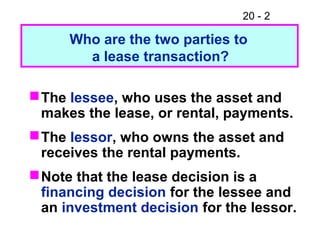
The lessee, who uses the asset and
makes the lease, or rental, payments.
The lessor, who owns the asset and
receives the rental payments.
Note that the lease decision is a
financing decision for the lessee and
an investment decision for the lessor.
Who are the two parties to
a lease transaction?
20 - 3
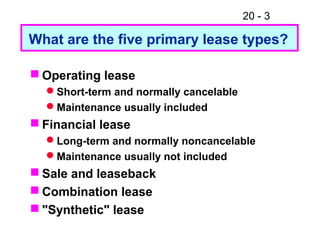
 Operating lease
Short-term and normally cancelable
Maintenance usually included
 Financial lease
Long-term and normally noncancelable
Maintenance usually not included
 Sale and leaseback
 Combination lease
 "Synthetic" lease
What are the five primary lease types?
20 - 4
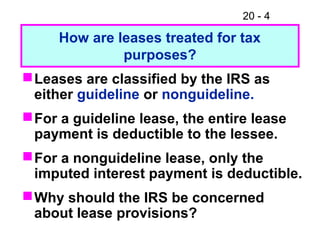
Leases are classified by the IRS as
either guideline or nonguideline.
For a guideline lease, the entire lease
payment is deductible to the lessee.
For a nonguideline lease, only the
imputed interest payment is deductible.
Why should the IRS be concerned
about lease provisions?
How are leases treated for tax
purposes?
20 - 5
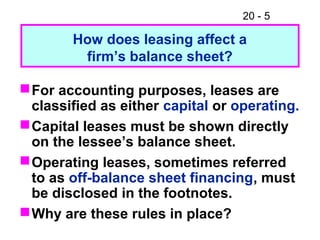
For accounting purposes, leases are
classified as either capital or operating.
Capital leases must be shown directly
on the lessee’s balance sheet.
Operating leases, sometimes referred
to as off-balance sheet financing, must
be disclosed in the footnotes.
Why are these rules in place?
How does leasing affect a
firm’s balance sheet?
20 - 6
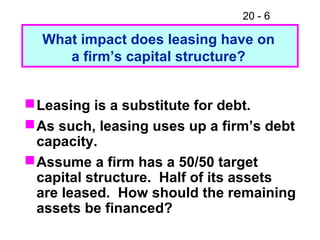
Leasing is a substitute for debt.
As such, leasing uses up a firm’s debt
capacity.
Assume a firm has a 50/50 target
capital structure. Half of its assets
are leased. How should the remaining
assets be financed?
What impact does leasing have on
a firm’s capital structure?
20 - 7
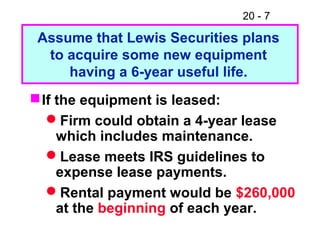
If the equipment is leased:
Firm could obtain a 4-year lease
which includes maintenance.
Lease meets IRS guidelines to
expense lease payments.
Rental payment would be $260,000
at the beginning of each year.
Assume that Lewis Securities plans
to acquire some new equipment
having a 6-year useful life.
20 - 8
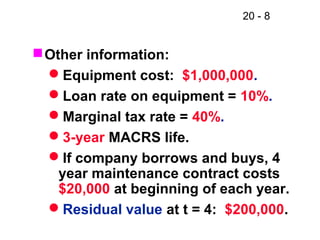
Other information:
Equipment cost: $1,000,000.
Loan rate on equipment = 10%.
Marginal tax rate = 40%.
3-year MACRS life.
If company borrows and buys, 4
year maintenance contract costs
$20,000 at beginning of each year.
Residual value at t = 4: $200,000.
20 - 9
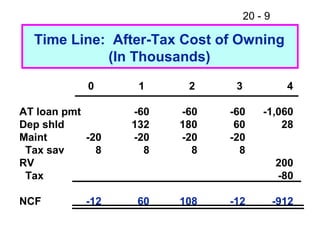
Time Line: After-Tax Cost of Owning
(In Thousands)
0 1 2 3 4
AT loan pmt -60 -60 -60 -1,060
Dep shld 132 180 60 28
Maint -20 -20 -20 -20
Tax sav 8 8 8 8
RV 200
Tax -80
NCF -12 60 108 -12 -912
20 - 10
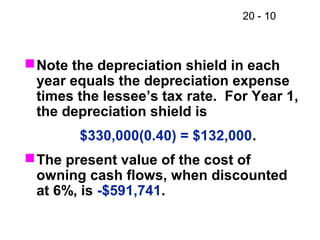
Note the depreciation shield in each
year equals the depreciation expense
times the lessee’s tax rate. For Year 1,
the depreciation shield is
$330,000(0.40) = $132,000.
The present value of the cost of
owning cash flows, when discounted
at 6%, is -$591,741.
20 - 11
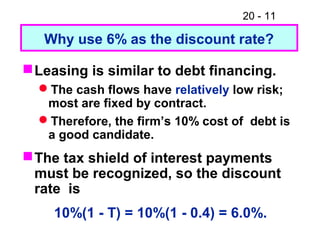
Leasing is similar to debt financing.
The cash flows have relatively low risk;
most are fixed by contract.
Therefore, the firm’s 10% cost of debt is
a good candidate.
The tax shield of interest payments
must be recognized, so the discount
rate is
10%(1 - T) = 10%(1 - 0.4) = 6.0%.
Why use 6% as the discount rate?
20 - 12
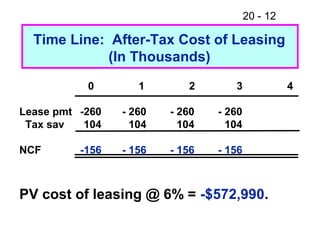
Time Line: After-Tax Cost of Leasing
(In Thousands)
0 1 2 3 4
Lease pmt -260 - 260 - 260 - 260
Tax sav 104 104 104 104
NCF -156 - 156 - 156 - 156
PV cost of leasing @ 6% = -$572,990.
20 - 13
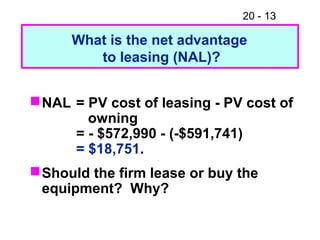
NAL = PV cost of leasing - PV cost of
owning
= - $572,990 - (-$591,741)
= $18,751.
Should the firm lease or buy the
equipment? Why?
What is the net advantage
to leasing (NAL)?
20 - 14
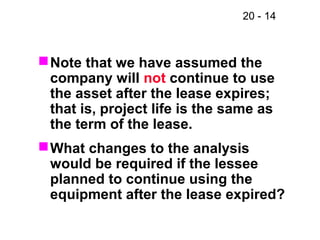
Note that we have assumed the
company will not continue to use
the asset after the lease expires;
that is, project life is the same as
the term of the lease.
What changes to the analysis
would be required if the lessee
planned to continue using the
equipment after the lease expired?
20 - 15
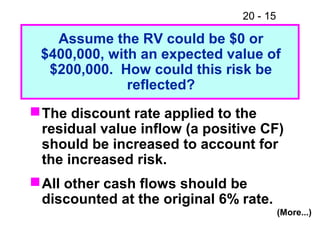
The discount rate applied to the
residual value inflow (a positive CF)
should be increased to account for
the increased risk.
All other cash flows should be
discounted at the original 6% rate.
Assume the RV could be $0 or
$400,000, with an expected value of
$200,000. How could this risk be
reflected?
(More...)
20 - 16
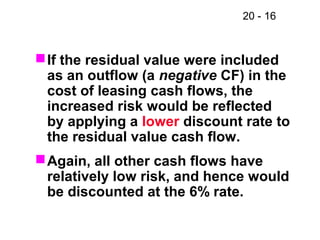
If the residual value were included
as an outflow (a negative CF) in the
cost of leasing cash flows, the
increased risk would be reflected
by applying a lower discount rate to
the residual value cash flow.
Again, all other cash flows have
relatively low risk, and hence would
be discounted at the 6% rate.
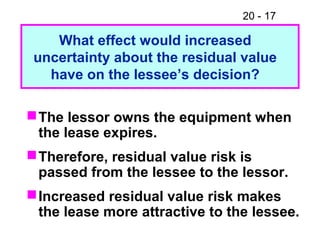
20 - 17
What effect would increased
uncertainty about the residual value
have on the lessee’s decision?
The lessor owns the equipment when
the lease expires.
Therefore, residual value risk is
passed from the lessee to the lessor.
Increased residual value risk makes
the lease more attractive to the lessee.
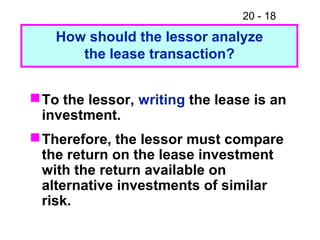
20 - 18
How should the lessor analyze
the lease transaction?
To the lessor, writing the lease is an
investment.
Therefore, the lessor must compare
the return on the lease investment
with the return available on
alternative investments of similar
risk.
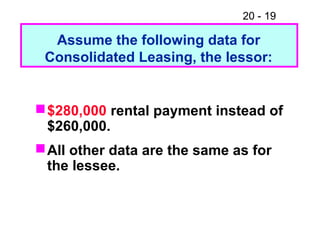
20 - 19
$280,000 rental payment instead of
$260,000.
All other data are the same as for
the lessee.
Assume the following data for
Consolidated Leasing, the lessor:
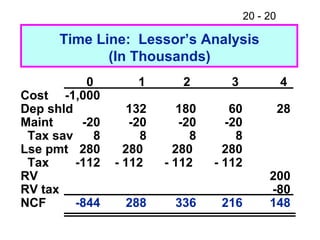
20 - 20
Time Line: Lessor’s Analysis
(In Thousands)
0 1 2 3 4
Cost -1,000
Dep shld 132 180 60 28
Maint -20 -20 -20 -20
Tax sav 8 8 8 8
Lse pmt 280 280 280 280
Tax -112 - 112 - 112 - 112
RV 200
RV tax -80
NCF -844 288 336 216 148
20 - 21
 The NPV of the net cash flows, when
discounted at 6%, is $25,325.
 The IRR is 7.46%.
 Should the lessor write the lease? Why?
20 - 22
With lease payments of $260,000, the
lessor’s cash flows would be equal,
but opposite in sign, to the lessee’s
NAL.
Thus, lessor’s NPV = -$18,751.
If all inputs are symmetrical, leasing
is a zero-sum game.
What are the implications?
Find the lessor’s NPV if the lease
payment were $260,000.
20 - 23
A cancellation clause would lower
the risk of the lease to the lessee but
raise the lessor’s risk.
To account for this, the lessor would
increase the annual lease payment or
else impose a penalty for early
cancellation.
What impact would a cancellation
clause have on the lease’s riskiness
from the lessee’s standpoint? From
the lessor’s standpoint?
20 - 24
Do higher residual values make
leasing less attractive to the lessee?
Is lease financing more available or
“better” than debt financing?
Is the lease analysis presented here
applicable to real estate leases? To
auto leases?
Other Issues in Lease Analysis
(More...)
20 - 25
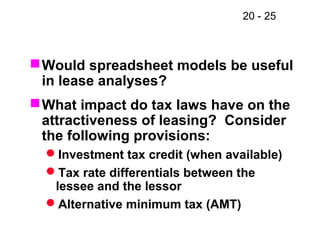
Would spreadsheet models be useful
in lease analyses?
What impact do tax laws have on the
attractiveness of leasing? Consider
the following provisions:
Investment tax credit (when available)
Tax rate differentials between the
lessee and the lessor
Alternative minimum tax (AMT)
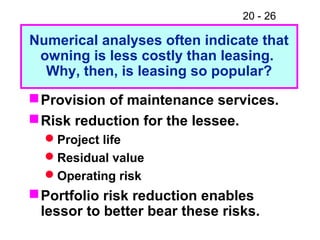
20 - 26
Provision of maintenance services.
Risk reduction for the lessee.
Project life
Residual value
Operating risk
Portfolio risk reduction enables
lessor to better bear these risks.
Numerical analyses often indicate that
owning is less costly than leasing.
Why, then, is leasing so popular?

Fm11 ch 20 lease financing

  • 1.
    20 - 1 Typesof leases Tax treatment of leases Effects on financial statements Lessee’s analysis Lessor’s analysis Other issues in lease analysis CHAPTER 20 Lease Financing
  • 2.
    20 - 2 Thelessee, who uses the asset and makes the lease, or rental, payments. The lessor, who owns the asset and receives the rental payments. Note that the lease decision is a financing decision for the lessee and an investment decision for the lessor. Who are the two parties to a lease transaction?
  • 3.
    20 - 3 Operating lease Short-term and normally cancelable Maintenance usually included  Financial lease Long-term and normally noncancelable Maintenance usually not included  Sale and leaseback  Combination lease  "Synthetic" lease What are the five primary lease types?
  • 4.
    20 - 4 Leasesare classified by the IRS as either guideline or nonguideline. For a guideline lease, the entire lease payment is deductible to the lessee. For a nonguideline lease, only the imputed interest payment is deductible. Why should the IRS be concerned about lease provisions? How are leases treated for tax purposes?
  • 5.
    20 - 5 Foraccounting purposes, leases are classified as either capital or operating. Capital leases must be shown directly on the lessee’s balance sheet. Operating leases, sometimes referred to as off-balance sheet financing, must be disclosed in the footnotes. Why are these rules in place? How does leasing affect a firm’s balance sheet?
  • 6.
    20 - 6 Leasingis a substitute for debt. As such, leasing uses up a firm’s debt capacity. Assume a firm has a 50/50 target capital structure. Half of its assets are leased. How should the remaining assets be financed? What impact does leasing have on a firm’s capital structure?
  • 7.
    20 - 7 Ifthe equipment is leased: Firm could obtain a 4-year lease which includes maintenance. Lease meets IRS guidelines to expense lease payments. Rental payment would be $260,000 at the beginning of each year. Assume that Lewis Securities plans to acquire some new equipment having a 6-year useful life.
  • 8.
    20 - 8 Otherinformation: Equipment cost: $1,000,000. Loan rate on equipment = 10%. Marginal tax rate = 40%. 3-year MACRS life. If company borrows and buys, 4 year maintenance contract costs $20,000 at beginning of each year. Residual value at t = 4: $200,000.
  • 9.
    20 - 9 TimeLine: After-Tax Cost of Owning (In Thousands) 0 1 2 3 4 AT loan pmt -60 -60 -60 -1,060 Dep shld 132 180 60 28 Maint -20 -20 -20 -20 Tax sav 8 8 8 8 RV 200 Tax -80 NCF -12 60 108 -12 -912
  • 10.
    20 - 10 Notethe depreciation shield in each year equals the depreciation expense times the lessee’s tax rate. For Year 1, the depreciation shield is $330,000(0.40) = $132,000. The present value of the cost of owning cash flows, when discounted at 6%, is -$591,741.
  • 11.
    20 - 11 Leasingis similar to debt financing. The cash flows have relatively low risk; most are fixed by contract. Therefore, the firm’s 10% cost of debt is a good candidate. The tax shield of interest payments must be recognized, so the discount rate is 10%(1 - T) = 10%(1 - 0.4) = 6.0%. Why use 6% as the discount rate?
  • 12.
    20 - 12 TimeLine: After-Tax Cost of Leasing (In Thousands) 0 1 2 3 4 Lease pmt -260 - 260 - 260 - 260 Tax sav 104 104 104 104 NCF -156 - 156 - 156 - 156 PV cost of leasing @ 6% = -$572,990.
  • 13.
    20 - 13 NAL= PV cost of leasing - PV cost of owning = - $572,990 - (-$591,741) = $18,751. Should the firm lease or buy the equipment? Why? What is the net advantage to leasing (NAL)?
  • 14.
    20 - 14 Notethat we have assumed the company will not continue to use the asset after the lease expires; that is, project life is the same as the term of the lease. What changes to the analysis would be required if the lessee planned to continue using the equipment after the lease expired?
  • 15.
    20 - 15 Thediscount rate applied to the residual value inflow (a positive CF) should be increased to account for the increased risk. All other cash flows should be discounted at the original 6% rate. Assume the RV could be $0 or $400,000, with an expected value of $200,000. How could this risk be reflected? (More...)
  • 16.
    20 - 16 Ifthe residual value were included as an outflow (a negative CF) in the cost of leasing cash flows, the increased risk would be reflected by applying a lower discount rate to the residual value cash flow. Again, all other cash flows have relatively low risk, and hence would be discounted at the 6% rate.
  • 17.
    20 - 17 Whateffect would increased uncertainty about the residual value have on the lessee’s decision? The lessor owns the equipment when the lease expires. Therefore, residual value risk is passed from the lessee to the lessor. Increased residual value risk makes the lease more attractive to the lessee.
  • 18.
    20 - 18 Howshould the lessor analyze the lease transaction? To the lessor, writing the lease is an investment. Therefore, the lessor must compare the return on the lease investment with the return available on alternative investments of similar risk.
  • 19.
    20 - 19 $280,000rental payment instead of $260,000. All other data are the same as for the lessee. Assume the following data for Consolidated Leasing, the lessor:
  • 20.
    20 - 20 TimeLine: Lessor’s Analysis (In Thousands) 0 1 2 3 4 Cost -1,000 Dep shld 132 180 60 28 Maint -20 -20 -20 -20 Tax sav 8 8 8 8 Lse pmt 280 280 280 280 Tax -112 - 112 - 112 - 112 RV 200 RV tax -80 NCF -844 288 336 216 148
  • 21.
    20 - 21 The NPV of the net cash flows, when discounted at 6%, is $25,325.  The IRR is 7.46%.  Should the lessor write the lease? Why?
  • 22.
    20 - 22 Withlease payments of $260,000, the lessor’s cash flows would be equal, but opposite in sign, to the lessee’s NAL. Thus, lessor’s NPV = -$18,751. If all inputs are symmetrical, leasing is a zero-sum game. What are the implications? Find the lessor’s NPV if the lease payment were $260,000.
  • 23.
    20 - 23 Acancellation clause would lower the risk of the lease to the lessee but raise the lessor’s risk. To account for this, the lessor would increase the annual lease payment or else impose a penalty for early cancellation. What impact would a cancellation clause have on the lease’s riskiness from the lessee’s standpoint? From the lessor’s standpoint?
  • 24.
    20 - 24 Dohigher residual values make leasing less attractive to the lessee? Is lease financing more available or “better” than debt financing? Is the lease analysis presented here applicable to real estate leases? To auto leases? Other Issues in Lease Analysis (More...)
  • 25.
    20 - 25 Wouldspreadsheet models be useful in lease analyses? What impact do tax laws have on the attractiveness of leasing? Consider the following provisions: Investment tax credit (when available) Tax rate differentials between the lessee and the lessor Alternative minimum tax (AMT)
  • 26.
    20 - 26 Provisionof maintenance services. Risk reduction for the lessee. Project life Residual value Operating risk Portfolio risk reduction enables lessor to better bear these risks. Numerical analyses often indicate that owning is less costly than leasing. Why, then, is leasing so popular?