WELCOME
Hons’3rd year
Financial Management
6 chapter: Lease Financing
Paper Code: 232513
Lease Financing
Presented by:
Mohammad JashimUddin
Assistant Professor
Department of Accounting
Wali Newaz Khan College, Kishoreganj
leasing
The process by which a firm can obtain the use of
certain fixed assets for which it must make a
series of contractual, periodic, tax-deductible
payments.
lessee
The receiver of the services of the assets
under a lease contract.
lessor
The owner of assets that are being
leased.
TYPES OF LEASES
The two basic types of leases that are available to a
business are operating leases and financial leases
(often called capital leases by accountants).
Operating Leases:
A cancelable contractual arrangement whereby the lessee agrees to make
periodic payments to the lessor, often for 5 or fewer years, to obtain an
asset’s services; generally, the total payments over the term of the lease
are less than the lessor’s initial cost of the leased asset.
Financial (or Capital) Leases:
A longer-term lease than an operating lease that is noncancelable and
obligates the lessee to make payments for the use of an asset over a
predefined period of time; the total payments over the term of the lease are
greater than the lessor’s initial cost of the leased asset
LEASE-VERSUS-
PURCHASE DECISION
lease-versus-purchase (or lease-versus-buy)
decision:
The decision facing firms needing to acquire new fixed assets:
whether to lease the assets or to purchase them, using
borrowed funds or available liquid resources.
LEASE-VERSUS-PURCHASE
DECISIONThe lease-versus-purchase decision involves application of the capital
budgeting methods. First, we determine the relevant cash flows and then
apply present value techniques. The following steps are involved in the
analysis:
Step 1 Find the after-tax cash outflows for each year under the lease
alternative. This step generally involves a fairly simple tax adjustment of the
annual lease payments. In addition, the cost of exercising a purchase option
in the final year of the lease term must frequently be included
LEASE-VERSUS-PURCHASE
DECISIONStep 2 Find the after-tax cash outflows for each year under the
purchase alternative. This step involves adjusting the sum of the
scheduled loan payment and maintenance cost outlay for the tax
shields resulting from the tax deductions attributable to
maintenance, depreciation, and interest.
LEASE-VERSUS-PURCHASE
DECISIONStep 3 Calculate the present value of the cash outflows
associated with the lease (from Step 1) and purchase (from Step
2) alternatives using the after-tax cost of debt as the discount
rate. The after-tax cost of debt is used to evaluate the lease-
versus-purchase decision because the decision itself involves the
choice between two financing techniques—leasing and
borrowing—that have very low risk.
LEASE-VERSUS-PURCHASE
DECISIONStep 4 Choose the alternative with the lower present value of
cash outflows from Step 3. It will be the least-cost financing
alternative.
The application of each of these steps is demonstrated in the following
example
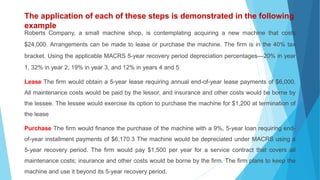
Roberts Company, a small machine shop, is contemplating acquiring a new machine that costs
$24,000. Arrangements can be made to lease or purchase the machine. The firm is in the 40% tax
bracket. Using the applicable MACRS 5-year recovery period depreciation percentages—20% in year
1, 32% in year 2, 19% in year 3, and 12% in years 4 and 5
Lease The firm would obtain a 5-year lease requiring annual end-of-year lease payments of $6,000.
All maintenance costs would be paid by the lessor, and insurance and other costs would be borne by
the lessee. The lessee would exercise its option to purchase the machine for $1,200 at termination of
the lease
Purchase The firm would finance the purchase of the machine with a 9%, 5-year loan requiring end-
of-year installment payments of $6,170.3 The machine would be depreciated under MACRS using a
5-year recovery period. The firm would pay $1,500 per year for a service contract that covers all
maintenance costs; insurance and other costs would be borne by the firm. The firm plans to keep the
machine and use it beyond its 5-year recovery period.
Using these data, we can apply the steps presented earlier:
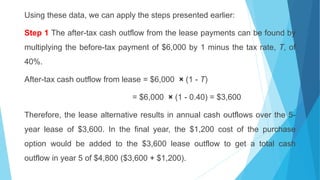
Step 1 The after-tax cash outflow from the lease payments can be found by
multiplying the before-tax payment of $6,000 by 1 minus the tax rate, T, of
40%.
After-tax cash outflow from lease = $6,000 × (1 - T)
= $6,000 × (1 - 0.40) = $3,600
Therefore, the lease alternative results in annual cash outflows over the 5-
year lease of $3,600. In the final year, the $1,200 cost of the purchase
option would be added to the $3,600 lease outflow to get a total cash
outflow in year 5 of $4,800 ($3,600 + $1,200).
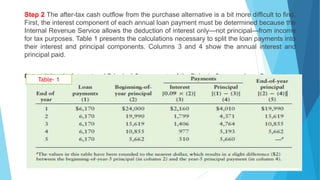
Step 2 The after-tax cash outflow from the purchase alternative is a bit more difficult to find.
First, the interest component of each annual loan payment must be determined because the
Internal Revenue Service allows the deduction of interest only—not principal—from income
for tax purposes. Table 1 presents the calculations necessary to split the loan payments into
their interest and principal components. Columns 3 and 4 show the annual interest and
principal paid.
Determining the Interest and Principal Components of the Roberts Company Loan Payments
Table- 1
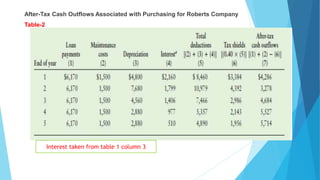
After-Tax Cash Outflows Associated with Purchasing for Roberts Company
Table-2
Interest taken from table 1 column 3
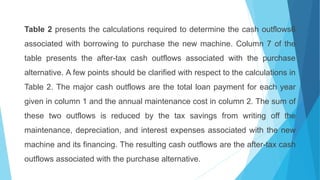
Table 2 presents the calculations required to determine the cash outflows6
associated with borrowing to purchase the new machine. Column 7 of the
table presents the after-tax cash outflows associated with the purchase
alternative. A few points should be clarified with respect to the calculations in
Table 2. The major cash outflows are the total loan payment for each year
given in column 1 and the annual maintenance cost in column 2. The sum of
these two outflows is reduced by the tax savings from writing off the
maintenance, depreciation, and interest expenses associated with the new
machine and its financing. The resulting cash outflows are the after-tax cash
outflows associated with the purchase alternative.
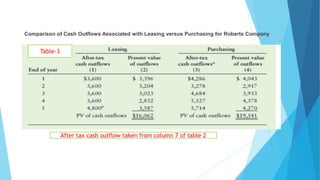
Step 3 The present values of the cash outflows associated with the lease
(from Step 1) and purchase (from Step 2) alternatives are calculated in
Table 3 If we ignore any flotation costs, the firm’s after-tax cost of debt
would be 5.4% [9% debt cost (1 0.40 tax rate)]. To reflect both the flotation
costs associated with selling new debt and the possible need to sell the debt
at a discount, we use an after-tax debt cost of 6% as the applicable
discount rate. The sum of the present values of the cash outflows for the
leasing alternative is given in column 2 of Table 3, and the sum of those for
the purchasing alternative is given in column 4.
Comparison of Cash Outflows Associated with Leasing versus Purchasing for Roberts Company
Table-3
After tax cash outflow taken from column 7 of table 2
Step 4 Because the present value of cash outflows for leasing
($16,062) is lower than that for purchasing ($19,541), the leasing
alternative is preferred. Leasing results in an incremental savings
of $3,479 ($19,541 - $16,062) and is therefore the less costly
alternative.
Thanks' to All

Lease financing

  • 1.
    WELCOME Hons’3rd year Financial Management 6chapter: Lease Financing Paper Code: 232513
  • 2.
    Lease Financing Presented by: MohammadJashimUddin Assistant Professor Department of Accounting Wali Newaz Khan College, Kishoreganj
  • 3.
    leasing The process bywhich a firm can obtain the use of certain fixed assets for which it must make a series of contractual, periodic, tax-deductible payments.
  • 4.
    lessee The receiver ofthe services of the assets under a lease contract.
  • 5.
    lessor The owner ofassets that are being leased.
  • 6.
    TYPES OF LEASES Thetwo basic types of leases that are available to a business are operating leases and financial leases (often called capital leases by accountants). Operating Leases: A cancelable contractual arrangement whereby the lessee agrees to make periodic payments to the lessor, often for 5 or fewer years, to obtain an asset’s services; generally, the total payments over the term of the lease are less than the lessor’s initial cost of the leased asset.
  • 7.
    Financial (or Capital)Leases: A longer-term lease than an operating lease that is noncancelable and obligates the lessee to make payments for the use of an asset over a predefined period of time; the total payments over the term of the lease are greater than the lessor’s initial cost of the leased asset
  • 8.
    LEASE-VERSUS- PURCHASE DECISION lease-versus-purchase (orlease-versus-buy) decision: The decision facing firms needing to acquire new fixed assets: whether to lease the assets or to purchase them, using borrowed funds or available liquid resources.
  • 9.
    LEASE-VERSUS-PURCHASE DECISIONThe lease-versus-purchase decisioninvolves application of the capital budgeting methods. First, we determine the relevant cash flows and then apply present value techniques. The following steps are involved in the analysis: Step 1 Find the after-tax cash outflows for each year under the lease alternative. This step generally involves a fairly simple tax adjustment of the annual lease payments. In addition, the cost of exercising a purchase option in the final year of the lease term must frequently be included
  • 10.
    LEASE-VERSUS-PURCHASE DECISIONStep 2 Findthe after-tax cash outflows for each year under the purchase alternative. This step involves adjusting the sum of the scheduled loan payment and maintenance cost outlay for the tax shields resulting from the tax deductions attributable to maintenance, depreciation, and interest.
  • 11.
    LEASE-VERSUS-PURCHASE DECISIONStep 3 Calculatethe present value of the cash outflows associated with the lease (from Step 1) and purchase (from Step 2) alternatives using the after-tax cost of debt as the discount rate. The after-tax cost of debt is used to evaluate the lease- versus-purchase decision because the decision itself involves the choice between two financing techniques—leasing and borrowing—that have very low risk.
  • 12.
    LEASE-VERSUS-PURCHASE DECISIONStep 4 Choosethe alternative with the lower present value of cash outflows from Step 3. It will be the least-cost financing alternative.
  • 13.
    The application ofeach of these steps is demonstrated in the following example Roberts Company, a small machine shop, is contemplating acquiring a new machine that costs $24,000. Arrangements can be made to lease or purchase the machine. The firm is in the 40% tax bracket. Using the applicable MACRS 5-year recovery period depreciation percentages—20% in year 1, 32% in year 2, 19% in year 3, and 12% in years 4 and 5 Lease The firm would obtain a 5-year lease requiring annual end-of-year lease payments of $6,000. All maintenance costs would be paid by the lessor, and insurance and other costs would be borne by the lessee. The lessee would exercise its option to purchase the machine for $1,200 at termination of the lease Purchase The firm would finance the purchase of the machine with a 9%, 5-year loan requiring end- of-year installment payments of $6,170.3 The machine would be depreciated under MACRS using a 5-year recovery period. The firm would pay $1,500 per year for a service contract that covers all maintenance costs; insurance and other costs would be borne by the firm. The firm plans to keep the machine and use it beyond its 5-year recovery period.
  • 14.
    Using these data,we can apply the steps presented earlier: Step 1 The after-tax cash outflow from the lease payments can be found by multiplying the before-tax payment of $6,000 by 1 minus the tax rate, T, of 40%. After-tax cash outflow from lease = $6,000 × (1 - T) = $6,000 × (1 - 0.40) = $3,600 Therefore, the lease alternative results in annual cash outflows over the 5- year lease of $3,600. In the final year, the $1,200 cost of the purchase option would be added to the $3,600 lease outflow to get a total cash outflow in year 5 of $4,800 ($3,600 + $1,200).
  • 15.
    Step 2 Theafter-tax cash outflow from the purchase alternative is a bit more difficult to find. First, the interest component of each annual loan payment must be determined because the Internal Revenue Service allows the deduction of interest only—not principal—from income for tax purposes. Table 1 presents the calculations necessary to split the loan payments into their interest and principal components. Columns 3 and 4 show the annual interest and principal paid. Determining the Interest and Principal Components of the Roberts Company Loan Payments Table- 1
  • 16.
    After-Tax Cash OutflowsAssociated with Purchasing for Roberts Company Table-2 Interest taken from table 1 column 3
  • 17.
    Table 2 presentsthe calculations required to determine the cash outflows6 associated with borrowing to purchase the new machine. Column 7 of the table presents the after-tax cash outflows associated with the purchase alternative. A few points should be clarified with respect to the calculations in Table 2. The major cash outflows are the total loan payment for each year given in column 1 and the annual maintenance cost in column 2. The sum of these two outflows is reduced by the tax savings from writing off the maintenance, depreciation, and interest expenses associated with the new machine and its financing. The resulting cash outflows are the after-tax cash outflows associated with the purchase alternative.
  • 18.
    Step 3 Thepresent values of the cash outflows associated with the lease (from Step 1) and purchase (from Step 2) alternatives are calculated in Table 3 If we ignore any flotation costs, the firm’s after-tax cost of debt would be 5.4% [9% debt cost (1 0.40 tax rate)]. To reflect both the flotation costs associated with selling new debt and the possible need to sell the debt at a discount, we use an after-tax debt cost of 6% as the applicable discount rate. The sum of the present values of the cash outflows for the leasing alternative is given in column 2 of Table 3, and the sum of those for the purchasing alternative is given in column 4.
  • 19.
    Comparison of CashOutflows Associated with Leasing versus Purchasing for Roberts Company Table-3 After tax cash outflow taken from column 7 of table 2
  • 20.
    Step 4 Becausethe present value of cash outflows for leasing ($16,062) is lower than that for purchasing ($19,541), the leasing alternative is preferred. Leasing results in an incremental savings of $3,479 ($19,541 - $16,062) and is therefore the less costly alternative.
  • 21.