FLYING WINDMILL
Presentation by: Tejashree.k
USN :
3VC13EE108
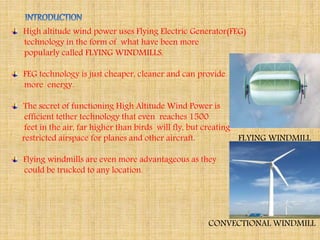
High altitude wind power uses Flying Electric Generator(FEG)
technology in the form of what have been more
popularly called FLYING WINDMILLS.
FEG technology is just cheaper, cleaner and can provide
more energy.
The secret of functioning High Altitude Wind Power is
efficient tether technology that even reaches 1500
feet in the air, far higher than birds will fly, but creating
restricted airspace for planes and other aircraft. FLYING WINDMILL
Flying windmills are even more advantageous as they
could be trucked to any location.
CONVECTIONAL WINDMILL
It is a windmill similar to a conventional one in its working principle but here the
rotor and generator will be floating in air just like a hot air balloon.
The generator will be enclosed in an inflatable structure and this structure is held by
a Tether and tied to the ground.
Canadian engineer Fred Ferguson, specialized in airships, proposed an innovative
system called as Magenn Air Rotor System (MARS).
The helium filled MARS is a buoyant turbine made of vectran – a bulletproof
material that is stronger than steel of the same thickness – and is connected to the
ground by an insulated conductive tether.
While in the sky,the MARS turbines spins in the wind,generating electricity.The
current is transferred down the tether for consumption,battery storage or
transmitted to a power grid.
LIFTING MECHANISM
1.Helium sustains the Magenn Air
Rotor System,which ascends to an
altitude as selected by the operator
for the best winds
2.This aerodynamic phenomenon
provides additional lift,keeps the MARS
device stabilized,position MARS within a
very controlled and restricted
location,and finally,causes MARS to pull
up overhead to maximize altitude rather
than drift downwind on its tether.
3.MARS is filled with helium gas,which is
inert and non-flammable.The lifting gas
creates a lift force that is in excess of the
total weight of the system.The helium
provides at least twice the positive lift
versus the overall weight of the MARS
unit.Additional lift is also created when
the rotor is spinning in a wind.
Arrangement of MARS
WORKING
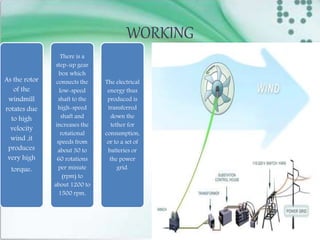
There is a
step-up gear
box which
connects the
low-speed
shaft to the
high-speed
shaft and
increases the
rotational
speeds from
about 30 to
60 rotations
per minute
(rpm) to
about 1200 to
1500 rpm.
The electrical
energy thus
produced is
transferred
down the
tether for
consumption,
or to a set of
batteries or
the power
grid.
As the rotor
of the
windmill
rotates due
to high
velocity
wind ,it
produces
very high
torque.
APPLICATIONS
1. OFF GRID FOR COTTAGES AND REMOTE USES SUCH AS CELL TOWERS.
2. DEVELOPING NATIONS WHERE INFRASTRUCTURE IS LIMITED OR
NON EXISTENT.
3. RAPID DEPLOYMENT TO DISASTER AREAS FOR POWER TO EMERGENCY AND
MEDICAL EQUIPMENT, WATER PUMPS, AND RELIEF EFFORTS (EX. KATRINA,
TSUNAMI).
4. AND MILITARY APPLICATIONS.
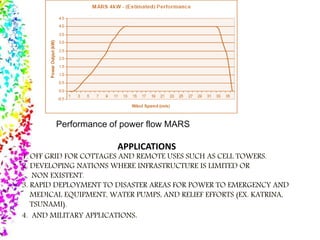
Performance of power flow MARS
ADVANTAGES
1. Low cost electricity .
2. Bird and bat friendly.
3. Lower noise
4. Wide range of wind speeds - 2 to more than 28 meters/second
5. Higher altitudes - from 200 to 800 feet above ground level are possible.
6. Ability to install closer to the power grid.
7. Ideal for off grid applications or where power is not reliable.
8. They do not require land, wide roads and heavy machinery for assembly. MARS
units remove these limitations.
DISADVANTAGES
1. MARS units cannot be installed within five miles of the boundary of any airport.
2. Initial cost is high.
3. Another disadvantage of floating windmills is that they have to be taken down
in extremely powerful winds, whereas common wind turbines are simply shut
down.
CONCLUSION
In case of flying windmills the MARS system is very simple to
install, requiring minimal on‐site work.
Despite its large size, no cranes or oversized vehicles were
required to deploy the system.
High‐altitude wind power using tethered wind turbine
devices has the potential to open up a new wind resource
in areas that are not served by convectional turbines.
http://www.theatlantic.com
www.magenn.com
http://www.nampet.com
www.dnvgl.com
www.William kamkwamba.com
www.Herman Melville.com
THANK YOU
FOR
YOUR
ATTENTION

Flying wind mill presentation

  • 1.
    FLYING WINDMILL Presentation by:Tejashree.k USN : 3VC13EE108
  • 2.
    High altitude windpower uses Flying Electric Generator(FEG) technology in the form of what have been more popularly called FLYING WINDMILLS. FEG technology is just cheaper, cleaner and can provide more energy. The secret of functioning High Altitude Wind Power is efficient tether technology that even reaches 1500 feet in the air, far higher than birds will fly, but creating restricted airspace for planes and other aircraft. FLYING WINDMILL Flying windmills are even more advantageous as they could be trucked to any location. CONVECTIONAL WINDMILL
  • 3.
    It is awindmill similar to a conventional one in its working principle but here the rotor and generator will be floating in air just like a hot air balloon. The generator will be enclosed in an inflatable structure and this structure is held by a Tether and tied to the ground. Canadian engineer Fred Ferguson, specialized in airships, proposed an innovative system called as Magenn Air Rotor System (MARS). The helium filled MARS is a buoyant turbine made of vectran – a bulletproof material that is stronger than steel of the same thickness – and is connected to the ground by an insulated conductive tether. While in the sky,the MARS turbines spins in the wind,generating electricity.The current is transferred down the tether for consumption,battery storage or transmitted to a power grid.
  • 5.
    LIFTING MECHANISM 1.Helium sustainsthe Magenn Air Rotor System,which ascends to an altitude as selected by the operator for the best winds 2.This aerodynamic phenomenon provides additional lift,keeps the MARS device stabilized,position MARS within a very controlled and restricted location,and finally,causes MARS to pull up overhead to maximize altitude rather than drift downwind on its tether. 3.MARS is filled with helium gas,which is inert and non-flammable.The lifting gas creates a lift force that is in excess of the total weight of the system.The helium provides at least twice the positive lift versus the overall weight of the MARS unit.Additional lift is also created when the rotor is spinning in a wind.
  • 6.
  • 7.
    WORKING There is a step-upgear box which connects the low-speed shaft to the high-speed shaft and increases the rotational speeds from about 30 to 60 rotations per minute (rpm) to about 1200 to 1500 rpm. The electrical energy thus produced is transferred down the tether for consumption, or to a set of batteries or the power grid. As the rotor of the windmill rotates due to high velocity wind ,it produces very high torque.
  • 8.
    APPLICATIONS 1. OFF GRIDFOR COTTAGES AND REMOTE USES SUCH AS CELL TOWERS. 2. DEVELOPING NATIONS WHERE INFRASTRUCTURE IS LIMITED OR NON EXISTENT. 3. RAPID DEPLOYMENT TO DISASTER AREAS FOR POWER TO EMERGENCY AND MEDICAL EQUIPMENT, WATER PUMPS, AND RELIEF EFFORTS (EX. KATRINA, TSUNAMI). 4. AND MILITARY APPLICATIONS. Performance of power flow MARS
  • 9.
    ADVANTAGES 1. Low costelectricity . 2. Bird and bat friendly. 3. Lower noise 4. Wide range of wind speeds - 2 to more than 28 meters/second 5. Higher altitudes - from 200 to 800 feet above ground level are possible. 6. Ability to install closer to the power grid. 7. Ideal for off grid applications or where power is not reliable. 8. They do not require land, wide roads and heavy machinery for assembly. MARS units remove these limitations. DISADVANTAGES 1. MARS units cannot be installed within five miles of the boundary of any airport. 2. Initial cost is high. 3. Another disadvantage of floating windmills is that they have to be taken down in extremely powerful winds, whereas common wind turbines are simply shut down.
  • 10.
    CONCLUSION In case offlying windmills the MARS system is very simple to install, requiring minimal on‐site work. Despite its large size, no cranes or oversized vehicles were required to deploy the system. High‐altitude wind power using tethered wind turbine devices has the potential to open up a new wind resource in areas that are not served by convectional turbines.
  • 11.
  • 12.