VISVESVARAYA TECHNOLOGICAL UNIVERSITY
“Jnana-Sangama”, Belgaum 590014, Karnataka, India
A PROJECT REPORT ON
“MAGENN AIR ROTOR SYSTEM (M.A.R.S)”
FLOATING ELECTRIC GENERATORS
Submitted in partial fulfilment of the requirements for the award of the degree of
BACHELOR OF ENGINEERING
IN
MECHANICAL ENGINEERING
For the Academic Year 2020-2021
Submitted By
KIRAN PRASAD.P
(4BW16ME019)
Under the Guidance of
Mr. HEMANTHA.C M.Tech
Assistant Professor,
Dept. Of Mech, BGSIT
DEPARTMENT OF MECHANICAL ENGINEERING
B.G.S INSITUTE OF TECHNOLOGY
BG Nagar, Nagamangala Taluk, Mandya District– 571448
2020–2021
B.G.S INSTITUTE OF TECHNOLOGY
BG Nagar, Nagamangala Taluk, Mandya District– 571448
Affiliated to Visvesvaraya Technological University, Belgaum.
DEPARTMENT OF MECHANICAL ENGINEERING
CERTIFICATE
This is to certify that the Technical Seminar Report entitled “MAGENN AIR ROTOR
SYSTEM (MARS)” FLOATING ELECTRIC GENERATORS is carried out by Mr. KIRAN
PRASAD P (4BW16ME019) in partial fulfilment for the award of Bachelor of Engineering
in Mechanical Engineering of the Visvesvaraya Technological University, Belgaum during
the year 2020-2021.It is certified that all correction/suggestions indicated for internal
assessment have been incorporated in the report deposited in the department library. The
Technical Seminar report has been approved as it satisfies the academic requirements in respect
of Technical Seminar work prescribed for the said degree.
___________________ ___________________ ___________________
Signature of the Guide Signature of HOD Signature of Principal
Prof. Hemantha C Dr. Manjunath H S Dr. B K Narendra
External Viva
Name of the examiners Signature
1.____________________ ____________________
2. ____________________ ____________________
TECHNICAL SEMINAR REPORT
Dept. Of Mechanical Engineering, BGSIT 2020-21 Page | 3
ACKNOWLEDGEMENT
The completion of any project involves the efforts of many people. We have been lucky to receive
a lot of help and support from all persons during the making of this project, so with gratitude we
take this opportunity to acknowledge all those who guided and encouraged me to emerge
successful.
It gives us immense pleasure in expressing our deepest sincere thoughts of gratitude to our college
president Jagadguru Sri Sri Sri Dr|| Nirmalanandanatha Mahaswamiji, Sri
Adichunchanagiri Shihkshana Trust (R.)
I would like to convey my heartful thanks to our beloved Principal Dr|| BK Narendra, BGSIT,
B.G Nagar for having supported me in my academic’s endeavors.
I am greatly indebted to Dr|| Manjunath S H, HOD, Dept. of Mechanical Engineering for giving
the opportunity to embark upon this topic.
We would like to sincerely thank our project co-ordinator Dr|| Girish K B professor, Dept. of
Mechanical Engineering, BGSIT, B G Nagar, Mandya for his valuable guidance.
We would like to sincerely thank our project guide. Hemantha C, Associate professor, Dept. of
Mechanical Engineering, BGSIT, B G Nagar, Mandya for his valuable guidance, support and
constructive suggestions for betterment of this project work.
Once again,I take this opportunity to extend my earnest gratitude and respect to all the
Teaching & Non-teaching staff of the department.
Regards,
KIRAN PRASAD.P
(4BW16ME019)
TECHNICAL SEMINAR REPORT
Dept. Of Mechanical Engineering, BGSIT 2020-21 Page | 4
ABSTACT
Magenn Power Air Rotor System (M.A.R.S.), helium filled wind generator that rotates around a
horizontal axis and sends electricity down a tether that can be used immediately, stored in a battery
or routed to the power grid. The Magenn Power Air Rotor System (MARS) is a patented high
altitude lighter-than-air tethered device that rotates about a horizontal axis in response to wind,
efficiently generating clean renewable electrical energy at a lower cost than all competing systems.
Airborne wind - turbines that fly in the sky and harvest energy from atmospheric wind has the
potential, say proponents, of reducing the cost of wind power. In April of 2008, Magenn Power
made history by having the world's first rotating airship. This paper presents an analysis of
M.A.R.S and its developments. The physical behaviour of machine is presented through its
components.
According to Sky Wind Power; the overuse of fossil fuels and the overabundance of radioactive
waste from nuclear energy plants are taking our planet once again down a path of destruction, for
something that is more expensive and far more dangerous in the long run. (Floating Electric
Generator) FEG technology is just cheaper, cleaner and can provide more energy than those
environmentally unhealthy methods of the past, making it a desirable substitute/alternative.
The secret to functioning High Altitude Wind Power is efficient tether technology that reaches
15,000 feet in the air, far higher than birds will fly, but creating restricted airspace for planes and
other aircraft.
This system is a highly advanced one that is been not yet implemented till 2010.Now Canadian
company is taking orders to distribute in 2011 in all the leading markets. This paper also presents
a detail view of working and advantages.
TECHNICAL SEMINAR REPORT
Dept. Of Mechanical Engineering, BGSIT 2020-21 Page | 5
TABLE OF CONTENTS
Chapters Page no
1.0 Introduction 7
2.0 Wind speed increases with Height 8
2.1Need for an Improvement 9
3.0M.A.R.S 10
4.0Components of MARS 12
4.1Helium balloon 12
4.2Helium gas 13
4.3Tethers & Wires 14
4.4Generator 15
4.5Winch 15
4.6Blade 16
4.7Turbine 17
4.8Cooling System 17
5.0Inside MARS 18
6.0Mechanism Involved 19
6.1 Lifting Mechanism 19
6.2MAGNUS Effect 21
7.0 Working of MARS 22
8.0Power Generation 25
8.1Performance of 4KW MARS 27
8.2Performance of 10KW MARS 27
9.0MARS Specifications 28
10.0 Comparisons 29
11.0Advantages & Limitations 30
12.0Applications 30
TECHNICAL SEMINAR REPORT
Dept. Of Mechanical Engineering, BGSIT 2020-21 Page | 6
13.0 Views of MARS 31
14.0 Conclusion 32
15.0References 33
TECHNICAL SEMINAR REPORT
Dept. Of Mechanical Engineering, BGSIT 2020-21 Page | 7
CHAPTER-1
INRODUCTION
Wind is the fastest growing energy source in the world and one of the lowest priced renewable
energy technologies today, at a cost of 4-6cents per kilo-watt hour." There is enough energy in
high altitude winds to power civilization 100 times over; and sooner or later we're going to learn
to tap into the power of winds and use it to run civilization." Magenn Power's high-altitude wind
turbine called MARS, is a Wind Power solution with distinct advantages over existing
Conventional Wind Turbines and Diesel Generating Systems including: global deployment, lower
costs, better performance and environmental advantages operational
The wind is a completely renewable source that will last forever. The life cycle for the energy
gained from wind turbines is simply as long as the physical parts last. The generation of electricity
from wind power takes place in several steps. It requires a rotor, usually consisting of 2-3 blades,
mounted atop a tower; wiring; and "balance of power" components such as converters, inverters
and batteries Wind turbines at ground level. produce at a rate of 20-25%, but when placed at
altitudes from 600-1000 feet, energy output can double. The Magenn Air Rotor System or MARS
is a stationary blimp kept afloat with helium and tethered into place on an electrical grid.
Centrifugal blades on the MARS can generate up to several megawatts of clean, renewable energy
at a price well below our current grounded wind turbines. An airborne wind turbine is a design
concept for a wind turbine that is supported in the air without a tower Airborne turbine system
would have the advantage of tapping an almost constant wind, without requirements for slip rings
or yaw mechanism, and without the expense of tower construction. As of 2010, no commercial
airborne wind turbines are in regular operation. Airborne turbine systems would have the
advantage of tapping an almost constant wind, without requirements for slip rings or yaw
mechanism, and without the expense of tower construction. As of 2010, no commercial airborne
wind turbines are in regular operation.
TECHNICAL SEMINAR REPORT
Dept. Of Mechanical Engineering, BGSIT 2020-21 Page | 8
CHAPTER-2
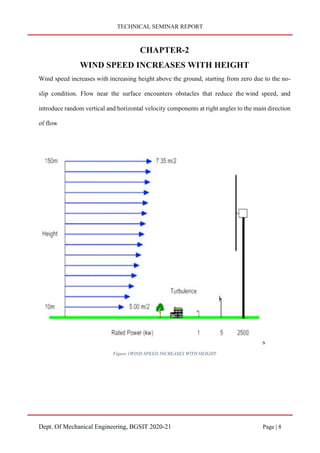
WIND SPEED INCREASES WITH HEIGHT
Wind speed increases with increasing height above the ground, starting from zero due to the no-
slip condition. Flow near the surface encounters obstacles that reduce the wind speed, and
introduce random vertical and horizontal velocity components at right angles to the main direction
of flow
s
Figure 1WIND SPEED INCREASES WITH HEIGHT
TECHNICAL SEMINAR REPORT
Dept. Of Mechanical Engineering, BGSIT 2020-21 Page | 9
CHAPTER-2.1
NEED FOR IMPROVEMENT
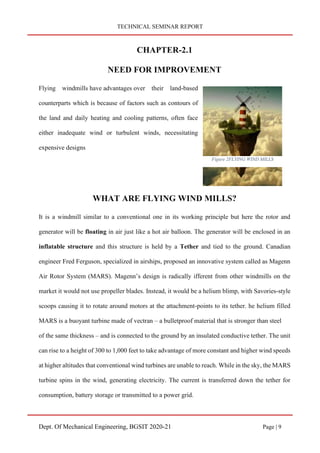
Flying windmills have advantages over their land-based
counterparts which is because of factors such as contours of
the land and daily heating and cooling patterns, often face
either inadequate wind or turbulent winds, necessitating
expensive designs
WHAT ARE FLYING WIND MILLS?
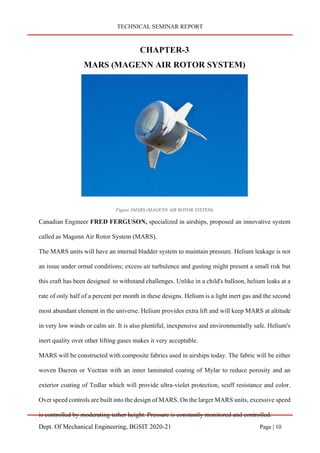
It is a windmill similar to a conventional one in its working principle but here the rotor and
generator will be floating in air just like a hot air balloon. The generator will be enclosed in an
inflatable structure and this structure is held by a Tether and tied to the ground. Canadian
engineer Fred Ferguson, specialized in airships, proposed an innovative system called as Magenn
Air Rotor System (MARS). Magenn’s design is radically ifferent from other windmills on the
market it would not use propeller blades. Instead, it would be a helium blimp, with Savories-style
scoops causing it to rotate around motors at the attachment-points to its tether. he helium filled
MARS is a buoyant turbine made of vectran – a bulletproof material that is stronger than steel
of the same thickness – and is connected to the ground by an insulated conductive tether. The unit
can rise to a height of 300 to 1,000 feet to take advantage of more constant and higher wind speeds
at higher altitudes that conventional wind turbines are unable to reach. While in the sky, the MARS
turbine spins in the wind, generating electricity. The current is transferred down the tether for
consumption, battery storage or transmitted to a power grid.
Figure 2FLYING WIND MILLS
TECHNICAL SEMINAR REPORT
Dept. Of Mechanical Engineering, BGSIT 2020-21 Page | 10
CHAPTER-3
MARS (MAGENN AIR ROTOR SYSTEM)
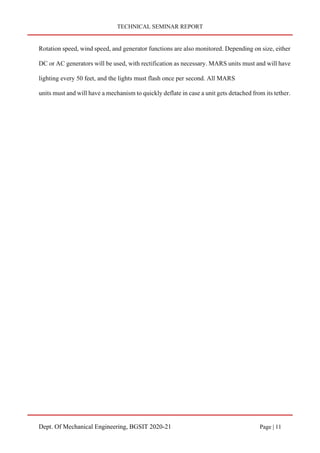
Figure 3MARS (MAGENN AIR ROTOR SYSTEM)
Canadian Engineer FRED FERGUSON, specialized in airships, proposed an innovative system
called as Magenn Air Rotor System (MARS).
The MARS units will have an internal bladder system to maintain pressure. Helium leakage is not
an issue under ormal conditions; excess air turbulence and gusting might present a small risk but
this craft has been designed to withstand challenges. Unlike in a child's balloon, helium leaks at a
rate of only half of a percent per month in these designs. Helium is a light inert gas and the second
most abundant element in the universe. Helium provides extra lift and will keep MARS at altitude
in very low winds or calm air. It is also plentiful, inexpensive and environmentally safe. Helium's
inert quality over other lifting gases makes it very acceptable.
MARS will be constructed with composite fabrics used in airships today. The fabric will be either
woven Dacron or Vectran with an inner laminated coating of Mylar to reduce porosity and an
exterior coating of Tedlar which will provide ultra-violet protection, scuff resistance and color.
Over speed controls are built into the design of MARS. On the larger MARS units, excessive speed
is controlled by moderating tether height. Pressure is constantly monitored and controlled.
TECHNICAL SEMINAR REPORT
Dept. Of Mechanical Engineering, BGSIT 2020-21 Page | 11
Rotation speed, wind speed, and generator functions are also monitored. Depending on size, either
DC or AC generators will be used, with rectification as necessary. MARS units must and will have
lighting every 50 feet, and the lights must flash once per second. All MARS
units must and will have a mechanism to quickly deflate in case a unit gets detached from its tether.
TECHNICAL SEMINAR REPORT
Dept. Of Mechanical Engineering, BGSIT 2020-21 Page | 12
CHAPTER-4
MAIN COMPONENTS OF M.A.R.S
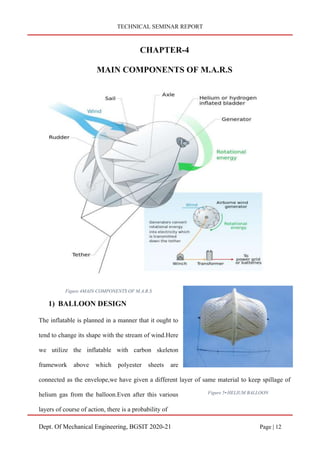
Figure 4MAIN COMPONENTS OF M.A.R.S
1) BALLOON DESIGN
The inflatable is planned in a manner that it ought to
tend to change its shape with the stream of wind.Here
we utilize the inflatable with carbon skeleton
framework above which polyester sheets are
connected as the envelope,we have given a different layer of same material to keep spillage of
helium gas from the balloon.Even after this various
layers of course of action, there is a probability of
Figure 5• HELIUM BALLOON
TECHNICAL SEMINAR REPORT
Dept. Of Mechanical Engineering, BGSIT 2020-21 Page | 13
leakage.To forestall it pressure sensor is fitted which will screen the weight Once the weight comes
to beneath the maximum furthest reaches of the lift, the helium pressurized gas container will be
encouraged with an order by the weight sensor and after that helium will be refilled in the inflatable.
For around 30 - 50 days,this whole framework will keep the inflatable noticeable all around. This inflatable
iscomposed in such way that it can be refilled and reused
• HELIUM BALLOON
A Helium balloon is a balloon that stays aloft due to being filled with a gas less dense than air or
lighter than air. Today, balloons include large blimps and small rubber party balloons. Helium
balloons work by the same law of buoyancy. As long as the helium plus the balloon is lighter than
the air it displaces, the balloon will float in the air. Helium sustains the Magenn Air Rotor System,
which ascends to an altitude as selected by the operator for the best winds
• HELIUM
Helium is the chemical element with atomic number 2 and an atomic weight of 4.002602, which
is represented by the symbol He. It is a colorless, odorless, tasteless, non-toxic, inert monatomic
gas that heads the noble gas group in the periodic table. Its boiling and melting points are the
lowest among the elements and it exists only as a gas except in extreme conditions.
2) HELIUM GAS USE
The air rotor is filled with He gas, which is inert and non-flammable. The lifting Helium gas creates
a lift force that is in excess of the total weight of the system. The He gas provides at least twice
the positive lift compared to the overall weight of the unit. The spinning of the rotor creates an
additional lift.. The aerodynamic effect that produces additional lift is the Magnus Effect.To keep
rotor at an altitude,the helium gas plays a major role. The gas is also plentiful, inexpensive and
environmentally safe.
TECHNICAL SEMINAR REPORT
Dept. Of Mechanical Engineering, BGSIT 2020-21 Page | 14
The combined lifting effect from the buoyant He lift and aerodynamic Magnus lift helps to stabilize
the air rotor against leaning in the wind. Based on the test done, an air rotor went straight up and
held a near vertical position in various wind speeds, as the Magnus effect increases as the wind
speed increases. Maximum lean is expected to be less than 45 degrees from the vertical.
The 4 kW rated power unit would requires slightly over 6,000 cubic feet of He. Helium leaks at a
rate of 0.5 percent per month or 6 percent per year, therefore the air rotor units will have to be
topped up with He every 4-6 months.
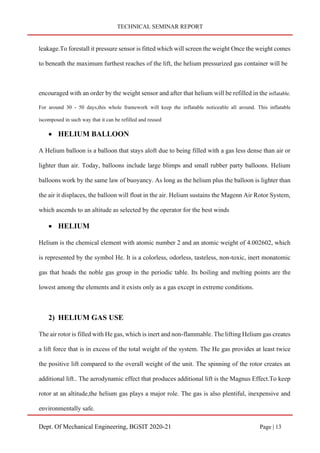
3) TETHER OR WIRES
A tether is a cord or fixture that anchors something
movable to a reference point which may be fixed or
moving. Energy generated by a high-altitude system
may be used aloft or sent to the ground surface by
conducting cables, mechanical force through a tether,
rotation of endless line loop, movement of changed
chemicals, flow of high pressure gases, flow of low-pressure gases, or laser or microwave power
beams. A tether is a long cable usually made of thin strands of high-strength fibers or conducting
wires. The tether can provide a mechanical connection between two space objects that enables the
transfer of energy and momentum from one object to the other. The electrical current that is
generated travels down the tethering lines to a transformer at the ground station, then is redirected
to the power grid.
Figure 63)TETHER OR WIRES
TECHNICAL SEMINAR REPORT
Dept. Of Mechanical Engineering, BGSIT 2020-21 Page | 15
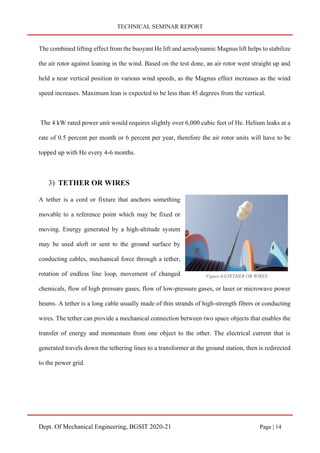
4) GENERATOR
The wind turbine generator converts mechanical energy to
electrical energy.
Wind turbine generators are a bit unusual, compared to other
generating units you ordinarily find attached to the electrical
grid. One reason isthat the generator has to work with a power
source (the wind turbine rotor) which supplies very fluctuating
mechanical power (torque). A generator situated 500-1000 feet above ground level would enjoy
much more consistent strong wind - which is why the Magenn MARS system makes so much
sense. It's a helium-filled rotating airship that spins in the wind on the end of a variable-length
tether that also acts as a power transmitter, and it's expected to operate at more like 50% of its rated
capacity.
On large wind turbines (above 100-150 kW) the voltage (tension) generated by the turbine is
usually 690 V three-phase alternating current (AC).The current is subsequently sent through a
transformer next to the wind turbine (or inside the tower) to raise the voltage to somewhere
between10,000 and 30,000 volts, depending on the standard in the local electrical grid. Large
manufacturers will supply both 50 Hz wind turbine models(for the electrical grids in most of the
world) and 60 Hz models (for the electrical grid in America).
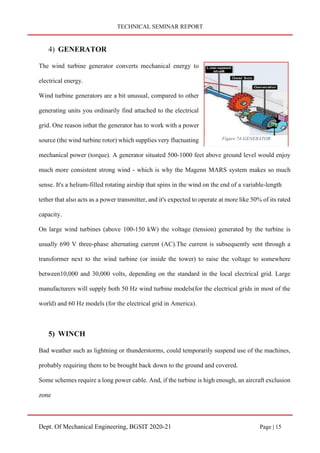
5) WINCH
Bad weather such as lightning or thunderstorms, could temporarily suspend use of the machines,
probably requiring them to be brought back down to the ground and covered.
Some schemes require a long power cable. And, if the turbine is high enough, an aircraft exclusion
zone
Figure 74-GENERATOR
TECHNICAL SEMINAR REPORT
Dept. Of Mechanical Engineering, BGSIT 2020-21 Page | 16
6) BLADE
The blades are relatively thin because this means they have a greater surface area to volume ratio
and so are affected more by the wind. For a simple demonstration, think of the difference between
fanning yourself with a flat piece of paper and a rolled up piece of paper. The flat piece causes a
far greater movement of air and the same goes in reverse. Air movement is going to affect the flat
piece much more than the roll, although the weight is the same. The blades are also curved to
increase their efficiency.
As the blades move they cause a shaft in the body of the wind turbine to start turning. This leads
into a gearbox. Gears transmit rotational energy in a similar manner to the cogs in an old fashioned
clock. The gears in the gearbox of a wind turbine end up spinning far faster than the blades were.
Wind turbine blades turn at a speed of 10-50 revolutions per minute, and are equipped with
regulators that shut the system down during hazardous weather to avoid having them spin out of
control.
Blade Specifications: Obviously, this is the one variable that engineers can control. Longer,
slimmer and lighter turbine blades can increase energy production. In his detailed May 5, 2010
article, Wind power Engineering Editor Paul Dvorak stresses the importance of turbine blades
being as light as possible, yet durable enough to withstand high winds without breaking. Current
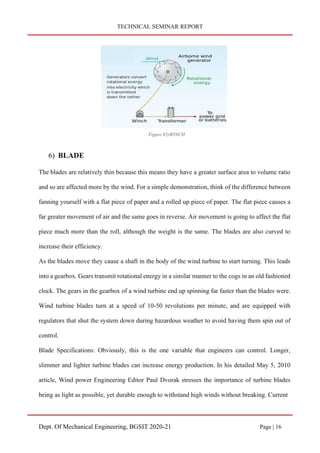
Figure 85)WINCH
TECHNICAL SEMINAR REPORT
Dept. Of Mechanical Engineering, BGSIT 2020-21 Page | 17
blades range from 130-300 feet (40-90 meters), but future prototypes may be as big as 435 feet
(145 meters).
7) TURBINE
There are two types of turbines. One is the vertical-axis type. It works like an egg beater. It works
for small power uses: pumping water andgrinding grain. This turbine cannot produce enough
energy for electrical purposes. The second turbine is a horizontal axis, which has the capabilities
of converting wind into electricity. This is the style used today on wind farms.
Turbines will generally last for around 120,000 hours, or about 20-25 years. Since they have
moving parts, they require maintenance and repair, ata cost of about 1 cent per killo watt hour
produced, or 1-2% annually of the original cost of the turbine.
The Honeywell turbine would measure 57 feet across and carry two one-megawatt turbines. In 34
MPH winds at 5,000 feet, the device would travel at 172 miles per hour and generate a megawatt
of energy. The generator sits in the back of the device to add stability. This is done by the massive
rotor blades, which form the visible part of a wind turbine.
8) COOLING SYSYTEM:
Generators need cooling while they work. On most turbines this is accomplished by encapsulating
the generator in a duct, using a large fan for aircooling, but a few manufacturers use water cooled
generators. Water cooled generators may be built more compactly, which also gives some
electrical efficiency advantages, but they require a radiator in the nacelle to get rid of the heat from
the liquid cooling system
TECHNICAL SEMINAR REPORT
Dept. Of Mechanical Engineering, BGSIT 2020-21 Page | 18
CHAPTER-5
INSIDE M.A.R.S
Magenn Power designed its turbine not only for easy deployment, but also for easy maintenance.
Obviously, a blimp like object floating at 1,000feet (305 meters) could receive quite a beating from
the elements, but the company estimates the MARS should last at least 15 years beforerequiring
maintenance. To achieve this longevity, the inflatable part of the turbine is made from an extremely
durable fabric used by most currentairships. The woven outer part is actually made from the same
material used in bulletproof vests and is lined with a coating that protects it fromUV rays and
abrasion. The inner portion is coated with Mylar (the silver part you see in helium balloons) to
prevent the helium gas from escaping.Since the MARS is located at such high altitudes, it was also
designed to be able to withstand strong winds. While conventional turbines will shutdown at wind
speeds in excess of 45 mph, the MARS can function at speeds greater than 63 mph. At the other
end of the spectrum, the MARSturbine can also convert wind energy into electricity at wind speeds
as low as 7 mph. Part of what enables the MARS to stay vertical at high wind speeds is due to
something called the Magnus effect. This refers to the lift createdwhen a curved object spins while
moving in a fluid medium like air. When the object spins, an area of high pressure forms beneath
it and causes itto rise. Golf balls, when hit a certain way, and curveball pitches in baseball, have a
back spin that causes them to lift in flight -- this is the Magnuseffect. Since the effect increases as
wind speed increases, the MARS is able to use it in combination with the lift from the helium to
maintain a nearvertical position and not lean in high winds The wide range of speeds at which it
can operate means that the MARS can deliver output much closer to its rated capacity than standard
designscan. This is because although wind energy can theoretically generate significant amounts
of electricity, most generators only produce a fraction ofthat because of inconsistent winds.
TECHNICAL SEMINAR REPORT
Dept. Of Mechanical Engineering, BGSIT 2020-21 Page | 19
CHAPTER-6
MECHANISM INVOLVED
6.1LIFTING MECHANISM
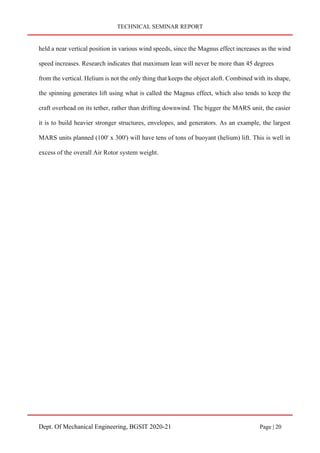
The Magenn Air Rotor System (MARS) is the
next generation of wind turbines with cost and
performance advantages over existing systems.
MARS is a lighter-than-air tethered wind turbine
that rotates about a horizontal axis in response to
wind, generating electrical energy. Helium sustains
the Magenn Air Rotor System, which ascends to an
altitude as selected by the operator for the best
winds. Its rotation also generates the “Magnus”
effect. This aerodynamic phenomenon provides
additional lift, keeps the MARS device stabilized,
positions MARS within a very controlled and
restricted location, and finally, causes MARS to pull up overhead
to maximize altitude rather than drift downwind on its tether. MARS is filled with helium gas,
which is inert and non-flammable. The lifting gas creates a lift force that is in excess of the total
weight of the system. The helium provides at least twice the positive lift versus the overall
weight of the MARS unit. Additional lift is also created when the rotor is spinning in a wind. The
aerodynamic effect that produces additional lift is called the Magnus Effect
The combined lifting effect from buoyant (helium) lift and aerodynamic (Magnus) lift help
stabilize the Air Rotor against "leaning" in the wind. In tests, an Air Rotor went straight up and
Figure 9LIFTING MECHANISM
TECHNICAL SEMINAR REPORT
Dept. Of Mechanical Engineering, BGSIT 2020-21 Page | 20
held a near vertical position in various wind speeds, since the Magnus effect increases as the wind
speed increases. Research indicates that maximum lean will never be more than 45 degrees
from the vertical. Helium is not the only thing that keeps the object aloft. Combined with its shape,
the spinning generates lift using what is called the Magnus effect, which also tends to keep the
craft overhead on its tether, rather than drifting downwind. The bigger the MARS unit, the easier
it is to build heavier stronger structures, envelopes, and generators. As an example, the largest
MARS units planned (100' x 300') will have tens of tons of buoyant (helium) lift. This is well in
excess of the overall Air Rotor system weight.
TECHNICAL SEMINAR REPORT
Dept. Of Mechanical Engineering, BGSIT 2020-21 Page | 21
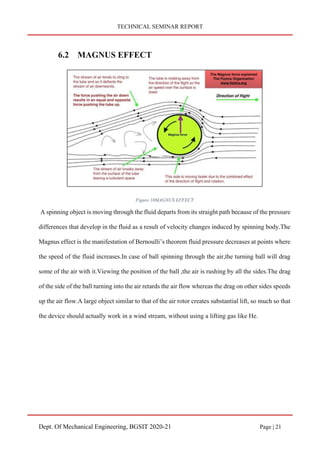
6.2 MAGNUS EFFECT
Figure 10MAGNUS EFFECT
A spinning object is moving through the fluid departs from its straight path because of the pressure
differences that develop in the fluid as a result of velocity changes induced by spinning body.The
Magnus effect is the manifestation of Bernoulli’s theorem fluid pressure decreases at points where
the speed of the fluid increases.In case of ball spinning through the air,the turning ball will drag
some of the air with it.Viewing the position of the ball ,the air is rushing by all the sides.The drag
of the side of the ball turning into the air retards the air flow whereas the drag on other sides speeds
up the air flow.A large object similar to that of the air rotor creates substantial lift, so much so that
the device should actually work in a wind stream, without using a lifting gas like He.
TECHNICAL SEMINAR REPORT
Dept. Of Mechanical Engineering, BGSIT 2020-21 Page | 22
CHAPTER-7
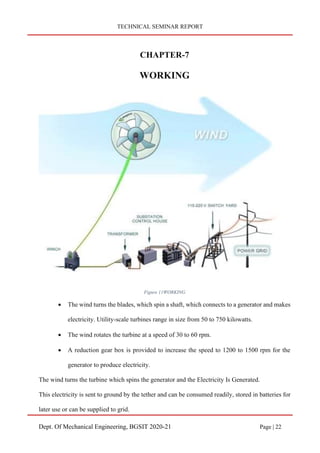
WORKING
Figure 11WORKING
• The wind turns the blades, which spin a shaft, which connects to a generator and makes
electricity. Utility-scale turbines range in size from 50 to 750 kilowatts.
• The wind rotates the turbine at a speed of 30 to 60 rpm.
• A reduction gear box is provided to increase the speed to 1200 to 1500 rpm for the
generator to produce electricity.
The wind turns the turbine which spins the generator and the Electricity Is Generated.
This electricity is sent to ground by the tether and can be consumed readily, stored in batteries for
later use or can be supplied to grid.
TECHNICAL SEMINAR REPORT
Dept. Of Mechanical Engineering, BGSIT 2020-21 Page | 23
Wind spins a turbine's blades, which, in turn, cause an attached generator to also spin. The wind
blows through blades (made of fiberglass-reinforced polyester – this makes the blades lightweight
and yet strong enough to withstand the force of the wind).The blades change the wind'senergy into
a rotational shaft energy (think of a standard fan).The shaft connects to a drive train with a gear
box that uses the rotation of the bladesto Spin the magnets in the generator to produce mechanical
energy This mechanical energy is imparted to the shaft in the hub of the turbine andcauses a great
amount of torque to develop on the shaft. At the other end of the shaft, a gearbox transfers the
energy to a secondary shaft. The stepup gearing causes higher revolutions per minute (rpm) in the
secondary shaft and consequently lower torque. A generator or alternator is mountedon the
secondary shaft, and converts the mechanical energy originally imparted by the wind to the turbine.
A protective cover, “nacelle”, housesthe shaft, drive train and generator.
The generator then converts that moving energy of the wind into electricity using electromagnetic
induction, which involves using the oppositecharges of a magnet to create an electric current. The
generators are at each end of the rotor with a direct output power connection to the twincables.
Outboard of the generators at each end of the rotor are wind vane stabilizers in the form of conical
wheels. The deviation in the trajectoryof a spinning projectile caused by the Magnus force. The
deviation is toward the direction of the spin and results from pressure differentials in thespinning
projectile. The Magnus effect is greatest when the axis of spin is perpendicular to the direction of
relative fluid velocity The Magnuseffect, associated with the rotor rotation, also provides
additional lift, which stabilises the rotor position causing it to pull up overhead, rather thandrift
downwind on its tether. In causes the blimp to rotate: That movement gets converted into
electrical energy and is then transferred down the tether. Instead of the large pinwheel blades that
are typical of wind turbines though, the blades of the M.A.R.S turbine are actually part of the three-
TECHNICAL SEMINAR REPORT
Dept. Of Mechanical Engineering, BGSIT 2020-21 Page | 24
dimensional blimp itself. The blades catch the wind, causing the entire blimp to spin around. After
the generator converts that movement into electricity, it's transferred down the turbine's long tether.
Whereas most regular turbines capture winds at altitudes of 200 to 300 feet (61 to 91meters), the
MARS turbine can reach winds from 600 to 1,000 feet (183 to 305 meters) above ground level.
Winds at these higher levels are significantly faster than low-level winds because they don't
encounter as much resistance from objects on the ground like trees and buildings. Research shows
that with each doubling of elevation, there is a 12 percent increase in wind speed with each
doubling of wind speed there is an eightfold increase in wind power.
TECHNICAL SEMINAR REPORT
Dept. Of Mechanical Engineering, BGSIT 2020-21 Page | 25
CHAPTER-8
POWER GENERATION
The wind pushes the rotor blades, converting kinetic energy to rotary motion. This spins a low-
speed shaft, which turns a gear at the lower end. The gear in turn drives a smaller gear on a high-
speed shaft that runs through generator housing.
A magnetic rotor on the high-speed shaft spins inside loops of copper wire that are wound around
an iron core. This creates "electromagnetic induction" through the coils and generates an electric
current. The current must be regulated for the strength of current desired (110 w in the US for
household AC current). It is then fed into a grid or routed into a battery bank for later use.
In the presence of high winds, floating rotor is capable of exerting a traction force equivalent to
several hundred kilo Newtons, moving at speeds that can exceed 80 m/s. The product of the force
multiplied by the speed provides to the order of magnitude of the potential power generated by the
kite:
P = F. V
A single balloon has the theoretical potential at a speed of 80 m/s and a force of 100,000 Newtons
of generating a power of:
P ≈ 100x103.80
≈ 8x10⁶[Watt]
= 8[MW]
which exceeds the rated power of existing horizontal axis wind turbines at 7 MW.
The floating wind generator can be envisioned as a giant carousel, solidly anchored to the ground.
Its nucleus consists of a central structure, tall enough to support the arms by means of a tenso
structure. This carousel is put into motion by the wind itself that drag the wind rotor out from their
TECHNICAL SEMINAR REPORT
Dept. Of Mechanical Engineering, BGSIT 2020-21 Page | 26
funnels within the arms, and into the sky. The rotating central structure contains the automatic
winches that control the pairs of cables of thousands of meters in length.Cables made of high
strength materials such as Dyneema have a tensile strength that is capable of holding 30 tons/cm2,
and these cables weigh just 100 kg/km.The applications of the air floating rotor are stated,Off grid
for cottages andremote uses such as cell towers and exploration equipment); Developing nations
where infrastructure is limited or nonexistent;Rapid deployment (to include airdrop) to disastrous
areas for power to emergency and medical equipment, and relief efforts (ex. Katrina, Tsunami)
and military applications.
TECHNICAL SEMINAR REPORT
Dept. Of Mechanical Engineering, BGSIT 2020-21 Page | 27
CHAPTER-8.1
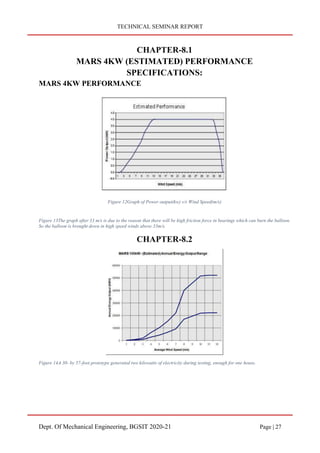
MARS 4KW (ESTIMATED) PERFORMANCE
SPECIFICATIONS:
MARS 4KW PERFORMANCE
Figure 13The graph after 33 m/s is due to the reason that there will be high friction force in bearings which can burn the balloon.
So the balloon is brought down in high speed winds above 33m/s.
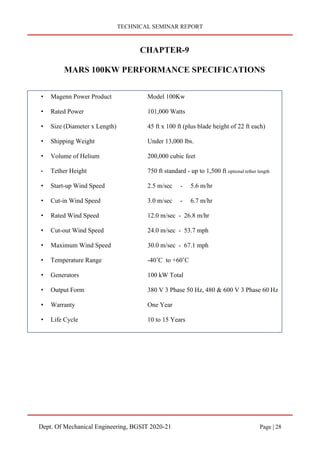
CHAPTER-8.2
Figure 14A 30- by 57-foot prototype generated two kilowatts of electricity during testing, enough for one house.
Figure 12Graph of Power output(kw) v/s Wind Speed(m/s)
TECHNICAL SEMINAR REPORT
Dept. Of Mechanical Engineering, BGSIT 2020-21 Page | 28
CHAPTER-9
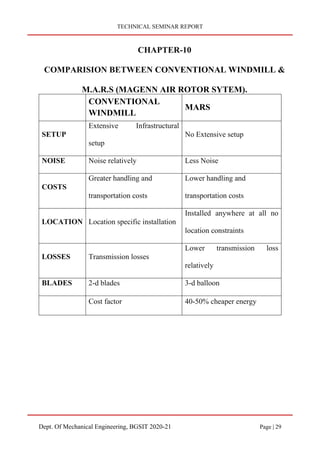
MARS 100KW PERFORMANCE SPECIFICATIONS
• Magenn Power Product Model 100Kw
• Rated Power 101,000 Watts
• Size (Diameter x Length) 45 ft x 100 ft (plus blade height of 22 ft each)
• Shipping Weight Under 13,000 lbs.
• Volume of Helium 200,000 cubic feet
• Tether Height 750 ft standard - up to 1,500 ft optional tether length
• Start-up Wind Speed 2.5 m/sec - 5.6 m/hr
• Cut-in Wind Speed 3.0 m/sec - 6.7 m/hr
• Rated Wind Speed 12.0 m/sec - 26.8 m/hr
• Cut-out Wind Speed 24.0 m/sec - 53.7 mph
• Maximum Wind Speed 30.0 m/sec - 67.1 mph
• Temperature Range -40’C to +60’C
• Generators 100 kW Total
• Output Form 380 V 3 Phase 50 Hz, 480 & 600 V 3 Phase 60 Hz
• Warranty One Year
• Life Cycle 10 to 15 Years
TECHNICAL SEMINAR REPORT
Dept. Of Mechanical Engineering, BGSIT 2020-21 Page | 29
CHAPTER-10
COMPARISION BETWEEN CONVENTIONAL WINDMILL &
M.A.R.S (MAGENN AIR ROTOR SYTEM).
CONVENTIONAL
WINDMILL
MARS
SETUP
Extensive Infrastructural
setup
No Extensive setup
NOISE Noise relatively Less Noise
COSTS
Greater handling and
transportation costs
Lower handling and
transportation costs
LOCATION Location specific installation
Installed anywhere at all no
location constraints
LOSSES Transmission losses
Lower transmission loss
relatively
BLADES 2-d blades 3-d balloon
Cost factor 40-50% cheaper energy
TECHNICAL SEMINAR REPORT
Dept. Of Mechanical Engineering, BGSIT 2020-21 Page | 30
CHAPTER-11
ADVANTAGES
1) The Advantages of MARS over Conventional Wind Turbines are:
2) Low-cost electricity - under 20 cents per kWh versus 50 cents to 99 cents per kWh for
diesel
3) Environmentally friendly
4) Wide range of wind speeds - 3 meters/second to more than 28 meters/second Higher
operating altitudes - from 500 feet to 1,000 feet aboveground level are possible without
expensive towers or cranes Fewer limits on placement location - coast line placement is
not necessary. Ability to install closer to the power grid Mobile Ideal for off grid
applications or where power is not reliable.
LIMITAIONS
1) MARS units cannot be installed within five miles of the boundary of any airport.
2) Initial cost is high.
3) Another disadvantage of floating windmills is that they have to be taken down in extremely
powerful winds,
whereas common wind turbines are simply shut down.
CHAPTER-12 APPLICATIONS
1) Off grid for cottages and remote uses such as cell towers and exploration equipment.
2) Developing nations where infrastructure is limited or non-existent.
3) Rapid deployment (to include airdrop) to disaster areas for power to emergency and
medical equipment, water pumps, and relief efforts (ex. Katrina, Tsunami).
4) And military applications.
TECHNICAL SEMINAR REPORT
Dept. Of Mechanical Engineering, BGSIT 2020-21 Page | 31
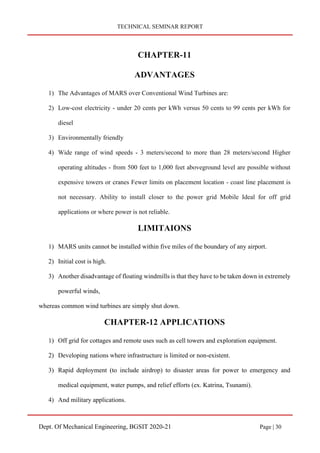
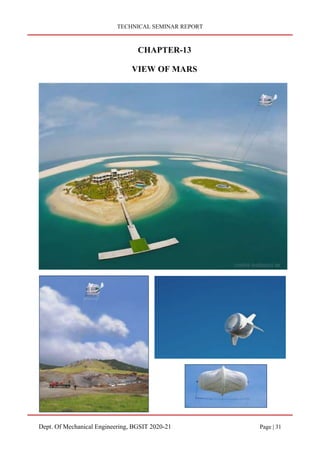
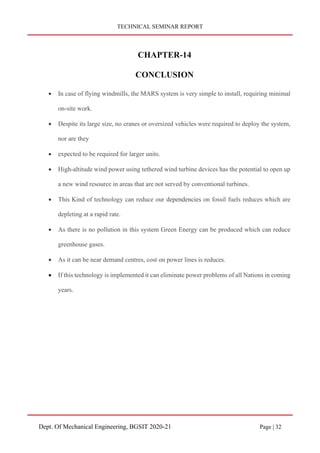
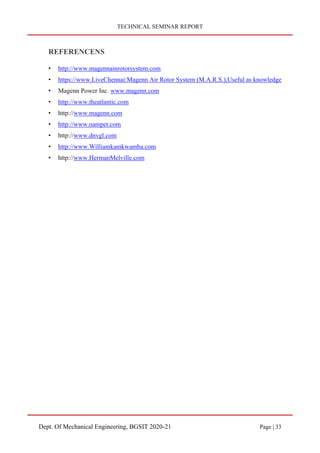
CHAPTER-13
VIEW OF MARS
TECHNICAL SEMINAR REPORT
Dept. Of Mechanical Engineering, BGSIT 2020-21 Page | 32
CHAPTER-14
CONCLUSION
• In case of flying windmills, the MARS system is very simple to install, requiring minimal
on‐site work.
• Despite its large size, no cranes or oversized vehicles were required to deploy the system,
nor are they
• expected to be required for larger units.
• High‐altitude wind power using tethered wind turbine devices has the potential to open up
a new wind resource in areas that are not served by conventional turbines.
• This Kind of technology can reduce our dependencies on fossil fuels reduces which are
depleting at a rapid rate.
• As there is no pollution in this system Green Energy can be produced which can reduce
greenhouse gases.
• As it can be near demand centres, cost on power lines is reduces.
• If this technology is implemented it can eliminate power problems of all Nations in coming
years.
TECHNICAL SEMINAR REPORT
Dept. Of Mechanical Engineering, BGSIT 2020-21 Page | 33
REFERENCENS
• http://www.magennainrotorsystem.com
• https://www.LiveChennai:Magenn Air Rotor System (M.A.R.S.),Useful as knowledge
• Magenn Power Inc. www.magenn.com
• http://www.theatlantic.com
• http://www.magenn.com
• http://www.nampet.com
• http://www.dnvgl.com
• http://www.Williamkamkwamba.com
• http://www.HermanMelville.com

MAGENN AIR ROTOR SYSTEM (M.A.R.S) Report

  • 1.
    VISVESVARAYA TECHNOLOGICAL UNIVERSITY “Jnana-Sangama”,Belgaum 590014, Karnataka, India A PROJECT REPORT ON “MAGENN AIR ROTOR SYSTEM (M.A.R.S)” FLOATING ELECTRIC GENERATORS Submitted in partial fulfilment of the requirements for the award of the degree of BACHELOR OF ENGINEERING IN MECHANICAL ENGINEERING For the Academic Year 2020-2021 Submitted By KIRAN PRASAD.P (4BW16ME019) Under the Guidance of Mr. HEMANTHA.C M.Tech Assistant Professor, Dept. Of Mech, BGSIT DEPARTMENT OF MECHANICAL ENGINEERING B.G.S INSITUTE OF TECHNOLOGY BG Nagar, Nagamangala Taluk, Mandya District– 571448 2020–2021
  • 2.
    B.G.S INSTITUTE OFTECHNOLOGY BG Nagar, Nagamangala Taluk, Mandya District– 571448 Affiliated to Visvesvaraya Technological University, Belgaum. DEPARTMENT OF MECHANICAL ENGINEERING CERTIFICATE This is to certify that the Technical Seminar Report entitled “MAGENN AIR ROTOR SYSTEM (MARS)” FLOATING ELECTRIC GENERATORS is carried out by Mr. KIRAN PRASAD P (4BW16ME019) in partial fulfilment for the award of Bachelor of Engineering in Mechanical Engineering of the Visvesvaraya Technological University, Belgaum during the year 2020-2021.It is certified that all correction/suggestions indicated for internal assessment have been incorporated in the report deposited in the department library. The Technical Seminar report has been approved as it satisfies the academic requirements in respect of Technical Seminar work prescribed for the said degree. ___________________ ___________________ ___________________ Signature of the Guide Signature of HOD Signature of Principal Prof. Hemantha C Dr. Manjunath H S Dr. B K Narendra External Viva Name of the examiners Signature 1.____________________ ____________________ 2. ____________________ ____________________
  • 3.
    TECHNICAL SEMINAR REPORT Dept.Of Mechanical Engineering, BGSIT 2020-21 Page | 3 ACKNOWLEDGEMENT The completion of any project involves the efforts of many people. We have been lucky to receive a lot of help and support from all persons during the making of this project, so with gratitude we take this opportunity to acknowledge all those who guided and encouraged me to emerge successful. It gives us immense pleasure in expressing our deepest sincere thoughts of gratitude to our college president Jagadguru Sri Sri Sri Dr|| Nirmalanandanatha Mahaswamiji, Sri Adichunchanagiri Shihkshana Trust (R.) I would like to convey my heartful thanks to our beloved Principal Dr|| BK Narendra, BGSIT, B.G Nagar for having supported me in my academic’s endeavors. I am greatly indebted to Dr|| Manjunath S H, HOD, Dept. of Mechanical Engineering for giving the opportunity to embark upon this topic. We would like to sincerely thank our project co-ordinator Dr|| Girish K B professor, Dept. of Mechanical Engineering, BGSIT, B G Nagar, Mandya for his valuable guidance. We would like to sincerely thank our project guide. Hemantha C, Associate professor, Dept. of Mechanical Engineering, BGSIT, B G Nagar, Mandya for his valuable guidance, support and constructive suggestions for betterment of this project work. Once again,I take this opportunity to extend my earnest gratitude and respect to all the Teaching & Non-teaching staff of the department. Regards, KIRAN PRASAD.P (4BW16ME019)
  • 4.
    TECHNICAL SEMINAR REPORT Dept.Of Mechanical Engineering, BGSIT 2020-21 Page | 4 ABSTACT Magenn Power Air Rotor System (M.A.R.S.), helium filled wind generator that rotates around a horizontal axis and sends electricity down a tether that can be used immediately, stored in a battery or routed to the power grid. The Magenn Power Air Rotor System (MARS) is a patented high altitude lighter-than-air tethered device that rotates about a horizontal axis in response to wind, efficiently generating clean renewable electrical energy at a lower cost than all competing systems. Airborne wind - turbines that fly in the sky and harvest energy from atmospheric wind has the potential, say proponents, of reducing the cost of wind power. In April of 2008, Magenn Power made history by having the world's first rotating airship. This paper presents an analysis of M.A.R.S and its developments. The physical behaviour of machine is presented through its components. According to Sky Wind Power; the overuse of fossil fuels and the overabundance of radioactive waste from nuclear energy plants are taking our planet once again down a path of destruction, for something that is more expensive and far more dangerous in the long run. (Floating Electric Generator) FEG technology is just cheaper, cleaner and can provide more energy than those environmentally unhealthy methods of the past, making it a desirable substitute/alternative. The secret to functioning High Altitude Wind Power is efficient tether technology that reaches 15,000 feet in the air, far higher than birds will fly, but creating restricted airspace for planes and other aircraft. This system is a highly advanced one that is been not yet implemented till 2010.Now Canadian company is taking orders to distribute in 2011 in all the leading markets. This paper also presents a detail view of working and advantages.
  • 5.
    TECHNICAL SEMINAR REPORT Dept.Of Mechanical Engineering, BGSIT 2020-21 Page | 5 TABLE OF CONTENTS Chapters Page no 1.0 Introduction 7 2.0 Wind speed increases with Height 8 2.1Need for an Improvement 9 3.0M.A.R.S 10 4.0Components of MARS 12 4.1Helium balloon 12 4.2Helium gas 13 4.3Tethers & Wires 14 4.4Generator 15 4.5Winch 15 4.6Blade 16 4.7Turbine 17 4.8Cooling System 17 5.0Inside MARS 18 6.0Mechanism Involved 19 6.1 Lifting Mechanism 19 6.2MAGNUS Effect 21 7.0 Working of MARS 22 8.0Power Generation 25 8.1Performance of 4KW MARS 27 8.2Performance of 10KW MARS 27 9.0MARS Specifications 28 10.0 Comparisons 29 11.0Advantages & Limitations 30 12.0Applications 30
  • 6.
    TECHNICAL SEMINAR REPORT Dept.Of Mechanical Engineering, BGSIT 2020-21 Page | 6 13.0 Views of MARS 31 14.0 Conclusion 32 15.0References 33
  • 7.
    TECHNICAL SEMINAR REPORT Dept.Of Mechanical Engineering, BGSIT 2020-21 Page | 7 CHAPTER-1 INRODUCTION Wind is the fastest growing energy source in the world and one of the lowest priced renewable energy technologies today, at a cost of 4-6cents per kilo-watt hour." There is enough energy in high altitude winds to power civilization 100 times over; and sooner or later we're going to learn to tap into the power of winds and use it to run civilization." Magenn Power's high-altitude wind turbine called MARS, is a Wind Power solution with distinct advantages over existing Conventional Wind Turbines and Diesel Generating Systems including: global deployment, lower costs, better performance and environmental advantages operational The wind is a completely renewable source that will last forever. The life cycle for the energy gained from wind turbines is simply as long as the physical parts last. The generation of electricity from wind power takes place in several steps. It requires a rotor, usually consisting of 2-3 blades, mounted atop a tower; wiring; and "balance of power" components such as converters, inverters and batteries Wind turbines at ground level. produce at a rate of 20-25%, but when placed at altitudes from 600-1000 feet, energy output can double. The Magenn Air Rotor System or MARS is a stationary blimp kept afloat with helium and tethered into place on an electrical grid. Centrifugal blades on the MARS can generate up to several megawatts of clean, renewable energy at a price well below our current grounded wind turbines. An airborne wind turbine is a design concept for a wind turbine that is supported in the air without a tower Airborne turbine system would have the advantage of tapping an almost constant wind, without requirements for slip rings or yaw mechanism, and without the expense of tower construction. As of 2010, no commercial airborne wind turbines are in regular operation. Airborne turbine systems would have the advantage of tapping an almost constant wind, without requirements for slip rings or yaw mechanism, and without the expense of tower construction. As of 2010, no commercial airborne wind turbines are in regular operation.
  • 8.
    TECHNICAL SEMINAR REPORT Dept.Of Mechanical Engineering, BGSIT 2020-21 Page | 8 CHAPTER-2 WIND SPEED INCREASES WITH HEIGHT Wind speed increases with increasing height above the ground, starting from zero due to the no- slip condition. Flow near the surface encounters obstacles that reduce the wind speed, and introduce random vertical and horizontal velocity components at right angles to the main direction of flow s Figure 1WIND SPEED INCREASES WITH HEIGHT
  • 9.
    TECHNICAL SEMINAR REPORT Dept.Of Mechanical Engineering, BGSIT 2020-21 Page | 9 CHAPTER-2.1 NEED FOR IMPROVEMENT Flying windmills have advantages over their land-based counterparts which is because of factors such as contours of the land and daily heating and cooling patterns, often face either inadequate wind or turbulent winds, necessitating expensive designs WHAT ARE FLYING WIND MILLS? It is a windmill similar to a conventional one in its working principle but here the rotor and generator will be floating in air just like a hot air balloon. The generator will be enclosed in an inflatable structure and this structure is held by a Tether and tied to the ground. Canadian engineer Fred Ferguson, specialized in airships, proposed an innovative system called as Magenn Air Rotor System (MARS). Magenn’s design is radically ifferent from other windmills on the market it would not use propeller blades. Instead, it would be a helium blimp, with Savories-style scoops causing it to rotate around motors at the attachment-points to its tether. he helium filled MARS is a buoyant turbine made of vectran – a bulletproof material that is stronger than steel of the same thickness – and is connected to the ground by an insulated conductive tether. The unit can rise to a height of 300 to 1,000 feet to take advantage of more constant and higher wind speeds at higher altitudes that conventional wind turbines are unable to reach. While in the sky, the MARS turbine spins in the wind, generating electricity. The current is transferred down the tether for consumption, battery storage or transmitted to a power grid. Figure 2FLYING WIND MILLS
  • 10.
    TECHNICAL SEMINAR REPORT Dept.Of Mechanical Engineering, BGSIT 2020-21 Page | 10 CHAPTER-3 MARS (MAGENN AIR ROTOR SYSTEM) Figure 3MARS (MAGENN AIR ROTOR SYSTEM) Canadian Engineer FRED FERGUSON, specialized in airships, proposed an innovative system called as Magenn Air Rotor System (MARS). The MARS units will have an internal bladder system to maintain pressure. Helium leakage is not an issue under ormal conditions; excess air turbulence and gusting might present a small risk but this craft has been designed to withstand challenges. Unlike in a child's balloon, helium leaks at a rate of only half of a percent per month in these designs. Helium is a light inert gas and the second most abundant element in the universe. Helium provides extra lift and will keep MARS at altitude in very low winds or calm air. It is also plentiful, inexpensive and environmentally safe. Helium's inert quality over other lifting gases makes it very acceptable. MARS will be constructed with composite fabrics used in airships today. The fabric will be either woven Dacron or Vectran with an inner laminated coating of Mylar to reduce porosity and an exterior coating of Tedlar which will provide ultra-violet protection, scuff resistance and color. Over speed controls are built into the design of MARS. On the larger MARS units, excessive speed is controlled by moderating tether height. Pressure is constantly monitored and controlled.
  • 11.
    TECHNICAL SEMINAR REPORT Dept.Of Mechanical Engineering, BGSIT 2020-21 Page | 11 Rotation speed, wind speed, and generator functions are also monitored. Depending on size, either DC or AC generators will be used, with rectification as necessary. MARS units must and will have lighting every 50 feet, and the lights must flash once per second. All MARS units must and will have a mechanism to quickly deflate in case a unit gets detached from its tether.
  • 12.
    TECHNICAL SEMINAR REPORT Dept.Of Mechanical Engineering, BGSIT 2020-21 Page | 12 CHAPTER-4 MAIN COMPONENTS OF M.A.R.S Figure 4MAIN COMPONENTS OF M.A.R.S 1) BALLOON DESIGN The inflatable is planned in a manner that it ought to tend to change its shape with the stream of wind.Here we utilize the inflatable with carbon skeleton framework above which polyester sheets are connected as the envelope,we have given a different layer of same material to keep spillage of helium gas from the balloon.Even after this various layers of course of action, there is a probability of Figure 5• HELIUM BALLOON
  • 13.
    TECHNICAL SEMINAR REPORT Dept.Of Mechanical Engineering, BGSIT 2020-21 Page | 13 leakage.To forestall it pressure sensor is fitted which will screen the weight Once the weight comes to beneath the maximum furthest reaches of the lift, the helium pressurized gas container will be encouraged with an order by the weight sensor and after that helium will be refilled in the inflatable. For around 30 - 50 days,this whole framework will keep the inflatable noticeable all around. This inflatable iscomposed in such way that it can be refilled and reused • HELIUM BALLOON A Helium balloon is a balloon that stays aloft due to being filled with a gas less dense than air or lighter than air. Today, balloons include large blimps and small rubber party balloons. Helium balloons work by the same law of buoyancy. As long as the helium plus the balloon is lighter than the air it displaces, the balloon will float in the air. Helium sustains the Magenn Air Rotor System, which ascends to an altitude as selected by the operator for the best winds • HELIUM Helium is the chemical element with atomic number 2 and an atomic weight of 4.002602, which is represented by the symbol He. It is a colorless, odorless, tasteless, non-toxic, inert monatomic gas that heads the noble gas group in the periodic table. Its boiling and melting points are the lowest among the elements and it exists only as a gas except in extreme conditions. 2) HELIUM GAS USE The air rotor is filled with He gas, which is inert and non-flammable. The lifting Helium gas creates a lift force that is in excess of the total weight of the system. The He gas provides at least twice the positive lift compared to the overall weight of the unit. The spinning of the rotor creates an additional lift.. The aerodynamic effect that produces additional lift is the Magnus Effect.To keep rotor at an altitude,the helium gas plays a major role. The gas is also plentiful, inexpensive and environmentally safe.
  • 14.
    TECHNICAL SEMINAR REPORT Dept.Of Mechanical Engineering, BGSIT 2020-21 Page | 14 The combined lifting effect from the buoyant He lift and aerodynamic Magnus lift helps to stabilize the air rotor against leaning in the wind. Based on the test done, an air rotor went straight up and held a near vertical position in various wind speeds, as the Magnus effect increases as the wind speed increases. Maximum lean is expected to be less than 45 degrees from the vertical. The 4 kW rated power unit would requires slightly over 6,000 cubic feet of He. Helium leaks at a rate of 0.5 percent per month or 6 percent per year, therefore the air rotor units will have to be topped up with He every 4-6 months. 3) TETHER OR WIRES A tether is a cord or fixture that anchors something movable to a reference point which may be fixed or moving. Energy generated by a high-altitude system may be used aloft or sent to the ground surface by conducting cables, mechanical force through a tether, rotation of endless line loop, movement of changed chemicals, flow of high pressure gases, flow of low-pressure gases, or laser or microwave power beams. A tether is a long cable usually made of thin strands of high-strength fibers or conducting wires. The tether can provide a mechanical connection between two space objects that enables the transfer of energy and momentum from one object to the other. The electrical current that is generated travels down the tethering lines to a transformer at the ground station, then is redirected to the power grid. Figure 63)TETHER OR WIRES
  • 15.
    TECHNICAL SEMINAR REPORT Dept.Of Mechanical Engineering, BGSIT 2020-21 Page | 15 4) GENERATOR The wind turbine generator converts mechanical energy to electrical energy. Wind turbine generators are a bit unusual, compared to other generating units you ordinarily find attached to the electrical grid. One reason isthat the generator has to work with a power source (the wind turbine rotor) which supplies very fluctuating mechanical power (torque). A generator situated 500-1000 feet above ground level would enjoy much more consistent strong wind - which is why the Magenn MARS system makes so much sense. It's a helium-filled rotating airship that spins in the wind on the end of a variable-length tether that also acts as a power transmitter, and it's expected to operate at more like 50% of its rated capacity. On large wind turbines (above 100-150 kW) the voltage (tension) generated by the turbine is usually 690 V three-phase alternating current (AC).The current is subsequently sent through a transformer next to the wind turbine (or inside the tower) to raise the voltage to somewhere between10,000 and 30,000 volts, depending on the standard in the local electrical grid. Large manufacturers will supply both 50 Hz wind turbine models(for the electrical grids in most of the world) and 60 Hz models (for the electrical grid in America). 5) WINCH Bad weather such as lightning or thunderstorms, could temporarily suspend use of the machines, probably requiring them to be brought back down to the ground and covered. Some schemes require a long power cable. And, if the turbine is high enough, an aircraft exclusion zone Figure 74-GENERATOR
  • 16.
    TECHNICAL SEMINAR REPORT Dept.Of Mechanical Engineering, BGSIT 2020-21 Page | 16 6) BLADE The blades are relatively thin because this means they have a greater surface area to volume ratio and so are affected more by the wind. For a simple demonstration, think of the difference between fanning yourself with a flat piece of paper and a rolled up piece of paper. The flat piece causes a far greater movement of air and the same goes in reverse. Air movement is going to affect the flat piece much more than the roll, although the weight is the same. The blades are also curved to increase their efficiency. As the blades move they cause a shaft in the body of the wind turbine to start turning. This leads into a gearbox. Gears transmit rotational energy in a similar manner to the cogs in an old fashioned clock. The gears in the gearbox of a wind turbine end up spinning far faster than the blades were. Wind turbine blades turn at a speed of 10-50 revolutions per minute, and are equipped with regulators that shut the system down during hazardous weather to avoid having them spin out of control. Blade Specifications: Obviously, this is the one variable that engineers can control. Longer, slimmer and lighter turbine blades can increase energy production. In his detailed May 5, 2010 article, Wind power Engineering Editor Paul Dvorak stresses the importance of turbine blades being as light as possible, yet durable enough to withstand high winds without breaking. Current Figure 85)WINCH
  • 17.
    TECHNICAL SEMINAR REPORT Dept.Of Mechanical Engineering, BGSIT 2020-21 Page | 17 blades range from 130-300 feet (40-90 meters), but future prototypes may be as big as 435 feet (145 meters). 7) TURBINE There are two types of turbines. One is the vertical-axis type. It works like an egg beater. It works for small power uses: pumping water andgrinding grain. This turbine cannot produce enough energy for electrical purposes. The second turbine is a horizontal axis, which has the capabilities of converting wind into electricity. This is the style used today on wind farms. Turbines will generally last for around 120,000 hours, or about 20-25 years. Since they have moving parts, they require maintenance and repair, ata cost of about 1 cent per killo watt hour produced, or 1-2% annually of the original cost of the turbine. The Honeywell turbine would measure 57 feet across and carry two one-megawatt turbines. In 34 MPH winds at 5,000 feet, the device would travel at 172 miles per hour and generate a megawatt of energy. The generator sits in the back of the device to add stability. This is done by the massive rotor blades, which form the visible part of a wind turbine. 8) COOLING SYSYTEM: Generators need cooling while they work. On most turbines this is accomplished by encapsulating the generator in a duct, using a large fan for aircooling, but a few manufacturers use water cooled generators. Water cooled generators may be built more compactly, which also gives some electrical efficiency advantages, but they require a radiator in the nacelle to get rid of the heat from the liquid cooling system
  • 18.
    TECHNICAL SEMINAR REPORT Dept.Of Mechanical Engineering, BGSIT 2020-21 Page | 18 CHAPTER-5 INSIDE M.A.R.S Magenn Power designed its turbine not only for easy deployment, but also for easy maintenance. Obviously, a blimp like object floating at 1,000feet (305 meters) could receive quite a beating from the elements, but the company estimates the MARS should last at least 15 years beforerequiring maintenance. To achieve this longevity, the inflatable part of the turbine is made from an extremely durable fabric used by most currentairships. The woven outer part is actually made from the same material used in bulletproof vests and is lined with a coating that protects it fromUV rays and abrasion. The inner portion is coated with Mylar (the silver part you see in helium balloons) to prevent the helium gas from escaping.Since the MARS is located at such high altitudes, it was also designed to be able to withstand strong winds. While conventional turbines will shutdown at wind speeds in excess of 45 mph, the MARS can function at speeds greater than 63 mph. At the other end of the spectrum, the MARSturbine can also convert wind energy into electricity at wind speeds as low as 7 mph. Part of what enables the MARS to stay vertical at high wind speeds is due to something called the Magnus effect. This refers to the lift createdwhen a curved object spins while moving in a fluid medium like air. When the object spins, an area of high pressure forms beneath it and causes itto rise. Golf balls, when hit a certain way, and curveball pitches in baseball, have a back spin that causes them to lift in flight -- this is the Magnuseffect. Since the effect increases as wind speed increases, the MARS is able to use it in combination with the lift from the helium to maintain a nearvertical position and not lean in high winds The wide range of speeds at which it can operate means that the MARS can deliver output much closer to its rated capacity than standard designscan. This is because although wind energy can theoretically generate significant amounts of electricity, most generators only produce a fraction ofthat because of inconsistent winds.
  • 19.
    TECHNICAL SEMINAR REPORT Dept.Of Mechanical Engineering, BGSIT 2020-21 Page | 19 CHAPTER-6 MECHANISM INVOLVED 6.1LIFTING MECHANISM The Magenn Air Rotor System (MARS) is the next generation of wind turbines with cost and performance advantages over existing systems. MARS is a lighter-than-air tethered wind turbine that rotates about a horizontal axis in response to wind, generating electrical energy. Helium sustains the Magenn Air Rotor System, which ascends to an altitude as selected by the operator for the best winds. Its rotation also generates the “Magnus” effect. This aerodynamic phenomenon provides additional lift, keeps the MARS device stabilized, positions MARS within a very controlled and restricted location, and finally, causes MARS to pull up overhead to maximize altitude rather than drift downwind on its tether. MARS is filled with helium gas, which is inert and non-flammable. The lifting gas creates a lift force that is in excess of the total weight of the system. The helium provides at least twice the positive lift versus the overall weight of the MARS unit. Additional lift is also created when the rotor is spinning in a wind. The aerodynamic effect that produces additional lift is called the Magnus Effect The combined lifting effect from buoyant (helium) lift and aerodynamic (Magnus) lift help stabilize the Air Rotor against "leaning" in the wind. In tests, an Air Rotor went straight up and Figure 9LIFTING MECHANISM
  • 20.
    TECHNICAL SEMINAR REPORT Dept.Of Mechanical Engineering, BGSIT 2020-21 Page | 20 held a near vertical position in various wind speeds, since the Magnus effect increases as the wind speed increases. Research indicates that maximum lean will never be more than 45 degrees from the vertical. Helium is not the only thing that keeps the object aloft. Combined with its shape, the spinning generates lift using what is called the Magnus effect, which also tends to keep the craft overhead on its tether, rather than drifting downwind. The bigger the MARS unit, the easier it is to build heavier stronger structures, envelopes, and generators. As an example, the largest MARS units planned (100' x 300') will have tens of tons of buoyant (helium) lift. This is well in excess of the overall Air Rotor system weight.
  • 21.
    TECHNICAL SEMINAR REPORT Dept.Of Mechanical Engineering, BGSIT 2020-21 Page | 21 6.2 MAGNUS EFFECT Figure 10MAGNUS EFFECT A spinning object is moving through the fluid departs from its straight path because of the pressure differences that develop in the fluid as a result of velocity changes induced by spinning body.The Magnus effect is the manifestation of Bernoulli’s theorem fluid pressure decreases at points where the speed of the fluid increases.In case of ball spinning through the air,the turning ball will drag some of the air with it.Viewing the position of the ball ,the air is rushing by all the sides.The drag of the side of the ball turning into the air retards the air flow whereas the drag on other sides speeds up the air flow.A large object similar to that of the air rotor creates substantial lift, so much so that the device should actually work in a wind stream, without using a lifting gas like He.
  • 22.
    TECHNICAL SEMINAR REPORT Dept.Of Mechanical Engineering, BGSIT 2020-21 Page | 22 CHAPTER-7 WORKING Figure 11WORKING • The wind turns the blades, which spin a shaft, which connects to a generator and makes electricity. Utility-scale turbines range in size from 50 to 750 kilowatts. • The wind rotates the turbine at a speed of 30 to 60 rpm. • A reduction gear box is provided to increase the speed to 1200 to 1500 rpm for the generator to produce electricity. The wind turns the turbine which spins the generator and the Electricity Is Generated. This electricity is sent to ground by the tether and can be consumed readily, stored in batteries for later use or can be supplied to grid.
  • 23.
    TECHNICAL SEMINAR REPORT Dept.Of Mechanical Engineering, BGSIT 2020-21 Page | 23 Wind spins a turbine's blades, which, in turn, cause an attached generator to also spin. The wind blows through blades (made of fiberglass-reinforced polyester – this makes the blades lightweight and yet strong enough to withstand the force of the wind).The blades change the wind'senergy into a rotational shaft energy (think of a standard fan).The shaft connects to a drive train with a gear box that uses the rotation of the bladesto Spin the magnets in the generator to produce mechanical energy This mechanical energy is imparted to the shaft in the hub of the turbine andcauses a great amount of torque to develop on the shaft. At the other end of the shaft, a gearbox transfers the energy to a secondary shaft. The stepup gearing causes higher revolutions per minute (rpm) in the secondary shaft and consequently lower torque. A generator or alternator is mountedon the secondary shaft, and converts the mechanical energy originally imparted by the wind to the turbine. A protective cover, “nacelle”, housesthe shaft, drive train and generator. The generator then converts that moving energy of the wind into electricity using electromagnetic induction, which involves using the oppositecharges of a magnet to create an electric current. The generators are at each end of the rotor with a direct output power connection to the twincables. Outboard of the generators at each end of the rotor are wind vane stabilizers in the form of conical wheels. The deviation in the trajectoryof a spinning projectile caused by the Magnus force. The deviation is toward the direction of the spin and results from pressure differentials in thespinning projectile. The Magnus effect is greatest when the axis of spin is perpendicular to the direction of relative fluid velocity The Magnuseffect, associated with the rotor rotation, also provides additional lift, which stabilises the rotor position causing it to pull up overhead, rather thandrift downwind on its tether. In causes the blimp to rotate: That movement gets converted into electrical energy and is then transferred down the tether. Instead of the large pinwheel blades that are typical of wind turbines though, the blades of the M.A.R.S turbine are actually part of the three-
  • 24.
    TECHNICAL SEMINAR REPORT Dept.Of Mechanical Engineering, BGSIT 2020-21 Page | 24 dimensional blimp itself. The blades catch the wind, causing the entire blimp to spin around. After the generator converts that movement into electricity, it's transferred down the turbine's long tether. Whereas most regular turbines capture winds at altitudes of 200 to 300 feet (61 to 91meters), the MARS turbine can reach winds from 600 to 1,000 feet (183 to 305 meters) above ground level. Winds at these higher levels are significantly faster than low-level winds because they don't encounter as much resistance from objects on the ground like trees and buildings. Research shows that with each doubling of elevation, there is a 12 percent increase in wind speed with each doubling of wind speed there is an eightfold increase in wind power.
  • 25.
    TECHNICAL SEMINAR REPORT Dept.Of Mechanical Engineering, BGSIT 2020-21 Page | 25 CHAPTER-8 POWER GENERATION The wind pushes the rotor blades, converting kinetic energy to rotary motion. This spins a low- speed shaft, which turns a gear at the lower end. The gear in turn drives a smaller gear on a high- speed shaft that runs through generator housing. A magnetic rotor on the high-speed shaft spins inside loops of copper wire that are wound around an iron core. This creates "electromagnetic induction" through the coils and generates an electric current. The current must be regulated for the strength of current desired (110 w in the US for household AC current). It is then fed into a grid or routed into a battery bank for later use. In the presence of high winds, floating rotor is capable of exerting a traction force equivalent to several hundred kilo Newtons, moving at speeds that can exceed 80 m/s. The product of the force multiplied by the speed provides to the order of magnitude of the potential power generated by the kite: P = F. V A single balloon has the theoretical potential at a speed of 80 m/s and a force of 100,000 Newtons of generating a power of: P ≈ 100x103.80 ≈ 8x10⁶[Watt] = 8[MW] which exceeds the rated power of existing horizontal axis wind turbines at 7 MW. The floating wind generator can be envisioned as a giant carousel, solidly anchored to the ground. Its nucleus consists of a central structure, tall enough to support the arms by means of a tenso structure. This carousel is put into motion by the wind itself that drag the wind rotor out from their
  • 26.
    TECHNICAL SEMINAR REPORT Dept.Of Mechanical Engineering, BGSIT 2020-21 Page | 26 funnels within the arms, and into the sky. The rotating central structure contains the automatic winches that control the pairs of cables of thousands of meters in length.Cables made of high strength materials such as Dyneema have a tensile strength that is capable of holding 30 tons/cm2, and these cables weigh just 100 kg/km.The applications of the air floating rotor are stated,Off grid for cottages andremote uses such as cell towers and exploration equipment); Developing nations where infrastructure is limited or nonexistent;Rapid deployment (to include airdrop) to disastrous areas for power to emergency and medical equipment, and relief efforts (ex. Katrina, Tsunami) and military applications.
  • 27.
    TECHNICAL SEMINAR REPORT Dept.Of Mechanical Engineering, BGSIT 2020-21 Page | 27 CHAPTER-8.1 MARS 4KW (ESTIMATED) PERFORMANCE SPECIFICATIONS: MARS 4KW PERFORMANCE Figure 13The graph after 33 m/s is due to the reason that there will be high friction force in bearings which can burn the balloon. So the balloon is brought down in high speed winds above 33m/s. CHAPTER-8.2 Figure 14A 30- by 57-foot prototype generated two kilowatts of electricity during testing, enough for one house. Figure 12Graph of Power output(kw) v/s Wind Speed(m/s)
  • 28.
    TECHNICAL SEMINAR REPORT Dept.Of Mechanical Engineering, BGSIT 2020-21 Page | 28 CHAPTER-9 MARS 100KW PERFORMANCE SPECIFICATIONS • Magenn Power Product Model 100Kw • Rated Power 101,000 Watts • Size (Diameter x Length) 45 ft x 100 ft (plus blade height of 22 ft each) • Shipping Weight Under 13,000 lbs. • Volume of Helium 200,000 cubic feet • Tether Height 750 ft standard - up to 1,500 ft optional tether length • Start-up Wind Speed 2.5 m/sec - 5.6 m/hr • Cut-in Wind Speed 3.0 m/sec - 6.7 m/hr • Rated Wind Speed 12.0 m/sec - 26.8 m/hr • Cut-out Wind Speed 24.0 m/sec - 53.7 mph • Maximum Wind Speed 30.0 m/sec - 67.1 mph • Temperature Range -40’C to +60’C • Generators 100 kW Total • Output Form 380 V 3 Phase 50 Hz, 480 & 600 V 3 Phase 60 Hz • Warranty One Year • Life Cycle 10 to 15 Years
  • 29.
    TECHNICAL SEMINAR REPORT Dept.Of Mechanical Engineering, BGSIT 2020-21 Page | 29 CHAPTER-10 COMPARISION BETWEEN CONVENTIONAL WINDMILL & M.A.R.S (MAGENN AIR ROTOR SYTEM). CONVENTIONAL WINDMILL MARS SETUP Extensive Infrastructural setup No Extensive setup NOISE Noise relatively Less Noise COSTS Greater handling and transportation costs Lower handling and transportation costs LOCATION Location specific installation Installed anywhere at all no location constraints LOSSES Transmission losses Lower transmission loss relatively BLADES 2-d blades 3-d balloon Cost factor 40-50% cheaper energy
  • 30.
    TECHNICAL SEMINAR REPORT Dept.Of Mechanical Engineering, BGSIT 2020-21 Page | 30 CHAPTER-11 ADVANTAGES 1) The Advantages of MARS over Conventional Wind Turbines are: 2) Low-cost electricity - under 20 cents per kWh versus 50 cents to 99 cents per kWh for diesel 3) Environmentally friendly 4) Wide range of wind speeds - 3 meters/second to more than 28 meters/second Higher operating altitudes - from 500 feet to 1,000 feet aboveground level are possible without expensive towers or cranes Fewer limits on placement location - coast line placement is not necessary. Ability to install closer to the power grid Mobile Ideal for off grid applications or where power is not reliable. LIMITAIONS 1) MARS units cannot be installed within five miles of the boundary of any airport. 2) Initial cost is high. 3) Another disadvantage of floating windmills is that they have to be taken down in extremely powerful winds, whereas common wind turbines are simply shut down. CHAPTER-12 APPLICATIONS 1) Off grid for cottages and remote uses such as cell towers and exploration equipment. 2) Developing nations where infrastructure is limited or non-existent. 3) Rapid deployment (to include airdrop) to disaster areas for power to emergency and medical equipment, water pumps, and relief efforts (ex. Katrina, Tsunami). 4) And military applications.
  • 31.
    TECHNICAL SEMINAR REPORT Dept.Of Mechanical Engineering, BGSIT 2020-21 Page | 31 CHAPTER-13 VIEW OF MARS
  • 32.
    TECHNICAL SEMINAR REPORT Dept.Of Mechanical Engineering, BGSIT 2020-21 Page | 32 CHAPTER-14 CONCLUSION • In case of flying windmills, the MARS system is very simple to install, requiring minimal on‐site work. • Despite its large size, no cranes or oversized vehicles were required to deploy the system, nor are they • expected to be required for larger units. • High‐altitude wind power using tethered wind turbine devices has the potential to open up a new wind resource in areas that are not served by conventional turbines. • This Kind of technology can reduce our dependencies on fossil fuels reduces which are depleting at a rapid rate. • As there is no pollution in this system Green Energy can be produced which can reduce greenhouse gases. • As it can be near demand centres, cost on power lines is reduces. • If this technology is implemented it can eliminate power problems of all Nations in coming years.
  • 33.
    TECHNICAL SEMINAR REPORT Dept.Of Mechanical Engineering, BGSIT 2020-21 Page | 33 REFERENCENS • http://www.magennainrotorsystem.com • https://www.LiveChennai:Magenn Air Rotor System (M.A.R.S.),Useful as knowledge • Magenn Power Inc. www.magenn.com • http://www.theatlantic.com • http://www.magenn.com • http://www.nampet.com • http://www.dnvgl.com • http://www.Williamkamkwamba.com • http://www.HermanMelville.com