VISVESVARAYA TECHNOLOGICAL UNIVERSITY
Jnana sangama,Belgaum-590018
Department of Mechanical Engineering,
BGS INSTITUTE OF TECHNOLOGY
BG Nagar, Nagamangala Taluk,
Mandya District-571448
2020-21
A Technical Seminar Presentation
Under the Guidance of
HEMANTHA.C
Assistant Professor,
Department of Mechanical Engineering,
BGSIT,BG Nagara- 571448
Presented by
KIRAN PRASAD.P
4BW16ME019
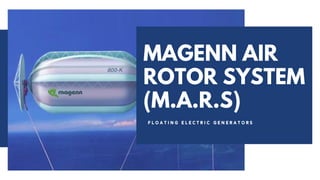
F L O A T I N G E L E C T R I C G E N E R A T O R S
TABLE OF
CONTENTS
WORKING &
MECHANISM
03
INTRODUCTION
01
COMPONENTS OF
MARS
02
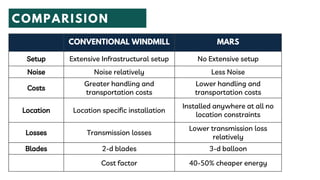
COMPARISIONS
04 PERFORMANCES
05
ADVANTAGES &
LIMITATIONS
06
VIEWS OF MARS
07
CONCLUSION
08
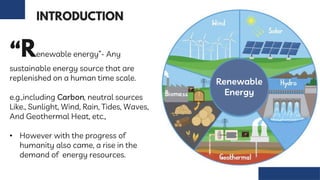
“ enewable energy”- Any
sustainable energy source that are
replenished on a human time scale.
e.g.,including Carbon, neutral sources
Like., Sunlight, Wind, Rain, Tides, Waves,
And Geothermal Heat, etc.,
• However with the progress of
humanity also came, a rise in the
demand of energy resources.
Renewable
Energy
● Led to over-exploitation of non-renewable resources
and many problems associated with them.
● A need for developments in renewable energy
technology
● Wind is the fastest growing energy source in the
world and one of the lowest priced renewable energy
in todays technologies.
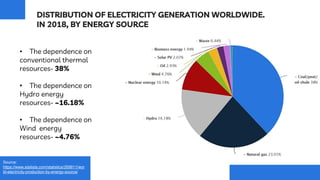
Source:
https://www.statista.com/statistics/269811/wor
ld-electricity-production-by-energy-source/
• The dependence on
conventional thermal
resources- 38%
• The dependence on
Hydro energy
resources- ~16.18%
• The dependence on
Wind energy
resources- ~4.76%
DISTRIBUTION OF ELECTRICITY GENERATION WORLDWIDE.
IN 2018, BY ENERGY SOURCE
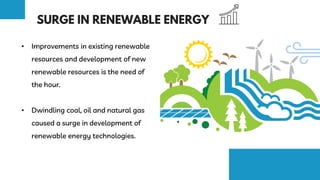
• Improvements in existing renewable
resources and development of new
renewable resources is the need of
the hour.
• Dwindling coal, oil and natural gas
caused a surge in development of
renewable energy technologies.
Contributes to a healthy
environment
03
Renewable Source of
Energy
01
Reduces Dependency on
fossil energy supply
02
Cost Effective Energy
Solution
04
It's Sustainable
05
WHY WIND ENERGY?
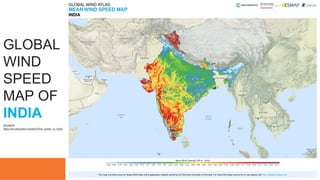
GLOBAL
WIND
SPEED
MAP OF
INDIA
SOURCE:
https://en.wikipedia.org/wiki/Wind_power_in_India
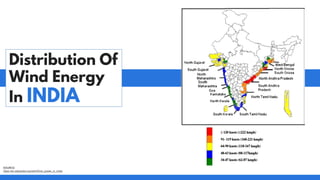
SOURCE:
https://en.wikipedia.org/wiki/Wind_power_in_India
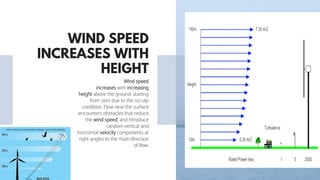
Wind speed
increases with increasing
height above the ground, starting
from zero due to the no-slip
condition. Flow near the surface
encounters obstacles that reduce
the wind speed, and introduce
random vertical and
horizontal velocity components at
right angles to the main direction
of flow.
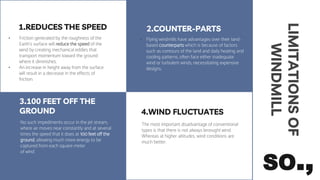
LIMITATIONS
OF
WINDMILL
• Friction generated by the roughness of the
Earth’s surface will reduce the speed of the
wind by creating mechanical eddies that
transport momentum toward the ground
where it diminishes.
• An increase in height away from the surface
will result in a decrease in the effects of
friction.
• Flying windmills have advantages over their land-
based counterparts which is because of factors
such as contours of the land and daily heating and
cooling patterns, often face either inadequate
wind or turbulent winds, necessitating expensive
designs.
No such impediments occur in the jet stream,
where air moves near constantly and at several
times the speed that it does at 100 feet off the
ground, allowing much more energy to be
captured from each square meter
of wind
2.COUNTER-PARTS
3.100 FEET OFF THE
GROUND
1.REDUCES THE SPEED
4.WIND FLUCTUATES
The most important disadvantage of conventional
types is that there is not always (enough) wind.
Whereas at higher altitudes, wind conditions are
much better.
SO.,
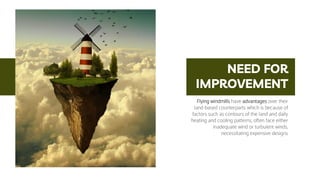
NEED FOR
IMPROVEMENT
Flying windmills have advantages over their
land-based counterparts which is because of
factors such as contours of the land and daily
heating and cooling patterns, often face either
inadequate wind or turbulent winds,
necessitating expensive designs
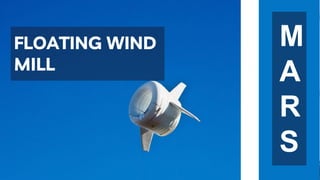
FLOATING WIND
MILL
01
M
A
R
S
This electrical energy is
transferred down the
for immediate
use, or to a set of batteries for
later use, or to the power grid.
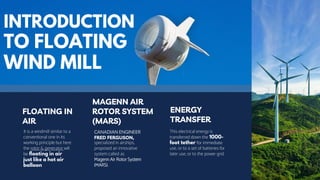
It is a windmill similar to a
conventional one in its
working principle but here
the rotor & generator will
be
FLOATING IN
AIR
ENERGY
TRANSFER
MAGENN AIR
ROTOR SYSTEM
(MARS)
CANADIAN ENGINEER
FRED FERGUSON,
specialized in airships,
proposed an innovative
system called as
Magenn Air Rotor System
(MARS).
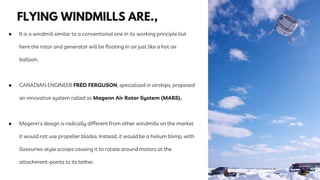
● It is a windmill similar to a conventional one in its working principle but
here the rotor and generator will be floating in air just like a hot air
balloon.
● CANADIAN ENGINEER FRED FERGUSON, specialized in airships, proposed
an innovative system called as Magenn Air Rotor System (MARS).
● Magenn’s design is radically different from other windmills on the market
it would not use propeller blades. Instead, it would be a helium blimp, with
Savouries-style scoops causing it to rotate around motors at the
attachment-points to its tether.
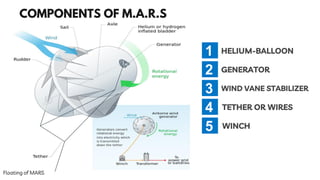
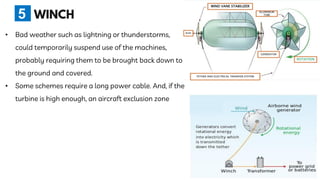
GENERATOR
WIND VANE STABILIZER
HELIUM-BALLOON
1
TETHER OR WIRES
WINCH
5
4
3
2
Floating of MARS
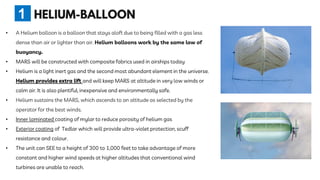
• A Helium balloon is a balloon that stays aloft due to being filled with a gas less
dense than air or lighter than air. Helium balloons work by the same law of
buoyancy.
• MARS will be constructed with composite fabrics used in airships today
• Helium is a light inert gas and the second most abundant element in the universe.
Helium provides extra lift and will keep MARS at altitude in very low winds or
calm air. It is also plentiful, inexpensive and environmentally safe.
• Helium sustains the MARS, which ascends to an altitude as selected by the
operator for the best winds.
• Inner laminated coating of mylar to reduce porosity of helium gas
• Exterior coating of Tedlar which will provide ultra-violet protection, scuff
resistance and colour.
• The unit can SEE to a height of 300 to 1,000 feet to take advantage of more
constant and higher wind speeds at higher altitudes that conventional wind
turbines are unable to reach.
1
While in the sky, the MARS
• The wind turbine generator converts mechanical
energy to electrical energy.
• Turbine spins in the wind, generating electricity.
The current is transferred down the tether for
consumption, battery storage or transmitted to
a power grid
• Over speed controls are built into the design of
MARS.
• The MARS units will have an internal bladder
system to maintain pressure.
2
[1 kW = 1.340 horsepower]
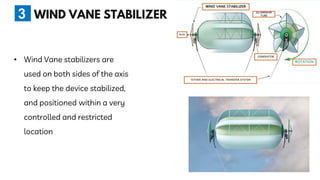
• Wind Vane stabilizers are
used on both sides of the axis
to keep the device stabilized,
and positioned within a very
controlled and restricted
location
3
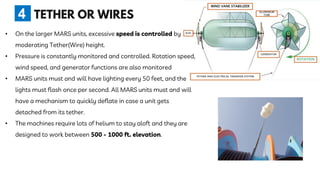
• On the larger MARS units, excessive speed is controlled by
moderating Tether(Wire) height.
• Pressure is constantly monitored and controlled. Rotation speed,
wind speed, and generator functions are also monitored
• MARS units must and will have lighting every 50 feet, and the
lights must flash once per second. All MARS units must and will
have a mechanism to quickly deflate in case a unit gets
detached from its tether.
• The machines require lots of helium to stay aloft and they are
designed to work between 500 - 1000 ft. elevation.
4
• Bad weather such as lightning or thunderstorms,
could temporarily suspend use of the machines,
probably requiring them to be brought back down to
the ground and covered.
• Some schemes require a long power cable. And, if the
turbine is high enough, an aircraft exclusion zone
5
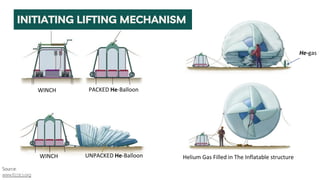
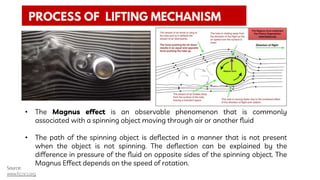
INITIATING LIFTING MECHANISM
Source:
www.fizzics.org
Helium Gas Filled in The Inflatable structure
WINCH UNPACKED He-Balloon
WINCH PACKED He-Balloon
He-gas
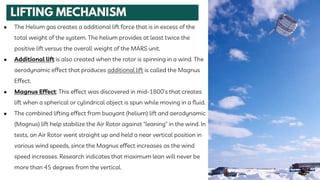
● The Helium gas creates a additional lift force that is in excess of the
total weight of the system. The helium provides at least twice the
positive lift versus the overall weight of the MARS unit.
● Additional lift is also created when the rotor is spinning in a wind. The
aerodynamic effect that produces additional lift is called the Magnus
Effect.
● Magnus Effect: This effect was discovered in mid-1800’s that creates
lift when a spherical or cylindrical object is spun while moving in a fluid.
● The combined lifting effect from buoyant (helium) lift and aerodynamic
(Magnus) lift help stabilize the Air Rotor against "leaning" in the wind. In
tests, an Air Rotor went straight up and held a near vertical position in
various wind speeds, since the Magnus effect increases as the wind
speed increases. Research indicates that maximum lean will never be
more than 45 degrees from the vertical.
Source:
www.fizzics.org
• The Magnus effect is an observable phenomenon that is commonly
associated with a spinning object moving through air or another fluid
• The path of the spinning object is deflected in a manner that is not present
when the object is not spinning. The deflection can be explained by the
difference in pressure of the fluid on opposite sides of the spinning object. The
Magnus Effect depends on the speed of rotation.
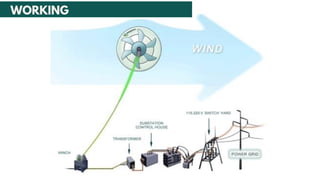
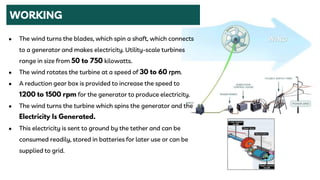
WORKING
● The wind turns the blades, which spin a shaft, which connects
to a generator and makes electricity. Utility-scale turbines
range in size from kilowatts.
● The wind rotates the turbine at a speed of rpm.
● A reduction gear box is provided to increase the speed to
for the generator to produce electricity.
● The wind turns the turbine which spins the generator and the
● This electricity is sent to ground by the tether and can be
consumed readily, stored in batteries for later use or can be
supplied to grid.
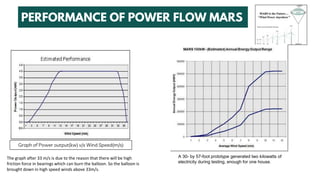
Graph of Power output(kw) v/s Wind Speed(m/s)
The graph after 33 m/s is due to the reason that there will be high
friction force in bearings which can burn the balloon. So the balloon is
brought down in high speed winds above 33m/s.
A 30- by 57-foot prototype generated two kilowatts of
electricity during testing, enough for one house.
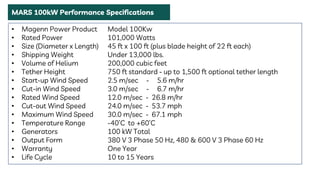
• Magenn Power Product Model 100Kw
• Rated Power 101,000 Watts
• Size (Diameter x Length) 45 ft x 100 ft (plus blade height of 22 ft each)
• Shipping Weight Under 13,000 lbs.
• Volume of Helium 200,000 cubic feet
• Tether Height 750 ft standard - up to 1,500 ft optional tether length
• Start-up Wind Speed 2.5 m/sec - 5.6 m/hr
• Cut-in Wind Speed 3.0 m/sec - 6.7 m/hr
• Rated Wind Speed 12.0 m/sec - 26.8 m/hr
• Cut-out Wind Speed 24.0 m/sec - 53.7 mph
• Maximum Wind Speed 30.0 m/sec - 67.1 mph
• Temperature Range -40’C to +60’C
• Generators 100 kW Total
• Output Form 380 V 3 Phase 50 Hz, 480 & 600 V 3 Phase 60 Hz
• Warranty One Year
• Life Cycle 10 to 15 Years
MARS 100kW Performance Specifications
Setup Extensive Infrastructural setup No Extensive setup
Noise Noise relatively Less Noise
Costs
Greater handling and
transportation costs
Lower handling and
transportation costs
Location Location specific installation
Installed anywhere at all no
location constraints
Losses Transmission losses
Lower transmission loss
relatively
Blades 2-d blades 3-d balloon
Cost factor 40-50% cheaper energy
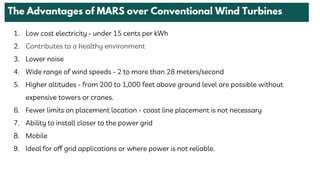
1. Low cost electricity - under 15 cents per kWh
2. Contributes to a healthy environment
3. Lower noise
4. Wide range of wind speeds - 2 to more than 28 meters/second
5. Higher altitudes - from 200 to 1,000 feet above ground level are possible without
expensive towers or cranes.
6. Fewer limits on placement location - coast line placement is not necessary
7. Ability to install closer to the power grid
8. Mobile
9. Ideal for off grid applications or where power is not reliable.
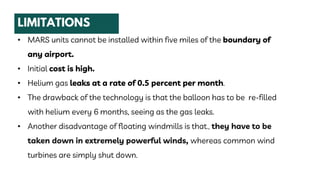
• MARS units cannot be installed within five miles of the boundary of
any airport.
• Initial cost is high.
• Helium gas leaks at a rate of 0.5 percent per month.
• The drawback of the technology is that the balloon has to be re-filled
with helium every 6 months, seeing as the gas leaks.
• Another disadvantage of floating windmills is that., they have to be
taken down in extremely powerful winds, whereas common wind
turbines are simply shut down.
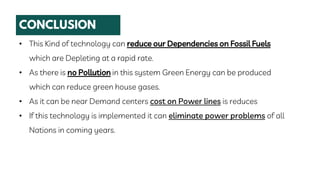
• This Kind of technology can reduce our Dependencies on Fossil Fuels
which are Depleting at a rapid rate.
• As there is no Pollution in this system Green Energy can be produced
which can reduce green house gases.
• As it can be near Demand centers cost on Power lines is reduces
• If this technology is implemented it can eliminate power problems of all
Nations in coming years.
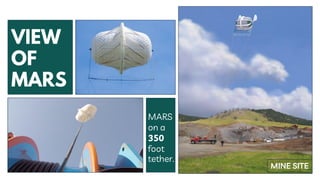
MINE SITE
MARS
on a
350
foot
tether.
• http://www.magennainrotorsystem.com
• https://www.LiveChennai:Magenn Air Rotor System
(M.A.R.S.),Useful as knowledge
• Magenn Power Inc. www.magenn.com
• http://www.theatlantic.com
• http://www.magenn.com
• http://www.nampet.com
• http://www.dnvgl.com
• http://www.Williamkamkwamba.com
• http://www.HermanMelville.com
you.

MAGENN AIR ROTOR SYSTEM (M.A.R.S) ppt

  • 1.
    VISVESVARAYA TECHNOLOGICAL UNIVERSITY Jnanasangama,Belgaum-590018 Department of Mechanical Engineering, BGS INSTITUTE OF TECHNOLOGY BG Nagar, Nagamangala Taluk, Mandya District-571448 2020-21 A Technical Seminar Presentation Under the Guidance of HEMANTHA.C Assistant Professor, Department of Mechanical Engineering, BGSIT,BG Nagara- 571448 Presented by KIRAN PRASAD.P 4BW16ME019
  • 2.
    F L OA T I N G E L E C T R I C G E N E R A T O R S
  • 3.
    TABLE OF CONTENTS WORKING & MECHANISM 03 INTRODUCTION 01 COMPONENTSOF MARS 02 COMPARISIONS 04 PERFORMANCES 05 ADVANTAGES & LIMITATIONS 06 VIEWS OF MARS 07 CONCLUSION 08
  • 4.
    “ enewable energy”-Any sustainable energy source that are replenished on a human time scale. e.g.,including Carbon, neutral sources Like., Sunlight, Wind, Rain, Tides, Waves, And Geothermal Heat, etc., • However with the progress of humanity also came, a rise in the demand of energy resources. Renewable Energy
  • 5.
    ● Led toover-exploitation of non-renewable resources and many problems associated with them. ● A need for developments in renewable energy technology ● Wind is the fastest growing energy source in the world and one of the lowest priced renewable energy in todays technologies.
  • 6.
    Source: https://www.statista.com/statistics/269811/wor ld-electricity-production-by-energy-source/ • The dependenceon conventional thermal resources- 38% • The dependence on Hydro energy resources- ~16.18% • The dependence on Wind energy resources- ~4.76% DISTRIBUTION OF ELECTRICITY GENERATION WORLDWIDE. IN 2018, BY ENERGY SOURCE
  • 7.
    • Improvements inexisting renewable resources and development of new renewable resources is the need of the hour. • Dwindling coal, oil and natural gas caused a surge in development of renewable energy technologies.
  • 8.
    Contributes to ahealthy environment 03 Renewable Source of Energy 01 Reduces Dependency on fossil energy supply 02 Cost Effective Energy Solution 04 It's Sustainable 05 WHY WIND ENERGY?
  • 9.
  • 10.
  • 11.
    Wind speed increases withincreasing height above the ground, starting from zero due to the no-slip condition. Flow near the surface encounters obstacles that reduce the wind speed, and introduce random vertical and horizontal velocity components at right angles to the main direction of flow.
  • 12.
    LIMITATIONS OF WINDMILL • Friction generatedby the roughness of the Earth’s surface will reduce the speed of the wind by creating mechanical eddies that transport momentum toward the ground where it diminishes. • An increase in height away from the surface will result in a decrease in the effects of friction. • Flying windmills have advantages over their land- based counterparts which is because of factors such as contours of the land and daily heating and cooling patterns, often face either inadequate wind or turbulent winds, necessitating expensive designs. No such impediments occur in the jet stream, where air moves near constantly and at several times the speed that it does at 100 feet off the ground, allowing much more energy to be captured from each square meter of wind 2.COUNTER-PARTS 3.100 FEET OFF THE GROUND 1.REDUCES THE SPEED 4.WIND FLUCTUATES The most important disadvantage of conventional types is that there is not always (enough) wind. Whereas at higher altitudes, wind conditions are much better. SO.,
  • 13.
    NEED FOR IMPROVEMENT Flying windmillshave advantages over their land-based counterparts which is because of factors such as contours of the land and daily heating and cooling patterns, often face either inadequate wind or turbulent winds, necessitating expensive designs
  • 14.
  • 15.
    This electrical energyis transferred down the for immediate use, or to a set of batteries for later use, or to the power grid. It is a windmill similar to a conventional one in its working principle but here the rotor & generator will be FLOATING IN AIR ENERGY TRANSFER MAGENN AIR ROTOR SYSTEM (MARS) CANADIAN ENGINEER FRED FERGUSON, specialized in airships, proposed an innovative system called as Magenn Air Rotor System (MARS).
  • 16.
    ● It isa windmill similar to a conventional one in its working principle but here the rotor and generator will be floating in air just like a hot air balloon. ● CANADIAN ENGINEER FRED FERGUSON, specialized in airships, proposed an innovative system called as Magenn Air Rotor System (MARS). ● Magenn’s design is radically different from other windmills on the market it would not use propeller blades. Instead, it would be a helium blimp, with Savouries-style scoops causing it to rotate around motors at the attachment-points to its tether.
  • 17.
    GENERATOR WIND VANE STABILIZER HELIUM-BALLOON 1 TETHEROR WIRES WINCH 5 4 3 2 Floating of MARS
  • 18.
    • A Heliumballoon is a balloon that stays aloft due to being filled with a gas less dense than air or lighter than air. Helium balloons work by the same law of buoyancy. • MARS will be constructed with composite fabrics used in airships today • Helium is a light inert gas and the second most abundant element in the universe. Helium provides extra lift and will keep MARS at altitude in very low winds or calm air. It is also plentiful, inexpensive and environmentally safe. • Helium sustains the MARS, which ascends to an altitude as selected by the operator for the best winds. • Inner laminated coating of mylar to reduce porosity of helium gas • Exterior coating of Tedlar which will provide ultra-violet protection, scuff resistance and colour. • The unit can SEE to a height of 300 to 1,000 feet to take advantage of more constant and higher wind speeds at higher altitudes that conventional wind turbines are unable to reach. 1
  • 19.
    While in thesky, the MARS • The wind turbine generator converts mechanical energy to electrical energy. • Turbine spins in the wind, generating electricity. The current is transferred down the tether for consumption, battery storage or transmitted to a power grid • Over speed controls are built into the design of MARS. • The MARS units will have an internal bladder system to maintain pressure. 2 [1 kW = 1.340 horsepower]
  • 20.
    • Wind Vanestabilizers are used on both sides of the axis to keep the device stabilized, and positioned within a very controlled and restricted location 3
  • 21.
    • On thelarger MARS units, excessive speed is controlled by moderating Tether(Wire) height. • Pressure is constantly monitored and controlled. Rotation speed, wind speed, and generator functions are also monitored • MARS units must and will have lighting every 50 feet, and the lights must flash once per second. All MARS units must and will have a mechanism to quickly deflate in case a unit gets detached from its tether. • The machines require lots of helium to stay aloft and they are designed to work between 500 - 1000 ft. elevation. 4
  • 22.
    • Bad weathersuch as lightning or thunderstorms, could temporarily suspend use of the machines, probably requiring them to be brought back down to the ground and covered. • Some schemes require a long power cable. And, if the turbine is high enough, an aircraft exclusion zone 5
  • 24.
    INITIATING LIFTING MECHANISM Source: www.fizzics.org HeliumGas Filled in The Inflatable structure WINCH UNPACKED He-Balloon WINCH PACKED He-Balloon He-gas
  • 25.
    ● The Heliumgas creates a additional lift force that is in excess of the total weight of the system. The helium provides at least twice the positive lift versus the overall weight of the MARS unit. ● Additional lift is also created when the rotor is spinning in a wind. The aerodynamic effect that produces additional lift is called the Magnus Effect. ● Magnus Effect: This effect was discovered in mid-1800’s that creates lift when a spherical or cylindrical object is spun while moving in a fluid. ● The combined lifting effect from buoyant (helium) lift and aerodynamic (Magnus) lift help stabilize the Air Rotor against "leaning" in the wind. In tests, an Air Rotor went straight up and held a near vertical position in various wind speeds, since the Magnus effect increases as the wind speed increases. Research indicates that maximum lean will never be more than 45 degrees from the vertical.
  • 26.
    Source: www.fizzics.org • The Magnuseffect is an observable phenomenon that is commonly associated with a spinning object moving through air or another fluid • The path of the spinning object is deflected in a manner that is not present when the object is not spinning. The deflection can be explained by the difference in pressure of the fluid on opposite sides of the spinning object. The Magnus Effect depends on the speed of rotation.
  • 27.
    WORKING ● The windturns the blades, which spin a shaft, which connects to a generator and makes electricity. Utility-scale turbines range in size from kilowatts. ● The wind rotates the turbine at a speed of rpm. ● A reduction gear box is provided to increase the speed to for the generator to produce electricity. ● The wind turns the turbine which spins the generator and the ● This electricity is sent to ground by the tether and can be consumed readily, stored in batteries for later use or can be supplied to grid.
  • 28.
    Graph of Poweroutput(kw) v/s Wind Speed(m/s) The graph after 33 m/s is due to the reason that there will be high friction force in bearings which can burn the balloon. So the balloon is brought down in high speed winds above 33m/s. A 30- by 57-foot prototype generated two kilowatts of electricity during testing, enough for one house.
  • 29.
    • Magenn PowerProduct Model 100Kw • Rated Power 101,000 Watts • Size (Diameter x Length) 45 ft x 100 ft (plus blade height of 22 ft each) • Shipping Weight Under 13,000 lbs. • Volume of Helium 200,000 cubic feet • Tether Height 750 ft standard - up to 1,500 ft optional tether length • Start-up Wind Speed 2.5 m/sec - 5.6 m/hr • Cut-in Wind Speed 3.0 m/sec - 6.7 m/hr • Rated Wind Speed 12.0 m/sec - 26.8 m/hr • Cut-out Wind Speed 24.0 m/sec - 53.7 mph • Maximum Wind Speed 30.0 m/sec - 67.1 mph • Temperature Range -40’C to +60’C • Generators 100 kW Total • Output Form 380 V 3 Phase 50 Hz, 480 & 600 V 3 Phase 60 Hz • Warranty One Year • Life Cycle 10 to 15 Years MARS 100kW Performance Specifications
  • 30.
    Setup Extensive Infrastructuralsetup No Extensive setup Noise Noise relatively Less Noise Costs Greater handling and transportation costs Lower handling and transportation costs Location Location specific installation Installed anywhere at all no location constraints Losses Transmission losses Lower transmission loss relatively Blades 2-d blades 3-d balloon Cost factor 40-50% cheaper energy
  • 31.
    1. Low costelectricity - under 15 cents per kWh 2. Contributes to a healthy environment 3. Lower noise 4. Wide range of wind speeds - 2 to more than 28 meters/second 5. Higher altitudes - from 200 to 1,000 feet above ground level are possible without expensive towers or cranes. 6. Fewer limits on placement location - coast line placement is not necessary 7. Ability to install closer to the power grid 8. Mobile 9. Ideal for off grid applications or where power is not reliable.
  • 32.
    • MARS unitscannot be installed within five miles of the boundary of any airport. • Initial cost is high. • Helium gas leaks at a rate of 0.5 percent per month. • The drawback of the technology is that the balloon has to be re-filled with helium every 6 months, seeing as the gas leaks. • Another disadvantage of floating windmills is that., they have to be taken down in extremely powerful winds, whereas common wind turbines are simply shut down.
  • 33.
    • This Kindof technology can reduce our Dependencies on Fossil Fuels which are Depleting at a rapid rate. • As there is no Pollution in this system Green Energy can be produced which can reduce green house gases. • As it can be near Demand centers cost on Power lines is reduces • If this technology is implemented it can eliminate power problems of all Nations in coming years.
  • 34.
  • 36.
    • http://www.magennainrotorsystem.com • https://www.LiveChennai:MagennAir Rotor System (M.A.R.S.),Useful as knowledge • Magenn Power Inc. www.magenn.com • http://www.theatlantic.com • http://www.magenn.com • http://www.nampet.com • http://www.dnvgl.com • http://www.Williamkamkwamba.com • http://www.HermanMelville.com
  • 37.