Fluids & Electrolytes
Pediatric Emergency Medicine
Boston Medical Center
Boston University School of Medicine
Objectives
 To discuss:
 Maintenance Fluids and Electrolyte Requirements
 Types of Dehydration
 Management of Dehydration
 Electrolyte Abnormalities
Composition of Body
Compartments
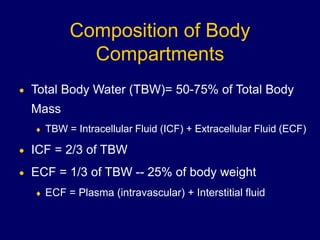
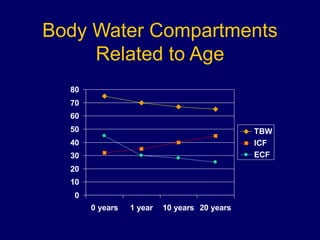
 Total Body Water (TBW)= 50-75% of Total Body
Mass
 TBW = Intracellular Fluid (ICF) + Extracellular Fluid (ECF)
 ICF = 2/3 of TBW
 ECF = 1/3 of TBW -- 25% of body weight
 ECF = Plasma (intravascular) + Interstitial fluid
Body Water Compartments
Related to Age
0
10
20
30
40
50
60
70
80
0 years 1 year 10 years 20 years
TBW
ICF
ECF
Regulation of Body Fluids and
Electrolytes
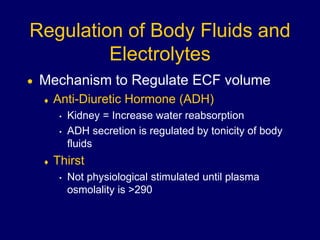
 Mechanism to Regulate ECF volume
 Anti-Diuretic Hormone (ADH)
• Kidney = Increase water reabsorption
• ADH secretion is regulated by tonicity of body
fluids
 Thirst
• Not physiological stimulated until plasma
osmolality is >290
Regulation of Body Fluids and
Electrolytes
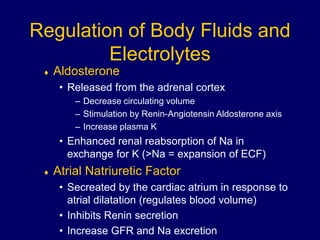
 Aldosterone
• Released from the adrenal cortex
– Decrease circulating volume
– Stimulation by Renin-Angiotensin Aldosterone axis
– Increase plasma K
• Enhanced renal reabsorption of Na in
exchange for K (>Na = expansion of ECF)
 Atrial Natriuretic Factor
• Secreated by the cardiac atrium in response to
atrial dilatation (regulates blood volume)
• Inhibits Renin secretion
• Increase GFR and Na excretion
Daily Maintenance
Requirements
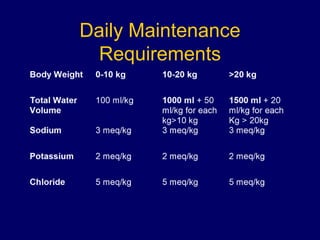
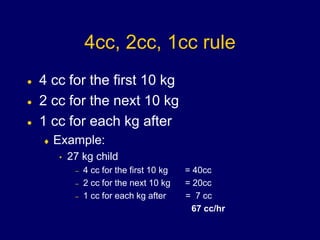
4cc, 2cc, 1cc rule
 4 cc for the first 10 kg
 2 cc for the next 10 kg
 1 cc for each kg after
 Example:
• 27 kg child
– 4 cc for the first 10 kg = 40cc
– 2 cc for the next 10 kg = 20cc
– 1 cc for each kg after = 7 cc
67 cc/hr
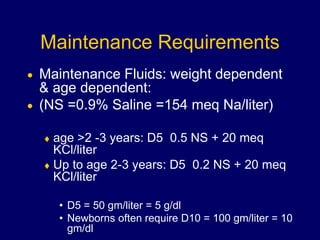
Maintenance Requirements
 Maintenance Fluids: weight dependent
& age dependent:
 (NS =0.9% Saline =154 meq Na/liter)
 age >2 -3 years: D5 0.5 NS + 20 meq
KCl/liter
 Up to age 2-3 years: D5 0.2 NS + 20 meq
KCl/liter
• D5 = 50 gm/liter = 5 g/dl
• Newborns often require D10 = 100 gm/liter = 10
gm/dl
Dehydration
 Epidemiology:
 One of the most common medical problems
 In the U.S. - 10% of all pediatric admissions
 Worldwide, over 3 million children under 5
years die from dehydration
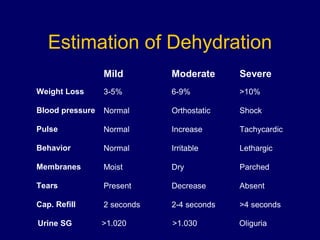
Estimation of Dehydration
Mild Moderate Severe
Weight Loss 3-5% 6-9% >10%
Blood pressure Normal Orthostatic Shock
Pulse Normal Increase Tachycardic
Behavior Normal Irritable Lethargic
Membranes Moist Dry Parched
Tears Present Decrease Absent
Cap. Refill 2 seconds 2-4 seconds >4 seconds
Urine SG >1.020 >1.030 Oliguria
Dehydration
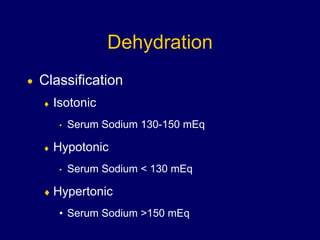
 Classification
 Isotonic
• Serum Sodium 130-150 mEq
 Hypotonic
• Serum Sodium < 130 mEq
 Hypertonic
• Serum Sodium >150 mEq
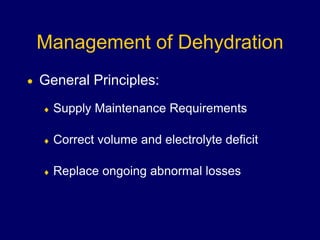
Management of Dehydration
 General Principles:
 Supply Maintenance Requirements
 Correct volume and electrolyte deficit
 Replace ongoing abnormal losses
Management of Dehydration
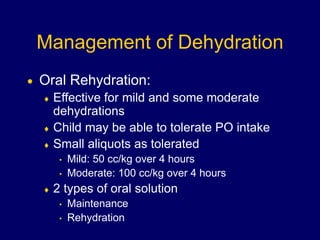
 Oral Rehydration:
 Effective for mild and some moderate
dehydrations
 Child may be able to tolerate PO intake
 Small aliquots as tolerated
• Mild: 50 cc/kg over 4 hours
• Moderate: 100 cc/kg over 4 hours
 2 types of oral solution
• Maintenance
• Rehydration
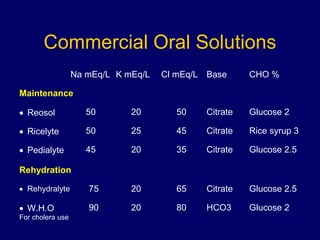
Commercial Oral Solutions
Na mEq/L K mEq/L Cl mEq/L Base CHO %
Maintenance
 Reosol 50 20 50 Citrate Glucose 2
 Ricelyte 50 25 45 Citrate Rice syrup 3
 Pedialyte 45 20 35 Citrate Glucose 2.5
Rehydration
 Rehydralyte 75 20 65 Citrate Glucose 2.5
 W.H.O
For cholera use
90 20 80 HCO3 Glucose 2
Management of Dehydration:
IV
 Replacement of Fluid Deficit Based on %
Dehydration:
 Example: 5 kg child who is 6% dehydrated: 5 x
60cc/kg
• fluid deficit (cc) = wt x % dehydration
• fluid deficit (cc) = wt in kg (1000cc/kg) x (1/100)
estimate of dehydration
• fluid deficit (cc) = wt x 10 x estimate of dehydration
• fluid deficit (cc) = 5 x 10 x 6
• fluid deficit (cc) = 300 cc
Management of Dehydration:
IV
 Initial: NS or LR 20 cc/kg Bolus in first hour
 Then Remainder of Deficit
• In previous example: total fluid deficit = 300cc
for 5 kg child who is 6% dehydrated = 60cc/kg
• Replacement:
– first hour: 20 cc/kg = 20 x 5 = 100 cc
– replace the rest: 40 cc/kg or 300 - 100 = 200 cc
– The type of fluid used and the rate of infusion
depends on the age and Na status of the patient:
» for isonatremic dehydration: correct deficits of
next 7 hours
» 200cc over 7 hours = 28 cc/hr
Hyponatremia
 Predisposing Factors
 Diabetes mellitus (hyperglycemia)
 Cystic fibrosis
 CNS disorders ( SIADH)
 Gastroenteritis
 Excessive water intake (formula dilution)
 Diuretics (thiazides and furosemide)
 Renal disease
Hyponatremia
 Hyponatremic Dehydration
 Hypovolemic Hyponatremic Dehydration
• High urine output and Na excretion
• Increase in atrial natriuretic factor
 Euvolemic Hyponatremic Dehydration
• ADH mediated water retention
 Hypervolemic Hyponatremic Dehydration
• Edematous disorder (nephrotic syndrome, CHF,
cirrhosis)
• Water intoxication
Hyponatremia
 Acute Hyponatremia (<24 hours)
 Early Onset (Serum Sodium <125 meq/L)
• Nausea
• Vomiting
• Headache
 Later or Severe (Serum Sodium <120 meq/L)
• Seizure
• Coma
• Respiratory arrest
Hyponatremia
 Chronic Hyponatremia (>48 hours)
 Lethargy
 Confusion
 Muscle cramps
 Neurologic Impairment
Hyponatremia
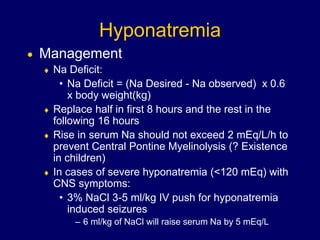
 Management
 Na Deficit:
• Na Deficit = (Na Desired - Na observed) x 0.6
x body weight(kg)
 Replace half in first 8 hours and the rest in the
following 16 hours
 Rise in serum Na should not exceed 2 mEq/L/h to
prevent Central Pontine Myelinolysis (? Existence
in children)
 In cases of severe hyponatremia (<120 mEq) with
CNS symptoms:
• 3% NaCl 3-5 ml/kg IV push for hyponatremia
induced seizures
– 6 ml/kg of NaCl will raise serum Na by 5 mEq/L
Hypernatremia
 Hypernatremia leads to hypertonicity
 Increase secretion of ADH
 Increase thirst
 Patients at risk
 Inability to secrete or respond to ADH
 No access to water
Hypernatremia
 Etiology
 Pure water depletion
• Diabetes insipidus (Central or Nephrogenic)
 Sodium excess
• Salt poisoning (PO or IV)
 Water depletion exceeding Na depletion
• Diarrhea, vomiting, decrease fluid intake
 Pharmacologic agents
• Lithium, Cyclophosphamide, Cisplatin
Hypernatremia
 Signs and symptoms
 Disturbances of consciousness
• Lethargy or Confusion
 Neuromuscular Irritability
• Muscle twitching, hyperreflexia
 Convulsions
 Hyperthermia
• Skin may feel thick or doughy
Hypernatremia
 Management
 Normal Saline or Ringer lactate to restore volume
 Hypotonic solution (D5 1/4 NS) to correct calculated
deficit over 48 hours
• Water Deficit
– Normal body H20 - Current body H20
• Current body water
– 0.6 x body weight (kg) x Normal Na/Observed Na
• Normal Body water
– 0.6 x body weight (kg)
 Decrease Na concentration at a rate of 0.5 mEq/hr
or ~ 10 mEq/day: Faster correction can result in
Cerebral Edema
Potassium
 Most abundant intracellular cation
 Normal serum values 3.5-5.5 mEq
 Abnormalities of serum K are potentially life-
threatening due to effect in cardiac function
Hypokalemia
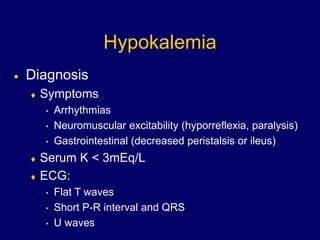
 Diagnosis
 Symptoms
• Arrhythmias
• Neuromuscular excitability (hyporreflexia, paralysis)
• Gastrointestinal (decreased peristalsis or ileus)
 Serum K < 3mEq/L
 ECG:
• Flat T waves
• Short P-R interval and QRS
• U waves
Hypokalemia
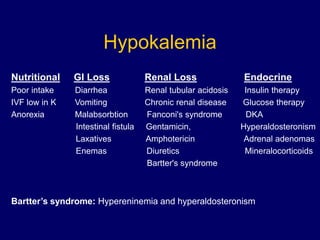
Nutritional GI Loss Renal Loss Endocrine
Poor intake Diarrhea Renal tubular acidosis Insulin therapy
IVF low in K Vomiting Chronic renal disease Glucose therapy
Anorexia Malabsorbtion Fanconi's syndrome DKA
Intestinal fistula Gentamicin, Hyperaldosteronism
Laxatives Amphotericin Adrenal adenomas
Enemas Diuretics Mineralocorticoids
Bartter's syndrome
Bartter’s syndrome: Hypereninemia and hyperaldosteronism
Hypokalemia
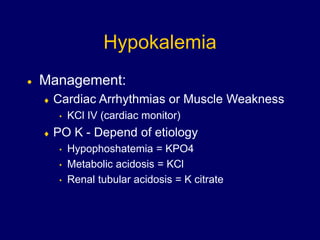
 Management:
 Cardiac Arrhythmias or Muscle Weakness
• KCl IV (cardiac monitor)
 PO K - Depend of etiology
• Hypophoshatemia = KPO4
• Metabolic acidosis = KCl
• Renal tubular acidosis = K citrate
Hyperkalemia
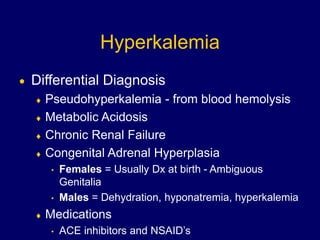
 Differential Diagnosis
 Pseudohyperkalemia - from blood hemolysis
 Metabolic Acidosis
 Chronic Renal Failure
 Congenital Adrenal Hyperplasia
• Females = Usually Dx at birth - Ambiguous
Genitalia
• Males = Dehydration, hyponatremia, hyperkalemia
 Medications
• ACE inhibitors and NSAID’s
Hyperkalemia
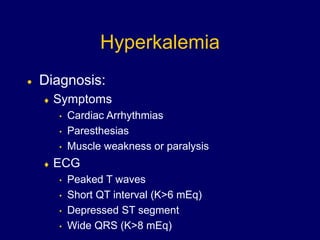
 Diagnosis:
 Symptoms
• Cardiac Arrhythmias
• Paresthesias
• Muscle weakness or paralysis
 ECG
• Peaked T waves
• Short QT interval (K>6 mEq)
• Depressed ST segment
• Wide QRS (K>8 mEq)
Hyperkalemia
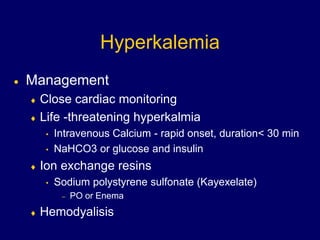
 Management
 Close cardiac monitoring
 Life -threatening hyperkalmia
• Intravenous Calcium - rapid onset, duration< 30 min
• NaHCO3 or glucose and insulin
 Ion exchange resins
• Sodium polystyrene sulfonate (Kayexelate)
– PO or Enema
 Hemodyalisis

Fluids & Electrolytes ppt.ppt

  • 1.
    Fluids & Electrolytes PediatricEmergency Medicine Boston Medical Center Boston University School of Medicine
  • 2.
    Objectives  To discuss: Maintenance Fluids and Electrolyte Requirements  Types of Dehydration  Management of Dehydration  Electrolyte Abnormalities
  • 3.
    Composition of Body Compartments Total Body Water (TBW)= 50-75% of Total Body Mass  TBW = Intracellular Fluid (ICF) + Extracellular Fluid (ECF)  ICF = 2/3 of TBW  ECF = 1/3 of TBW -- 25% of body weight  ECF = Plasma (intravascular) + Interstitial fluid
  • 4.
    Body Water Compartments Relatedto Age 0 10 20 30 40 50 60 70 80 0 years 1 year 10 years 20 years TBW ICF ECF
  • 5.
    Regulation of BodyFluids and Electrolytes  Mechanism to Regulate ECF volume  Anti-Diuretic Hormone (ADH) • Kidney = Increase water reabsorption • ADH secretion is regulated by tonicity of body fluids  Thirst • Not physiological stimulated until plasma osmolality is >290
  • 6.
    Regulation of BodyFluids and Electrolytes  Aldosterone • Released from the adrenal cortex – Decrease circulating volume – Stimulation by Renin-Angiotensin Aldosterone axis – Increase plasma K • Enhanced renal reabsorption of Na in exchange for K (>Na = expansion of ECF)  Atrial Natriuretic Factor • Secreated by the cardiac atrium in response to atrial dilatation (regulates blood volume) • Inhibits Renin secretion • Increase GFR and Na excretion
  • 7.
  • 8.
    4cc, 2cc, 1ccrule  4 cc for the first 10 kg  2 cc for the next 10 kg  1 cc for each kg after  Example: • 27 kg child – 4 cc for the first 10 kg = 40cc – 2 cc for the next 10 kg = 20cc – 1 cc for each kg after = 7 cc 67 cc/hr
  • 9.
    Maintenance Requirements  MaintenanceFluids: weight dependent & age dependent:  (NS =0.9% Saline =154 meq Na/liter)  age >2 -3 years: D5 0.5 NS + 20 meq KCl/liter  Up to age 2-3 years: D5 0.2 NS + 20 meq KCl/liter • D5 = 50 gm/liter = 5 g/dl • Newborns often require D10 = 100 gm/liter = 10 gm/dl
  • 10.
    Dehydration  Epidemiology:  Oneof the most common medical problems  In the U.S. - 10% of all pediatric admissions  Worldwide, over 3 million children under 5 years die from dehydration
  • 11.
    Estimation of Dehydration MildModerate Severe Weight Loss 3-5% 6-9% >10% Blood pressure Normal Orthostatic Shock Pulse Normal Increase Tachycardic Behavior Normal Irritable Lethargic Membranes Moist Dry Parched Tears Present Decrease Absent Cap. Refill 2 seconds 2-4 seconds >4 seconds Urine SG >1.020 >1.030 Oliguria
  • 12.
    Dehydration  Classification  Isotonic •Serum Sodium 130-150 mEq  Hypotonic • Serum Sodium < 130 mEq  Hypertonic • Serum Sodium >150 mEq
  • 13.
    Management of Dehydration General Principles:  Supply Maintenance Requirements  Correct volume and electrolyte deficit  Replace ongoing abnormal losses
  • 14.
    Management of Dehydration Oral Rehydration:  Effective for mild and some moderate dehydrations  Child may be able to tolerate PO intake  Small aliquots as tolerated • Mild: 50 cc/kg over 4 hours • Moderate: 100 cc/kg over 4 hours  2 types of oral solution • Maintenance • Rehydration
  • 15.
    Commercial Oral Solutions NamEq/L K mEq/L Cl mEq/L Base CHO % Maintenance  Reosol 50 20 50 Citrate Glucose 2  Ricelyte 50 25 45 Citrate Rice syrup 3  Pedialyte 45 20 35 Citrate Glucose 2.5 Rehydration  Rehydralyte 75 20 65 Citrate Glucose 2.5  W.H.O For cholera use 90 20 80 HCO3 Glucose 2
  • 16.
    Management of Dehydration: IV Replacement of Fluid Deficit Based on % Dehydration:  Example: 5 kg child who is 6% dehydrated: 5 x 60cc/kg • fluid deficit (cc) = wt x % dehydration • fluid deficit (cc) = wt in kg (1000cc/kg) x (1/100) estimate of dehydration • fluid deficit (cc) = wt x 10 x estimate of dehydration • fluid deficit (cc) = 5 x 10 x 6 • fluid deficit (cc) = 300 cc
  • 17.
    Management of Dehydration: IV Initial: NS or LR 20 cc/kg Bolus in first hour  Then Remainder of Deficit • In previous example: total fluid deficit = 300cc for 5 kg child who is 6% dehydrated = 60cc/kg • Replacement: – first hour: 20 cc/kg = 20 x 5 = 100 cc – replace the rest: 40 cc/kg or 300 - 100 = 200 cc – The type of fluid used and the rate of infusion depends on the age and Na status of the patient: » for isonatremic dehydration: correct deficits of next 7 hours » 200cc over 7 hours = 28 cc/hr
  • 18.
    Hyponatremia  Predisposing Factors Diabetes mellitus (hyperglycemia)  Cystic fibrosis  CNS disorders ( SIADH)  Gastroenteritis  Excessive water intake (formula dilution)  Diuretics (thiazides and furosemide)  Renal disease
  • 19.
    Hyponatremia  Hyponatremic Dehydration Hypovolemic Hyponatremic Dehydration • High urine output and Na excretion • Increase in atrial natriuretic factor  Euvolemic Hyponatremic Dehydration • ADH mediated water retention  Hypervolemic Hyponatremic Dehydration • Edematous disorder (nephrotic syndrome, CHF, cirrhosis) • Water intoxication
  • 20.
    Hyponatremia  Acute Hyponatremia(<24 hours)  Early Onset (Serum Sodium <125 meq/L) • Nausea • Vomiting • Headache  Later or Severe (Serum Sodium <120 meq/L) • Seizure • Coma • Respiratory arrest
  • 21.
    Hyponatremia  Chronic Hyponatremia(>48 hours)  Lethargy  Confusion  Muscle cramps  Neurologic Impairment
  • 22.
    Hyponatremia  Management  NaDeficit: • Na Deficit = (Na Desired - Na observed) x 0.6 x body weight(kg)  Replace half in first 8 hours and the rest in the following 16 hours  Rise in serum Na should not exceed 2 mEq/L/h to prevent Central Pontine Myelinolysis (? Existence in children)  In cases of severe hyponatremia (<120 mEq) with CNS symptoms: • 3% NaCl 3-5 ml/kg IV push for hyponatremia induced seizures – 6 ml/kg of NaCl will raise serum Na by 5 mEq/L
  • 23.
    Hypernatremia  Hypernatremia leadsto hypertonicity  Increase secretion of ADH  Increase thirst  Patients at risk  Inability to secrete or respond to ADH  No access to water
  • 24.
    Hypernatremia  Etiology  Purewater depletion • Diabetes insipidus (Central or Nephrogenic)  Sodium excess • Salt poisoning (PO or IV)  Water depletion exceeding Na depletion • Diarrhea, vomiting, decrease fluid intake  Pharmacologic agents • Lithium, Cyclophosphamide, Cisplatin
  • 25.
    Hypernatremia  Signs andsymptoms  Disturbances of consciousness • Lethargy or Confusion  Neuromuscular Irritability • Muscle twitching, hyperreflexia  Convulsions  Hyperthermia • Skin may feel thick or doughy
  • 26.
    Hypernatremia  Management  NormalSaline or Ringer lactate to restore volume  Hypotonic solution (D5 1/4 NS) to correct calculated deficit over 48 hours • Water Deficit – Normal body H20 - Current body H20 • Current body water – 0.6 x body weight (kg) x Normal Na/Observed Na • Normal Body water – 0.6 x body weight (kg)  Decrease Na concentration at a rate of 0.5 mEq/hr or ~ 10 mEq/day: Faster correction can result in Cerebral Edema
  • 27.
    Potassium  Most abundantintracellular cation  Normal serum values 3.5-5.5 mEq  Abnormalities of serum K are potentially life- threatening due to effect in cardiac function
  • 28.
    Hypokalemia  Diagnosis  Symptoms •Arrhythmias • Neuromuscular excitability (hyporreflexia, paralysis) • Gastrointestinal (decreased peristalsis or ileus)  Serum K < 3mEq/L  ECG: • Flat T waves • Short P-R interval and QRS • U waves
  • 29.
    Hypokalemia Nutritional GI LossRenal Loss Endocrine Poor intake Diarrhea Renal tubular acidosis Insulin therapy IVF low in K Vomiting Chronic renal disease Glucose therapy Anorexia Malabsorbtion Fanconi's syndrome DKA Intestinal fistula Gentamicin, Hyperaldosteronism Laxatives Amphotericin Adrenal adenomas Enemas Diuretics Mineralocorticoids Bartter's syndrome Bartter’s syndrome: Hypereninemia and hyperaldosteronism
  • 30.
    Hypokalemia  Management:  CardiacArrhythmias or Muscle Weakness • KCl IV (cardiac monitor)  PO K - Depend of etiology • Hypophoshatemia = KPO4 • Metabolic acidosis = KCl • Renal tubular acidosis = K citrate
  • 31.
    Hyperkalemia  Differential Diagnosis Pseudohyperkalemia - from blood hemolysis  Metabolic Acidosis  Chronic Renal Failure  Congenital Adrenal Hyperplasia • Females = Usually Dx at birth - Ambiguous Genitalia • Males = Dehydration, hyponatremia, hyperkalemia  Medications • ACE inhibitors and NSAID’s
  • 32.
    Hyperkalemia  Diagnosis:  Symptoms •Cardiac Arrhythmias • Paresthesias • Muscle weakness or paralysis  ECG • Peaked T waves • Short QT interval (K>6 mEq) • Depressed ST segment • Wide QRS (K>8 mEq)
  • 33.
    Hyperkalemia  Management  Closecardiac monitoring  Life -threatening hyperkalmia • Intravenous Calcium - rapid onset, duration< 30 min • NaHCO3 or glucose and insulin  Ion exchange resins • Sodium polystyrene sulfonate (Kayexelate) – PO or Enema  Hemodyalisis