JIMMA UNIVERSITY
JIMMA INSTITUTE OF TECHNOLOGY
School of Chemical Engineering
course: Fluid Machine For Chemical Engineering
course code: ChEg 2101
Chapter One
Fluid machines in chemical process industries
By: Temesgen Abeto
1. Definition of Fluid Machines
2. Characteristic Features and Definition of Fluid Machines
3. Energy Transfer and Specific Work of Fluid Machines
4. Theory of turbo machines
5. Theory of Positive Displacement Pumps
6. Theory of Positive Displacement Compressors
7. Capacity regulation
8. Selection and specification of Fluid Machines
● Inthe processingindustries it isoften necessary to pump
fluidsoverlong distances.
● Intermediate products are often pumped from one factory
site to another, andrawmaterials suchasnatural gasand
petroleum products maybepumped verylongdistancesto
domestic or industrial consumers.
● It isnecessary, therefore, to consider the problems concerned
with calculating the powerrequirements for pumping, with
designingthe most suitableflowsystem, with estimating the
most economicalsizesofpipes, with measuringthe rate of
flow,andfrequently with controlling this flowat asteady
rate.
APPLICATION OF FLUID MACHINES
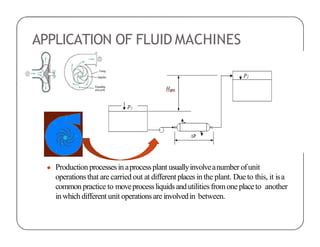
● Production processesin aprocessplant usuallyinvolveanumber ofunit
operationsthat are carried out at different placesin the plant. Dueto this, it isa
common practice to moveprocessliquidsandutilities fromone placeto another
in whichdifferent unit operationsare involvedin between.
Cont…
Fans
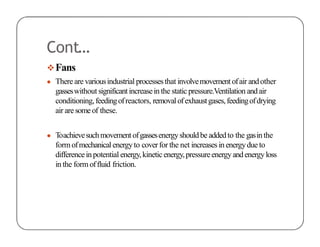
● There are variousindustrial processesthat involvemovement ofair andother
gasseswithout significantincreasein the static pressure.Ventilation andair
conditioning,feedingofreactors, removalofexhaustgases,feedingofdrying
air are someof these.
● Toachievesuchmovement ofgassesenergyshouldbe addedto the gasin the
formofmechanical energyto coverfor the net increasesin energydue to
differenceinpotential energy,kineticenergy,pressureenergyandenergyloss
in the form offluid friction.
Compressors and blowers
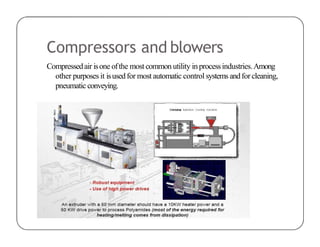
Compressedair isone ofthe most common utility in processindustries.Among
other purposes it isusedfor most automatic control systems andfor cleaning,
pneumatic conveying.
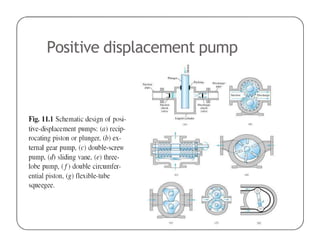
Positive displacement pump
INTRODUCTION
objective:-
isto study
● the purpose offluidmachinesandtheir applicationin process
industries
● the role ofthe chemicalengineer with respect to fluid machines.
 Inadditionsomebasicrelevantconceptsandterminologiesareexplained.
FLUID MACHINES IN CHEMICAL PROCESS
INDUSTRIES
● Inchemicalandprocessindustries it isusuallyrequired
to increase the mechanicalenergy of fluids.
● Inmovingfluidsfrom one placeto another it maybe
required to increase the mechanicalenergy (toaccountfor
increaseinpotentialenergy,velocityenergy,pressureenergyandlossesdue
tofluid friction)
● Ingassesthe energy maybe related to movingthe gasor
compress it.The machinesused for this purpose are
called fluid machines.
Cont….
● Thechemicalengineer isinvolvedin selecting, installing,
operating, testing andmaintainingfluid machines
● Todo this effectivelythe engineer hasto knowthe system
where the fluid machineisto beusedandthe operating
principles, capability andlimitations ofthe different types of
fluid machines.
Transport Phenomena
● Transport phenomena are really just a fancy way that Chemical
Engineers group together three areas of study that have certain
ideas in common. These three areas of study are:
Theyarethestudyofthetransfer of
● Momentumtransfer
● HeatTransfer
● MassTransfer
something.
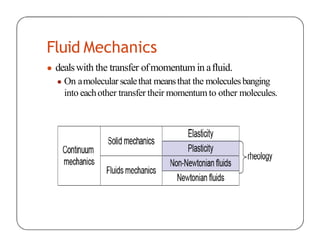
Fluid Mechanics
● dealswith the transfer ofmomentum in afluid.
● On amolecular scalethat meansthat the moleculesbanging
into eachother transfer their momentum to other molecules.
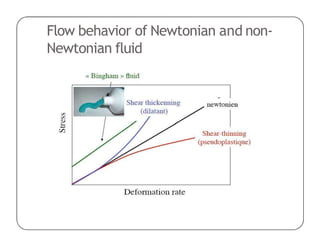
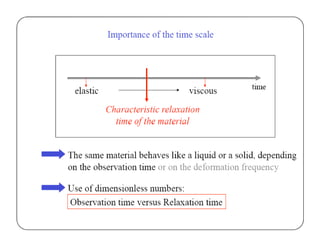
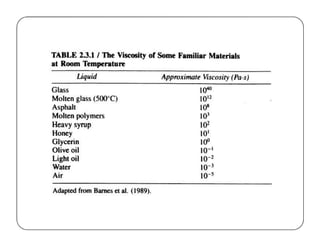
Flow behavior of Newtonian and non-
Newtonian fluid
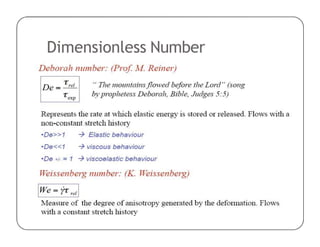
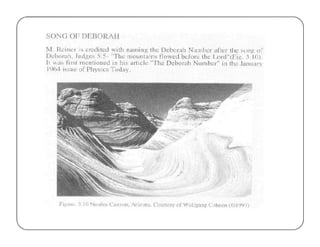
Dimensionless Number
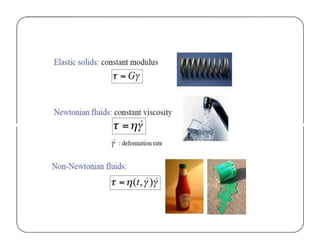
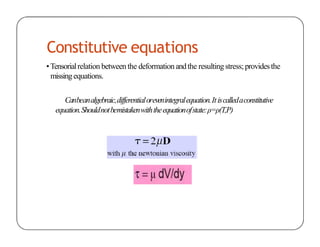
Constitutive equations
•Tensorialrelation between the deformationandthe resultingstress; providesthe
missing equations.
Canbeanalgebraic,differentialorevenintegralequation.Itiscalledaconstitutive
equation.Shouldnotbemistakenwiththeequationofstate:ρ=ρ(T,P)
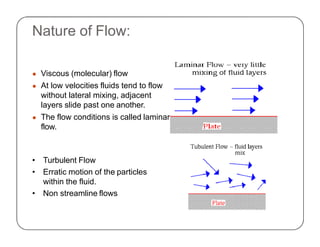
Nature of Flow:
● Viscous (molecular) flow
● At low velocities fluids tend to flow
without lateral mixing, adjacent
layers slide past one another.
● The flow conditions is called laminar
flow.
• Turbulent Flow
• Erratic motion of the particles
within the fluid.
• Non streamline flows
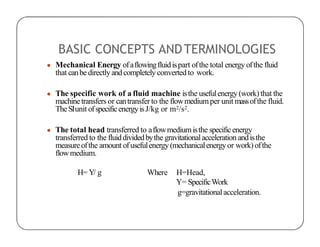
BASIC CONCEPTS ANDTERMINOLOGIES
● Mechanical Energy ofaflowingfluidispart ofthe total energyofthe fluid
that canbe directlyandcompletely converted to work.
● The specific work of a fluid machine isthe usefulenergy(work) that the
machinetransfers or cantransfer to the flowmediumper unit massofthe fluid.
TheSIunit ofspecificenergyisJ/kg or m2/s2.
● The total head transferred to aflowmediumisthe specificenergy
transferred to the fluiddividedbythe gravitationalacceleration andisthe
measureofthe amount ofusefulenergy(mechanicalenergyor work) ofthe
flowmedium.
H= Y/ g Where H=Head,
Y= SpecificWork
g=gravitationalacceleration.
Pulsation and Priming
● Pulsation:-The capacityofsomefluidmachinesisnot
uniform, it varieswith time. Pulsationisthis non uniformity
ofthe capacityfluid machines.
● Priming:-Some pumpsrequire that the air in the suction
line shouldbereplaced byliquid before theystart pumping.
Theprocessofreplacingthe air in the suction pipe with
liquid isknownas priming.
● Loss of Head islossofthe usefulheadofthe flowmedium
due to fluidfriction or the turbulence that occurs whenthe
fluid passesanobstruction, suddencontraction or sudden
expansion,etc.
Pressure
● Absolute pressure (static) ofafluid on asurfaceisthe
normal force exerted bythe fluidper unit areaofthe
surface.
● Gauge Pressure isthe pressure abovethe atmospheric
pressure.
AbsolutePressure = GaugePressure + AtmosphericPressure
● VacuumPressure isthe pressure belowthe atmospheric
pressure.
AbsolutePressure = AtmosphericPressure -VacuumPressure
Pumps
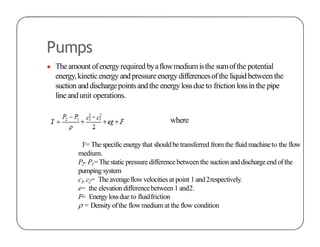
● Theamount ofenergyrequired byaflowmediumisthe sumofthe potential
energy,kineticenergyandpressure energydifferencesofthe liquidbetween the
suction anddischargepointsandthe energylossdue to friction lossin the pipe
line andunit operations.
where
Y=Thespecificenergy that shouldbe transferred from the fluid machineto the flow
medium.
P2- P1=Thestaticpressure differencebetweenthe suction anddischargeend ofthe
pumping system
c1,c2= Theaverageflowvelocities at point 1 and2respectively.
e= the elevation differencebetween 1 and2.
F= Energylossdue to fluidfriction
 = Density ofthe flowmedium at the flow condition
Compressors and blowers
● Theenergyrequirement in compressionprocessdependson the type of
compression.There are two types ofidealcompressions:adiabaticcompression
andisothermal compression.
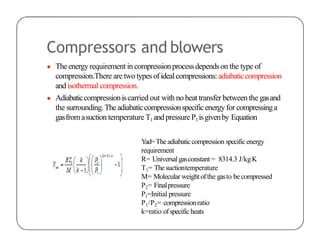
● Adiabaticcompressioniscarried out with no heat transfer between the gasand
the surrounding.Theadiabaticcompressionspecificenergyfor compressinga
gasfromasuction temperature T1andpressure P1isgivenby Equation
Yad=Theadiabaticcompression specificenergy
requirement
R= Universalgasconstant= 8314.3 J/kgK
T1= Thesuctiontemperature
M= Molecular weightofthe gasto be compressed
P2= Finalpressure
P1=Initial pressure
P1/P2= compressionratio
k=ratio ofspecificheats
Cont…
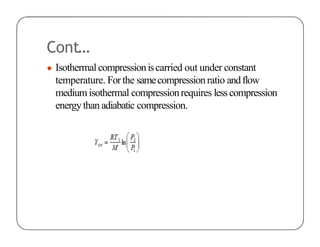
● Isothermalcompressioniscarried out under constant
temperature. Forthe samecompressionratio andflow
mediumisothermal compressionrequires lesscompression
energythan adiabatic compression.
fluid machine

fluid machine

  • 1.
    JIMMA UNIVERSITY JIMMA INSTITUTEOF TECHNOLOGY School of Chemical Engineering course: Fluid Machine For Chemical Engineering course code: ChEg 2101 Chapter One Fluid machines in chemical process industries By: Temesgen Abeto
  • 2.
    1. Definition ofFluid Machines 2. Characteristic Features and Definition of Fluid Machines 3. Energy Transfer and Specific Work of Fluid Machines 4. Theory of turbo machines 5. Theory of Positive Displacement Pumps 6. Theory of Positive Displacement Compressors 7. Capacity regulation 8. Selection and specification of Fluid Machines
  • 5.
    ● Inthe processingindustriesit isoften necessary to pump fluidsoverlong distances. ● Intermediate products are often pumped from one factory site to another, andrawmaterials suchasnatural gasand petroleum products maybepumped verylongdistancesto domestic or industrial consumers. ● It isnecessary, therefore, to consider the problems concerned with calculating the powerrequirements for pumping, with designingthe most suitableflowsystem, with estimating the most economicalsizesofpipes, with measuringthe rate of flow,andfrequently with controlling this flowat asteady rate.
  • 6.
    APPLICATION OF FLUIDMACHINES ● Production processesin aprocessplant usuallyinvolveanumber ofunit operationsthat are carried out at different placesin the plant. Dueto this, it isa common practice to moveprocessliquidsandutilities fromone placeto another in whichdifferent unit operationsare involvedin between.
  • 7.
    Cont… Fans ● There arevariousindustrial processesthat involvemovement ofair andother gasseswithout significantincreasein the static pressure.Ventilation andair conditioning,feedingofreactors, removalofexhaustgases,feedingofdrying air are someof these. ● Toachievesuchmovement ofgassesenergyshouldbe addedto the gasin the formofmechanical energyto coverfor the net increasesin energydue to differenceinpotential energy,kineticenergy,pressureenergyandenergyloss in the form offluid friction.
  • 8.
    Compressors and blowers Compressedairisone ofthe most common utility in processindustries.Among other purposes it isusedfor most automatic control systems andfor cleaning, pneumatic conveying.
  • 9.
  • 10.
    INTRODUCTION objective:- isto study ● thepurpose offluidmachinesandtheir applicationin process industries ● the role ofthe chemicalengineer with respect to fluid machines.  Inadditionsomebasicrelevantconceptsandterminologiesareexplained.
  • 11.
    FLUID MACHINES INCHEMICAL PROCESS INDUSTRIES ● Inchemicalandprocessindustries it isusuallyrequired to increase the mechanicalenergy of fluids. ● Inmovingfluidsfrom one placeto another it maybe required to increase the mechanicalenergy (toaccountfor increaseinpotentialenergy,velocityenergy,pressureenergyandlossesdue tofluid friction) ● Ingassesthe energy maybe related to movingthe gasor compress it.The machinesused for this purpose are called fluid machines.
  • 12.
    Cont…. ● Thechemicalengineer isinvolvedinselecting, installing, operating, testing andmaintainingfluid machines ● Todo this effectivelythe engineer hasto knowthe system where the fluid machineisto beusedandthe operating principles, capability andlimitations ofthe different types of fluid machines.
  • 13.
    Transport Phenomena ● Transportphenomena are really just a fancy way that Chemical Engineers group together three areas of study that have certain ideas in common. These three areas of study are: Theyarethestudyofthetransfer of ● Momentumtransfer ● HeatTransfer ● MassTransfer something.
  • 14.
    Fluid Mechanics ● dealswiththe transfer ofmomentum in afluid. ● On amolecular scalethat meansthat the moleculesbanging into eachother transfer their momentum to other molecules.
  • 16.
    Flow behavior ofNewtonian and non- Newtonian fluid
  • 20.
  • 23.
    Constitutive equations •Tensorialrelation betweenthe deformationandthe resultingstress; providesthe missing equations. Canbeanalgebraic,differentialorevenintegralequation.Itiscalledaconstitutive equation.Shouldnotbemistakenwiththeequationofstate:ρ=ρ(T,P)
  • 24.
    Nature of Flow: ●Viscous (molecular) flow ● At low velocities fluids tend to flow without lateral mixing, adjacent layers slide past one another. ● The flow conditions is called laminar flow. • Turbulent Flow • Erratic motion of the particles within the fluid. • Non streamline flows
  • 25.
    BASIC CONCEPTS ANDTERMINOLOGIES ●Mechanical Energy ofaflowingfluidispart ofthe total energyofthe fluid that canbe directlyandcompletely converted to work. ● The specific work of a fluid machine isthe usefulenergy(work) that the machinetransfers or cantransfer to the flowmediumper unit massofthe fluid. TheSIunit ofspecificenergyisJ/kg or m2/s2. ● The total head transferred to aflowmediumisthe specificenergy transferred to the fluiddividedbythe gravitationalacceleration andisthe measureofthe amount ofusefulenergy(mechanicalenergyor work) ofthe flowmedium. H= Y/ g Where H=Head, Y= SpecificWork g=gravitationalacceleration.
  • 26.
    Pulsation and Priming ●Pulsation:-The capacityofsomefluidmachinesisnot uniform, it varieswith time. Pulsationisthis non uniformity ofthe capacityfluid machines. ● Priming:-Some pumpsrequire that the air in the suction line shouldbereplaced byliquid before theystart pumping. Theprocessofreplacingthe air in the suction pipe with liquid isknownas priming. ● Loss of Head islossofthe usefulheadofthe flowmedium due to fluidfriction or the turbulence that occurs whenthe fluid passesanobstruction, suddencontraction or sudden expansion,etc.
  • 27.
    Pressure ● Absolute pressure(static) ofafluid on asurfaceisthe normal force exerted bythe fluidper unit areaofthe surface. ● Gauge Pressure isthe pressure abovethe atmospheric pressure. AbsolutePressure = GaugePressure + AtmosphericPressure ● VacuumPressure isthe pressure belowthe atmospheric pressure. AbsolutePressure = AtmosphericPressure -VacuumPressure
  • 28.
    Pumps ● Theamount ofenergyrequiredbyaflowmediumisthe sumofthe potential energy,kineticenergyandpressure energydifferencesofthe liquidbetween the suction anddischargepointsandthe energylossdue to friction lossin the pipe line andunit operations. where Y=Thespecificenergy that shouldbe transferred from the fluid machineto the flow medium. P2- P1=Thestaticpressure differencebetweenthe suction anddischargeend ofthe pumping system c1,c2= Theaverageflowvelocities at point 1 and2respectively. e= the elevation differencebetween 1 and2. F= Energylossdue to fluidfriction  = Density ofthe flowmedium at the flow condition
  • 29.
    Compressors and blowers ●Theenergyrequirement in compressionprocessdependson the type of compression.There are two types ofidealcompressions:adiabaticcompression andisothermal compression. ● Adiabaticcompressioniscarried out with no heat transfer between the gasand the surrounding.Theadiabaticcompressionspecificenergyfor compressinga gasfromasuction temperature T1andpressure P1isgivenby Equation Yad=Theadiabaticcompression specificenergy requirement R= Universalgasconstant= 8314.3 J/kgK T1= Thesuctiontemperature M= Molecular weightofthe gasto be compressed P2= Finalpressure P1=Initial pressure P1/P2= compressionratio k=ratio ofspecificheats
  • 30.
    Cont… ● Isothermalcompressioniscarried outunder constant temperature. Forthe samecompressionratio andflow mediumisothermal compressionrequires lesscompression energythan adiabatic compression.