


Applied Fluid Dynamics
End of Part 1: Incompressible Flow
Chemical Engineering Guy
www.ChemicalEngineeringGuy.com
You’re Set!
You’re done with Incompressible Flow
www.ChemicalEngineeringGuy.com
Review what you should know!
www.ChemicalEngineeringGuy.com
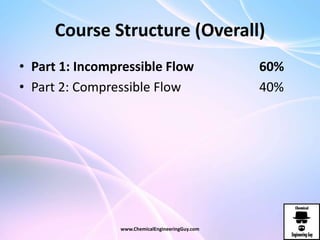
Course Structure (Overall)
• Part 1: Incompressible Flow 60%
• Part 2: Compressible Flow 40%
www.ChemicalEngineeringGuy.com
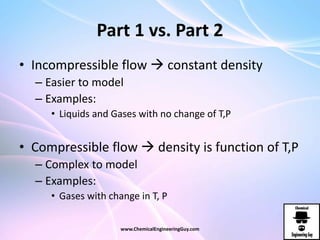
Part 1 vs. Part 2
• Incompressible flow  constant density
– Easier to model
– Examples:
• Liquids and Gases with no change of T,P
• Compressible flow  density is function of T,P
– Complex to model
– Examples:
• Gases with change in T, P
www.ChemicalEngineeringGuy.com
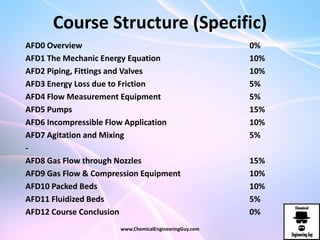
Course Structure (Specific)
AFD0 Overview 0%
AFD1 The Mechanic Energy Equation 10%
AFD2 Piping, Fittings and Valves 10%
AFD3 Energy Loss due to Friction 5%
AFD4 Flow Measurement Equipment 5%
AFD5 Pumps 15%
AFD6 Incompressible Flow Application 10%
AFD7 Agitation and Mixing 5%
-
AFD8 Gas Flow through Nozzles 15%
AFD9 Gas Flow & Compression Equipment 10%
AFD10 Packed Beds 10%
AFD11 Fluidized Beds 5%
AFD12 Course Conclusion 0%
www.ChemicalEngineeringGuy.com
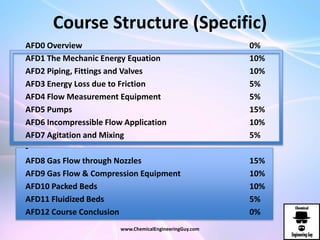
Course Structure (Specific)
www.ChemicalEngineeringGuy.com
AFD0 Overview 0%
AFD1 The Mechanic Energy Equation 10%
AFD2 Piping, Fittings and Valves 10%
AFD3 Energy Loss due to Friction 5%
AFD4 Flow Measurement Equipment 5%
AFD5 Pumps 15%
AFD6 Incompressible Flow Application 10%
AFD7 Agitation and Mixing 5%
-
AFD8 Gas Flow through Nozzles 15%
AFD9 Gas Flow & Compression Equipment 10%
AFD10 Packed Beds 10%
AFD11 Fluidized Beds 5%
AFD12 Course Conclusion 0%
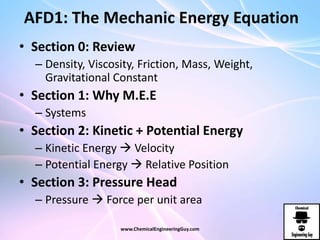
AFD1: The Mechanic Energy Equation
• Section 0: Review
– Density, Viscosity, Friction, Mass, Weight,
Gravitational Constant
• Section 1: Why M.E.E
– Systems
• Section 2: Kinetic + Potential Energy
– Kinetic Energy  Velocity
– Potential Energy  Relative Position
• Section 3: Pressure Head
– Pressure  Force per unit area
www.ChemicalEngineeringGuy.com
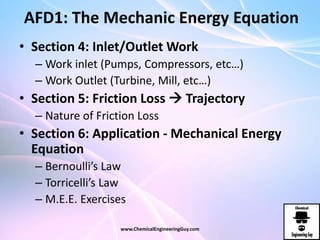
AFD1: The Mechanic Energy Equation
• Section 4: Inlet/Outlet Work
– Work inlet (Pumps, Compressors, etc…)
– Work Outlet (Turbine, Mill, etc…)
• Section 5: Friction Loss  Trajectory
– Nature of Friction Loss
• Section 6: Application - Mechanical Energy
Equation
– Bernoulli’s Law
– Torricelli’s Law
– M.E.E. Exercises
www.ChemicalEngineeringGuy.com
AFD2: Piping, Fittings and Valves
• Section 1: Pipe types and materials
– Pipe vs Piping
– Piping Material
• Material Roughness
– Piping Sizing
• Schedules
• BWG
• Section 2: Fittings & Flow Rate Measure
– Function of fittings
– Common Fittings used in Engineering
• Section 3: Valves
– Common Valves used in the industry
www.ChemicalEngineeringGuy.com
AFD3: Energy Loss due to Friction
• Section 1: Flow in Pipes Review
– Reynolds Number: Laminar and Turbulent Flows
– Pipe Roughness
• Section 2: Friction Loss in Pipes (Hff)
– Moody's and Fanning Friction Factors
– Moody’s Diagram
– Equations for F.F (Chen, Hazen-Williams, etc.)
• Section 3: Friction Loss in Fittings, Valves (Hfs)
– K value
– L/D equivalences
– K values for Fittings and Valves
www.ChemicalEngineeringGuy.com
AFD4: Flow Measurement Equipment
• Section 1: Venturi Tube
– Introduction to measurements
– The M.E.E Balance
– Advantages + Disadvantages
• Section 2: Orifice Plates
– The M.E.E Balance
– The Friction Coefficient Graphs
– Advantages + Disadvantages
• Section 3: Other Measurement Equipment
– Thermal Mass Flow Meter
– Paddle Wheel Flow Meter
– More Devices…
www.ChemicalEngineeringGuy.com
AFD5: Pumps
• Section 1: Pump Types
– Positive displacement
• Lobe, Screw, Piston, Vane, Gear
– Kinetic
• Axial and Centrifugal
– Pump Performance
• NHSPr
• Power
• Section 2: System Curve
– System Head
– System Curve
www.ChemicalEngineeringGuy.com
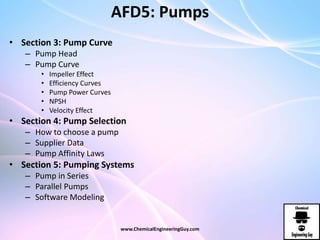
AFD5: Pumps
• Section 3: Pump Curve
– Pump Head
– Pump Curve
• Impeller Effect
• Efficiency Curves
• Pump Power Curves
• NPSH
• Velocity Effect
• Section 4: Pump Selection
– How to choose a pump
– Supplier Data
– Pump Affinity Laws
• Section 5: Pumping Systems
– Pump in Series
– Parallel Pumps
– Software Modeling
www.ChemicalEngineeringGuy.com
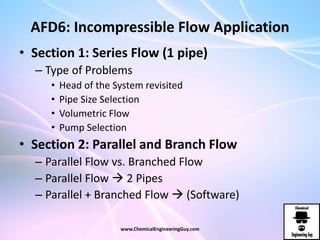
AFD6: Incompressible Flow Application
• Section 1: Series Flow (1 pipe)
– Type of Problems
• Head of the System revisited
• Pipe Size Selection
• Volumetric Flow
• Pump Selection
• Section 2: Parallel and Branch Flow
– Parallel Flow vs. Branched Flow
– Parallel Flow  2 Pipes
– Parallel + Branched Flow  (Software)
www.ChemicalEngineeringGuy.com
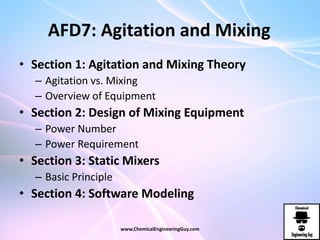
AFD7: Agitation and Mixing
• Section 1: Agitation and Mixing Theory
– Agitation vs. Mixing
– Overview of Equipment
• Section 2: Design of Mixing Equipment
– Power Number
– Power Requirement
• Section 3: Static Mixers
– Basic Principle
• Section 4: Software Modeling
www.ChemicalEngineeringGuy.com
What’s next?
• PART 2  Compressible Flow
www.ChemicalEngineeringGuy.com
What’s next?
• How do gases move in pipes?
• How do you pressurize gases?
• Compression Types?
• What is a compressor
www.ChemicalEngineeringGuy.com
Questions and Problems
• There are no problems in this section.
• All problems and exercises are solved in the
next webpage
– www.ChemicalEngineeringGuy.com
• Courses
– Applied Fluid Dynamics
» Part 1: Incompressible Flow
» Part 2: Compressible Flow
www.ChemicalEngineeringGuy.com
Contact Information!
• Get extra information here!
– Directly on the WebPage:
• www.ChemicalEngineeringGuy.com/courses
– FB page:
• www.facebook.com/Chemical.Engineering.Guy
– My Twitter:
• www.twitter.com/ChemEngGuy
– Contact me by e-mail:
• Contact@ChemicalEngineeringGuy.com
www.ChemicalEngineeringGuy.com

AFD Incompressible Flow - Conclusion

  • 1.
    Applied Fluid Dynamics Endof Part 1: Incompressible Flow Chemical Engineering Guy www.ChemicalEngineeringGuy.com
  • 2.
    You’re Set! You’re donewith Incompressible Flow www.ChemicalEngineeringGuy.com
  • 3.
    Review what youshould know! www.ChemicalEngineeringGuy.com
  • 4.
    Course Structure (Overall) •Part 1: Incompressible Flow 60% • Part 2: Compressible Flow 40% www.ChemicalEngineeringGuy.com
  • 5.
    Part 1 vs.Part 2 • Incompressible flow  constant density – Easier to model – Examples: • Liquids and Gases with no change of T,P • Compressible flow  density is function of T,P – Complex to model – Examples: • Gases with change in T, P www.ChemicalEngineeringGuy.com
  • 6.
    Course Structure (Specific) AFD0Overview 0% AFD1 The Mechanic Energy Equation 10% AFD2 Piping, Fittings and Valves 10% AFD3 Energy Loss due to Friction 5% AFD4 Flow Measurement Equipment 5% AFD5 Pumps 15% AFD6 Incompressible Flow Application 10% AFD7 Agitation and Mixing 5% - AFD8 Gas Flow through Nozzles 15% AFD9 Gas Flow & Compression Equipment 10% AFD10 Packed Beds 10% AFD11 Fluidized Beds 5% AFD12 Course Conclusion 0% www.ChemicalEngineeringGuy.com
  • 7.
    Course Structure (Specific) www.ChemicalEngineeringGuy.com AFD0Overview 0% AFD1 The Mechanic Energy Equation 10% AFD2 Piping, Fittings and Valves 10% AFD3 Energy Loss due to Friction 5% AFD4 Flow Measurement Equipment 5% AFD5 Pumps 15% AFD6 Incompressible Flow Application 10% AFD7 Agitation and Mixing 5% - AFD8 Gas Flow through Nozzles 15% AFD9 Gas Flow & Compression Equipment 10% AFD10 Packed Beds 10% AFD11 Fluidized Beds 5% AFD12 Course Conclusion 0%
  • 8.
    AFD1: The MechanicEnergy Equation • Section 0: Review – Density, Viscosity, Friction, Mass, Weight, Gravitational Constant • Section 1: Why M.E.E – Systems • Section 2: Kinetic + Potential Energy – Kinetic Energy  Velocity – Potential Energy  Relative Position • Section 3: Pressure Head – Pressure  Force per unit area www.ChemicalEngineeringGuy.com
  • 9.
    AFD1: The MechanicEnergy Equation • Section 4: Inlet/Outlet Work – Work inlet (Pumps, Compressors, etc…) – Work Outlet (Turbine, Mill, etc…) • Section 5: Friction Loss  Trajectory – Nature of Friction Loss • Section 6: Application - Mechanical Energy Equation – Bernoulli’s Law – Torricelli’s Law – M.E.E. Exercises www.ChemicalEngineeringGuy.com
  • 10.
    AFD2: Piping, Fittingsand Valves • Section 1: Pipe types and materials – Pipe vs Piping – Piping Material • Material Roughness – Piping Sizing • Schedules • BWG • Section 2: Fittings & Flow Rate Measure – Function of fittings – Common Fittings used in Engineering • Section 3: Valves – Common Valves used in the industry www.ChemicalEngineeringGuy.com
  • 11.
    AFD3: Energy Lossdue to Friction • Section 1: Flow in Pipes Review – Reynolds Number: Laminar and Turbulent Flows – Pipe Roughness • Section 2: Friction Loss in Pipes (Hff) – Moody's and Fanning Friction Factors – Moody’s Diagram – Equations for F.F (Chen, Hazen-Williams, etc.) • Section 3: Friction Loss in Fittings, Valves (Hfs) – K value – L/D equivalences – K values for Fittings and Valves www.ChemicalEngineeringGuy.com
  • 12.
    AFD4: Flow MeasurementEquipment • Section 1: Venturi Tube – Introduction to measurements – The M.E.E Balance – Advantages + Disadvantages • Section 2: Orifice Plates – The M.E.E Balance – The Friction Coefficient Graphs – Advantages + Disadvantages • Section 3: Other Measurement Equipment – Thermal Mass Flow Meter – Paddle Wheel Flow Meter – More Devices… www.ChemicalEngineeringGuy.com
  • 13.
    AFD5: Pumps • Section1: Pump Types – Positive displacement • Lobe, Screw, Piston, Vane, Gear – Kinetic • Axial and Centrifugal – Pump Performance • NHSPr • Power • Section 2: System Curve – System Head – System Curve www.ChemicalEngineeringGuy.com
  • 14.
    AFD5: Pumps • Section3: Pump Curve – Pump Head – Pump Curve • Impeller Effect • Efficiency Curves • Pump Power Curves • NPSH • Velocity Effect • Section 4: Pump Selection – How to choose a pump – Supplier Data – Pump Affinity Laws • Section 5: Pumping Systems – Pump in Series – Parallel Pumps – Software Modeling www.ChemicalEngineeringGuy.com
  • 15.
    AFD6: Incompressible FlowApplication • Section 1: Series Flow (1 pipe) – Type of Problems • Head of the System revisited • Pipe Size Selection • Volumetric Flow • Pump Selection • Section 2: Parallel and Branch Flow – Parallel Flow vs. Branched Flow – Parallel Flow  2 Pipes – Parallel + Branched Flow  (Software) www.ChemicalEngineeringGuy.com
  • 16.
    AFD7: Agitation andMixing • Section 1: Agitation and Mixing Theory – Agitation vs. Mixing – Overview of Equipment • Section 2: Design of Mixing Equipment – Power Number – Power Requirement • Section 3: Static Mixers – Basic Principle • Section 4: Software Modeling www.ChemicalEngineeringGuy.com
  • 17.
    What’s next? • PART2  Compressible Flow www.ChemicalEngineeringGuy.com
  • 18.
    What’s next? • Howdo gases move in pipes? • How do you pressurize gases? • Compression Types? • What is a compressor www.ChemicalEngineeringGuy.com
  • 19.
    Questions and Problems •There are no problems in this section. • All problems and exercises are solved in the next webpage – www.ChemicalEngineeringGuy.com • Courses – Applied Fluid Dynamics » Part 1: Incompressible Flow » Part 2: Compressible Flow www.ChemicalEngineeringGuy.com
  • 20.
    Contact Information! • Getextra information here! – Directly on the WebPage: • www.ChemicalEngineeringGuy.com/courses – FB page: • www.facebook.com/Chemical.Engineering.Guy – My Twitter: • www.twitter.com/ChemEngGuy – Contact me by e-mail: • Contact@ChemicalEngineeringGuy.com www.ChemicalEngineeringGuy.com