MAHENDRA TIWARI
CSJMA14001390232
COMPUTATIONAL
FLUID DYNAMICS
1
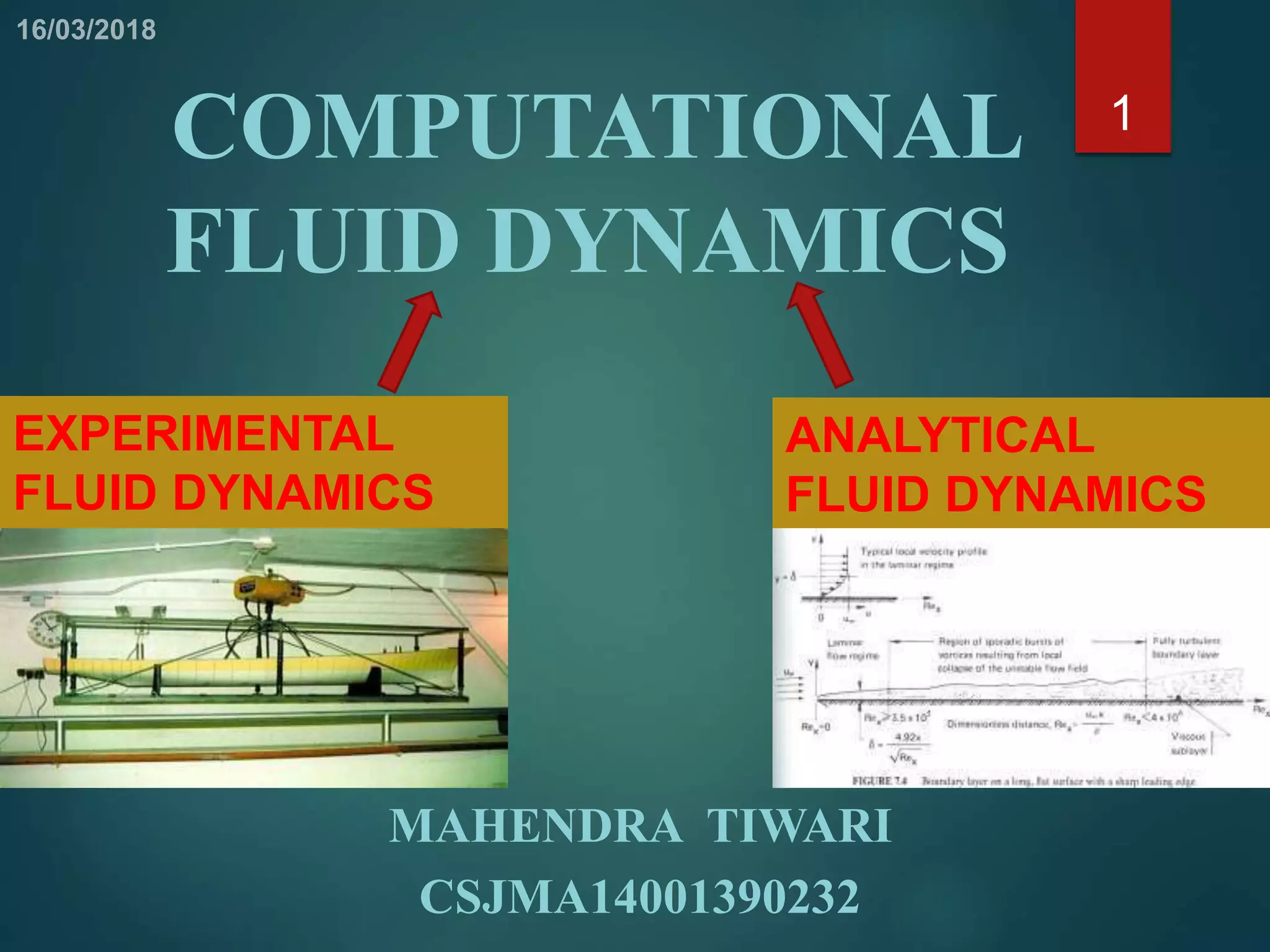
EXPERIMENTAL
FLUID DYNAMICS
(EFD)
ANALYTICAL
FLUID DYNAMICS
(AFD)
2
“A theory is something nobody believes except the person proposing the theory and an
experiment is something everybody believes except the person doing the experiment”
--Albert Einstein(1879-1955)
Overview:-
 What is CFD?
 Purpose and Aim
 How it works?
 Advantages
 Applications
 Limitations of CFD
 References
3
What is CFD?
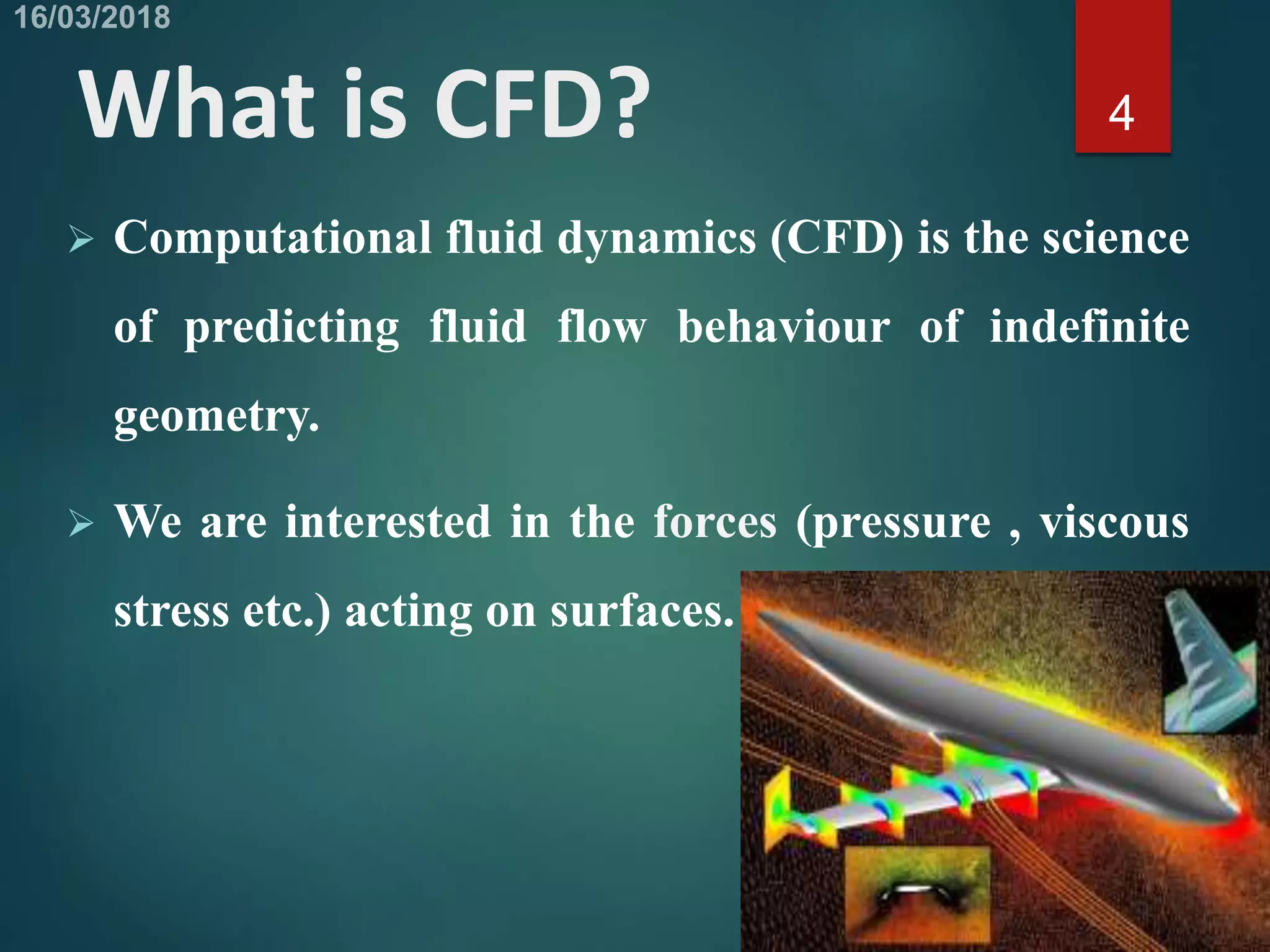
 Computational fluid dynamics (CFD) is the science
of predicting fluid flow behaviour of indefinite
geometry.
 We are interested in the forces (pressure , viscous
stress etc.) acting on surfaces.
4
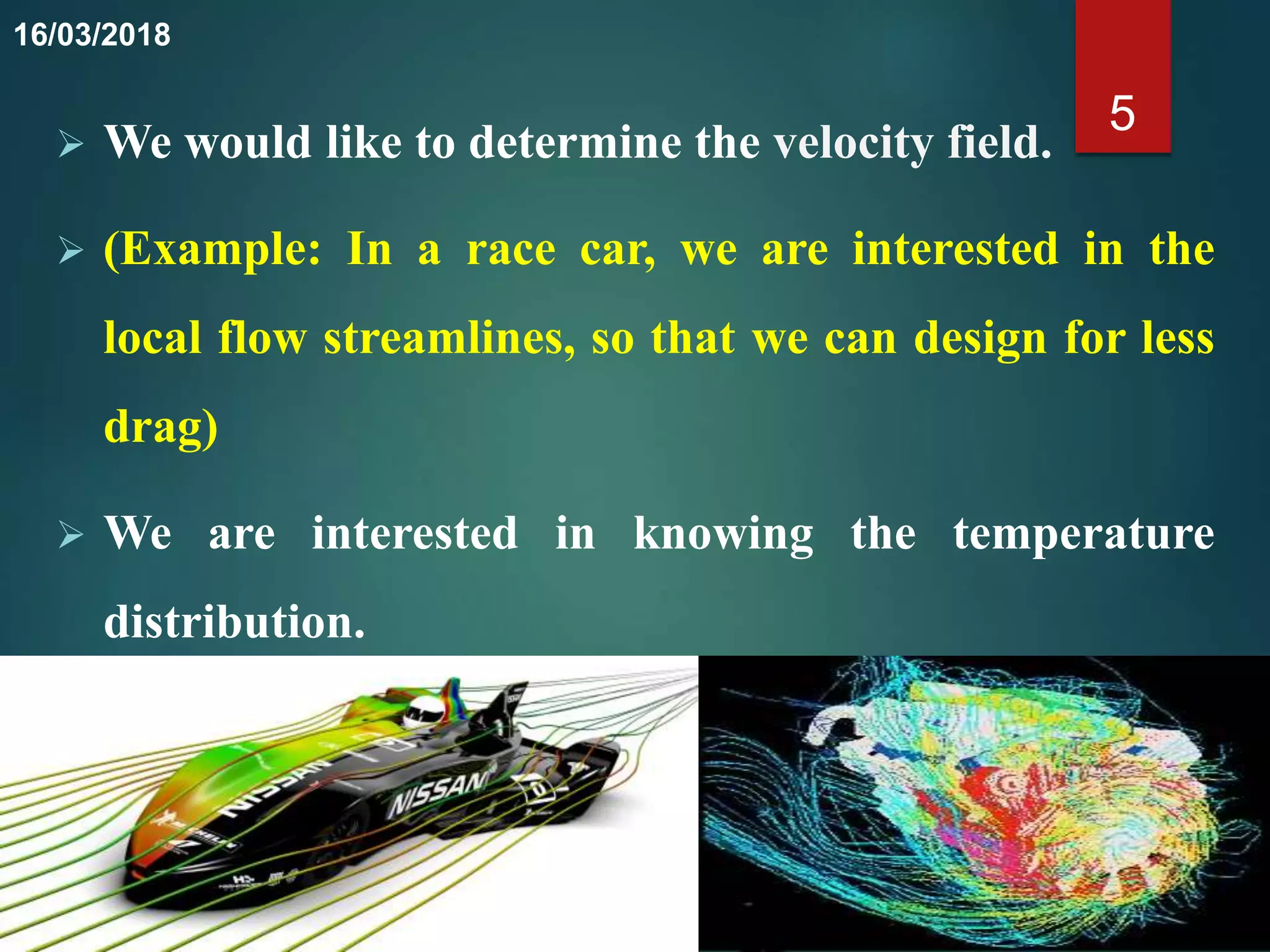
 We would like to determine the velocity field.
 (Example: In a race car, we are interested in the
local flow streamlines, so that we can design for less
drag)
 We are interested in knowing the temperature
distribution.
5
16/03/2018
History of CFD 6
Since 1940s analytical solution to most fluid dynamics
problems was available for idealized solutions.
Methods for solution of ODEs or PDEs were conceived only
on paper due to absence of personal computer.
FLUENT, TIDAL, C-MOLD, GASP,
FLOTRAN, SPLASH etc.
National Scenario in CFD:
 Educational / Research Institutes –IIT’s, IISc, BARC
 NAL, BHEL, SAIL, GTRE, Cummins, Mahindra,
Birla group,GE, TCS etc.
7
16/03/2018
Why CFD ?? 8
Growth in complexity of unsolved engineering
problem.
Need for quick solutions of moderate
accuracy.
Developments in computers in terms of speed and
storage.
Efficient solution algorithms.
How it works?
 Analysis begins with a mathematical model of a
physical problem.
 Conservation of mass, momentum, and energy must
be satisfied throughout the region of interest.
 Fluid properties are modeled empirically.
9
10
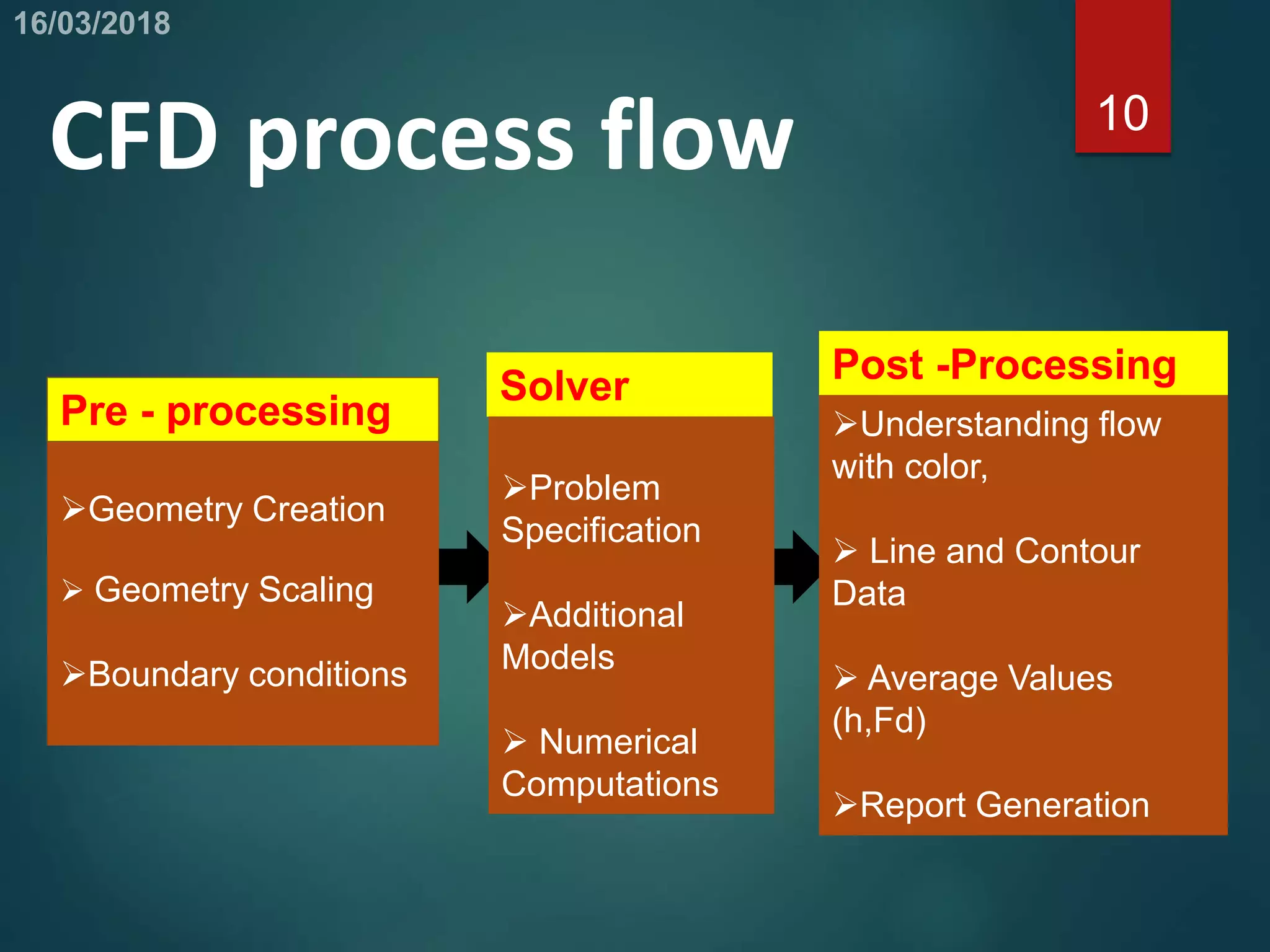
CFD process flow
Pre - processing
Solver
Post -Processing
Geometry Creation
 Geometry Scaling
Boundary conditions
Problem
Specification
Additional
Models
 Numerical
Computations
Understanding flow
with color,
 Line and Contour
Data
 Average Values
(h,Fd)
Report Generation
11
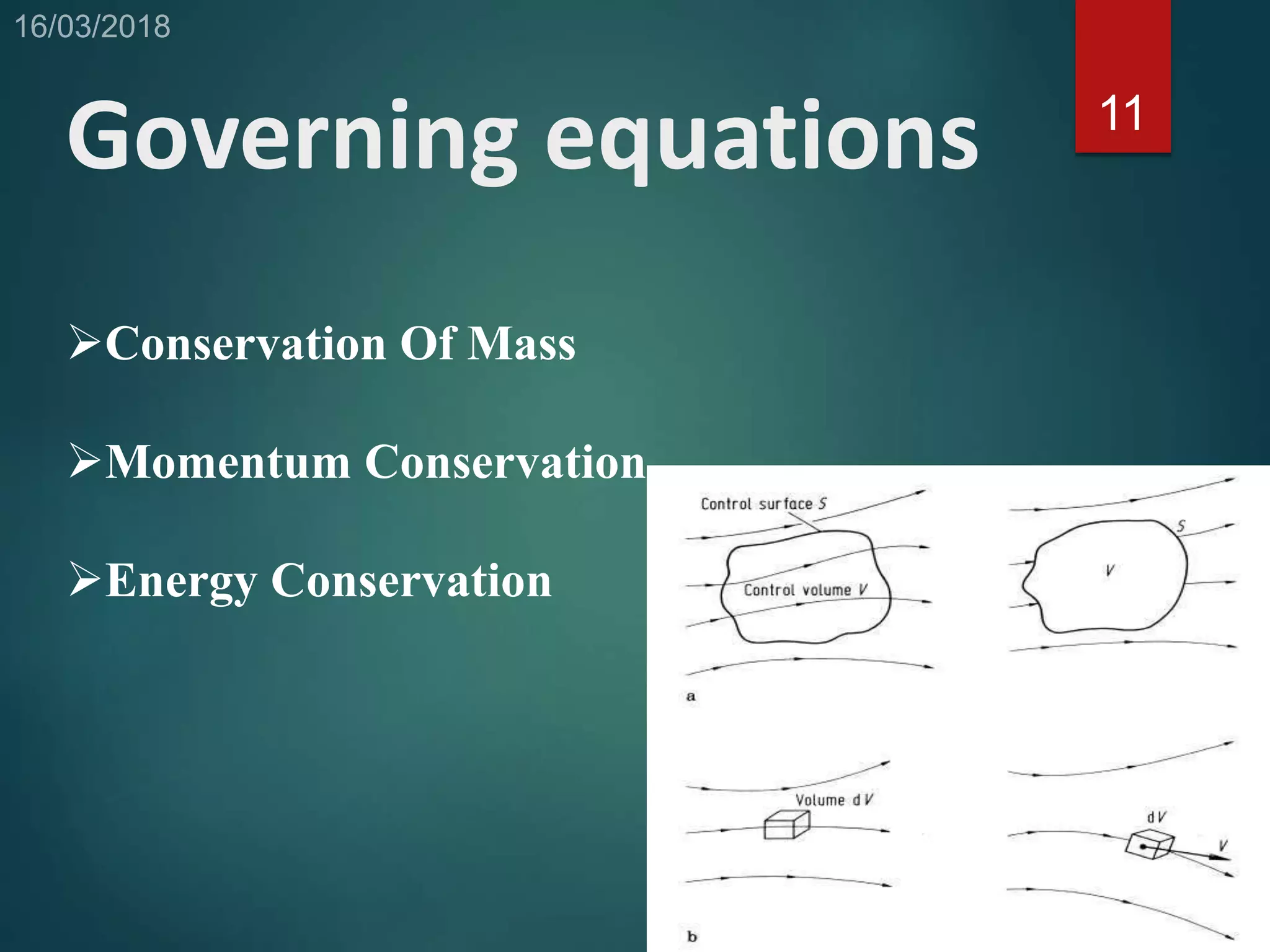
Governing equations
Conservation Of Mass
Momentum Conservation
Energy Conservation
12
Operation
The flow region or calculation domain is divided
into a large number of finite volumes or cells.
Partial differential equations are discretized
using a wide range of techniques: finite difference,
finite volume or finite element.
Algebraic equations gathered into matrices which
are solved by an iterative procedure .
Advantages:
 Relatively low cost:-
CFD simulations are relatively inexpensive, and costs are
likely to decrease as computers become more powerful.
 Speed:-
CFD simulations can be executed in a short period of
time.
 Ability to simulate real conditions:-
CFD provides the ability to theoretically simulate any
physical condition.
13
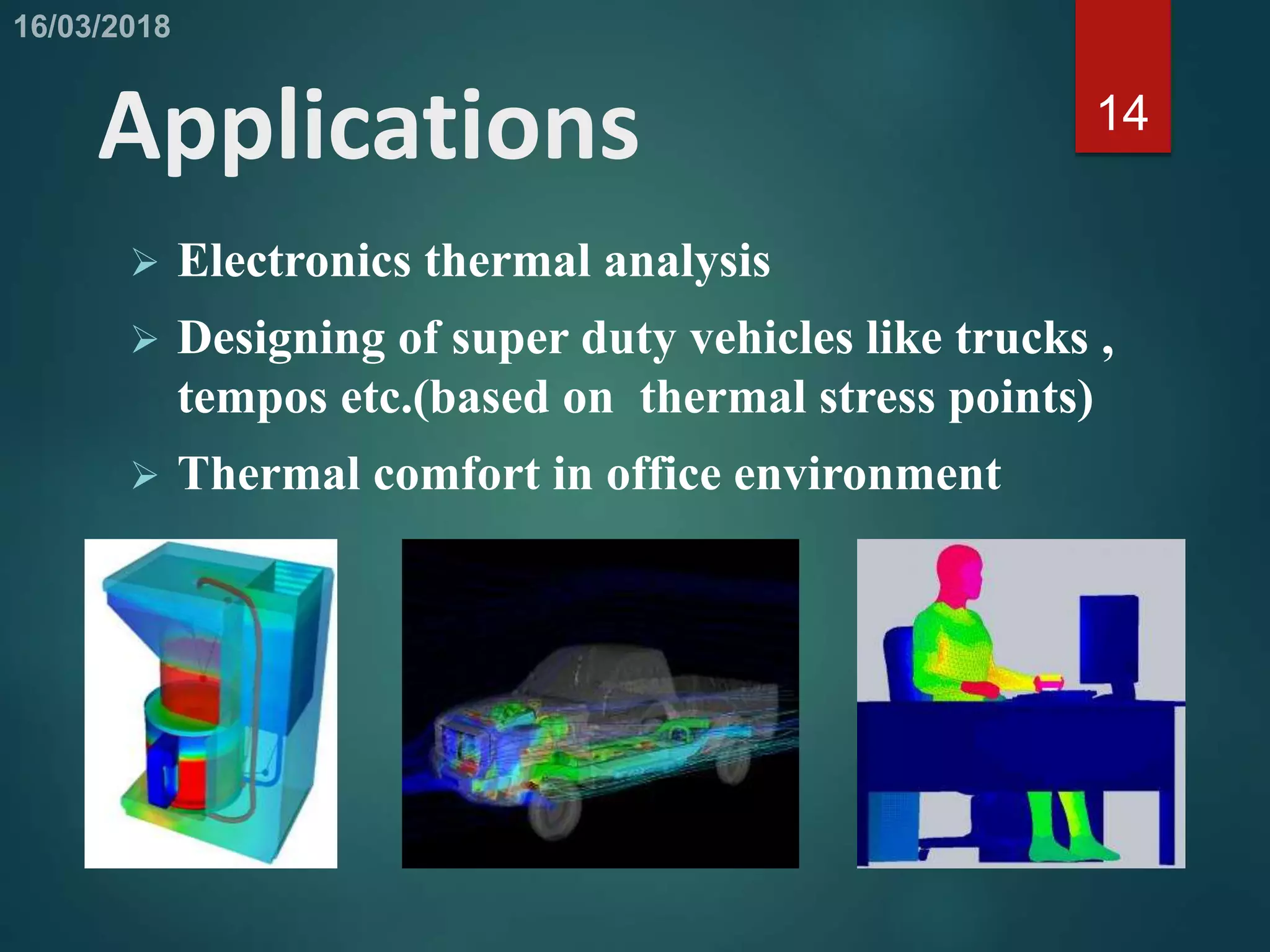
Applications
 Electronics thermal analysis
 Designing of super duty vehicles like trucks ,
tempos etc.(based on thermal stress points)
 Thermal comfort in office environment
14
Limitations of CFD 15
Physical models
CFD solutions rely upon physical models of real
Processes
Numerical Errors
Round-off error
Truncation error
Boundary conditions
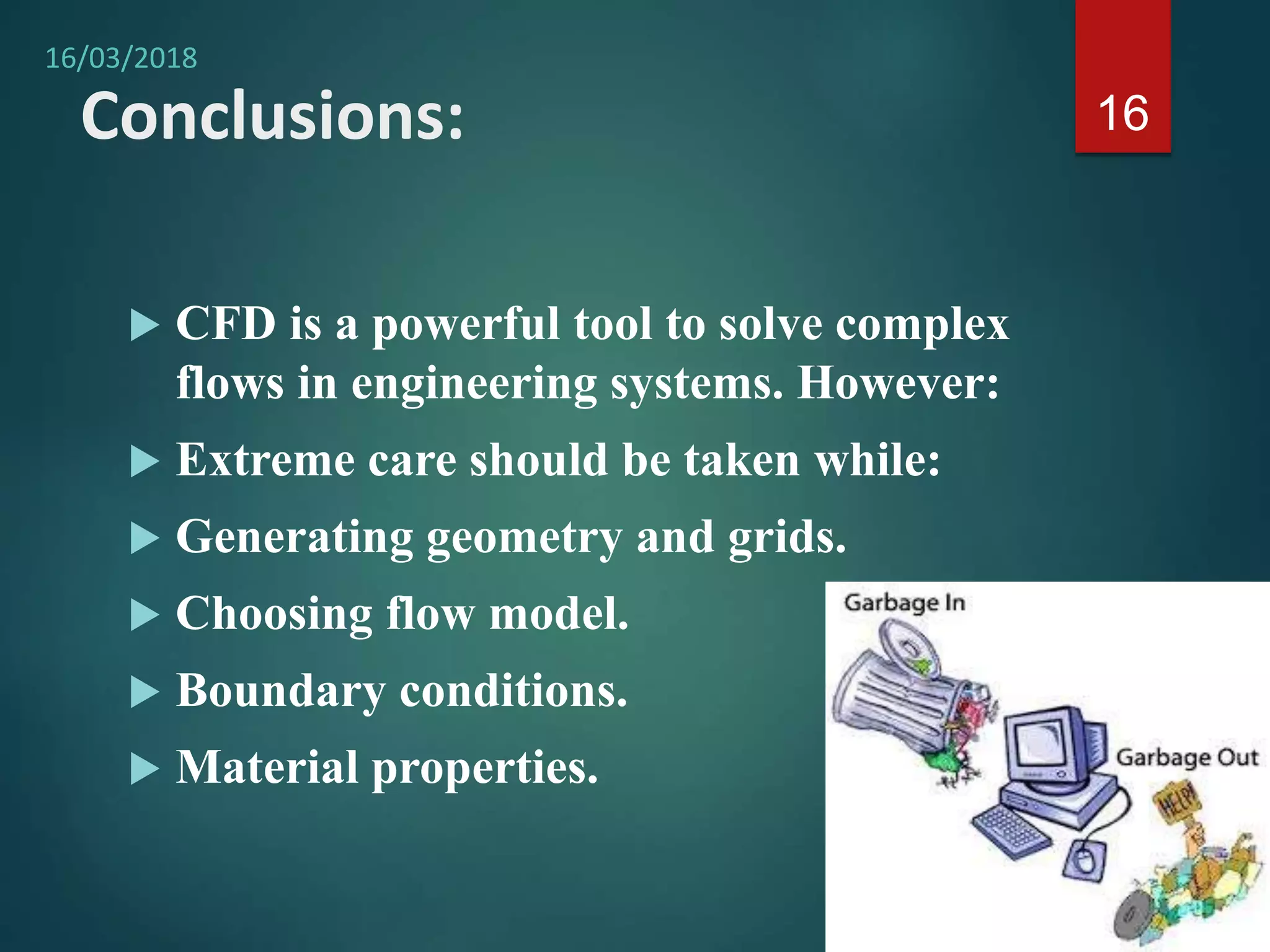
Conclusions:
 CFD is a powerful tool to solve complex
flows in engineering systems. However:
 Extreme care should be taken while:
 Generating geometry and grids.
 Choosing flow model.
 Boundary conditions.
 Material properties.
16
16/03/2018
References
https://en.wikipedia.org/wiki/Computational_fluid_dyna
mics
https://www.quora.com/topic/Computational-Fluid-
Dynamics
https ://www.springerlink.com
17
18

FLUID DYNAMIC

  • 1.
  • 2.
    2 “A theory issomething nobody believes except the person proposing the theory and an experiment is something everybody believes except the person doing the experiment” --Albert Einstein(1879-1955)
  • 3.
    Overview:-  What isCFD?  Purpose and Aim  How it works?  Advantages  Applications  Limitations of CFD  References 3
  • 4.
    What is CFD? Computational fluid dynamics (CFD) is the science of predicting fluid flow behaviour of indefinite geometry.  We are interested in the forces (pressure , viscous stress etc.) acting on surfaces. 4
  • 5.
     We wouldlike to determine the velocity field.  (Example: In a race car, we are interested in the local flow streamlines, so that we can design for less drag)  We are interested in knowing the temperature distribution. 5 16/03/2018
  • 6.
    History of CFD6 Since 1940s analytical solution to most fluid dynamics problems was available for idealized solutions. Methods for solution of ODEs or PDEs were conceived only on paper due to absence of personal computer. FLUENT, TIDAL, C-MOLD, GASP, FLOTRAN, SPLASH etc.
  • 7.
    National Scenario inCFD:  Educational / Research Institutes –IIT’s, IISc, BARC  NAL, BHEL, SAIL, GTRE, Cummins, Mahindra, Birla group,GE, TCS etc. 7 16/03/2018
  • 8.
    Why CFD ??8 Growth in complexity of unsolved engineering problem. Need for quick solutions of moderate accuracy. Developments in computers in terms of speed and storage. Efficient solution algorithms.
  • 9.
    How it works? Analysis begins with a mathematical model of a physical problem.  Conservation of mass, momentum, and energy must be satisfied throughout the region of interest.  Fluid properties are modeled empirically. 9
  • 10.
    10 CFD process flow Pre- processing Solver Post -Processing Geometry Creation  Geometry Scaling Boundary conditions Problem Specification Additional Models  Numerical Computations Understanding flow with color,  Line and Contour Data  Average Values (h,Fd) Report Generation
  • 11.
    11 Governing equations Conservation OfMass Momentum Conservation Energy Conservation
  • 12.
    12 Operation The flow regionor calculation domain is divided into a large number of finite volumes or cells. Partial differential equations are discretized using a wide range of techniques: finite difference, finite volume or finite element. Algebraic equations gathered into matrices which are solved by an iterative procedure .
  • 13.
    Advantages:  Relatively lowcost:- CFD simulations are relatively inexpensive, and costs are likely to decrease as computers become more powerful.  Speed:- CFD simulations can be executed in a short period of time.  Ability to simulate real conditions:- CFD provides the ability to theoretically simulate any physical condition. 13
  • 14.
    Applications  Electronics thermalanalysis  Designing of super duty vehicles like trucks , tempos etc.(based on thermal stress points)  Thermal comfort in office environment 14
  • 15.
    Limitations of CFD15 Physical models CFD solutions rely upon physical models of real Processes Numerical Errors Round-off error Truncation error Boundary conditions
  • 16.
    Conclusions:  CFD isa powerful tool to solve complex flows in engineering systems. However:  Extreme care should be taken while:  Generating geometry and grids.  Choosing flow model.  Boundary conditions.  Material properties. 16 16/03/2018
  • 17.
  • 18.