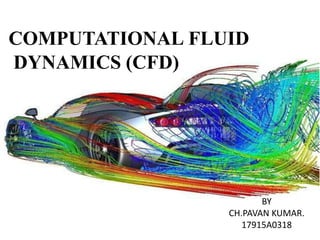
COMPUTATIONAL FLUID
DYNAMICS (CFD)
BY
CH.PAVAN KUMAR.
17915A0318
CONTENTS.
1.INTRODUCTION.
2.OBJECTIVES.
3.USE OF CFD.
4.PROCESS.
5.RESOURCES.
6.APPLICATIONS.
7.CONCLUSION.
8.REFERENCES.
INTRODUCTION
What is cfd ?
-Computational Fluid Dynamics .
-Historically Analytical Fluid Dynamics and EFD
(Experimental Fluid Dynamics) was used.
-CFD has become feasible due to the advent of high
speed digital computers.
-Computer simulation for prediction of fluid –flow
phenomena.
OBJECTIVES.
• Product design development-
product validation and enhancement.
• Design Optimization-
multi-parameter optimization.
• Flow analysis-
extensive characterization of the flow
• Performance evaluation-
performance estimation.
USE OF CFD.
• Why use CFD?
– Analysis and Design
• Simulation-based design instead of “build &
test”
• Simulation of physical fluid phenomena that are
difficult to be measured by experiments.
– Knowledge and exploration of flow physics
PROCESS.
1. Geometry description
2. Specification of flow conditions and properties
3. Selection of models
4. Specification of initial and boundary conditions
5. Grid generation and transformation
6. Specification of numerical parameters
7. Flow solution
8. Post processing: Analysis, and visualization
9. Uncertainty assessment
SOFTWARES & RESOURCES.
• More information on CFD can be got on the following
website:
– CFD Online: http://www.cfd-online.com/
– CFD software
• FLUENT: http://www.fluent.com/
• COMSOL http://www.comsol.com/
• CD-adapco: http://www.cd-adapco.com/
– Grid generation software
• Gridgen: http://www.pointwise.com
• GridPro: http://www.gridpro.com/
– Visualization software
• Tecplot: http://www.amtec.com/
• Fieldview: http://www.ilight.com/
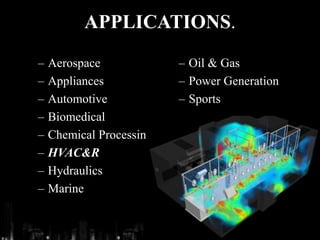
APPLICATIONS.
– Aerospace
– Appliances
– Automotive
– Biomedical
– Chemical Processing
– HVAC&R
– Hydraulics
– Marine
– Oil & Gas
– Power Generation
– Sports
CONCLUSION.
The CFD is one of the best analysis method to
analyze as will as to give profound results and in the
near future there may be a transformation to a higher
level where more number of people show their interests
in this field.
REFERENCES.
• http://www.fondtech.eu/site/index.php/cfd-
main/cfd-objec.
• https://ntrs.nasa.gov/archive/nasa/casi.ntrs.nasa.gov
/20050182778.pdf.
• https://www.cfd-online.com/
THANK YOU

Computational fluidDynamics