PROMOTING SPEECH FLUENCY:
A CLASSROOM PERSPECTIVE
Joan McCormack; Colin Campbell and Parvaneh Tavakoli
International Study and Language Institute
Department of English Language and Applied Linguistics
OUTLINE OF THE PRESENTATION
 What is speech/oral fluency?
 What does research in this area suggest?
 Our recent research at University of Reading
 How to promote fluency in second/modern foreign
language classroom
 Special thanks to the following departments for
funding the research & this workshop
 CeLM (Centre for Literacy & Multilingualism)
 ISLI (International Study & Language Institute)
 DELAL (Department of English Language & Applied
Linguistics)
SMALL GROUP DISCUSSION
 In small groups, discuss the following questions:
 What is speech fluency?
 Why is it important?
 Can speech fluency be taught in classroom?
 15 minutes discussion + 10 minutes feedback
WHY SPEECH FLUENCY (MFL)
 Speaking fluently is a key goal in language learning for
many teachers and learners
 extracts from Modern Foreign Languages GCSE subject
content (January 2015)
 develop ability to communicate confidently and
coherently with native speakers in speech
 express and develop thoughts and ideas spontaneously
and fluently
 develop language strategies, including repair strategies
WHY SPEECH FLUENCY (CEFR)
 Fluency is one of the five key components of speaking in CEFR
 Extracts from Common European Framework of Reference for
Languages
 Ability to speak fluently in speaking and delivering
presentations is a priority
 Ability to interact with others with a degree of fluency and
spontaneity
 Two generic qualitative factors which determine the functional
success of the learner/user are:
 a) fluency, the ability to articulate, to keep going, and to
cope when one lands in a dead end
 b) propositional precision, the ability to formulate
thoughts and propositions so as to make one’s meaning
clear
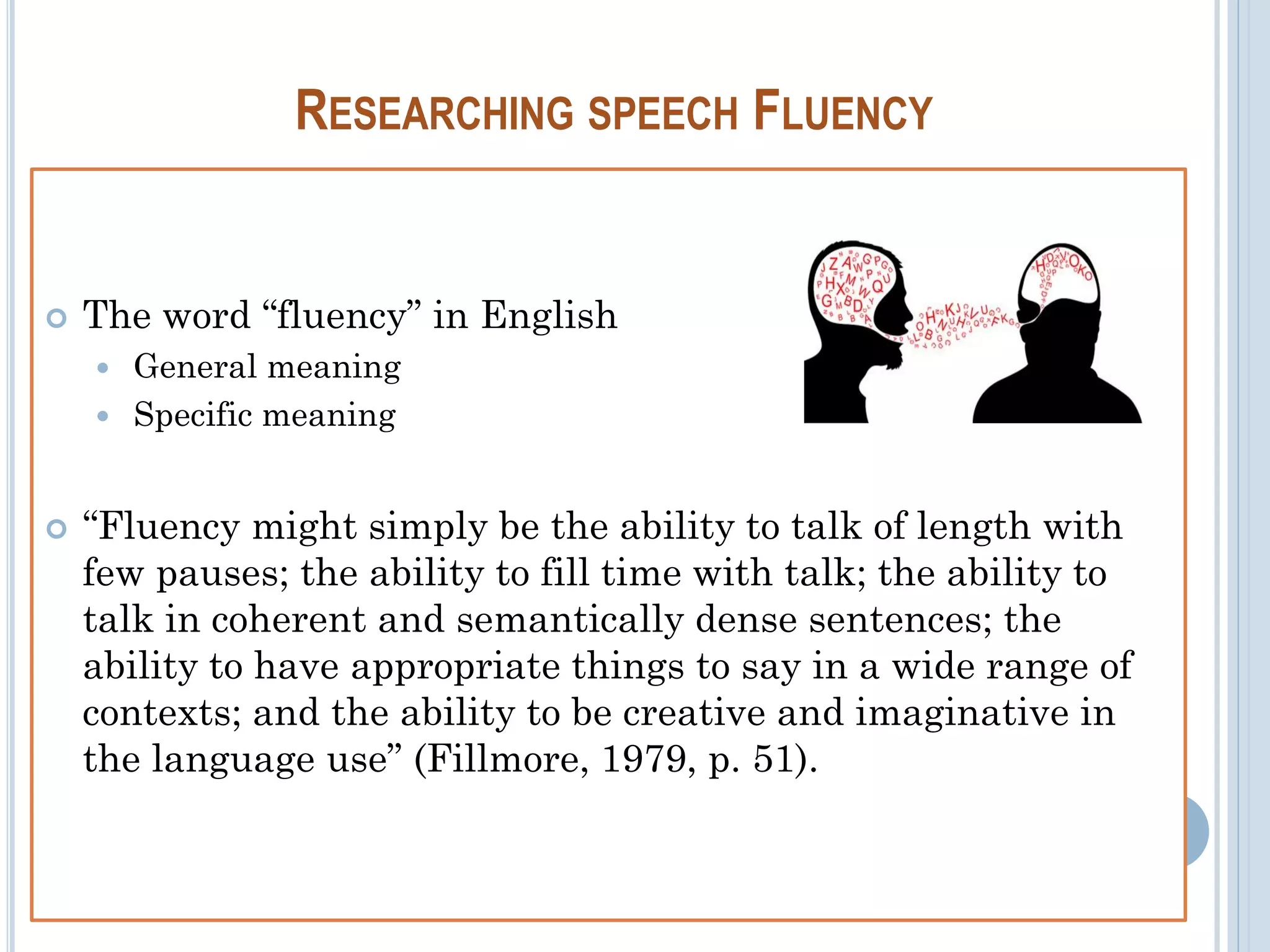
RESEARCHING SPEECH FLUENCY
 The word “fluency” in English
 General meaning
 Specific meaning
 “Fluency might simply be the ability to talk of length with
few pauses; the ability to fill time with talk; the ability to
talk in coherent and semantically dense sentences; the
ability to have appropriate things to say in a wide range of
contexts; and the ability to be creative and imaginative in
the language use” (Fillmore, 1979, p. 51).
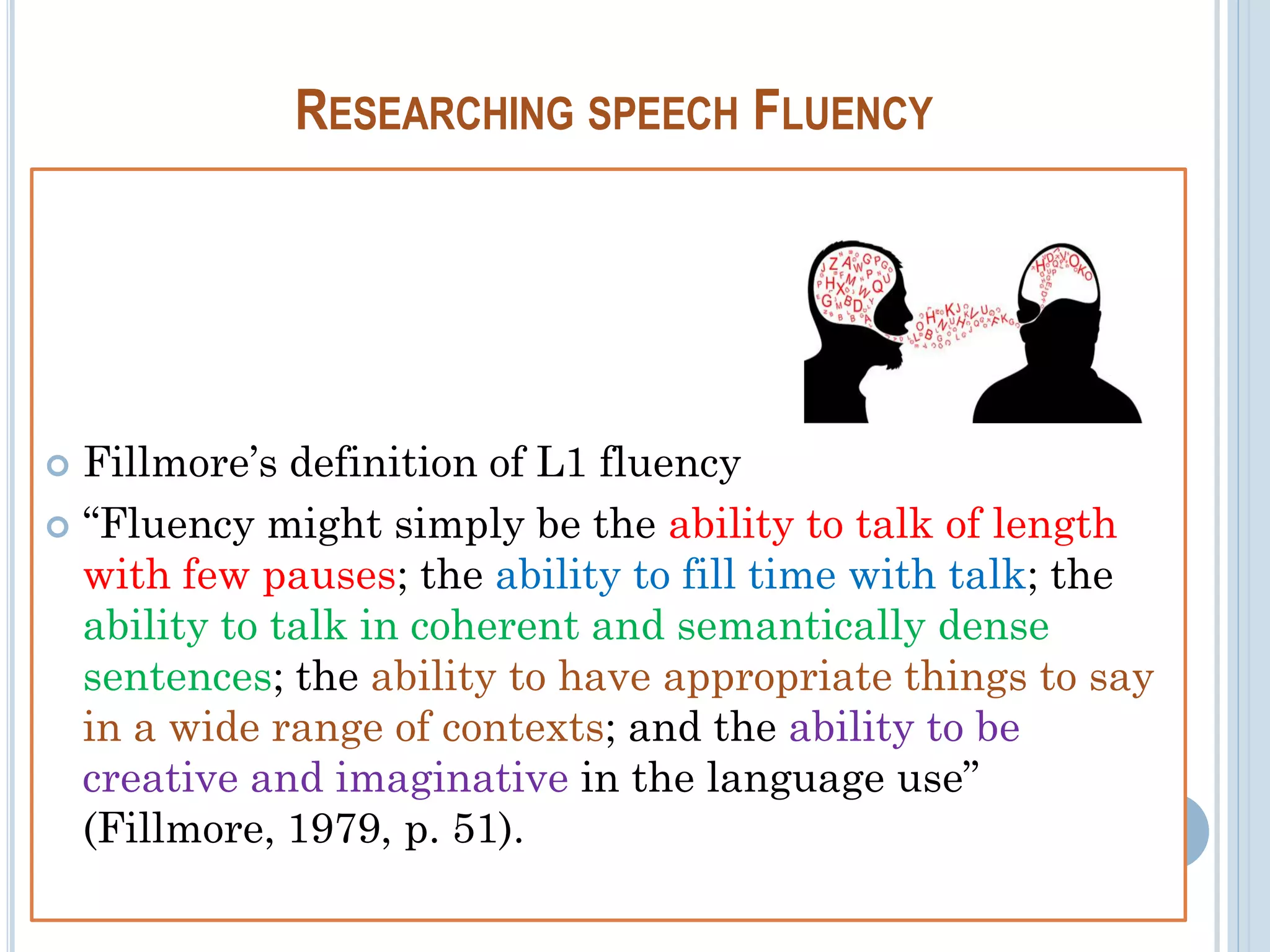
RESEARCHING SPEECH FLUENCY
 Fillmore’s definition of L1 fluency
 “Fluency might simply be the ability to talk of length
with few pauses; the ability to fill time with talk; the
ability to talk in coherent and semantically dense
sentences; the ability to have appropriate things to say
in a wide range of contexts; and the ability to be
creative and imaginative in the language use”
(Fillmore, 1979, p. 51).
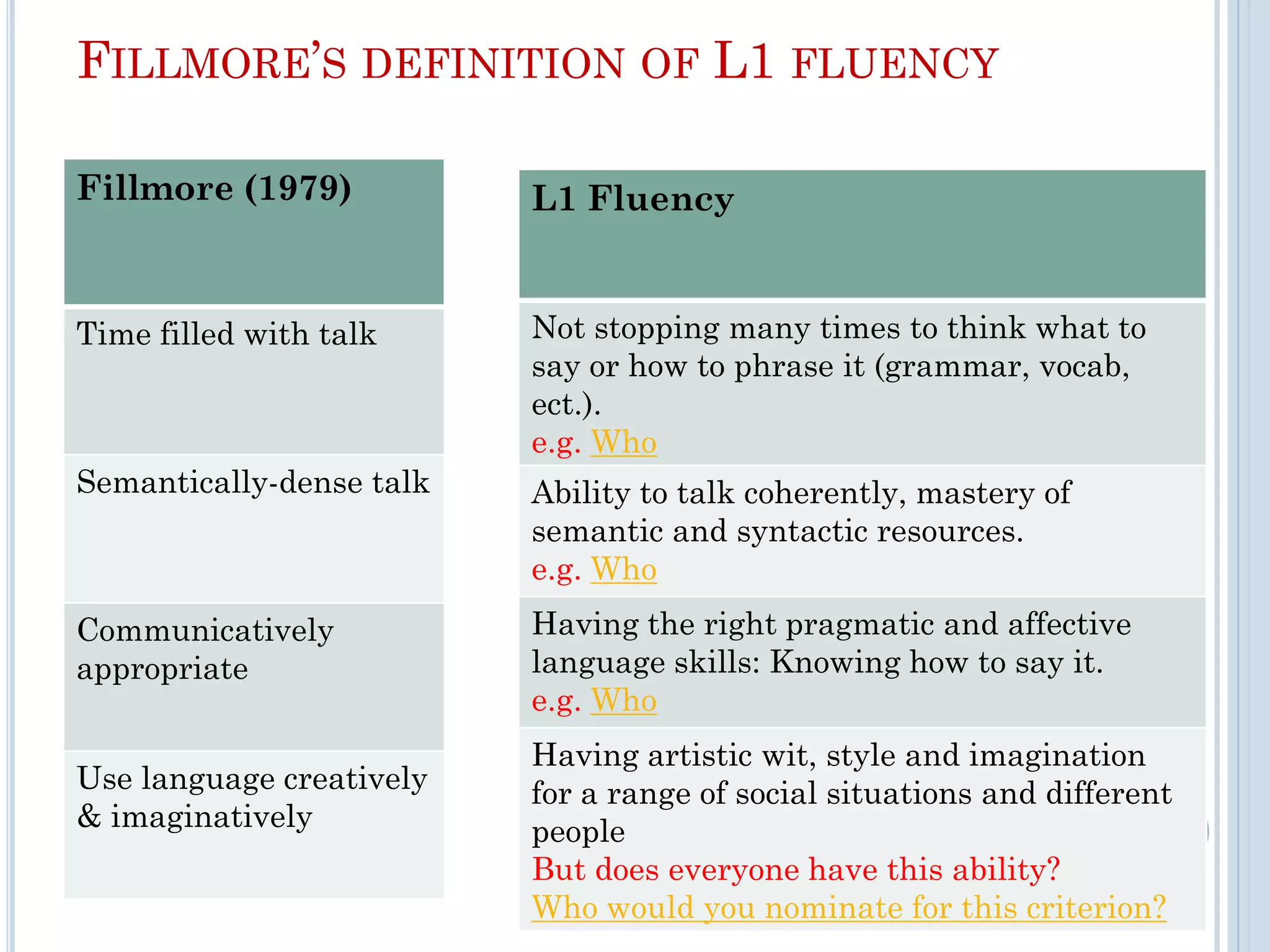
FILLMORE’S DEFINITION OF L1 FLUENCY
Fillmore (1979)
Time filled with talk
Semantically-dense talk
Communicatively
appropriate
Use language creatively
& imaginatively
L1 Fluency
Not stopping many times to think what to
say or how to phrase it (grammar, vocab,
ect.).
e.g. Who
Ability to talk coherently, mastery of
semantic and syntactic resources.
e.g. Who
Having the right pragmatic and affective
language skills: Knowing how to say it.
e.g. Who
Having artistic wit, style and imagination
for a range of social situations and different
people
But does everyone have this ability?
Who would you nominate for this criterion?
DEFINING L2 SPEECH FLUENCY:
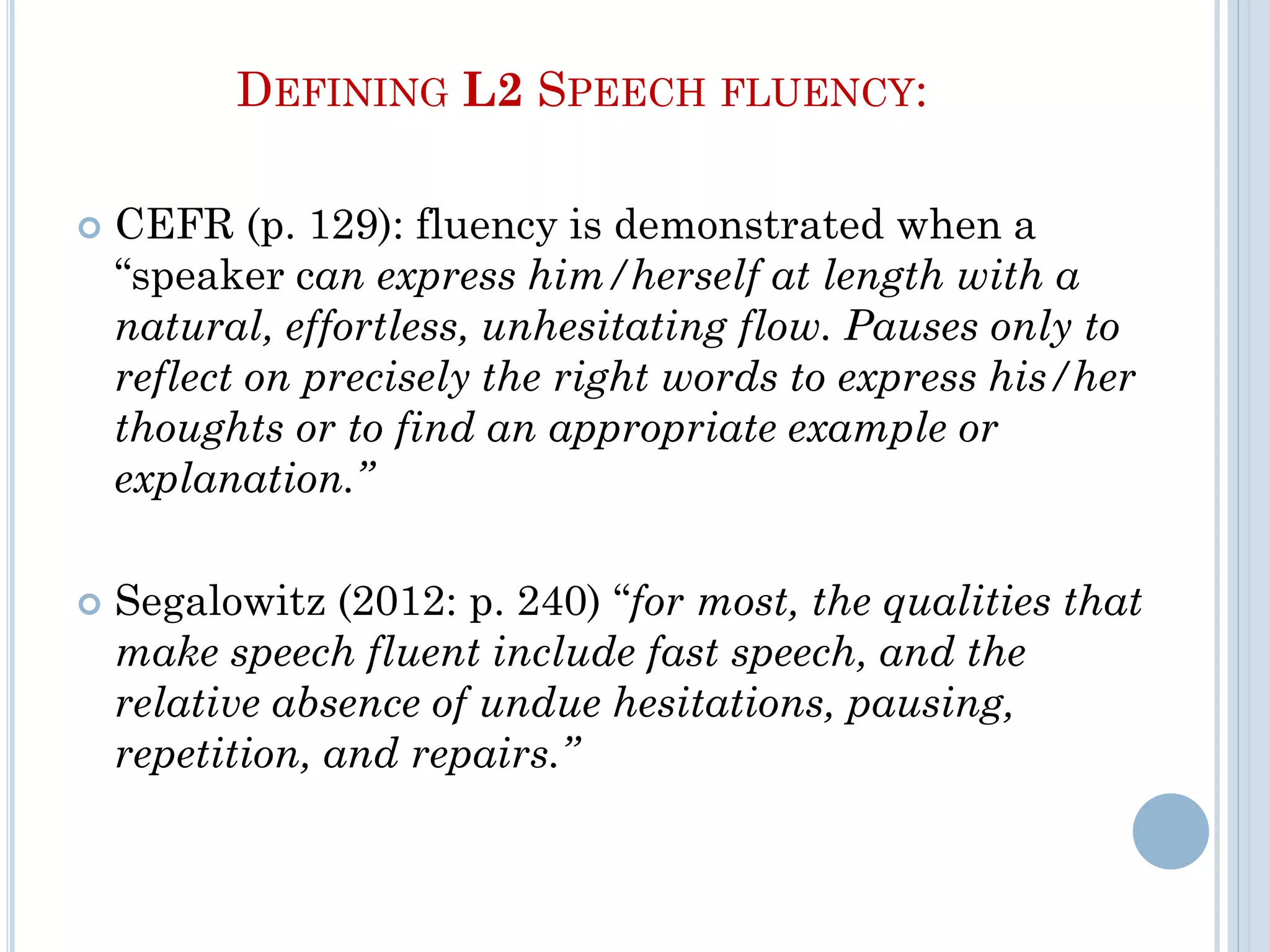
 CEFR (p. 129): fluency is demonstrated when a
“speaker can express him/herself at length with a
natural, effortless, unhesitating flow. Pauses only to
reflect on precisely the right words to express his/her
thoughts or to find an appropriate example or
explanation.”
 Segalowitz (2012: p. 240) “for most, the qualities that
make speech fluent include fast speech, and the
relative absence of undue hesitations, pausing,
repetition, and repairs.”
DEFINING L2 SPEECH FLUENCY
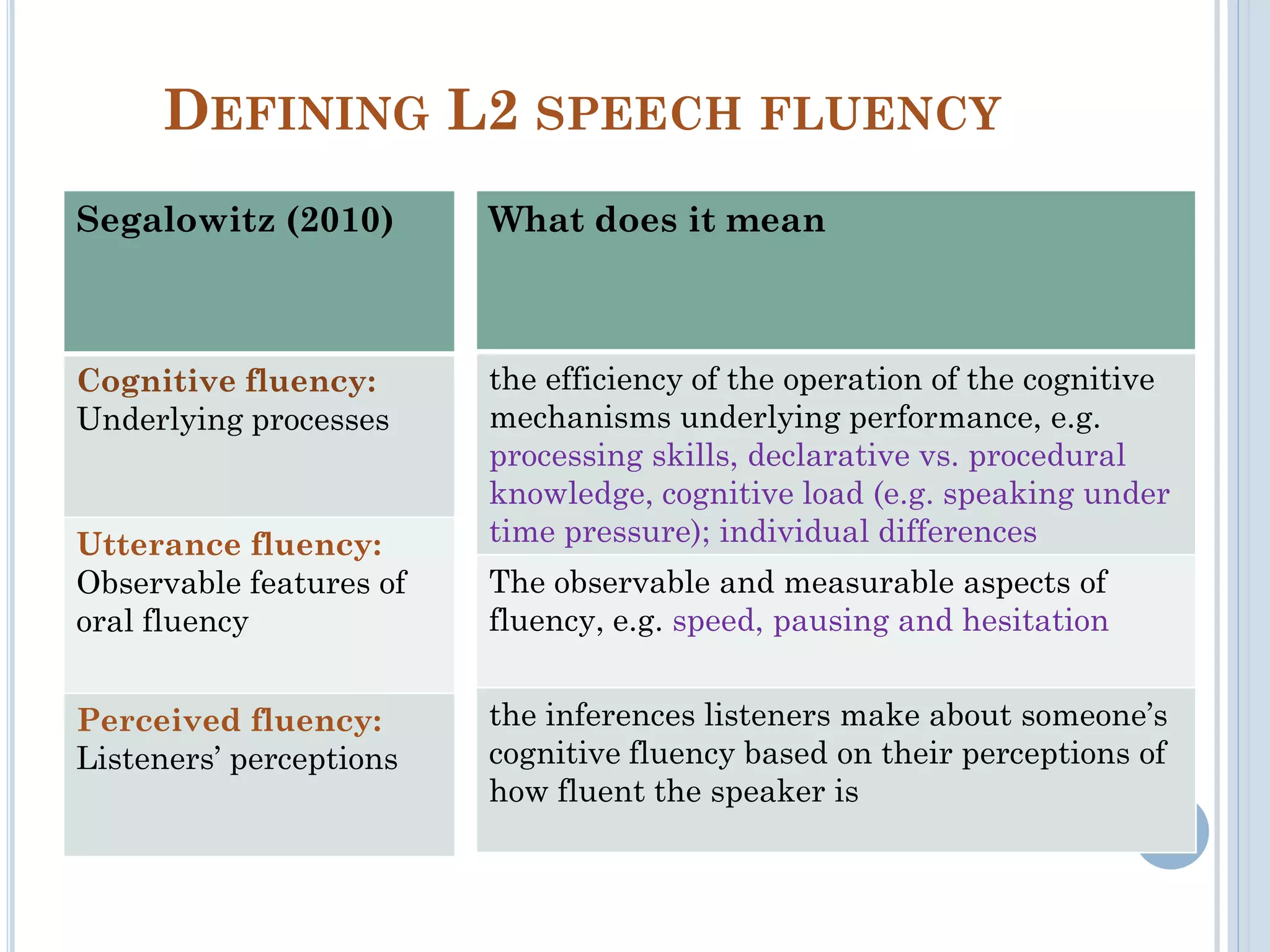
What does it mean
the efficiency of the operation of the cognitive
mechanisms underlying performance, e.g.
processing skills, declarative vs. procedural
knowledge, cognitive load (e.g. speaking under
time pressure); individual differences
The observable and measurable aspects of
fluency, e.g. speed, pausing and hesitation
the inferences listeners make about someone’s
cognitive fluency based on their perceptions of
how fluent the speaker is
Segalowitz (2010)
Cognitive fluency:
Underlying processes
Utterance fluency:
Observable features of
oral fluency
Perceived fluency:
Listeners’ perceptions
DEFINING & MEASURING L2 FLUENCY
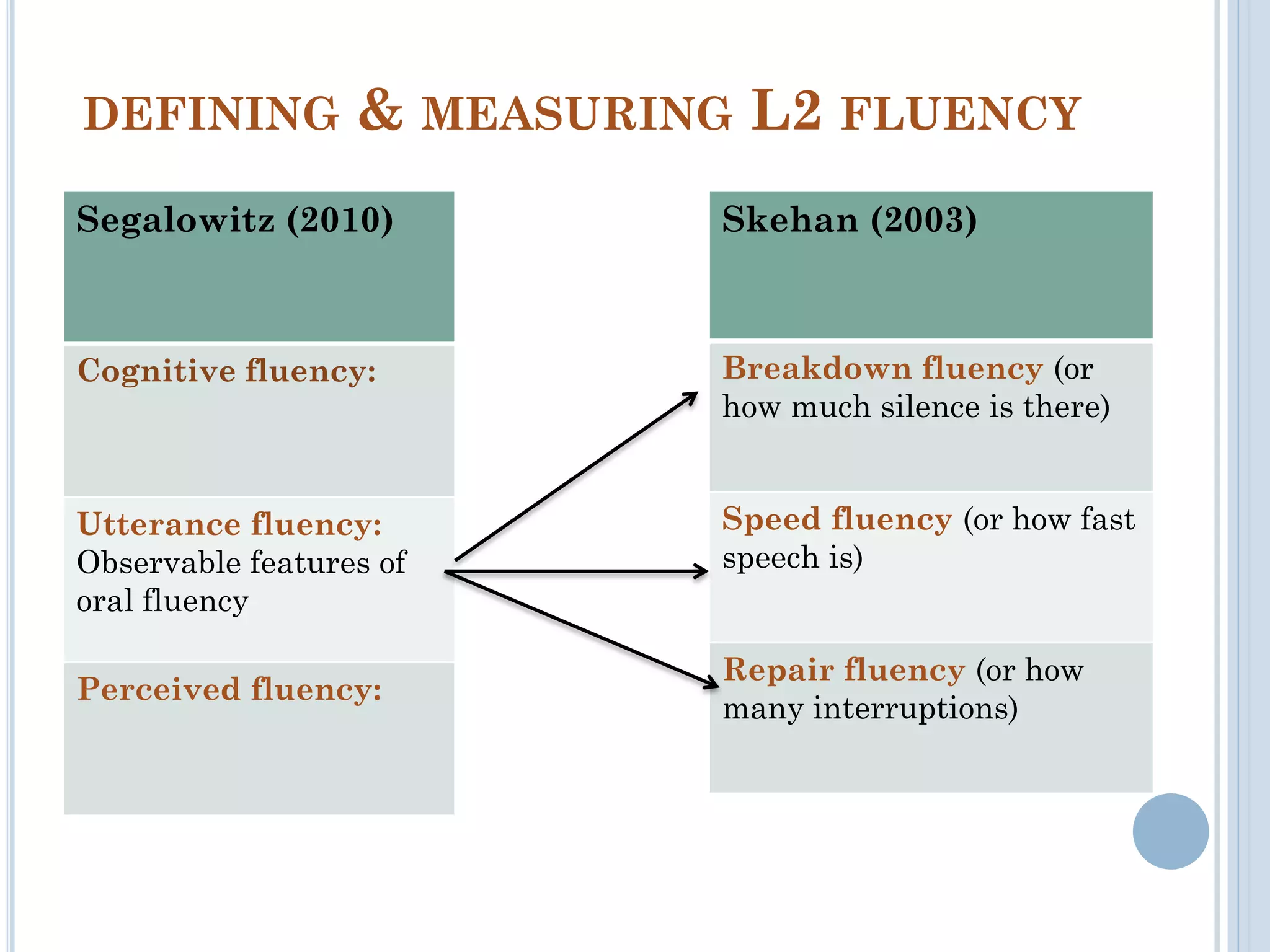
Skehan (2003)
Breakdown fluency (or
how much silence is there)
Speed fluency (or how fast
speech is)
Repair fluency (or how
many interruptions)
Segalowitz (2010)
Cognitive fluency:
Utterance fluency:
Observable features of
oral fluency
Perceived fluency:
WHAT MAKES SPEECH DYSFLUENT
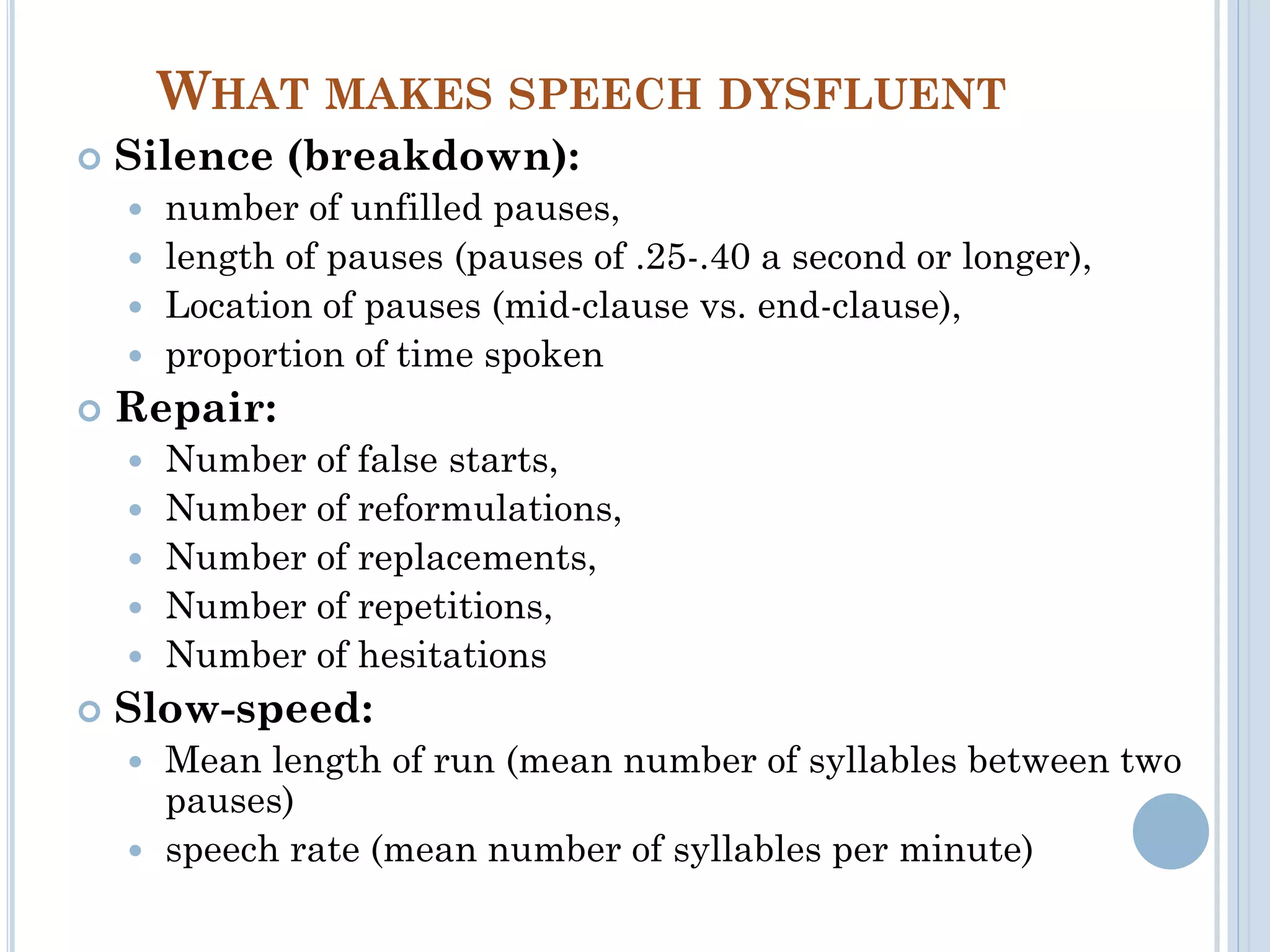
 Silence (breakdown):
 number of unfilled pauses,
 length of pauses (pauses of .25-.40 a second or longer),
 Location of pauses (mid-clause vs. end-clause),
 proportion of time spoken
 Repair:
 Number of false starts,
 Number of reformulations,
 Number of replacements,
 Number of repetitions,
 Number of hesitations
 Slow-speed:
 Mean length of run (mean number of syllables between two
pauses)
 speech rate (mean number of syllables per minute)
WHAT WE ALREADY KNOW
 Fluency develops in time as it needs automatization and
proceduralisation of rule use (DeKeyser, 2007; Freed, 2000)
 Task design and/or task conditions have an impact on L2
fluency (Ellis & Yuan, 2004; Skehan & Foster, 1996; Tavakoli & Foster, 2008)
 e.g. structured tasks elicit more fluent language
 Individual styles (de Jong et al, 2012)
 e.g. some speakers talk faster than others
 Impact of first language
 e.g. languages differ, to a small extent, in terms of certain aspects of
fluency, e.g. empty fillers such as err & ehmm
 Learners may not pause more than native speakers; they
pause at wrong places (Tavakoli, 2011)
 But can pedagogic intervention help improve learner fluency
over a limited period of time?
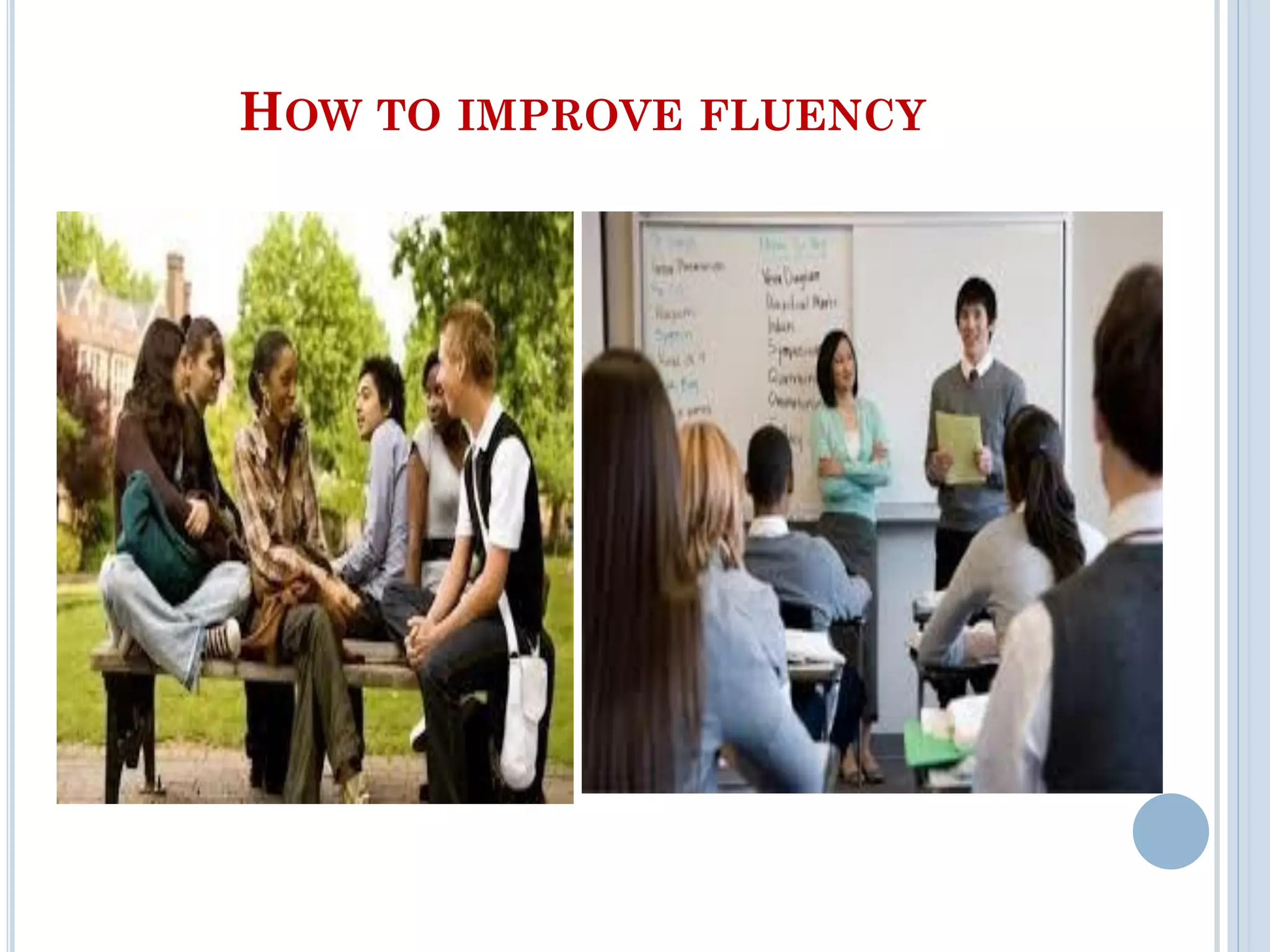
HOW TO IMPROVE FLUENCY
RECENT RESEARCH AT UNIVERSITY OF READING
 Does instruction help improve learner fluency?
 Instruction
 Strategy training
 Awareness raising activities
 practise
 Students:
 45 students enrolled on pre-sessional courses at university in the
UK (37 reported here)
 B2 level(CEFR); placement was based on IELTS scores (or
equivalent)
 Context:
 EAP classes (16 hours per week)
 Two groups: experimental and control
 Tests:
 Language proficiency test before the experiment started
 A monologue and a dialogue at the beginning of the experiment
 Another monologue and a dialogue at the end of the period
OUR RESEARCH PROJECT
 Research questions:
 Does awareness raising and strategy training have an impact
on the development of L2 speech fluency (of learners on an
intensive EAP course in the target language context)?
 Impact on monologic performance
 Impact on dialogic performance
 Which aspects of fluency are more sensitive to this instruction?
 Methodology
 A pretest-posttest design
 A 4-week intervention
 in class activities twice a week, each 15 minutes
 and homework
 Participants
 45 students enrolled on presessional courses at university in
the UK (37 reported here)
 B2 level(CEFR); placement was based on IELTS scores (or
equivalent)
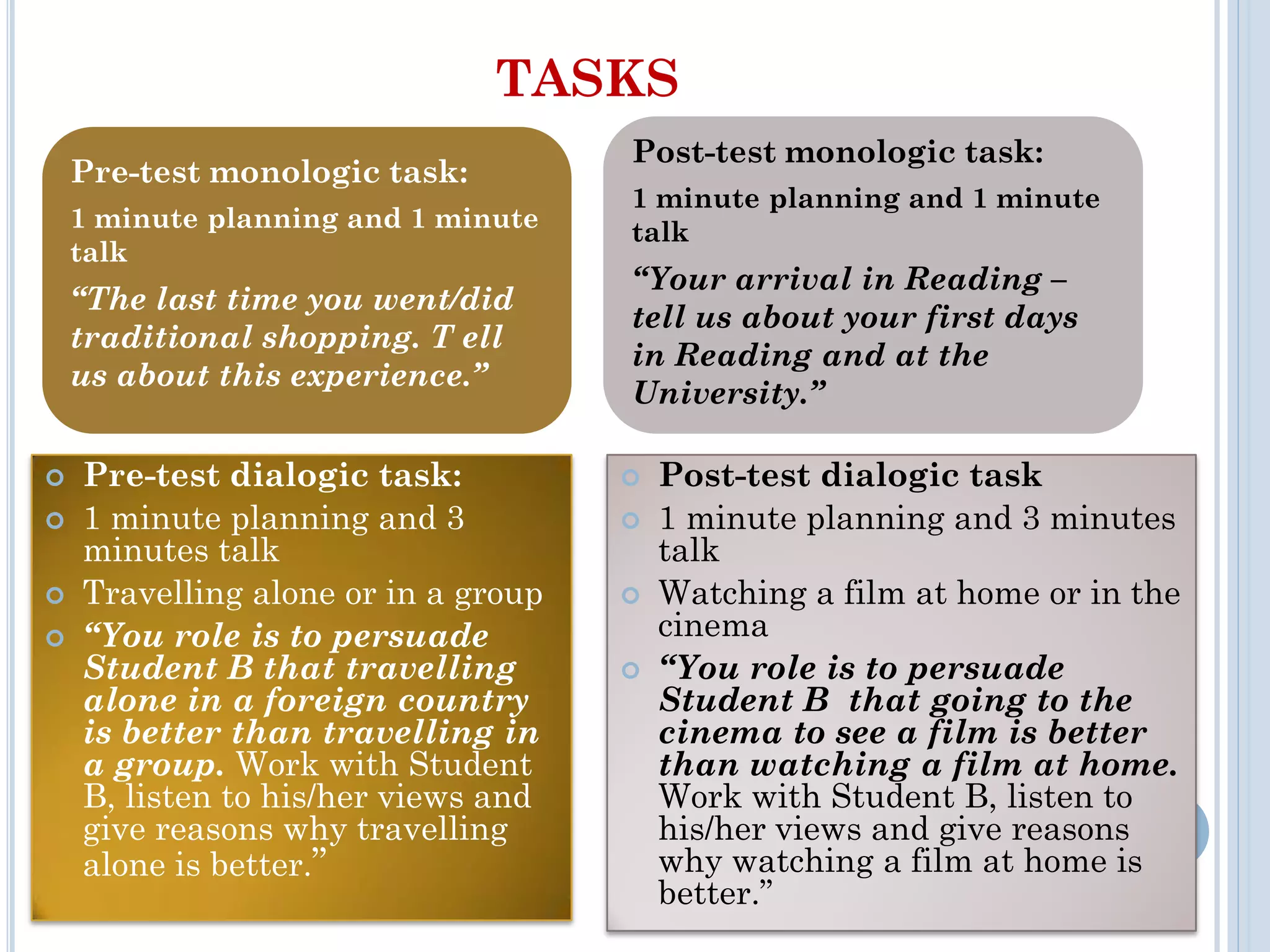
TASKS
 Pre-test dialogic task:
 1 minute planning and 3
minutes talk
 Travelling alone or in a group
 “You role is to persuade
Student B that travelling
alone in a foreign country
is better than travelling in
a group. Work with Student
B, listen to his/her views and
give reasons why travelling
alone is better.”
 Post-test dialogic task
 1 minute planning and 3 minutes
talk
 Watching a film at home or in the
cinema
 “You role is to persuade
Student B that going to the
cinema to see a film is better
than watching a film at home.
Work with Student B, listen to
his/her views and give reasons
why watching a film at home is
better.”
Pre-test monologic task:
1 minute planning and 1 minute
talk
“The last time you went/did
traditional shopping. T ell
us about this experience.”
Post-test monologic task:
1 minute planning and 1 minute
talk
“Your arrival in Reading –
tell us about your first days
in Reading and at the
University.”
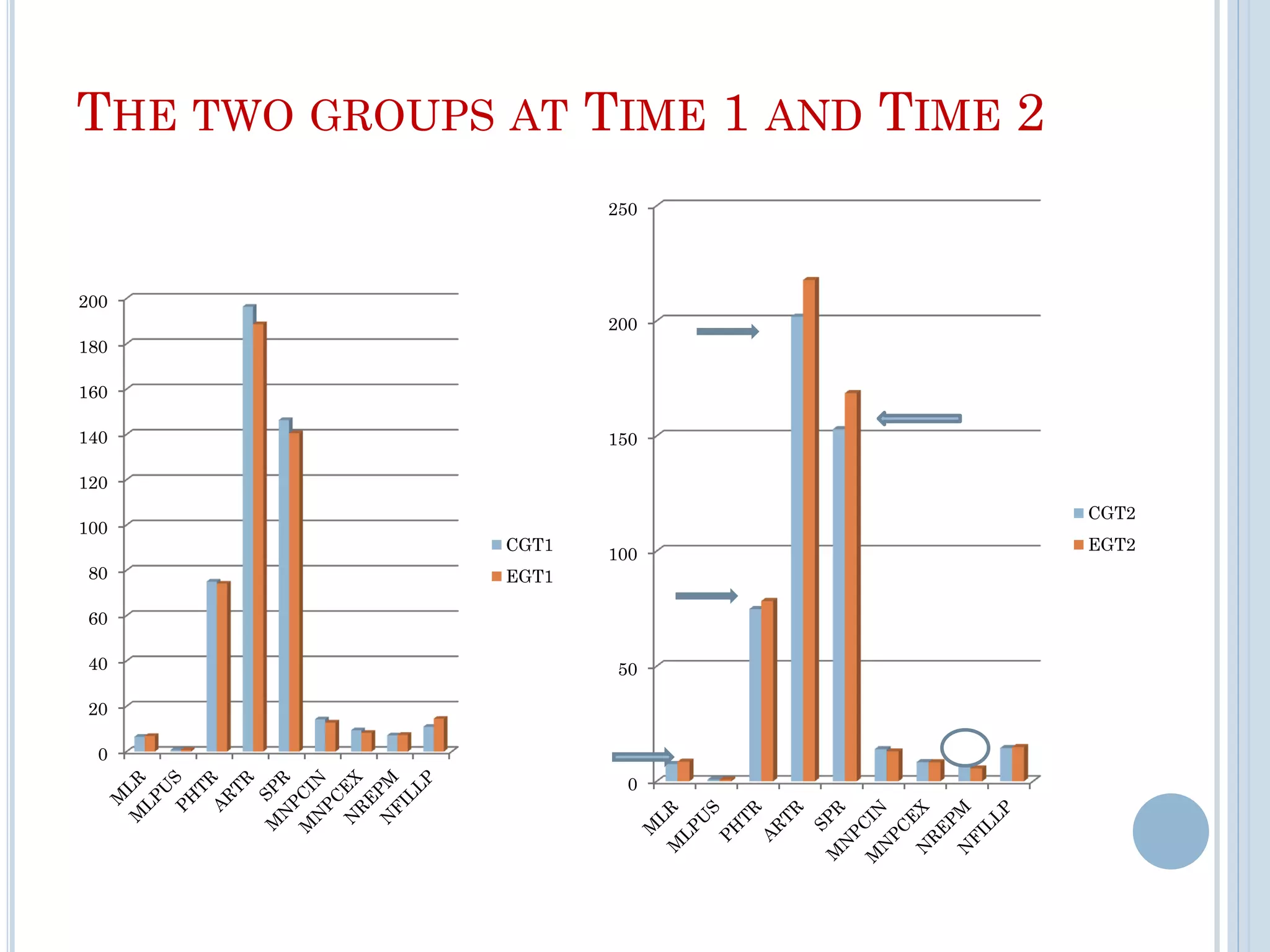
THE TWO GROUPS AT TIME 1 AND TIME 2
0
20
40
60
80
100
120
140
160
180
200
CGT1
EGT1
0
50
100
150
200
250
CGT2
EGT2
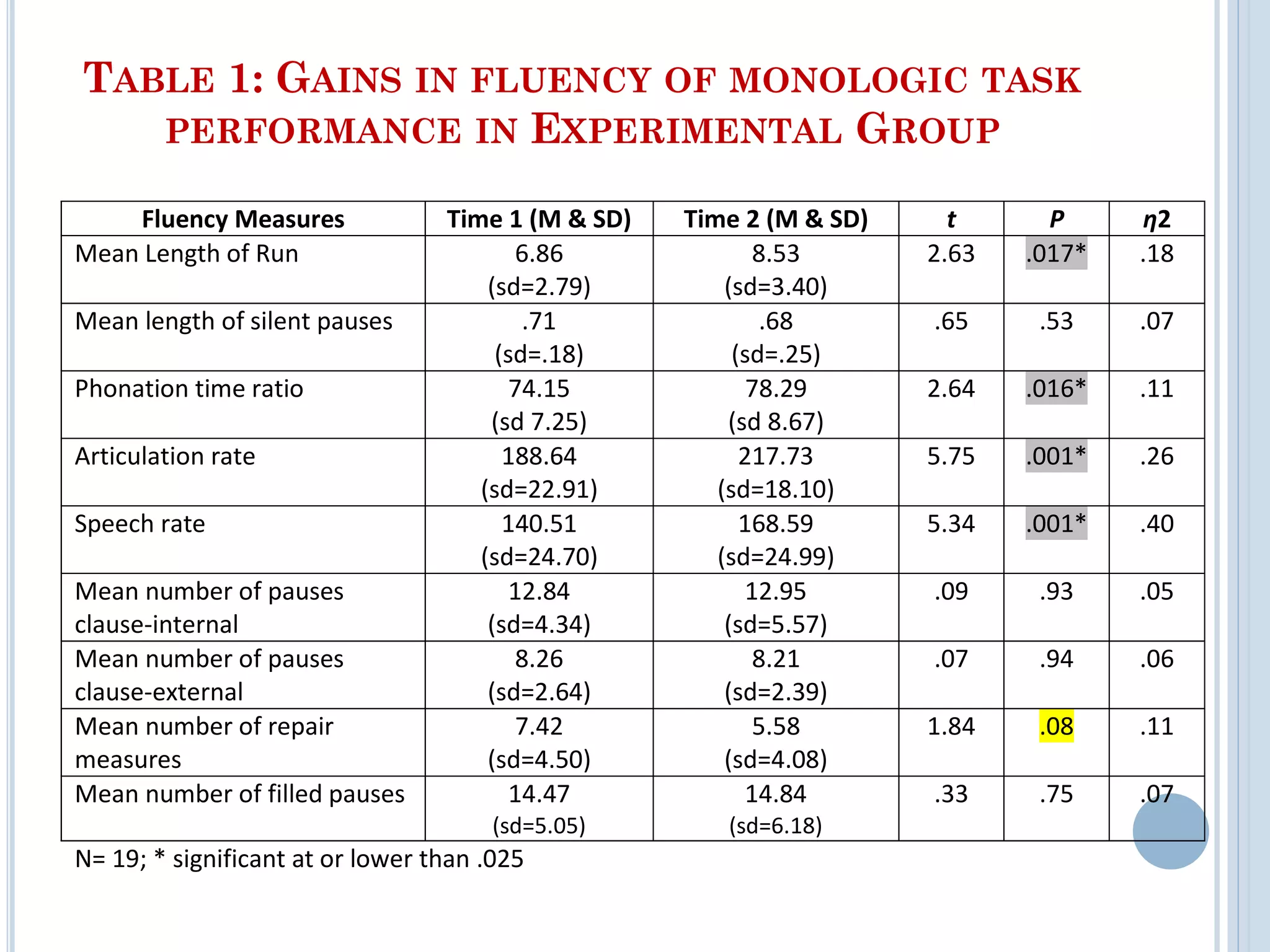
TABLE 1: GAINS IN FLUENCY OF MONOLOGIC TASK
PERFORMANCE IN EXPERIMENTAL GROUP
Fluency Measures Time 1 (M & SD) Time 2 (M & SD) t P η2
Mean Length of Run 6.86
(sd=2.79)
8.53
(sd=3.40)
2.63 .017* .18
Mean length of silent pauses .71
(sd=.18)
.68
(sd=.25)
.65 .53 .07
Phonation time ratio 74.15
(sd 7.25)
78.29
(sd 8.67)
2.64 .016* .11
Articulation rate 188.64
(sd=22.91)
217.73
(sd=18.10)
5.75 .001* .26
Speech rate 140.51
(sd=24.70)
168.59
(sd=24.99)
5.34 .001* .40
Mean number of pauses
clause-internal
12.84
(sd=4.34)
12.95
(sd=5.57)
.09 .93 .05
Mean number of pauses
clause-external
8.26
(sd=2.64)
8.21
(sd=2.39)
.07 .94 .06
Mean number of repair
measures
7.42
(sd=4.50)
5.58
(sd=4.08)
1.84 .08 .11
Mean number of filled pauses 14.47
(sd=5.05)
14.84
(sd=6.18)
.33 .75 .07
N= 19; * significant at or lower than .025
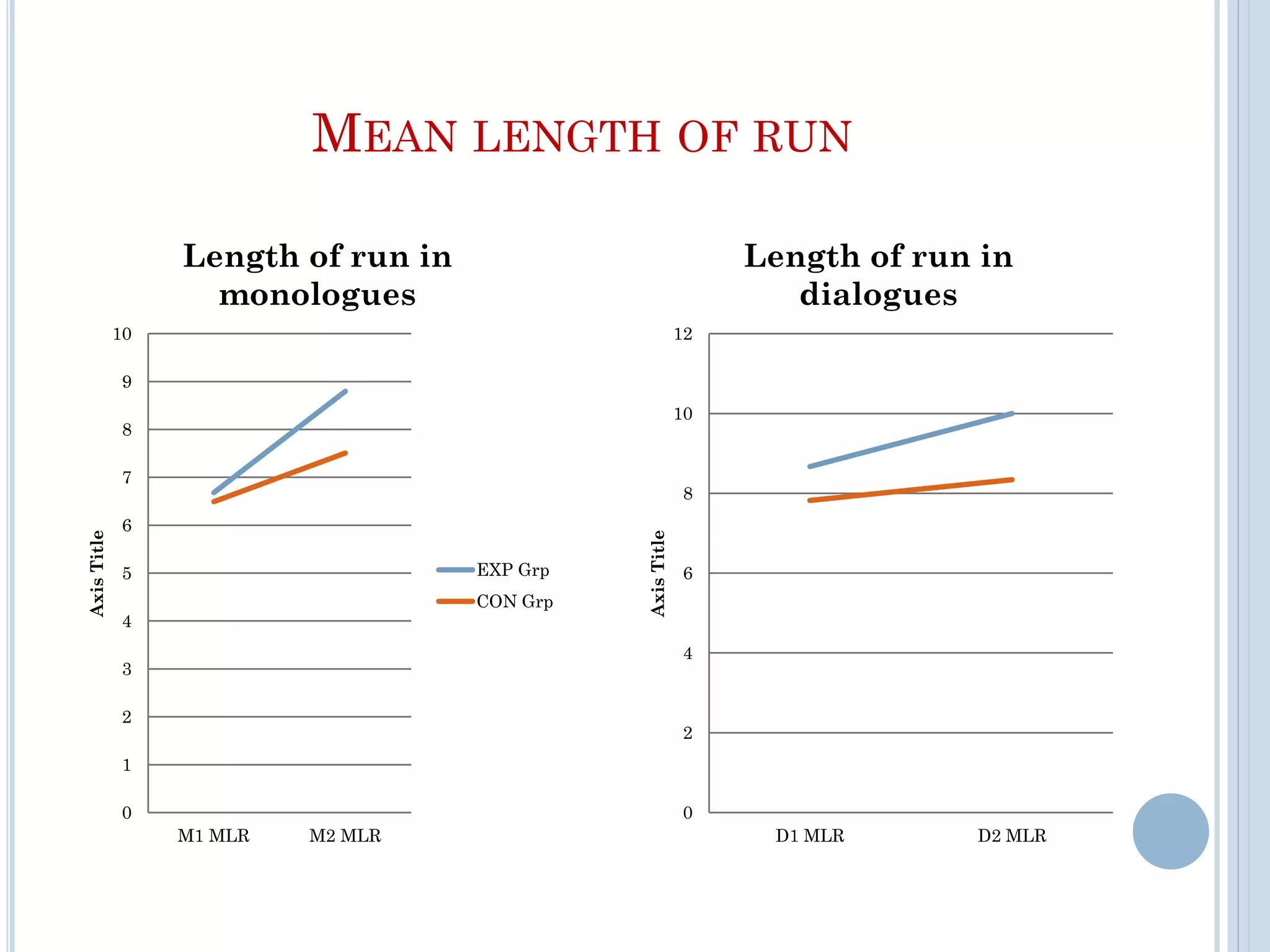
MEAN LENGTH OF RUN
0
1
2
3
4
5
6
7
8
9
10
M1 MLR M2 MLR
AxisTitle
Length of run in
monologues
EXP Grp
CON Grp
0
2
4
6
8
10
12
D1 MLR D2 MLR
AxisTitle
Length of run in
dialogues
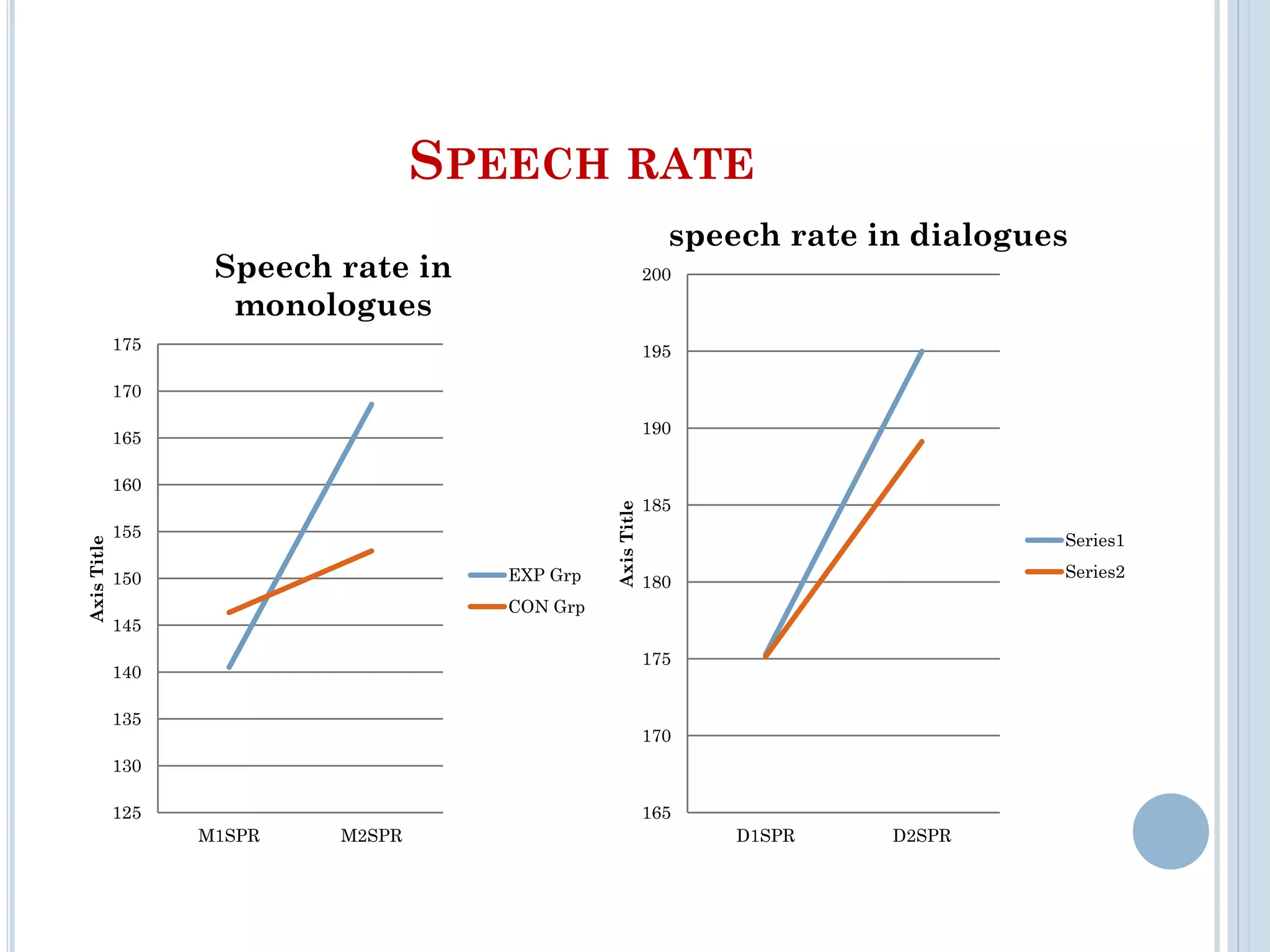
SPEECH RATE
125
130
135
140
145
150
155
160
165
170
175
M1SPR M2SPR
AxisTitle
Speech rate in
monologues
EXP Grp
CON Grp
165
170
175
180
185
190
195
200
D1SPR D2SPR
AxisTitle
speech rate in dialogues
Series1
Series2
SUMMARY OF FINDINGS
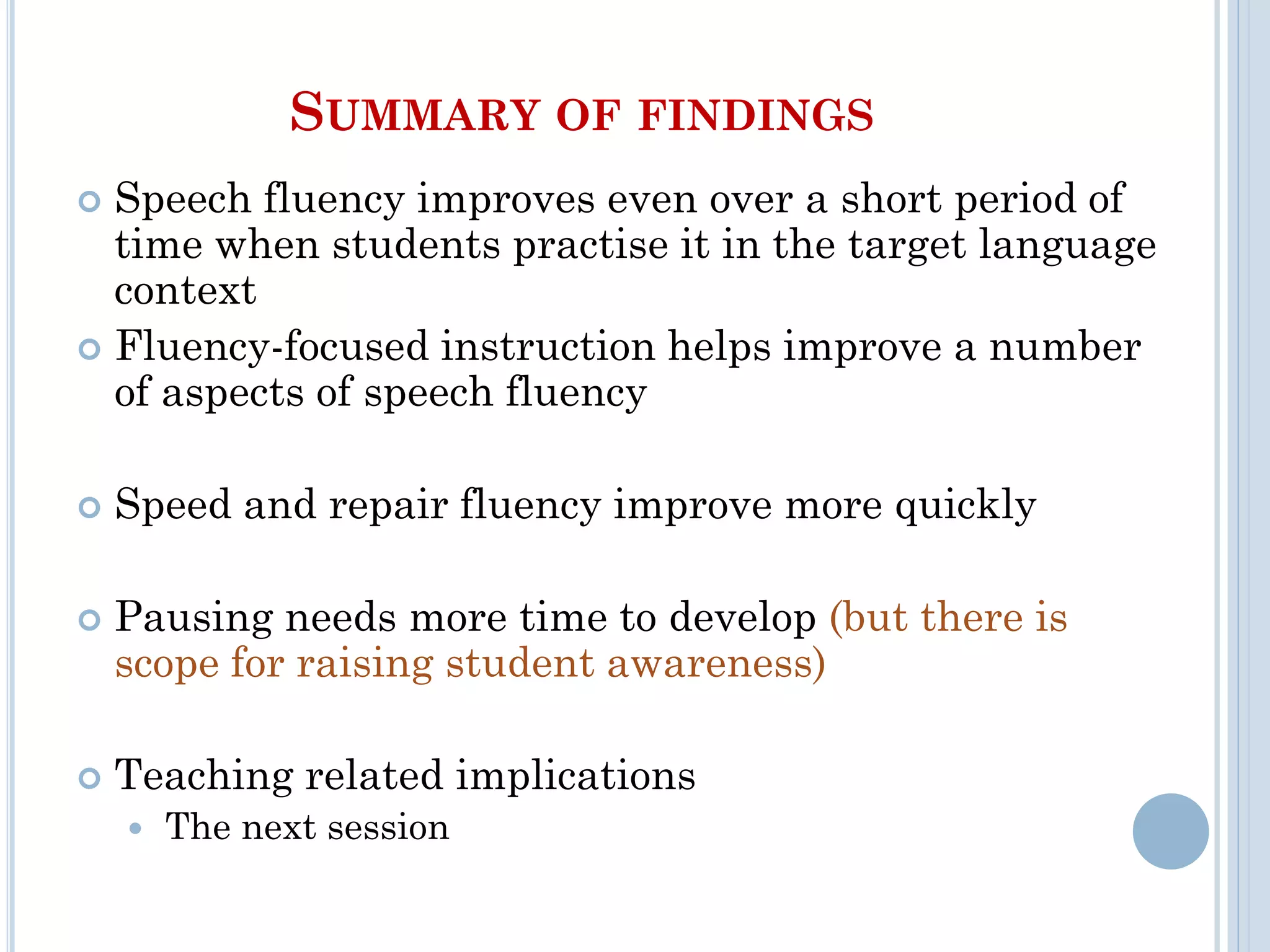
 Speech fluency improves even over a short period of
time when students practise it in the target language
context
 Fluency-focused instruction helps improve a number
of aspects of speech fluency
 Speed and repair fluency improve more quickly
 Pausing needs more time to develop (but there is
scope for raising student awareness)
 Teaching related implications
 The next session
REFERENCES:
 de Jong, N., R. Groenhourt, et al. (2012). "L2 fluency: speaking style or proficiency?" Applied
Psycholinguistics 34(1): 1-21.
 Fillmore, C. J. (1979). On fluency. Pespectives on fluency. H. Riggenbach. Ann Arbor, University
of Michigan Press: 43-61.
 Freed, B. (2000). Is fluency, like beauty, in the eyes (and ears) of the beholder? Perspectives on
fluency. H. Riggenbach. Ann Arbor, University of Michigan Press: 243-266.
 Seifoori, Z. and Vahidi, Z. (2012). The impact of fluency strategy training
 on Iranian EFL learners’ speech under online planning conditions. Language Awareness. 21(1):
101=112.
 Segalowitz, N. (2010). The cognitive bases of second language fluency. New York, Routledge.
 Segalowitz, N. (2012). Second language fluency. The Routledge encyclopedia of second language
acquisition. P. Robinson. New York, Routledge.
 Skehan, P. (2003). "Task-based instruction." Language Teaching 36: 1-14.
 Skehan, P. (2014). “Processing perspectives on task performance”. Amsterdam: John Benjamins.
 Tavakoli, P. (2004). Effects of task characteristics and conditions on L2 performance. Unpublished
Thesis: King’s College London, UK.
 Tavakoli, P. (2011). "Pausing patterns: Differences between L2 learners and native speakers."
ELT Journal 65(1): 71-9.
 Tavakoli, P. and P. Foster (2008). "Task design and second language performance: The effect of
narrative type on learner output." Language Learning 58(2): 439-473.Tavakoli,
 P. and P. Skehan (2005). Strategic planning, task structure and performance testing. Planning
and task performance in a second language. R. Ellis. Amsterdam, John Benjamins: 239-277.
AND WHAT NEXT
 We would like to interview you if you are available in
the autumn term
 Contact us if you have questions
 Contact us if there is anything we can help you
 We maybe able to help you, although we won’t
guarantee we would have the resources or funding to do
so
 But we will consider sympathetically any request for
help from you

Final speech fluency workshop

  • 1.
    PROMOTING SPEECH FLUENCY: ACLASSROOM PERSPECTIVE Joan McCormack; Colin Campbell and Parvaneh Tavakoli International Study and Language Institute Department of English Language and Applied Linguistics
  • 2.
    OUTLINE OF THEPRESENTATION  What is speech/oral fluency?  What does research in this area suggest?  Our recent research at University of Reading  How to promote fluency in second/modern foreign language classroom  Special thanks to the following departments for funding the research & this workshop  CeLM (Centre for Literacy & Multilingualism)  ISLI (International Study & Language Institute)  DELAL (Department of English Language & Applied Linguistics)
  • 3.
    SMALL GROUP DISCUSSION In small groups, discuss the following questions:  What is speech fluency?  Why is it important?  Can speech fluency be taught in classroom?  15 minutes discussion + 10 minutes feedback
  • 4.
    WHY SPEECH FLUENCY(MFL)  Speaking fluently is a key goal in language learning for many teachers and learners  extracts from Modern Foreign Languages GCSE subject content (January 2015)  develop ability to communicate confidently and coherently with native speakers in speech  express and develop thoughts and ideas spontaneously and fluently  develop language strategies, including repair strategies
  • 5.
    WHY SPEECH FLUENCY(CEFR)  Fluency is one of the five key components of speaking in CEFR  Extracts from Common European Framework of Reference for Languages  Ability to speak fluently in speaking and delivering presentations is a priority  Ability to interact with others with a degree of fluency and spontaneity  Two generic qualitative factors which determine the functional success of the learner/user are:  a) fluency, the ability to articulate, to keep going, and to cope when one lands in a dead end  b) propositional precision, the ability to formulate thoughts and propositions so as to make one’s meaning clear
  • 6.
    RESEARCHING SPEECH FLUENCY The word “fluency” in English  General meaning  Specific meaning  “Fluency might simply be the ability to talk of length with few pauses; the ability to fill time with talk; the ability to talk in coherent and semantically dense sentences; the ability to have appropriate things to say in a wide range of contexts; and the ability to be creative and imaginative in the language use” (Fillmore, 1979, p. 51).
  • 7.
    RESEARCHING SPEECH FLUENCY Fillmore’s definition of L1 fluency  “Fluency might simply be the ability to talk of length with few pauses; the ability to fill time with talk; the ability to talk in coherent and semantically dense sentences; the ability to have appropriate things to say in a wide range of contexts; and the ability to be creative and imaginative in the language use” (Fillmore, 1979, p. 51).
  • 8.
    FILLMORE’S DEFINITION OFL1 FLUENCY Fillmore (1979) Time filled with talk Semantically-dense talk Communicatively appropriate Use language creatively & imaginatively L1 Fluency Not stopping many times to think what to say or how to phrase it (grammar, vocab, ect.). e.g. Who Ability to talk coherently, mastery of semantic and syntactic resources. e.g. Who Having the right pragmatic and affective language skills: Knowing how to say it. e.g. Who Having artistic wit, style and imagination for a range of social situations and different people But does everyone have this ability? Who would you nominate for this criterion?
  • 9.
    DEFINING L2 SPEECHFLUENCY:  CEFR (p. 129): fluency is demonstrated when a “speaker can express him/herself at length with a natural, effortless, unhesitating flow. Pauses only to reflect on precisely the right words to express his/her thoughts or to find an appropriate example or explanation.”  Segalowitz (2012: p. 240) “for most, the qualities that make speech fluent include fast speech, and the relative absence of undue hesitations, pausing, repetition, and repairs.”
  • 10.
    DEFINING L2 SPEECHFLUENCY What does it mean the efficiency of the operation of the cognitive mechanisms underlying performance, e.g. processing skills, declarative vs. procedural knowledge, cognitive load (e.g. speaking under time pressure); individual differences The observable and measurable aspects of fluency, e.g. speed, pausing and hesitation the inferences listeners make about someone’s cognitive fluency based on their perceptions of how fluent the speaker is Segalowitz (2010) Cognitive fluency: Underlying processes Utterance fluency: Observable features of oral fluency Perceived fluency: Listeners’ perceptions
  • 11.
    DEFINING & MEASURINGL2 FLUENCY Skehan (2003) Breakdown fluency (or how much silence is there) Speed fluency (or how fast speech is) Repair fluency (or how many interruptions) Segalowitz (2010) Cognitive fluency: Utterance fluency: Observable features of oral fluency Perceived fluency:
  • 12.
    WHAT MAKES SPEECHDYSFLUENT  Silence (breakdown):  number of unfilled pauses,  length of pauses (pauses of .25-.40 a second or longer),  Location of pauses (mid-clause vs. end-clause),  proportion of time spoken  Repair:  Number of false starts,  Number of reformulations,  Number of replacements,  Number of repetitions,  Number of hesitations  Slow-speed:  Mean length of run (mean number of syllables between two pauses)  speech rate (mean number of syllables per minute)
  • 13.
    WHAT WE ALREADYKNOW  Fluency develops in time as it needs automatization and proceduralisation of rule use (DeKeyser, 2007; Freed, 2000)  Task design and/or task conditions have an impact on L2 fluency (Ellis & Yuan, 2004; Skehan & Foster, 1996; Tavakoli & Foster, 2008)  e.g. structured tasks elicit more fluent language  Individual styles (de Jong et al, 2012)  e.g. some speakers talk faster than others  Impact of first language  e.g. languages differ, to a small extent, in terms of certain aspects of fluency, e.g. empty fillers such as err & ehmm  Learners may not pause more than native speakers; they pause at wrong places (Tavakoli, 2011)  But can pedagogic intervention help improve learner fluency over a limited period of time?
  • 14.
  • 15.
    RECENT RESEARCH ATUNIVERSITY OF READING  Does instruction help improve learner fluency?  Instruction  Strategy training  Awareness raising activities  practise  Students:  45 students enrolled on pre-sessional courses at university in the UK (37 reported here)  B2 level(CEFR); placement was based on IELTS scores (or equivalent)  Context:  EAP classes (16 hours per week)  Two groups: experimental and control  Tests:  Language proficiency test before the experiment started  A monologue and a dialogue at the beginning of the experiment  Another monologue and a dialogue at the end of the period
  • 16.
    OUR RESEARCH PROJECT Research questions:  Does awareness raising and strategy training have an impact on the development of L2 speech fluency (of learners on an intensive EAP course in the target language context)?  Impact on monologic performance  Impact on dialogic performance  Which aspects of fluency are more sensitive to this instruction?  Methodology  A pretest-posttest design  A 4-week intervention  in class activities twice a week, each 15 minutes  and homework  Participants  45 students enrolled on presessional courses at university in the UK (37 reported here)  B2 level(CEFR); placement was based on IELTS scores (or equivalent)
  • 17.
    TASKS  Pre-test dialogictask:  1 minute planning and 3 minutes talk  Travelling alone or in a group  “You role is to persuade Student B that travelling alone in a foreign country is better than travelling in a group. Work with Student B, listen to his/her views and give reasons why travelling alone is better.”  Post-test dialogic task  1 minute planning and 3 minutes talk  Watching a film at home or in the cinema  “You role is to persuade Student B that going to the cinema to see a film is better than watching a film at home. Work with Student B, listen to his/her views and give reasons why watching a film at home is better.” Pre-test monologic task: 1 minute planning and 1 minute talk “The last time you went/did traditional shopping. T ell us about this experience.” Post-test monologic task: 1 minute planning and 1 minute talk “Your arrival in Reading – tell us about your first days in Reading and at the University.”
  • 18.
    THE TWO GROUPSAT TIME 1 AND TIME 2 0 20 40 60 80 100 120 140 160 180 200 CGT1 EGT1 0 50 100 150 200 250 CGT2 EGT2
  • 19.
    TABLE 1: GAINSIN FLUENCY OF MONOLOGIC TASK PERFORMANCE IN EXPERIMENTAL GROUP Fluency Measures Time 1 (M & SD) Time 2 (M & SD) t P η2 Mean Length of Run 6.86 (sd=2.79) 8.53 (sd=3.40) 2.63 .017* .18 Mean length of silent pauses .71 (sd=.18) .68 (sd=.25) .65 .53 .07 Phonation time ratio 74.15 (sd 7.25) 78.29 (sd 8.67) 2.64 .016* .11 Articulation rate 188.64 (sd=22.91) 217.73 (sd=18.10) 5.75 .001* .26 Speech rate 140.51 (sd=24.70) 168.59 (sd=24.99) 5.34 .001* .40 Mean number of pauses clause-internal 12.84 (sd=4.34) 12.95 (sd=5.57) .09 .93 .05 Mean number of pauses clause-external 8.26 (sd=2.64) 8.21 (sd=2.39) .07 .94 .06 Mean number of repair measures 7.42 (sd=4.50) 5.58 (sd=4.08) 1.84 .08 .11 Mean number of filled pauses 14.47 (sd=5.05) 14.84 (sd=6.18) .33 .75 .07 N= 19; * significant at or lower than .025
  • 20.
    MEAN LENGTH OFRUN 0 1 2 3 4 5 6 7 8 9 10 M1 MLR M2 MLR AxisTitle Length of run in monologues EXP Grp CON Grp 0 2 4 6 8 10 12 D1 MLR D2 MLR AxisTitle Length of run in dialogues
  • 21.
    SPEECH RATE 125 130 135 140 145 150 155 160 165 170 175 M1SPR M2SPR AxisTitle Speechrate in monologues EXP Grp CON Grp 165 170 175 180 185 190 195 200 D1SPR D2SPR AxisTitle speech rate in dialogues Series1 Series2
  • 22.
    SUMMARY OF FINDINGS Speech fluency improves even over a short period of time when students practise it in the target language context  Fluency-focused instruction helps improve a number of aspects of speech fluency  Speed and repair fluency improve more quickly  Pausing needs more time to develop (but there is scope for raising student awareness)  Teaching related implications  The next session
  • 23.
    REFERENCES:  de Jong,N., R. Groenhourt, et al. (2012). "L2 fluency: speaking style or proficiency?" Applied Psycholinguistics 34(1): 1-21.  Fillmore, C. J. (1979). On fluency. Pespectives on fluency. H. Riggenbach. Ann Arbor, University of Michigan Press: 43-61.  Freed, B. (2000). Is fluency, like beauty, in the eyes (and ears) of the beholder? Perspectives on fluency. H. Riggenbach. Ann Arbor, University of Michigan Press: 243-266.  Seifoori, Z. and Vahidi, Z. (2012). The impact of fluency strategy training  on Iranian EFL learners’ speech under online planning conditions. Language Awareness. 21(1): 101=112.  Segalowitz, N. (2010). The cognitive bases of second language fluency. New York, Routledge.  Segalowitz, N. (2012). Second language fluency. The Routledge encyclopedia of second language acquisition. P. Robinson. New York, Routledge.  Skehan, P. (2003). "Task-based instruction." Language Teaching 36: 1-14.  Skehan, P. (2014). “Processing perspectives on task performance”. Amsterdam: John Benjamins.  Tavakoli, P. (2004). Effects of task characteristics and conditions on L2 performance. Unpublished Thesis: King’s College London, UK.  Tavakoli, P. (2011). "Pausing patterns: Differences between L2 learners and native speakers." ELT Journal 65(1): 71-9.  Tavakoli, P. and P. Foster (2008). "Task design and second language performance: The effect of narrative type on learner output." Language Learning 58(2): 439-473.Tavakoli,  P. and P. Skehan (2005). Strategic planning, task structure and performance testing. Planning and task performance in a second language. R. Ellis. Amsterdam, John Benjamins: 239-277.
  • 24.
    AND WHAT NEXT We would like to interview you if you are available in the autumn term  Contact us if you have questions  Contact us if there is anything we can help you  We maybe able to help you, although we won’t guarantee we would have the resources or funding to do so  But we will consider sympathetically any request for help from you