DYSFLUNCY & ITS MANAGEMENT
Presented to Ms. Shahista Naz
Dated:April 14th 2015.
Presented By:
Imrana Shakoor
Management of Normal Development
Disfluceny
•
Imrana Shakoor
Disfluency
Disfluency is a error which can distrusted flow of speech in
shape of filers or distortion.
• When it can be occur?
• During Debate
• During one on one Conversation
• Singing
• others
Imrana Shakoor
❖various breaks, irregularities that occurs within the
flow of otherwise fluent speech
❖including false starts, i.e. words and sentences that
are cut off mid-utterance, phrases.
❖That are restarted or repeated and repeated
syllables, fillers.
Imrana Shakoor
Imrana Shakoor
FLLIERS:
• Fillers are parts of speech which are not generally recognized as purposeful or
containing formal meaning.
• Commonly emanate as pauses Such as uh, um ,like and er, but also leads
to repairs.
For Example:
"He was wearing a black-uh, I mean a blue, a blue shirt“
um, aa I,m working in admin office of k.u oh sorry sorry in somewhere where
else. Imrana Shakoor
Imrana Shakoor
DIFFERENCE BETWEEN STUTTERING AND
DISFLUENCY
• There is tiny difference between stuttering and Normal disfluency.
• Stuttering is a severe condition of dissiliency when it’s become a regular
disruption during speech all the time.
• It’s the main differences between them because dsyfluency disturb the
fluency of speech rarely due to some reasons.
• ButWhen flow of speech is destructed most of the time it will consider as
stuttering due to articulation disorder.
Imrana Shakoor
TYPES OF DISFLUENCY
There are at least five major explanation for fluency failure.One
type of disfluent speech is the result of a normal developmental
process and the remaining four are the result of different
abnormalities.
Imrana Shakoor
1: NORMAL DEVELOPMENTAL
DISFLUUENCY
❖This is a very common disorder that is in most cases a child outgrows without any
professional help. Normal developmental disfluency is commonly mistaken as
stuttering. It usually occurs in children between ages of 1 to 6 years old
Imrana Shakoor
2: STUTTERING
❖Stuttering is a speech disorder in which sounds, syllables, or words are repeated
or prolonged, disrupting the normal flow of speech. These speech disruptions
may be accompanied by struggling behaviors, such as rapid eye blinks or tremors
of the lips
Imrana Shakoor
3: NEUROGENIC DYSFUNCTION
❖ Neurogenic stuttering is a type of fluency disorder in
which a person has difficulty in producing speech in a
normal, smooth fashion. Individuals with fluency disorders
may have speech that sounds fragmented or halting, with
frequent interruptions and difficulty producing words
without effort or struggle.
Imrana Shakoor
TYPES OF NEUROGENIC
DYSFUNCTION
❖ Motor speech dysfluencies
❖ Neurolinguistic dysfluencies
❖ Chemical reaction dysfluncies
Imrana Shakoor
4: PSYCHOGENIC DYSFUNCTION
❖Psychogenic disfluencies may be grouped into three categories. However,
emotionaly based disfluencies far outnumber manipulatiotive disfluencies and
malingering as a documented phenomena.
Imrana Shakoor
5: LANGUAGE DELAY
❖A language delay is a communication disorder. A child is said to have
alanguage delay if he or she does not meet the language developmental
milestones for his or her age. Language may be developing, but it is at a slower
rate than the norm for the child's age.
Imrana Shakoor
CURE & TREATMENT
APPROACHES
Imrana Shakoor
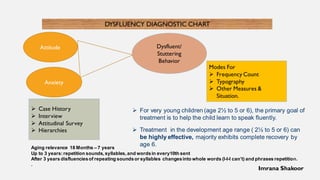
Attitude
Anxiety
Dysfluent/
Stuttering
Behavior
➢ Case History
➢ Interview
➢ Attitudinal Survey
➢ Hierarchies
Modes For
➢ Frequency Count
➢ Typography
➢ Other Measures &
Situation.
DYSFLUENCY DIAGNOSTIC CHART
➢ For very young children (age 2½ to 5 or 6), the primary goal of
treatment is to help the child learn to speak fluently.
➢ Treatment in the development age range ( 2½ to 5 or 6) can
be highly effective, majority exhibits complete recovery by
age 6.
Aging relevance 18 Months – 7 years
Up to 3 years:repetition sounds, syllables,and wordsin every10th sent
After 3 years disfluenciesof repeating soundsor syllables changesinto whole words (I-I-I can’t) and phrases repetition.
.
Imrana Shakoor
EVALUATION & ASSESSMENT OF DYSFLUENCY
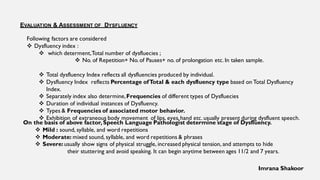
Following factors are considered
❖ Dysfluency index :
❖ which determent,Total number of dysfluecies ;
❖ No. of Repetition+ No. of Pauses+ no. of prolongation etc. In taken sample.
❖ Total dysfluency Index reflects all dysfluencies produced by individual.
❖ Dysfluency Index reflects Percentage ofTotal & each dysfluency type based on Total Dysfluency
Index.
❖ Separately index also determine,Frequencies of different types of Dysfluecies
❖ Duration of individual instances of Dysfluency.
❖ Types & Frequencies of associated motor behavior.
❖ Exhibition of extraneous body movement of lips, eyes,hand etc. usually present during dysfluent speech.
On the basis of above factor,Speech Language Pathologist determine stage of Dysfluency.
❖ Mild : sound, syllable, and word repetitions
❖ Moderate: mixed sound, syllable, and word repetitions & phrases
❖ Severe: usually show signs of physical struggle, increased physical tension, and attempts to hide
their stuttering and avoid speaking. It can begin anytime between ages 11/2 and 7 years.
Imrana Shakoor
FLUENCY SHAPING FOR DYSFLUENCY & STAMMERING
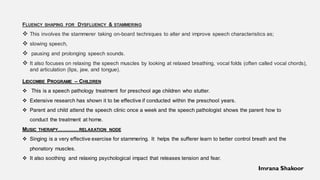
❖ This involves the stammerer taking on-board techniques to alter and improve speech characteristics as;
❖ slowing speech,
❖ pausing and prolonging speech sounds.
❖ It also focuses on relaxing the speech muscles by looking at relaxed breathing, vocal folds (often called vocal chords),
and articulation (lips, jaw, and tongue).
LIDCOMBE PROGRAME – CHILDREN
❖ This is a speech pathology treatment for preschool age children who stutter.
❖ Extensive research has shown it to be effective if conducted within the preschool years.
❖ Parent and child attend the speech clinic once a week and the speech pathologist shows the parent how to
conduct the treatment at home.
MUSIC THERAPY…………RELAXATION NODE
❖ Singing is a very effective exercise for stammering. It helps the sufferer learn to better control breath and the
phonatory muscles.
❖ It also soothing and relaxing psychological impact that releases tension and fear.
Imrana Shakoor
MODIFICATION THERAPY FOR STAMMERING
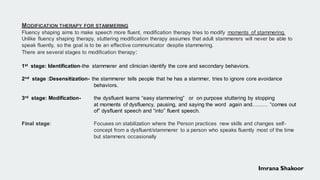
Fluency shaping aims to make speech more fluent, modification therapy tries to modify moments of stammering.
Unlike fluency shaping therapy, stuttering modification therapy assumes that adult stammerers will never be able to
speak fluently, so the goal is to be an effective communicator despite stammering.
There are several stages to modification therapy:
1st stage: Identification-the stammerer and clinician identify the core and secondary behaviors.
2nd stage :Desensitization- the stammerer tells people that he has a stammer, tries to ignore core avoidance
behaviors.
3rd stage: Modification- the dysfluent learns “easy stammering” or on purpose stuttering by stopping
at moments of dysfluency, pausing, and saying the word again and……… “comes out
of” dysfluent speech and “into” fluent speech.
Final stage: Focuses on stabilization where the Person practices new skills and changes self-
concept from a dysfluent/stammerer to a person who speaks fluently most of the time
but stammers occasionally
Imrana Shakoor
HOME STRATEGIES TO HELP FLUENCY
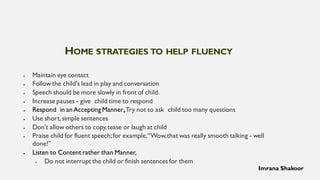
• Maintain eye contact
• Follow the child's lead in play and conversation
• Speech should be more slowly in front of child.
• Increase pauses - give child time to respond
• Respond in an Accepting Manner,Try not to ask child too many questions
• Use short,simple sentences
• Don't allow others to copy,tease or laugh at child
• Praise child for fluent speech;for example,“Wow,that was really smooth talking - well
done!”
• Listen to Content rather than Manner,
• Do not interrupt the child or finish sentences for them
Imrana Shakoor
REFERENCES
• http://www.isastutter.org/CDRomProject/parent/disfluent.html
• http://www.cincinnatichildrens.org/health/s/stuttering
• http://www.thesaurus.com/browse/strutting
• http://thechive.com/2010/09/01/leo-strutting-gets-the-photoshop-treatment-64-photos/
• Kenneth G. Shiply.
Imrana Shakoor

Developmal Dysfluency issues & its Management

  • 1.
    DYSFLUNCY & ITSMANAGEMENT Presented to Ms. Shahista Naz Dated:April 14th 2015. Presented By: Imrana Shakoor
  • 2.
    Management of NormalDevelopment Disfluceny • Imrana Shakoor
  • 3.
    Disfluency Disfluency is aerror which can distrusted flow of speech in shape of filers or distortion. • When it can be occur? • During Debate • During one on one Conversation • Singing • others Imrana Shakoor
  • 4.
    ❖various breaks, irregularitiesthat occurs within the flow of otherwise fluent speech ❖including false starts, i.e. words and sentences that are cut off mid-utterance, phrases. ❖That are restarted or repeated and repeated syllables, fillers. Imrana Shakoor
  • 5.
  • 6.
    FLLIERS: • Fillers areparts of speech which are not generally recognized as purposeful or containing formal meaning. • Commonly emanate as pauses Such as uh, um ,like and er, but also leads to repairs. For Example: "He was wearing a black-uh, I mean a blue, a blue shirt“ um, aa I,m working in admin office of k.u oh sorry sorry in somewhere where else. Imrana Shakoor
  • 7.
  • 8.
    DIFFERENCE BETWEEN STUTTERINGAND DISFLUENCY • There is tiny difference between stuttering and Normal disfluency. • Stuttering is a severe condition of dissiliency when it’s become a regular disruption during speech all the time. • It’s the main differences between them because dsyfluency disturb the fluency of speech rarely due to some reasons. • ButWhen flow of speech is destructed most of the time it will consider as stuttering due to articulation disorder. Imrana Shakoor
  • 9.
    TYPES OF DISFLUENCY Thereare at least five major explanation for fluency failure.One type of disfluent speech is the result of a normal developmental process and the remaining four are the result of different abnormalities. Imrana Shakoor
  • 10.
    1: NORMAL DEVELOPMENTAL DISFLUUENCY ❖Thisis a very common disorder that is in most cases a child outgrows without any professional help. Normal developmental disfluency is commonly mistaken as stuttering. It usually occurs in children between ages of 1 to 6 years old Imrana Shakoor
  • 11.
    2: STUTTERING ❖Stuttering isa speech disorder in which sounds, syllables, or words are repeated or prolonged, disrupting the normal flow of speech. These speech disruptions may be accompanied by struggling behaviors, such as rapid eye blinks or tremors of the lips Imrana Shakoor
  • 12.
    3: NEUROGENIC DYSFUNCTION ❖Neurogenic stuttering is a type of fluency disorder in which a person has difficulty in producing speech in a normal, smooth fashion. Individuals with fluency disorders may have speech that sounds fragmented or halting, with frequent interruptions and difficulty producing words without effort or struggle. Imrana Shakoor
  • 13.
    TYPES OF NEUROGENIC DYSFUNCTION ❖Motor speech dysfluencies ❖ Neurolinguistic dysfluencies ❖ Chemical reaction dysfluncies Imrana Shakoor
  • 14.
    4: PSYCHOGENIC DYSFUNCTION ❖Psychogenicdisfluencies may be grouped into three categories. However, emotionaly based disfluencies far outnumber manipulatiotive disfluencies and malingering as a documented phenomena. Imrana Shakoor
  • 15.
    5: LANGUAGE DELAY ❖Alanguage delay is a communication disorder. A child is said to have alanguage delay if he or she does not meet the language developmental milestones for his or her age. Language may be developing, but it is at a slower rate than the norm for the child's age. Imrana Shakoor
  • 16.
  • 17.
    Attitude Anxiety Dysfluent/ Stuttering Behavior ➢ Case History ➢Interview ➢ Attitudinal Survey ➢ Hierarchies Modes For ➢ Frequency Count ➢ Typography ➢ Other Measures & Situation. DYSFLUENCY DIAGNOSTIC CHART ➢ For very young children (age 2½ to 5 or 6), the primary goal of treatment is to help the child learn to speak fluently. ➢ Treatment in the development age range ( 2½ to 5 or 6) can be highly effective, majority exhibits complete recovery by age 6. Aging relevance 18 Months – 7 years Up to 3 years:repetition sounds, syllables,and wordsin every10th sent After 3 years disfluenciesof repeating soundsor syllables changesinto whole words (I-I-I can’t) and phrases repetition. . Imrana Shakoor
  • 18.
    EVALUATION & ASSESSMENTOF DYSFLUENCY Following factors are considered ❖ Dysfluency index : ❖ which determent,Total number of dysfluecies ; ❖ No. of Repetition+ No. of Pauses+ no. of prolongation etc. In taken sample. ❖ Total dysfluency Index reflects all dysfluencies produced by individual. ❖ Dysfluency Index reflects Percentage ofTotal & each dysfluency type based on Total Dysfluency Index. ❖ Separately index also determine,Frequencies of different types of Dysfluecies ❖ Duration of individual instances of Dysfluency. ❖ Types & Frequencies of associated motor behavior. ❖ Exhibition of extraneous body movement of lips, eyes,hand etc. usually present during dysfluent speech. On the basis of above factor,Speech Language Pathologist determine stage of Dysfluency. ❖ Mild : sound, syllable, and word repetitions ❖ Moderate: mixed sound, syllable, and word repetitions & phrases ❖ Severe: usually show signs of physical struggle, increased physical tension, and attempts to hide their stuttering and avoid speaking. It can begin anytime between ages 11/2 and 7 years. Imrana Shakoor
  • 19.
    FLUENCY SHAPING FORDYSFLUENCY & STAMMERING ❖ This involves the stammerer taking on-board techniques to alter and improve speech characteristics as; ❖ slowing speech, ❖ pausing and prolonging speech sounds. ❖ It also focuses on relaxing the speech muscles by looking at relaxed breathing, vocal folds (often called vocal chords), and articulation (lips, jaw, and tongue). LIDCOMBE PROGRAME – CHILDREN ❖ This is a speech pathology treatment for preschool age children who stutter. ❖ Extensive research has shown it to be effective if conducted within the preschool years. ❖ Parent and child attend the speech clinic once a week and the speech pathologist shows the parent how to conduct the treatment at home. MUSIC THERAPY…………RELAXATION NODE ❖ Singing is a very effective exercise for stammering. It helps the sufferer learn to better control breath and the phonatory muscles. ❖ It also soothing and relaxing psychological impact that releases tension and fear. Imrana Shakoor
  • 20.
    MODIFICATION THERAPY FORSTAMMERING Fluency shaping aims to make speech more fluent, modification therapy tries to modify moments of stammering. Unlike fluency shaping therapy, stuttering modification therapy assumes that adult stammerers will never be able to speak fluently, so the goal is to be an effective communicator despite stammering. There are several stages to modification therapy: 1st stage: Identification-the stammerer and clinician identify the core and secondary behaviors. 2nd stage :Desensitization- the stammerer tells people that he has a stammer, tries to ignore core avoidance behaviors. 3rd stage: Modification- the dysfluent learns “easy stammering” or on purpose stuttering by stopping at moments of dysfluency, pausing, and saying the word again and……… “comes out of” dysfluent speech and “into” fluent speech. Final stage: Focuses on stabilization where the Person practices new skills and changes self- concept from a dysfluent/stammerer to a person who speaks fluently most of the time but stammers occasionally Imrana Shakoor
  • 21.
    HOME STRATEGIES TOHELP FLUENCY • Maintain eye contact • Follow the child's lead in play and conversation • Speech should be more slowly in front of child. • Increase pauses - give child time to respond • Respond in an Accepting Manner,Try not to ask child too many questions • Use short,simple sentences • Don't allow others to copy,tease or laugh at child • Praise child for fluent speech;for example,“Wow,that was really smooth talking - well done!” • Listen to Content rather than Manner, • Do not interrupt the child or finish sentences for them Imrana Shakoor
  • 22.
    REFERENCES • http://www.isastutter.org/CDRomProject/parent/disfluent.html • http://www.cincinnatichildrens.org/health/s/stuttering •http://www.thesaurus.com/browse/strutting • http://thechive.com/2010/09/01/leo-strutting-gets-the-photoshop-treatment-64-photos/ • Kenneth G. Shiply. Imrana Shakoor