Seed Dormancy and Germination
Seed Dormancy: An intrinsic temporal block to the completion of
germination that provides additional time for seed dispersal over
greater geographic distances, or for seasonal dormancy cycling in
the soil seed bank.
It also maximizes seedling survival by preventing germination in
unfavourable conditions
Dr. Soumitra Paul, MPP Lab, Dept. of Botany, CU
Types of Dormancy
• Primary Dormancy: Newly dispersed, mature seeds that fail to germinate
under normal conditions
Induced by ABA during seed maturation
• Secondary Dormancy: Once primary dormancy has been lost, non-dormant
seeds under unfavourable conditions may acquire secondary dormancy
• Coat imposed Dormancy on embryo: Dormancy imposed by endosperm, seed
coat or surrounding tissues, germinate readily in presence of water and oxygen
once the seed coat is removed
Water impermeability: Arid and semi arid regions
Mechanical Constraint : Thick walled endosperm too rigid to penetrate
by radicle
Interference with gas exchange: Surrounding tissues limit the supply of
oxygen to the embryo
Retention of inhibitors: Contain secondary metabolites like phenolics,
tannins and Coumarins Dr. Soumitra Paul, MPP Lab, Dept. of
Botany, CU
Non dormant seeds can exhibit
vivipary and precocious germination
• Vivipary: In some estuarine plants mature seeds not
only lack dormancy, but also germinate while still on
the mother plant, a phenomenon known as Vivipary.
• Precocious germination: In maize (viviparous mutant)
the embryo germinate directly on the cob while still
attached to the parent plant, referred to precocious
germination
Dr. Soumitra Paul, MPP Lab, Dept. of Botany, CU
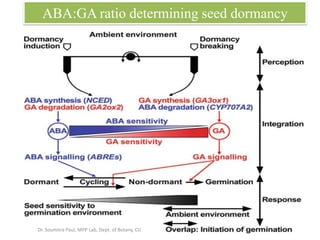
ABA:GA ratio determining seed dormancy
Dr. Soumitra Paul, MPP Lab, Dept. of Botany, CU
Release from Dormancy
• Light: Mainly regulated by Pr: Pfr ration, all light requiring seeds exhibit coat-imposed
dormancy and removal of the outer tissues, specifically endosperm allows the embryo to
germinate without light. Light enable the radicle to penetrate the endosperm
• Chilling: A period of low temperature (0ᵒC-10ᵒC) is required to break the dormancy,
referred as Stratification
• After ripening: A period of dry storage at room temperature is required for germination.
Seeds are considered “dry” when their water content drops below 20%, In several
species ABA content declines during after ripening period, helps in germination
• Chemical Compounds: Respiratory inhibitors, sulfhydryl compounds, oxidants, nitrate
(along with light), NO, Smoke (contain multiple germinating stimulants), Karrikinolides
(a ingredient of smoke) contains karrikins which structurally resembles with
strigolactones
Dr. Soumitra Paul, MPP Lab, Dept. of Botany, CU
Seed Germination
• Phase I: Dry seeds take up water rapidly by the process of
imbibition
• Phase II: Water uptake by imbibitions declines and metabolic
processes, including transcription and translation, are reinitiated.
The embryo expands and radicle emerges from the seed coat
• Phase III: Water uptake resumes due to decrease in solute
potential as the seedlings grows and stored food reserves of the
seeds are mobilized
Dr. Soumitra Paul, MPP Lab, Dept. of Botany, CU
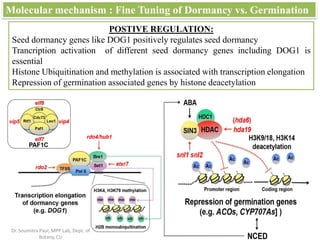
Molecular mechanism : Fine Tuning of Dormancy vs. Germination
POSTIVE REGULATION:
Seed dormancy genes like DOG1 positively regulates seed dormancy
Trancription activation of different seed dormancy genes including DOG1 is
essential
Histone Ubiquitination and methylation is associated with transcription elongation
Repression of germination associated genes by histone deacetylation
Dr. Soumitra Paul, MPP Lab, Dept. of
Botany, CU
NEGATIVE REGULATION OF SEED DORMANCY
REPRESSION OF DORMANCY GENES AND ACTIVATION OF
GERMINATION GENES THROUGH HISTONE DEACETYLATION:
HD2B mediates dormancy-releasing process. In ColHD2B/Cvi seeds, expression of
GA3ox1 and GA3ox2 and GA4 levels are increased, while expression of GA2ox2,
a GA deactivation gene, is reduced compared to wild-type Cvi seeds. Since HDAC
represses gene expression through histone deacetylation, GA2ox2 repression could
be a direct effect of HD2B. In contrast, the up- regulation of GA3ox genes may be
through repression of their up stream regulators or some other mechanisms. It is
interesting that the three separate hormone pathways (ethylene, ABA, and GA)
associated with seed dormancy are regulated by histone deacetylation.
Dr. Soumitra Paul, MPP Lab, Dept. of
Botany, CU
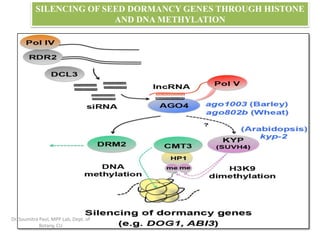
SILENCING OF SEED DORMANCY GENES THROUGH HISTONE
AND DNA METHYLATION
Dr. Soumitra Paul, MPP Lab, Dept. of
Botany, CU
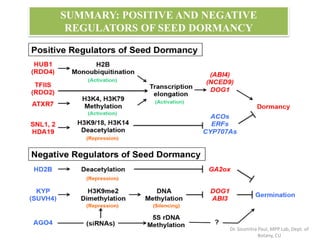
SUMMARY: POSITIVE AND NEGATIVE
REGULATORS OF SEED DORMANCY
Dr. Soumitra Paul, MPP Lab, Dept. of
Botany, CU

Seed dormancy and germination regulation

  • 1.
    Seed Dormancy andGermination Seed Dormancy: An intrinsic temporal block to the completion of germination that provides additional time for seed dispersal over greater geographic distances, or for seasonal dormancy cycling in the soil seed bank. It also maximizes seedling survival by preventing germination in unfavourable conditions Dr. Soumitra Paul, MPP Lab, Dept. of Botany, CU
  • 2.
    Types of Dormancy •Primary Dormancy: Newly dispersed, mature seeds that fail to germinate under normal conditions Induced by ABA during seed maturation • Secondary Dormancy: Once primary dormancy has been lost, non-dormant seeds under unfavourable conditions may acquire secondary dormancy • Coat imposed Dormancy on embryo: Dormancy imposed by endosperm, seed coat or surrounding tissues, germinate readily in presence of water and oxygen once the seed coat is removed Water impermeability: Arid and semi arid regions Mechanical Constraint : Thick walled endosperm too rigid to penetrate by radicle Interference with gas exchange: Surrounding tissues limit the supply of oxygen to the embryo Retention of inhibitors: Contain secondary metabolites like phenolics, tannins and Coumarins Dr. Soumitra Paul, MPP Lab, Dept. of Botany, CU
  • 3.
    Non dormant seedscan exhibit vivipary and precocious germination • Vivipary: In some estuarine plants mature seeds not only lack dormancy, but also germinate while still on the mother plant, a phenomenon known as Vivipary. • Precocious germination: In maize (viviparous mutant) the embryo germinate directly on the cob while still attached to the parent plant, referred to precocious germination Dr. Soumitra Paul, MPP Lab, Dept. of Botany, CU
  • 4.
    ABA:GA ratio determiningseed dormancy Dr. Soumitra Paul, MPP Lab, Dept. of Botany, CU
  • 5.
    Release from Dormancy •Light: Mainly regulated by Pr: Pfr ration, all light requiring seeds exhibit coat-imposed dormancy and removal of the outer tissues, specifically endosperm allows the embryo to germinate without light. Light enable the radicle to penetrate the endosperm • Chilling: A period of low temperature (0ᵒC-10ᵒC) is required to break the dormancy, referred as Stratification • After ripening: A period of dry storage at room temperature is required for germination. Seeds are considered “dry” when their water content drops below 20%, In several species ABA content declines during after ripening period, helps in germination • Chemical Compounds: Respiratory inhibitors, sulfhydryl compounds, oxidants, nitrate (along with light), NO, Smoke (contain multiple germinating stimulants), Karrikinolides (a ingredient of smoke) contains karrikins which structurally resembles with strigolactones Dr. Soumitra Paul, MPP Lab, Dept. of Botany, CU
  • 6.
    Seed Germination • PhaseI: Dry seeds take up water rapidly by the process of imbibition • Phase II: Water uptake by imbibitions declines and metabolic processes, including transcription and translation, are reinitiated. The embryo expands and radicle emerges from the seed coat • Phase III: Water uptake resumes due to decrease in solute potential as the seedlings grows and stored food reserves of the seeds are mobilized Dr. Soumitra Paul, MPP Lab, Dept. of Botany, CU
  • 7.
    Molecular mechanism :Fine Tuning of Dormancy vs. Germination POSTIVE REGULATION: Seed dormancy genes like DOG1 positively regulates seed dormancy Trancription activation of different seed dormancy genes including DOG1 is essential Histone Ubiquitination and methylation is associated with transcription elongation Repression of germination associated genes by histone deacetylation Dr. Soumitra Paul, MPP Lab, Dept. of Botany, CU
  • 8.
    NEGATIVE REGULATION OFSEED DORMANCY REPRESSION OF DORMANCY GENES AND ACTIVATION OF GERMINATION GENES THROUGH HISTONE DEACETYLATION: HD2B mediates dormancy-releasing process. In ColHD2B/Cvi seeds, expression of GA3ox1 and GA3ox2 and GA4 levels are increased, while expression of GA2ox2, a GA deactivation gene, is reduced compared to wild-type Cvi seeds. Since HDAC represses gene expression through histone deacetylation, GA2ox2 repression could be a direct effect of HD2B. In contrast, the up- regulation of GA3ox genes may be through repression of their up stream regulators or some other mechanisms. It is interesting that the three separate hormone pathways (ethylene, ABA, and GA) associated with seed dormancy are regulated by histone deacetylation. Dr. Soumitra Paul, MPP Lab, Dept. of Botany, CU
  • 9.
    SILENCING OF SEEDDORMANCY GENES THROUGH HISTONE AND DNA METHYLATION Dr. Soumitra Paul, MPP Lab, Dept. of Botany, CU
  • 10.
    SUMMARY: POSITIVE ANDNEGATIVE REGULATORS OF SEED DORMANCY Dr. Soumitra Paul, MPP Lab, Dept. of Botany, CU