FLOW CYTOMETRY
IMMUNOPHENOTYPIN
G
OBJECTIVE
■ Appreciate the mechanism and role of flow cytometry in
diagnosis and classification of various haematological
neoplasm
INTRODUCTION
■ Flow cytometry (FC) measures single cells “flowing” through a detector
system
■ Flow cytometer
– Flow means – flow tract
– Cytometer – device for cell analysis
■ Applications of FC range from
– common clinical laboratory tests, such as complete blood count with
differential and monitoring of CD4 cell count in HIV patients
– to advanced, multicolor flow cytometry used to identify subtypes
INTRODUCTION
■ Flow cytometry is a sensitive, powerful method for simultaneously obtaining
information on various cellular processes, including expression of surface
markers, intracellular cytokine and signaling proteins
■ Measures characteristics on each cell and hence play role in characterizing
heterogeneous cell populations.
Flow cytometry (FC)
■ FC process begins with the selection of fluorescent-labeled antibodies
specific to cell-surface markers used to characterize the cell population of
interest.
■ These cell surface markers are usually glycoproteins called cluster of
differentiation (CD) markers, and they help differentiate cell subpopulations
■ Flow cytometry can be performed on a variety of tissues, including peripheral
blood, bone marrow aspirates, skin biopsies, and tissue culture cell lines.
FLOW CYTOMETRY
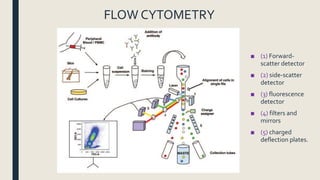
■ (1) Forward-
scatter detector
■ (2) side-scatter
detector
■ (3) fluorescence
detector
■ (4) filters and
mirrors
■ (5) charged
deflection plates.
FLOW CYTOMETRY
■ Each cell passes through several laser beams so that different optical
properties can be measured.
■ Optical information known as forward scatter (FSC) and side scatter (SSC) is
obtained based on the angle of light emitted from the analyzed cell.
■ FSC – provides information correlating with cell size.
■ SSC – information on the granularity of the cell.
– This could be useful, for example, when trying to distinguish between
lymphocytes and granulocytes
Immunophenotyping
■ Methods
– Flow cytometry
– Immunohistochemistry
Immunophenotyping
■ Immunophenotyping is a technique that uses monoclonal antibodies to
identify protein markers present in the cytoplasm, nucleus or surface
membrane of cells, thereby identifying the cell type and degree of
differentiation.
■ Immunophenotyping establishes clonality and determine pattern of
expression of cell markers and hence the determination of malignant
subtypes.
■ Examples;
– Chronic lymphocytic leukaemia exhibits CD5, CD23, CD19, CD20 markers
– Multiple myeloma, plasma cells exhibit – CD38 and CD138
10
Thank
You

FLOW CYTOMETRY IMMUNOPHENOTYPING-2.pptx

  • 1.
  • 2.
    OBJECTIVE ■ Appreciate themechanism and role of flow cytometry in diagnosis and classification of various haematological neoplasm
  • 3.
    INTRODUCTION ■ Flow cytometry(FC) measures single cells “flowing” through a detector system ■ Flow cytometer – Flow means – flow tract – Cytometer – device for cell analysis ■ Applications of FC range from – common clinical laboratory tests, such as complete blood count with differential and monitoring of CD4 cell count in HIV patients – to advanced, multicolor flow cytometry used to identify subtypes
  • 4.
    INTRODUCTION ■ Flow cytometryis a sensitive, powerful method for simultaneously obtaining information on various cellular processes, including expression of surface markers, intracellular cytokine and signaling proteins ■ Measures characteristics on each cell and hence play role in characterizing heterogeneous cell populations.
  • 5.
    Flow cytometry (FC) ■FC process begins with the selection of fluorescent-labeled antibodies specific to cell-surface markers used to characterize the cell population of interest. ■ These cell surface markers are usually glycoproteins called cluster of differentiation (CD) markers, and they help differentiate cell subpopulations ■ Flow cytometry can be performed on a variety of tissues, including peripheral blood, bone marrow aspirates, skin biopsies, and tissue culture cell lines.
  • 6.
    FLOW CYTOMETRY ■ (1)Forward- scatter detector ■ (2) side-scatter detector ■ (3) fluorescence detector ■ (4) filters and mirrors ■ (5) charged deflection plates.
  • 7.
    FLOW CYTOMETRY ■ Eachcell passes through several laser beams so that different optical properties can be measured. ■ Optical information known as forward scatter (FSC) and side scatter (SSC) is obtained based on the angle of light emitted from the analyzed cell. ■ FSC – provides information correlating with cell size. ■ SSC – information on the granularity of the cell. – This could be useful, for example, when trying to distinguish between lymphocytes and granulocytes
  • 8.
    Immunophenotyping ■ Methods – Flowcytometry – Immunohistochemistry
  • 9.
    Immunophenotyping ■ Immunophenotyping isa technique that uses monoclonal antibodies to identify protein markers present in the cytoplasm, nucleus or surface membrane of cells, thereby identifying the cell type and degree of differentiation. ■ Immunophenotyping establishes clonality and determine pattern of expression of cell markers and hence the determination of malignant subtypes. ■ Examples; – Chronic lymphocytic leukaemia exhibits CD5, CD23, CD19, CD20 markers – Multiple myeloma, plasma cells exhibit – CD38 and CD138
  • 10.