BUILDING SERVICES – 1
B.Arch
4th Semester
Presentation by:
Rahul Sharma
HMS School of architecture, Tumkur 1
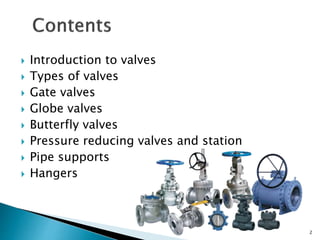
 Introduction to valves
 Types of valves
 Gate valves
 Globe valves
 Butterfly valves
 Pressure reducing valves and station
 Pipe supports
 Hangers
2
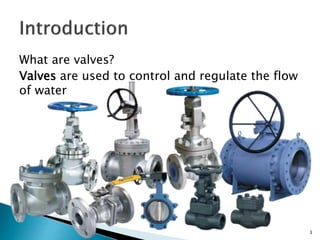
What are valves?
Valves are used to control and regulate the flow
of water
3
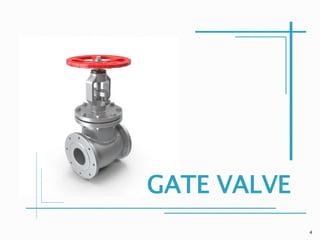
GATE VALVE
4
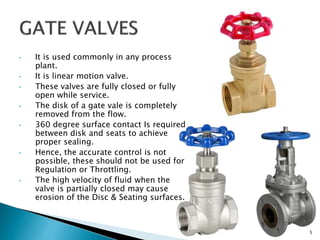
• It is used commonly in any process
plant.
• It is linear motion valve.
• These valves are fully closed or fully
open while service.
• The disk of a gate vale is completely
removed from the flow.
• 360 degree surface contact Is required
between disk and seats to achieve
proper sealing.
• Hence, the accurate control is not
possible, these should not be used for
Regulation or Throttling.
• The high velocity of fluid when the
valve is partially closed may cause
erosion of the Disc & Seating surfaces.
5

6
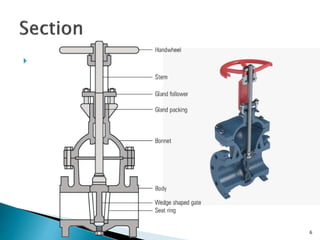
 Solid taper wedge.
 Flexible wedge.
 Split wedge or parallel disks valve.
7
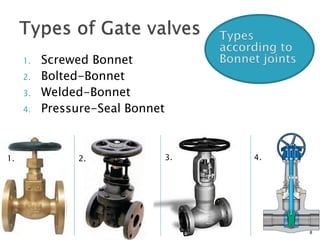
1. Screwed Bonnet
2. Bolted-Bonnet
3. Welded-Bonnet
4. Pressure-Seal Bonnet
1. 4.2. 3.
8
1. Rising Stem or OS & Y Type
(Outside Stem and Screw Type)
2. Non-rising Stem type
1. 2.
9
ADVANTAGES
 Pressure drop during operation is less
 Most of the gate valve can be used as bi directional
 They are suitable for high pressure and temperature
application and requires less maintenance
DISADVANTAGES
 It cannot be used to control the flow
 It is a slow operation
 When partially open it creates vibration and noise
10
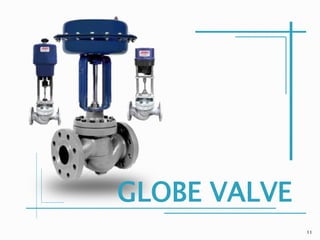
GLOBE VALVE
11
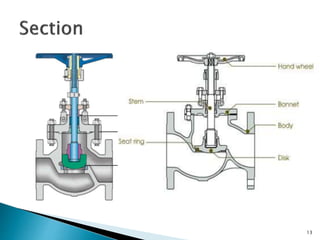
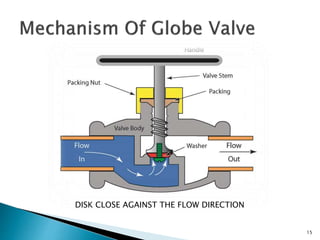
 It is the linear motion valve used to stop/start
and regulate fluid flow
 The globe valve disk can be removed entirely
from the flow path
 During opening and closing of the globe valve,
disc moves perpendicular to the seat
 This movement creates annular space between
disk and seat ring that gradually close as the
valve closed
 This characteristic provides the globe valve
good throttling ability required for regulating
the flow
 As compared to gate valve leakage from globe
valve is very less
12
13
14
Globe valves can be arranged in such a
way that the disc closes against the
flow or in the same direction of flow
Disk w
15
DISK CLOSE AGAINST THE FLOW DIRECTION
 Ball Type
 Needle Type
 Composite type
16
1. Z types
2. Y types
3. Angle Types
17
3.
1.
2.
 Globe valves are used in the systems where
flow control is required and leak tightness is
also important
 Used in feed- water, chemical, air, lube oil
and almost all services where pressure drop
is not an issue
 Used as automatic control valve
 Used in vents and drains where leak tightness
and safety are major concerns
18
ADVANTAGES
 Better shut off as compared to gate valve
 Good for frequent operation as no fear of wear of seat and disk
 Easy to repair, as seat and disk can be access from the valve top
 Fast operation compares to gate valve due to shorter stroke
length
 Usually operated by automatic actuator
19
DISADVANTAGE S
 In a large high-pressure line, pulsations and impacts can damage
internal trim parts.
 Large valve require considerable power to open and create noise
while in operation.
 It is heavier than other valves of the same pressure rating.
 Costlier compared to gate valve.
20
BUTTERFLY VALVE
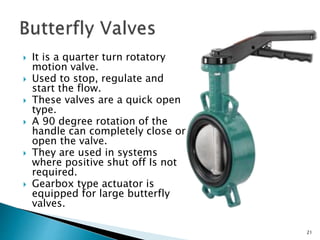
 It is a quarter turn rotatory
motion valve.
 Used to stop, regulate and
start the flow.
 These valves are a quick open
type.
 A 90 degree rotation of the
handle can completely close or
open the valve.
 They are used in systems
where positive shut off Is not
required.
 Gearbox type actuator is
equipped for large butterfly
valves.
21
 Hand-wheel is connected to the stem via a
gearbox
 This will reduce the force but at the same
time reduce the speed of the operation
 This type of valve should be in open position
while installation
 If it is in closed position while installing, the
rubber seat will wedge against the valve disk
and make it difficult to open
22
 Used in many different
fluid services
 Can be used liquids,
cooling water, air, gasses,
firefighting and vaccum
services
 These perform well in
slurry applications
 Used in all type of
industries application even
in high pressure and
temperature services
23
 Suitable for large valve applications because it is
compact, light weight, it requires less space as
compared to other valves
 It need less time to open or close due to quick
operation
 Compared to other valves, its maintenance costs
are usually low
 A pressure drop across a butterfly valve is small
 Valve with non-metallic seating can be used in
chemical or corrosive media
24
 There is a chance for cavitation and choke as
the disk is always in the flow turbulence flow
can affect the disc movement
 Throttling is limited to low differential
pressure services and that too with a 30-80
degree disk opening
25
PRESSURE RELIEF
VALVE
26
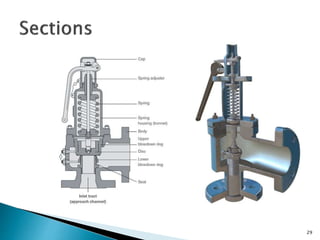
 A pressure relief valve is a safety device
designed to protect pressurized equipment
or system during an overpressure event or
in the event of vacuum.
 An overpressure event is a condition, in
which pressure inside the equipment or
piping system increased beyond the
specified design pressure or maximum
allowable working pressure (MAWP).
27
 If not relieved this can damage the system,
property and personal.
 Similarly, an unwanted vacuum is also
dangerous for the system.
 The primary purpose of a pressure Relief
Valve is the protect the life and property by
venting fluid from an over-pressurized
system.
 Vacuum relief valve ensures that vacuum like
situation does not occur in the system by
allowing air inside the system.
28
29
There are three types of pressure relief devices:
 Reclosing-type pressure relief devices
 Non-reclosing type pressure relief devices
 Vacuum relief devices
30
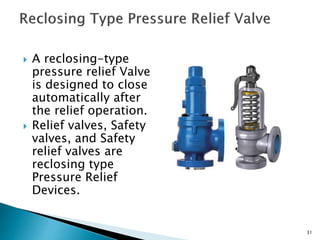
 A reclosing-type
pressure relief Valve
is designed to close
automatically after
the relief operation.
 Relief valves, Safety
valves, and Safety
relief valves are
reclosing type
Pressure Relief
Devices.
31
Advantages
 It Can be used in all kind of Gas and Liquid
services
 Suitable for high pressure and temperature
services
 Low cost compares to other types
Disadvantages
 Back pressure can affect the functioning of
the valve
 Spring is subjected to corrosion if service
material is corrosive
 Not suitable for hazardous services
32
PIPE SUPPORTS AND HANGERS
33
 For any industrial piping or ducting system, it is
critical that hangers and supports are correctly
spaced.
 Too much space between supports adds unnecessary
stress to your system, causing deflection and
sagging.
 Too little spacing, and will incur unnecessary
expenses.
 An advantage CPVC has over other thermoplastics is
that at elevated temperatures it maintains its
structural integrity, requiring fewer supports.
 Depending on the size of the system, this can create
significant advantages across material, design and—
most importantly—labour costs.
34
 Although required support spacing is less for
CPVC than other thermoplastics, it is not as
rigid as traditional metal piping systems,
requiring additional supports.
 However, in corrosive applications, the
additional hangers are a small price to pay for
extended system reliability.
 Ultimately, the number and spacing of
hangers and supports will be determined by
the system conditions and piping or ducting
requirements.
35
When determining support spacing for CPVC piping or ducting
systems, the following all affect installation specifications:
 Duct/piping diameter. Larger diameter piping or ducting is
inherently less prone to deflection, allowing for fewer supports.
 Temperature parameters of the system. As temperature
increases, the material stiffness or flexural modulus of
thermoplastics decreases, requiring more frequent supports.
 Weight of transported liquids. Denser processing chemicals and
solids will increase demands on the piping, creating the need for
more supports.
 Location of concentrated loads. To help support the weight of
heavy instruments or valves in the system, additional supports
may be employed.
 Possibility that process solids/liquids accumulate in the
system. To prevent sagging of the pipe, processes prone to
weight build up from solids or liquids should consider increasing
the number of supports.
36
 While the recommended support
distances are provided for
straight runs, industrial systems
are not solely comprised of
straight runs of pipe.
 Valves, flanges, bends, tees,
joints, and other heavy
components may require
independent support in CPVC
systems.
 Add additional supports for
straight runs when necessary
and assure that you don’t go
over the recommended distance
between supports.
37
 When choosing hangers, clamps, or supports,
ensure the right fit for the situation and
provide the necessary support.
 Also, be especially careful that edges are
smooth/rounded to negate the chance the
pipe will be scratch or abraded by the support
or hanger.
 Not forcing fittings into place or over
tightening them will also help keep piping
free from harm.
38
 Recommended options include the following:
39
Sources:
www.hardhatengineer.com
www.corzan.com
40
41
Presentation by:
Rahul Sharma
HMS School Of Architecture, Tumkur

Flow control valves

  • 1.
    BUILDING SERVICES –1 B.Arch 4th Semester Presentation by: Rahul Sharma HMS School of architecture, Tumkur 1
  • 2.
     Introduction tovalves  Types of valves  Gate valves  Globe valves  Butterfly valves  Pressure reducing valves and station  Pipe supports  Hangers 2
  • 3.
    What are valves? Valvesare used to control and regulate the flow of water 3
  • 4.
  • 5.
    • It isused commonly in any process plant. • It is linear motion valve. • These valves are fully closed or fully open while service. • The disk of a gate vale is completely removed from the flow. • 360 degree surface contact Is required between disk and seats to achieve proper sealing. • Hence, the accurate control is not possible, these should not be used for Regulation or Throttling. • The high velocity of fluid when the valve is partially closed may cause erosion of the Disc & Seating surfaces. 5
  • 6.
  • 7.
     Solid taperwedge.  Flexible wedge.  Split wedge or parallel disks valve. 7
  • 8.
    1. Screwed Bonnet 2.Bolted-Bonnet 3. Welded-Bonnet 4. Pressure-Seal Bonnet 1. 4.2. 3. 8
  • 9.
    1. Rising Stemor OS & Y Type (Outside Stem and Screw Type) 2. Non-rising Stem type 1. 2. 9
  • 10.
    ADVANTAGES  Pressure dropduring operation is less  Most of the gate valve can be used as bi directional  They are suitable for high pressure and temperature application and requires less maintenance DISADVANTAGES  It cannot be used to control the flow  It is a slow operation  When partially open it creates vibration and noise 10
  • 11.
  • 12.
     It isthe linear motion valve used to stop/start and regulate fluid flow  The globe valve disk can be removed entirely from the flow path  During opening and closing of the globe valve, disc moves perpendicular to the seat  This movement creates annular space between disk and seat ring that gradually close as the valve closed  This characteristic provides the globe valve good throttling ability required for regulating the flow  As compared to gate valve leakage from globe valve is very less 12
  • 13.
  • 14.
    14 Globe valves canbe arranged in such a way that the disc closes against the flow or in the same direction of flow Disk w
  • 15.
    15 DISK CLOSE AGAINSTTHE FLOW DIRECTION
  • 16.
     Ball Type Needle Type  Composite type 16
  • 17.
    1. Z types 2.Y types 3. Angle Types 17 3. 1. 2.
  • 18.
     Globe valvesare used in the systems where flow control is required and leak tightness is also important  Used in feed- water, chemical, air, lube oil and almost all services where pressure drop is not an issue  Used as automatic control valve  Used in vents and drains where leak tightness and safety are major concerns 18
  • 19.
    ADVANTAGES  Better shutoff as compared to gate valve  Good for frequent operation as no fear of wear of seat and disk  Easy to repair, as seat and disk can be access from the valve top  Fast operation compares to gate valve due to shorter stroke length  Usually operated by automatic actuator 19 DISADVANTAGE S  In a large high-pressure line, pulsations and impacts can damage internal trim parts.  Large valve require considerable power to open and create noise while in operation.  It is heavier than other valves of the same pressure rating.  Costlier compared to gate valve.
  • 20.
  • 21.
     It isa quarter turn rotatory motion valve.  Used to stop, regulate and start the flow.  These valves are a quick open type.  A 90 degree rotation of the handle can completely close or open the valve.  They are used in systems where positive shut off Is not required.  Gearbox type actuator is equipped for large butterfly valves. 21
  • 22.
     Hand-wheel isconnected to the stem via a gearbox  This will reduce the force but at the same time reduce the speed of the operation  This type of valve should be in open position while installation  If it is in closed position while installing, the rubber seat will wedge against the valve disk and make it difficult to open 22
  • 23.
     Used inmany different fluid services  Can be used liquids, cooling water, air, gasses, firefighting and vaccum services  These perform well in slurry applications  Used in all type of industries application even in high pressure and temperature services 23
  • 24.
     Suitable forlarge valve applications because it is compact, light weight, it requires less space as compared to other valves  It need less time to open or close due to quick operation  Compared to other valves, its maintenance costs are usually low  A pressure drop across a butterfly valve is small  Valve with non-metallic seating can be used in chemical or corrosive media 24
  • 25.
     There isa chance for cavitation and choke as the disk is always in the flow turbulence flow can affect the disc movement  Throttling is limited to low differential pressure services and that too with a 30-80 degree disk opening 25
  • 26.
  • 27.
     A pressurerelief valve is a safety device designed to protect pressurized equipment or system during an overpressure event or in the event of vacuum.  An overpressure event is a condition, in which pressure inside the equipment or piping system increased beyond the specified design pressure or maximum allowable working pressure (MAWP). 27
  • 28.
     If notrelieved this can damage the system, property and personal.  Similarly, an unwanted vacuum is also dangerous for the system.  The primary purpose of a pressure Relief Valve is the protect the life and property by venting fluid from an over-pressurized system.  Vacuum relief valve ensures that vacuum like situation does not occur in the system by allowing air inside the system. 28
  • 29.
  • 30.
    There are threetypes of pressure relief devices:  Reclosing-type pressure relief devices  Non-reclosing type pressure relief devices  Vacuum relief devices 30
  • 31.
     A reclosing-type pressurerelief Valve is designed to close automatically after the relief operation.  Relief valves, Safety valves, and Safety relief valves are reclosing type Pressure Relief Devices. 31
  • 32.
    Advantages  It Canbe used in all kind of Gas and Liquid services  Suitable for high pressure and temperature services  Low cost compares to other types Disadvantages  Back pressure can affect the functioning of the valve  Spring is subjected to corrosion if service material is corrosive  Not suitable for hazardous services 32
  • 33.
  • 34.
     For anyindustrial piping or ducting system, it is critical that hangers and supports are correctly spaced.  Too much space between supports adds unnecessary stress to your system, causing deflection and sagging.  Too little spacing, and will incur unnecessary expenses.  An advantage CPVC has over other thermoplastics is that at elevated temperatures it maintains its structural integrity, requiring fewer supports.  Depending on the size of the system, this can create significant advantages across material, design and— most importantly—labour costs. 34
  • 35.
     Although requiredsupport spacing is less for CPVC than other thermoplastics, it is not as rigid as traditional metal piping systems, requiring additional supports.  However, in corrosive applications, the additional hangers are a small price to pay for extended system reliability.  Ultimately, the number and spacing of hangers and supports will be determined by the system conditions and piping or ducting requirements. 35
  • 36.
    When determining supportspacing for CPVC piping or ducting systems, the following all affect installation specifications:  Duct/piping diameter. Larger diameter piping or ducting is inherently less prone to deflection, allowing for fewer supports.  Temperature parameters of the system. As temperature increases, the material stiffness or flexural modulus of thermoplastics decreases, requiring more frequent supports.  Weight of transported liquids. Denser processing chemicals and solids will increase demands on the piping, creating the need for more supports.  Location of concentrated loads. To help support the weight of heavy instruments or valves in the system, additional supports may be employed.  Possibility that process solids/liquids accumulate in the system. To prevent sagging of the pipe, processes prone to weight build up from solids or liquids should consider increasing the number of supports. 36
  • 37.
     While therecommended support distances are provided for straight runs, industrial systems are not solely comprised of straight runs of pipe.  Valves, flanges, bends, tees, joints, and other heavy components may require independent support in CPVC systems.  Add additional supports for straight runs when necessary and assure that you don’t go over the recommended distance between supports. 37
  • 38.
     When choosinghangers, clamps, or supports, ensure the right fit for the situation and provide the necessary support.  Also, be especially careful that edges are smooth/rounded to negate the chance the pipe will be scratch or abraded by the support or hanger.  Not forcing fittings into place or over tightening them will also help keep piping free from harm. 38
  • 39.
     Recommended optionsinclude the following: 39
  • 40.
  • 41.
    41 Presentation by: Rahul Sharma HMSSchool Of Architecture, Tumkur

Editor's Notes

  • #11 Repairs such as lapping and grinding of seats are more difficult due to limited access. (meaning ?)