Presented by:
Pankaj Chaudhary
Lecturer,
Institute of Hotel Management,
Bhopal.
A. Role of ingredients in bread Making
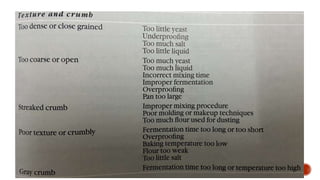
B. Bread Faults
C. Bread Improvers
 Bread flour
Strong flour(high protein content) with high gluten content.
Rough in texture
 Cake flour
Weak flour(low protein content) with low gluten content.
Smooth and fine in texture.
 Pastry flour
Lower in gluten than bread flour but higher than cake flour.
Used for cookies, pies, pastries, sweet yeast doughs
 All Purpose flour
Slightly weaker than bread flour.
 It gives structure to the bread.
 It form the basic ingredients for any bread.
 Protein percentage in bread flour- 12%-15%
 Protein percentage in cake flour- 6% - 8%
 Italian style 00 or doppio flour(very fine flour for pizza and pastas)- 8.5% - 12%
 To soften the bread.
 To add moistness and richness.
 To increase keeping quality.
 To add flavour.
 To assist in leavening when used in flaky products.
 To add sweetness and flavour.
 To tenderize the bread.
 To give crust colour
 To increase keeping quality.
 To act as creaming agent with fats.
 Various sugars used- Granulated sugar/confectioners sugar/mollasses/corn
syrup/glucose syrup/Honey
 To combine all the ingredients.
 Development of gluten.
 Moisture
 Yeast activity.
 To dissolve other ingredients.
 Leavening is the process of incorporation of gas in dough.
 Yeast- fermentation
 Yeast contributes flavour to the bread
 Controls the activity of yeast.
 Preservation
 Flavour
 Strengthens gluten.
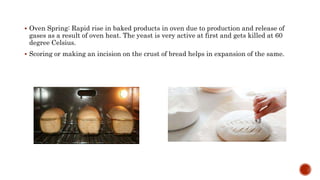
 Oven Spring: Rapid rise in baked products in oven due to production and release of
gases as a result of oven heat. The yeast is very active at first and gets killed at 60
degree Celsius.
 Scoring or making an incision on the crust of bread helps in expansion of the same.
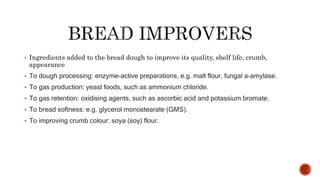
• Ingredients added to the bread dough to improve its quality, shelf life, crumb,
appearance
• To dough processing: enzyme-active preparations, e.g. malt flour, fungal a-amylase.
• To gas production: yeast foods, such as ammonium chloride.
• To gas retention: oxidising agents, such as ascorbic acid and potassium bromate.
• To bread softness: e.g. glycerol monostearate (GMS).
• To improving crumb colour: soya (soy) flour.
 Enzymes: Amylase, protease
 Emulsifiers: Lecithin
 Oxidising agents: Benzyl Peroxide
Bread making.pptx

Bread making.pptx

  • 1.
  • 2.
    A. Role ofingredients in bread Making B. Bread Faults C. Bread Improvers
  • 3.
     Bread flour Strongflour(high protein content) with high gluten content. Rough in texture  Cake flour Weak flour(low protein content) with low gluten content. Smooth and fine in texture.  Pastry flour Lower in gluten than bread flour but higher than cake flour. Used for cookies, pies, pastries, sweet yeast doughs  All Purpose flour Slightly weaker than bread flour.
  • 4.
     It givesstructure to the bread.  It form the basic ingredients for any bread.  Protein percentage in bread flour- 12%-15%  Protein percentage in cake flour- 6% - 8%  Italian style 00 or doppio flour(very fine flour for pizza and pastas)- 8.5% - 12%
  • 5.
     To softenthe bread.  To add moistness and richness.  To increase keeping quality.  To add flavour.  To assist in leavening when used in flaky products.
  • 6.
     To addsweetness and flavour.  To tenderize the bread.  To give crust colour  To increase keeping quality.  To act as creaming agent with fats.  Various sugars used- Granulated sugar/confectioners sugar/mollasses/corn syrup/glucose syrup/Honey
  • 7.
     To combineall the ingredients.  Development of gluten.  Moisture  Yeast activity.  To dissolve other ingredients.
  • 8.
     Leavening isthe process of incorporation of gas in dough.  Yeast- fermentation  Yeast contributes flavour to the bread
  • 9.
     Controls theactivity of yeast.  Preservation  Flavour  Strengthens gluten.
  • 10.
     Oven Spring:Rapid rise in baked products in oven due to production and release of gases as a result of oven heat. The yeast is very active at first and gets killed at 60 degree Celsius.  Scoring or making an incision on the crust of bread helps in expansion of the same.
  • 15.
    • Ingredients addedto the bread dough to improve its quality, shelf life, crumb, appearance • To dough processing: enzyme-active preparations, e.g. malt flour, fungal a-amylase. • To gas production: yeast foods, such as ammonium chloride. • To gas retention: oxidising agents, such as ascorbic acid and potassium bromate. • To bread softness: e.g. glycerol monostearate (GMS). • To improving crumb colour: soya (soy) flour.
  • 16.
     Enzymes: Amylase,protease  Emulsifiers: Lecithin  Oxidising agents: Benzyl Peroxide