HACCP PLAN FOR BAKED FOODS
Department of Food Science and Technology
Faculty of Agricultural Technology
Bogor Agricultural University
2009
Langkah 1 : Establish the HACCP team
Name Expertise/Position Position in the team
Dewi Food Tech. & HACCP specialist/ Coordinator
QA Mgr.
Rahman Engineering/Production Mgr. Member
Putri Microbiology/QC Mgr. Member
Surya Chemistry/Warehouse Mgr. Member
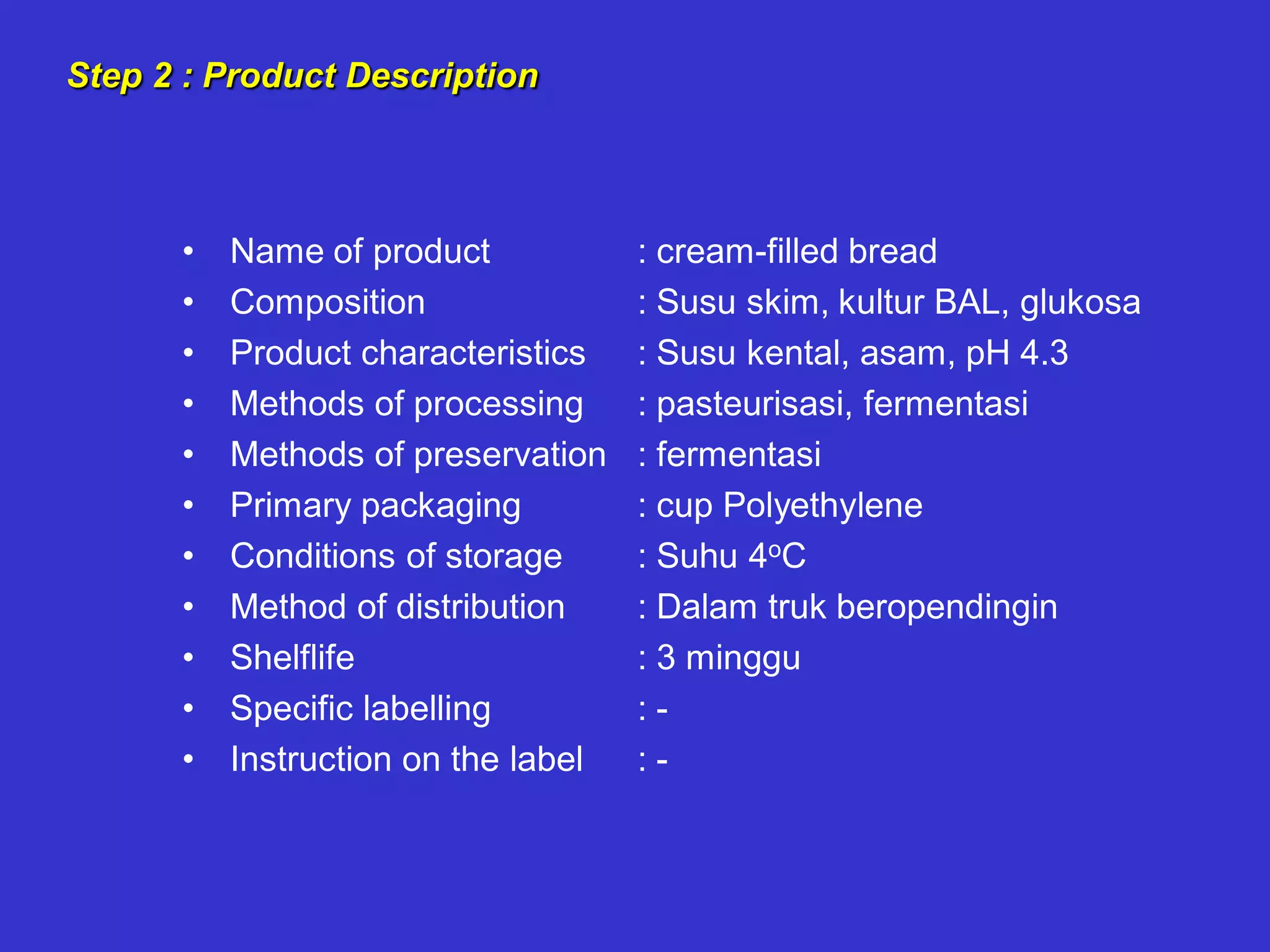
Step 2 : Product Description
• Name of product
• Composition
• Product characteristics
• Methods of processing
• Methods of preservation
• Primary packaging
• Conditions of storage
• Method of distribution
• Shelflife
• Specific labelling
• Instruction on the label
: cream-filled bread
: Susu skim, kultur BAL, glukosa
: Susu kental, asam, pH 4.3
: pasteurisasi, fermentasi
: fermentasi
: cup Polyethylene
: Suhu 4oC
: Dalam truk beropendingin
: 3 minggu
: -
: -
Step 3 : Identification of the Product’s Intended Use
• Name of product
• Intended use
• Target consumer
: Cream-filled bread
: Directly consumed
: General public
Step 4 : Establish Process Flow Diagram
Process flow diagram for the bread :
Weigh all ingredients (sugar, salt, skim milk, shortening, egg, wheat flour, yeast, cold water)
Mixing (sugar, salt and skim milk)
Add shortening and egg
Blending (into creamed mixture)
Add wheat flour, yeast, and cold water
Blending (into non-sticky dough)
Round the dough
Fermentation 1 (15 minutes at 27-300C)
Divide the dough and weigh 900 gram each
Fermentation 2 (27-300 C)
Spread dough surface with beaten-egg
Baking (10-15 minutes at 1800C)
Cooling at room temperature (25-300C)
Filling with cream
Packaging (PET bag/pouch)
Storage and distribution at room temperature (25-300C) for a maximum 3-5 days
Step 4 : Establish Process Flow Diagram
Process flow diagram for the cream :
Weigh all the ingredients (jelly mallow, butter, shortening)
Mix all the ingredients
Beating (medium speed, 20 minutes)
Storage (refrigerated)
Step 5 : On-site Confirmation of Flow Diagram : Bread
Receiving (sugar, salt, skim milk, shortening, wheat flour, yeast) Receiving (egg, water)
Dry storage at room temperature (25-300 C) Storage at 5-150 C
Weigh all ingredients
Mixing (sugar, salt and skim milk)
Add shortening and egg
Blending (into creamed mixture)
Add wheat flour, yeast, and cold water
Blending (into non-sticky dough)
Round the dough
Fermentation 1 (15 minutes at 27-300C)
Divide the dough and weigh 900 gram each
Fermentation 2 (27-300 C)
Spread dough surface with beaten-egg
Baking (10-15 minutes at 1800C)
Cooling at room temperature (25-300C)
Filling with cream
Packaging (PET bag/pouch)
Storage and distribution at room temperature (25-300C) for a maximum 3-5 days
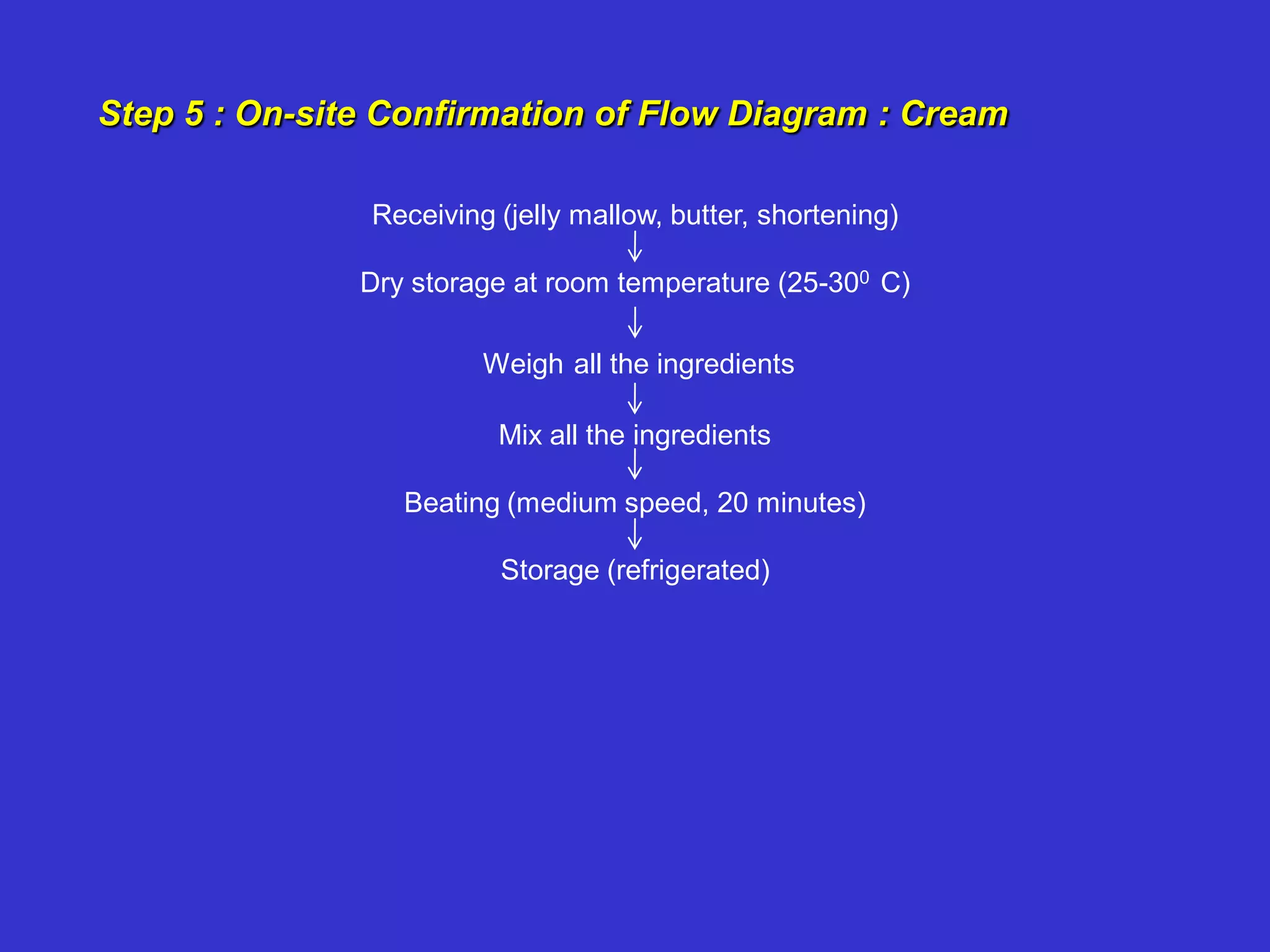
Step 5 : On-site Confirmation of Flow Diagram : Cream
Receiving (jelly mallow, butter, shortening)
Dry storage at room temperature (25-300 C)
Weigh all the ingredients
Mix all the ingredients
Beating (medium speed, 20 minutes)
Storage (refrigerated)
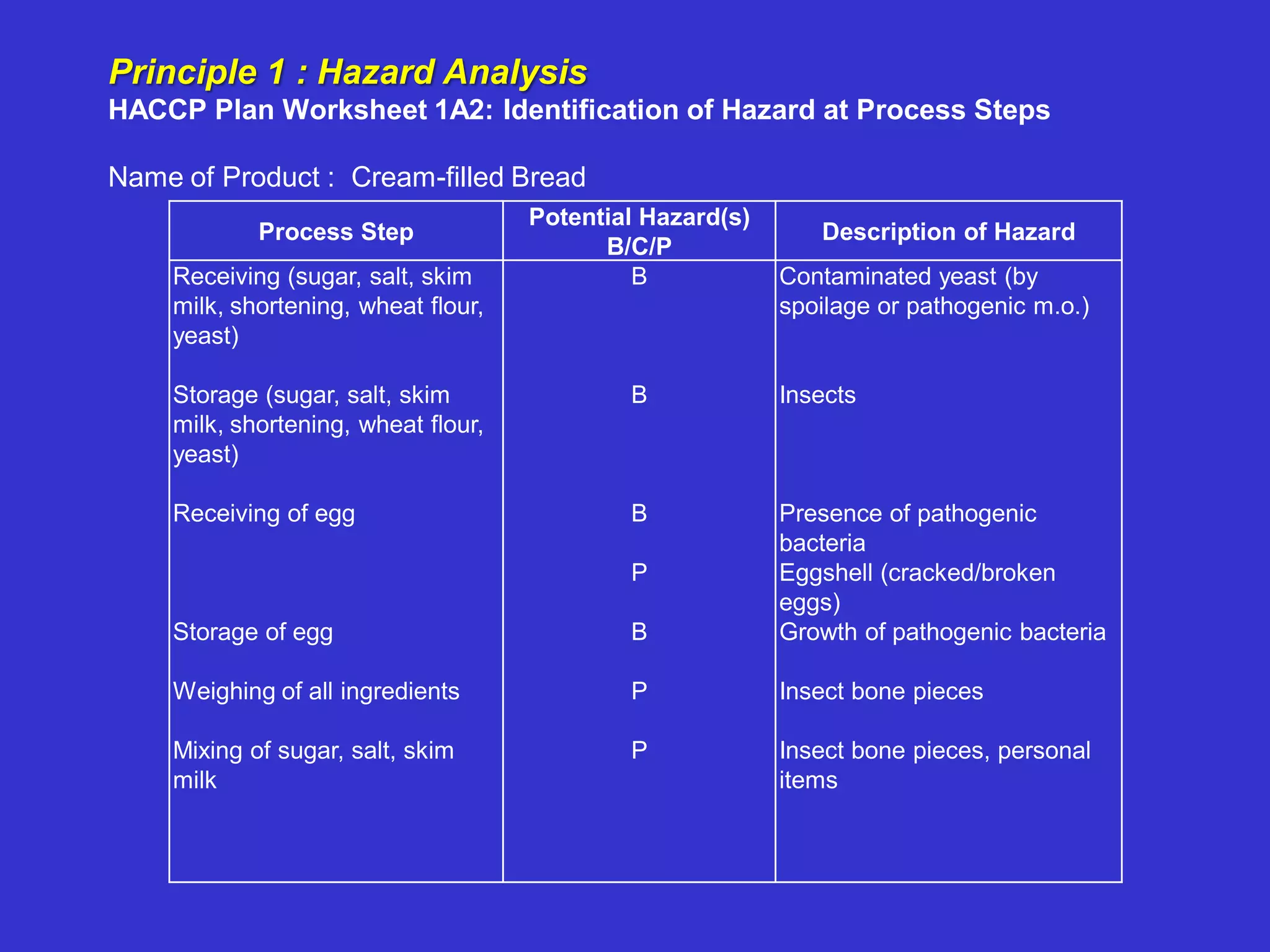
Principle 1 : Hazard Analysis
HACCP Plan Worksheet 1A2: Identification of Hazard at Process Steps
Name of Product : Cream-filled Bread
Process Step
Potential Hazard(s)
B/C/P
Description of Hazard
Receiving (sugar, salt, skim
milk, shortening, wheat flour,
yeast)
Storage (sugar, salt, skim
milk, shortening, wheat flour,
yeast)
Receiving of egg
Storage of egg
Weighing of all ingredients
Mixing of sugar, salt, skim
milk
B
B
B
P
B
P
P
Contaminated yeast (by
spoilage or pathogenic m.o.)
Insects
Presence of pathogenic
bacteria
Eggshell (cracked/broken
eggs)
Growth of pathogenic bacteria
Insect bone pieces
Insect bone pieces, personal
items
Process Step
Potential Hazard(s)
B/C/P
Description of Hazard
Adding egg and
shortening
Adding wheat flour,
yeast and cold water
Blending
Rounding the dough
Fermentation 1
Dividing the dough
Fermentation 2
B
P
B
P
B
P
B
B
B
B
Contamination of pathogenic bacteria
Eggshell
Contamination of spoilage or pathogenic
bacteria (from yeast and water)
Insect bone pieces
Contamination of spoilage m.o. from the
air
Personal item
Contamination of spoilage and
pathogenic m.o. from the air and worker
Contamination of spoilage m.o. from the
air
Contamination of spoilage and
pathogenic m.o. from the air and worker
Contamination of spoilage m.o. from the
air
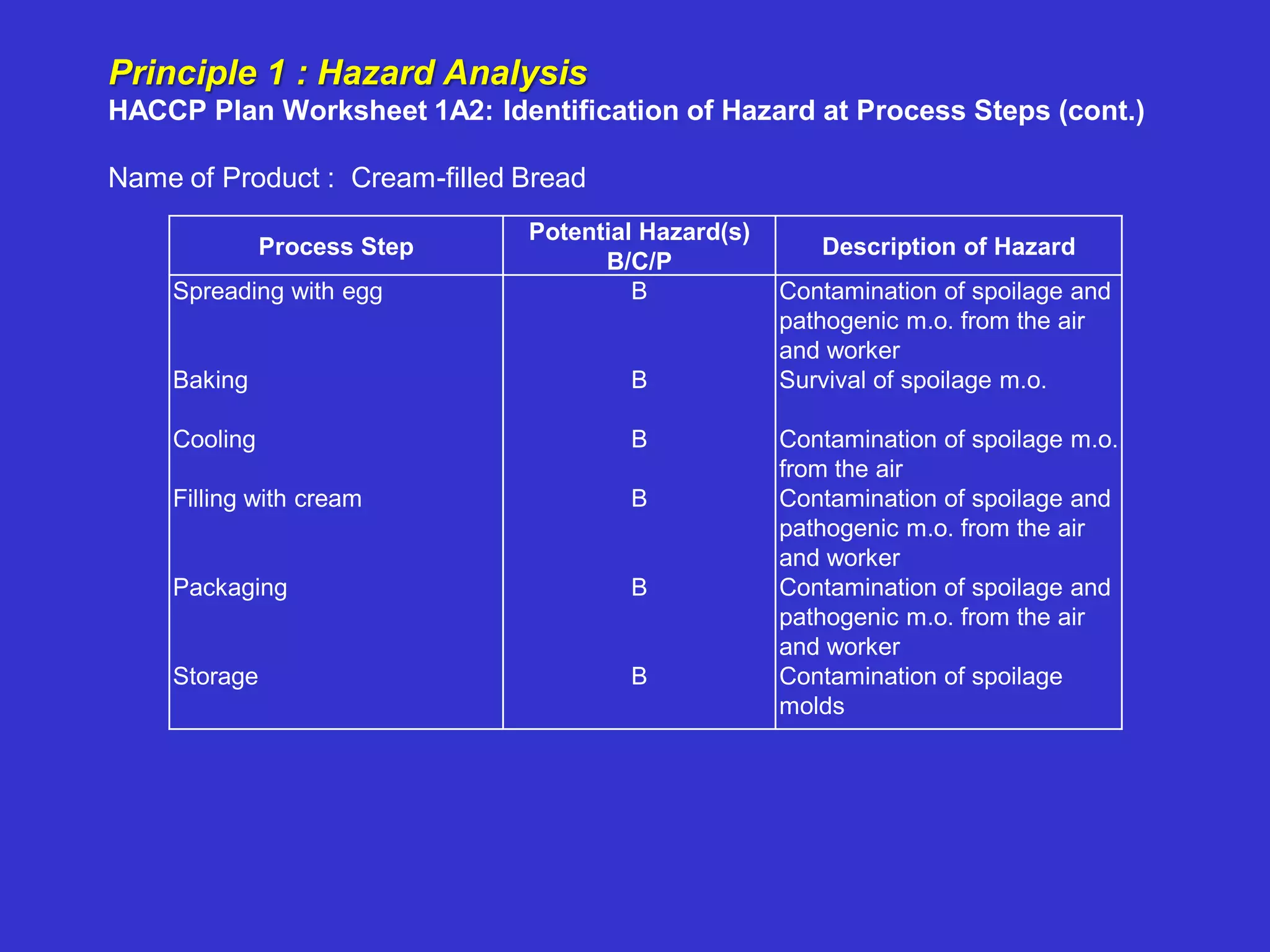
Principle 1 : Hazard Analysis
HACCP Plan Worksheet 1A2: Identification of Hazard at Process Steps (cont.)
Name of Product : Cream-filled Bread
Process Step
Potential Hazard(s)
B/C/P
Description of Hazard
Spreading with egg
Baking
Cooling
Filling with cream
Packaging
Storage
B
B
B
B
B
B
Contamination of spoilage and
pathogenic m.o. from the air
and worker
Survival of spoilage m.o.
Contamination of spoilage m.o.
from the air
Contamination of spoilage and
pathogenic m.o. from the air
and worker
Contamination of spoilage and
pathogenic m.o. from the air
and worker
Contamination of spoilage
molds
Principle 1 : Hazard Analysis
HACCP Plan Worksheet 1A2: Identification of Hazard at Process Steps (cont.)
Name of Product : Cream-filled Bread
Process Step
Potential Hazard(s)
B/C/P
Description of Hazard
Receiving jelly mallow, butter,
shortening
Storage
Weighing all ingredients
Mixing
Beating
Storage
-
B
C
-
P
P
B
-
Contamination of spoilage m.o.
Decomposition of chemical
compound
-
Personal item
Personal item
Growth of spoilage m.o.
Principle 1 : Hazard Analysis
HACCP Plan Worksheet 1A2: Identification of Hazard at Process Steps (cont.)
Name of Product : Cream-filled Bread
Principle 1 : Hazard Analysis
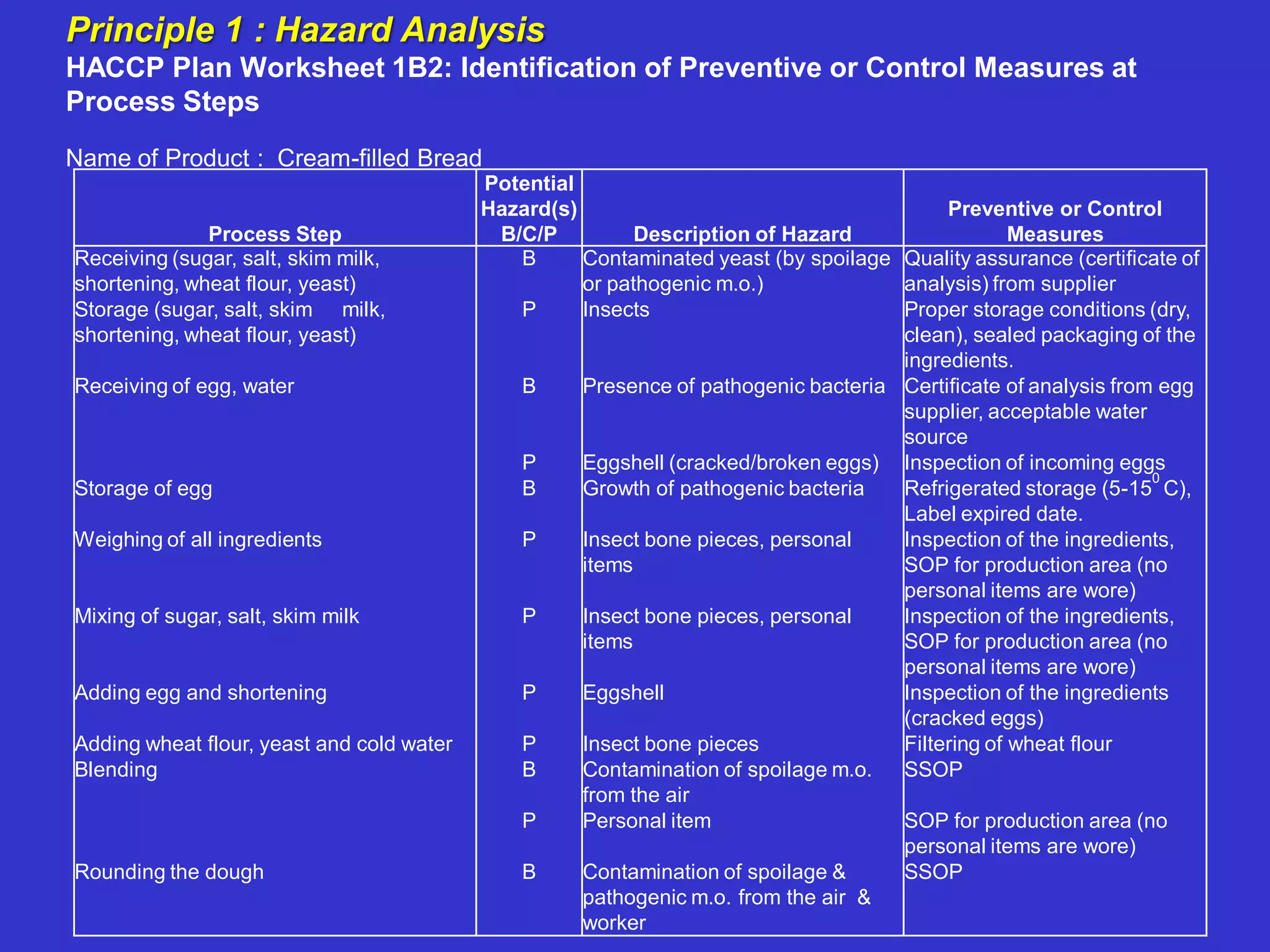
HACCP Plan Worksheet 1B2: Identification of Preventive or Control Measures at
Process Steps
Name of Product : Cream-filled Bread
Process Step
Potential
Hazard(s)
B/C/P Description of Hazard
Preventive or Control
Measures
Receiving (sugar, salt, skim milk,
shortening, wheat flour, yeast)
B Contaminated yeast (by spoilage
or pathogenic m.o.)
Quality assurance (certificate of
analysis) from supplier
Storage (sugar, salt, skim milk,
shortening, wheat flour, yeast)
P Insects Proper storage conditions (dry,
clean), sealed packaging of the
ingredients.
Receiving of egg, water B Presence of pathogenic bacteria Certificate of analysis from egg
supplier, acceptable water
source
P Eggshell (cracked/broken eggs) Inspection of incoming eggs
Storage of egg B Growth of pathogenic bacteria Refrigerated storage (5-15
0
C),
Label expired date.
Weighing of all ingredients P Insect bone pieces, personal
items
Inspection of the ingredients,
SOP for production area (no
personal items are wore)
Mixing of sugar, salt, skim milk P Insect bone pieces, personal
items
Inspection of the ingredients,
SOP for production area (no
personal items are wore)
Adding egg and shortening P Eggshell Inspection of the ingredients
(cracked eggs)
Adding wheat flour, yeast and cold water P Insect bone pieces Filtering of wheat flour
Blending B Contamination of spoilage m.o.
from the air
SSOP
P Personal item SOP for production area (no
personal items are wore)
Rounding the dough B Contamination of spoilage &
pathogenic m.o. from the air &
worker
SSOP
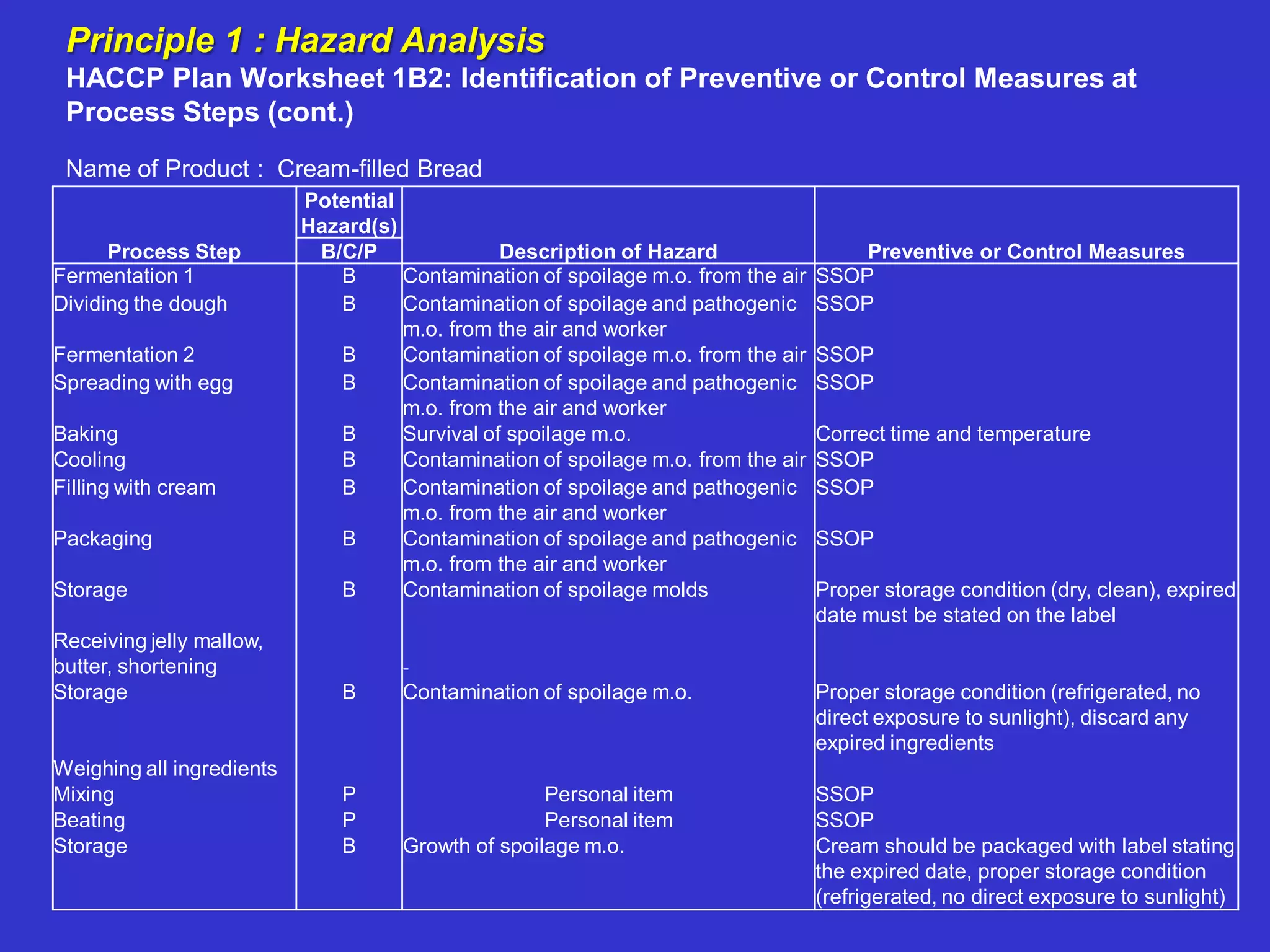
Process Step
Potential
Hazard(s)
Description of Hazard Preventive or Control MeasuresB/C/P
Fermentation 1 B Contamination of spoilage m.o. from the air SSOP
Dividing the dough B Contamination of spoilage and pathogenic
m.o. from the air and worker
SSOP
Fermentation 2 B Contamination of spoilage m.o. from the air SSOP
Spreading with egg B Contamination of spoilage and pathogenic
m.o. from the air and worker
SSOP
Baking B Survival of spoilage m.o. Correct time and temperature
Cooling B Contamination of spoilage m.o. from the air SSOP
Filling with cream B Contamination of spoilage and pathogenic
m.o. from the air and worker
SSOP
Packaging B Contamination of spoilage and pathogenic
m.o. from the air and worker
SSOP
Storage B Contamination of spoilage molds Proper storage condition (dry, clean), expired
date must be stated on the label
Receiving jelly mallow,
butter, shortening -
Storage B Contamination of spoilage m.o. Proper storage condition (refrigerated, no
direct exposure to sunlight), discard any
expired ingredients
Weighing all ingredients
Mixing P Personal item SSOP
Beating P Personal item SSOP
Storage B Growth of spoilage m.o. Cream should be packaged with label stating
the expired date, proper storage condition
(refrigerated, no direct exposure to sunlight)
Principle 1 : Hazard Analysis
HACCP Plan Worksheet 1B2: Identification of Preventive or Control Measures at
Process Steps (cont.)
Name of Product : Cream-filled Bread
Principle 1 : Hazard Analysis
HACCP Plan Worksheet 1C2: Determination of Hazards Significance at Process Steps
Name of Product : Cream-filled Bread
Process Step
Potential
Hazard(s)
B/C/P
Description of
Hazard
Reasonably
likely to
occur
Severity
Significant
hazard
(Y/N)
Preventive or Control
Measures
Receiving (sugar, salt,
skim milk, shortening,
wheat flour, yeast)
Storage (sugar, salt,
skim milk,
shortening, wheat
flour, yeast)
Receiving egg, water
Storage of egg
Weighing of all
ingredients
B
P
B
P
B
P
Contaminated
yeast (by
spoilage/
pathogenic
m.o.)
Insects
Presence of
pathogenic
bacteria
Eggshell
(Cracked /
broken eggs)
Growth of
pathogenic
bacteria
Insect bone
pieces, personal
items
l
h
m
h
l
l
M
M
M
M
L
M
N
Y
N
Y
N
N
Quality assurance
(certificate of analysis) from
supplier
Proper storage conditions
(dry, clean), sealed packaging
of the ingredients.
Certificate of analysis from
egg supplier, acceptable
water source
Inspection of incoming eggs
Refrigerated storage (5-150
C), Label expired date.
Inspection of the ingredients,
SOP for production area (no
personal items are wore)
Process Step
Potential
Hazard(s)
B/C/P
Description of
Hazard
Reasonably
likely to
occur
Seve-
rity
Significant
hazard
(Y/N)
Preventive or Control
Measures
Mixing of sugar, salt, skim
milk
Adding egg and
shortening
Adding wheat flour, yeast
and cold water
Blending
Rounding the dough
Fermentation 1
P
P
P
B
P
B
B
Insect bone
pieces, personal
items
Eggshell
Insect bone
pieces
Contamination
of spoilage m.o.
from the air
Personal item
Contamination
of spoilage and
pathogenic m.o.
from the air and
worker
Contamination
of spoilage m.o.
from the air
l
m
m
m
m
l
l
M
M
M
L
M
L
L
N
N
N
N
N
N
N
Inspection of the ingredients,
SOP for production area (no
personal items are wore)
Inspection of the ingredients
(cracked eggs)
Filtering of wheat flour
SSOP
SOP for production area (no
personal items are wore)
SSOP
SSOP
Principle 1 : Hazard Analysis
HACCP Plan Worksheet 1C2: Determination of Hazards Significance at Process Steps (cont.)
Name of Product : Cream-filled Bread
Process Step
Potential
Hazard(s)
B/C/P
Description of Hazard
Reasonably
likely to
occur
Seve-
rity
Significant
hazard
(Y/N)
Preventive or
Control
Measures
Dividing the dough
Fermentation 2
Spreading with egg
Baking
Cooling
Filling with cream
Packaging of bread
Storage and
distribution
B
B
B
B
B
B
B
B
Contamination of spoilage and
pathogenic m.o. from the air, weigh-
scale, and worker
Contamination of spoilage m.o. from the
air
Contamination of spoilage and
pathogenic m.o. from the air and worker
Survival of spoilage m.o.
Contamination of spoilage m.o. from the
air
Contamination of spoilage and
pathogenic m.o. from the air and worker
Contamination of spoilage and
pathogenic m.o. from the air and worker
Contamination of spoilage molds
m
l
m
l
m
m
m
m
L
L
H
H
M
H
H
M
N
N
Y
N
N
Y
Y
N
SSOP
SSOP
SSOP
Correct time
and
temperature
SSOP
SSOP
SSOP
Proper storage
condition (dry,
clean), expired
date must be
stated on the
label
Principle 1 : Hazard Analysis
HACCP Plan Worksheet 1C2: Determination of Hazards Significance at Process Steps (cont.)
Name of Product : Cream-filled Bread
Process Step
Potential
Hazard(s)
B/C/P
Description of Hazard
Reasonably
likely to
occur
Seve-
rity
Significant
hazard
(Y/N)
Preventive or Control
Measures
Receiving jelly
mallow, butter,
shortening
Storage of jelly
mallow, butter,
shortening
Weighing all
ingredients
Mixing
Beating
Storage of cream
-
B
C
-
P
P
B
-
Contamination of spoilage
m.o.
Decomposition of chemical
compound
-
Personal item
Personal item
Growth of spoilage m.o.
-
m
m
-
l
l
m
-
H
H
-
M
M
H
-
Y
Y
-
N
N
Y
-
Proper storage condition
(refrigerated, no direct
exposure to sunlight),
discard any expired
ingredients
-
SSOP
SSOP
Cream should be packaged
with label stating the
expired date, proper
storage condition
(refrigerated, no direct
exposure to sunlight)
Principle 1 : Hazard Analysis
HACCP Plan Worksheet 1C2: Determination of Hazards Significance at Process Steps (cont.)
Name of Product : Cream-filled Bread
Principle 2 : Establishment of Critical Control Point CCP
HACCP Plan Worksheet 2A : Establishment of CCP in Ingredients
Name of Product : Cream-filled Bread
Ingredient
Potential
Hazard (s)
P1 P2 P3 CCP?
Sugar B
P
Y
Y
Y
Y
N
N
N
N
Wheat flour B
P
Y
Y
Y
Y
N
N
N
N
Yeast B Y Y N N
Egg B
C
P
Y
Y
Y
Y
N
N
N
-
-
N
Y
Y
Water B Y Y N N
Principle 2 : Establishment of Critical Control Point (CCP)
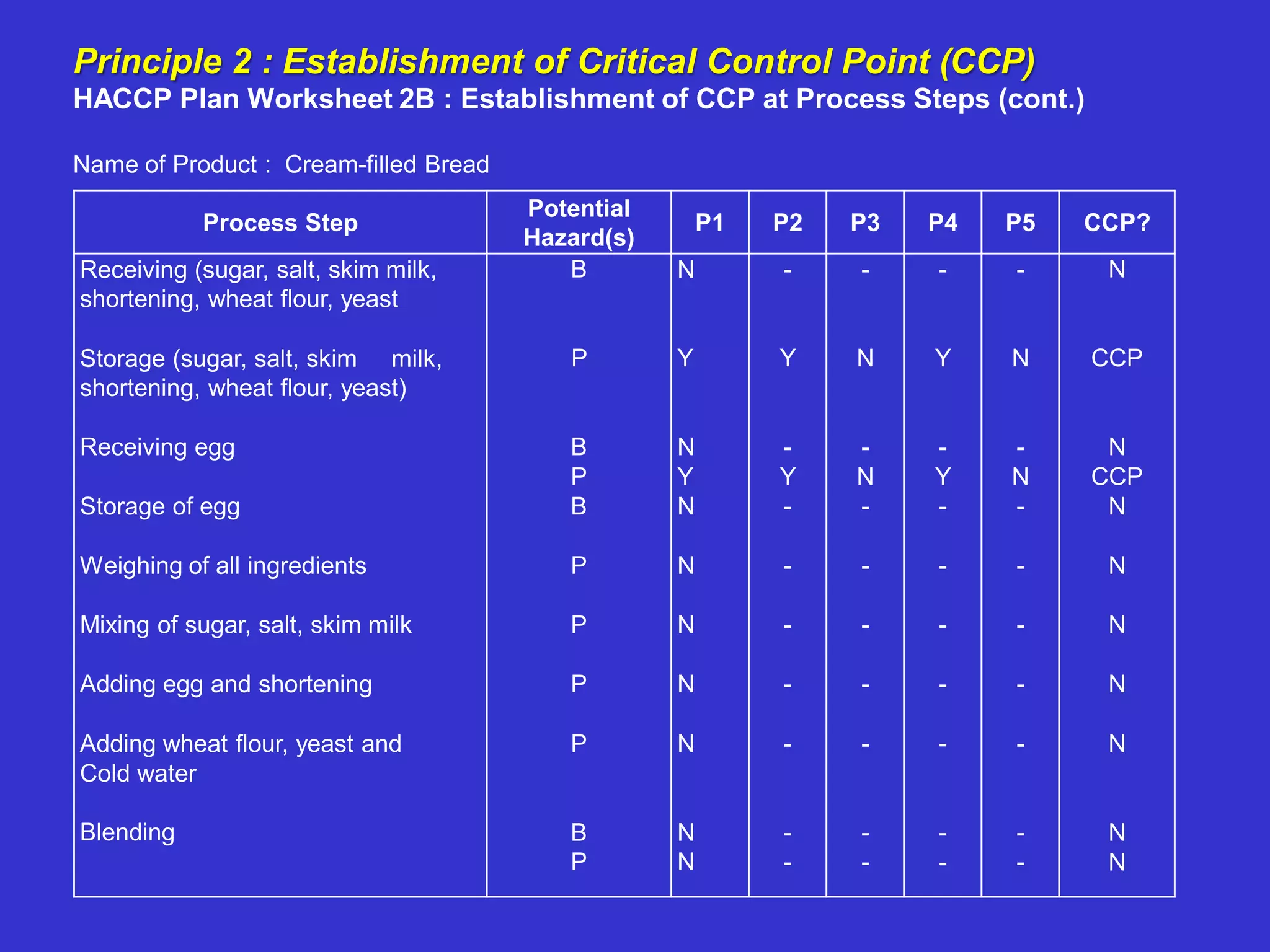
HACCP Plan Worksheet 2B : Establishment of CCP at Process Steps (cont.)
Name of Product : Cream-filled Bread
Process Step
Potential
Hazard(s)
P1 P2 P3 P4 P5 CCP?
Receiving (sugar, salt, skim milk,
shortening, wheat flour, yeast
Storage (sugar, salt, skim milk,
shortening, wheat flour, yeast)
Receiving egg
Storage of egg
Weighing of all ingredients
Mixing of sugar, salt, skim milk
Adding egg and shortening
Adding wheat flour, yeast and
Cold water
Blending
B
P
B
P
B
P
P
P
P
B
P
N
Y
N
Y
N
N
N
N
N
N
N
-
Y
-
Y
-
-
-
-
-
-
-
-
N
-
N
-
-
-
-
-
-
-
-
Y
-
Y
-
-
-
-
-
-
-
-
N
-
N
-
-
-
-
-
-
-
N
CCP
N
CCP
N
N
N
N
N
N
N
Process Step
Potential
Hazard(s)
P1 P2 P3 P4 P5 CCP?
Rounding the dough
Fermentation 1
Dividing the dough
Fermentation 2
Spreading with egg
Baking
Cooling
Filling with cream
Packaging
Storage and distribution of bread
B
B
B
B
B
B
B
B
B
B
N
N
N
N
Y
N
N
Y
Y
N
-
-
-
-
Y
-
-
Y
Y
-
-
-
-
-
N
-
-
N
N
-
-
-
-
-
Y
-
-
Y
Y
-
-
-
-
-
Y
-
-
N
N
-
N
N
N
N
N
N
N
CCP
CCP
N
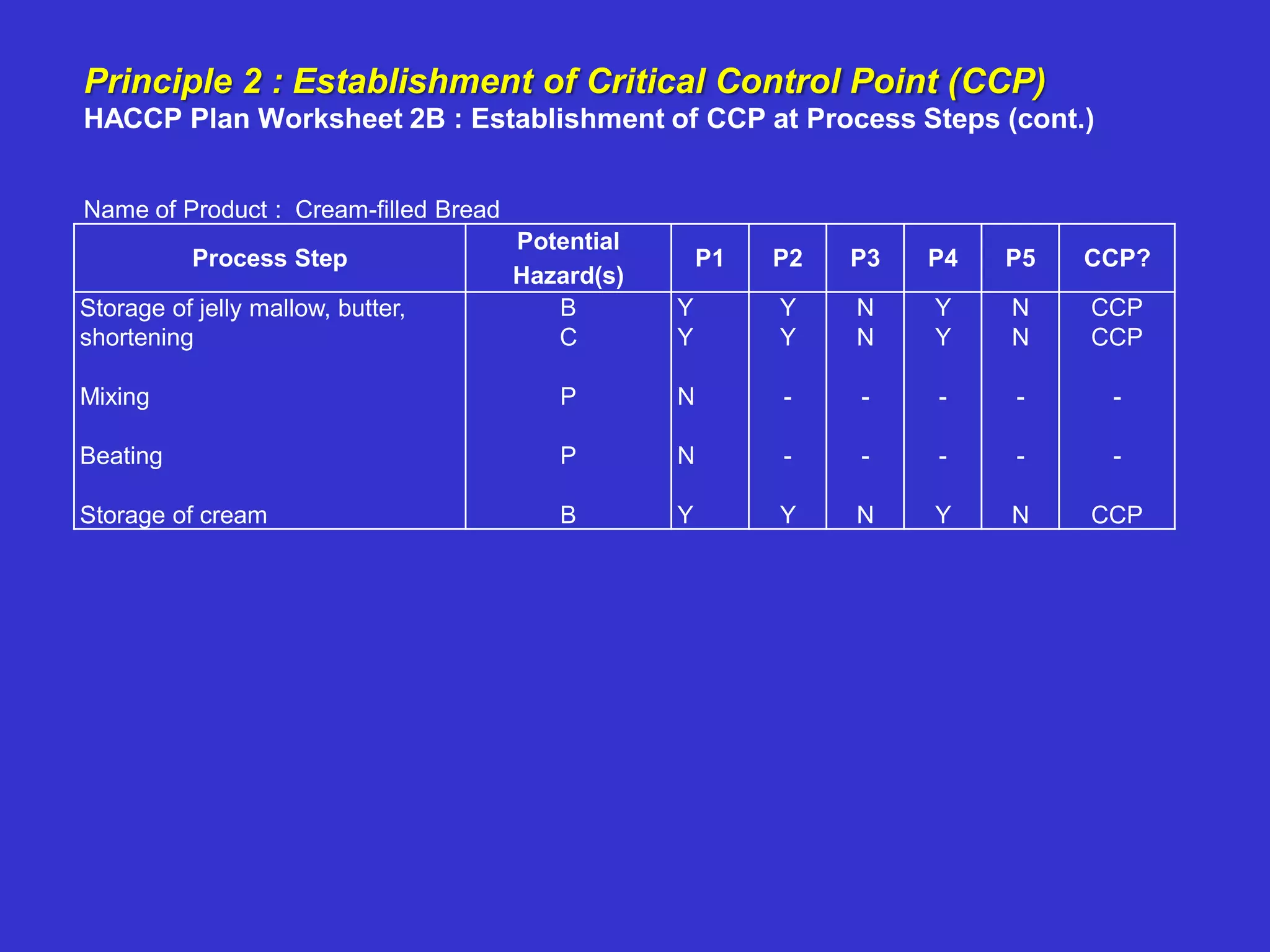
Principle 2 : Establishment of Critical Control Point (CCP)
HACCP Plan Worksheet 2B : Establishment of CCP at Process Steps (cont.)
Name of Product : Cream-filled Bread
Process Step
Potential
Hazard(s)
P1 P2 P3 P4 P5 CCP?
Storage of jelly mallow, butter,
shortening
Mixing
Beating
Storage of cream
B
C
P
P
B
Y
Y
N
N
Y
Y
Y
-
-
Y
N
N
-
-
N
Y
Y
-
-
Y
N
N
-
-
N
CCP
CCP
-
-
CCP
Principle 2 : Establishment of Critical Control Point (CCP)
HACCP Plan Worksheet 2B : Establishment of CCP at Process Steps (cont.)
Name of Product : Cream-filled Bread
Principle 3: Establishment of Critical Limits
HACCP Plan Worksheet 3 : Establishment of Critical Limits
Name of Product : Cream-filled Bread
Ingredient/ Process Step CCP No. CL
Egg
Storage (sugar, salt, skim milk,
shortening, wheat flour, yeast)
Receiving egg
Filling with cream
Packaging of bread
1 (C)
2 (P)
3 (P)
4 (P)
5 (B)
6 (B)
Antibiotic residue = 0
Cracked / broken egg = 0
Rh = 90-92%
Time < 1 month
SSOP = applied
Cracked/broken egg = 0
Holding Time <10 min, T=20-250 C
Storage of jelly mallow, butter, shortening
Storage of cream
7 (B)
8 (C)
9 (B)
T = 5-150 C, label expired date
Principle 4: Establishment of Monitoring Procedures
HACCP Plan Worksheet 4 : Establishment of Monitoring Procedures
Name of Product : Cream-filled Bread
Ingredient/
Process Step
CCP
No.
CL
Monitoring Procedures
What How Where Who Freq.
Egg
Storage (sugar,
salt, skim
milk, shortening,
wheat flour,
yeast)
Receiving egg
Filling with
cream
Packaging of
bread
1 (C)
2 (P)
3 (P)
4 (P)
5 (B)
6 (B)
Antibiotic residue
= 0
Cracked / broken
egg = 0
Rh = 90=92
Time < 1 month
SSOP = applied
Cracked/broken
egg = 0
Holding Time <10
min, T=20-250 C
Holding Time <10
min, T=20-250 C
Antibiotic residue
on CoA
Cracked/broken
eggs
Rh
Storage time
SSOP application
Cracked/broken
eggs
Time and
temperature
Time and
temperature
Check the CoA
Inspection of
incoming eggs
Measure the Rh
Check storage time
Check the
application of
SSOP
Inspection of
incoming eggs
Check/ measure
time and
temperature
Check/ measure
time and temp.
Receiving
site
Receiving
site
Storage
room /
warehouse
Receiving
site
Production
area
Production
area
Receiving
personnel
Receiving
personnel
Warehouse
mngr.
Receiving
personnel
Area
personnel
Area
personnel
Every
receiving
Every
receiving
Every
day
Every
receiving
Time :
every 10
minutes
T : Every
6 hours
Storage of jelly
mallow, butter,
shortening
Storage of
cream
7 (B)
8 (C)
9 (B)
T = 5-150 C, label
expired date
T = 5-150 C, label
expired date
Temperature,
label of the
ingredients
Temperature,
label of cream
Measure temp.,
check label
Measure temp.
check label
Warehouse
Warehouse
Warehouse
mngr.
Warehouse
mngr.
Every
day
Every
day
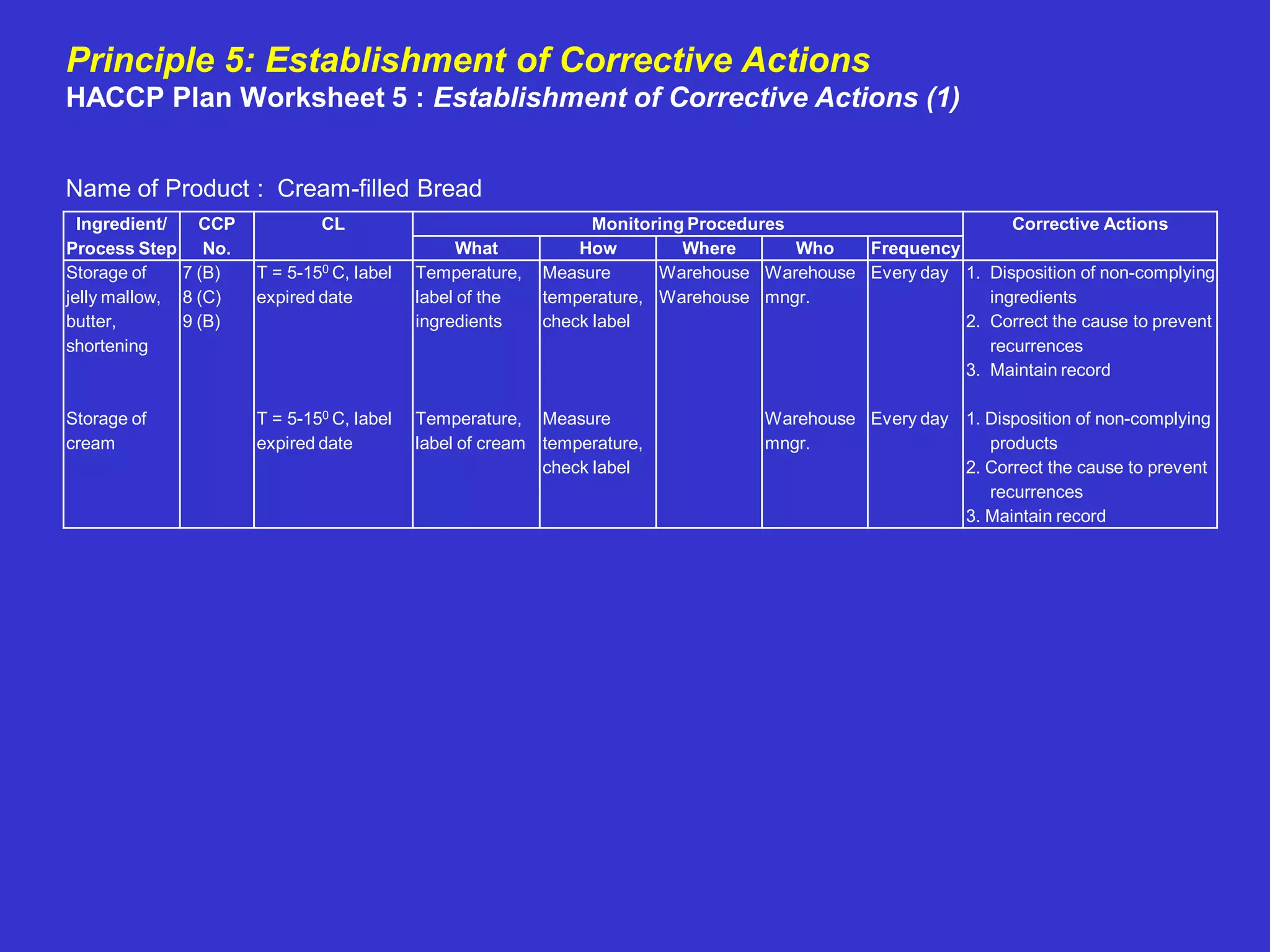
Principle 5: Establishment of Corrective Actions
HACCP Plan Worksheet 5 : Establishment of Corrective Actions (1)
Name of Product : Cream-filled Bread
Ingredient/
Process Step
CCP
No.
CL Monitoring Procedures Corrective Actions
What How Where Who Frequency
Egg
Storage
(sugar, salt,
skim milk,
shortening,
wheat flour,
yeast)
Receiving egg
Filling with
cream
Packaging of
bread
1 (C)
2 (P)
3 (P)
4 (P)
5 (B)
6 (B)
Antibiotic
residue = 0
Cracked /
broken egg = 0
Rh =
Time < 1 month
SSOP = applied
Cracked/broken
egg = 0
Holding Time
<10 min, T=20-
250 C
Holding Time
<10 min, T=20-
250 C
Antibiotic
residue on CoA
Cracked/broke
n eggs
Rh
Storage time
SSOP
application
Cracked/broke
n eggs
Time and
temperature
Time and
temperature
Check the
CoA
Inspection
of incoming
eggs
Measure
Rh,check
storage
time
Check the
application
of SSOP
Inspection
of incoming
eggs
Check/
measure
time and
temperatur
e
Check/
measure
time and
temperatur
e
Receiving
site
Receiving
site
Storage
room /
warehouse
Receiving
site
Production
area
Production
area
Receiving
personnel
Receiving
personnel
Warehouse
mngr.
Receiving
personnel
Area
personnel
Area
personnel
Every
receiving
Every
receiving
Every day
Every
Receiving
Time :
every 10
minutes
T : Every 6
hours
Time :
Every 10
minutes
T : Every 6
hours
1. Rejection of non-complying
ingredient
2. Write a report to warehouse mngr.
1. Disposition of contaminated
ingredients
2. Correct the cause to prevent
recurrences
3. Maintain record
4. Write a report to warehouse mngr.
1. Rejection of non-complying
ingredient
2. Write a report to warehouse mngr.
1. Disposition of non-complying
products
2. Correct the cause to prevent
recurrences
3. Maintain record
4. Write a report to QA mngr.
1. Disposition of non-complying
products
2. Correct the cause to prevent
recurrences
3. Maintain record
4. Write a report to QA mngr.
Ingredient/
Process Step
CCP
No.
CL Monitoring Procedures Corrective Actions
What How Where Who Frequency
Storage of
jelly mallow,
butter,
shortening
Storage of
cream
7 (B)
8 (C)
9 (B)
T = 5-150 C, label
expired date
T = 5-150 C, label
expired date
Temperature,
label of the
ingredients
Temperature,
label of cream
Measure
temperature,
check label
Measure
temperature,
check label
Warehouse
Warehouse
Warehouse
mngr.
Warehouse
mngr.
Every day
Every day
1. Disposition of non-complying
ingredients
2. Correct the cause to prevent
recurrences
3. Maintain record
1. Disposition of non-complying
products
2. Correct the cause to prevent
recurrences
3. Maintain record
Principle 5: Establishment of Corrective Actions
HACCP Plan Worksheet 5 : Establishment of Corrective Actions (1)
Name of Product : Cream-filled Bread
Principle 6: Establishment of Verification Procedures
HACCP Plan Worksheet 6 : Establishment of Verification Procedures
Name of Product : Cream-filled Bread
Ingredient/
Process Step
CCP
No.
CL Monitoring Procedures Corrective Actions Verification
ActivitiesWhat How Where Who Frequen
cy
Egg
Storage (sugar,
salt, skim
milk, shortening,
wheat flour,
yeast)
Receiving egg
Filling with
cream
Packaging
1 (C)
2 (P)
3 (P)
4 (P)
5 (B)
6 (B)
Antibiotic
residue = 0
Cracked /
broken egg = 0
Rh = 90-92%
Time < 1
month
SSOP =
applied
Cracked/broke
n egg = 0
Holding Time
<10 min, T=20-
250 C
Holding Time
<10 min, T=20-
250 C
Antibiotic
residue on
CoA
Cracked/bro
ken eggs
Rh
Storage time
SSOP
application
Cracked/bro
ken eggs
Time and
temperature
Time and
temperature
Check the
CoA
Inspection of
incoming
eggs
Measure the
Rh
Check the
storage time
Check the
application
of SSOP
Inspection of
incoming
eggs
Check/
measure
time and
temperature
Check/
measure
time and
temperature
Receiving
site
Receiving
site
Storage
room /
warehous
e
Receiving
site
Productio
n area
Productio
n area
Receiving
personnel
Receiving
personnel
Warehou
se mngr.
Receiving
personnel
Productio
n
superviso
r
Productio
n
superviso
r
Every
receiving
Every
receiving
Every day
Every
receiving
Time :
every 10
minutes
T : Every
6 hours
Time :
Every 10
minutes
T : Every
6 hours
1. Rejection of non-complying
ingredient
2. Write a report to warehouse
mngr.
1. Disposition of contaminated
ingredients
2. Correct the cause to prevent
recurrences
3. Maintain record
4. Write a report to warehouse
mngr.
1. Rejection of non-complying
ingredient
2. Write a report to warehouse
mngr.
1. Disposition of non-complying
products
2. Correct the cause to prevent
recurrences
3. Maintain record
4. Write a report to QA mngr.
1. Disposition of non-complying
products
2. Correct the cause to prevent
recurrences
3. Maintain record
4. Write a report to QA mngr.
Analysis of
antibiotic residue
every 1 year
Calibration of Rh-
meter
Inspection of
insects
contamination
every 1 month
Customer
complaint
Microb.analysisof
products
Microb. Analysis of
products
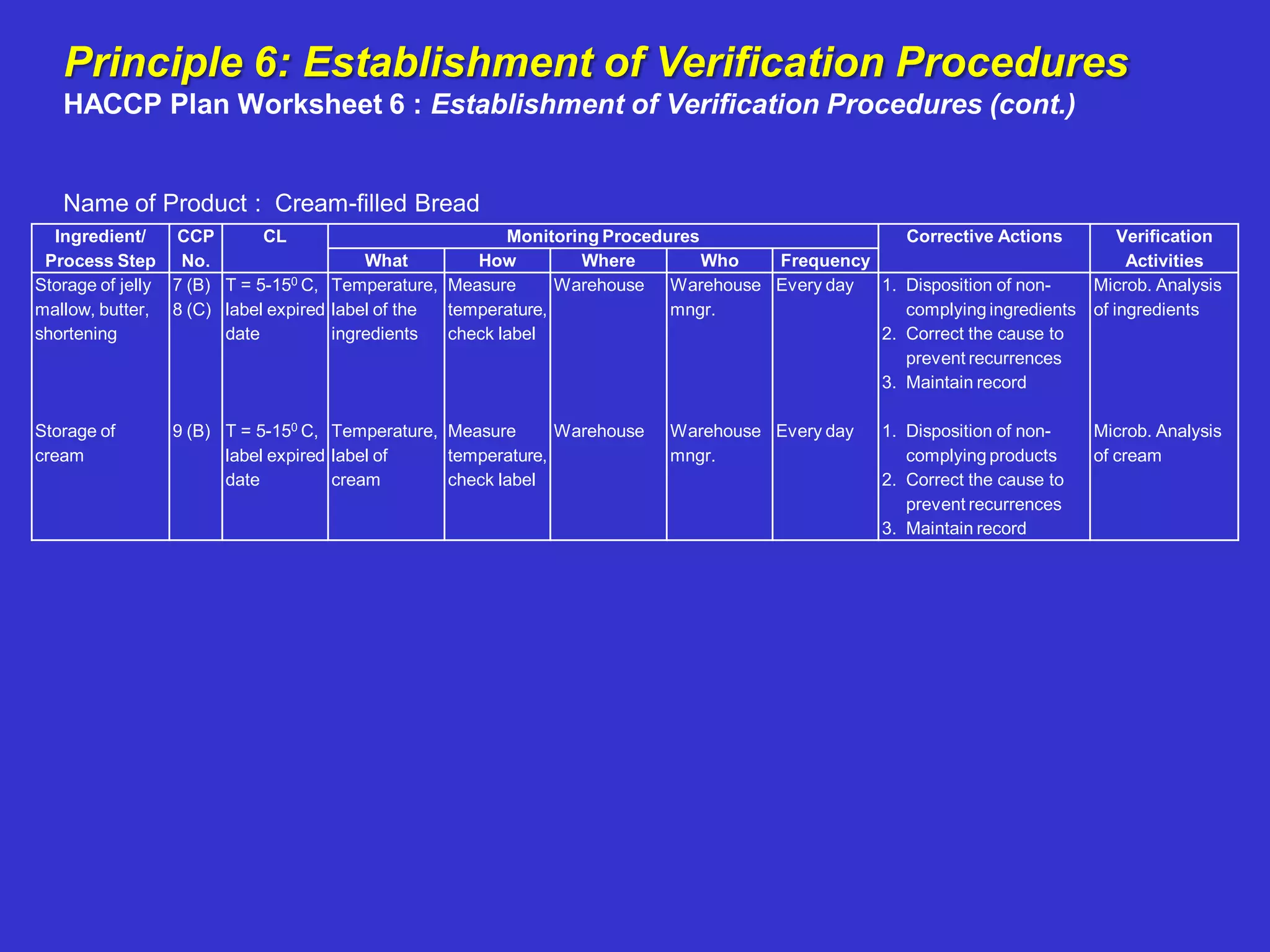
Ingredient/
Process Step
CCP
No.
CL Monitoring Procedures Corrective Actions Verification
ActivitiesWhat How Where Who Frequency
Storage of jelly
mallow, butter,
shortening
Storage of
cream
7 (B)
8 (C)
9 (B)
T = 5-150 C,
label expired
date
T = 5-150 C,
label expired
date
Temperature,
label of the
ingredients
Temperature,
label of
cream
Measure
temperature,
check label
Measure
temperature,
check label
Warehouse
Warehouse
Warehouse
mngr.
Warehouse
mngr.
Every day
Every day
1. Disposition of non-
complying ingredients
2. Correct the cause to
prevent recurrences
3. Maintain record
1. Disposition of non-
complying products
2. Correct the cause to
prevent recurrences
3. Maintain record
Microb. Analysis
of ingredients
Microb. Analysis
of cream
Principle 6: Establishment of Verification Procedures
HACCP Plan Worksheet 6 : Establishment of Verification Procedures (cont.)
Name of Product : Cream-filled Bread
Principle 7: Establishment of Record-keeping Procedures
HACCP Plan Worksheet 7 : Establishment of Record-keeping Procedures
Name of Product : Cream-filled Bread
Ingredient/
Process
Step
CCP
No.
CL Monitoring Procedures Corrective Actions Verification
Activities RecordsWhat How Where Who Frequenc
y
Egg
Storage
(sugar, salt,
skim milk,
shortening,
wheat flour,
yeast)
Receiving
egg
Filling with
cream
Packaging
of bread
1 (C)
2 (P)
3 (P)
4 (P)
5 (B)
6 (B)
Antibiotic
residue = 0
Cracked /
broken egg = 0
Rh = 90-92%
Time < 1 month
SSOP =
applied
Cracked/broke
n egg = 0
Holding Time
<10 min, T=20-
250 C
Holding Time
<10 min, T=20-
250 C
Antibiotic
residue on CoA
Cracked/broke
n eggs
Rh
Storage time
SSOP
application
Cracked/broke
n eggs
Time and
temperature
Time and
temperature
Check the CoA
Inspection of
incoming eggs
Measure the Rh
Check the storage
time
Check the
application of
SSOP
Inspection of
incoming eggs
Check/ measure
time and
temperature
Check/ measure
time and
temperature
Receiving
site
Receiving
site
Storage
room /
warehous
e
Receiving
site
Productio
n area
Productio
n area
Receiving
personnel
Receiving
personnel
Warehouse
mngr.
Receiving
personnel
Production
supervisor
Production
supervisor
Every
receiving
Every
receiving
Every day
Every
receiving
Time :
every 10
minutes
T : Every
6 hours
Time :
Every 10
minutes
T : Every
6 hours
1. Rejection of non-complying
ingredient
2. Write a report to warehouse mngr.
1. Disposition of contaminated
ingredients
2. Correct the cause to prevent
recurrences
3. Maintain record
4. Write a report to warehouse mngr.
1. Rejection of non-complying
ingredient
2. Write a report to warehouse mngr.
1. Disposition of non-complying
products
2. Correct the cause to prevent
recurrences
3. Maintain record
4. Write a report to QA mngr.
1. Disposition of non-complying
products
2. Correct the cause to prevent
recurrences
3. Maintain record
4. Write a report to QA mngr.
Analysis of
antibiotic residue
every 1 year
Calibration of
Rh-meter
Inspection of
insects
contamination
every 1 month
Customer
complaint
Microb. analysis
of products
Microb. Analysis
of products
Receiving log
Warehouse log,
Rh operation
document, Rh
calibration
documents,
Insects inspection
document
Receiving log
Production log,
microb. analysis
document
Production log,
microbiological
analysis document
Ingredient
/ Process
Step
CCP
No.
CL Monitoring Procedures Corrective Actions Verificatio
n
Activities
RecordsWhat How Where Who Frequency
Storage of
jelly
mallow,
butter,
shortening
Storage of
cream
7 (B)
8 (C)
9 (B)
T = 5-150
C, label
expired
date
T = 5-150
C, label
expired
date
Temperature,
label of the
ingredients
Temperature,
label of
cream
Measure
temperature
, check label
Measure
temperature
, check label
Wareho
use
Wareho
use
Warehous
e mngr.
Warehous
e mngr.
Every day
Every day
1. Disposition of non-complying
ingredients
2. Correct the cause to prevent
recurrences
3. Maintain record
1. Disposition of non-complying
products
2. Correct the cause to prevent
recurrences
3. Maintain record
Microb.
Analysis of
ingredients
Microb.
Analysis of
cream
Warehouse
log, microb.
Analysis
document
Warehouse
log, microb.
Analysis
document
Principle 7: Establishment of Record-keeping Procedures
HACCP Plan Worksheet 7 : Establishment of Record-keeping Procedures (cont.)
Name of Product : Cream-filled Bread
HACCP Plan
Cream-Filled Bread
Ingredient/
Process
Step
CCP
No.
CL Monitoring Procedures Corrective Actions Verification
Activities RecordsWhat How Where Who Frequenc
y
Egg
Storage
(sugar, salt,
skim milk,
shortening,
wheat flour,
yeast)
Receiving
egg
Filling with
cream
Packaging
of bread
1 (C)
2 (P)
3 (P)
4 (P)
5 (B)
6 (B)
Antibiotic
residue = 0
Cracked /
broken egg = 0
Rh = 90-92%
Time < 1 month
SSOP =
applied
Cracked/broke
n egg = 0
Holding Time
<10 min, T=20-
250 C
Holding Time
<10 min, T=20-
250 C
Antibiotic
residue on CoA
Cracked/broke
n eggs
Rh
Storage time
SSOP
application
Cracked/broke
n eggs
Time and
temperature
Time and
temperature
Check the CoA
Inspection of
incoming eggs
Measure the Rh
Check the storage
time
Check the
application of
SSOP
Inspection of
incoming eggs
Check/ measure
time and
temperature
Check/ measure
time and
temperature
Receiving
site
Receiving
site
Storage
room /
warehous
e
Receiving
site
Productio
n area
Productio
n area
Receiving
personnel
Receiving
personnel
Warehouse
mngr.
Receiving
personnel
Production
supervisor
Production
supervisor
Every
receiving
Every
receiving
Every day
Every
receiving
Time :
every 10
minutes
T : Every
6 hours
Time :
Every 10
minutes
T : Every
6 hours
1. Rejection of non-complying
ingredient
2. Write a report to warehouse mngr.
1. Disposition of contaminated
ingredients
2. Correct the cause to prevent
recurrences
3. Maintain record
4. Write a report to warehouse mngr.
1. Rejection of non-complying
ingredient
2. Write a report to warehouse mngr.
1. Disposition of non-complying
products
2. Correct the cause to prevent
recurrences
3. Maintain record
4. Write a report to QA mngr.
1. Disposition of non-complying
products
2. Correct the cause to prevent
recurrences
3. Maintain record
4. Write a report to QA mngr.
Analysis of
antibiotic residue
every 1 year
Calibration of
Rh-meter
Inspection of
insects
contamination
every 1 month
Customer
complaint
Microb. analysis
of products
Microb. Analysis
of products
Receiving log
Warehouse log,
Rh operation
document, Rh
calibration
documents,
Insects inspection
document
Receiving log
Production log,
microb. analysis
document
Production log,
microbiological
analysis document
Ingredient
/ Process
Step
CCP
No.
CL Monitoring Procedures Corrective Actions Verificatio
n
Activities
RecordsWhat How Where Who Frequency
Storage of
jelly
mallow,
butter,
shortening
Storage of
cream
7 (B)
8 (C)
9 (B)
T = 5-150
C, label
expired
date
T = 5-150
C, label
expired
date
Temperature,
label of the
ingredients
Temperature,
label of
cream
Measure
temperature
, check label
Measure
temperature
, check label
Wareho
use
Wareho
use
Warehous
e mngr.
Warehous
e mngr.
Every day
Every day
1. Disposition of non-complying
ingredients
2. Correct the cause to prevent
recurrences
3. Maintain record
1. Disposition of non-complying
products
2. Correct the cause to prevent
recurrences
3. Maintain record
Microb.
Analysis of
ingredients
Microb.
Analysis of
cream
Warehouse
log, microb.
Analysis
document
Warehouse
log, microb.
Analysis
document
HACCP Plan (cont.)
Cream-Filled Bread

Bakery Haccp plan

  • 1.
    HACCP PLAN FORBAKED FOODS Department of Food Science and Technology Faculty of Agricultural Technology Bogor Agricultural University 2009
  • 2.
    Langkah 1 :Establish the HACCP team Name Expertise/Position Position in the team Dewi Food Tech. & HACCP specialist/ Coordinator QA Mgr. Rahman Engineering/Production Mgr. Member Putri Microbiology/QC Mgr. Member Surya Chemistry/Warehouse Mgr. Member
  • 3.
    Step 2 :Product Description • Name of product • Composition • Product characteristics • Methods of processing • Methods of preservation • Primary packaging • Conditions of storage • Method of distribution • Shelflife • Specific labelling • Instruction on the label : cream-filled bread : Susu skim, kultur BAL, glukosa : Susu kental, asam, pH 4.3 : pasteurisasi, fermentasi : fermentasi : cup Polyethylene : Suhu 4oC : Dalam truk beropendingin : 3 minggu : - : -
  • 4.
    Step 3 :Identification of the Product’s Intended Use • Name of product • Intended use • Target consumer : Cream-filled bread : Directly consumed : General public
  • 5.
    Step 4 :Establish Process Flow Diagram Process flow diagram for the bread : Weigh all ingredients (sugar, salt, skim milk, shortening, egg, wheat flour, yeast, cold water) Mixing (sugar, salt and skim milk) Add shortening and egg Blending (into creamed mixture) Add wheat flour, yeast, and cold water Blending (into non-sticky dough) Round the dough Fermentation 1 (15 minutes at 27-300C) Divide the dough and weigh 900 gram each Fermentation 2 (27-300 C) Spread dough surface with beaten-egg Baking (10-15 minutes at 1800C) Cooling at room temperature (25-300C) Filling with cream Packaging (PET bag/pouch) Storage and distribution at room temperature (25-300C) for a maximum 3-5 days
  • 6.
    Step 4 :Establish Process Flow Diagram Process flow diagram for the cream : Weigh all the ingredients (jelly mallow, butter, shortening) Mix all the ingredients Beating (medium speed, 20 minutes) Storage (refrigerated)
  • 7.
    Step 5 :On-site Confirmation of Flow Diagram : Bread Receiving (sugar, salt, skim milk, shortening, wheat flour, yeast) Receiving (egg, water) Dry storage at room temperature (25-300 C) Storage at 5-150 C Weigh all ingredients Mixing (sugar, salt and skim milk) Add shortening and egg Blending (into creamed mixture) Add wheat flour, yeast, and cold water Blending (into non-sticky dough) Round the dough Fermentation 1 (15 minutes at 27-300C) Divide the dough and weigh 900 gram each Fermentation 2 (27-300 C) Spread dough surface with beaten-egg Baking (10-15 minutes at 1800C) Cooling at room temperature (25-300C) Filling with cream Packaging (PET bag/pouch) Storage and distribution at room temperature (25-300C) for a maximum 3-5 days
  • 8.
    Step 5 :On-site Confirmation of Flow Diagram : Cream Receiving (jelly mallow, butter, shortening) Dry storage at room temperature (25-300 C) Weigh all the ingredients Mix all the ingredients Beating (medium speed, 20 minutes) Storage (refrigerated)
  • 9.
    Principle 1 :Hazard Analysis HACCP Plan Worksheet 1A2: Identification of Hazard at Process Steps Name of Product : Cream-filled Bread Process Step Potential Hazard(s) B/C/P Description of Hazard Receiving (sugar, salt, skim milk, shortening, wheat flour, yeast) Storage (sugar, salt, skim milk, shortening, wheat flour, yeast) Receiving of egg Storage of egg Weighing of all ingredients Mixing of sugar, salt, skim milk B B B P B P P Contaminated yeast (by spoilage or pathogenic m.o.) Insects Presence of pathogenic bacteria Eggshell (cracked/broken eggs) Growth of pathogenic bacteria Insect bone pieces Insect bone pieces, personal items
  • 10.
    Process Step Potential Hazard(s) B/C/P Descriptionof Hazard Adding egg and shortening Adding wheat flour, yeast and cold water Blending Rounding the dough Fermentation 1 Dividing the dough Fermentation 2 B P B P B P B B B B Contamination of pathogenic bacteria Eggshell Contamination of spoilage or pathogenic bacteria (from yeast and water) Insect bone pieces Contamination of spoilage m.o. from the air Personal item Contamination of spoilage and pathogenic m.o. from the air and worker Contamination of spoilage m.o. from the air Contamination of spoilage and pathogenic m.o. from the air and worker Contamination of spoilage m.o. from the air Principle 1 : Hazard Analysis HACCP Plan Worksheet 1A2: Identification of Hazard at Process Steps (cont.) Name of Product : Cream-filled Bread
  • 11.
    Process Step Potential Hazard(s) B/C/P Descriptionof Hazard Spreading with egg Baking Cooling Filling with cream Packaging Storage B B B B B B Contamination of spoilage and pathogenic m.o. from the air and worker Survival of spoilage m.o. Contamination of spoilage m.o. from the air Contamination of spoilage and pathogenic m.o. from the air and worker Contamination of spoilage and pathogenic m.o. from the air and worker Contamination of spoilage molds Principle 1 : Hazard Analysis HACCP Plan Worksheet 1A2: Identification of Hazard at Process Steps (cont.) Name of Product : Cream-filled Bread
  • 12.
    Process Step Potential Hazard(s) B/C/P Descriptionof Hazard Receiving jelly mallow, butter, shortening Storage Weighing all ingredients Mixing Beating Storage - B C - P P B - Contamination of spoilage m.o. Decomposition of chemical compound - Personal item Personal item Growth of spoilage m.o. Principle 1 : Hazard Analysis HACCP Plan Worksheet 1A2: Identification of Hazard at Process Steps (cont.) Name of Product : Cream-filled Bread
  • 13.
    Principle 1 :Hazard Analysis HACCP Plan Worksheet 1B2: Identification of Preventive or Control Measures at Process Steps Name of Product : Cream-filled Bread Process Step Potential Hazard(s) B/C/P Description of Hazard Preventive or Control Measures Receiving (sugar, salt, skim milk, shortening, wheat flour, yeast) B Contaminated yeast (by spoilage or pathogenic m.o.) Quality assurance (certificate of analysis) from supplier Storage (sugar, salt, skim milk, shortening, wheat flour, yeast) P Insects Proper storage conditions (dry, clean), sealed packaging of the ingredients. Receiving of egg, water B Presence of pathogenic bacteria Certificate of analysis from egg supplier, acceptable water source P Eggshell (cracked/broken eggs) Inspection of incoming eggs Storage of egg B Growth of pathogenic bacteria Refrigerated storage (5-15 0 C), Label expired date. Weighing of all ingredients P Insect bone pieces, personal items Inspection of the ingredients, SOP for production area (no personal items are wore) Mixing of sugar, salt, skim milk P Insect bone pieces, personal items Inspection of the ingredients, SOP for production area (no personal items are wore) Adding egg and shortening P Eggshell Inspection of the ingredients (cracked eggs) Adding wheat flour, yeast and cold water P Insect bone pieces Filtering of wheat flour Blending B Contamination of spoilage m.o. from the air SSOP P Personal item SOP for production area (no personal items are wore) Rounding the dough B Contamination of spoilage & pathogenic m.o. from the air & worker SSOP
  • 14.
    Process Step Potential Hazard(s) Description ofHazard Preventive or Control MeasuresB/C/P Fermentation 1 B Contamination of spoilage m.o. from the air SSOP Dividing the dough B Contamination of spoilage and pathogenic m.o. from the air and worker SSOP Fermentation 2 B Contamination of spoilage m.o. from the air SSOP Spreading with egg B Contamination of spoilage and pathogenic m.o. from the air and worker SSOP Baking B Survival of spoilage m.o. Correct time and temperature Cooling B Contamination of spoilage m.o. from the air SSOP Filling with cream B Contamination of spoilage and pathogenic m.o. from the air and worker SSOP Packaging B Contamination of spoilage and pathogenic m.o. from the air and worker SSOP Storage B Contamination of spoilage molds Proper storage condition (dry, clean), expired date must be stated on the label Receiving jelly mallow, butter, shortening - Storage B Contamination of spoilage m.o. Proper storage condition (refrigerated, no direct exposure to sunlight), discard any expired ingredients Weighing all ingredients Mixing P Personal item SSOP Beating P Personal item SSOP Storage B Growth of spoilage m.o. Cream should be packaged with label stating the expired date, proper storage condition (refrigerated, no direct exposure to sunlight) Principle 1 : Hazard Analysis HACCP Plan Worksheet 1B2: Identification of Preventive or Control Measures at Process Steps (cont.) Name of Product : Cream-filled Bread
  • 15.
    Principle 1 :Hazard Analysis HACCP Plan Worksheet 1C2: Determination of Hazards Significance at Process Steps Name of Product : Cream-filled Bread Process Step Potential Hazard(s) B/C/P Description of Hazard Reasonably likely to occur Severity Significant hazard (Y/N) Preventive or Control Measures Receiving (sugar, salt, skim milk, shortening, wheat flour, yeast) Storage (sugar, salt, skim milk, shortening, wheat flour, yeast) Receiving egg, water Storage of egg Weighing of all ingredients B P B P B P Contaminated yeast (by spoilage/ pathogenic m.o.) Insects Presence of pathogenic bacteria Eggshell (Cracked / broken eggs) Growth of pathogenic bacteria Insect bone pieces, personal items l h m h l l M M M M L M N Y N Y N N Quality assurance (certificate of analysis) from supplier Proper storage conditions (dry, clean), sealed packaging of the ingredients. Certificate of analysis from egg supplier, acceptable water source Inspection of incoming eggs Refrigerated storage (5-150 C), Label expired date. Inspection of the ingredients, SOP for production area (no personal items are wore)
  • 16.
    Process Step Potential Hazard(s) B/C/P Description of Hazard Reasonably likelyto occur Seve- rity Significant hazard (Y/N) Preventive or Control Measures Mixing of sugar, salt, skim milk Adding egg and shortening Adding wheat flour, yeast and cold water Blending Rounding the dough Fermentation 1 P P P B P B B Insect bone pieces, personal items Eggshell Insect bone pieces Contamination of spoilage m.o. from the air Personal item Contamination of spoilage and pathogenic m.o. from the air and worker Contamination of spoilage m.o. from the air l m m m m l l M M M L M L L N N N N N N N Inspection of the ingredients, SOP for production area (no personal items are wore) Inspection of the ingredients (cracked eggs) Filtering of wheat flour SSOP SOP for production area (no personal items are wore) SSOP SSOP Principle 1 : Hazard Analysis HACCP Plan Worksheet 1C2: Determination of Hazards Significance at Process Steps (cont.) Name of Product : Cream-filled Bread
  • 17.
    Process Step Potential Hazard(s) B/C/P Description ofHazard Reasonably likely to occur Seve- rity Significant hazard (Y/N) Preventive or Control Measures Dividing the dough Fermentation 2 Spreading with egg Baking Cooling Filling with cream Packaging of bread Storage and distribution B B B B B B B B Contamination of spoilage and pathogenic m.o. from the air, weigh- scale, and worker Contamination of spoilage m.o. from the air Contamination of spoilage and pathogenic m.o. from the air and worker Survival of spoilage m.o. Contamination of spoilage m.o. from the air Contamination of spoilage and pathogenic m.o. from the air and worker Contamination of spoilage and pathogenic m.o. from the air and worker Contamination of spoilage molds m l m l m m m m L L H H M H H M N N Y N N Y Y N SSOP SSOP SSOP Correct time and temperature SSOP SSOP SSOP Proper storage condition (dry, clean), expired date must be stated on the label Principle 1 : Hazard Analysis HACCP Plan Worksheet 1C2: Determination of Hazards Significance at Process Steps (cont.) Name of Product : Cream-filled Bread
  • 18.
    Process Step Potential Hazard(s) B/C/P Description ofHazard Reasonably likely to occur Seve- rity Significant hazard (Y/N) Preventive or Control Measures Receiving jelly mallow, butter, shortening Storage of jelly mallow, butter, shortening Weighing all ingredients Mixing Beating Storage of cream - B C - P P B - Contamination of spoilage m.o. Decomposition of chemical compound - Personal item Personal item Growth of spoilage m.o. - m m - l l m - H H - M M H - Y Y - N N Y - Proper storage condition (refrigerated, no direct exposure to sunlight), discard any expired ingredients - SSOP SSOP Cream should be packaged with label stating the expired date, proper storage condition (refrigerated, no direct exposure to sunlight) Principle 1 : Hazard Analysis HACCP Plan Worksheet 1C2: Determination of Hazards Significance at Process Steps (cont.) Name of Product : Cream-filled Bread
  • 19.
    Principle 2 :Establishment of Critical Control Point CCP HACCP Plan Worksheet 2A : Establishment of CCP in Ingredients Name of Product : Cream-filled Bread Ingredient Potential Hazard (s) P1 P2 P3 CCP? Sugar B P Y Y Y Y N N N N Wheat flour B P Y Y Y Y N N N N Yeast B Y Y N N Egg B C P Y Y Y Y N N N - - N Y Y Water B Y Y N N
  • 20.
    Principle 2 :Establishment of Critical Control Point (CCP) HACCP Plan Worksheet 2B : Establishment of CCP at Process Steps (cont.) Name of Product : Cream-filled Bread Process Step Potential Hazard(s) P1 P2 P3 P4 P5 CCP? Receiving (sugar, salt, skim milk, shortening, wheat flour, yeast Storage (sugar, salt, skim milk, shortening, wheat flour, yeast) Receiving egg Storage of egg Weighing of all ingredients Mixing of sugar, salt, skim milk Adding egg and shortening Adding wheat flour, yeast and Cold water Blending B P B P B P P P P B P N Y N Y N N N N N N N - Y - Y - - - - - - - - N - N - - - - - - - - Y - Y - - - - - - - - N - N - - - - - - - N CCP N CCP N N N N N N N
  • 21.
    Process Step Potential Hazard(s) P1 P2P3 P4 P5 CCP? Rounding the dough Fermentation 1 Dividing the dough Fermentation 2 Spreading with egg Baking Cooling Filling with cream Packaging Storage and distribution of bread B B B B B B B B B B N N N N Y N N Y Y N - - - - Y - - Y Y - - - - - N - - N N - - - - - Y - - Y Y - - - - - Y - - N N - N N N N N N N CCP CCP N Principle 2 : Establishment of Critical Control Point (CCP) HACCP Plan Worksheet 2B : Establishment of CCP at Process Steps (cont.) Name of Product : Cream-filled Bread
  • 22.
    Process Step Potential Hazard(s) P1 P2P3 P4 P5 CCP? Storage of jelly mallow, butter, shortening Mixing Beating Storage of cream B C P P B Y Y N N Y Y Y - - Y N N - - N Y Y - - Y N N - - N CCP CCP - - CCP Principle 2 : Establishment of Critical Control Point (CCP) HACCP Plan Worksheet 2B : Establishment of CCP at Process Steps (cont.) Name of Product : Cream-filled Bread
  • 23.
    Principle 3: Establishmentof Critical Limits HACCP Plan Worksheet 3 : Establishment of Critical Limits Name of Product : Cream-filled Bread Ingredient/ Process Step CCP No. CL Egg Storage (sugar, salt, skim milk, shortening, wheat flour, yeast) Receiving egg Filling with cream Packaging of bread 1 (C) 2 (P) 3 (P) 4 (P) 5 (B) 6 (B) Antibiotic residue = 0 Cracked / broken egg = 0 Rh = 90-92% Time < 1 month SSOP = applied Cracked/broken egg = 0 Holding Time <10 min, T=20-250 C Holding Time <10 min, T=20-250 C Storage of jelly mallow, butter, shortening Storage of cream 7 (B) 8 (C) 9 (B) T = 5-150 C, label expired date T = 5-150 C, label expired date
  • 24.
    Principle 4: Establishmentof Monitoring Procedures HACCP Plan Worksheet 4 : Establishment of Monitoring Procedures Name of Product : Cream-filled Bread Ingredient/ Process Step CCP No. CL Monitoring Procedures What How Where Who Freq. Egg Storage (sugar, salt, skim milk, shortening, wheat flour, yeast) Receiving egg Filling with cream Packaging of bread 1 (C) 2 (P) 3 (P) 4 (P) 5 (B) 6 (B) Antibiotic residue = 0 Cracked / broken egg = 0 Rh = 90=92 Time < 1 month SSOP = applied Cracked/broken egg = 0 Holding Time <10 min, T=20-250 C Holding Time <10 min, T=20-250 C Antibiotic residue on CoA Cracked/broken eggs Rh Storage time SSOP application Cracked/broken eggs Time and temperature Time and temperature Check the CoA Inspection of incoming eggs Measure the Rh Check storage time Check the application of SSOP Inspection of incoming eggs Check/ measure time and temperature Check/ measure time and temp. Receiving site Receiving site Storage room / warehouse Receiving site Production area Production area Receiving personnel Receiving personnel Warehouse mngr. Receiving personnel Area personnel Area personnel Every receiving Every receiving Every day Every receiving Time : every 10 minutes T : Every 6 hours Storage of jelly mallow, butter, shortening Storage of cream 7 (B) 8 (C) 9 (B) T = 5-150 C, label expired date T = 5-150 C, label expired date Temperature, label of the ingredients Temperature, label of cream Measure temp., check label Measure temp. check label Warehouse Warehouse Warehouse mngr. Warehouse mngr. Every day Every day
  • 25.
    Principle 5: Establishmentof Corrective Actions HACCP Plan Worksheet 5 : Establishment of Corrective Actions (1) Name of Product : Cream-filled Bread Ingredient/ Process Step CCP No. CL Monitoring Procedures Corrective Actions What How Where Who Frequency Egg Storage (sugar, salt, skim milk, shortening, wheat flour, yeast) Receiving egg Filling with cream Packaging of bread 1 (C) 2 (P) 3 (P) 4 (P) 5 (B) 6 (B) Antibiotic residue = 0 Cracked / broken egg = 0 Rh = Time < 1 month SSOP = applied Cracked/broken egg = 0 Holding Time <10 min, T=20- 250 C Holding Time <10 min, T=20- 250 C Antibiotic residue on CoA Cracked/broke n eggs Rh Storage time SSOP application Cracked/broke n eggs Time and temperature Time and temperature Check the CoA Inspection of incoming eggs Measure Rh,check storage time Check the application of SSOP Inspection of incoming eggs Check/ measure time and temperatur e Check/ measure time and temperatur e Receiving site Receiving site Storage room / warehouse Receiving site Production area Production area Receiving personnel Receiving personnel Warehouse mngr. Receiving personnel Area personnel Area personnel Every receiving Every receiving Every day Every Receiving Time : every 10 minutes T : Every 6 hours Time : Every 10 minutes T : Every 6 hours 1. Rejection of non-complying ingredient 2. Write a report to warehouse mngr. 1. Disposition of contaminated ingredients 2. Correct the cause to prevent recurrences 3. Maintain record 4. Write a report to warehouse mngr. 1. Rejection of non-complying ingredient 2. Write a report to warehouse mngr. 1. Disposition of non-complying products 2. Correct the cause to prevent recurrences 3. Maintain record 4. Write a report to QA mngr. 1. Disposition of non-complying products 2. Correct the cause to prevent recurrences 3. Maintain record 4. Write a report to QA mngr.
  • 26.
    Ingredient/ Process Step CCP No. CL MonitoringProcedures Corrective Actions What How Where Who Frequency Storage of jelly mallow, butter, shortening Storage of cream 7 (B) 8 (C) 9 (B) T = 5-150 C, label expired date T = 5-150 C, label expired date Temperature, label of the ingredients Temperature, label of cream Measure temperature, check label Measure temperature, check label Warehouse Warehouse Warehouse mngr. Warehouse mngr. Every day Every day 1. Disposition of non-complying ingredients 2. Correct the cause to prevent recurrences 3. Maintain record 1. Disposition of non-complying products 2. Correct the cause to prevent recurrences 3. Maintain record Principle 5: Establishment of Corrective Actions HACCP Plan Worksheet 5 : Establishment of Corrective Actions (1) Name of Product : Cream-filled Bread
  • 27.
    Principle 6: Establishmentof Verification Procedures HACCP Plan Worksheet 6 : Establishment of Verification Procedures Name of Product : Cream-filled Bread Ingredient/ Process Step CCP No. CL Monitoring Procedures Corrective Actions Verification ActivitiesWhat How Where Who Frequen cy Egg Storage (sugar, salt, skim milk, shortening, wheat flour, yeast) Receiving egg Filling with cream Packaging 1 (C) 2 (P) 3 (P) 4 (P) 5 (B) 6 (B) Antibiotic residue = 0 Cracked / broken egg = 0 Rh = 90-92% Time < 1 month SSOP = applied Cracked/broke n egg = 0 Holding Time <10 min, T=20- 250 C Holding Time <10 min, T=20- 250 C Antibiotic residue on CoA Cracked/bro ken eggs Rh Storage time SSOP application Cracked/bro ken eggs Time and temperature Time and temperature Check the CoA Inspection of incoming eggs Measure the Rh Check the storage time Check the application of SSOP Inspection of incoming eggs Check/ measure time and temperature Check/ measure time and temperature Receiving site Receiving site Storage room / warehous e Receiving site Productio n area Productio n area Receiving personnel Receiving personnel Warehou se mngr. Receiving personnel Productio n superviso r Productio n superviso r Every receiving Every receiving Every day Every receiving Time : every 10 minutes T : Every 6 hours Time : Every 10 minutes T : Every 6 hours 1. Rejection of non-complying ingredient 2. Write a report to warehouse mngr. 1. Disposition of contaminated ingredients 2. Correct the cause to prevent recurrences 3. Maintain record 4. Write a report to warehouse mngr. 1. Rejection of non-complying ingredient 2. Write a report to warehouse mngr. 1. Disposition of non-complying products 2. Correct the cause to prevent recurrences 3. Maintain record 4. Write a report to QA mngr. 1. Disposition of non-complying products 2. Correct the cause to prevent recurrences 3. Maintain record 4. Write a report to QA mngr. Analysis of antibiotic residue every 1 year Calibration of Rh- meter Inspection of insects contamination every 1 month Customer complaint Microb.analysisof products Microb. Analysis of products
  • 28.
    Ingredient/ Process Step CCP No. CL MonitoringProcedures Corrective Actions Verification ActivitiesWhat How Where Who Frequency Storage of jelly mallow, butter, shortening Storage of cream 7 (B) 8 (C) 9 (B) T = 5-150 C, label expired date T = 5-150 C, label expired date Temperature, label of the ingredients Temperature, label of cream Measure temperature, check label Measure temperature, check label Warehouse Warehouse Warehouse mngr. Warehouse mngr. Every day Every day 1. Disposition of non- complying ingredients 2. Correct the cause to prevent recurrences 3. Maintain record 1. Disposition of non- complying products 2. Correct the cause to prevent recurrences 3. Maintain record Microb. Analysis of ingredients Microb. Analysis of cream Principle 6: Establishment of Verification Procedures HACCP Plan Worksheet 6 : Establishment of Verification Procedures (cont.) Name of Product : Cream-filled Bread
  • 29.
    Principle 7: Establishmentof Record-keeping Procedures HACCP Plan Worksheet 7 : Establishment of Record-keeping Procedures Name of Product : Cream-filled Bread Ingredient/ Process Step CCP No. CL Monitoring Procedures Corrective Actions Verification Activities RecordsWhat How Where Who Frequenc y Egg Storage (sugar, salt, skim milk, shortening, wheat flour, yeast) Receiving egg Filling with cream Packaging of bread 1 (C) 2 (P) 3 (P) 4 (P) 5 (B) 6 (B) Antibiotic residue = 0 Cracked / broken egg = 0 Rh = 90-92% Time < 1 month SSOP = applied Cracked/broke n egg = 0 Holding Time <10 min, T=20- 250 C Holding Time <10 min, T=20- 250 C Antibiotic residue on CoA Cracked/broke n eggs Rh Storage time SSOP application Cracked/broke n eggs Time and temperature Time and temperature Check the CoA Inspection of incoming eggs Measure the Rh Check the storage time Check the application of SSOP Inspection of incoming eggs Check/ measure time and temperature Check/ measure time and temperature Receiving site Receiving site Storage room / warehous e Receiving site Productio n area Productio n area Receiving personnel Receiving personnel Warehouse mngr. Receiving personnel Production supervisor Production supervisor Every receiving Every receiving Every day Every receiving Time : every 10 minutes T : Every 6 hours Time : Every 10 minutes T : Every 6 hours 1. Rejection of non-complying ingredient 2. Write a report to warehouse mngr. 1. Disposition of contaminated ingredients 2. Correct the cause to prevent recurrences 3. Maintain record 4. Write a report to warehouse mngr. 1. Rejection of non-complying ingredient 2. Write a report to warehouse mngr. 1. Disposition of non-complying products 2. Correct the cause to prevent recurrences 3. Maintain record 4. Write a report to QA mngr. 1. Disposition of non-complying products 2. Correct the cause to prevent recurrences 3. Maintain record 4. Write a report to QA mngr. Analysis of antibiotic residue every 1 year Calibration of Rh-meter Inspection of insects contamination every 1 month Customer complaint Microb. analysis of products Microb. Analysis of products Receiving log Warehouse log, Rh operation document, Rh calibration documents, Insects inspection document Receiving log Production log, microb. analysis document Production log, microbiological analysis document
  • 30.
    Ingredient / Process Step CCP No. CL MonitoringProcedures Corrective Actions Verificatio n Activities RecordsWhat How Where Who Frequency Storage of jelly mallow, butter, shortening Storage of cream 7 (B) 8 (C) 9 (B) T = 5-150 C, label expired date T = 5-150 C, label expired date Temperature, label of the ingredients Temperature, label of cream Measure temperature , check label Measure temperature , check label Wareho use Wareho use Warehous e mngr. Warehous e mngr. Every day Every day 1. Disposition of non-complying ingredients 2. Correct the cause to prevent recurrences 3. Maintain record 1. Disposition of non-complying products 2. Correct the cause to prevent recurrences 3. Maintain record Microb. Analysis of ingredients Microb. Analysis of cream Warehouse log, microb. Analysis document Warehouse log, microb. Analysis document Principle 7: Establishment of Record-keeping Procedures HACCP Plan Worksheet 7 : Establishment of Record-keeping Procedures (cont.) Name of Product : Cream-filled Bread
  • 31.
    HACCP Plan Cream-Filled Bread Ingredient/ Process Step CCP No. CLMonitoring Procedures Corrective Actions Verification Activities RecordsWhat How Where Who Frequenc y Egg Storage (sugar, salt, skim milk, shortening, wheat flour, yeast) Receiving egg Filling with cream Packaging of bread 1 (C) 2 (P) 3 (P) 4 (P) 5 (B) 6 (B) Antibiotic residue = 0 Cracked / broken egg = 0 Rh = 90-92% Time < 1 month SSOP = applied Cracked/broke n egg = 0 Holding Time <10 min, T=20- 250 C Holding Time <10 min, T=20- 250 C Antibiotic residue on CoA Cracked/broke n eggs Rh Storage time SSOP application Cracked/broke n eggs Time and temperature Time and temperature Check the CoA Inspection of incoming eggs Measure the Rh Check the storage time Check the application of SSOP Inspection of incoming eggs Check/ measure time and temperature Check/ measure time and temperature Receiving site Receiving site Storage room / warehous e Receiving site Productio n area Productio n area Receiving personnel Receiving personnel Warehouse mngr. Receiving personnel Production supervisor Production supervisor Every receiving Every receiving Every day Every receiving Time : every 10 minutes T : Every 6 hours Time : Every 10 minutes T : Every 6 hours 1. Rejection of non-complying ingredient 2. Write a report to warehouse mngr. 1. Disposition of contaminated ingredients 2. Correct the cause to prevent recurrences 3. Maintain record 4. Write a report to warehouse mngr. 1. Rejection of non-complying ingredient 2. Write a report to warehouse mngr. 1. Disposition of non-complying products 2. Correct the cause to prevent recurrences 3. Maintain record 4. Write a report to QA mngr. 1. Disposition of non-complying products 2. Correct the cause to prevent recurrences 3. Maintain record 4. Write a report to QA mngr. Analysis of antibiotic residue every 1 year Calibration of Rh-meter Inspection of insects contamination every 1 month Customer complaint Microb. analysis of products Microb. Analysis of products Receiving log Warehouse log, Rh operation document, Rh calibration documents, Insects inspection document Receiving log Production log, microb. analysis document Production log, microbiological analysis document
  • 32.
    Ingredient / Process Step CCP No. CL MonitoringProcedures Corrective Actions Verificatio n Activities RecordsWhat How Where Who Frequency Storage of jelly mallow, butter, shortening Storage of cream 7 (B) 8 (C) 9 (B) T = 5-150 C, label expired date T = 5-150 C, label expired date Temperature, label of the ingredients Temperature, label of cream Measure temperature , check label Measure temperature , check label Wareho use Wareho use Warehous e mngr. Warehous e mngr. Every day Every day 1. Disposition of non-complying ingredients 2. Correct the cause to prevent recurrences 3. Maintain record 1. Disposition of non-complying products 2. Correct the cause to prevent recurrences 3. Maintain record Microb. Analysis of ingredients Microb. Analysis of cream Warehouse log, microb. Analysis document Warehouse log, microb. Analysis document HACCP Plan (cont.) Cream-Filled Bread