APA Vehicle Aerodynamics Subcommittee: Flight Mechanics Issues for Aircraft, and underlying Fluid Dynamics Phenomena Stephen McParlin  APA TC ( [email_address] )  Robert Tramel APA TC ( [email_address] ) AIAA-2009-0744
Contents Introduction Design drivers for aircraft Airworthiness requirements Flight Mechanics issues Taxonomy approach and factors considered Fluid Dynamics phenomena Causality Sources of data Preliminary conclusions The way forward Suggested areas of interest Working group definition Flight Mechanics Issues for Aircraft: AIAA-2009-0744
Introduction This is a product of the APA TC Identify/tackle capability gaps in CFD for aircraft Evolution of the concept from ‘moment prediction’ Increased emphasis on understanding fluid dynamics Lessons learned from the DPW series Increased role for experimental analysis Case for ‘Building Block’ approach Review historical evidence Flight, wind tunnel test experience Consider flow control successes Recommend workshop topics/structure Engage Fluid Dynamics community in/outside AIAA Flight Mechanics Issues for Aircraft: AIAA-2009-0744
Contents Introduction Design drivers for aircraft Airworthiness requirements Flight Mechanics issues Taxonomy approach and factors considered Fluid Dynamics phenomena Causality Sources of data Preliminary conclusions The way forward Suggested areas of interest Working group definition Flight Mechanics Issues for Aircraft: AIAA-2009-0744
Design drivers for aircraft The basis for our consideration and prioritisation of issues is driven by application pull, rather than technology push Impact on the design and operation of aircraft Civil transports Combat aircraft Based on meeting end user requirements while containing: Cost Complexity Risk Looking to establish industrial-strength processes and tools Where do we need to mature CFD methods to make an impact? Focus on aircraft performance, stability and control Flight Mechanics Issues for Aircraft: AIAA-2009-0744
Airworthiness requirements (1) ‏ Military requirements for flying qualities “ The aircraft shall be…resistant to departure from controlled flight, post-stall gyrations and spins. Adequate warning of approach to departure shall be provided. The aircraft shall exhibit no uncommanded motion which cannot be arrested promptly by simple application of pilot control.” – US MIL-STD-1797A “ It is desirable that the specified flying qualities should be achieved by good aerodynamic and mechanical design. However automatic devices may be used where an overall benefit accrues provided that the system as a whole meets the requirements.” - UK DefStan 00-970 Flight Mechanics Issues for Aircraft: AIAA-2009-0744
Airworthiness requirements (2) ‏ Civil requirements for flying qualities “ It must be possible to produce and to correct roll and yaw by unreversed use of aileron and rudder controls, up to the time the aeroplane is stalled. No abnormal nose-up pitching may occur. The longitudinal control force must be positive up to and throughout the stall. In addition, it must be possible to promptly prevent stalling and to recover from a stall by normal use of the controls”   (CS 25.203) ‏ “ Stall warning with sufficient margin to prevent inadvertent stalling with the flaps and landing gear in any normal position must be clear and distinctive to the pilot in straight and turning flight” (CS 25.207)  “ The aeroplane must be demonstrated in flight to be free from any vibration and buffeting that would prevent continued safe flight in any likely operating condition”   (CS 25.251)  Flight Mechanics Issues for Aircraft: AIAA-2009-0744
Flying/Handling qualities Customers require: Predictable and consistent stability characteristics Well-defined departure boundaries Adequate warning of departure Easy recovery But, we have potential challenges: Abrupt, non-linear stability changes and divergent modes Lack of control power at or beyond departure Solutions are multidisciplinary, a blend of: Aerodynamic design Flight Control System design Flow Control, where necessary Flight Mechanics Issues for Aircraft: AIAA-2009-0744
Flight mechanics issues Longitudinal Static Pitch up, tuck under, Mach tuck Dynamic:  unstable SPO and phugoid (‘Falling leaf’) – limit cycle behaviour Lateral/directional Static Wing drop, nose slice (“yaw off”) ‏ Dynamic unstable Dutch Roll/Wing Rock Classical linear stability modes become non-linear as the underlying aerodynamic forces become non-linear Prediction of non-linear  changes  in aerodynamics is the key Flight Mechanics Issues for Aircraft: AIAA-2009-0744
Contents Introduction Design drivers for aircraft Airworthiness requirements Flight Mechanics issues Taxonomy approach and factors considered Fluid Dynamics phenomena Causality Sources of data Preliminary conclusions The way forward Suggested areas of interest Working group definition Flight Mechanics Issues for Aircraft: AIAA-2009-0744
Taxonomy approach Identify causation of non-linear stability characteristics Which problem happens, to which classes of configuration, at which operating condition Consider the nature of flows at these conditions Look at available experimental evidence Postulate driving Fluid Dynamics phenomena Investigate fundamental Fluid Dynamics Validate CFD against ‘building block’ experiments Use experimental knowledge base to inform CFD use Flight Mechanics Issues for Aircraft: AIAA-2009-0744
Factors considered in taxonomy Flight mechanics mode Longitudinal/lateral, static/dynamic Flight regime Low speed/subsonic/transonic/supersonic Manoeuvre type Cruise/steady-state/transient Configuration type Unswept/Swept/Slender/Hybrid/non-slender Flight Mechanics Issues for Aircraft: AIAA-2009-0744
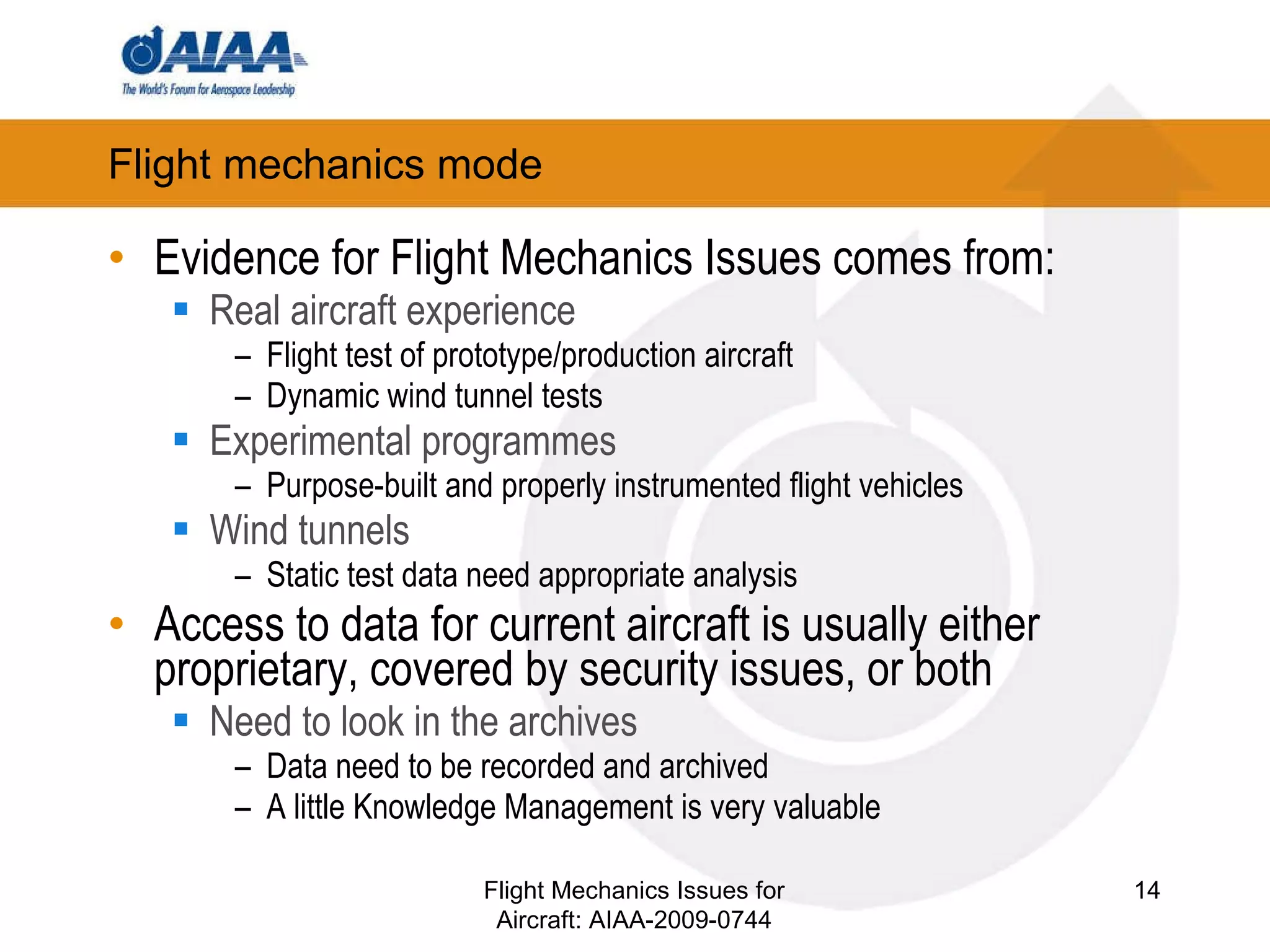
Flight mechanics mode Evidence for Flight Mechanics Issues comes from: Real aircraft experience Flight test of prototype/production aircraft Dynamic wind tunnel tests Experimental programmes Purpose-built and properly instrumented flight vehicles Wind tunnels Static test data need appropriate analysis Access to data for current aircraft is usually either proprietary, covered by security issues, or both Need to look in the archives Data need to be recorded and archived A little Knowledge Management is very valuable Flight Mechanics Issues for Aircraft: AIAA-2009-0744
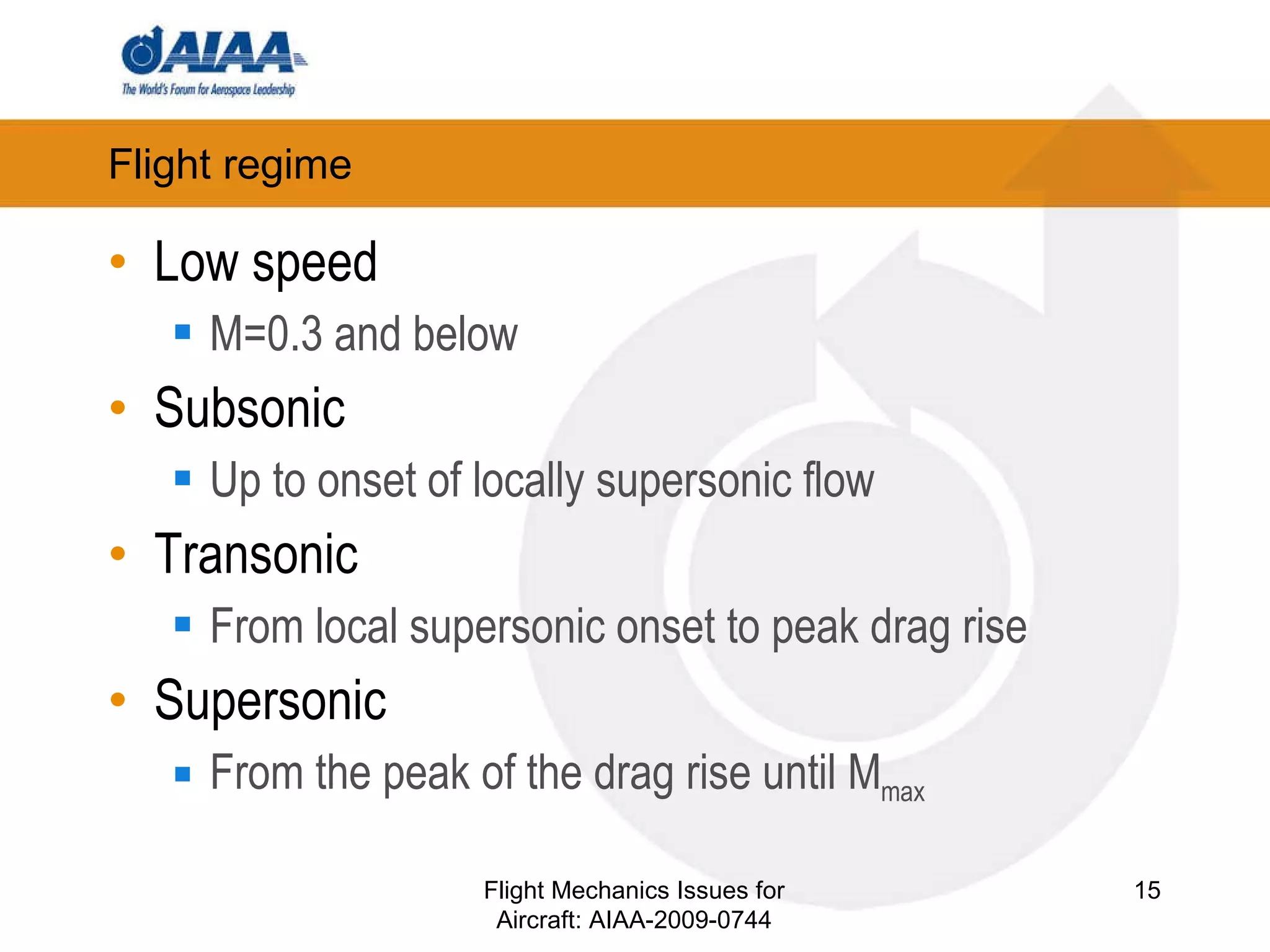
Flight regime Low speed M=0.3 and below Subsonic Up to onset of locally supersonic flow Transonic From local supersonic onset to peak drag rise Supersonic From the peak of the drag rise until M max Flight Mechanics Issues for Aircraft: AIAA-2009-0744
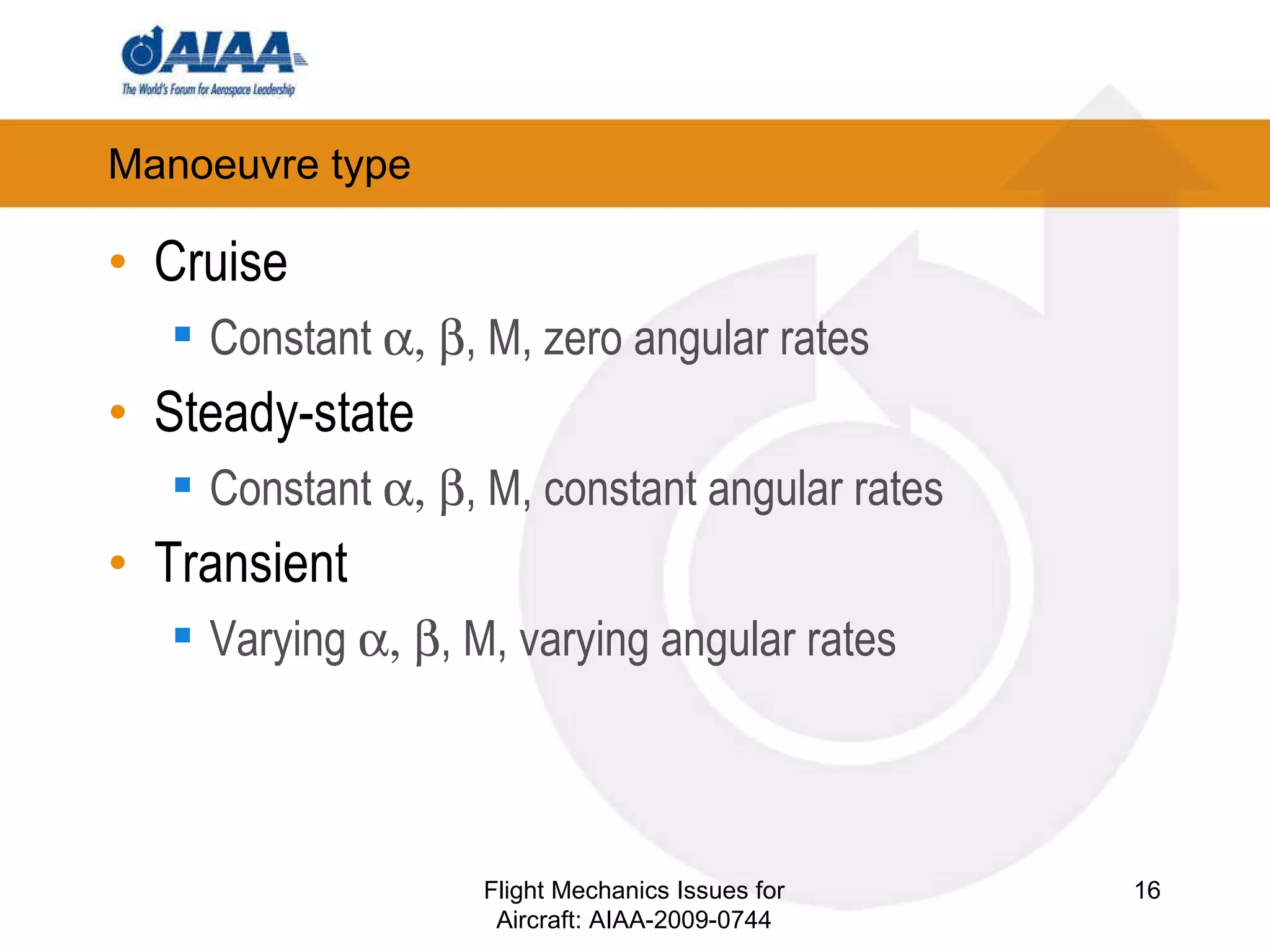
Manoeuvre type Cruise Constant   , M, zero angular rates Steady-state Constant   , M, constant angular rates Transient Varying   , M, varying angular rates Flight Mechanics Issues for Aircraft: AIAA-2009-0744
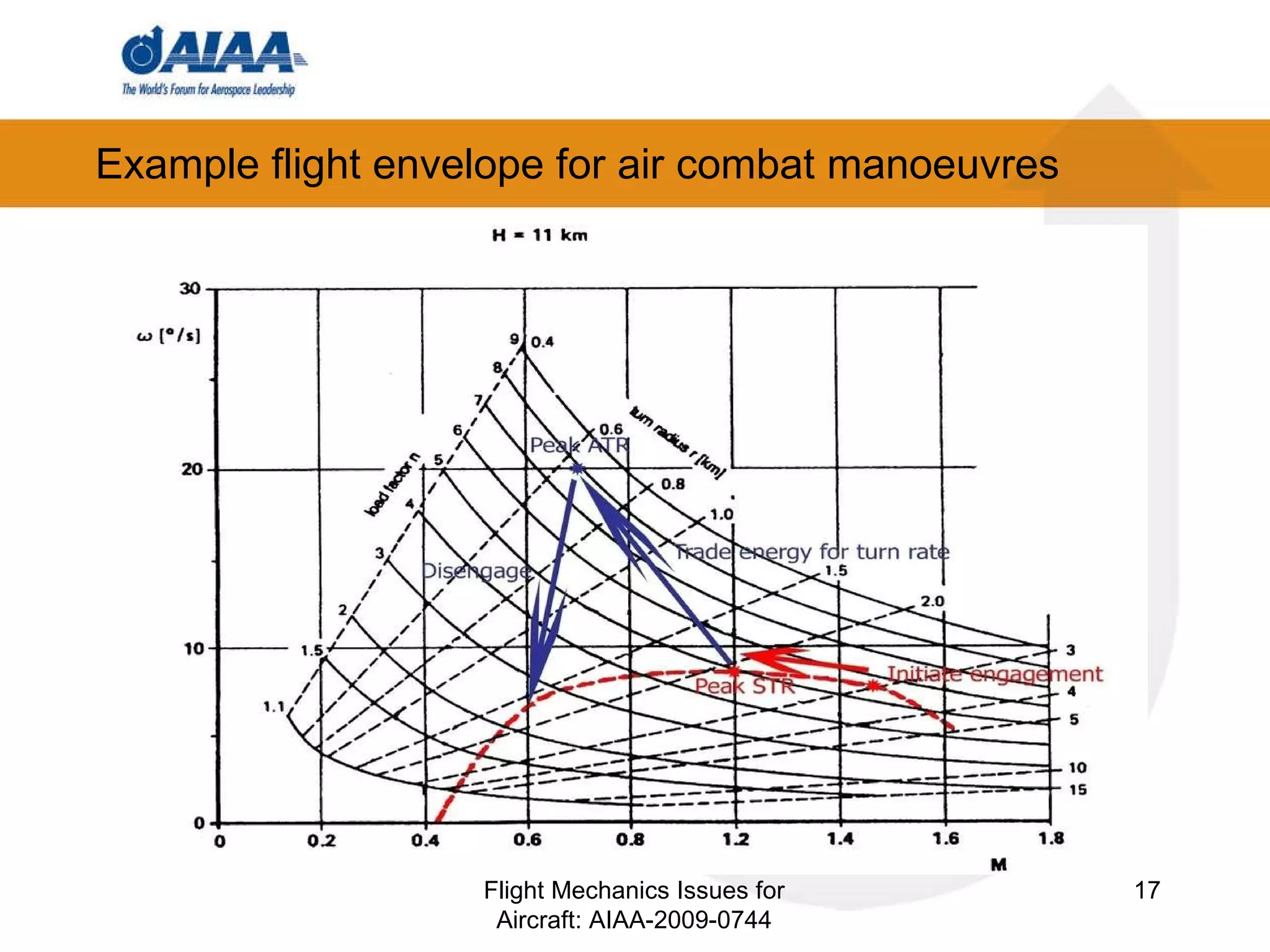
Example flight envelope for air combat manoeuvres Flight Mechanics Issues for Aircraft: AIAA-2009-0744
Configuration type Unswept e.g. Sailplanes, U-2, turboprop-powered transports Swept e.g. B-47, F-86, turbojet/fan-powered transports Slender e.g. F-106, SR-71, Concorde, SSBJ concepts Hybrid swept/slender e.g. F-16, F/A-18, F-22, MiG-29, Su-27 Non-slender e.g. F-4, Avro Vulcan, Eurofighter Typhoon Flight Mechanics Issues for Aircraft: AIAA-2009-0744
Effect of design Mach number on configuration type Flight Mechanics Issues for Aircraft: AIAA-2009-0744
Nature of the taxonomic matrix The matrix is not dense: Factors interact Mach number drives configuration shape Mach number drives manoeuvre type Configuration shape drives flight mechanics modes Mach number  vs.  configuration matrix  Approximately triangular Mach number vs. manoeuvre type matrix: Higher Mach: thrust and/or structural limits Low Mach: lift and control power limits at low q Preliminary analysis indicates areas of interest Flight Mechanics Issues for Aircraft: AIAA-2009-0744
Contents Introduction Design drivers for aircraft Airworthiness requirements Flight Mechanics issues Taxonomy approach and factors considered Fluid Dynamics phenomena Causality Sources of data Preliminary conclusions The way forward Suggested areas of interest Working group definition Flight Mechanics Issues for Aircraft: AIAA-2009-0744
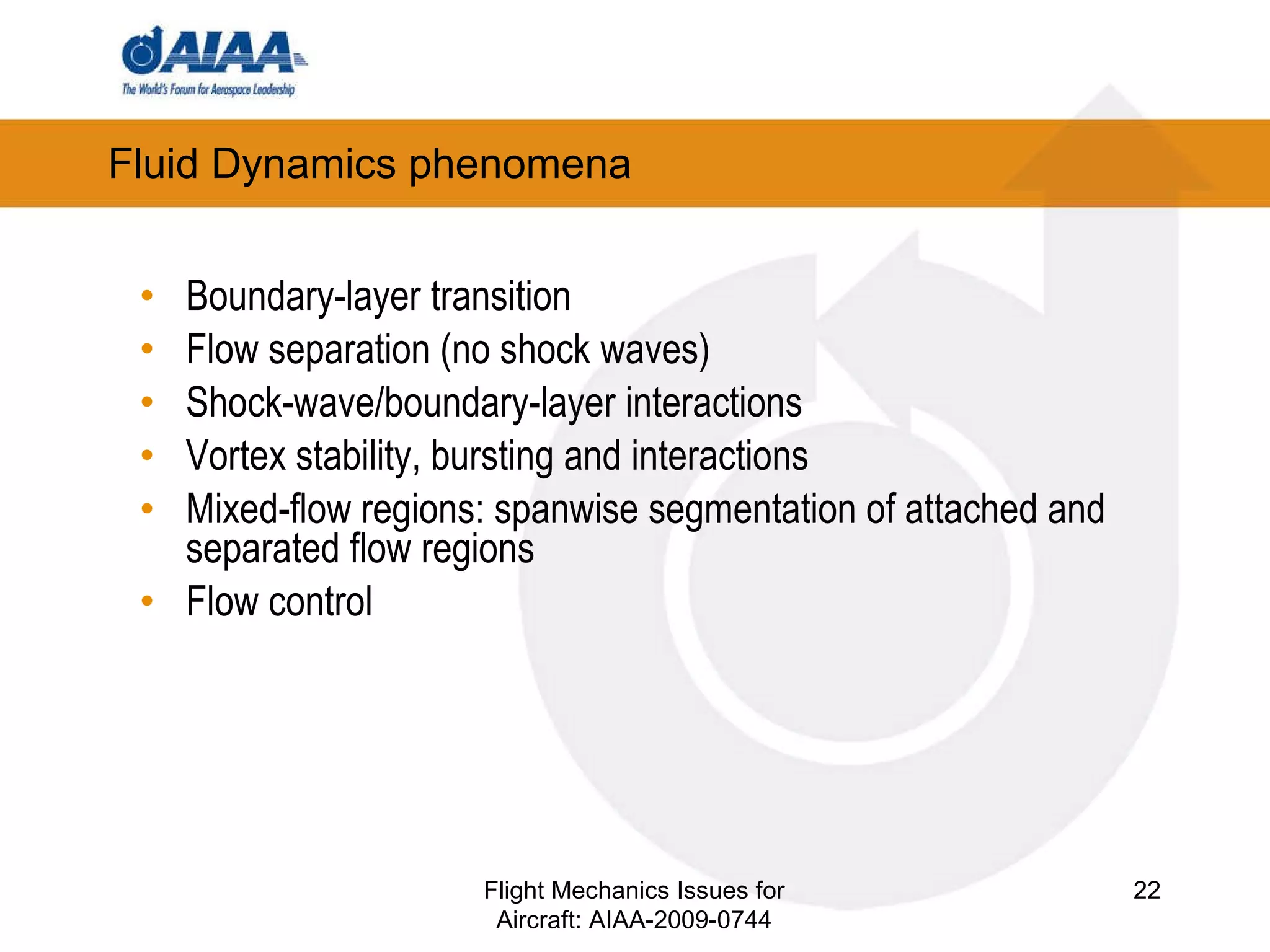
Fluid Dynamics phenomena Boundary-layer transition Flow separation (no shock waves) Shock-wave/boundary-layer interactions Vortex stability, bursting and interactions Mixed-flow regions: spanwise segmentation of attached and separated flow regions Flow control Flight Mechanics Issues for Aircraft: AIAA-2009-0744
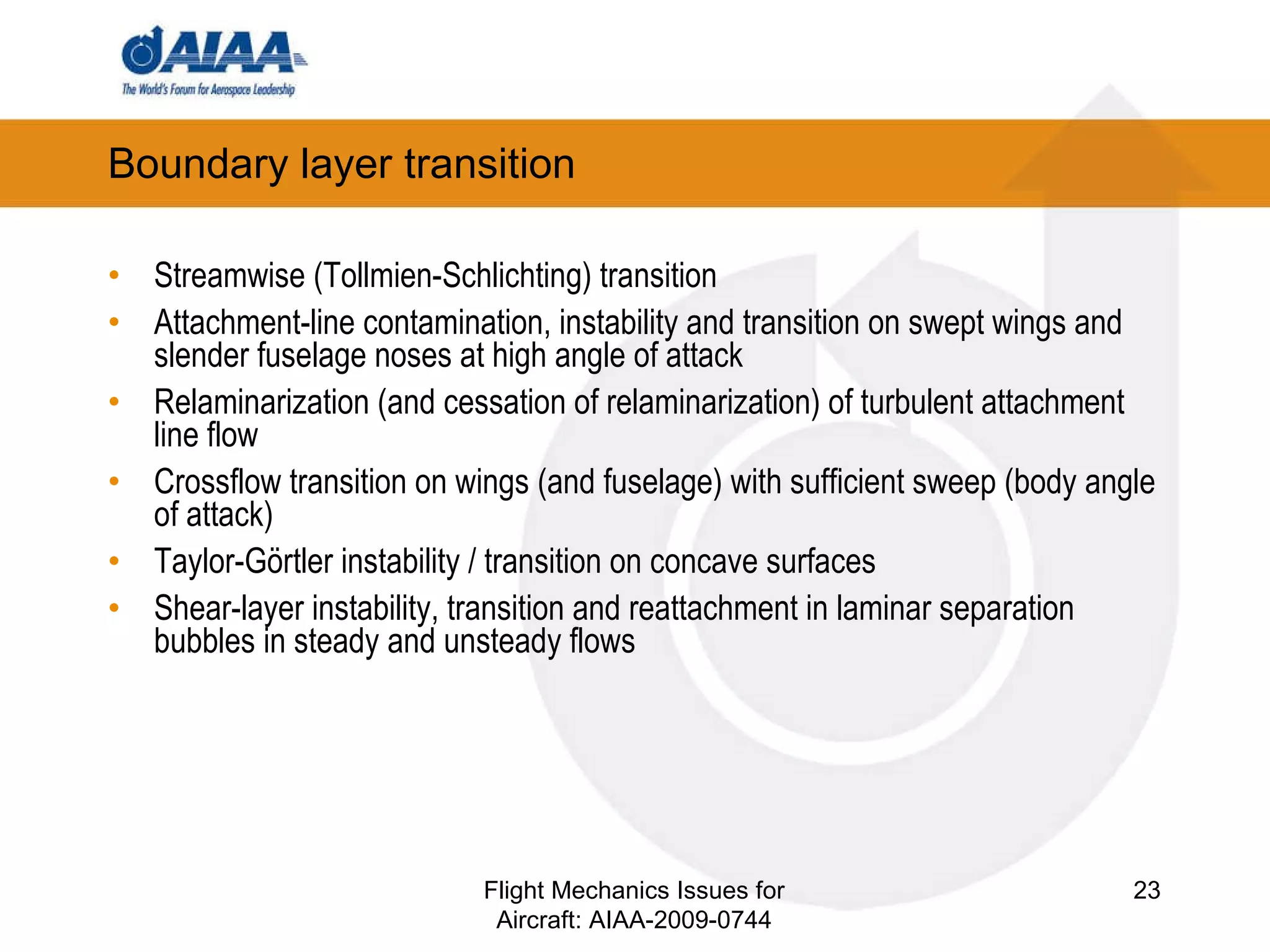
Boundary layer transition Streamwise (Tollmien-Schlichting) transition Attachment-line contamination, instability and transition on swept wings and slender fuselage noses at high angle of attack Relaminarization (and cessation of relaminarization) of turbulent attachment line flow  Crossflow transition on wings (and fuselage) with sufficient sweep (body angle of attack) Taylor-Görtler instability / transition on concave surfaces Shear-layer instability, transition and reattachment in laminar separation bubbles in steady and unsteady flows Flight Mechanics Issues for Aircraft: AIAA-2009-0744
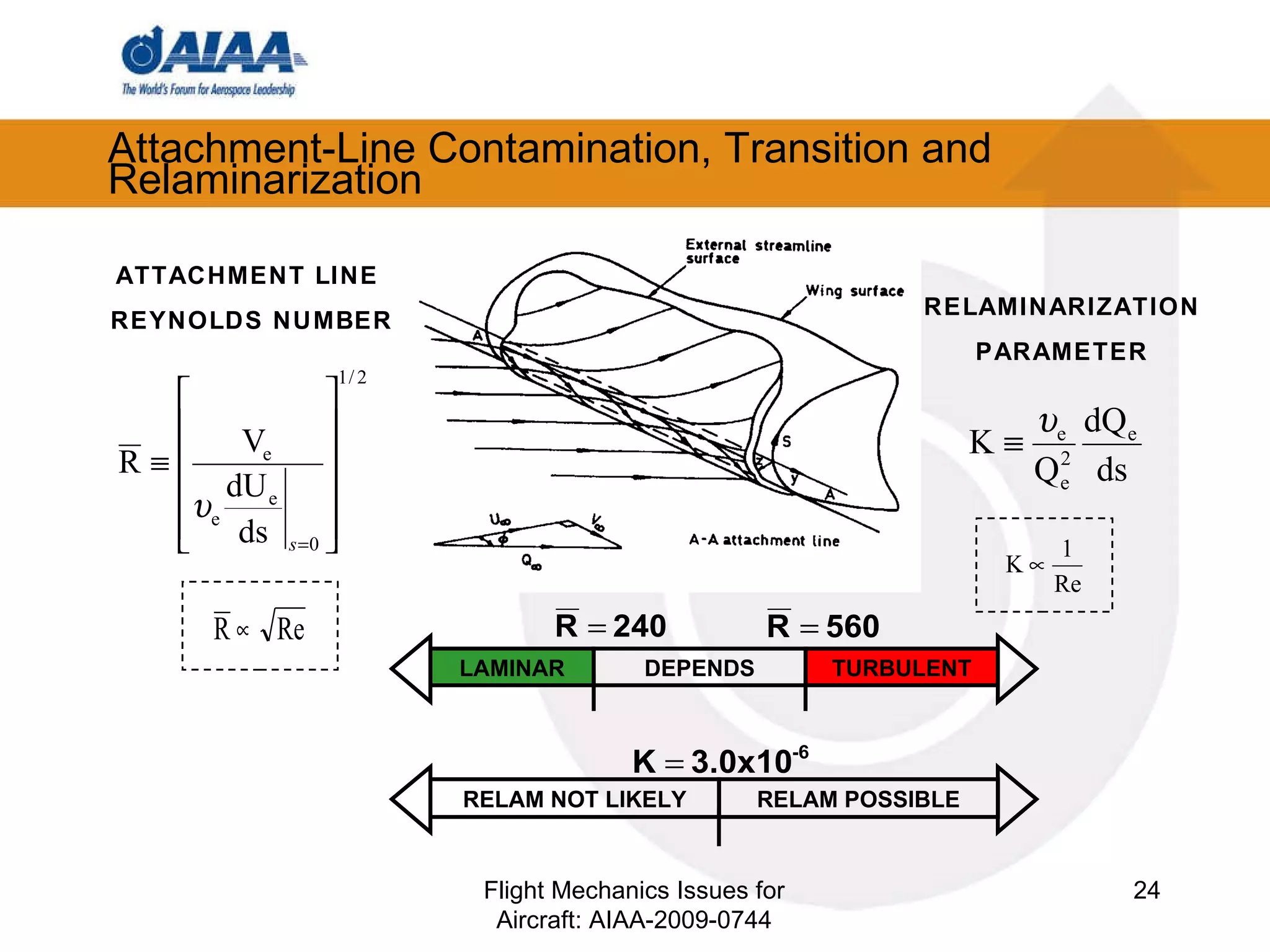
Attachment-Line Contamination, Transition and Relaminarization Flight Mechanics Issues for Aircraft: AIAA-2009-0744 ATTACHMENT LINE REYNOLDS NUMBER RELAMINARIZATION PARAMETER LAMINAR TURBULENT DEPENDS RELAM NOT LIKELY RELAM POSSIBLE
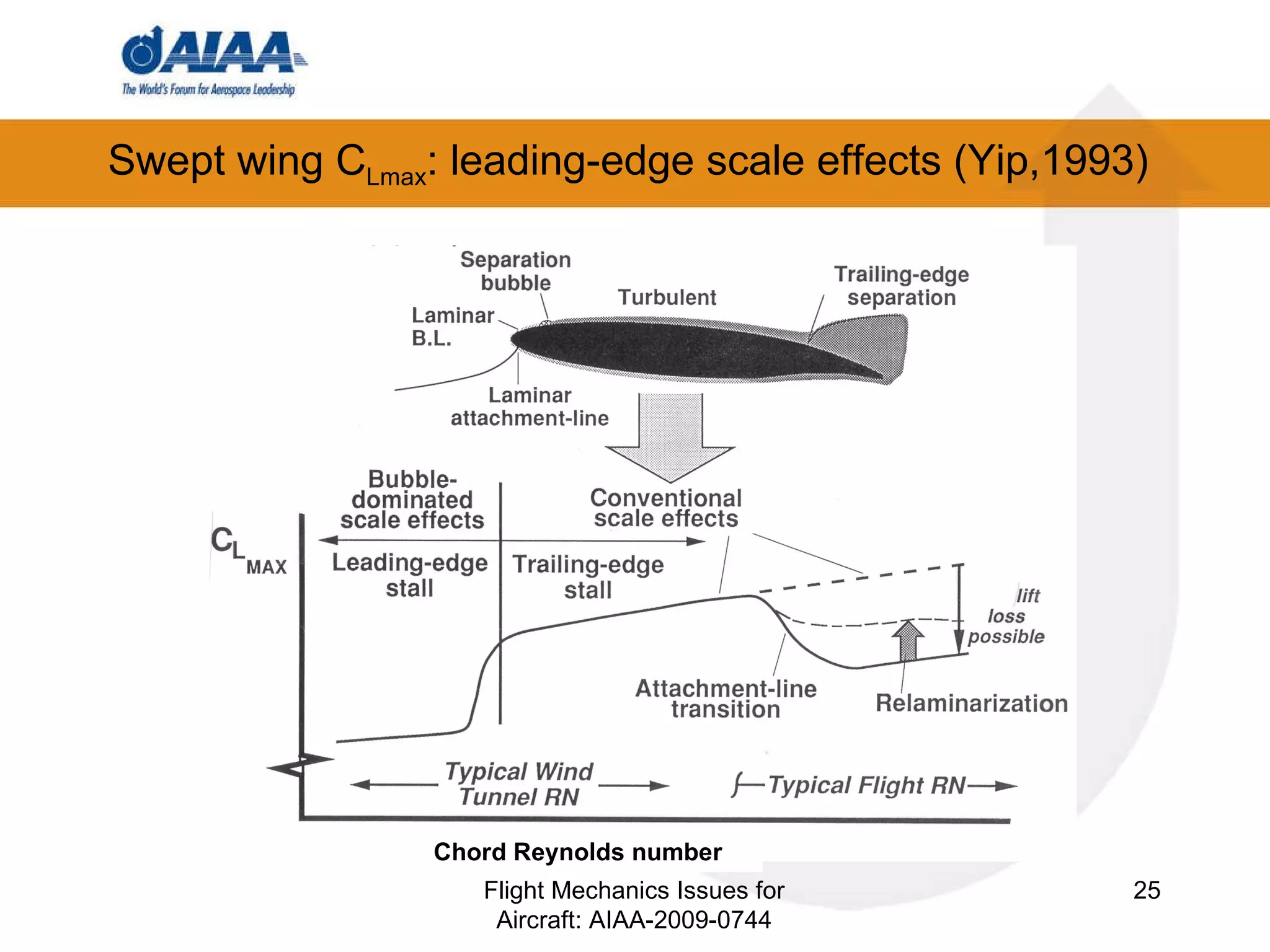
Swept wing C Lmax : leading-edge scale effects (Yip,1993) Flight Mechanics Issues for Aircraft: AIAA-2009-0744 Chord Reynolds number
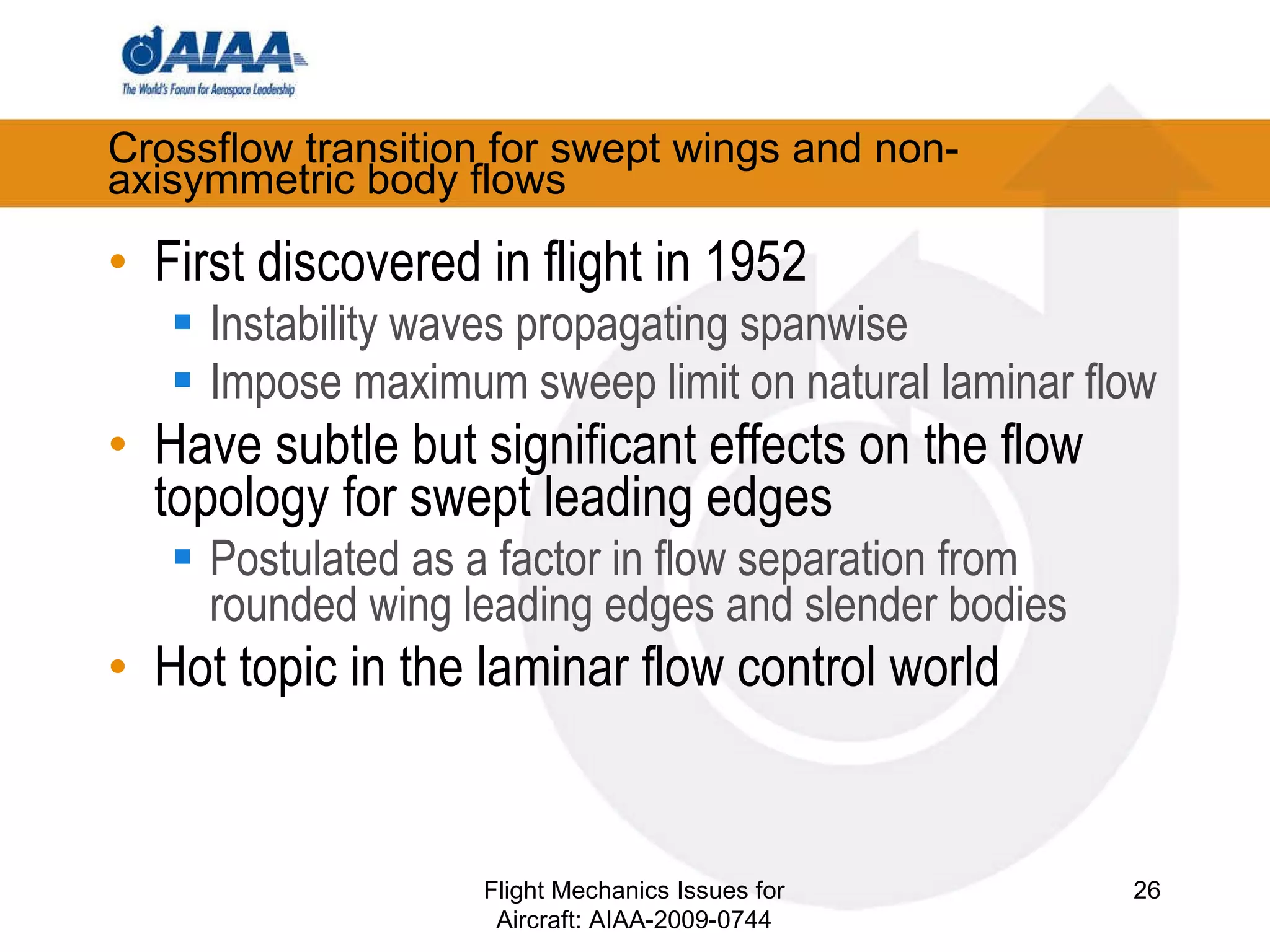
Crossflow transition for swept wings and non-axisymmetric body flows First discovered in flight in 1952 Instability waves propagating spanwise Impose maximum sweep limit on natural laminar flow Have subtle but significant effects on the flow topology for swept leading edges Postulated as a factor in flow separation from rounded wing leading edges and slender bodies Hot topic in the laminar flow control world Flight Mechanics Issues for Aircraft: AIAA-2009-0744
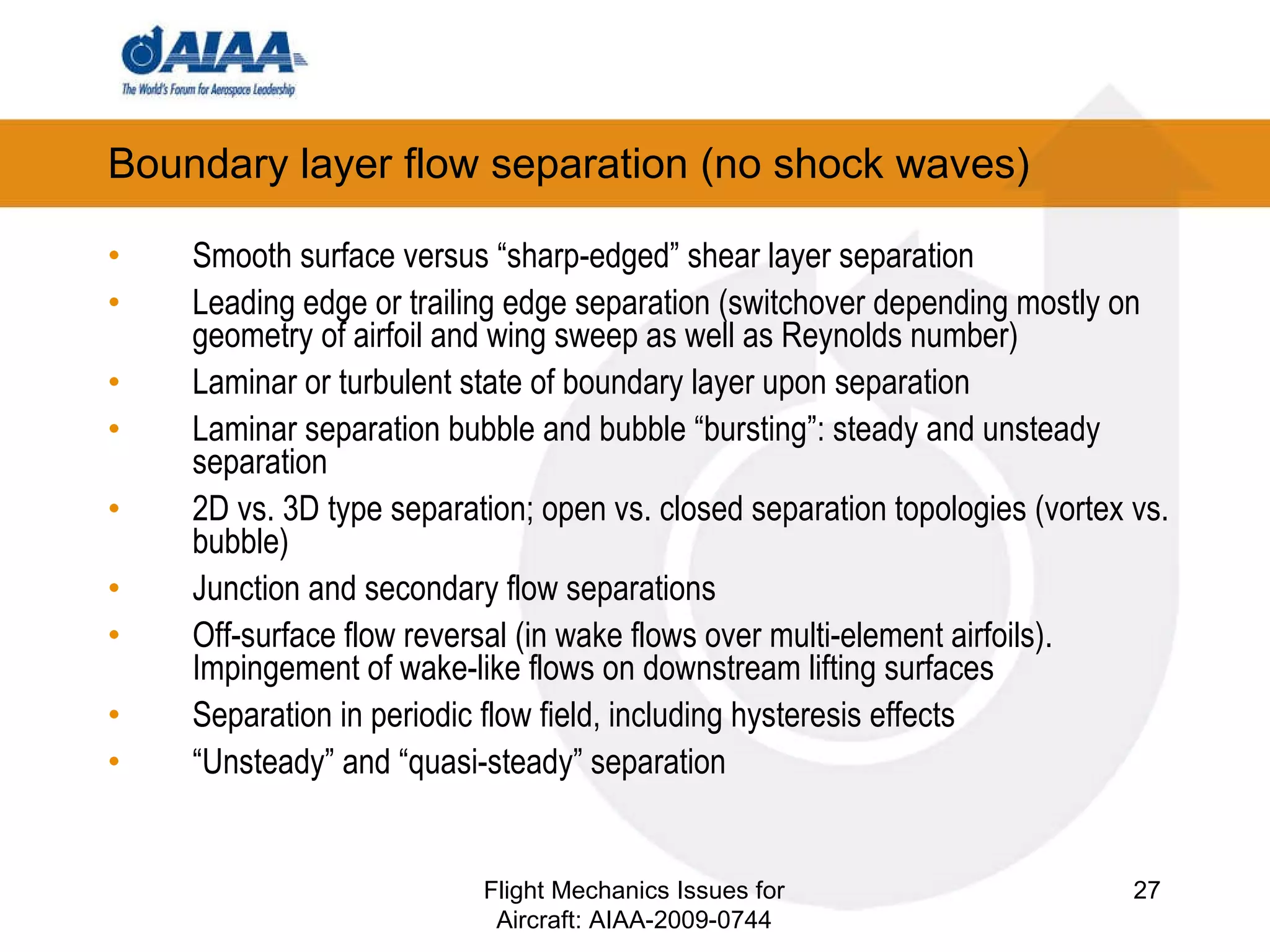
Boundary layer flow separation (no shock waves) Smooth surface versus “sharp-edged” shear layer separation Leading edge or trailing edge separation (switchover depending mostly on geometry of airfoil and wing sweep as well as Reynolds number) Laminar or turbulent state of boundary layer upon separation  Laminar separation bubble and bubble “bursting”: steady and unsteady separation 2D vs. 3D type separation; open vs. closed separation topologies (vortex vs. bubble) Junction and secondary flow separations Off-surface flow reversal (in wake flows over multi-element airfoils).  Impingement of wake-like flows on downstream lifting surfaces Separation in periodic flow field, including hysteresis effects “ Unsteady” and “quasi-steady” separation Flight Mechanics Issues for Aircraft: AIAA-2009-0744
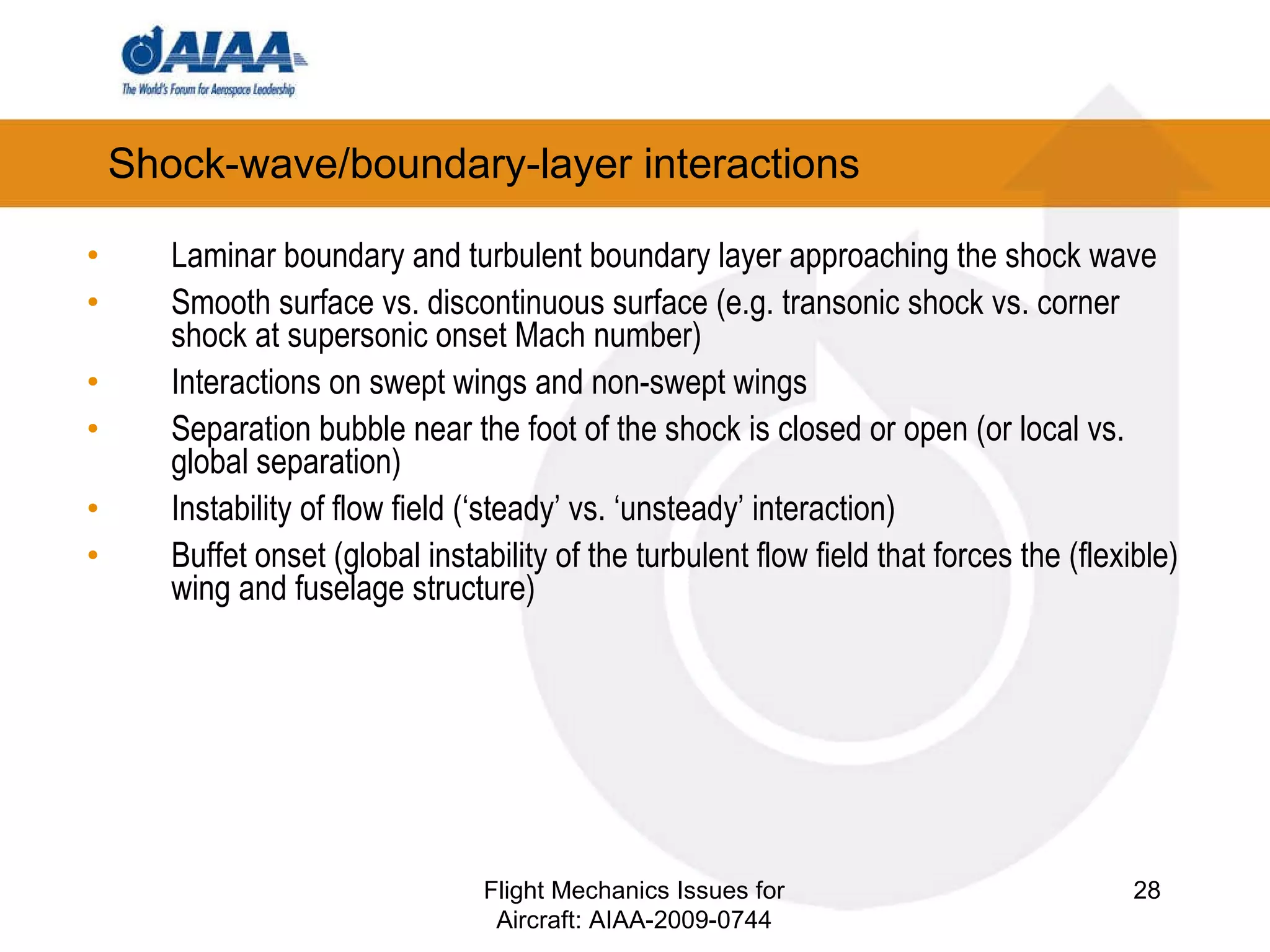
Shock-wave/boundary-layer interactions Laminar boundary and turbulent boundary layer approaching the shock wave Smooth surface vs. discontinuous surface (e.g. transonic shock vs. corner shock at supersonic onset Mach number) Interactions on swept wings and non-swept wings Separation bubble near the foot of the shock is closed or open (or local vs. global separation) Instability of flow field (‘steady’ vs. ‘unsteady’ interaction) Buffet onset (global instability of the turbulent flow field that forces the (flexible) wing and fuselage structure) Flight Mechanics Issues for Aircraft: AIAA-2009-0744
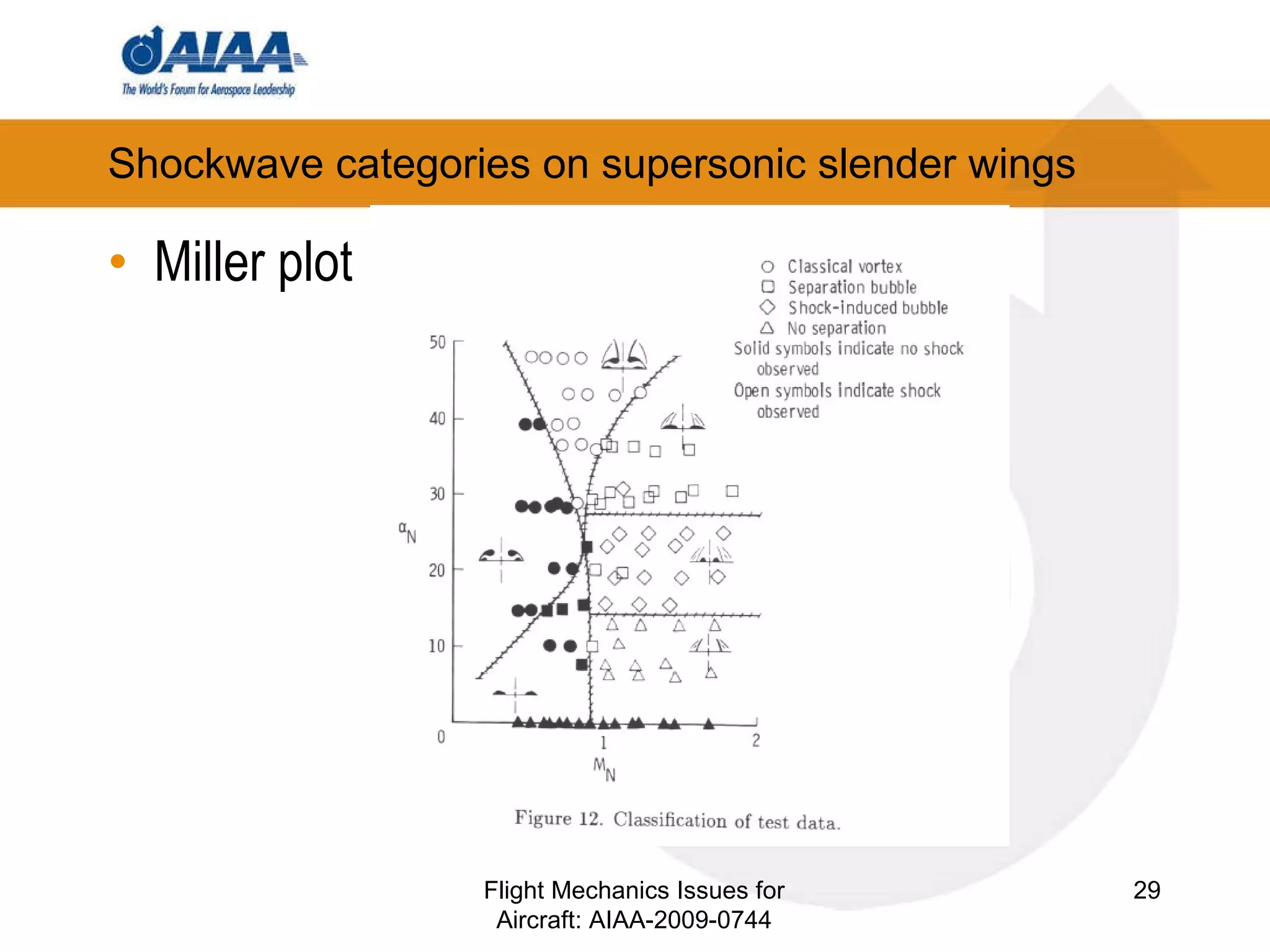
Shockwave categories on supersonic slender wings Miller plot Flight Mechanics Issues for Aircraft: AIAA-2009-0744
Vortex stability, bursting and interactions LEX/Chine vortex bursting and resulting fin buffet on hybrid and slender wings Forebody vortices from slender bodies interacting with downstream wing or empennage. Foreplane tip vortex over downstream wing/empennage Vortex from nacelle chine/strake flowing over unswept/swept wing with highly deflected flap settings Shock/vortex interactions at transonic and supersonic conditions Flight Mechanics Issues for Aircraft: AIAA-2009-0744
Mixed flow regions – spanwise segmentation of flow separation Using geometric or flow control devices, the flow on wings can be segmented into regions of attached and separated flow. Often the presence of a strong vortex can allow suitable segmentation of wing flow. Some possible segmentation examples: Strake/swept wing with strong vortex on inboard strake and unswept type flow further outboard Küchemann type tip flow field, where a stable vortical flow is generated on the outboard aft-swept wing tip, while the flow further inboard may be separated Spanwise discontinuities in leading-edge geometry to affect span loading and formation of local vortices to provide spanwise containment of separated flow (drooped outboard leading edge, leading-edge notches, fences etc.) Flight Mechanics Issues for Aircraft: AIAA-2009-0744
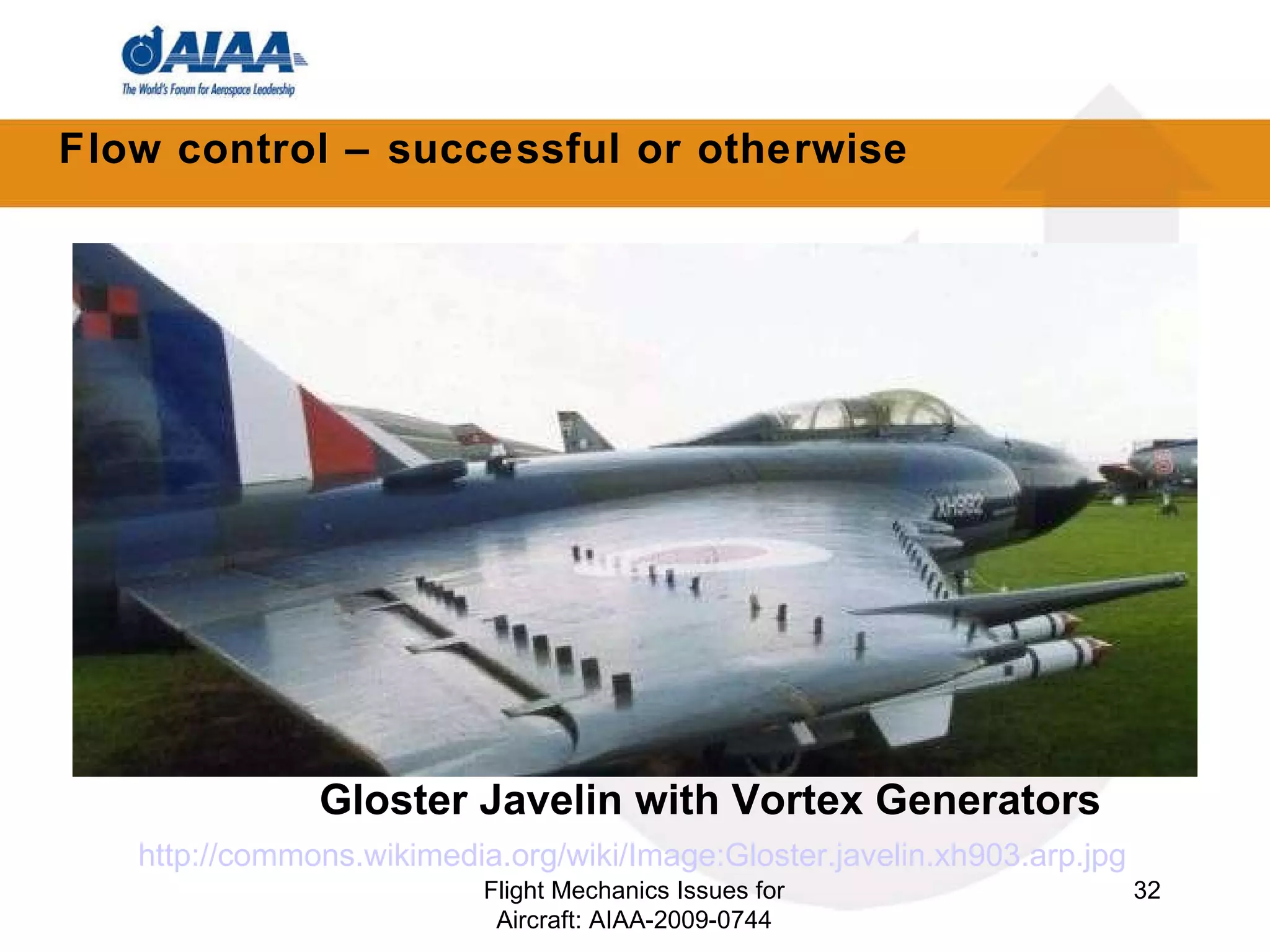
Flight Mechanics Issues for Aircraft: AIAA-2009-0744 Flow control – successful or otherwise Gloster Javelin with Vortex Generators http://commons.wikimedia.org/wiki/Image:Gloster.javelin.xh903.arp.jpg
Contents Introduction Design drivers for aircraft Airworthiness requirements Flight Mechanics issues Taxonomy approach and factors considered Fluid Dynamics phenomena Causality Sources of data Preliminary conclusions The way forward Suggested areas of interest Working group definition Flight Mechanics Issues for Aircraft: AIAA-2009-0744
Causality – which flow phenomena? Sources of data: Compendia of real aircraft experience AGARD studies into buffet and manoeuvre limits Abrupt Wing Stall program Experimental flight/wind tunnel test programmes Numerous X-types Collaborative testing/analysis programmes Historical sources are important (incl. people) Examples of successful (and otherwise) flow control Which are the most significant problems? Relevance to operational use hugely important Flight Mechanics Issues for Aircraft: AIAA-2009-0744
Causality – preliminary conclusions Non-linear flight mechanics are driven by development of flow separations Rapid changes in flow topology represent highest risk Predicting flow separation  onset  is key What fluid dynamics phenomena do we need to capture?  Operational relevance: Most transport/combat aircraft operate predominantly at high subsonic/transonic conditions Transport aircraft cruise/cruise-climb Core of combat aircraft manoeuvre envelope Low-speed high-lift for launch/recovery Flight Mechanics Issues for Aircraft: AIAA-2009-0744
Different types of flow separation Significant configuration dependencies 'Designed' shapes have more subtle pressure gradients than simple models Simple geometries may produce unrepresentative physics Combat aircraft are more prone to leading edge flow separation Thin wings, high adverse pressure gradients near l.e. Large impact on drag over whole flight envelope Transport aircraft are more prone to trailing edge flow separation Thicker wings, strong adverse pressure gradient in recovery to trailing edge Shock-induced flow separations are common to both Buffet margin is a design/certification issue Frequently the source of abrupt wing stall Predicting flow separation at transonic conditions Flight Mechanics Issues for Aircraft: AIAA-2009-0744
Flow separation at low-speed and high-lift  Leading edge flow separation is the predominant issue for thin or highly swept wings Problem common to that at transonic manoeuvre conditions Loss of leading edge thrust produces significant drag penalty Changes in flow topology have consequences for stability characteristics ‘ Real’ aircraft have designed leading edges or high lift systems Trailing edge separations are the predominant issue for thick or low sweep wings Cumulative momentum loss under the influence of pressure gradients Less problematic for drag and stability than leading edge separations Complex viscous flows on high-lift systems Major design area for transport aircraft wings  Flight Mechanics Issues for Aircraft: AIAA-2009-0744
Contents Introduction Design drivers for aircraft Airworthiness requirements Flight Mechanics issues Taxonomy approach and factors considered Fluid Dynamics phenomena Causality Sources of data Preliminary conclusions The way forward Suggested areas of interest Working group definition Flight Mechanics Issues for Aircraft: AIAA-2009-0744
The way forward (1) ‏ Suggested areas of interest: Transonic buffet prediction Relevant to most relevant classes of air vehicle 'Building block' experimental data available (UFAST) Potential for investigation on a full configuration (CRM) ‏ Flow separation onset from rounded leading edges Very high impact for military configurations Configuration-level activity starting in RTO Candidate for developing 'building block' experimental program to support configuration-level activity elsewhere Trailing edge flow separation Flight Mechanics Issues for Aircraft: AIAA-2009-0744
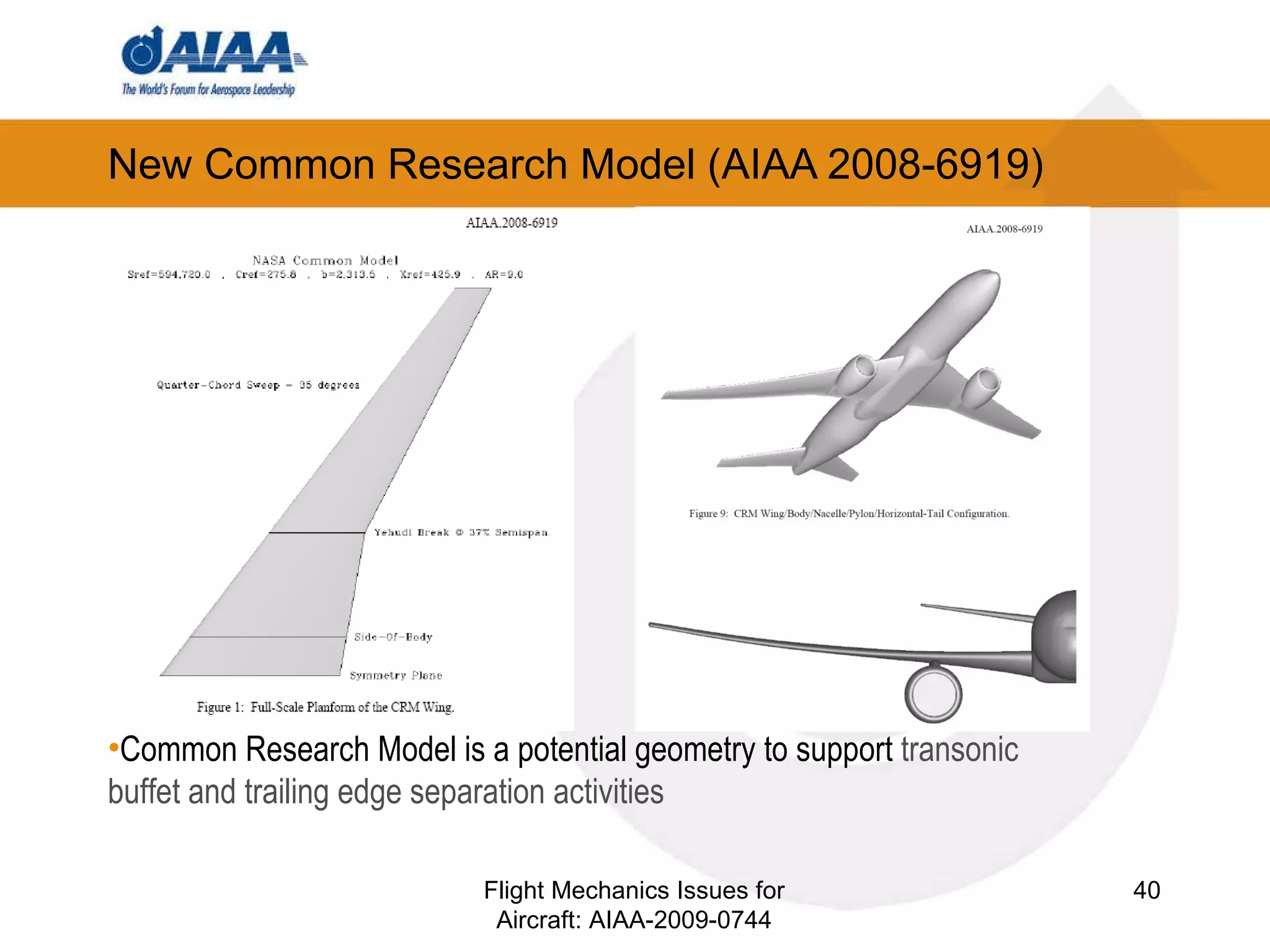
New Common Research Model (AIAA 2008-6919) ‏ Common Research Model is a potential geometry to support  transonic buffet and trailing edge separation activities Flight Mechanics Issues for Aircraft: AIAA-2009-0744
The way forward (2) ‏ Establish Working Group across APA/FD TCs: Develop basis for AIAA predictive workshops Focus on specific issues identified Invite participation of topic specialist “Greybeards” Develop understanding of experimental evidence Identify necessary level of flow modelling Engage with CFD community Determine best practice Demonstrate CFD capability against model problems Refine methods/guidance to users Flight Mechanics Issues for Aircraft: AIAA-2009-0744
Summary Provided an initial taxonomy of Fluid Dynamics causation for Flight Mechanics problems Suggested three areas of primary interest Prioritised on Operational Impact Applied Aerodynamics and Fluid Dynamics TCs are forming a joint Working Group to develop a strategy to improve industrial capability Invited sessions by topic specialists and a workshop are planned for the next two years
Acknowledgements Thanks are due to the current and past members of the APA TC who contributed feedback: Darren Grove, Jeff Slotnick and particularly Paul Vijgen External comments gratefully received from: Bram Elsenaar, John Fulker and Frank Lynch N.b.  Feedback and revision of the proposed activities is an ongoing process Contributions gratefully received for consideration by the Working Group
Flight Mechanics Issues for Aircraft: AIAA-2009-0744
Proposed framework for workshops Propose Topic of Workshop to relevant TC’s Identify experiments that exhibit relevant fluid-mechanics feature Identify available (publishable) experimental and CFD data for this geometry Provide geometry (and available test data) to community together with flow conditions for analysis  Obtain list of participants to conduct CFD (and possible experiments).  Obtain CFD results Collect CFD results and prepare initial Workshop with results (invited papers etc.) ‏ Define need for additional CFD and experiments in follow-on Workshops Flight Mechanics Issues for Aircraft: AIAA-2009-0744
Common Research Model (CRM) – see AIAA 2008-6919 CRM (Common Research Model) is defined within NASA’s a Subsonic Fixed Wing project (SFW) by Aerodynamics Technical Working Group (TWG) ‏ TWG  representatives from Boeing, Lockheed-Martin, Northrop-Grumman, Gulfstream,Cessna, Hawker-Beechcraft, Pratt and Whitney, Air Force, Navy, and NASA SFW CRM (Common Research Model) geometry to be released in public by Fall 2008.  Boeing design Mach 0.85 design Modern airfoils With horizontal tail to allow trim Wind-tunnel data (NTF-cryo and Ames 11-ft pressure tunnel) to be taken in Spring – Fall 2009
Transonic Buffet and Trailing-Edge Separation Data from CRM Planned CRM data may be suitable for first Workshop on topics suggested in White Paper Planned test data (AIAA 2008-6919): Mach 0.7 to 0.92 Angles of attack into pitch up and buffet onset Rec = 5 million (Ames 11-ft TPT) and Rec = 3 – 30 million (Langley NTF) ‏ Measurements: Balance (6-component), surface pressures, wing-shape under loading (Ames and Langley) ‏ PIV and skin-friction interferometry (Ames) ‏ Flush wing-mounted Kulites in outboard wing Flight Mechanics Issues for Aircraft: AIAA-2009-0744

Flight Mechanics Issues presentation

  • 1.
    APA Vehicle AerodynamicsSubcommittee: Flight Mechanics Issues for Aircraft, and underlying Fluid Dynamics Phenomena Stephen McParlin APA TC ( [email_address] ) Robert Tramel APA TC ( [email_address] ) AIAA-2009-0744
  • 2.
    Contents Introduction Designdrivers for aircraft Airworthiness requirements Flight Mechanics issues Taxonomy approach and factors considered Fluid Dynamics phenomena Causality Sources of data Preliminary conclusions The way forward Suggested areas of interest Working group definition Flight Mechanics Issues for Aircraft: AIAA-2009-0744
  • 3.
    Contents Introduction Designdrivers for aircraft Airworthiness requirements Flight Mechanics issues Taxonomy approach and factors considered Fluid Dynamics phenomena Causality Sources of data Preliminary conclusions The way forward Suggested areas of interest Working group definition Flight Mechanics Issues for Aircraft: AIAA-2009-0744
  • 4.
    Introduction This isa product of the APA TC Identify/tackle capability gaps in CFD for aircraft Evolution of the concept from ‘moment prediction’ Increased emphasis on understanding fluid dynamics Lessons learned from the DPW series Increased role for experimental analysis Case for ‘Building Block’ approach Review historical evidence Flight, wind tunnel test experience Consider flow control successes Recommend workshop topics/structure Engage Fluid Dynamics community in/outside AIAA Flight Mechanics Issues for Aircraft: AIAA-2009-0744
  • 5.
    Contents Introduction Designdrivers for aircraft Airworthiness requirements Flight Mechanics issues Taxonomy approach and factors considered Fluid Dynamics phenomena Causality Sources of data Preliminary conclusions The way forward Suggested areas of interest Working group definition Flight Mechanics Issues for Aircraft: AIAA-2009-0744
  • 6.
    Design drivers foraircraft The basis for our consideration and prioritisation of issues is driven by application pull, rather than technology push Impact on the design and operation of aircraft Civil transports Combat aircraft Based on meeting end user requirements while containing: Cost Complexity Risk Looking to establish industrial-strength processes and tools Where do we need to mature CFD methods to make an impact? Focus on aircraft performance, stability and control Flight Mechanics Issues for Aircraft: AIAA-2009-0744
  • 7.
    Airworthiness requirements (1)‏ Military requirements for flying qualities “ The aircraft shall be…resistant to departure from controlled flight, post-stall gyrations and spins. Adequate warning of approach to departure shall be provided. The aircraft shall exhibit no uncommanded motion which cannot be arrested promptly by simple application of pilot control.” – US MIL-STD-1797A “ It is desirable that the specified flying qualities should be achieved by good aerodynamic and mechanical design. However automatic devices may be used where an overall benefit accrues provided that the system as a whole meets the requirements.” - UK DefStan 00-970 Flight Mechanics Issues for Aircraft: AIAA-2009-0744
  • 8.
    Airworthiness requirements (2)‏ Civil requirements for flying qualities “ It must be possible to produce and to correct roll and yaw by unreversed use of aileron and rudder controls, up to the time the aeroplane is stalled. No abnormal nose-up pitching may occur. The longitudinal control force must be positive up to and throughout the stall. In addition, it must be possible to promptly prevent stalling and to recover from a stall by normal use of the controls” (CS 25.203) ‏ “ Stall warning with sufficient margin to prevent inadvertent stalling with the flaps and landing gear in any normal position must be clear and distinctive to the pilot in straight and turning flight” (CS 25.207) “ The aeroplane must be demonstrated in flight to be free from any vibration and buffeting that would prevent continued safe flight in any likely operating condition” (CS 25.251) Flight Mechanics Issues for Aircraft: AIAA-2009-0744
  • 9.
    Flying/Handling qualities Customersrequire: Predictable and consistent stability characteristics Well-defined departure boundaries Adequate warning of departure Easy recovery But, we have potential challenges: Abrupt, non-linear stability changes and divergent modes Lack of control power at or beyond departure Solutions are multidisciplinary, a blend of: Aerodynamic design Flight Control System design Flow Control, where necessary Flight Mechanics Issues for Aircraft: AIAA-2009-0744
  • 10.
    Flight mechanics issuesLongitudinal Static Pitch up, tuck under, Mach tuck Dynamic: unstable SPO and phugoid (‘Falling leaf’) – limit cycle behaviour Lateral/directional Static Wing drop, nose slice (“yaw off”) ‏ Dynamic unstable Dutch Roll/Wing Rock Classical linear stability modes become non-linear as the underlying aerodynamic forces become non-linear Prediction of non-linear changes in aerodynamics is the key Flight Mechanics Issues for Aircraft: AIAA-2009-0744
  • 11.
    Contents Introduction Designdrivers for aircraft Airworthiness requirements Flight Mechanics issues Taxonomy approach and factors considered Fluid Dynamics phenomena Causality Sources of data Preliminary conclusions The way forward Suggested areas of interest Working group definition Flight Mechanics Issues for Aircraft: AIAA-2009-0744
  • 12.
    Taxonomy approach Identifycausation of non-linear stability characteristics Which problem happens, to which classes of configuration, at which operating condition Consider the nature of flows at these conditions Look at available experimental evidence Postulate driving Fluid Dynamics phenomena Investigate fundamental Fluid Dynamics Validate CFD against ‘building block’ experiments Use experimental knowledge base to inform CFD use Flight Mechanics Issues for Aircraft: AIAA-2009-0744
  • 13.
    Factors considered intaxonomy Flight mechanics mode Longitudinal/lateral, static/dynamic Flight regime Low speed/subsonic/transonic/supersonic Manoeuvre type Cruise/steady-state/transient Configuration type Unswept/Swept/Slender/Hybrid/non-slender Flight Mechanics Issues for Aircraft: AIAA-2009-0744
  • 14.
    Flight mechanics modeEvidence for Flight Mechanics Issues comes from: Real aircraft experience Flight test of prototype/production aircraft Dynamic wind tunnel tests Experimental programmes Purpose-built and properly instrumented flight vehicles Wind tunnels Static test data need appropriate analysis Access to data for current aircraft is usually either proprietary, covered by security issues, or both Need to look in the archives Data need to be recorded and archived A little Knowledge Management is very valuable Flight Mechanics Issues for Aircraft: AIAA-2009-0744
  • 15.
    Flight regime Lowspeed M=0.3 and below Subsonic Up to onset of locally supersonic flow Transonic From local supersonic onset to peak drag rise Supersonic From the peak of the drag rise until M max Flight Mechanics Issues for Aircraft: AIAA-2009-0744
  • 16.
    Manoeuvre type CruiseConstant  , M, zero angular rates Steady-state Constant  , M, constant angular rates Transient Varying  , M, varying angular rates Flight Mechanics Issues for Aircraft: AIAA-2009-0744
  • 17.
    Example flight envelopefor air combat manoeuvres Flight Mechanics Issues for Aircraft: AIAA-2009-0744
  • 18.
    Configuration type Unswepte.g. Sailplanes, U-2, turboprop-powered transports Swept e.g. B-47, F-86, turbojet/fan-powered transports Slender e.g. F-106, SR-71, Concorde, SSBJ concepts Hybrid swept/slender e.g. F-16, F/A-18, F-22, MiG-29, Su-27 Non-slender e.g. F-4, Avro Vulcan, Eurofighter Typhoon Flight Mechanics Issues for Aircraft: AIAA-2009-0744
  • 19.
    Effect of designMach number on configuration type Flight Mechanics Issues for Aircraft: AIAA-2009-0744
  • 20.
    Nature of thetaxonomic matrix The matrix is not dense: Factors interact Mach number drives configuration shape Mach number drives manoeuvre type Configuration shape drives flight mechanics modes Mach number vs. configuration matrix Approximately triangular Mach number vs. manoeuvre type matrix: Higher Mach: thrust and/or structural limits Low Mach: lift and control power limits at low q Preliminary analysis indicates areas of interest Flight Mechanics Issues for Aircraft: AIAA-2009-0744
  • 21.
    Contents Introduction Designdrivers for aircraft Airworthiness requirements Flight Mechanics issues Taxonomy approach and factors considered Fluid Dynamics phenomena Causality Sources of data Preliminary conclusions The way forward Suggested areas of interest Working group definition Flight Mechanics Issues for Aircraft: AIAA-2009-0744
  • 22.
    Fluid Dynamics phenomenaBoundary-layer transition Flow separation (no shock waves) Shock-wave/boundary-layer interactions Vortex stability, bursting and interactions Mixed-flow regions: spanwise segmentation of attached and separated flow regions Flow control Flight Mechanics Issues for Aircraft: AIAA-2009-0744
  • 23.
    Boundary layer transitionStreamwise (Tollmien-Schlichting) transition Attachment-line contamination, instability and transition on swept wings and slender fuselage noses at high angle of attack Relaminarization (and cessation of relaminarization) of turbulent attachment line flow Crossflow transition on wings (and fuselage) with sufficient sweep (body angle of attack) Taylor-Görtler instability / transition on concave surfaces Shear-layer instability, transition and reattachment in laminar separation bubbles in steady and unsteady flows Flight Mechanics Issues for Aircraft: AIAA-2009-0744
  • 24.
    Attachment-Line Contamination, Transitionand Relaminarization Flight Mechanics Issues for Aircraft: AIAA-2009-0744 ATTACHMENT LINE REYNOLDS NUMBER RELAMINARIZATION PARAMETER LAMINAR TURBULENT DEPENDS RELAM NOT LIKELY RELAM POSSIBLE
  • 25.
    Swept wing CLmax : leading-edge scale effects (Yip,1993) Flight Mechanics Issues for Aircraft: AIAA-2009-0744 Chord Reynolds number
  • 26.
    Crossflow transition forswept wings and non-axisymmetric body flows First discovered in flight in 1952 Instability waves propagating spanwise Impose maximum sweep limit on natural laminar flow Have subtle but significant effects on the flow topology for swept leading edges Postulated as a factor in flow separation from rounded wing leading edges and slender bodies Hot topic in the laminar flow control world Flight Mechanics Issues for Aircraft: AIAA-2009-0744
  • 27.
    Boundary layer flowseparation (no shock waves) Smooth surface versus “sharp-edged” shear layer separation Leading edge or trailing edge separation (switchover depending mostly on geometry of airfoil and wing sweep as well as Reynolds number) Laminar or turbulent state of boundary layer upon separation Laminar separation bubble and bubble “bursting”: steady and unsteady separation 2D vs. 3D type separation; open vs. closed separation topologies (vortex vs. bubble) Junction and secondary flow separations Off-surface flow reversal (in wake flows over multi-element airfoils). Impingement of wake-like flows on downstream lifting surfaces Separation in periodic flow field, including hysteresis effects “ Unsteady” and “quasi-steady” separation Flight Mechanics Issues for Aircraft: AIAA-2009-0744
  • 28.
    Shock-wave/boundary-layer interactions Laminarboundary and turbulent boundary layer approaching the shock wave Smooth surface vs. discontinuous surface (e.g. transonic shock vs. corner shock at supersonic onset Mach number) Interactions on swept wings and non-swept wings Separation bubble near the foot of the shock is closed or open (or local vs. global separation) Instability of flow field (‘steady’ vs. ‘unsteady’ interaction) Buffet onset (global instability of the turbulent flow field that forces the (flexible) wing and fuselage structure) Flight Mechanics Issues for Aircraft: AIAA-2009-0744
  • 29.
    Shockwave categories onsupersonic slender wings Miller plot Flight Mechanics Issues for Aircraft: AIAA-2009-0744
  • 30.
    Vortex stability, burstingand interactions LEX/Chine vortex bursting and resulting fin buffet on hybrid and slender wings Forebody vortices from slender bodies interacting with downstream wing or empennage. Foreplane tip vortex over downstream wing/empennage Vortex from nacelle chine/strake flowing over unswept/swept wing with highly deflected flap settings Shock/vortex interactions at transonic and supersonic conditions Flight Mechanics Issues for Aircraft: AIAA-2009-0744
  • 31.
    Mixed flow regions– spanwise segmentation of flow separation Using geometric or flow control devices, the flow on wings can be segmented into regions of attached and separated flow. Often the presence of a strong vortex can allow suitable segmentation of wing flow. Some possible segmentation examples: Strake/swept wing with strong vortex on inboard strake and unswept type flow further outboard Küchemann type tip flow field, where a stable vortical flow is generated on the outboard aft-swept wing tip, while the flow further inboard may be separated Spanwise discontinuities in leading-edge geometry to affect span loading and formation of local vortices to provide spanwise containment of separated flow (drooped outboard leading edge, leading-edge notches, fences etc.) Flight Mechanics Issues for Aircraft: AIAA-2009-0744
  • 32.
    Flight Mechanics Issuesfor Aircraft: AIAA-2009-0744 Flow control – successful or otherwise Gloster Javelin with Vortex Generators http://commons.wikimedia.org/wiki/Image:Gloster.javelin.xh903.arp.jpg
  • 33.
    Contents Introduction Designdrivers for aircraft Airworthiness requirements Flight Mechanics issues Taxonomy approach and factors considered Fluid Dynamics phenomena Causality Sources of data Preliminary conclusions The way forward Suggested areas of interest Working group definition Flight Mechanics Issues for Aircraft: AIAA-2009-0744
  • 34.
    Causality – whichflow phenomena? Sources of data: Compendia of real aircraft experience AGARD studies into buffet and manoeuvre limits Abrupt Wing Stall program Experimental flight/wind tunnel test programmes Numerous X-types Collaborative testing/analysis programmes Historical sources are important (incl. people) Examples of successful (and otherwise) flow control Which are the most significant problems? Relevance to operational use hugely important Flight Mechanics Issues for Aircraft: AIAA-2009-0744
  • 35.
    Causality – preliminaryconclusions Non-linear flight mechanics are driven by development of flow separations Rapid changes in flow topology represent highest risk Predicting flow separation onset is key What fluid dynamics phenomena do we need to capture? Operational relevance: Most transport/combat aircraft operate predominantly at high subsonic/transonic conditions Transport aircraft cruise/cruise-climb Core of combat aircraft manoeuvre envelope Low-speed high-lift for launch/recovery Flight Mechanics Issues for Aircraft: AIAA-2009-0744
  • 36.
    Different types offlow separation Significant configuration dependencies 'Designed' shapes have more subtle pressure gradients than simple models Simple geometries may produce unrepresentative physics Combat aircraft are more prone to leading edge flow separation Thin wings, high adverse pressure gradients near l.e. Large impact on drag over whole flight envelope Transport aircraft are more prone to trailing edge flow separation Thicker wings, strong adverse pressure gradient in recovery to trailing edge Shock-induced flow separations are common to both Buffet margin is a design/certification issue Frequently the source of abrupt wing stall Predicting flow separation at transonic conditions Flight Mechanics Issues for Aircraft: AIAA-2009-0744
  • 37.
    Flow separation atlow-speed and high-lift Leading edge flow separation is the predominant issue for thin or highly swept wings Problem common to that at transonic manoeuvre conditions Loss of leading edge thrust produces significant drag penalty Changes in flow topology have consequences for stability characteristics ‘ Real’ aircraft have designed leading edges or high lift systems Trailing edge separations are the predominant issue for thick or low sweep wings Cumulative momentum loss under the influence of pressure gradients Less problematic for drag and stability than leading edge separations Complex viscous flows on high-lift systems Major design area for transport aircraft wings Flight Mechanics Issues for Aircraft: AIAA-2009-0744
  • 38.
    Contents Introduction Designdrivers for aircraft Airworthiness requirements Flight Mechanics issues Taxonomy approach and factors considered Fluid Dynamics phenomena Causality Sources of data Preliminary conclusions The way forward Suggested areas of interest Working group definition Flight Mechanics Issues for Aircraft: AIAA-2009-0744
  • 39.
    The way forward(1) ‏ Suggested areas of interest: Transonic buffet prediction Relevant to most relevant classes of air vehicle 'Building block' experimental data available (UFAST) Potential for investigation on a full configuration (CRM) ‏ Flow separation onset from rounded leading edges Very high impact for military configurations Configuration-level activity starting in RTO Candidate for developing 'building block' experimental program to support configuration-level activity elsewhere Trailing edge flow separation Flight Mechanics Issues for Aircraft: AIAA-2009-0744
  • 40.
    New Common ResearchModel (AIAA 2008-6919) ‏ Common Research Model is a potential geometry to support transonic buffet and trailing edge separation activities Flight Mechanics Issues for Aircraft: AIAA-2009-0744
  • 41.
    The way forward(2) ‏ Establish Working Group across APA/FD TCs: Develop basis for AIAA predictive workshops Focus on specific issues identified Invite participation of topic specialist “Greybeards” Develop understanding of experimental evidence Identify necessary level of flow modelling Engage with CFD community Determine best practice Demonstrate CFD capability against model problems Refine methods/guidance to users Flight Mechanics Issues for Aircraft: AIAA-2009-0744
  • 42.
    Summary Provided aninitial taxonomy of Fluid Dynamics causation for Flight Mechanics problems Suggested three areas of primary interest Prioritised on Operational Impact Applied Aerodynamics and Fluid Dynamics TCs are forming a joint Working Group to develop a strategy to improve industrial capability Invited sessions by topic specialists and a workshop are planned for the next two years
  • 43.
    Acknowledgements Thanks aredue to the current and past members of the APA TC who contributed feedback: Darren Grove, Jeff Slotnick and particularly Paul Vijgen External comments gratefully received from: Bram Elsenaar, John Fulker and Frank Lynch N.b. Feedback and revision of the proposed activities is an ongoing process Contributions gratefully received for consideration by the Working Group
  • 44.
    Flight Mechanics Issuesfor Aircraft: AIAA-2009-0744
  • 45.
    Proposed framework forworkshops Propose Topic of Workshop to relevant TC’s Identify experiments that exhibit relevant fluid-mechanics feature Identify available (publishable) experimental and CFD data for this geometry Provide geometry (and available test data) to community together with flow conditions for analysis Obtain list of participants to conduct CFD (and possible experiments). Obtain CFD results Collect CFD results and prepare initial Workshop with results (invited papers etc.) ‏ Define need for additional CFD and experiments in follow-on Workshops Flight Mechanics Issues for Aircraft: AIAA-2009-0744
  • 46.
    Common Research Model(CRM) – see AIAA 2008-6919 CRM (Common Research Model) is defined within NASA’s a Subsonic Fixed Wing project (SFW) by Aerodynamics Technical Working Group (TWG) ‏ TWG representatives from Boeing, Lockheed-Martin, Northrop-Grumman, Gulfstream,Cessna, Hawker-Beechcraft, Pratt and Whitney, Air Force, Navy, and NASA SFW CRM (Common Research Model) geometry to be released in public by Fall 2008. Boeing design Mach 0.85 design Modern airfoils With horizontal tail to allow trim Wind-tunnel data (NTF-cryo and Ames 11-ft pressure tunnel) to be taken in Spring – Fall 2009
  • 47.
    Transonic Buffet andTrailing-Edge Separation Data from CRM Planned CRM data may be suitable for first Workshop on topics suggested in White Paper Planned test data (AIAA 2008-6919): Mach 0.7 to 0.92 Angles of attack into pitch up and buffet onset Rec = 5 million (Ames 11-ft TPT) and Rec = 3 – 30 million (Langley NTF) ‏ Measurements: Balance (6-component), surface pressures, wing-shape under loading (Ames and Langley) ‏ PIV and skin-friction interferometry (Ames) ‏ Flush wing-mounted Kulites in outboard wing Flight Mechanics Issues for Aircraft: AIAA-2009-0744

Editor's Notes

  • #26 Yip, L. P., Vijgen, P. M. H. W., Hardin, J. D., and Van Dam, C. P., "In-Flight Pressure Distributions and Skin-Friction Measurements of a Subsonic-Transport High-Lift Wing Section," 71st AGARD Fluid Dynamics Panel Meeting, Symposium on High-Lift System Aerodynamics, Banff, Canada, Oct. 5-8, 1992. AGARD-CP-515, Sept. 1993. pp. 21-1 - 21-19.
  • #30 Fig 12 from NASA TP-2430 David S. Miller and Richard M. Wood Lee-Side Flow Over Delta Wings at Supersonic Speeds June 1985 http://ntrs.nasa.gov/archive/nasa/casi.ntrs.nasa.gov/19850021609_1985021609.pdf