8. DESCENT
Performance JAR 25
DESCENT
 Descent analysis
 Descent profile
 Top of descend
DESCENT ANALYSIS
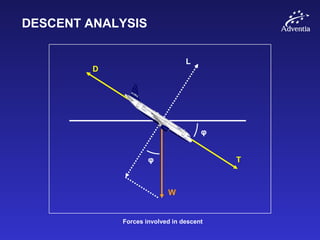
φ
φ
D
T
L
W
Forces involved in descent
DESCENT ANALYSIS
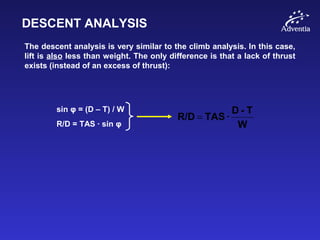
The descent analysis is very similar to the climb analysis. In this case,
lift is also less than weight. The only difference is that a lack of thrust
exists (instead of an excess of thrust):
sin φ = (D – T) / W
R/D = TAS · sin φ W
T-D
·TASR/D =
DESCENT ANALYSIS
TAS
R/D
VR/D MIN
60k T
70k T
80k T
φ
BEST GLIDE ANGLE
Vφ MIN
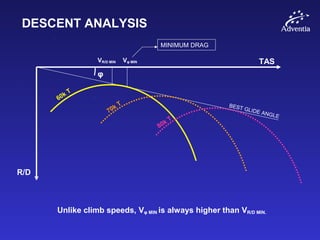
Unlike climb speeds, Vφ MIN is always higher than VR/D MIN.
MINIMUM DRAG
DESCENT ANALYSIS
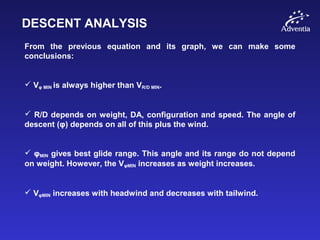
From the previous equation and its graph, we can make some
conclusions:
 Vφ MIN is always higher than VR/D MIN.
 R/D depends on weight, DA, configuration and speed. The angle of
descent (φ) depends on all of this plus the wind.
 φMIN gives best glide range. This angle and its range do not depend
on weight. However, the VφMIN increases as weight increases.
 VφMIN increases with headwind and decreases with tailwind.
DESCENT ANALYSIS
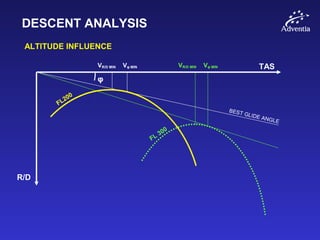
ALTITUDE INFLUENCE
TAS
R/D
VR/D MIN
FL200
FL 300
φ
BEST GLIDE ANGLE
Vφ MIN VR/D MIN Vφ MIN
DESCENT ANALYSIS
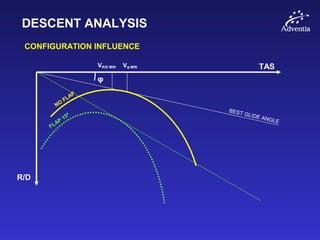
CONFIGURATION INFLUENCE
TAS
R/D
VR/D MIN
NO
FLAP
FLAP
15º
φ
BEST GLIDE ANGLE
Vφ MIN
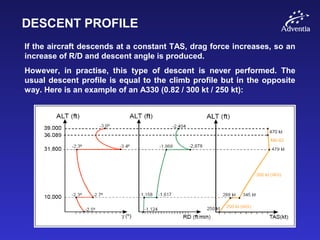
DESCENT PROFILE
If the aircraft descends at a constant TAS, drag force increases, so an
increase of R/D and descent angle is produced.
However, in practise, this type of descent is never performed. The
usual descent profile is equal to the climb profile but in the opposite
way. Here is an example of an A330 (0.82 / 300 kt / 250 kt):
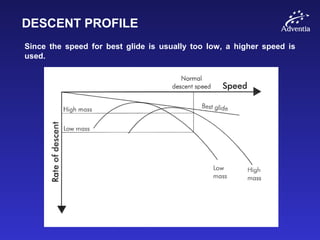
DESCENT PROFILE
Since the speed for best glide is usually too low, a higher speed is
used.
POINT OF DESCENT
Unless otherwise instructed by ATC, the flight crew will determine the
Top Of Descent (POD) for every flight.
TOD location depends on several factors, such as weight, icing
conditions, wind and cabin pressure limitations.
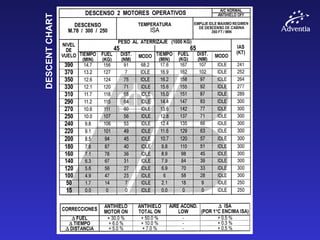
If an accurate determination of TOD location is required, descent
charts must be used. However, to simplify operation and reduce pilot’s
workload, a general rule for jet aircraft exists:
TOD = Flight levels to be descended · 3
Then, gross corrections (based upon experience) have to be made due
to wind, weight and icing.
DESCENTCHART

8. descent

  • 1.
  • 2.
    DESCENT  Descent analysis Descent profile  Top of descend
  • 3.
  • 4.
    DESCENT ANALYSIS The descentanalysis is very similar to the climb analysis. In this case, lift is also less than weight. The only difference is that a lack of thrust exists (instead of an excess of thrust): sin φ = (D – T) / W R/D = TAS · sin φ W T-D ·TASR/D =
  • 5.
    DESCENT ANALYSIS TAS R/D VR/D MIN 60kT 70k T 80k T φ BEST GLIDE ANGLE Vφ MIN Unlike climb speeds, Vφ MIN is always higher than VR/D MIN. MINIMUM DRAG
  • 6.
    DESCENT ANALYSIS From theprevious equation and its graph, we can make some conclusions:  Vφ MIN is always higher than VR/D MIN.  R/D depends on weight, DA, configuration and speed. The angle of descent (φ) depends on all of this plus the wind.  φMIN gives best glide range. This angle and its range do not depend on weight. However, the VφMIN increases as weight increases.  VφMIN increases with headwind and decreases with tailwind.
  • 7.
    DESCENT ANALYSIS ALTITUDE INFLUENCE TAS R/D VR/DMIN FL200 FL 300 φ BEST GLIDE ANGLE Vφ MIN VR/D MIN Vφ MIN
  • 8.
    DESCENT ANALYSIS CONFIGURATION INFLUENCE TAS R/D VR/DMIN NO FLAP FLAP 15º φ BEST GLIDE ANGLE Vφ MIN
  • 9.
    DESCENT PROFILE If theaircraft descends at a constant TAS, drag force increases, so an increase of R/D and descent angle is produced. However, in practise, this type of descent is never performed. The usual descent profile is equal to the climb profile but in the opposite way. Here is an example of an A330 (0.82 / 300 kt / 250 kt):
  • 10.
    DESCENT PROFILE Since thespeed for best glide is usually too low, a higher speed is used.
  • 11.
    POINT OF DESCENT Unlessotherwise instructed by ATC, the flight crew will determine the Top Of Descent (POD) for every flight. TOD location depends on several factors, such as weight, icing conditions, wind and cabin pressure limitations. If an accurate determination of TOD location is required, descent charts must be used. However, to simplify operation and reduce pilot’s workload, a general rule for jet aircraft exists: TOD = Flight levels to be descended · 3 Then, gross corrections (based upon experience) have to be made due to wind, weight and icing.
  • 12.