#DWwebinar
Flexible vs. Rigid
Couplings
#DWwebinar
q  This webinar will be available afterwards at
www.designworldonline.com & email
q  Q&A at the end of the presentation
q  Hashtag for this webinar: #DWwebinar
Before We Start
#DWwebinar
Mike Santora
Associate Editor -
Moderator
Design World
Edward Cole
Engineering Manager
Ringfeder Power
Transmission USA Corp.
Andy Lechner
Product Manager
R+W America
Flexible vs. Rigid Couplings
Bobby Watkins
Vice President of Sales
Ruland Manufacturing Co. Inc.
Meet the speakers…
#DWwebinar
#DWwebinar
PARALLEL	SHAFT	MISALIGNMENT	
• 	results	from	lack	of	pilots	in	moun>ng	frames	/	coupling	housings	
• 	most	harmful	to	bearings	and	couplings	
• 	even	small	amounts	(e.g.,	>0.001”)	can	place	a	large	amount	of	
stress	on	adjacent	shaN	bearings,	contribute	to	vibra>on,	and	reduce	
system	efficiency
#DWwebinar
ANGULAR	SHAFT	MISALIGNMENT	
• 	results	from	moun>ng	surfaces	not	being	flat	or	level	
• 	slightly	less	harmful	to	bearings	and	couplings	
• 	rarely	exists	without	parallel	misalignment
#DWwebinar
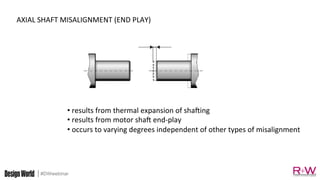
AXIAL	SHAFT	MISALIGNMENT	(END	PLAY)	
• 	results	from	thermal	expansion	of	shaNing	
• 	results	from	motor	shaN	end-play	
• 	occurs	to	varying	degrees	independent	of	other	types	of	misalignment
#DWwebinar
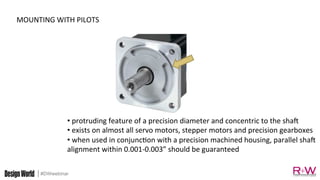
MOUNTING	WITH	PILOTS	
• 	protruding	feature	of	a	precision	diameter	and	concentric	to	the	shaN	
• 	exists	on	almost	all	servo	motors,	stepper	motors	and	precision	gearboxes	
• 	when	used	in	conjunc>on	with	a	precision	machined	housing,	parallel	shaN	
alignment	within	0.001-0.003”	should	be	guaranteed
#DWwebinar
RIGID	COUPLINGS	
• 	disclaimer	–	R+W	does	not	make	rigid	couplings	
• 	very	useful	in	joining	shaNs	which	are	not	both	bearing	supported	
• 	allows	one	shaN	to	support	the	other	
• 	no	misalignment	loading	if	only	one	shaN	is	bearing	supported	
• 	useful	when	one	connected	component	has	a	flexible	frame	
• 	(e.g.,	encoders	with	flexible	mounts)	
• 	allows	that	component	to	flex	during	shaN	rota>on	to			
compensate	for	misalignment	
• 	some>mes	used	to	couple	a	length	of	shaNing	on	each	end	
• 	works	well	when	the	shaN	is	long	enough	to	flex	slightly	
• 	mostly	for	slower	rota>onal	speeds	
• 	oNen	used	in	cases	where	high	precision	rota>on	is	needed	but	then	
require	difficult	alignment	procedures
#DWwebinar
FLEXIBLE	COUPLINGS	
• 	disclaimer	–	R+W	does	make	and	sell	flexible	couplings	
• 	generally	considered	to	be	a	best	prac>ce	between	supported	shaNs	
• 	reduces	side	loads,	which	are	s>ll	high	at	0.001”	misalignment	
• 	helps	extend	bearing	life		
• 	can	help	with	vibra>on	damping	
• 	many	varie>es	and	moun>ng	op>ons	are	available	on	the	market	
• 	torsionally	rigid	versions	
• 	vibra>on	damping	versions	
• 	high	misalignment	versions	
• 	self-suppor>ng	line	shaN	versions
#DWwebinar
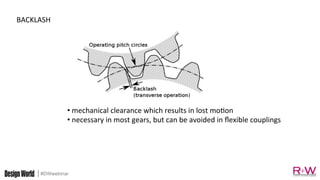
BACKLASH	
• 	mechanical	clearance	which	results	in	lost	mo>on	
• 	necessary	in	most	gears,	but	can	be	avoided	in	flexible	couplings
#DWwebinar
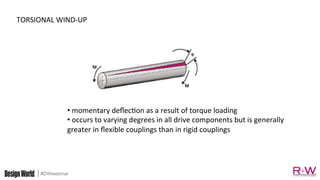
TORSIONAL	WIND-UP	
• 	momentary	deflec>on	as	a	result	of	torque	loading	
• 	occurs	to	varying	degrees	in	all	drive	components	but	is	generally	
greater	in	flexible	couplings	than	in	rigid	couplings
#DWwebinar
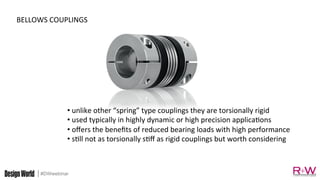
BELLOWS	COUPLINGS	
• 	unlike	other	“spring”	type	couplings	they	are	torsionally	rigid	
• 	used	typically	in	highly	dynamic	or	high	precision	applica>ons	
• 	offers	the	benefits	of	reduced	bearing	loads	with	high	performance	
• 	s>ll	not	as	torsionally	s>ff	as	rigid	couplings	but	worth	considering
#DWwebinar
PRECISION	ELASTOMER	COUPLINGS	
• 	torsionally	soN	for	vibra>on	damping	but	preloaded	for	zero	backlash	
• 	offers	compensa>on	for	small	amounts	of	shaN	misalignment	
• 	high	torque	density	compared	with	other	flexible	coupling	types
#DWwebinar
EXAMPLE:		BALL	SCREW	/	LEAD	SCREW	APPLICATION	
• 	GIVEN:		10Nm	torque	load	/	10mm	lead	
• 	10Nm	bellows	coupling	
• 	torsional	s>ffness	of	157	Nm/deg	=	0.064°	angular	deflec>on	
• 	with	a	10mm	lead	this	results	in	0.0018mm	(0.00007”)linear	error	
• 	10Nm	elastomer	coupling	(standard	insert)	
• 	sta>c	torsional	s>ffness	of	4.54	Nm/deg	=	2.2°	angular	deflec>on	
• 	with	a	10mm	lead	this	results	in	0.0611mm	(0.00241”)	linear	error
#DWwebinar
THANKS	FOR	YOUR	TIME!
Selecting Couplings For
Your Servo Applications
Ed Cole, Engineering Manager
#DWwebinar
Servo Coupling Requirements!
•  Backlash-free to maintain positioning accuracy.
•  Mass balanced for high rotational speeds.
•  Designed for low to moderate torques—usually to 100 Nm.
•  Tolerant of shaft misalignments.
•  Maintenance free.
#DWwebinar
Servo Coupling Applications!
•  Any automation system with shaft-driven linear motion, including:
•  Machine tools.
•  Packaging equipment.
•  Test and measurement systems.
•  Semiconductor manufacturing.
#DWwebinar
Servo Coupling Choices!
•  Two types of servo couplings can meet these requirements:
•  Rigid metal bellows couplings.
•  For example, Ringfeder Gerwah EKN and DKN Series.
•  Flexible servo insert couplings.
•  For example, Ringfeder Gerwah GWE Series.
#DWwebinar
Servo Coupling Choices!
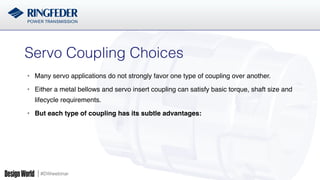
•  Many servo applications do not strongly favor one type of coupling over another.
•  Either a metal bellows and servo insert coupling can satisfy basic torque, shaft size and
lifecycle requirements.
•  But each type of coupling has its subtle advantages:
#DWwebinar
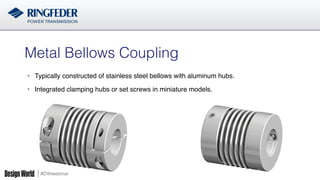
Metal Bellows Coupling!
•  Typically constructed of stainless steel bellows with aluminum hubs.
•  Integrated clamping hubs or set screws in miniature models.
#DWwebinar
Metal Bellows Coupling!
#DWwebinar
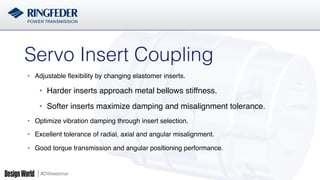
Servo Insert Coupling!
•  Typically	consists	of	aluminum	hubs	and	elastomer	“spider”	inserts.	
•  Clamping	via	set	screws	or	integrated	clamping	hub
#DWwebinar
•  Adjustable flexibility by changing elastomer inserts.
•  Harder inserts approach metal bellows stiffness.
•  Softer inserts maximize damping and misalignment tolerance.
•  Optimize vibration damping through insert selection.
•  Excellent tolerance of radial, axial and angular misalignment.
•  Good torque transmission and angular positioning performance.
Servo Insert Coupling!
#DWwebinar
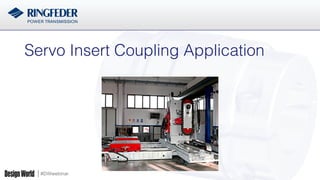
Servo Insert Coupling Application!
#DWwebinar
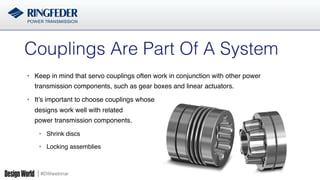
•  Keep in mind that servo couplings often work in conjunction with other power
transmission components, such as gear boxes and linear actuators.
•  It’s important to choose couplings whose 

designs work well with related
power transmission components.
•  Shrink discs
•  Locking assemblies
Couplings Are Part Of A System!
#DWwebinar
Couplings Are Part Of A System!
#DWwebinar
Couplings Are Part Of A System!
#DWwebinar
Metal Bellows Servo Insert
Product Examples! EKN, DKN, AKN Series! GWE Series!
Adjustable Rigidity!
Torque Transmission!
Backlash Free!
Misalignment Tolerance!
Damping!
Low Inertia!
Servo Couplings At A Glance!
Thank You
Ed Cole
Engineering Manager
Tel: (201) 666-3320
Email: edward.cole@ringfeder.com
#DWwebinar Presented	by:	Bobby	Watkins	 www.ruland.com
Flexible vs. Rigid Couplings
Presented	by:	Bobby	Watkins	 www.ruland.com
#DWwebinar Presented	by:	Bobby	Watkins	 www.ruland.com
Types of Misalignment
Presented	by:	Bobby	Watkins	 www.ruland.com
#DWwebinar Presented	by:	Bobby	Watkins	 www.ruland.com
Why is misalignment a concern?
•  Adds	stress	to	system	components	
•  Caused	by	tolerance	mismatch
#DWwebinar Presented	by:	Bobby	Watkins	 www.ruland.com
Backlash, Windup, and Bearing Loads
Coupling	with	Windup	 •  Windup	is	not	backlash	
•  Backlash	refers	to	power	transmission	error	
•  Windup	is	posi>on	error	without	torque	error	
•  All	couplings	have	windup	
•  Zero-backlash	means	zero	loss	in	power	
transmission	
•  Bearing	loads	increase	wear	
•  Excessive	bearing	loads	result	in	bearing	wear	
and	
•  premature	failure	
•  Couplings	designed	to	flex	during	misalignment	
produce	bearing	load	
•  Coupling	misalignment	ra>ngs	oNen	result	from	
bearing	loads	
Coupling	with	Misalignment
#DWwebinar Presented	by:	Bobby	Watkins	 www.ruland.com
Bearing Loads
•  Misalignment	exists	between	
the	motor	and	the	driven	system	
due	to	tolerances	and/or	system	
incompa>bility	
•  Bearing	loads	are	generated	as	a	
result	and	are	harmful	to	system	
performance	
•  Other	system	design	factors	
must	be	considered	when	
selec>ng	a	coupling
#DWwebinar Presented	by:	Bobby	Watkins	 www.ruland.com
Managing Misalignment
•  Selec>on	of	the	correct	coupling	
is	cri>cal	
•  Must	address	the	applica>on	
misalignment	type	or	types	
•  Must	stay	within	the	coupling	
specifica>ons	
•  Must	install	the	coupling	
properly	
•  Other	applica>on	criteria	must	
also	be	addressed
#DWwebinar Presented	by:	Bobby	Watkins	 www.ruland.com
Rigid Couplings
Benefits	
•  Best	torque	transmission	capabili>es	
•  Almost	zero-windup	=	the	most	precise	coupling	
available	
•  Suitable	for	shaN	support	and	push-pull	applica>ons	
•  Low	cost	
Drawbacks	
•  No	misalignment	capabili>es	
•  No	allowance	for	thermal	expansion	
•  Extremely	high	bearing	loads	if	used	incorrectly	
•  Poten>al	for	damage	to	system	components	
•  Very	high	iner>a	-	not	suitable	for	high	RPM	applica>ons
#DWwebinar Presented	by:	Bobby	Watkins	 www.ruland.com
Flexible Couplings
Benefits	
•  Accommodate	misalignment	
•  Different	styles	allow	the	user	to	select	the	best	fit	for	
the	applica>on	
•  High	RPM	capabili>es	
•  Many	standard	size	op>ons	are	available	
•  Most	have	low	iner>a	
Drawbacks	
•  Some	require	maintenance	
•  Installa>on	can	require	specialized	alignment	systems	
•  Limited	torque	capabili>es	
•  Both	shaNs	must	be	bearing	supported	
•  High	cost	
Oldham	Coupling	 Bellows	Coupling	Beam	Coupling	 Jaw	Coupling	 Disc	Coupling
#DWwebinar Presented	by:	Bobby	Watkins	 www.ruland.com
Product SelecFon
•  Mul>ple	solu>ons	may	exist	when	
selec>ng	a	coupling	
•  Specific	couplings	are	beser	suited	
for	each	type	of	misalignment,	for	
example:	oldhams	with	parallel	
misalignment	or	beam	couplings	for	
angular	misalignment	
•  Bearing	loads	and	windup	are	a	side	
effect	of	all	couplings	
•  Proper	coupling	selec>on	requires	a	
full	understanding	of	the	system	
requirements
#DWwebinar
Mike Santora
Associate Editor -
Moderator
Design World
@DW_MikeSantora
Edward Cole
Engineering Manager
Ringfeder Power
Transmission USA Corp.
Edward.cole@ringfeder.com
Andy Lechner
Product Manager
R+W America
Alechner@rw-america.com
Flexible vs. Rigid Couplings
Bobby Watkins
Vice President of Sales
Ruland Manufacturing Co. Inc.
Robert.watkins@ruland.com
Questions?
#DWwebinar
Thank You
q  This webinar will be available at
designworldonline.com & email
q  Tweet with hashtag #DWwebinar
q  Connect with Design World
q  Discuss this on EngineeringExchange.com

Flexibile vs. Rigid Couplings