FLEET MANAGEMENT SYSTEM
Contents
 Definition
 Field Of Application
 Route Planning
 GPS Tracking
 Advantages
Definition
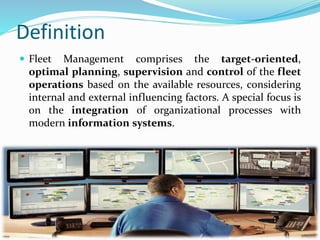
 Fleet Management comprises the target-oriented,
optimal planning, supervision and control of the fleet
operations based on the available resources, considering
internal and external influencing factors. A special focus is
on the integration of organizational processes with
modern information systems.
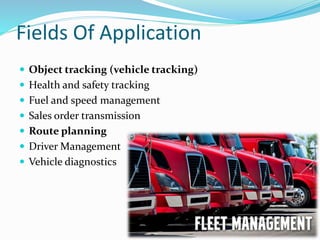
Fields Of Application
 Object tracking (vehicle tracking)
 Health and safety tracking
 Fuel and speed management
 Sales order transmission
 Route planning
 Driver Management
 Vehicle diagnostics
Route Planning
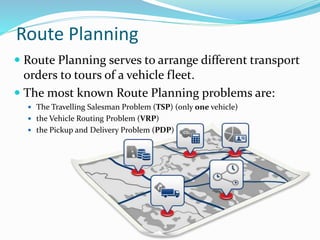
 Route Planning serves to arrange different transport
orders to tours of a vehicle fleet.
 The most known Route Planning problems are:
 The Travelling Salesman Problem (TSP) (only one vehicle)
 the Vehicle Routing Problem (VRP)
 the Pickup and Delivery Problem (PDP)
Travelling Salesman Problem (TSP)
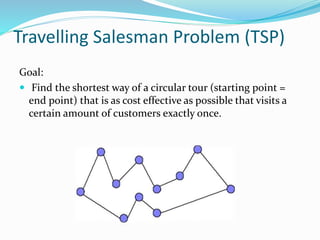
Goal:
 Find the shortest way of a circular tour (starting point =
end point) that is as cost effective as possible that visits a
certain amount of customers exactly once.
Vehicle Routing Problem (VRP)
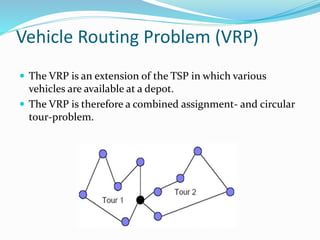
 The VRP is an extension of the TSP in which various
vehicles are available at a depot.
 The VRP is therefore a combined assignment- and circular
tour-problem.
Pickup and Delivery Problem (PDP)
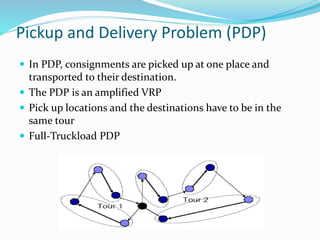
 In PDP, consignments are picked up at one place and
transported to their destination.
 The PDP is an amplified VRP
 Pick up locations and the destinations have to be in the
same tour
 Full-Truckload PDP
Route Planning
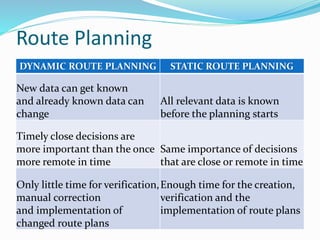
DYNAMIC ROUTE PLANNING STATIC ROUTE PLANNING
New data can get known
and already known data can
change
All relevant data is known
before the planning starts
Timely close decisions are
more important than the once
more remote in time
Same importance of decisions
that are close or remote in time
Only little time for verification,
manual correction
and implementation of
changed route plans
Enough time for the creation,
verification and the
implementation of route plans
Location-Tracking
 Location-tracking helps companies to
 streamline and control supply chains
 move products to the market faster
 monitor assets
 prevent inventory loss
 track vehicle fleets
 Location tracking is not one, single technology.
 Local Area & Indoor Tracking
 RFID: Small, battery-less microchips is attached to consumer
goods, vehicles, objects to track movements.
 Wide Area Tracking
 GPS: Signals received from Satellites to track movements of objects
moving great distances.
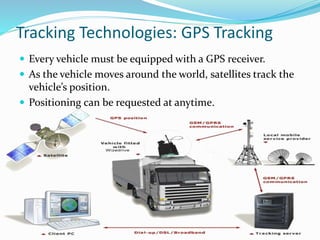
Tracking Technologies: GPS Tracking
 Every vehicle must be equipped with a GPS receiver.
 As the vehicle moves around the world, satellites track the
vehicle’s position.
 Positioning can be requested at anytime.
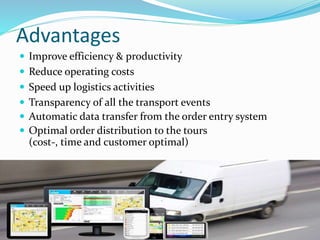
Advantages
 Improve efficiency & productivity
 Reduce operating costs
 Speed up logistics activities
 Transparency of all the transport events
 Automatic data transfer from the order entry system
 Optimal order distribution to the tours
(cost-, time and customer optimal)
Fleet management system

Fleet management system

  • 1.
  • 2.
    Contents  Definition  FieldOf Application  Route Planning  GPS Tracking  Advantages
  • 3.
    Definition  Fleet Managementcomprises the target-oriented, optimal planning, supervision and control of the fleet operations based on the available resources, considering internal and external influencing factors. A special focus is on the integration of organizational processes with modern information systems.
  • 4.
    Fields Of Application Object tracking (vehicle tracking)  Health and safety tracking  Fuel and speed management  Sales order transmission  Route planning  Driver Management  Vehicle diagnostics
  • 5.
    Route Planning  RoutePlanning serves to arrange different transport orders to tours of a vehicle fleet.  The most known Route Planning problems are:  The Travelling Salesman Problem (TSP) (only one vehicle)  the Vehicle Routing Problem (VRP)  the Pickup and Delivery Problem (PDP)
  • 6.
    Travelling Salesman Problem(TSP) Goal:  Find the shortest way of a circular tour (starting point = end point) that is as cost effective as possible that visits a certain amount of customers exactly once.
  • 7.
    Vehicle Routing Problem(VRP)  The VRP is an extension of the TSP in which various vehicles are available at a depot.  The VRP is therefore a combined assignment- and circular tour-problem.
  • 8.
    Pickup and DeliveryProblem (PDP)  In PDP, consignments are picked up at one place and transported to their destination.  The PDP is an amplified VRP  Pick up locations and the destinations have to be in the same tour  Full-Truckload PDP
  • 9.
    Route Planning DYNAMIC ROUTEPLANNING STATIC ROUTE PLANNING New data can get known and already known data can change All relevant data is known before the planning starts Timely close decisions are more important than the once more remote in time Same importance of decisions that are close or remote in time Only little time for verification, manual correction and implementation of changed route plans Enough time for the creation, verification and the implementation of route plans
  • 10.
    Location-Tracking  Location-tracking helpscompanies to  streamline and control supply chains  move products to the market faster  monitor assets  prevent inventory loss  track vehicle fleets  Location tracking is not one, single technology.  Local Area & Indoor Tracking  RFID: Small, battery-less microchips is attached to consumer goods, vehicles, objects to track movements.  Wide Area Tracking  GPS: Signals received from Satellites to track movements of objects moving great distances.
  • 11.
    Tracking Technologies: GPSTracking  Every vehicle must be equipped with a GPS receiver.  As the vehicle moves around the world, satellites track the vehicle’s position.  Positioning can be requested at anytime.
  • 12.
    Advantages  Improve efficiency& productivity  Reduce operating costs  Speed up logistics activities  Transparency of all the transport events  Automatic data transfer from the order entry system  Optimal order distribution to the tours (cost-, time and customer optimal)

Editor's Notes

  • #9 Plus the pick up location has to be visited before the destination Full-Truckload PDP: When using Full-Truckload PDP it is necessary to drive after the loading of a consignment directly to the destination because no more consignments can be loaded. The pickup place & the destination are combined.