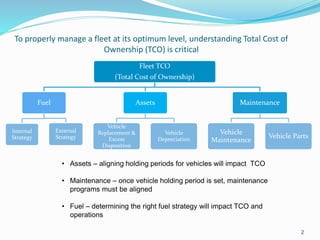
To properly manage a fleet at its optimum level, understanding Total Cost of
Ownership (TCO) is critical
2
Fleet TCO
(Total Cost of Ownership)
Fuel
Internal
Strategy
External
Strategy
Assets
Vehicle
Replacement &
Excess
Disposition
Vehicle
Depreciation
Maintenance
Vehicle
Maintenance
Vehicle Parts
• Assets – aligning holding periods for vehicles will impact TCO
• Maintenance – once vehicle holding period is set, maintenance
programs must be aligned
• Fuel – determining the right fuel strategy will impact TCO and
operations
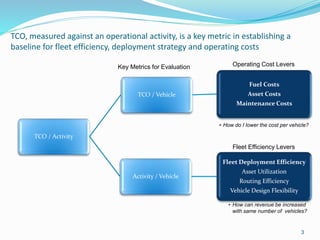
TCO, measured against an operational activity, is a key metric in establishing a
baseline for fleet efficiency, deployment strategy and operating costs
TCO / Activity
TCO / Vehicle
Fuel Costs
Asset Costs
Maintenance Costs
Activity / Vehicle
Fleet Deployment Efficiency
Asset Utilization
Routing Efficiency
Vehicle Design Flexibility
3
Fleet Efficiency Levers
Key Metrics for Evaluation
• How can revenue be increased
with same number of vehicles?
• How do I lower the cost per vehicle?
Operating Cost Levers
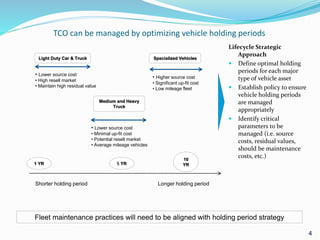
TCO can be managed by optimizing vehicle holding periods
Lifecycle Strategic
Approach
 Define optimal holding
periods for each major
type of vehicle asset
 Establish policy to ensure
vehicle holding periods
are managed
appropriately
 Identify critical
parameters to be
managed (i.e. source
costs, residual values,
should be maintenance
costs, etc.)
4
Fleet maintenance practices will need to be aligned with holding period strategy
Longer holding period
Light Duty Car & Truck Specialized Vehicles
• Higher source cost
• Significant up-fit cost
• Low mileage fleet
• Lower source cost
• High resell market
• Maintain high residual value
Shorter holding period
1 YR
10
YR5 YR
Medium and Heavy
Truck
• Lower source cost
• Minimal up-fit cost
• Potential resell market
• Average mileage vehicles
5
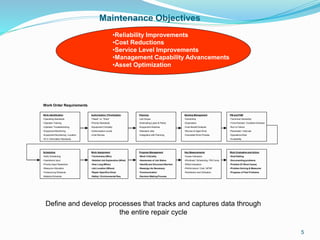
•Reliability Improvements
•Cost Reductions
•Service Level Improvements
•Management Capability Advancements
•Asset Optimization
PM and PdM
•Technical Ownership
•Time Directed / Condition Directed
•Run to Failure
•Parameter / Intervals
•Operations Role
•Availability
Work Identification
•Operating Standards
•Operator Training
•Operator Troubleshooting
•Equipment Monitoring
•Equipment Numbering / Location
•W.0. Information Standards
Authorization / Prioritization
•“Need” vs. “Want”
•Priority Standards
•Equipment Criticality
•Authorization Levels
•Cost Review
Planning
•Job Scope
•Estimating (Labor & Parts)
•Equipment Histories
•Standard Jobs
•Integration with Planning
Backlog Management
•Ownership
•Duplication
•Cost Benefit Analysis
•Review of Aged Work
•Cancelled Work Process
Scheduling
•Daily Scheduling
•Operations Input
•Priority Issue Resolution
•Resource Allocation
•Outsourcing Schedule
•Material Schedule
Work Assignment
•Technicians (Who)
•Detailed Job Explanation (What)
•How Long (When)
•Job Location (Where)
•Repair Specifics (How)
•Safety / Environmental Req
Progress Management
•Work Criticality
•Awareness of Job Status
•Identify and Document Barriers
•Reassign As Necessary
•Communication
•Decision Making Process
Work Evaluation and Action
•Goal Setting
•Documenting problems
•Problem ID (Root Cause)
•Problem Solving & Measures
•Progress of Past Problems
Key Measurements
•Cause Indicators
•Workload / Scheduling / PM Comp
•Effect Indicators
•Performance / Cost / MTBF
•Distribution and Utilization
Maintenance Objectives
Work Order Requirements
Define and develop processes that tracks and captures data through
the entire repair cycle
6
•Reliability Improvements
•Cost Reductions
•Service Level Improvements
•Management Capability Advancements
•Asset Optimization
Progress Management
Work Evaluation and Action
Key Measurements PM and PdM
Backlog ManagementWork Identification Authorization / Prioritization Planning
Scheduling Work Assignment
Work Order Requirements
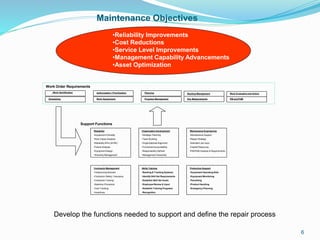
Reliability
•Equipment Criticality
•Root Cause Analysis
•Reliability KPIs (MTBF)
•Failure Analysis
•Equipment Design
•Warranty Management
Organization Development
•Strategic Planning
•Team Building
•Organizational Alignment
•Functional Accountability
•Responsibility Defined
•Management Ownership
Maintenance Engineering
•Maintenance Support
•Repair Strategy
•Standard Job Input
•Capital Resources
•PM/PDM Analysis & Requirements
Contractor Management
•Outsourcing Decision
•Contractor Safety / Insurance
•Contractor Training
•Selection Procedure
•Cost Tracking
•Incentives
Skills Training
•Ranking & Tracking Systems
•Identify Skill Set Requirements
•Establish Skill Set Goals
•Employee Review & Input
•Establish Training Programs
•Recognition
Production Support
•Equipment Operating Stds
•Equipment Monitoring
•Permitting
•Product Handling
•Emergency Planning
Support Functions
Maintenance Objectives
Develop the functions needed to support and define the repair process
7
•Reliability Improvements
•Cost Reductions
•Service Level Improvements
•Management Capability Advancements
•Asset Optimization
Progress Management
Work Evaluation and Action
Key Measurements PM and PdM
Backlog ManagementWork Identification Authorization / Prioritization Planning
Scheduling Work Assignment
Core Elements
Reliability Organization Development Maintenance Engineering
Skills TrainingContractor Management Production Support
Support Functions
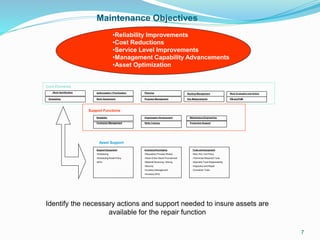
Support Equipment
•Scheduling
•Scheduling Break Policy
•KPIs
Inventory/Purchasing
•Requisition Process (Roles)
•Stock & Non-Stock Procurement
•Material Receiving / Storing
•Security
•Inventory Management
•Inventory KPIs
Tools and Equipment
•New Hire Tool Policy
•Technician Required Tools
•Specialty Tools Responsibility
•Inspection and Repair
•Contractor Tools
Asset Support
Maintenance Objectives
Identify the necessary actions and support needed to insure assets are
available for the repair function
8
•Reliability Improvements
•Cost Reductions
•Service Level Improvements
•Management Capability Advancements
•Asset Optimization
Progress Management
Work Evaluation and Action
Key Measurements PM and PdM
Backlog ManagementWork Identification Authorization / Prioritization Planning
Scheduling Work Assignment
Core Elements
Reliability Organization Development Maintenance Engineering
Skills TrainingContractor Management Production Support
Support Functions
Support Equipment Inventory/Purchasing Tools and Equipment
Asset Support
Unscheduled Work
•Troubleshooting
•Labor and Equipment Req.
•Labor and Equipment Avail.
•Technical Support
•Present Maintenance Schedule
•Communication
Other
•Communication / Cooperation
•Inaccurate Inventory
•Pilfering and/or Theft
•Inadequate Materials Inspection
•Equipment Availability
•Budget
Constraints
Maintenance Objectives
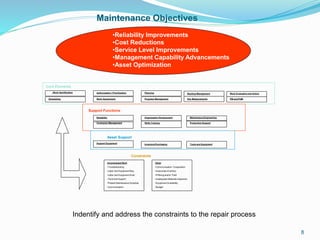
Indentify and address the constraints to the repair process
9
•Reliability Improvements
•Cost Reductions
•Service Level Improvements
•Management Capability Advancements
•Asset Optimization
Progress Management
Work Evaluation and Action
Key Measurements PM and PdM
Backlog ManagementWork Identification Authorization / Prioritization Planning
Scheduling Work Assignment
Core Elements
Reliability Organization Development Maintenance Engineering
Skills TrainingContractor Management Production Support
Support Functions
Support Equipment Inventory/Purchasing Tools and Equipment
Asset Support
Other
Constraints
Maintenance Management System
•Holder of Maintenance Process
•Accessibility and Table of Authorities
•Compatible with Other Business Systems
•Cost Tracking to Specific Equipment
•Labor
•Parts / Materials
•Equipment & Repair Histories
•Planning, Procurement, Scheduling &
Executive Interface
•KPI Development & Generation
Unscheduled Work
Maintenance Objectives
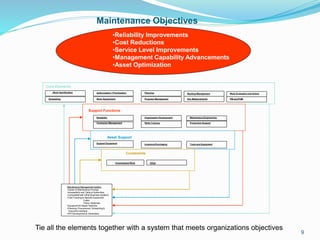
Tie all the elements together with a system that meets organizations objectives
CostperHourorMile
0
200
400
600
800
1000
1200
1400
1600
0 10 20 30 40 50 60 70 80 90
Ideal PM Interval
Accumulated Time or Miles
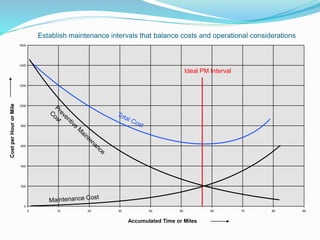
Establish maintenance intervals that balance costs and operational considerations
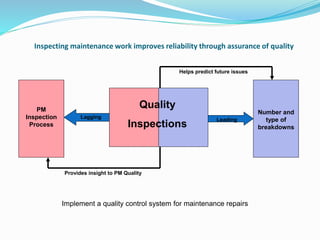
Inspecting maintenance work improves reliability through assurance of quality
Quality
Inspections
Lagging
Leading
PM
Inspection
Process
Number and
type of
breakdowns
Provides insight to PM Quality
Helps predict future issues
Implement a quality control system for maintenance repairs
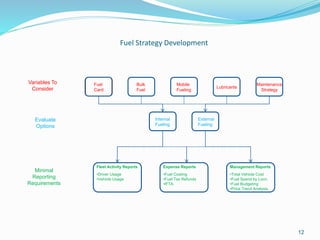
Fuel Strategy Development
12
Fuel
Card
Bulk
Fuel
Mobile
Fueling
Lubricants
Maintenance
Strategy
Internal
Fueling
External
Fueling
Fleet Activity Reports
•Driver Usage
•Vehicle Usage
Expense Reports
•Fuel Costing
•Fuel Tax Refunds
•IFTA
Management Reports
•Total Vehicle Cost
•Fuel Spend by Locn.
•Fuel Budgeting
•Price Trend Analysis
Variables To
Consider
Evaluate
Options
Minimal
Reporting
Requirements
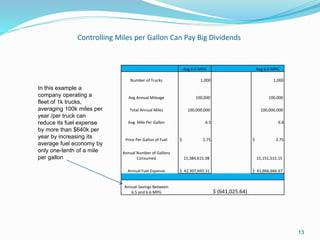
Controlling Miles per Gallon Can Pay Big Dividends
13
In this example a
company operating a
fleet of 1k trucks,
averaging 100k miles per
year /per truck can
reduce its fuel expense
by more than $640k per
year by increasing its
average fuel economy by
only one-tenth of a mile
per gallon
Avg 6.5 MPG Avg 6.6 MPG
Number of Trucks 1,000 1,000
Avg Annual Mileage 100,000 100,000
Total Annual Miles 100,000,000 100,000,000
Avg. Mile Per Gallon 6.5 6.6
Price Per Gallon of Fuel $ 2.75 $ 2.75
Annual Number of Gallons
Consumed 15,384,615.38 15,151,515.15
Annual Fuel Expense $ 42,307,692.31 $ 41,666,666.67
Annual Savings Between
6.5 and 6.6 MPG $ (641,025.64)
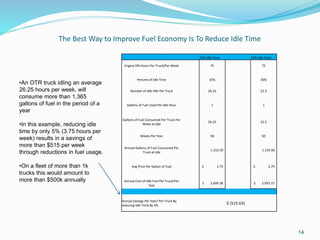
The Best Way to Improve Fuel Economy Is To Reduce Idle Time
14
35% Idle Time 30% Idle Time
Engine ON Hours Per Truck/Per Week 75 75
Percent of Idle Time 35% 30%
Number of Idle HRs Per Truck 26.25 22.5
Gallons of Fuel Used Per Idle Hour 1 1
Gallons of Fuel Consumed Per Truck Per
Week at Idle
26.25 22.5
Weeks Per Year 50 50
Annual Gallons of Fuel Consumed Per
Truck at Idle
1,312.50 1,125.00
Avg Price Per Gallon of Fuel $ 2.75 $ 2.75
Annual Cost of Idle Fuel Per Truck/Per
Year
$ 3,609.38 $ 3,093.75
Annual Savings Per Year/ Per Truck By
reducing Idle Time By 5%
$ (515.63)
•An OTR truck idling an average
26.25 hours per week, will
consume more than 1,365
gallons of fuel in the period of a
year
•In this example, reducing idle
time by only 5% (3.75 hours per
week) results in a savings of
more than $515 per week
through reductions in fuel usage.
•On a fleet of more than 1k
trucks this would amount to
more than $500k annually
For more information contact
James L Cade at 901-651-0157
15

Fleet Management Basics

  • 2.
    To properly managea fleet at its optimum level, understanding Total Cost of Ownership (TCO) is critical 2 Fleet TCO (Total Cost of Ownership) Fuel Internal Strategy External Strategy Assets Vehicle Replacement & Excess Disposition Vehicle Depreciation Maintenance Vehicle Maintenance Vehicle Parts • Assets – aligning holding periods for vehicles will impact TCO • Maintenance – once vehicle holding period is set, maintenance programs must be aligned • Fuel – determining the right fuel strategy will impact TCO and operations
  • 3.
    TCO, measured againstan operational activity, is a key metric in establishing a baseline for fleet efficiency, deployment strategy and operating costs TCO / Activity TCO / Vehicle Fuel Costs Asset Costs Maintenance Costs Activity / Vehicle Fleet Deployment Efficiency Asset Utilization Routing Efficiency Vehicle Design Flexibility 3 Fleet Efficiency Levers Key Metrics for Evaluation • How can revenue be increased with same number of vehicles? • How do I lower the cost per vehicle? Operating Cost Levers
  • 4.
    TCO can bemanaged by optimizing vehicle holding periods Lifecycle Strategic Approach  Define optimal holding periods for each major type of vehicle asset  Establish policy to ensure vehicle holding periods are managed appropriately  Identify critical parameters to be managed (i.e. source costs, residual values, should be maintenance costs, etc.) 4 Fleet maintenance practices will need to be aligned with holding period strategy Longer holding period Light Duty Car & Truck Specialized Vehicles • Higher source cost • Significant up-fit cost • Low mileage fleet • Lower source cost • High resell market • Maintain high residual value Shorter holding period 1 YR 10 YR5 YR Medium and Heavy Truck • Lower source cost • Minimal up-fit cost • Potential resell market • Average mileage vehicles
  • 5.
    5 •Reliability Improvements •Cost Reductions •ServiceLevel Improvements •Management Capability Advancements •Asset Optimization PM and PdM •Technical Ownership •Time Directed / Condition Directed •Run to Failure •Parameter / Intervals •Operations Role •Availability Work Identification •Operating Standards •Operator Training •Operator Troubleshooting •Equipment Monitoring •Equipment Numbering / Location •W.0. Information Standards Authorization / Prioritization •“Need” vs. “Want” •Priority Standards •Equipment Criticality •Authorization Levels •Cost Review Planning •Job Scope •Estimating (Labor & Parts) •Equipment Histories •Standard Jobs •Integration with Planning Backlog Management •Ownership •Duplication •Cost Benefit Analysis •Review of Aged Work •Cancelled Work Process Scheduling •Daily Scheduling •Operations Input •Priority Issue Resolution •Resource Allocation •Outsourcing Schedule •Material Schedule Work Assignment •Technicians (Who) •Detailed Job Explanation (What) •How Long (When) •Job Location (Where) •Repair Specifics (How) •Safety / Environmental Req Progress Management •Work Criticality •Awareness of Job Status •Identify and Document Barriers •Reassign As Necessary •Communication •Decision Making Process Work Evaluation and Action •Goal Setting •Documenting problems •Problem ID (Root Cause) •Problem Solving & Measures •Progress of Past Problems Key Measurements •Cause Indicators •Workload / Scheduling / PM Comp •Effect Indicators •Performance / Cost / MTBF •Distribution and Utilization Maintenance Objectives Work Order Requirements Define and develop processes that tracks and captures data through the entire repair cycle
  • 6.
    6 •Reliability Improvements •Cost Reductions •ServiceLevel Improvements •Management Capability Advancements •Asset Optimization Progress Management Work Evaluation and Action Key Measurements PM and PdM Backlog ManagementWork Identification Authorization / Prioritization Planning Scheduling Work Assignment Work Order Requirements Reliability •Equipment Criticality •Root Cause Analysis •Reliability KPIs (MTBF) •Failure Analysis •Equipment Design •Warranty Management Organization Development •Strategic Planning •Team Building •Organizational Alignment •Functional Accountability •Responsibility Defined •Management Ownership Maintenance Engineering •Maintenance Support •Repair Strategy •Standard Job Input •Capital Resources •PM/PDM Analysis & Requirements Contractor Management •Outsourcing Decision •Contractor Safety / Insurance •Contractor Training •Selection Procedure •Cost Tracking •Incentives Skills Training •Ranking & Tracking Systems •Identify Skill Set Requirements •Establish Skill Set Goals •Employee Review & Input •Establish Training Programs •Recognition Production Support •Equipment Operating Stds •Equipment Monitoring •Permitting •Product Handling •Emergency Planning Support Functions Maintenance Objectives Develop the functions needed to support and define the repair process
  • 7.
    7 •Reliability Improvements •Cost Reductions •ServiceLevel Improvements •Management Capability Advancements •Asset Optimization Progress Management Work Evaluation and Action Key Measurements PM and PdM Backlog ManagementWork Identification Authorization / Prioritization Planning Scheduling Work Assignment Core Elements Reliability Organization Development Maintenance Engineering Skills TrainingContractor Management Production Support Support Functions Support Equipment •Scheduling •Scheduling Break Policy •KPIs Inventory/Purchasing •Requisition Process (Roles) •Stock & Non-Stock Procurement •Material Receiving / Storing •Security •Inventory Management •Inventory KPIs Tools and Equipment •New Hire Tool Policy •Technician Required Tools •Specialty Tools Responsibility •Inspection and Repair •Contractor Tools Asset Support Maintenance Objectives Identify the necessary actions and support needed to insure assets are available for the repair function
  • 8.
    8 •Reliability Improvements •Cost Reductions •ServiceLevel Improvements •Management Capability Advancements •Asset Optimization Progress Management Work Evaluation and Action Key Measurements PM and PdM Backlog ManagementWork Identification Authorization / Prioritization Planning Scheduling Work Assignment Core Elements Reliability Organization Development Maintenance Engineering Skills TrainingContractor Management Production Support Support Functions Support Equipment Inventory/Purchasing Tools and Equipment Asset Support Unscheduled Work •Troubleshooting •Labor and Equipment Req. •Labor and Equipment Avail. •Technical Support •Present Maintenance Schedule •Communication Other •Communication / Cooperation •Inaccurate Inventory •Pilfering and/or Theft •Inadequate Materials Inspection •Equipment Availability •Budget Constraints Maintenance Objectives Indentify and address the constraints to the repair process
  • 9.
    9 •Reliability Improvements •Cost Reductions •ServiceLevel Improvements •Management Capability Advancements •Asset Optimization Progress Management Work Evaluation and Action Key Measurements PM and PdM Backlog ManagementWork Identification Authorization / Prioritization Planning Scheduling Work Assignment Core Elements Reliability Organization Development Maintenance Engineering Skills TrainingContractor Management Production Support Support Functions Support Equipment Inventory/Purchasing Tools and Equipment Asset Support Other Constraints Maintenance Management System •Holder of Maintenance Process •Accessibility and Table of Authorities •Compatible with Other Business Systems •Cost Tracking to Specific Equipment •Labor •Parts / Materials •Equipment & Repair Histories •Planning, Procurement, Scheduling & Executive Interface •KPI Development & Generation Unscheduled Work Maintenance Objectives Tie all the elements together with a system that meets organizations objectives
  • 10.
    CostperHourorMile 0 200 400 600 800 1000 1200 1400 1600 0 10 2030 40 50 60 70 80 90 Ideal PM Interval Accumulated Time or Miles Establish maintenance intervals that balance costs and operational considerations
  • 11.
    Inspecting maintenance workimproves reliability through assurance of quality Quality Inspections Lagging Leading PM Inspection Process Number and type of breakdowns Provides insight to PM Quality Helps predict future issues Implement a quality control system for maintenance repairs
  • 12.
    Fuel Strategy Development 12 Fuel Card Bulk Fuel Mobile Fueling Lubricants Maintenance Strategy Internal Fueling External Fueling FleetActivity Reports •Driver Usage •Vehicle Usage Expense Reports •Fuel Costing •Fuel Tax Refunds •IFTA Management Reports •Total Vehicle Cost •Fuel Spend by Locn. •Fuel Budgeting •Price Trend Analysis Variables To Consider Evaluate Options Minimal Reporting Requirements
  • 13.
    Controlling Miles perGallon Can Pay Big Dividends 13 In this example a company operating a fleet of 1k trucks, averaging 100k miles per year /per truck can reduce its fuel expense by more than $640k per year by increasing its average fuel economy by only one-tenth of a mile per gallon Avg 6.5 MPG Avg 6.6 MPG Number of Trucks 1,000 1,000 Avg Annual Mileage 100,000 100,000 Total Annual Miles 100,000,000 100,000,000 Avg. Mile Per Gallon 6.5 6.6 Price Per Gallon of Fuel $ 2.75 $ 2.75 Annual Number of Gallons Consumed 15,384,615.38 15,151,515.15 Annual Fuel Expense $ 42,307,692.31 $ 41,666,666.67 Annual Savings Between 6.5 and 6.6 MPG $ (641,025.64)
  • 14.
    The Best Wayto Improve Fuel Economy Is To Reduce Idle Time 14 35% Idle Time 30% Idle Time Engine ON Hours Per Truck/Per Week 75 75 Percent of Idle Time 35% 30% Number of Idle HRs Per Truck 26.25 22.5 Gallons of Fuel Used Per Idle Hour 1 1 Gallons of Fuel Consumed Per Truck Per Week at Idle 26.25 22.5 Weeks Per Year 50 50 Annual Gallons of Fuel Consumed Per Truck at Idle 1,312.50 1,125.00 Avg Price Per Gallon of Fuel $ 2.75 $ 2.75 Annual Cost of Idle Fuel Per Truck/Per Year $ 3,609.38 $ 3,093.75 Annual Savings Per Year/ Per Truck By reducing Idle Time By 5% $ (515.63) •An OTR truck idling an average 26.25 hours per week, will consume more than 1,365 gallons of fuel in the period of a year •In this example, reducing idle time by only 5% (3.75 hours per week) results in a savings of more than $515 per week through reductions in fuel usage. •On a fleet of more than 1k trucks this would amount to more than $500k annually
  • 15.
    For more informationcontact James L Cade at 901-651-0157 15