SUPPLY CHAIN
A FUTURE APPROACH…….


          Zubin Poonawalla
     CEO – GreenLogiNXT Pvt Ltd


                    Copyright © 2011. All Rights Reserved
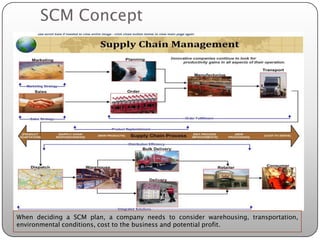
SCM Concept


When deciding a SCM plan, a company needs to consider warehousing, transportation,
environmental conditions, cost to the business and potential profit.
Key Factors For Success

 Route & vehicle Optimization
 Customer service
 Inventory management
 Transportation
 Warehousing
 Technology
 Packaging
 Logistics providers
Demand driven Value Network
 Integrative Improvement System - can be defined
  as a standard system that simultaneously and
  interdependently drives operational improvement
  across all functions and processes
 Three key structural components
   Maturity- and process-based transformation
   Functional integration
   Sustainability through a three-tier system
Integrative Improvement System
 Maturity- and process-based transformation
Transferring process improvement ownership from
  technical experts to front-line teams requires
  structural reorganization around lateral processes.
 Functional integration
   The integrative approach is an organization primarily
  designed around processes, products, and
  customers, not functions.
 Sustainability through a three-tier system
   Sustainable improvement does not result from the
  mere application of improvement tools and processes
  for example Lean, Six Sigma, autonomous
  maintenance, one point lessons etc. Sustainable
  change requires a three-tier system – management
  principles, operating systems, and tools
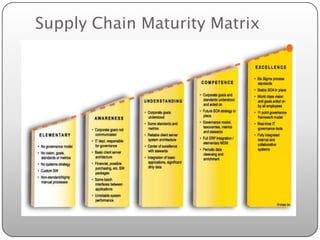
Supply Chain Maturity Matrix
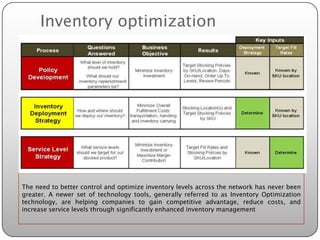
Inventory optimization


The need to better control and optimize inventory levels across the network has never been
greater. A newer set of technology tools, generally referred to as Inventory Optimization
technology, are helping companies to gain competitive advantage, reduce costs, and
increase service levels through significantly enhanced inventory management
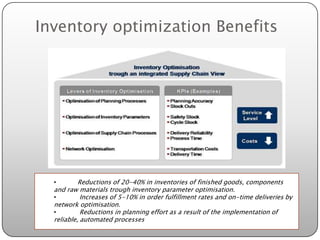
Inventory optimization Benefits


  •        Reductions of 20-40% in inventories of finished goods, components
  and raw materials trough inventory parameter optimisation.
  •         Increases of 5-10% in order fulfillment rates and on-time deliveries by
  network optimisation.
  •         Reductions in planning effort as a result of the implementation of
  reliable, automated processes
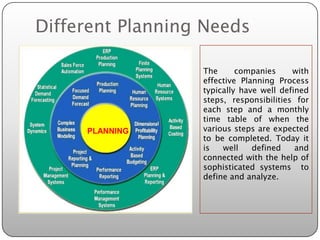
Different Planning Needs

                  The      companies     with
                  effective Planning Process
                  typically have well defined
                  steps, responsibilities for
                  each step and a monthly
                  time table of when the
     PLANNING     various steps are expected
                  to be completed. Today it
                  is   well    defined    and
                  connected with the help of
                  sophisticated systems to
                  define and analyze.
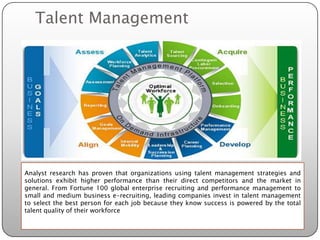
Talent Management


Analyst research has proven that organizations using talent management strategies and
solutions exhibit higher performance than their direct competitors and the market in
general. From Fortune 100 global enterprise recruiting and performance management to
small and medium business e-recruiting, leading companies invest in talent management
to select the best person for each job because they know success is powered by the total
talent quality of their workforce
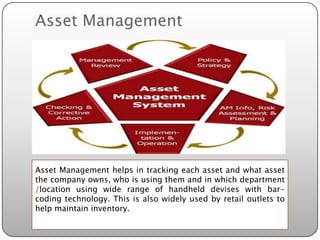
Asset Management


Asset Management helps in tracking each asset and what asset
the company owns, who is using them and in which department
/location using wide range of handheld devises with bar-
coding technology. This is also widely used by retail outlets to
help maintain inventory.
Principles Of Asset Management
 Set a vision for how your utility will manage assets in
    the future;
   Understand best practices, to apply and to attain the
    vision;
   Define achievable strategies, projects and measures
    to guide you from where you are now to where you
    want to be in the future;
   Determine what business processes and technologies
    will be affected by adopting best practices;
   Optimize your organization for high efficiency.
   Identify how information systems can support your
    strategies and goals.
   Prioritize and sequence projects required to attain
    your program
Technology & Logistics
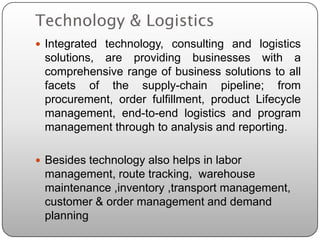
 Integrated technology, consulting and logistics
 solutions, are providing businesses with a
 comprehensive range of business solutions to all
 facets of the supply-chain pipeline; from
 procurement, order fulfillment, product Lifecycle
 management, end-to-end logistics and program
 management through to analysis and reporting.

 Besides technology also helps in labor
 management, route tracking, warehouse
 maintenance ,inventory ,transport management,
 customer & order management and demand
 planning
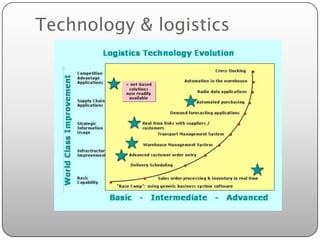
Technology & logistics
Technology & Route
Optimization
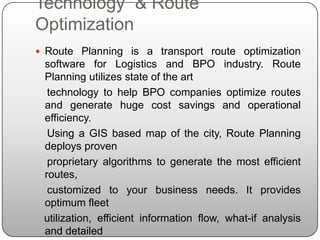
 Route Planning is a transport route optimization
 software for Logistics and BPO industry. Route
 Planning utilizes state of the art
  technology to help BPO companies optimize routes
 and generate huge cost savings and operational
 efficiency.
  Using a GIS based map of the city, Route Planning
 deploys proven
  proprietary algorithms to generate the most efficient
 routes,
  customized to your business needs. It provides
 optimum fleet
 utilization, efficient information flow, what-if analysis
 and detailed
Packaging & technology
   Despite a global recession, emphasis is on innovation in design, choice of
    materials, processing, and life cycle logistics.
   The future of packaging is in sustainability.
   Environmentally conscious decisions are being prevalent today and more and more
    importance given to it being environmentally friendly.
   Walmart continues to be on the forefront of sustainable packaging in the retail
    arena. Although the retail giant has achieved many of its environmental goals such
    as plastic bag reduction, it continues to be unable to eliminate PVC from private-
    label packaging. As sustainable packaging evolves, Walmart will continue to strive in
    achieving its PVC elimination goals.
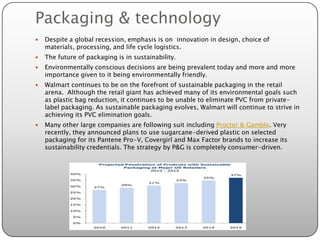
   Many other large companies are following suit including Proctor & Gamble. Very
    recently, they announced plans to use sugarcane-derived plastic on selected
    packaging for its Pantene Pro-V, Covergirl and Max Factor brands to increase its
    sustainability credentials. The strategy by P&G is completely consumer-driven.
Transportation
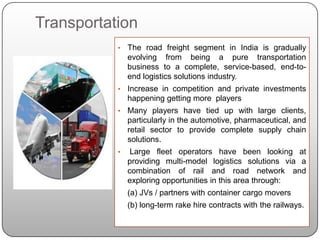
           •   The road freight segment in India is gradually
               evolving from being a pure transportation
               business to a complete, service-based, end-to-
               end logistics solutions industry.
           •   Increase in competition and private investments
               happening getting more players
           •   Many players have tied up with large clients,
               particularly in the automotive, pharmaceutical, and
               retail sector to provide complete supply chain
               solutions.
           •    Large fleet operators have been looking at
               providing multi-model logistics solutions via a
               combination of rail and road network and
               exploring opportunities in this area through:
               (a) JVs / partners with container cargo movers
               (b) long-term rake hire contracts with the railways.
Transportation - Shipping


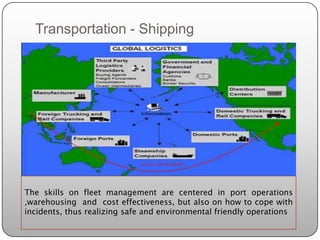
The skills on fleet management are centered in port operations
,warehousing and cost effectiveness, but also on how to cope with
incidents, thus realizing safe and environmental friendly operations
Transportation - Air
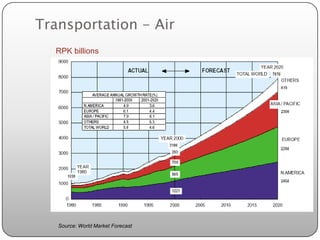
  RPK billions


   Source: World Market Forecast
Transportation - Railways
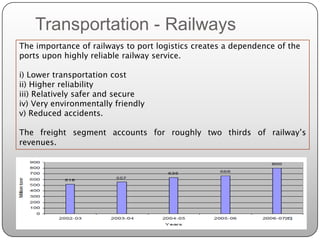
The importance of railways to port logistics creates a dependence of the
ports upon highly reliable railway service.

i) Lower transportation cost
ii) Higher reliability
iii) Relatively safer and secure
iv) Very environmentally friendly
v) Reduced accidents.

The freight segment accounts for roughly two thirds of railway’s
revenues.
Transportation -Emerging concepts

The Companies in logistics for procurement, manufacturing, and sales,
aiming to reduce CO2 emissions and costs. For example, the monthly
transportation volume of products and parts from China to Japan is
enough to fill 400 40-foot containers. To the Americas and Europe,
products and parts of a volume equivalent to 1,000 40-foot containers
are shipped from China each month. Given these volumes, efficiency
improvement in logistics is an important issue in promoting business
on a global scale.


Importance is now given to cargo carrying efficiency through reviewing
packaging materials and mixed packing, modal shifts among
warehouses, direct deliveries to customers, and by optimizing
transportation routes through the introduction of the milk run system.
The   aim is     to reduce wastage related to packaging materials,
transportation, space, trans-shipment, and storage.
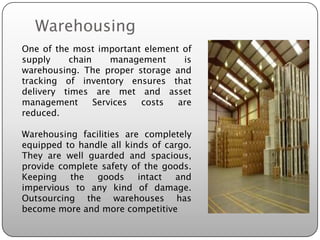
Warehousing
One of the most important element of
supply    chain     management    is
warehousing. The proper storage and
tracking of inventory ensures that
delivery times are met and asset
management      Services costs   are
reduced.

Warehousing facilities are completely
equipped to handle all kinds of cargo.
They are well guarded and spacious,
provide complete safety of the goods.
Keeping   the   goods     intact  and
impervious to any kind of damage.
Outsourcing the warehouses has
become more and more competitive
Warehouse Management
 The selection of location of ware house has long term
  repercussions in reducing the operating cost and smooth
  running of operations
 The store layout are easy movement of material, good
  housekeeping, sufficient space for men and material
  handling equipment, and optimum utilization of available
  storage space.
 Depending upon the type of material to be stored in the
  warehouse, number of people involved in the handling
  operation, design the infrastructure and facilities of
  warehouse.
 Today letting out warehouses are building one has
  become lucrative business
SCM Future
 Segment customers based on the service needs
 Analysis can be used to segment customers
  based on "buying behaviors," and network
  models can be used to calculate the cost-to-
  serve of each segment under varying scenarios.
 Strategic sourcing analyses should be
  undertaken, followed by the installation of e-
  procurement software to sustain the savings
  identified, on an ongoing basis.
 Supply chain planning technology should be
  implemented - it is the critical link between
  supply chain strategy and supply chain
  operations.
3 Party Logistics
 It has been found that 64 percent of the study’s
  respondents are using more 3PL-based services, with
  42 percent of total logistics expenditures allocated
  for outsourcing and another 58 percent citing how
  they are reducing or consolidating their 3PL partners.
 Private investors are getting more and more involved
  and play a role in getting into all areas of logistics
  and thus affecting nature of the global economy
  continues to impact buyers of logistics services.
 Information technologies are a necessary element of
  3PL expertise and are becoming a must with the 3PL
  providers. In recent years the gap has narrowed, with
  93 percent viewing IT as a necessary element of 3PL
  expertise and 54 percent of shippers indicating they
  are satisfied with 3PL IT capabilities.
ecommerce
 The trend of outsourcing logistics solutions has
  led companies Internet based e-commerce
  outsourcing solutions.
 They have formed an alliance with all the players
  in the logistics sphere have global coverage.
 E-commerce already is substantially influencing
  business in Asia. More and more people are
  using it to get to the core of supply chain and
  minimize the time of response to the end
  customer and have real time inventory system
The Future Of Supply Chain


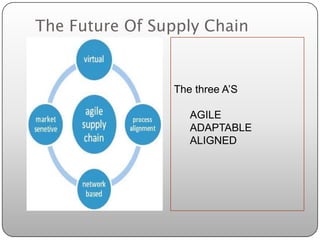
                The three A’S

                   AGILE
                   ADAPTABLE
                   ALIGNED
Future of Supply Chain
 Market Sensitive - The company should be able to read and
  understand the demand in the market as well as being able to
  respond to it.

 Virtual Supply Chain-This is information-based. By using
  information technology applications, such as electronic data
  interchange (EDI), all parties through the supply chain have
  access to real and same demand information, and the data will
  not be distorted by being transferred from one stop to another,
  through the supply chain

 Process Integration - more companies outsource every functions,
  except their core competencies, these kind of integration and
  trust-based relationships become more crucial. Collaboration has
  become the key word

 Network –It is important to empower all the parties in the supply
  chain, and applying better relationship management, structure
  and co-ordination
Challenges Today
 The main challenges facing manufacturing companies, both now
  and increasingly in the future are:
     increasing competition,
     changing relationships with business stakeholders,
     increasingly demanding customers
      growth in new technology
     global distribution of design and production
      environmental legislation
     political and economic factors.

  Manufacturing companies need to respond in the following ways:
   be more responsive to changing markets
   be more customer focused
   be adaptable to new situations
   form alliances and partnerships
   manage the strategic supply chain
   minimize the time-to-market of new products
   utilize the developing technologies for global communication
Future of Supply Chain
 Business Performance Consulting:
Business Performance Consulting services to
 continuously monitor and review the overall
 performance of the business operations,
 processes, and results against set standards
 and metrics. Assist customers to keep track
 of their long-term and short-term operational
 goals, both quantitatively and qualitatively.
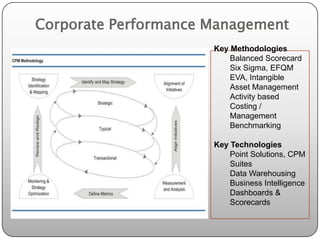
Corporate Performance Management
                      Key Methodologies
                          Balanced Scorecard
                          Six Sigma, EFQM
                          EVA, Intangible
                          Asset Management
                          Activity based
                          Costing /
                          Management
                          Benchmarking

                      Key Technologies
                          Point Solutions, CPM
                          Suites
                          Data Warehousing
                          Business Intelligence
                          Dashboards &
                          Scorecards
Process Consulting
 Business Process Consulting services include BPR, Package
  Assessment and Remediation, CRM processes and Supply
  Chain processes.


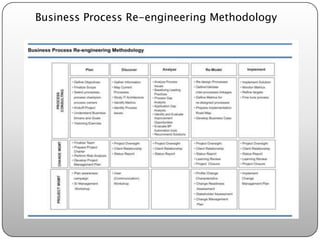
   Business Process Re-engineering (BPR) Services
    Business Process Re-engineering services focus on these areas
    and strive to achieve a radical improvement by using
    comprehensive process analysis and redesign techniques.
     Assessment and Diagnostics
     Transformation and Innovation
    Change Management is an integral part of this methodology.
Business Process Re-engineering Methodology
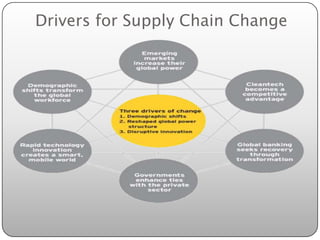
Drivers for Supply Chain Change
Key Measures for success
 A ‘transparent’ supply chain in which information is made
    visible across your organization, and to appropriate
    partners, to enable better planning and resource allocation
   Procurement sourcing strategies and systems that create
    lower acquisition costs
   Demand planning and sales-and-order processes for
    better forecasting, loading and delivery performance
   Lean strategies for asset and inventory optimization
   Supplier and customer relationship management strategies
    to sustain the trading network and improve purchase-to-
    payment management
   Green initiatives to ensure the cost effectiveness,
    regulatory compliance and corporate credibility of the
    supply network
   Risk management and contingency strategies to ensure
    that your supply network never lets you down
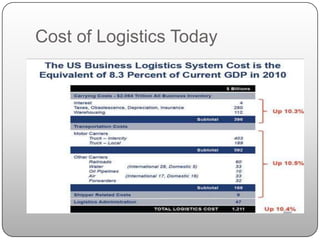
Cost of Logistics Today
THANK - YOU

Zp scm future_v2

  • 1.
    SUPPLY CHAIN A FUTUREAPPROACH……. Zubin Poonawalla CEO – GreenLogiNXT Pvt Ltd Copyright © 2011. All Rights Reserved
  • 2.
    SCM Concept When decidinga SCM plan, a company needs to consider warehousing, transportation, environmental conditions, cost to the business and potential profit.
  • 3.
    Key Factors ForSuccess  Route & vehicle Optimization  Customer service  Inventory management  Transportation  Warehousing  Technology  Packaging  Logistics providers
  • 4.
    Demand driven ValueNetwork  Integrative Improvement System - can be defined as a standard system that simultaneously and interdependently drives operational improvement across all functions and processes  Three key structural components  Maturity- and process-based transformation  Functional integration  Sustainability through a three-tier system
  • 5.
    Integrative Improvement System Maturity- and process-based transformation Transferring process improvement ownership from technical experts to front-line teams requires structural reorganization around lateral processes.  Functional integration The integrative approach is an organization primarily designed around processes, products, and customers, not functions.  Sustainability through a three-tier system Sustainable improvement does not result from the mere application of improvement tools and processes for example Lean, Six Sigma, autonomous maintenance, one point lessons etc. Sustainable change requires a three-tier system – management principles, operating systems, and tools
  • 6.
  • 7.
    Inventory optimization The needto better control and optimize inventory levels across the network has never been greater. A newer set of technology tools, generally referred to as Inventory Optimization technology, are helping companies to gain competitive advantage, reduce costs, and increase service levels through significantly enhanced inventory management
  • 8.
    Inventory optimization Benefits • Reductions of 20-40% in inventories of finished goods, components and raw materials trough inventory parameter optimisation. • Increases of 5-10% in order fulfillment rates and on-time deliveries by network optimisation. • Reductions in planning effort as a result of the implementation of reliable, automated processes
  • 9.
    Different Planning Needs The companies with effective Planning Process typically have well defined steps, responsibilities for each step and a monthly time table of when the PLANNING various steps are expected to be completed. Today it is well defined and connected with the help of sophisticated systems to define and analyze.
  • 10.
    Talent Management Analyst researchhas proven that organizations using talent management strategies and solutions exhibit higher performance than their direct competitors and the market in general. From Fortune 100 global enterprise recruiting and performance management to small and medium business e-recruiting, leading companies invest in talent management to select the best person for each job because they know success is powered by the total talent quality of their workforce
  • 11.
    Asset Management Asset Managementhelps in tracking each asset and what asset the company owns, who is using them and in which department /location using wide range of handheld devises with bar- coding technology. This is also widely used by retail outlets to help maintain inventory.
  • 12.
    Principles Of AssetManagement  Set a vision for how your utility will manage assets in the future;  Understand best practices, to apply and to attain the vision;  Define achievable strategies, projects and measures to guide you from where you are now to where you want to be in the future;  Determine what business processes and technologies will be affected by adopting best practices;  Optimize your organization for high efficiency.  Identify how information systems can support your strategies and goals.  Prioritize and sequence projects required to attain your program
  • 13.
    Technology & Logistics Integrated technology, consulting and logistics solutions, are providing businesses with a comprehensive range of business solutions to all facets of the supply-chain pipeline; from procurement, order fulfillment, product Lifecycle management, end-to-end logistics and program management through to analysis and reporting.  Besides technology also helps in labor management, route tracking, warehouse maintenance ,inventory ,transport management, customer & order management and demand planning
  • 14.
  • 15.
    Technology & Route Optimization Route Planning is a transport route optimization software for Logistics and BPO industry. Route Planning utilizes state of the art technology to help BPO companies optimize routes and generate huge cost savings and operational efficiency. Using a GIS based map of the city, Route Planning deploys proven proprietary algorithms to generate the most efficient routes, customized to your business needs. It provides optimum fleet utilization, efficient information flow, what-if analysis and detailed
  • 16.
    Packaging & technology  Despite a global recession, emphasis is on innovation in design, choice of materials, processing, and life cycle logistics.  The future of packaging is in sustainability.  Environmentally conscious decisions are being prevalent today and more and more importance given to it being environmentally friendly.  Walmart continues to be on the forefront of sustainable packaging in the retail arena. Although the retail giant has achieved many of its environmental goals such as plastic bag reduction, it continues to be unable to eliminate PVC from private- label packaging. As sustainable packaging evolves, Walmart will continue to strive in achieving its PVC elimination goals.  Many other large companies are following suit including Proctor & Gamble. Very recently, they announced plans to use sugarcane-derived plastic on selected packaging for its Pantene Pro-V, Covergirl and Max Factor brands to increase its sustainability credentials. The strategy by P&G is completely consumer-driven.
  • 17.
    Transportation • The road freight segment in India is gradually evolving from being a pure transportation business to a complete, service-based, end-to- end logistics solutions industry. • Increase in competition and private investments happening getting more players • Many players have tied up with large clients, particularly in the automotive, pharmaceutical, and retail sector to provide complete supply chain solutions. • Large fleet operators have been looking at providing multi-model logistics solutions via a combination of rail and road network and exploring opportunities in this area through: (a) JVs / partners with container cargo movers (b) long-term rake hire contracts with the railways.
  • 18.
    Transportation - Shipping Theskills on fleet management are centered in port operations ,warehousing and cost effectiveness, but also on how to cope with incidents, thus realizing safe and environmental friendly operations
  • 19.
    Transportation - Air RPK billions Source: World Market Forecast
  • 20.
    Transportation - Railways Theimportance of railways to port logistics creates a dependence of the ports upon highly reliable railway service. i) Lower transportation cost ii) Higher reliability iii) Relatively safer and secure iv) Very environmentally friendly v) Reduced accidents. The freight segment accounts for roughly two thirds of railway’s revenues.
  • 21.
    Transportation -Emerging concepts TheCompanies in logistics for procurement, manufacturing, and sales, aiming to reduce CO2 emissions and costs. For example, the monthly transportation volume of products and parts from China to Japan is enough to fill 400 40-foot containers. To the Americas and Europe, products and parts of a volume equivalent to 1,000 40-foot containers are shipped from China each month. Given these volumes, efficiency improvement in logistics is an important issue in promoting business on a global scale. Importance is now given to cargo carrying efficiency through reviewing packaging materials and mixed packing, modal shifts among warehouses, direct deliveries to customers, and by optimizing transportation routes through the introduction of the milk run system. The aim is to reduce wastage related to packaging materials, transportation, space, trans-shipment, and storage.
  • 22.
    Warehousing One of themost important element of supply chain management is warehousing. The proper storage and tracking of inventory ensures that delivery times are met and asset management Services costs are reduced. Warehousing facilities are completely equipped to handle all kinds of cargo. They are well guarded and spacious, provide complete safety of the goods. Keeping the goods intact and impervious to any kind of damage. Outsourcing the warehouses has become more and more competitive
  • 23.
    Warehouse Management  Theselection of location of ware house has long term repercussions in reducing the operating cost and smooth running of operations  The store layout are easy movement of material, good housekeeping, sufficient space for men and material handling equipment, and optimum utilization of available storage space.  Depending upon the type of material to be stored in the warehouse, number of people involved in the handling operation, design the infrastructure and facilities of warehouse.  Today letting out warehouses are building one has become lucrative business
  • 24.
    SCM Future  Segmentcustomers based on the service needs  Analysis can be used to segment customers based on "buying behaviors," and network models can be used to calculate the cost-to- serve of each segment under varying scenarios.  Strategic sourcing analyses should be undertaken, followed by the installation of e- procurement software to sustain the savings identified, on an ongoing basis.  Supply chain planning technology should be implemented - it is the critical link between supply chain strategy and supply chain operations.
  • 25.
    3 Party Logistics It has been found that 64 percent of the study’s respondents are using more 3PL-based services, with 42 percent of total logistics expenditures allocated for outsourcing and another 58 percent citing how they are reducing or consolidating their 3PL partners.  Private investors are getting more and more involved and play a role in getting into all areas of logistics and thus affecting nature of the global economy continues to impact buyers of logistics services.  Information technologies are a necessary element of 3PL expertise and are becoming a must with the 3PL providers. In recent years the gap has narrowed, with 93 percent viewing IT as a necessary element of 3PL expertise and 54 percent of shippers indicating they are satisfied with 3PL IT capabilities.
  • 26.
    ecommerce  The trendof outsourcing logistics solutions has led companies Internet based e-commerce outsourcing solutions.  They have formed an alliance with all the players in the logistics sphere have global coverage.  E-commerce already is substantially influencing business in Asia. More and more people are using it to get to the core of supply chain and minimize the time of response to the end customer and have real time inventory system
  • 27.
    The Future OfSupply Chain The three A’S AGILE ADAPTABLE ALIGNED
  • 28.
    Future of SupplyChain  Market Sensitive - The company should be able to read and understand the demand in the market as well as being able to respond to it.  Virtual Supply Chain-This is information-based. By using information technology applications, such as electronic data interchange (EDI), all parties through the supply chain have access to real and same demand information, and the data will not be distorted by being transferred from one stop to another, through the supply chain  Process Integration - more companies outsource every functions, except their core competencies, these kind of integration and trust-based relationships become more crucial. Collaboration has become the key word  Network –It is important to empower all the parties in the supply chain, and applying better relationship management, structure and co-ordination
  • 29.
    Challenges Today  Themain challenges facing manufacturing companies, both now and increasingly in the future are:  increasing competition,  changing relationships with business stakeholders,  increasingly demanding customers  growth in new technology  global distribution of design and production  environmental legislation  political and economic factors. Manufacturing companies need to respond in the following ways:  be more responsive to changing markets  be more customer focused  be adaptable to new situations  form alliances and partnerships  manage the strategic supply chain  minimize the time-to-market of new products  utilize the developing technologies for global communication
  • 30.
    Future of SupplyChain  Business Performance Consulting: Business Performance Consulting services to continuously monitor and review the overall performance of the business operations, processes, and results against set standards and metrics. Assist customers to keep track of their long-term and short-term operational goals, both quantitatively and qualitatively.
  • 31.
    Corporate Performance Management Key Methodologies Balanced Scorecard Six Sigma, EFQM EVA, Intangible Asset Management Activity based Costing / Management Benchmarking Key Technologies Point Solutions, CPM Suites Data Warehousing Business Intelligence Dashboards & Scorecards
  • 32.
    Process Consulting  BusinessProcess Consulting services include BPR, Package Assessment and Remediation, CRM processes and Supply Chain processes.  Business Process Re-engineering (BPR) Services Business Process Re-engineering services focus on these areas and strive to achieve a radical improvement by using comprehensive process analysis and redesign techniques.  Assessment and Diagnostics  Transformation and Innovation Change Management is an integral part of this methodology.
  • 33.
  • 34.
    Drivers for SupplyChain Change
  • 35.
    Key Measures forsuccess  A ‘transparent’ supply chain in which information is made visible across your organization, and to appropriate partners, to enable better planning and resource allocation  Procurement sourcing strategies and systems that create lower acquisition costs  Demand planning and sales-and-order processes for better forecasting, loading and delivery performance  Lean strategies for asset and inventory optimization  Supplier and customer relationship management strategies to sustain the trading network and improve purchase-to- payment management  Green initiatives to ensure the cost effectiveness, regulatory compliance and corporate credibility of the supply network  Risk management and contingency strategies to ensure that your supply network never lets you down
  • 36.
  • 37.