STRATEGIC FLEET AND
TRANSPORT MANAGEMENT
CHARLES COTTER
HOLIDAY INN HOTEL, SANDTON
7-8 DECEMBER 2015
TRAINING PROGRAMME OVERVIEW
• Defining the fundamental concepts
• Strategic Fleet Management – principles and practice
• Stakeholder Analysis - Fleet and Transport Management
• Risk Management - Fleet and Transport Management
• Internal Control – Fleet and Transport Management
• Performance Management - Fleet and Transport Management
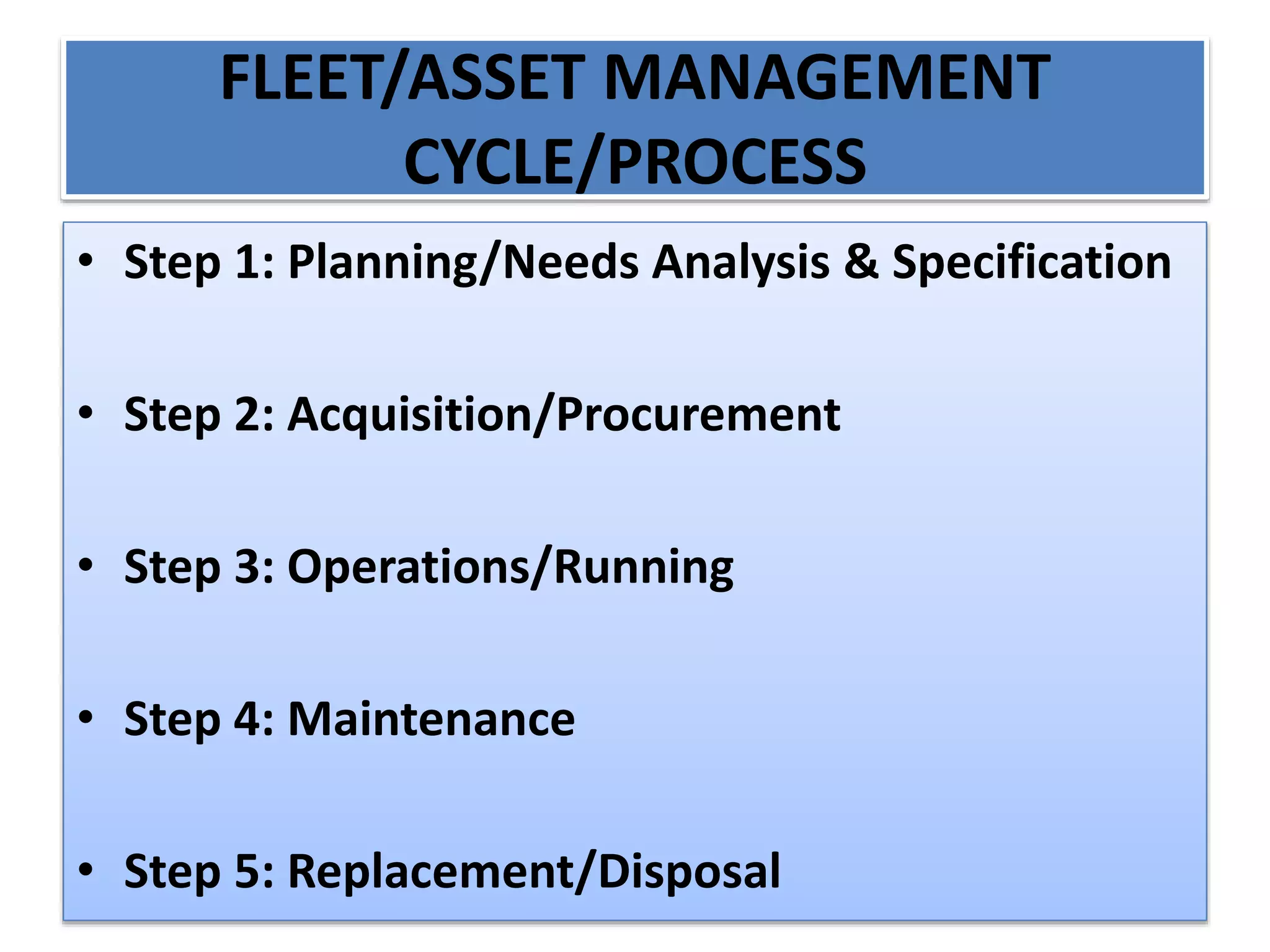
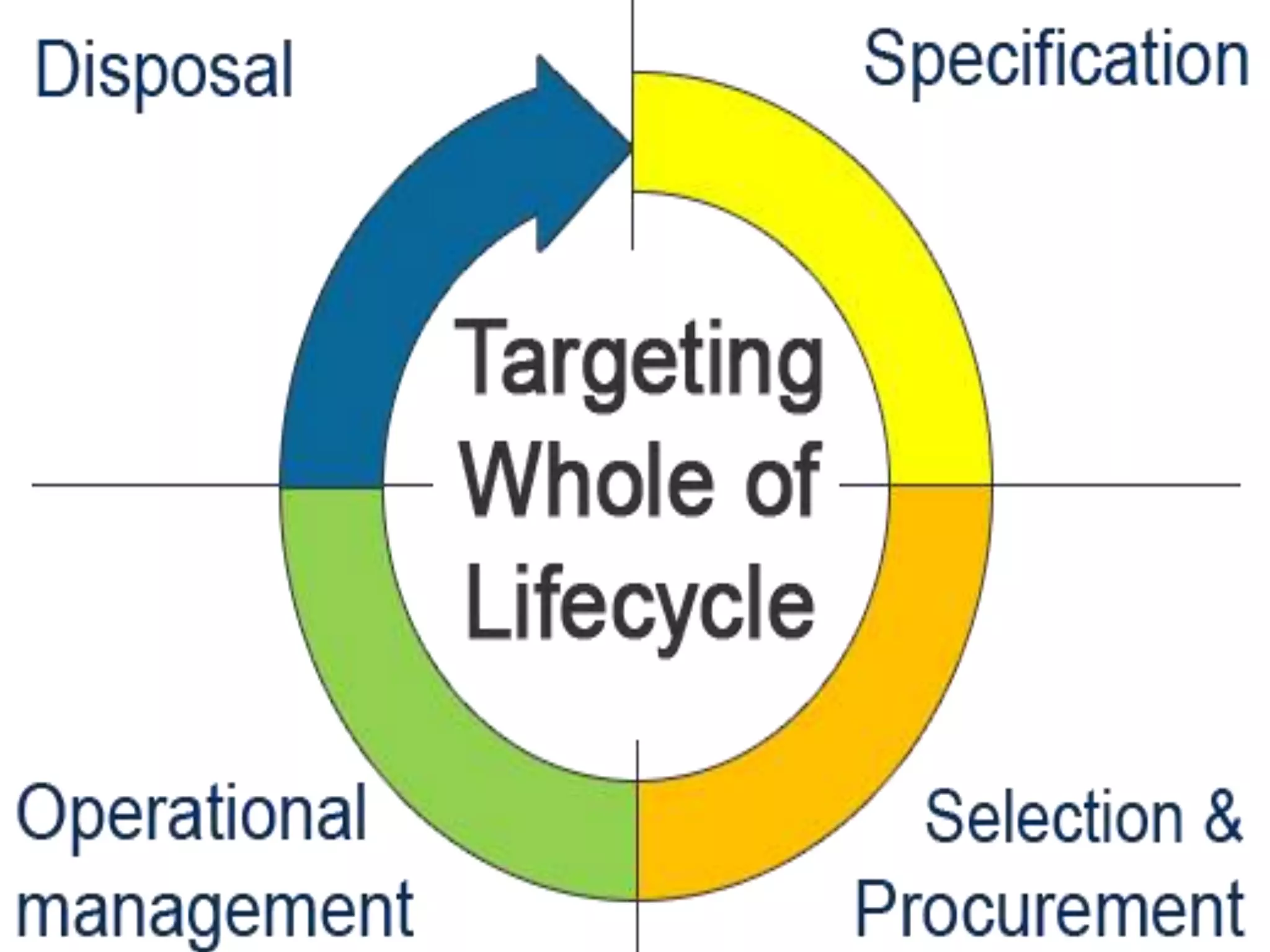
• Strategic Fleet and Asset Management cycle/process
INTRODUCTORY LEARNING ACTIVITY
• How would you define Strategic Fleet and
Transport Management?
• What are the critical success factors for
Strategic Fleet and Transport Management?
How are we performing in terms of these
factors?
• What are the obstacles to effective Strategic
Fleet and Transport Management in general?
STRATEGIC FLEET MANAGEMENT –
DEFINITION AND BENEFIT
• Strategic Fleet Management stresses the
importance of achieving objectives and the use
of metrics to benchmark progress (Mike Antich)
• Strategic Fleet Management principles will help
an organization to develop a fleet which is fit for
purpose.
• Fleet management plans and practices should be
aligned with the organizational strategic plan
and objectives
RELATING FLEET MANAGEMENT TO THE
BALANCED BUSINESS SCORECARD
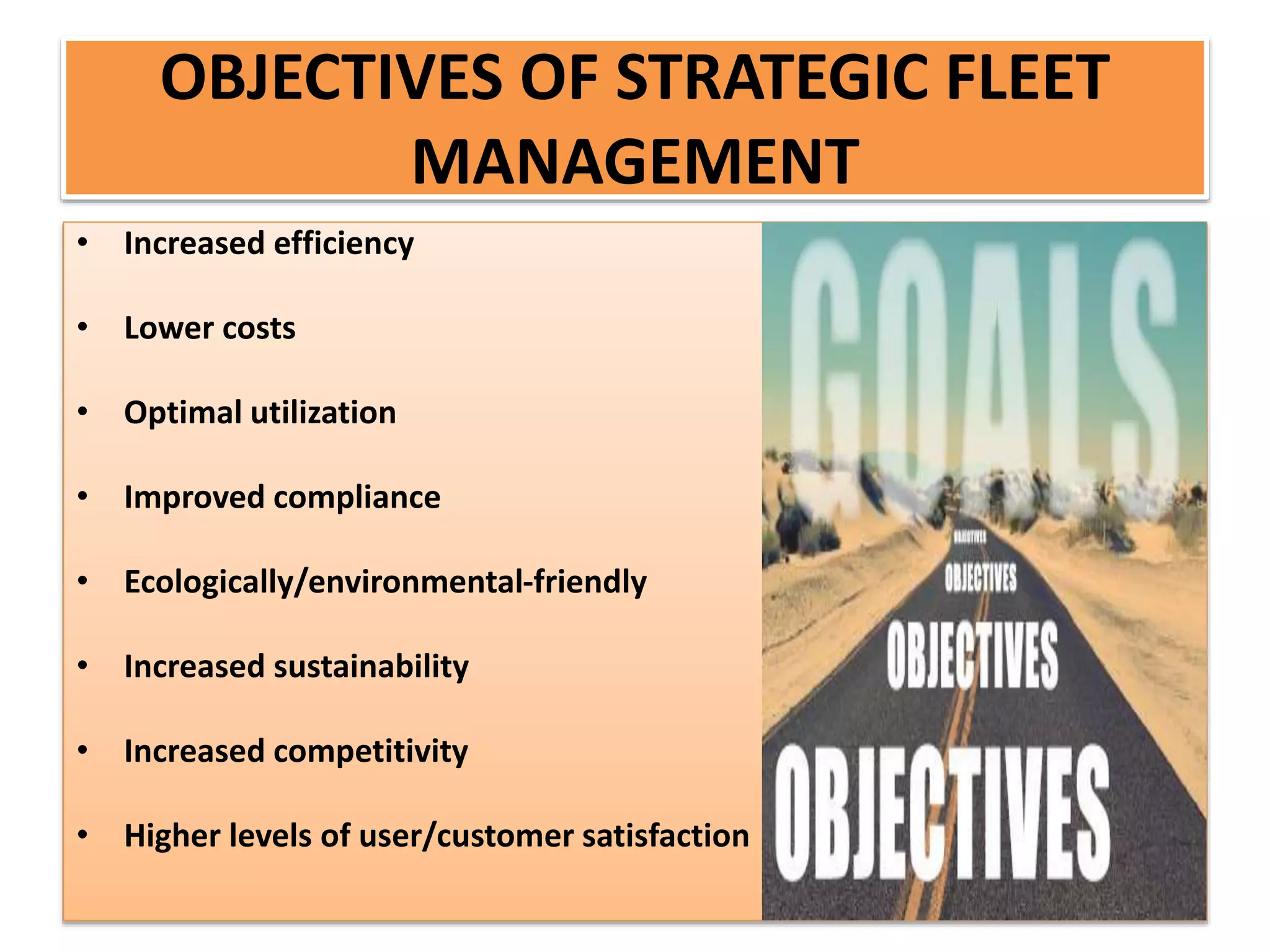
OBJECTIVES OF STRATEGIC FLEET
MANAGEMENT
• Increased efficiency
• Lower costs
• Optimal utilization
• Improved compliance
• Ecologically/environmental-friendly
• Increased sustainability
• Increased competitivity
• Higher levels of user/customer satisfaction
4-STEP STRATEGIC FLEET
MANAGEMENT PROCESS
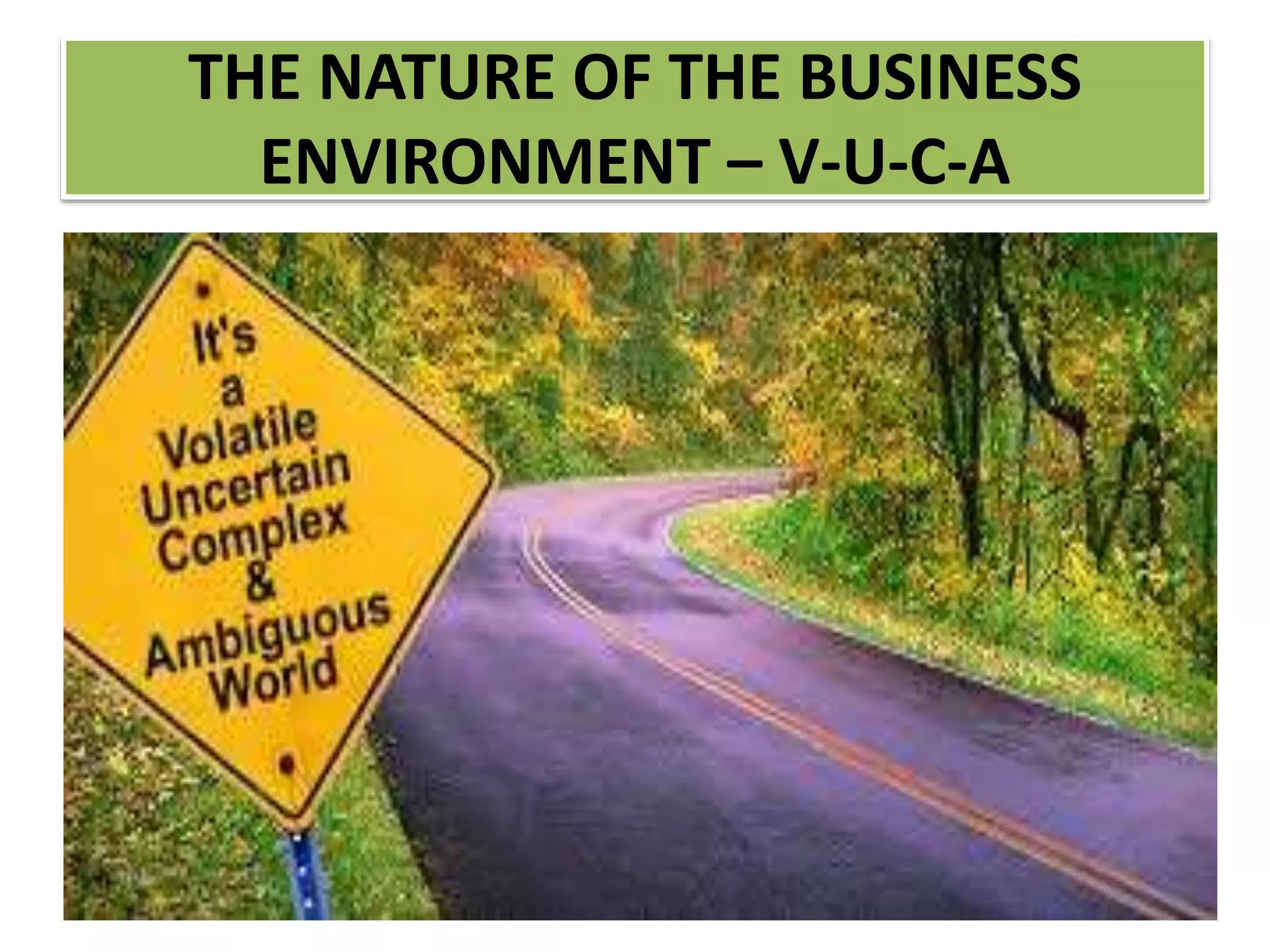
THE NATURE OF THE BUSINESS
ENVIRONMENT – V-U-C-A
CONTEXT OF FLEET MANAGEMENT
P-E-S-T-E-L ANALYSIS
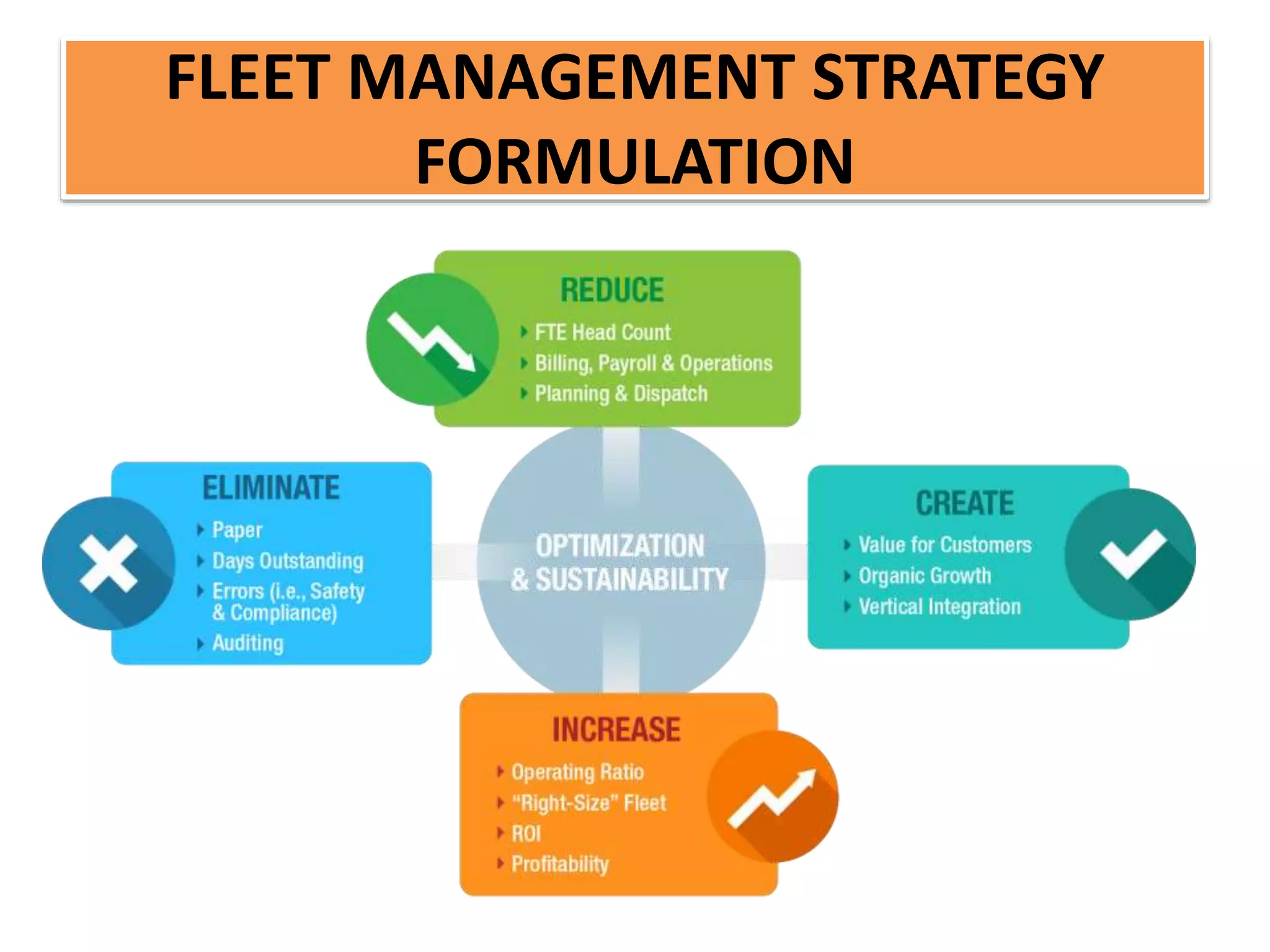
FLEET MANAGEMENT STRATEGY
FORMULATION
LEARNING ACTIVITY 1
• Refer to page 21 in the Learner Manual
• Syndicate group activity:
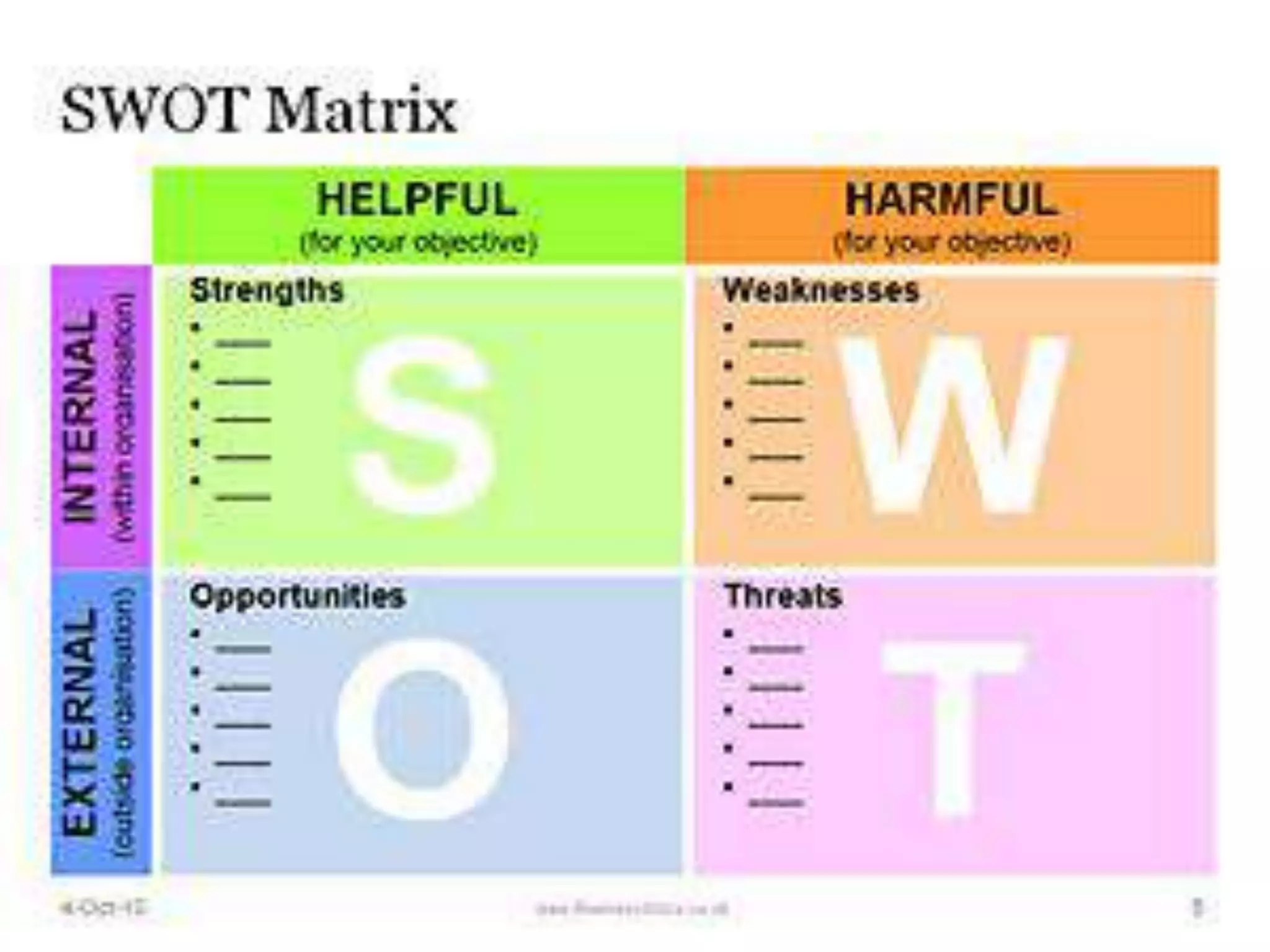
• By means of SWOT and PESTEL analyses,
apply step 1 of the Strategic Fleet
Management process, to your current,
organizational fleet management practice.
ROLE PLAYERS IN FLEET & TRANSPORT
MANAGEMENT
• Fleet Management Stakeholder Management
Process:
Step 1: Identify stakeholders (internal and external)
Step 2: Analyze & Prioritize stakeholders
Step 3: Get to know stakeholders (engagement)
Step 4: Stakeholder relationship management
STEP 1: IDENTIFY STAKEHOLDERS
(INTERNAL)
• Department of Transport
• HoD (Accounting Officer)
• Head of Supply Chain
• CFO
• Transport Officer
• Drivers
STEP 1: IDENTIFY STAKEHOLDERS
(EXTERNAL)
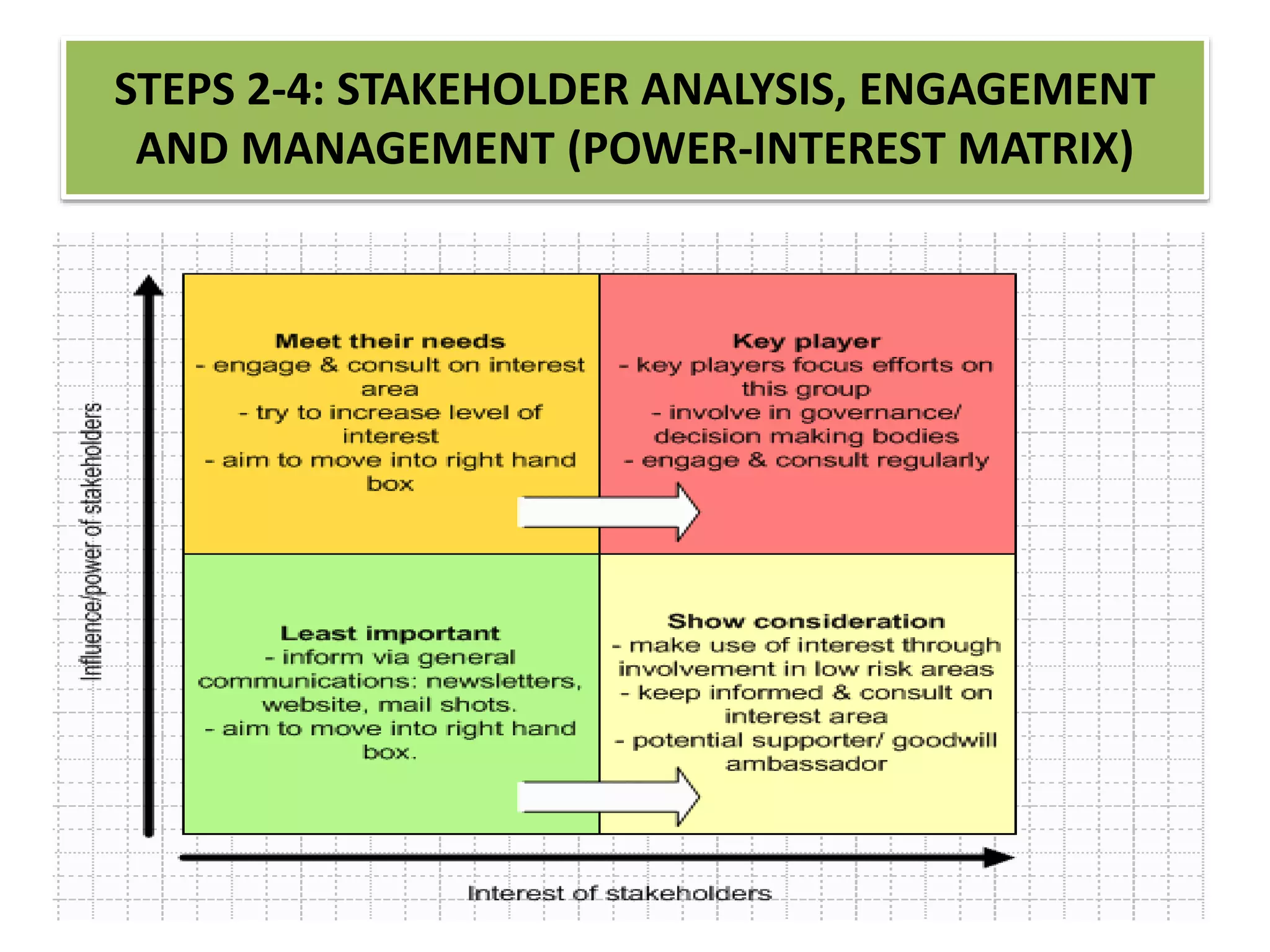
STEPS 2-4: STAKEHOLDER ANALYSIS, ENGAGEMENT
AND MANAGEMENT (POWER-INTEREST MATRIX)
LEARNING ACTIVITY 2
• Refer to page 25 in the Learner Manual
• Syndicate group activity:
• Conduct a Stakeholder Analysis your current,
organizational fleet management practice.
FLEET RISK MANAGEMENT
• Definition of Risk
• Definition of Risk Management
• Applying Risk Management principles to
Fleet decision-making, policy and practice
• Applying the Fleet Risk Management Process
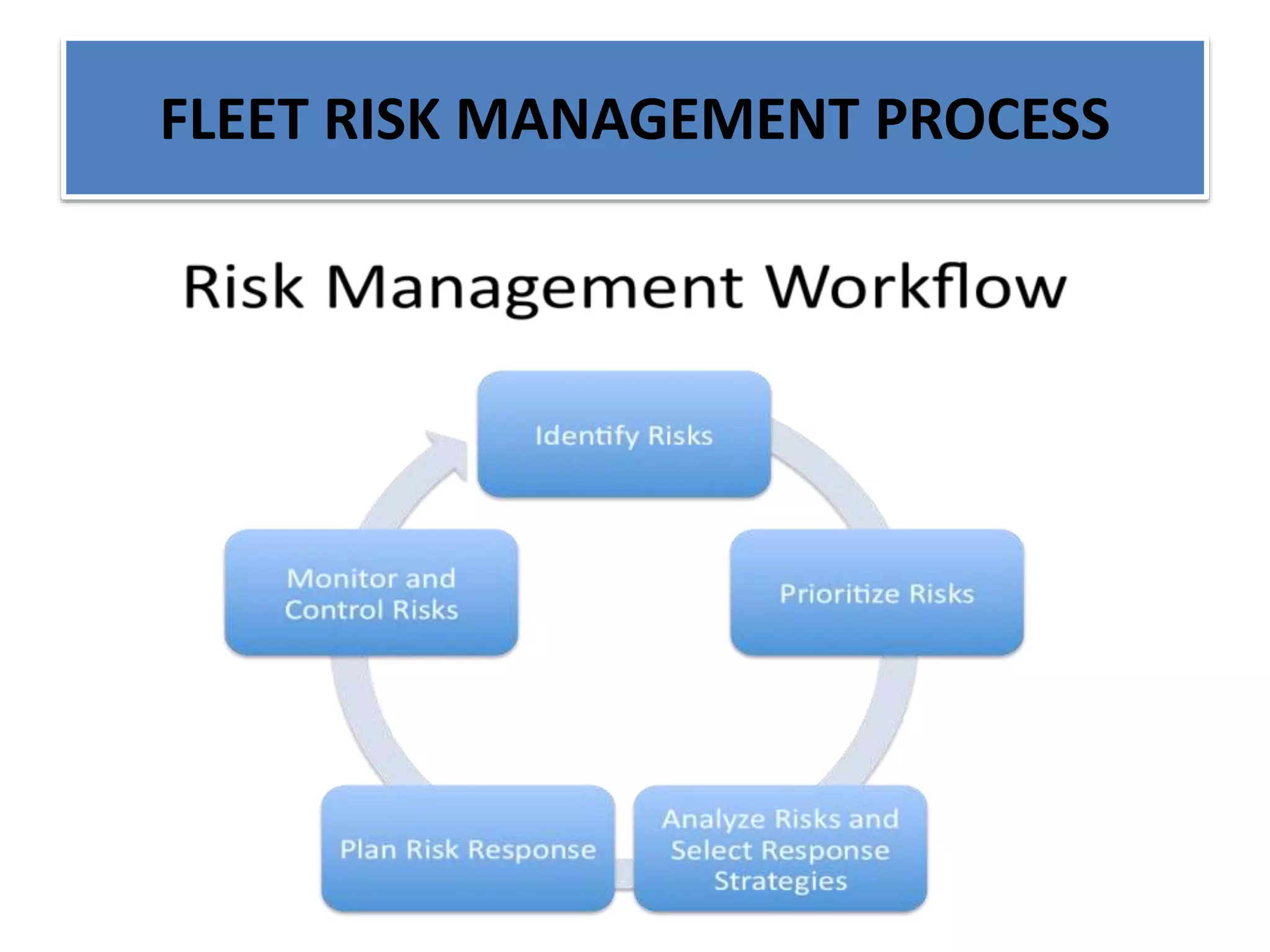
FLEET RISK MANAGEMENT PROCESS
• Step 1: Risk Identification
• Step 2: Risk Analysis
• Step 3: Risk Prioritization
• Step 4: Risk Response
• Step 5: Risk Evaluation
FLEET RISK MANAGEMENT PROCESS
FLEET RISK MATRIX
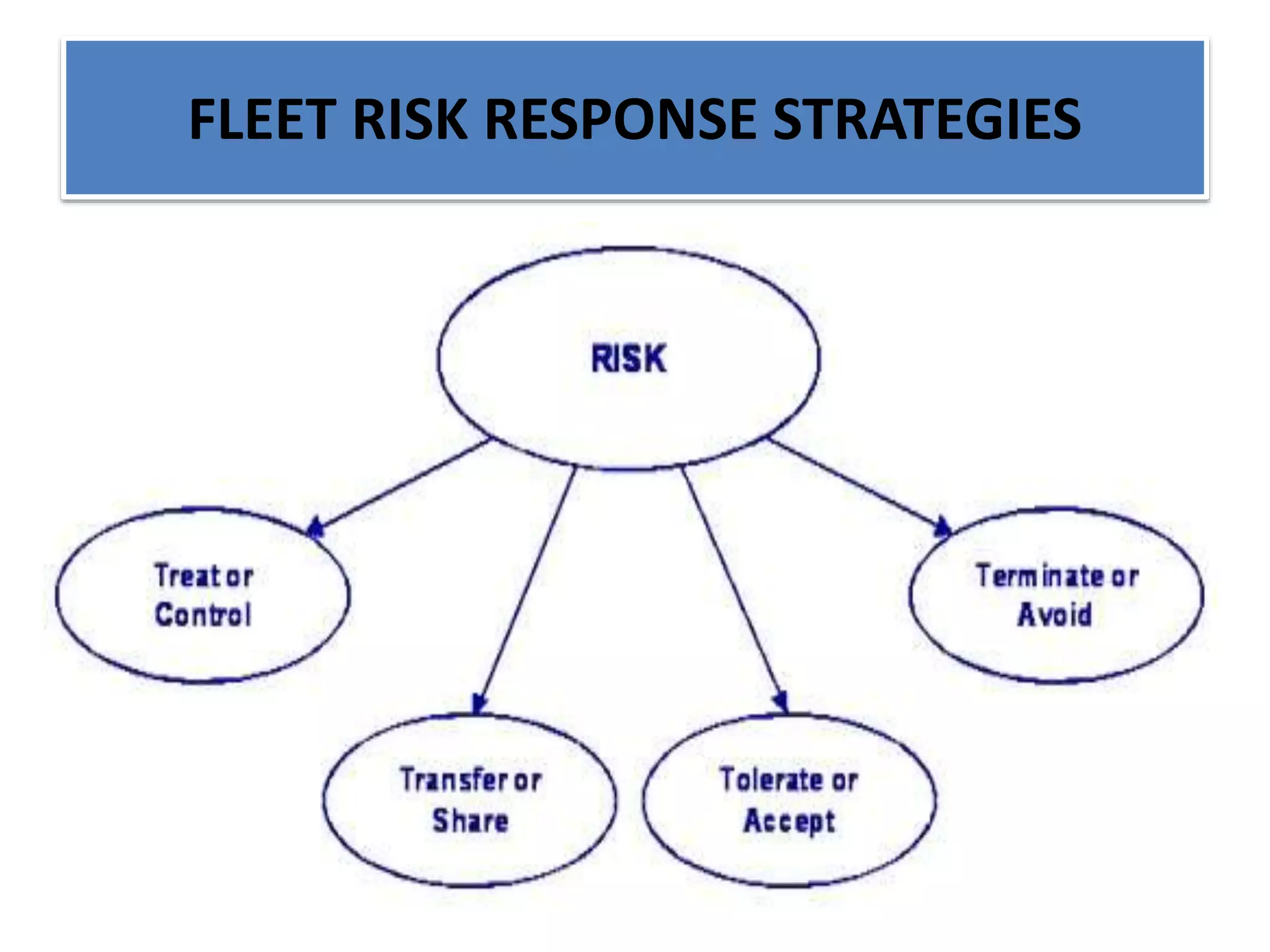
FLEET RISK RESPONSE STRATEGIES
LEARNING ACTIVITY 3
• Refer to page 37 in the Learner Manual
• Syndicate group activity:
• Apply the Fleet Risk Management process to
your current, organizational fleet
management practice.
FLEET INTERNAL CONTROL
• Definition of Internal Control
• Internal control process
• Elements of the control environment
• Types of internal control
• Factors influencing the internal control process
• Internal control system
• Applying the internal control principles to fleet and transport
management measures and practices
DEFINING INTERNAL CONTROL
• Internal controls can be defined as all means devised to
promote, govern and check upon various activities for
the purpose of seeing that institutional objectives are
met.
• It can also be defined as the measures implemented in
a public institution to improve the quality of
management and to avoid or prevent
mismanagement.
• Internal control is the management function that
ensures the co-ordination and effective functioning of
all institutional activities so that institutional objectives
are implemented and pursued according to plan.
FLEET MANAGEMENT INTERNAL CONTROL
PROCESS
INTERNAL CONTROL QUESTIONS AND
REALITIES
• What exactly needs to be controlled?
• What environment does the control exist in i.e. is
it a high vulnerability area, a high risk area?
• Fleet cars are always a high risk due to them
being a highly sought after commodity, easily
camouflaged, and cash generating
• Fleet equipment is not as high due to their
conspicuous nature, but still highly sought after.
ELEMENTS OF THE FLEET CONTROL
ENVIRONMENT
• Sound management characteristics
• Efficient organizational structures
• Effective internal audit function
• Acceptable personnel policies
• Written procedures
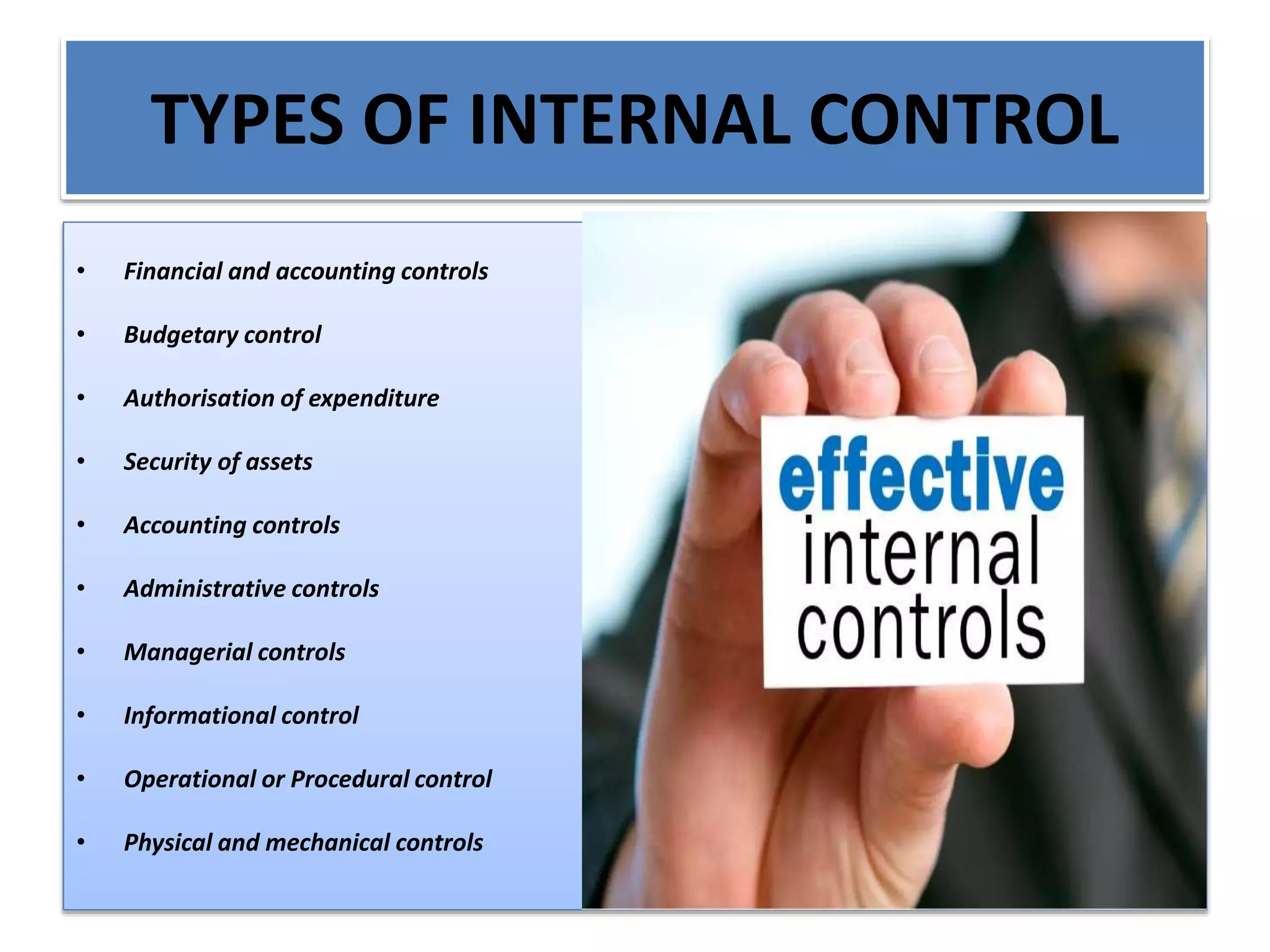
TYPES OF INTERNAL CONTROL
• Financial and accounting controls
• Budgetary control
• Authorisation of expenditure
• Security of assets
• Accounting controls
• Administrative controls
• Managerial controls
• Informational control
• Operational or Procedural control
• Physical and mechanical controls
FLEET INTERNAL CONTROL SYSTEM
FLEET INTERNAL CONTROL MEASURES
• Map the current systems
• Ascertain the current control points
• Evaluate each control measure
• Ascertain whether:
 the cost of control justifies the measure of control it produces
 it achieves it control objectives,
 it could be substituted with a more effective means of control
• Decide where extra control points are needed, i.e. where no control exists, or
where control is over-controlled for it’s intended purpose
• Develop and Implement Control measures:
 Trip Authorizations
 Pre and Post inspections
LEARNING ACTIVITY 4
• Refer to page 50 in the Learner Manual
• Syndicate group activity:
• By referring to the elements and types of fleet
internal control, evaluate the degree of
compliance of your current, organizational fleet
management practice.
• Identify gaps and recommend fleet control
improvement strategies.
FLEET PERFORMANCE METRICS AND
MANAGEMENT
OPTIMIZING FLEET PERFORMANCE
• Considering the fleet as an asset
• 3 E’s – efficiency, economics and effectiveness
• Components of fleet performance – inputs, process, outputs and
outcomes
• Value-for-money chain
• Total Cost of Ownership (TCO)
• Performance Efficiencies
• Performance Indicators
• Fleet Performance Management process
FLEET PERFORMANCE MANAGEMENT
• Objective: It is important that vehicles are managed effectively,
efficiently and economically to ensure that a prompt and speedy
service are delivered.
• There are a number of measures used to assess asset performance:
 the asset’s physical condition
 its utilization
 its functionality
 its financial performance
• This information (business intelligence) is then used to determine the
current and projected economic return of the asset or portfolio.
Discounted Cash Flow analysis can be used to provide a measure of the
Net Present Value and the Internal Rate of Return for assets.
THE 3 E’S OF FLEET PERFORMANCE
• Economy - can be defined as the lowest cost
for a given quality and quantity of inputs
• Efficiency - can be defined as the extent to
which inputs are used optimally to produce
outputs
• Effectiveness - can be defined as the
maximum outcome by the selection of the
optimal mix of outputs
FLEET PERFORMANCE EXCELLENCE
VALUE FOR MONEY CHAIN
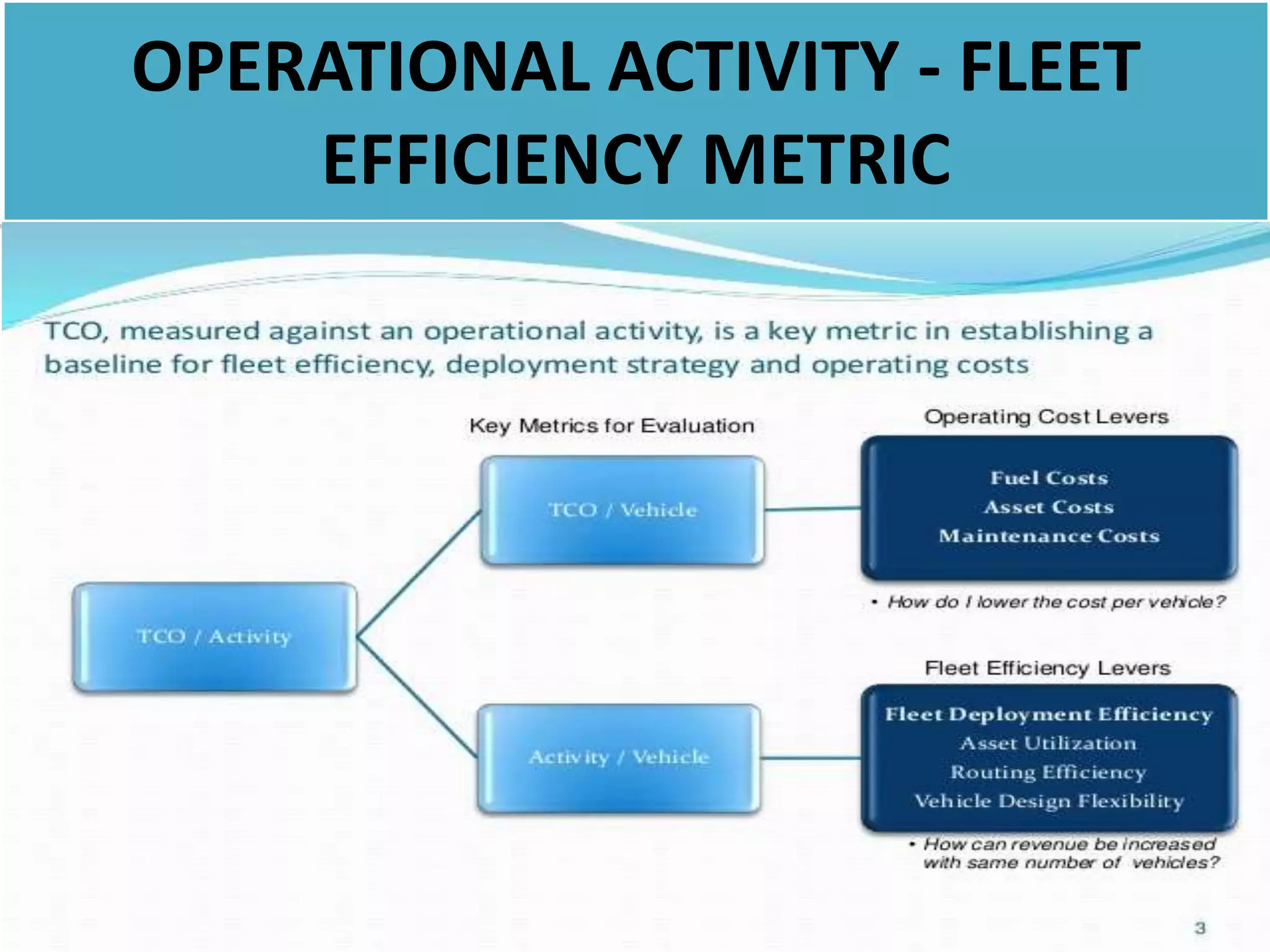
TOTAL COST OF OWNERSHIP (TCO)
OPERATIONAL ACTIVITY - FLEET
EFFICIENCY METRIC
FLEET PERFORMANCE METRICS
FLEET PERFORMANCE EFFICIENCIES
• Fleet use:
Vehicle availability
Vehicle downtime
Vehicle utilization
• Compliance:
number of accidents
number of vehicle defects
number of DoT failures (vehicle safety, roadworthiness and
exhaust emissions) or first time passes
FLEET PERFORMANCE EFFICIENCIES
• Operational:
Fuel usage
CO2 emissions
• Costs:
maintenance cost per vehicle
tyre cost per vehicle
insurance cost per vehicle
operating cost per vehicle
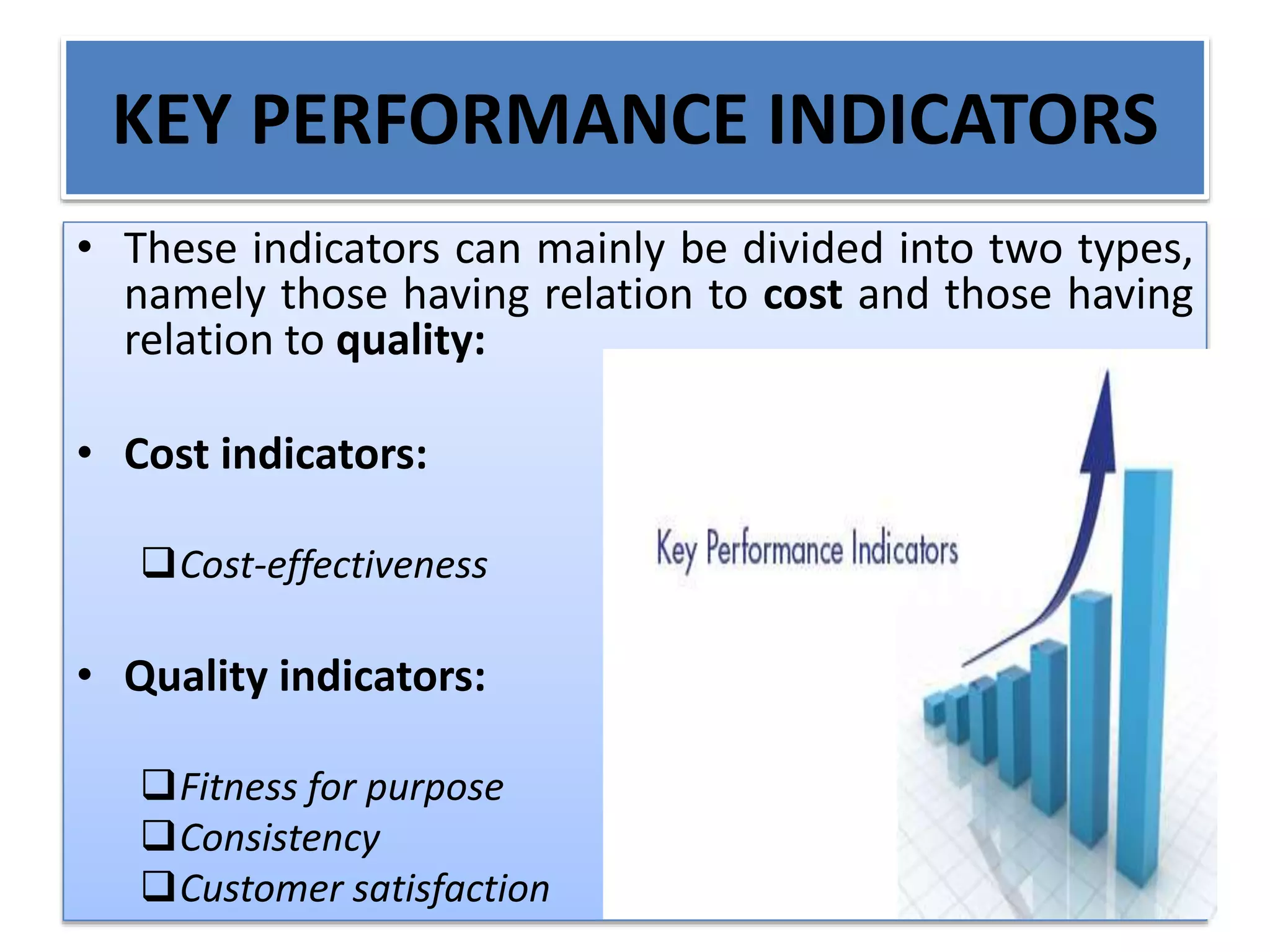
KEY PERFORMANCE INDICATORS
• These indicators can mainly be divided into two types,
namely those having relation to cost and those having
relation to quality:
• Cost indicators:
Cost-effectiveness
• Quality indicators:
Fitness for purpose
Consistency
Customer satisfaction
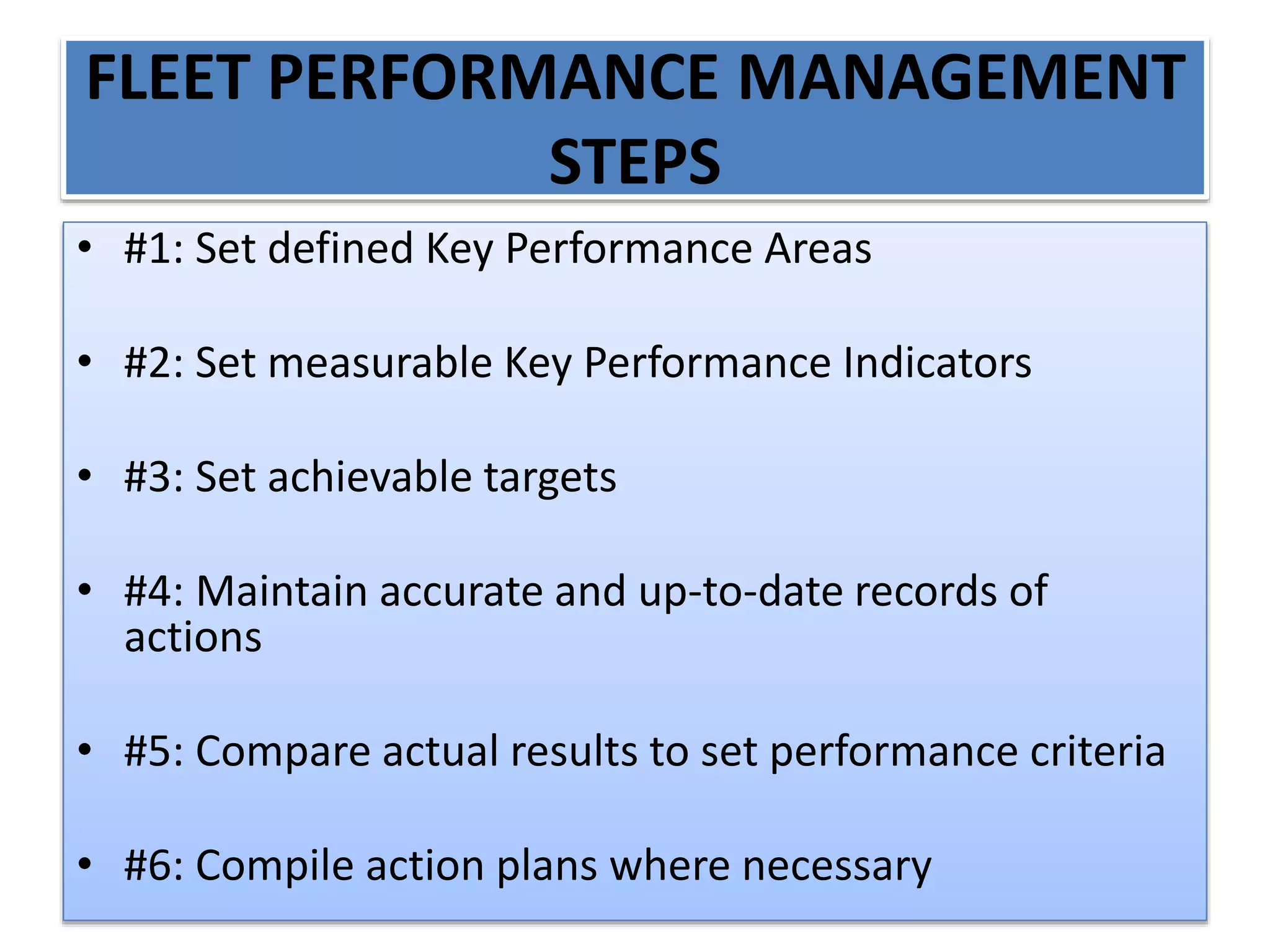
FLEET PERFORMANCE MANAGEMENT
STEPS
• #1: Set defined Key Performance Areas
• #2: Set measurable Key Performance Indicators
• #3: Set achievable targets
• #4: Maintain accurate and up-to-date records of
actions
• #5: Compare actual results to set performance criteria
• #6: Compile action plans where necessary
EXAMPLE: FLEET KPA/KPI/TARGET
KEY PERFORMANCE AREA KEY PERFORMANCE INDICATOR TARGET
Cost Fuel Cost Per KM Less than R7.50 X total kms travelled
Total Monthly Repair Cost Less than 5% of initial cost / 5 years / 12 months
Customer Satisfaction
Appropriateness of vehicle for the
purpose it was required for
Less than 5% dissatisfaction
Problems experienced with the vehicle
during the trip
Less than 10% customers experiencing problems
with the vehicle
Repeat problem reports Less than 2% repeat problem reports
Safety Number of safe trips Less than 2% incidents
Number of vehicle thefts Less than 2% vehicle thefts
Fleet Utilisation % hours vehicles are underutilised Less than 20% dormant vehicles
Number of times vehicles could not be
supplied
Less than 15% unavailability
Fleet Appearance Number of times vehicles were dirty Less than 20%
Number of vehicles with bumps and
dents
Less than 15%
Number of vehicles with bad paint jobs Less than 5%
LEARNING ACTIVITY 5
• Refer to page 66 in the Learner Manual
• Syndicate group activity:
• By referring to the 3 E’s of the value-for-money chain
and other fleet performance indicators and metrics,
evaluate the performance of your current,
organizational fleet management practice.
• Identify performance gaps and recommend fleet
performance optimization and improvement
strategies.
FLEET/ASSET MANAGEMENT
CYCLE/PROCESS
• Step 1: Planning/Needs Analysis & Specification
• Step 2: Acquisition/Procurement
• Step 3: Operations/Running
• Step 4: Maintenance
• Step 5: Replacement/Disposal
LEARNING ACTIVITY 6
• Refer to page 68 in the Learner Manual
• Syndicate group activity:
• Apply step 1 of the Fleet Management cycle
to your current, organizational vehicle fleet
practices. Indicate what means and/or
sources and methods you will utilize for the
needs analysis and the required vehicle
specifications.
STEP 2: PROCUREMENT/ACQUISITION
EVALUATION CRITERIA
• Viability
• Feasibility
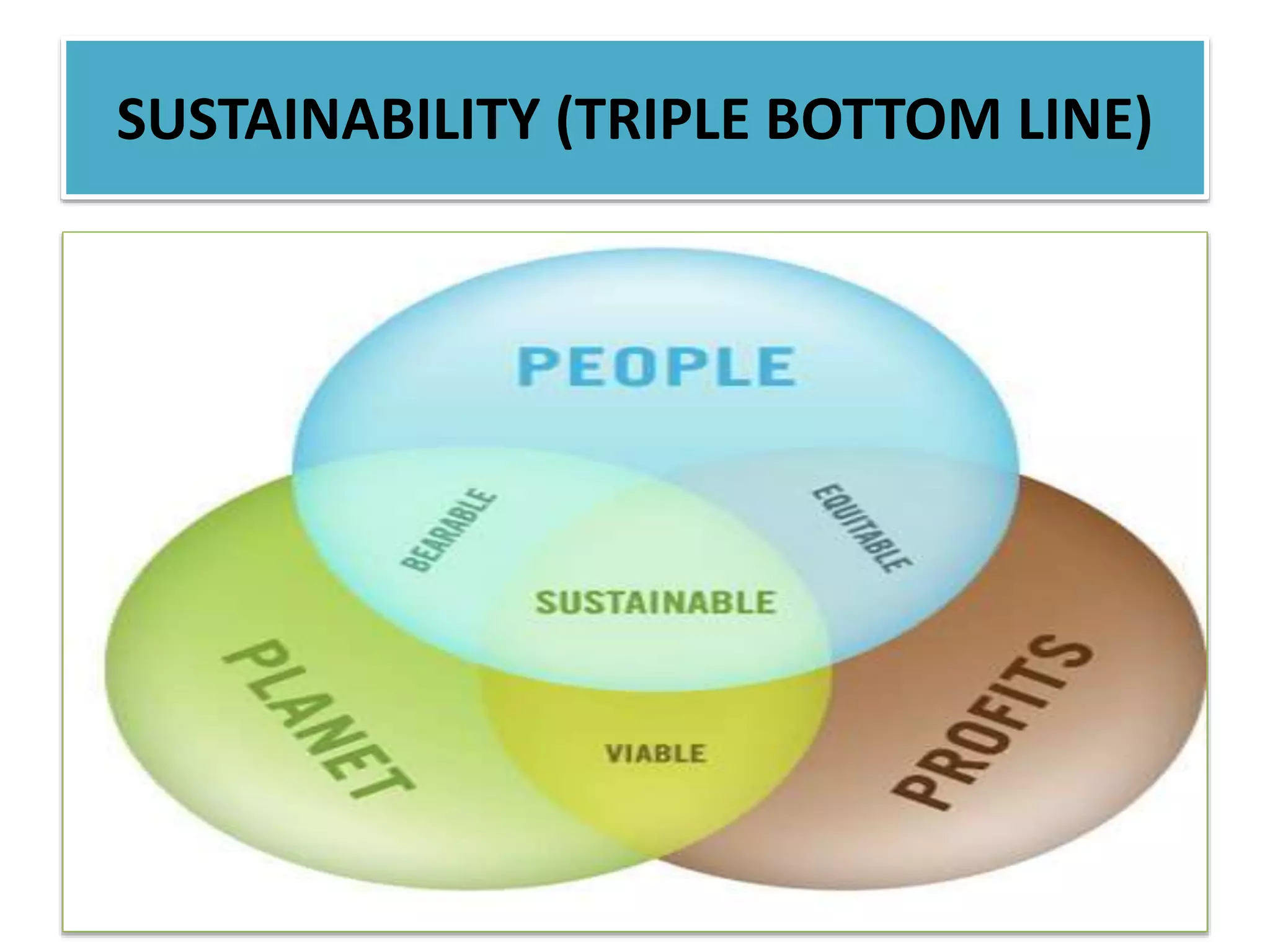
• Sustainability
 Profits
 People
 Planet
SUSTAINABILITY (TRIPLE BOTTOM LINE)
STEP 2: EVALUATION OF VEHICLE FINANCE
OPTIONS
• Financial and numerical metrics:
Cost-Benefit Analysis
Payback period
Return-on-Investment (ROI)
Net Present Value (NPV)
Internal Rate of Return (IRR)
STEP 2: EVALUATION OF VEHICLE TYPES
(BY MEANS OF DECISION MATRIX)
LEARNING ACTIVITY 7
• Refer to page 70 in the Learner Manual
• Syndicate group activity:
• Apply step 2 of the Fleet Management cycle to your
current, organizational vehicle fleet practices. Indicate
the vehicle options, selection criteria and weighting
and decision-making process.
• By means of building a business case, justify the
selection – type and number of vehicles.
STEP 3: OPERATIONS/RUNNING
• Effective Utilization and Maintenance of Fleet
Resources
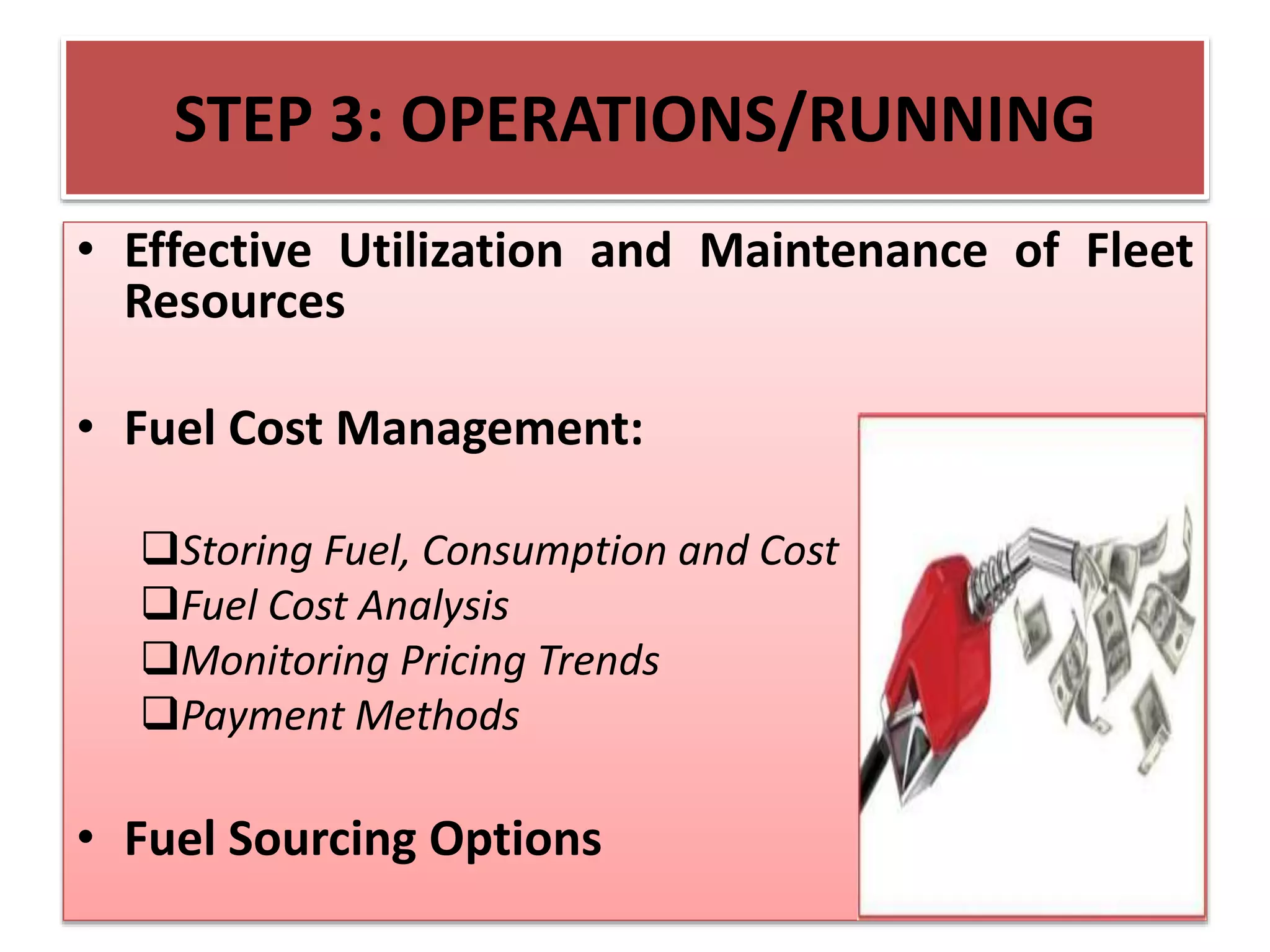
• Fuel Cost Management:
Storing Fuel, Consumption and Cost
Fuel Cost Analysis
Monitoring Pricing Trends
Payment Methods
• Fuel Sourcing Options
STEP 3: OPERATIONS/RUNNING
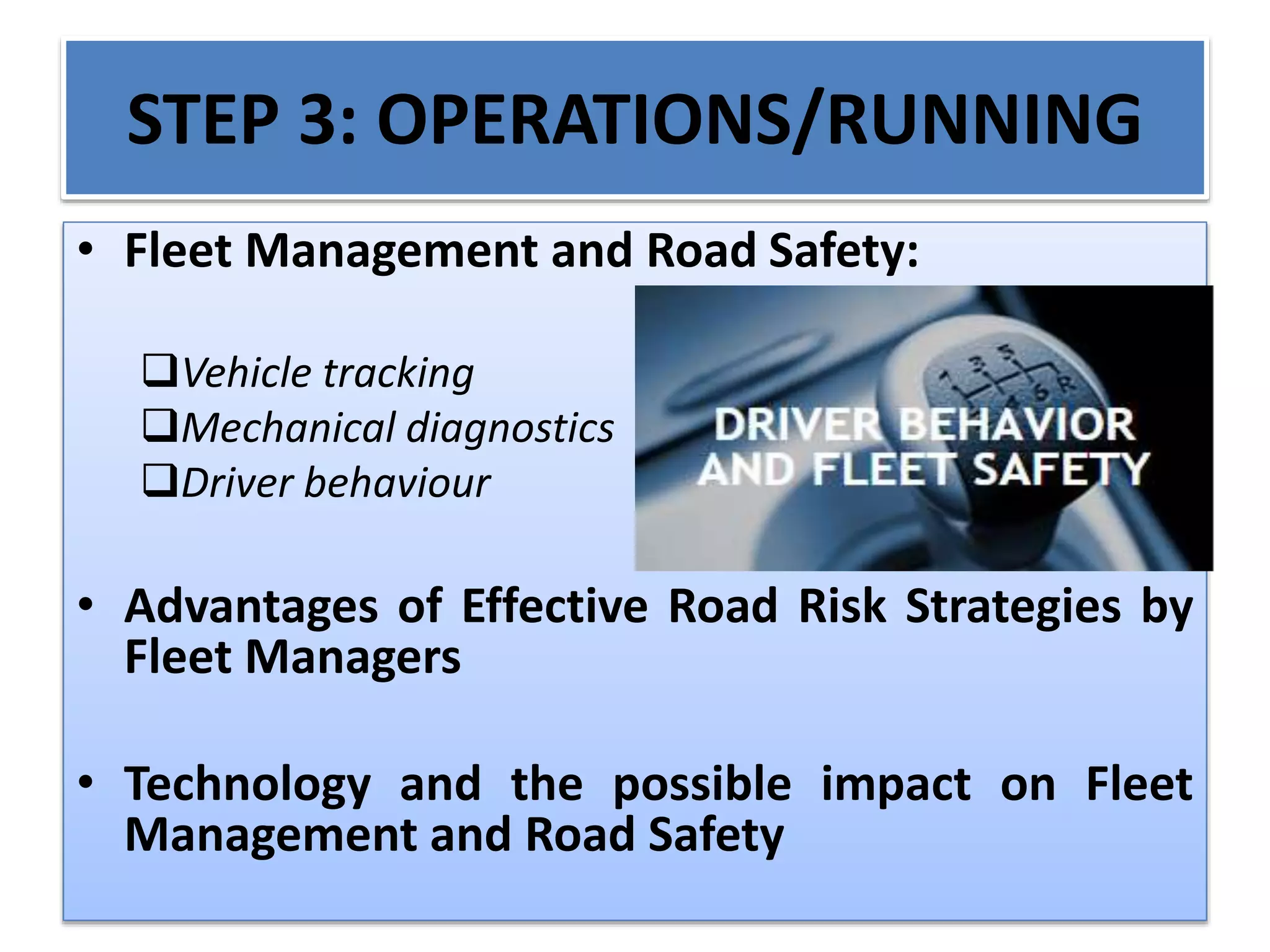
• Fleet Management and Road Safety:
Vehicle tracking
Mechanical diagnostics
Driver behaviour
• Advantages of Effective Road Risk Strategies by
Fleet Managers
• Technology and the possible impact on Fleet
Management and Road Safety
LEARNING ACTIVITY 8
• Refer to page 77 in the Learner Manual
• Syndicate group activity:
• Apply step 3 of the Fleet Management cycle to
your current, organizational vehicle fleet
practices. Indicate the fuel cost management
strategies; road safety measures how vehicles
will be safeguarded and the technology-enabled
monitoring and tracking devices.
STEP 4: MAINTENANCE
MANAGEMENT
• Why have a Maintenance Plan?
• What needs to be taken into consideration?
• Objective: The purpose of maintenance management is
to maintain a fleet of vehicles, using both preventative
maintenance and corrective maintenance, in such a
manner that the time the vehicle is off the road is
minimised (vehicle downtime) whilst ensuring that
maintenance costs are kept as low as possible.
• Benefits of a well-maintained vehicle
MAINTENANCE MANAGEMENT FOCAL
POINTS
• Maintenance schedules
• Maintenance authorization
• Tracking maintenance history
• Monitoring pricing trends
• Invoice scrutiny
• Payment methods
• Cumulative maintenance cost analysis
• Warranty control
• Outsourcing option
CATEGORIES OF MAINTENANCE
LEARNING ACTIVITY 9
• Refer to page 85 in the Learner Manual
• Syndicate group activity:
• Apply step 4 of the Fleet Management cycle
to your current, organizational vehicle fleet
practices. Indicate the maintenance category,
schedule and sourcing option/s.
STEP 5: REPLACEMENT & DISPOSAL
• How often should vehicles be replaced?
 condition:
 mileage;
 age;
 ‘whole-life’ costings; and
 environmental targets
• Replacement Cycle Management:
 Age of the vehicle being replaced;
 Odometer reading of the vehicle being replaced;
 Operating costs of the vehicle being replaced;
 Stock availability of the replacement vehicle;
 Market demand for the used vehicle to be sold.
MAIN SELLING/DISPOSAL METHODS
• Retailing
• Employee sales
• Trade-ins
• Auctions
• Public tender
• Transfer and/or sale to another entity
• Controlled dumping, specialized disposal (for items that have a low value
or are unhygienic)
• Professional valuations
LEARNING ACTIVITY 10
• Refer to page 89 in the Learner Manual
• Syndicate group activity:
• Apply step 5 of the Fleet Management cycle
to your current, organizational vehicle fleet
practices. Indicate the vehicle replacement
and disposal criteria and procedure.
CONCLUSION
• Key points
• Summary
• Questions
CONTACT DETAILS
• Charles Cotter
• (+27) 84 562 9446
• charlescot@polka.co.za
• LinkedIn
• Twitter: Charles_Cotter
• http://www.slideshare.net/CharlesCotter

Strategic Fleet and Transport Management

  • 1.
    STRATEGIC FLEET AND TRANSPORTMANAGEMENT CHARLES COTTER HOLIDAY INN HOTEL, SANDTON 7-8 DECEMBER 2015
  • 2.
    TRAINING PROGRAMME OVERVIEW •Defining the fundamental concepts • Strategic Fleet Management – principles and practice • Stakeholder Analysis - Fleet and Transport Management • Risk Management - Fleet and Transport Management • Internal Control – Fleet and Transport Management • Performance Management - Fleet and Transport Management • Strategic Fleet and Asset Management cycle/process
  • 3.
    INTRODUCTORY LEARNING ACTIVITY •How would you define Strategic Fleet and Transport Management? • What are the critical success factors for Strategic Fleet and Transport Management? How are we performing in terms of these factors? • What are the obstacles to effective Strategic Fleet and Transport Management in general?
  • 4.
    STRATEGIC FLEET MANAGEMENT– DEFINITION AND BENEFIT • Strategic Fleet Management stresses the importance of achieving objectives and the use of metrics to benchmark progress (Mike Antich) • Strategic Fleet Management principles will help an organization to develop a fleet which is fit for purpose. • Fleet management plans and practices should be aligned with the organizational strategic plan and objectives
  • 5.
    RELATING FLEET MANAGEMENTTO THE BALANCED BUSINESS SCORECARD
  • 6.
    OBJECTIVES OF STRATEGICFLEET MANAGEMENT • Increased efficiency • Lower costs • Optimal utilization • Improved compliance • Ecologically/environmental-friendly • Increased sustainability • Increased competitivity • Higher levels of user/customer satisfaction
  • 7.
  • 8.
    THE NATURE OFTHE BUSINESS ENVIRONMENT – V-U-C-A
  • 9.
    CONTEXT OF FLEETMANAGEMENT
  • 11.
  • 12.
  • 13.
    LEARNING ACTIVITY 1 •Refer to page 21 in the Learner Manual • Syndicate group activity: • By means of SWOT and PESTEL analyses, apply step 1 of the Strategic Fleet Management process, to your current, organizational fleet management practice.
  • 14.
    ROLE PLAYERS INFLEET & TRANSPORT MANAGEMENT • Fleet Management Stakeholder Management Process: Step 1: Identify stakeholders (internal and external) Step 2: Analyze & Prioritize stakeholders Step 3: Get to know stakeholders (engagement) Step 4: Stakeholder relationship management
  • 15.
    STEP 1: IDENTIFYSTAKEHOLDERS (INTERNAL) • Department of Transport • HoD (Accounting Officer) • Head of Supply Chain • CFO • Transport Officer • Drivers
  • 16.
    STEP 1: IDENTIFYSTAKEHOLDERS (EXTERNAL)
  • 17.
    STEPS 2-4: STAKEHOLDERANALYSIS, ENGAGEMENT AND MANAGEMENT (POWER-INTEREST MATRIX)
  • 18.
    LEARNING ACTIVITY 2 •Refer to page 25 in the Learner Manual • Syndicate group activity: • Conduct a Stakeholder Analysis your current, organizational fleet management practice.
  • 20.
    FLEET RISK MANAGEMENT •Definition of Risk • Definition of Risk Management • Applying Risk Management principles to Fleet decision-making, policy and practice • Applying the Fleet Risk Management Process
  • 21.
    FLEET RISK MANAGEMENTPROCESS • Step 1: Risk Identification • Step 2: Risk Analysis • Step 3: Risk Prioritization • Step 4: Risk Response • Step 5: Risk Evaluation
  • 22.
  • 23.
  • 24.
  • 25.
    LEARNING ACTIVITY 3 •Refer to page 37 in the Learner Manual • Syndicate group activity: • Apply the Fleet Risk Management process to your current, organizational fleet management practice.
  • 27.
    FLEET INTERNAL CONTROL •Definition of Internal Control • Internal control process • Elements of the control environment • Types of internal control • Factors influencing the internal control process • Internal control system • Applying the internal control principles to fleet and transport management measures and practices
  • 28.
    DEFINING INTERNAL CONTROL •Internal controls can be defined as all means devised to promote, govern and check upon various activities for the purpose of seeing that institutional objectives are met. • It can also be defined as the measures implemented in a public institution to improve the quality of management and to avoid or prevent mismanagement. • Internal control is the management function that ensures the co-ordination and effective functioning of all institutional activities so that institutional objectives are implemented and pursued according to plan.
  • 29.
  • 30.
    INTERNAL CONTROL QUESTIONSAND REALITIES • What exactly needs to be controlled? • What environment does the control exist in i.e. is it a high vulnerability area, a high risk area? • Fleet cars are always a high risk due to them being a highly sought after commodity, easily camouflaged, and cash generating • Fleet equipment is not as high due to their conspicuous nature, but still highly sought after.
  • 31.
    ELEMENTS OF THEFLEET CONTROL ENVIRONMENT • Sound management characteristics • Efficient organizational structures • Effective internal audit function • Acceptable personnel policies • Written procedures
  • 32.
    TYPES OF INTERNALCONTROL • Financial and accounting controls • Budgetary control • Authorisation of expenditure • Security of assets • Accounting controls • Administrative controls • Managerial controls • Informational control • Operational or Procedural control • Physical and mechanical controls
  • 33.
  • 34.
    FLEET INTERNAL CONTROLMEASURES • Map the current systems • Ascertain the current control points • Evaluate each control measure • Ascertain whether:  the cost of control justifies the measure of control it produces  it achieves it control objectives,  it could be substituted with a more effective means of control • Decide where extra control points are needed, i.e. where no control exists, or where control is over-controlled for it’s intended purpose • Develop and Implement Control measures:  Trip Authorizations  Pre and Post inspections
  • 35.
    LEARNING ACTIVITY 4 •Refer to page 50 in the Learner Manual • Syndicate group activity: • By referring to the elements and types of fleet internal control, evaluate the degree of compliance of your current, organizational fleet management practice. • Identify gaps and recommend fleet control improvement strategies.
  • 36.
  • 37.
    OPTIMIZING FLEET PERFORMANCE •Considering the fleet as an asset • 3 E’s – efficiency, economics and effectiveness • Components of fleet performance – inputs, process, outputs and outcomes • Value-for-money chain • Total Cost of Ownership (TCO) • Performance Efficiencies • Performance Indicators • Fleet Performance Management process
  • 38.
    FLEET PERFORMANCE MANAGEMENT •Objective: It is important that vehicles are managed effectively, efficiently and economically to ensure that a prompt and speedy service are delivered. • There are a number of measures used to assess asset performance:  the asset’s physical condition  its utilization  its functionality  its financial performance • This information (business intelligence) is then used to determine the current and projected economic return of the asset or portfolio. Discounted Cash Flow analysis can be used to provide a measure of the Net Present Value and the Internal Rate of Return for assets.
  • 39.
    THE 3 E’SOF FLEET PERFORMANCE • Economy - can be defined as the lowest cost for a given quality and quantity of inputs • Efficiency - can be defined as the extent to which inputs are used optimally to produce outputs • Effectiveness - can be defined as the maximum outcome by the selection of the optimal mix of outputs
  • 40.
  • 41.
  • 42.
    TOTAL COST OFOWNERSHIP (TCO)
  • 43.
    OPERATIONAL ACTIVITY -FLEET EFFICIENCY METRIC
  • 44.
  • 45.
    FLEET PERFORMANCE EFFICIENCIES •Fleet use: Vehicle availability Vehicle downtime Vehicle utilization • Compliance: number of accidents number of vehicle defects number of DoT failures (vehicle safety, roadworthiness and exhaust emissions) or first time passes
  • 46.
    FLEET PERFORMANCE EFFICIENCIES •Operational: Fuel usage CO2 emissions • Costs: maintenance cost per vehicle tyre cost per vehicle insurance cost per vehicle operating cost per vehicle
  • 48.
    KEY PERFORMANCE INDICATORS •These indicators can mainly be divided into two types, namely those having relation to cost and those having relation to quality: • Cost indicators: Cost-effectiveness • Quality indicators: Fitness for purpose Consistency Customer satisfaction
  • 49.
    FLEET PERFORMANCE MANAGEMENT STEPS •#1: Set defined Key Performance Areas • #2: Set measurable Key Performance Indicators • #3: Set achievable targets • #4: Maintain accurate and up-to-date records of actions • #5: Compare actual results to set performance criteria • #6: Compile action plans where necessary
  • 50.
    EXAMPLE: FLEET KPA/KPI/TARGET KEYPERFORMANCE AREA KEY PERFORMANCE INDICATOR TARGET Cost Fuel Cost Per KM Less than R7.50 X total kms travelled Total Monthly Repair Cost Less than 5% of initial cost / 5 years / 12 months Customer Satisfaction Appropriateness of vehicle for the purpose it was required for Less than 5% dissatisfaction Problems experienced with the vehicle during the trip Less than 10% customers experiencing problems with the vehicle Repeat problem reports Less than 2% repeat problem reports Safety Number of safe trips Less than 2% incidents Number of vehicle thefts Less than 2% vehicle thefts Fleet Utilisation % hours vehicles are underutilised Less than 20% dormant vehicles Number of times vehicles could not be supplied Less than 15% unavailability Fleet Appearance Number of times vehicles were dirty Less than 20% Number of vehicles with bumps and dents Less than 15% Number of vehicles with bad paint jobs Less than 5%
  • 51.
    LEARNING ACTIVITY 5 •Refer to page 66 in the Learner Manual • Syndicate group activity: • By referring to the 3 E’s of the value-for-money chain and other fleet performance indicators and metrics, evaluate the performance of your current, organizational fleet management practice. • Identify performance gaps and recommend fleet performance optimization and improvement strategies.
  • 53.
    FLEET/ASSET MANAGEMENT CYCLE/PROCESS • Step1: Planning/Needs Analysis & Specification • Step 2: Acquisition/Procurement • Step 3: Operations/Running • Step 4: Maintenance • Step 5: Replacement/Disposal
  • 55.
    LEARNING ACTIVITY 6 •Refer to page 68 in the Learner Manual • Syndicate group activity: • Apply step 1 of the Fleet Management cycle to your current, organizational vehicle fleet practices. Indicate what means and/or sources and methods you will utilize for the needs analysis and the required vehicle specifications.
  • 56.
    STEP 2: PROCUREMENT/ACQUISITION EVALUATIONCRITERIA • Viability • Feasibility • Sustainability  Profits  People  Planet
  • 57.
  • 59.
    STEP 2: EVALUATIONOF VEHICLE FINANCE OPTIONS • Financial and numerical metrics: Cost-Benefit Analysis Payback period Return-on-Investment (ROI) Net Present Value (NPV) Internal Rate of Return (IRR)
  • 60.
    STEP 2: EVALUATIONOF VEHICLE TYPES (BY MEANS OF DECISION MATRIX)
  • 61.
    LEARNING ACTIVITY 7 •Refer to page 70 in the Learner Manual • Syndicate group activity: • Apply step 2 of the Fleet Management cycle to your current, organizational vehicle fleet practices. Indicate the vehicle options, selection criteria and weighting and decision-making process. • By means of building a business case, justify the selection – type and number of vehicles.
  • 62.
    STEP 3: OPERATIONS/RUNNING •Effective Utilization and Maintenance of Fleet Resources • Fuel Cost Management: Storing Fuel, Consumption and Cost Fuel Cost Analysis Monitoring Pricing Trends Payment Methods • Fuel Sourcing Options
  • 63.
    STEP 3: OPERATIONS/RUNNING •Fleet Management and Road Safety: Vehicle tracking Mechanical diagnostics Driver behaviour • Advantages of Effective Road Risk Strategies by Fleet Managers • Technology and the possible impact on Fleet Management and Road Safety
  • 64.
    LEARNING ACTIVITY 8 •Refer to page 77 in the Learner Manual • Syndicate group activity: • Apply step 3 of the Fleet Management cycle to your current, organizational vehicle fleet practices. Indicate the fuel cost management strategies; road safety measures how vehicles will be safeguarded and the technology-enabled monitoring and tracking devices.
  • 65.
    STEP 4: MAINTENANCE MANAGEMENT •Why have a Maintenance Plan? • What needs to be taken into consideration? • Objective: The purpose of maintenance management is to maintain a fleet of vehicles, using both preventative maintenance and corrective maintenance, in such a manner that the time the vehicle is off the road is minimised (vehicle downtime) whilst ensuring that maintenance costs are kept as low as possible. • Benefits of a well-maintained vehicle
  • 66.
    MAINTENANCE MANAGEMENT FOCAL POINTS •Maintenance schedules • Maintenance authorization • Tracking maintenance history • Monitoring pricing trends • Invoice scrutiny • Payment methods • Cumulative maintenance cost analysis • Warranty control • Outsourcing option
  • 67.
  • 68.
    LEARNING ACTIVITY 9 •Refer to page 85 in the Learner Manual • Syndicate group activity: • Apply step 4 of the Fleet Management cycle to your current, organizational vehicle fleet practices. Indicate the maintenance category, schedule and sourcing option/s.
  • 69.
    STEP 5: REPLACEMENT& DISPOSAL • How often should vehicles be replaced?  condition:  mileage;  age;  ‘whole-life’ costings; and  environmental targets • Replacement Cycle Management:  Age of the vehicle being replaced;  Odometer reading of the vehicle being replaced;  Operating costs of the vehicle being replaced;  Stock availability of the replacement vehicle;  Market demand for the used vehicle to be sold.
  • 70.
    MAIN SELLING/DISPOSAL METHODS •Retailing • Employee sales • Trade-ins • Auctions • Public tender • Transfer and/or sale to another entity • Controlled dumping, specialized disposal (for items that have a low value or are unhygienic) • Professional valuations
  • 71.
    LEARNING ACTIVITY 10 •Refer to page 89 in the Learner Manual • Syndicate group activity: • Apply step 5 of the Fleet Management cycle to your current, organizational vehicle fleet practices. Indicate the vehicle replacement and disposal criteria and procedure.
  • 72.
    CONCLUSION • Key points •Summary • Questions
  • 73.
    CONTACT DETAILS • CharlesCotter • (+27) 84 562 9446 • charlescot@polka.co.za • LinkedIn • Twitter: Charles_Cotter • http://www.slideshare.net/CharlesCotter