



FLASHPATH
H a z e m A l i
ANATOMY OF THE
PLACENTA
H a z e m A l i
GENERAL
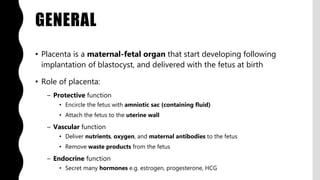
• Placenta is a maternal-fetal organ that start developing following
implantation of blastocyst, and delivered with the fetus at birth
• Role of placenta:
– Protective function
• Encircle the fetus with amniotic sac (containing fluid)
• Attach the fetus to the uterine wall
– Vascular function
• Deliver nutrients, oxygen, and maternal antibodies to the fetus
• Remove waste products from the fetus
– Endocrine function
• Secret many hormones e.g. estrogen, progesterone, HCG
GENERAL
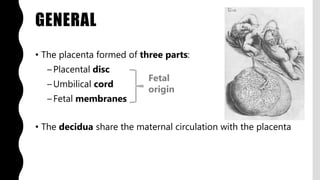
• The placenta formed of three parts:
–Placental disc
–Umbilical cord
–Fetal membranes
• The decidua share the maternal circulation with the placenta
Fetal
origin
PLACENTAL DISC
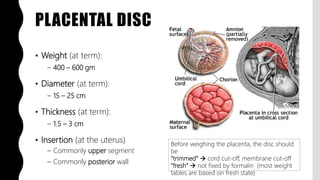
• Weight (at term):
– 400 – 600 gm
• Diameter (at term):
– 15 – 25 cm
• Thickness (at term):
– 1.5 – 3 cm
• Insertion (at the uterus)
– Commonly upper segment
– Commonly posterior wall
Before weighing the placenta, the disc should
be
“trimmed”  cord cut-off, membrane cut-off
“fresh”  not fixed by formalin (most weight
tables are based on fresh state)
PLACENTAL DISC
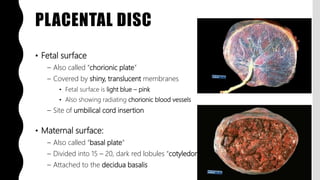
• Fetal surface
– Also called “chorionic plate”
– Covered by shiny, translucent membranes
• Fetal surface is light blue – pink
• Also showing radiating chorionic blood vessels
– Site of umbilical cord insertion
• Maternal surface:
– Also called “basal plate”
– Divided into 15 – 20, dark red lobules “cotyledons”
– Attached to the decidua basalis
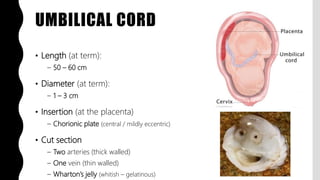
UMBILICAL CORD
• Length (at term):
– 50 – 60 cm
• Diameter (at term):
– 1 – 3 cm
• Insertion (at the placenta)
– Chorionic plate (central / mildly eccentric)
• Cut section
– Two arteries (thick walled)
– One vein (thin walled)
– Wharton’s jelly (whitish – gelatinous)
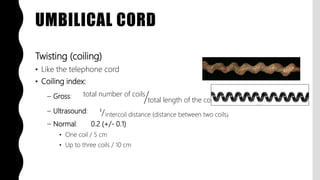
UMBILICAL CORD
Twisting (coiling)
• Like the telephone cord
• Coiling index:
– Gross: total number of coils
total length of the cord
– Ultrasound: 1
intercoil distance (distance between two coils)
– Normal: 0.2 (+/- 0.1)
• One coil / 5 cm
• Up to three coils / 10 cm
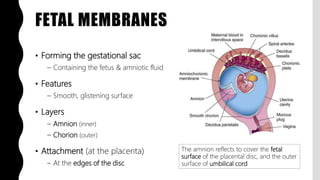
FETAL MEMBRANES
• Forming the gestational sac
– Containing the fetus & amniotic fluid
• Features
– Smooth, glistening surface
• Layers
– Amnion (inner)
– Chorion (outer)
• Attachment (at the placenta)
– At the edges of the disc
The amnion reflects to cover the fetal
surface of the placental disc, and the outer
surface of umbilical cord
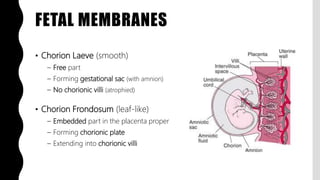
FETAL MEMBRANES
• Chorion Laeve (smooth)
– Free part
– Forming gestational sac (with amnion)
– No chorionic villi (atrophied)
• Chorion Frondosum (leaf-like)
– Embedded part in the placenta proper
– Forming chorionic plate
– Extending into chorionic villi
DECIDUA
• Endometrium of the pregnant uterus
– Contains maternal (endometrial) vessels
• Three parts
– Basalis: site of placental disc attachment
– Parietalis: lines of the rest of uterus
– Capsularis: covers the developing sac
• Eventually will fuse with the parietalis
in enlarged sac
WWW.
DO NOT FORGET TO SEARCH FOR MORE PICS
AND VIRTUAL SLIDES
THANK YOU
H a z e m A l i

FlashPath - Placenta - Anatomy

  • 1.
    FLASHPATH H a ze m A l i
  • 2.
  • 3.
    GENERAL • Placenta isa maternal-fetal organ that start developing following implantation of blastocyst, and delivered with the fetus at birth • Role of placenta: – Protective function • Encircle the fetus with amniotic sac (containing fluid) • Attach the fetus to the uterine wall – Vascular function • Deliver nutrients, oxygen, and maternal antibodies to the fetus • Remove waste products from the fetus – Endocrine function • Secret many hormones e.g. estrogen, progesterone, HCG
  • 4.
    GENERAL • The placentaformed of three parts: –Placental disc –Umbilical cord –Fetal membranes • The decidua share the maternal circulation with the placenta Fetal origin
  • 5.
    PLACENTAL DISC • Weight(at term): – 400 – 600 gm • Diameter (at term): – 15 – 25 cm • Thickness (at term): – 1.5 – 3 cm • Insertion (at the uterus) – Commonly upper segment – Commonly posterior wall Before weighing the placenta, the disc should be “trimmed”  cord cut-off, membrane cut-off “fresh”  not fixed by formalin (most weight tables are based on fresh state)
  • 6.
    PLACENTAL DISC • Fetalsurface – Also called “chorionic plate” – Covered by shiny, translucent membranes • Fetal surface is light blue – pink • Also showing radiating chorionic blood vessels – Site of umbilical cord insertion • Maternal surface: – Also called “basal plate” – Divided into 15 – 20, dark red lobules “cotyledons” – Attached to the decidua basalis
  • 7.
    UMBILICAL CORD • Length(at term): – 50 – 60 cm • Diameter (at term): – 1 – 3 cm • Insertion (at the placenta) – Chorionic plate (central / mildly eccentric) • Cut section – Two arteries (thick walled) – One vein (thin walled) – Wharton’s jelly (whitish – gelatinous)
  • 8.
    UMBILICAL CORD Twisting (coiling) •Like the telephone cord • Coiling index: – Gross: total number of coils total length of the cord – Ultrasound: 1 intercoil distance (distance between two coils) – Normal: 0.2 (+/- 0.1) • One coil / 5 cm • Up to three coils / 10 cm
  • 9.
    FETAL MEMBRANES • Formingthe gestational sac – Containing the fetus & amniotic fluid • Features – Smooth, glistening surface • Layers – Amnion (inner) – Chorion (outer) • Attachment (at the placenta) – At the edges of the disc The amnion reflects to cover the fetal surface of the placental disc, and the outer surface of umbilical cord
  • 10.
    FETAL MEMBRANES • ChorionLaeve (smooth) – Free part – Forming gestational sac (with amnion) – No chorionic villi (atrophied) • Chorion Frondosum (leaf-like) – Embedded part in the placenta proper – Forming chorionic plate – Extending into chorionic villi
  • 11.
    DECIDUA • Endometrium ofthe pregnant uterus – Contains maternal (endometrial) vessels • Three parts – Basalis: site of placental disc attachment – Parietalis: lines of the rest of uterus – Capsularis: covers the developing sac • Eventually will fuse with the parietalis in enlarged sac
  • 12.
    WWW. DO NOT FORGETTO SEARCH FOR MORE PICS AND VIRTUAL SLIDES
  • 13.
    THANK YOU H az e m A l i