SYLLABUS
CHEMICAL ENGINEER
By
Chemical Engineering Guy
www.ChemicalEngineeringGuy.com
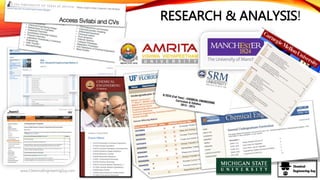
RESEARCH & ANALYSIS!
www.ChemicalEngineeringGuy.com
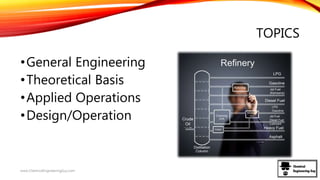
TOPICS
•General Engineering
•Theoretical Basis
•Applied Operations
•Design/Operation
www.ChemicalEngineeringGuy.com
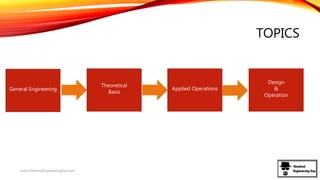
TOPICS
General Engineering
Theoretical
Basis
Applied Operations
Design
&
Operation
www.ChemicalEngineeringGuy.com
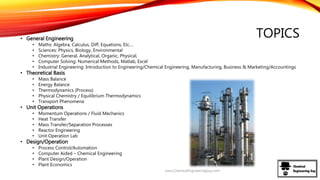
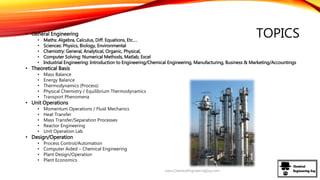
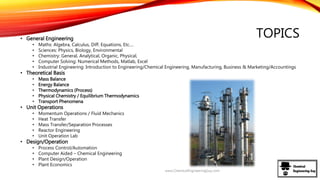
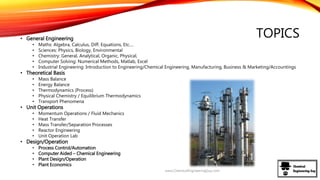
TOPICS• General Engineering
• Maths: Algebra, Calculus, Diff. Equations, Etc.…
• Sciences: Physics, Biology, Environmental
• Chemistry: General, Analytical, Organic, Physical,
• Computer Solving: Numerical Methods, Matlab, Excel
• Industrial Engineering: Introduction to Engineering/Chemical Engineering, Manufacturing, Business & Marketing/Accountings
• Theoretical Basis
• Mass Balance
• Energy Balance
• Thermodynamics (Process)
• Physical Chemistry / Equilibrium Thermodynamics
• Transport Phenomena
• Unit Operations
• Momentum Operations / Fluid Mechanics
• Heat Transfer
• Mass Transfer/Separation Processes
• Reactor Engineering
• Unit Operation Lab
• Design/Operation
• Process Control/Automation
• Computer Aided – Chemical Engineering
• Plant Design/Operation
• Plant Economics
www.ChemicalEngineeringGuy.com
TOPICS
•General Engineering
•Theoretical Basis
•Unit Operations
•Design/Operation
www.ChemicalEngineeringGuy.com
TOPICS• General Engineering
• Maths: Algebra, Calculus, Diff. Equations, Etc.…
• Sciences: Physics, Biology, Environmental
• Chemistry: General, Analytical, Organic, Physical,
• Computer Solving: Numerical Methods, Matlab, Excel
• Industrial Engineering: Introduction to Engineering/Chemical Engineering, Manufacturing, Business & Marketing/Accountings
• Theoretical Basis
• Mass Balance
• Energy Balance
• Thermodynamics (Process)
• Physical Chemistry / Equilibrium Thermodynamics
• Transport Phenomena
• Unit Operations
• Momentum Operations / Fluid Mechanics
• Heat Transfer
• Mass Transfer/Separation Processes
• Reactor Engineering
• Unit Operation Lab
• Design/Operation
• Process Control/Automation
• Computer Aided – Chemical Engineering
• Plant Design/Operation
• Plant Economics
www.ChemicalEngineeringGuy.com
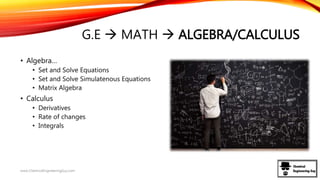
G.E  MATH  ALGEBRA/CALCULUS
• Algebra…
• Set and Solve Equations
• Set and Solve Simulatenous Equations
• Matrix Algebra
• Calculus
• Derivatives
• Rate of changes
• Integrals
www.ChemicalEngineeringGuy.com
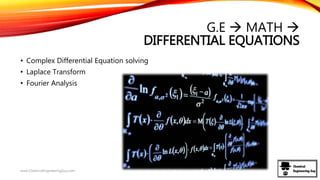
G.E  MATH 
DIFFERENTIAL EQUATIONS
• Complex Differential Equation solving
• Laplace Transform
• Fourier Analysis
www.ChemicalEngineeringGuy.com
G.E  SCIENCES
PHYSICS & BIOLOGY
www.ChemicalEngineeringGuy.com
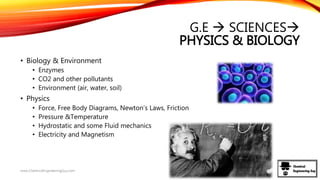
G.E  SCIENCES
PHYSICS & BIOLOGY
• Biology & Environment
• Enzymes
• CO2 and other pollutants
• Environment (air, water, soil)
• Physics
• Force, Free Body Diagrams, Newton’s Laws, Friction
• Pressure &Temperature
• Hydrostatic and some Fluid mechanics
• Electricity and Magnetism
www.ChemicalEngineeringGuy.com
G.E  SCIENCES
PHYSICS & BIOLOGY
www.ChemicalEngineeringGuy.com
G.E  CHEMISTRY
www.ChemicalEngineeringGuy.com
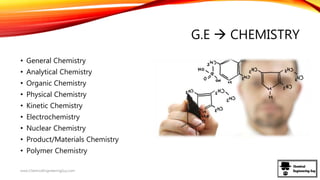
G.E  CHEMISTRY
• General Chemistry
• Analytical Chemistry
• Organic Chemistry
• Physical Chemistry
• Kinetic Chemistry
• Electrochemistry
• Nuclear Chemistry
• Product/Materials Chemistry
• Polymer Chemistry
www.ChemicalEngineeringGuy.com
G.E  CHEMISTRY 
GENERAL CHEM.
• Element/Component/Molecules/ions
• Mass Number, Electrons/Neutrons/Protons Atomic No.
• Periodic Table and its relationship
• Intra/Intermolecular Bondings and Geometry
• Type of Reactions
• Acid & Bases; Precipitation; Redox No. and Reactions, Single/double Replacement
• Basics on Equilibrium
• Mixtures/Solutions
• Reaction Balances
• Ideal Gas Law
www.ChemicalEngineeringGuy.com
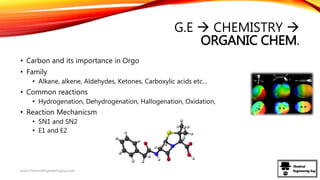
G.E  CHEMISTRY 
ORGANIC CHEM.
• Carbon and its importance in Orgo
• Family
• Alkane, alkene, Aldehydes, Ketones, Carboxylic acids etc…
• Common reactions
• Hydrogenation, Dehydrogenation, Hallogenation, Oxidation,
• Reaction Mechanicsm
• SN1 and SN2
• E1 and E2
www.ChemicalEngineeringGuy.com
G.E  CHEMISTRY 
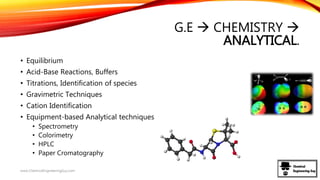
ANALYTICAL.
• Equilibrium
• Acid-Base Reactions, Buffers
• Titrations, Identification of species
• Gravimetric Techniques
• Cation Identification
• Equipment-based Analytical techniques
• Spectrometry
• Colorimetry
• HPLC
• Paper Cromatography
www.ChemicalEngineeringGuy.com
G.E  CHEMISTRY 
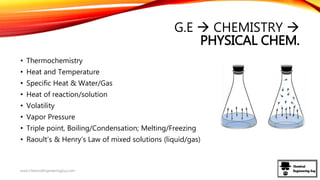
PHYSICAL CHEM.
• Thermochemistry
• Heat and Temperature
• Specific Heat & Water/Gas
• Heat of reaction/solution
• Volatility
• Vapor Pressure
• Triple point, Boiling/Condensation; Melting/Freezing
• Raoult’s & Henry’s Law of mixed solutions (liquid/gas)
www.ChemicalEngineeringGuy.com
G.E  CHEMISTRY 
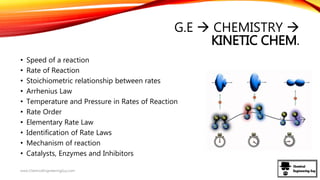
KINETIC CHEM.
• Speed of a reaction
• Rate of Reaction
• Stoichiometric relationship between rates
• Arrhenius Law
• Temperature and Pressure in Rates of Reaction
• Rate Order
• Elementary Rate Law
• Identification of Rate Laws
• Mechanism of reaction
• Catalysts, Enzymes and Inhibitors
www.ChemicalEngineeringGuy.com
G.E  CHEMISTRY 
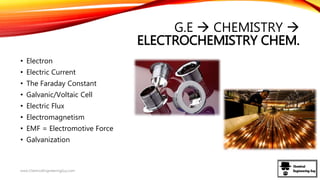
ELECTROCHEMISTRY CHEM.
• Electron
• Electric Current
• The Faraday Constant
• Galvanic/Voltaic Cell
• Electric Flux
• Electromagnetism
• EMF = Electromotive Force
• Galvanization
www.ChemicalEngineeringGuy.com
G.E  CHEMISTRY 
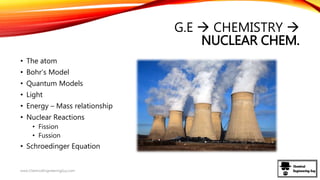
NUCLEAR CHEM.
• The atom
• Bohr’s Model
• Quantum Models
• Light
• Energy – Mass relationship
• Nuclear Reactions
• Fission
• Fussion
• Schroedinger Equation
www.ChemicalEngineeringGuy.com
G.E  CHEMISTRY 
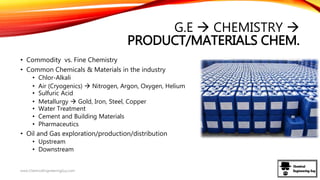
PRODUCT/MATERIALS CHEM.
• Commodity vs. Fine Chemistry
• Common Chemicals & Materials in the industry
• Chlor-Alkali
• Air (Cryogenics)  Nitrogen, Argon, Oxygen, Helium
• Sulfuric Acid
• Metallurgy  Gold, Iron, Steel, Copper
• Water Treatment
• Cement and Building Materials
• Pharmaceutics
• Oil and Gas exploration/production/distribution
• Upstream
• Downstream
www.ChemicalEngineeringGuy.com
G.E  CHEMISTRY 
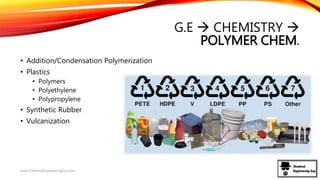
POLYMER CHEM.
• Addition/Condensation Polymerization
• Plastics
• Polymers
• Polyethylene
• Polypropylene
• Synthetic Rubber
• Vulcanization
www.ChemicalEngineeringGuy.com
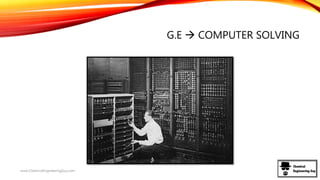
G.E  COMPUTER SOLVING
www.ChemicalEngineeringGuy.com
G.E  COMPUTER SOLVING
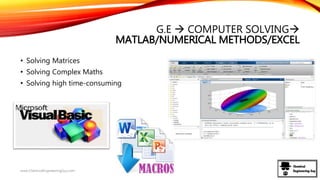
MATLAB/NUMERICAL METHODS/EXCEL
• Solving Matrices
• Solving Complex Maths
• Solving high time-consuming
www.ChemicalEngineeringGuy.com
G.E  COMPUTER SOLVING
MATLAB/NUMERICAL METHODS/EXCEL
www.ChemicalEngineeringGuy.com
G.E  INDUSTRIAL ENG.
www.ChemicalEngineeringGuy.com
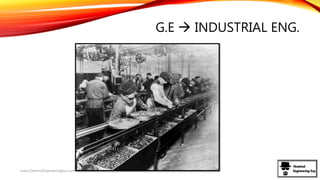
G.E  INDUSTRIAL ENG.
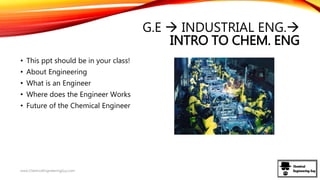
INTRO TO CHEM. ENG
• This ppt should be in your class!
• About Engineering
• What is an Engineer
• Where does the Engineer Works
• Future of the Chemical Engineer
www.ChemicalEngineeringGuy.com
G.E  INDUSTRIAL ENG.
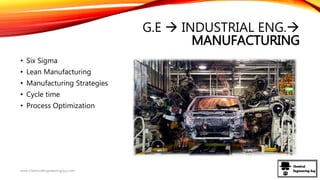
MANUFACTURING
• Six Sigma
• Lean Manufacturing
• Manufacturing Strategies
• Cycle time
• Process Optimization
www.ChemicalEngineeringGuy.com
G.E  INDUSTRIAL ENG.
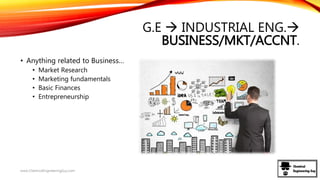
BUSINESS/MKT/ACCNT.
• Anything related to Business…
• Market Research
• Marketing fundamentals
• Basic Finances
• Entrepreneurship
www.ChemicalEngineeringGuy.com
G.E  INDUSTRIAL ENG.
BUSINESS/MKT/ACCNT.
www.ChemicalEngineeringGuy.com
TOPICS
•General Engineering
•Theoretical Basis
•Unit Operations
•Design/Operation
www.ChemicalEngineeringGuy.com
TOPICS• General Engineering
• Maths: Algebra, Calculus, Diff. Equations, Etc.…
• Sciences: Physics, Biology, Environmental
• Chemistry: General, Analytical, Organic, Physical,
• Computer Solving: Numerical Methods, Matlab, Excel
• Industrial Engineering: Introduction to Engineering/Chemical Engineering, Manufacturing, Business & Marketing/Accountings
• Theoretical Basis
• Mass Balance
• Energy Balance
• Thermodynamics (Process)
• Physical Chemistry / Equilibrium Thermodynamics
• Transport Phenomena
• Unit Operations
• Momentum Operations / Fluid Mechanics
• Heat Transfer
• Mass Transfer/Separation Processes
• Reactor Engineering
• Unit Operation Lab
• Design/Operation
• Process Control/Automation
• Computer Aided – Chemical Engineering
• Plant Design/Operation
• Plant Economics
www.ChemicalEngineeringGuy.com
THEORETICAL BASIS
www.ChemicalEngineeringGuy.com
THEORETICAL BASIS
• Mass Balance
• Energy Balance
• Thermodynamics (Process)
• Physical Chemistry / Equilibrium Thermodynamics
• Transport Phenomena
www.ChemicalEngineeringGuy.com
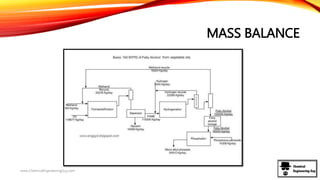
MASS BALANCE
www.ChemicalEngineeringGuy.com
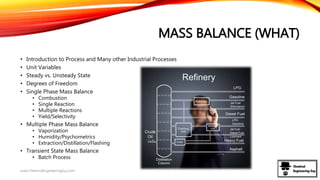
MASS BALANCE (WHAT)
• Introduction to Process and Many other Industrial Processes
• Unit Variables
• Steady vs. Unsteady State
• Degrees of Freedom
• Single Phase Mass Balance
• Combustion
• Single Reaction
• Multiple Reactions
• Yield/Selectivity
• Multiple Phase Mass Balance
• Vaporization
• Humidity/Psychometrics
• Extraction/Distillation/Flashing
• Transient State Mass Balance
• Batch Process
www.ChemicalEngineeringGuy.com
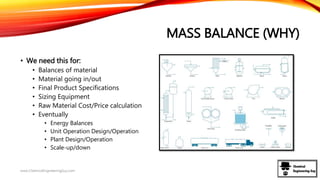
MASS BALANCE (WHY)
• We need this for:
• Balances of material
• Material going in/out
• Final Product Specifications
• Sizing Equipment
• Raw Material Cost/Price calculation
• Eventually
• Energy Balances
• Unit Operation Design/Operation
• Plant Design/Operation
• Scale-up/down
www.ChemicalEngineeringGuy.com
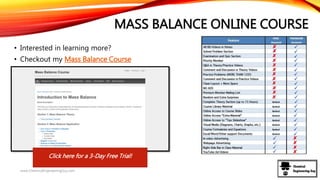
MASS BALANCE ONLINE COURSE
• Interested in learning more?
• Checkout my Mass Balance Course
Click here for a 3-Day Free Trial!
www.ChemicalEngineeringGuy.com
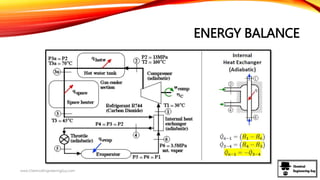
ENERGY BALANCE
www.ChemicalEngineeringGuy.com
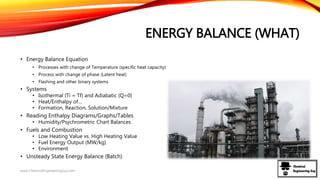
ENERGY BALANCE (WHAT)
• Energy Balance Equation
• Processes with change of Temperature (specific heat capacity)
• Process with change of phase (Latent heat)
• Flashing and other binary systems
• Systems
• Isothermal (Ti = Tf) and Adiabatic (Q=0)
• Heat/Enthalpy of…
• Formation, Reaction, Solution/Mixture
• Reading Enthalpy Diagrams/Graphs/Tables
• Humidity/Psychrometric Chart Balances
• Fuels and Combustion
• Low Heating Value vs. High Heating Value
• Fuel Energy Output (MW/kg)
• Environment
• Unsteady State Energy Balance (Batch)
www.ChemicalEngineeringGuy.com
ENERGY BALANCE (WHY)
• Calculate Energy requirement of Process/Units
• Fuel consumption calculation
• Unit Operation Design/Operation
• Utility Requirements
• Pricing/Costing of energy consumption
• CO2 emissions
• Temperature Calculations
• Equilibrium Calculations
www.ChemicalEngineeringGuy.com
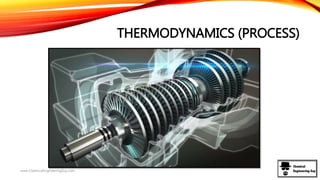
THERMODYNAMICS (PROCESS)
www.ChemicalEngineeringGuy.com
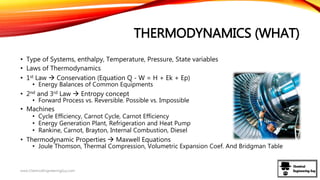
THERMODYNAMICS (WHAT)
• Type of Systems, enthalpy, Temperature, Pressure, State variables
• Laws of Thermodynamics
• 1st Law  Conservation (Equation Q - W = H + Ek + Ep)
• Energy Balances of Common Equipments
• 2nd and 3rd Law  Entropy concept
• Forward Process vs. Reversible. Possible vs. Impossible
• Machines
• Cycle Efficiency, Carnot Cycle, Carnot Efficiency
• Energy Generation Plant, Refrigeration and Heat Pump
• Rankine, Carnot, Brayton, Internal Combustion, Diesel
• Thermodynamic Properties  Maxwell Equations
• Joule Thomson, Thermal Compression, Volumetric Expansion Coef. And Bridgman Table
www.ChemicalEngineeringGuy.com
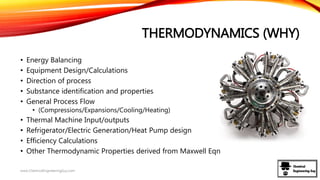
THERMODYNAMICS (WHY)
• Energy Balancing
• Equipment Design/Calculations
• Direction of process
• Substance identification and properties
• General Process Flow
• (Compressions/Expansions/Cooling/Heating)
• Thermal Machine Input/outputs
• Refrigerator/Electric Generation/Heat Pump design
• Efficiency Calculations
• Other Thermodynamic Properties derived from Maxwell Eqn
www.ChemicalEngineeringGuy.com
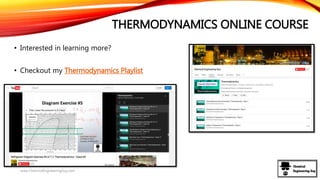
THERMODYNAMICS ONLINE COURSE
• Interested in learning more?
• Checkout my Thermodynamics Playlist
www.ChemicalEngineeringGuy.com
PHYSICAL CHEMISTRY / EQUILIBRIUM
THERMODYNAMICS
www.ChemicalEngineeringGuy.com
PHYSICAL CHEMISTRY/ EQUILIBRIUM
THERMODYNAMICS (WHAT)
• Definitions and Introduction in Equilibrium (Phase Equilibrium)
• Gibbs free Energy
• Fugacity of gases
• Van’t Hoff Equation & Clasius-Clapeyron Equation
• Multicomponent Mixtures
• Liquid-Vapor Equilibrium (LVE)
• Residual Properties and Real Mixtures
• Henry and Raoult Law (ideal)
• The law deviations, azeotropes, activity coeff…
• Ideal Solution and Real Gas (IS-RG)  Ki of substances
• Real Solution and Real Gas (RS-RG)  Margules, Van Laar, Wilson, NRTL and UNIQUAC,
UNIFAC
• Reaction Equilibrium
www.ChemicalEngineeringGuy.com
PHYSICAL CHEMISTRY/EQUILIBRIUM
THERMODYNAMICS (WHY)
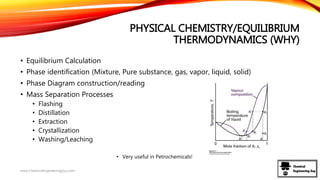
• Equilibrium Calculation
• Phase identification (Mixture, Pure substance, gas, vapor, liquid, solid)
• Phase Diagram construction/reading
• Mass Separation Processes
• Flashing
• Distillation
• Extraction
• Crystallization
• Washing/Leaching
• Very useful in Petrochemicals!
www.ChemicalEngineeringGuy.com
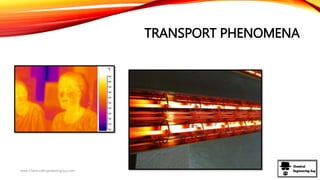
TRANSPORT PHENOMENA
www.ChemicalEngineeringGuy.com
TRANSPORT PHENOMENA (WHAT)
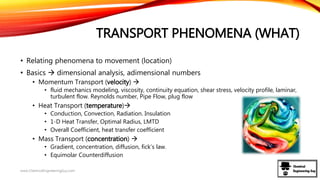
• Relating phenomena to movement (location)
• Basics  dimensional analysis, adimensional numbers
• Momentum Transport (velocity) 
• fluid mechanics modeling, viscosity, continuity equation, shear stress, velocity profile, laminar,
turbulent flow. Reynolds number, Pipe Flow, plug flow
• Heat Transport (temperature)
• Conduction, Convection, Radiation. Insulation
• 1-D Heat Transfer, Optimal Radius, LMTD
• Overall Coefficient, heat transfer coefficient
• Mass Transport (concentration) 
• Gradient, concentration, diffusion, fick’s law.
• Equimolar Counterdiffusion
www.ChemicalEngineeringGuy.com
TRANSPORT PHENOMENA (WHY)
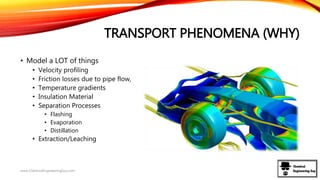
• Model a LOT of things
• Velocity profiling
• Friction losses due to pipe flow,
• Temperature gradients
• Insulation Material
• Separation Processes
• Flashing
• Evaporation
• Distillation
• Extraction/Leaching
www.ChemicalEngineeringGuy.com
TOPICS
•General Engineering
•Theoretical Basis
•Unit Operations
•Design/Operation
www.ChemicalEngineeringGuy.com
TOPICS• General Engineering
• Maths: Algebra, Calculus, Diff. Equations, Etc.…
• Sciences: Physics, Biology, Environmental
• Chemistry: General, Analytical, Organic, Physical,
• Computer Solving: Numerical Methods, Matlab, Excel
• Industrial Engineering: Introduction to Engineering/Chemical Engineering, Manufacturing, Business & Marketing/Accountings
• Theoretical Basis
• Mass Balance
• Energy Balance
• Thermodynamics (Process)
• Physical Chemistry / Equilibrium Thermodynamics
• Transport Phenomena
• Unit Operations
• Momentum Operations / Fluid Mechanics
• Heat Transfer
• Mass Transfer/Separation Processes
• Reactor Engineering
• Unit Operation Lab
• Design/Operation
• Process Control/Automation
• Computer Aided – Chemical Engineering
• Plant Design/Operation
• Plant Economics
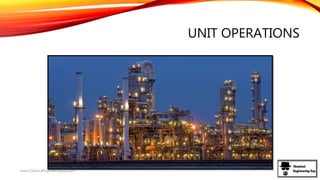
UNIT OPERATIONS
www.ChemicalEngineeringGuy.com
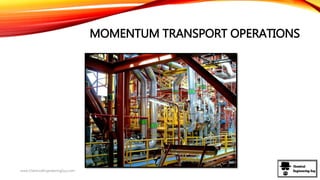
MOMENTUM TRANSPORT OPERATIONS
www.ChemicalEngineeringGuy.com
MOMENTUM TRANSFER
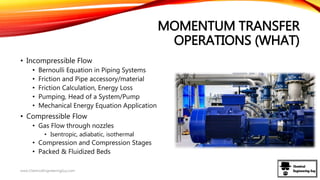
OPERATIONS (WHAT)
• Incompressible Flow
• Bernoulli Equation in Piping Systems
• Friction and Pipe accessory/material
• Friction Calculation, Energy Loss
• Pumping, Head of a System/Pump
• Mechanical Energy Equation Application
• Compressible Flow
• Gas Flow through nozzles
• Isentropic, adiabatic, isothermal
• Compression and Compression Stages
• Packed & Fluidized Beds
www.ChemicalEngineeringGuy.com
MOMENTUM TRANSFER
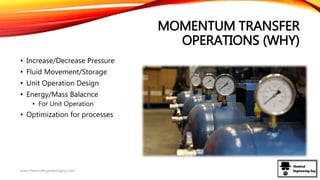
OPERATIONS (WHY)
• Increase/Decrease Pressure
• Fluid Movement/Storage
• Unit Operation Design
• Energy/Mass Balacnce
• For Unit Operation
• Optimization for processes
www.ChemicalEngineeringGuy.com
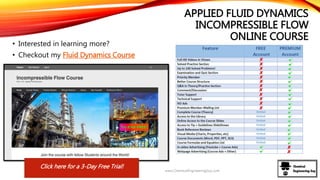
APPLIED FLUID DYNAMICS
INCOMPRESSIBLE FLOW
ONLINE COURSE
• Interested in learning more?
• Checkout my Fluid Dynamics Course
Click here for a 3-Day Free Trial!
www.ChemicalEngineeringGuy.com
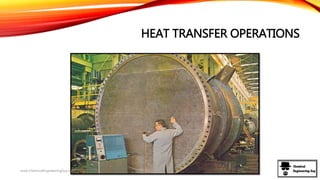
HEAT TRANSFER OPERATIONS
www.ChemicalEngineeringGuy.com
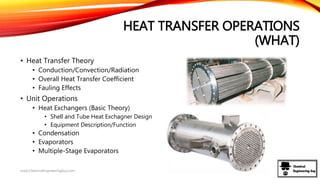
HEAT TRANSFER OPERATIONS
(WHAT)
• Heat Transfer Theory
• Conduction/Convection/Radiation
• Overall Heat Transfer Coefficient
• Fauling Effects
• Unit Operations
• Heat Exchangers (Basic Theory)
• Shell and Tube Heat Exchagner Design
• Equipment Description/Function
• Condensation
• Evaporators
• Multiple-Stage Evaporators
www.ChemicalEngineeringGuy.com
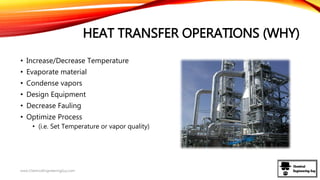
HEAT TRANSFER OPERATIONS (WHY)
• Increase/Decrease Temperature
• Evaporate material
• Condense vapors
• Design Equipment
• Decrease Fauling
• Optimize Process
• (i.e. Set Temperature or vapor quality)
www.ChemicalEngineeringGuy.com
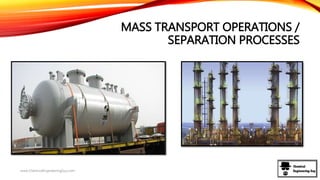
MASS TRANSPORT OPERATIONS /
SEPARATION PROCESSES
www.ChemicalEngineeringGuy.com
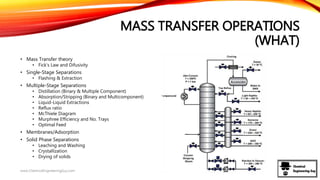
MASS TRANSFER OPERATIONS
(WHAT)
• Mass Transfer theory
• Fick’s Law and Difusivity
• Single-Stage Separations
• Flashing & Extraction
• Multiple-Stage Separations
• Distillation (Binary & Multiple Component)
• Absorption/Stripping (Binary and Multicomponent)
• Liquid-Liquid Extractions
• Reflux ratio
• McThiele Diagram
• Murphree Efficiency and No. Trays
• Optimal Feed
• Membranes/Adsorption
• Solid Phase Separations
• Leaching and Washing
• Crystallization
• Drying of solids
www.ChemicalEngineeringGuy.com
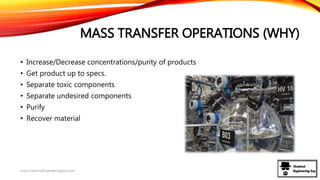
MASS TRANSFER OPERATIONS (WHY)
• Increase/Decrease concentrations/purity of products
• Get product up to specs.
• Separate toxic components
• Separate undesired components
• Purify
• Recover material
www.ChemicalEngineeringGuy.com
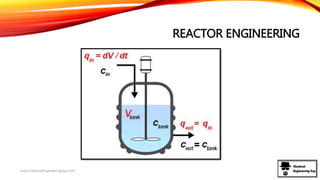
REACTOR ENGINEERING
www.ChemicalEngineeringGuy.com
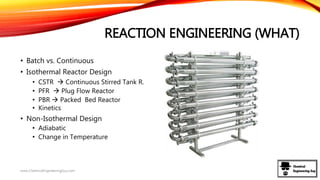
REACTION ENGINEERING (WHAT)
• Batch vs. Continuous
• Isothermal Reactor Design
• CSTR  Continuous Stirred Tank R.
• PFR  Plug Flow Reactor
• PBR  Packed Bed Reactor
• Kinetics
• Non-Isothermal Design
• Adiabatic
• Change in Temperature
www.ChemicalEngineeringGuy.com
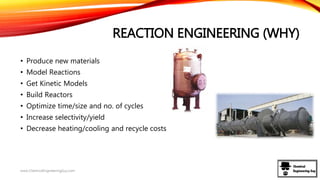
REACTION ENGINEERING (WHY)
• Produce new materials
• Model Reactions
• Get Kinetic Models
• Build Reactors
• Optimize time/size and no. of cycles
• Increase selectivity/yield
• Decrease heating/cooling and recycle costs
www.ChemicalEngineeringGuy.com
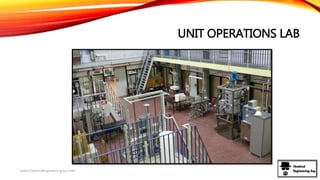
UNIT OPERATIONS LAB
www.ChemicalEngineeringGuy.com
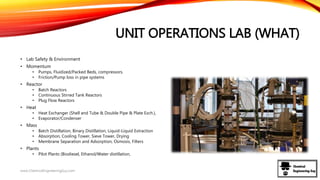
UNIT OPERATIONS LAB (WHAT)
• Lab Safety & Environment
• Momentum
• Pumps, Fluidized/Packed Beds, compressors.
• Friction/Pump loss in pipe systems
• Reactor
• Batch Reactors
• Continuous Stirred Tank Reactors
• Plug Flow Reactors
• Heat
• Heat Exchanger (Shell and Tube & Double Pipe & Plate Exch.),
• Evaporator/Condenser
• Mass
• Batch Distillation, Binary Distillation, Liquid-Liquid Extraction
• Absorption, Cooling Tower, Sieve Tower, Drying
• Membrane Separation and Adsorption, Osmosis, Filters
• Plants
• Pilot Plants (Biodiesel, Ethanol/Water distillation,
www.ChemicalEngineeringGuy.com
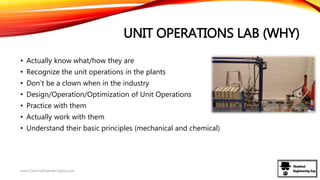
UNIT OPERATIONS LAB (WHY)
• Actually know what/how they are
• Recognize the unit operations in the plants
• Don’t be a clown when in the industry
• Design/Operation/Optimization of Unit Operations
• Practice with them
• Actually work with them
• Understand their basic principles (mechanical and chemical)
www.ChemicalEngineeringGuy.com
TOPICS
•General Engineering
•Theoretical Basis
•Applied Operations
•Design/Operation
www.ChemicalEngineeringGuy.com
TOPICS• General Engineering
• Maths: Algebra, Calculus, Diff. Equations, Etc.…
• Sciences: Physics, Biology, Environmental
• Chemistry: General, Analytical, Organic, Physical,
• Computer Solving: Numerical Methods, Matlab, Excel
• Industrial Engineering: Introduction to Engineering/Chemical Engineering, Manufacturing, Business & Marketing/Accountings
• Theoretical Basis
• Mass Balance
• Energy Balance
• Thermodynamics (Process)
• Physical Chemistry / Equilibrium Thermodynamics
• Transport Phenomena
• Unit Operations
• Momentum Operations / Fluid Mechanics
• Heat Transfer
• Mass Transfer/Separation Processes
• Reactor Engineering
• Unit Operation Lab
• Design/Operation
• Process Control/Automation
• Computer Aided – Chemical Engineering
• Plant Design/Operation
• Plant Economics
www.ChemicalEngineeringGuy.com
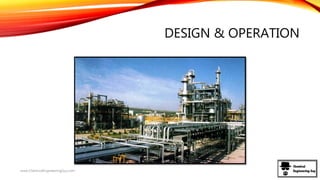
DESIGN & OPERATION
www.ChemicalEngineeringGuy.com
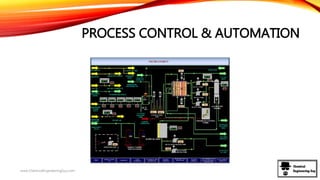
PROCESS CONTROL & AUTOMATION
www.ChemicalEngineeringGuy.com
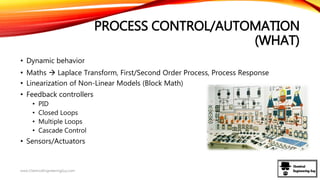
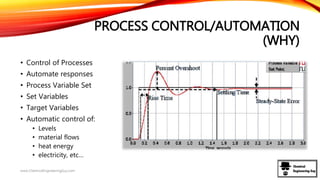
PROCESS CONTROL/AUTOMATION
(WHAT)
• Dynamic behavior
• Maths  Laplace Transform, First/Second Order Process, Process Response
• Linearization of Non-Linear Models (Block Math)
• Feedback controllers
• PID
• Closed Loops
• Multiple Loops
• Cascade Control
• Sensors/Actuators
www.ChemicalEngineeringGuy.com
PROCESS CONTROL/AUTOMATION
(WHY)
• Control of Processes
• Automate responses
• Process Variable Set
• Set Variables
• Target Variables
• Automatic control of:
• Levels
• material flows
• heat energy
• electricity, etc…
www.ChemicalEngineeringGuy.com
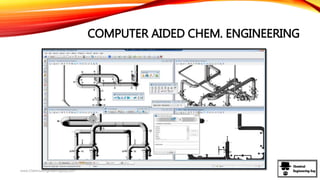
COMPUTER AIDED CHEM. ENGINEERING
www.ChemicalEngineeringGuy.com
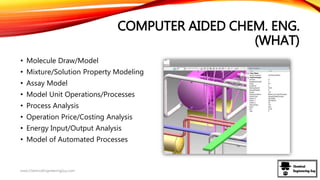
COMPUTER AIDED CHEM. ENG.
(WHAT)
• Molecule Draw/Model
• Mixture/Solution Property Modeling
• Assay Model
• Model Unit Operations/Processes
• Process Analysis
• Operation Price/Costing Analysis
• Energy Input/Output Analysis
• Model of Automated Processes
www.ChemicalEngineeringGuy.com
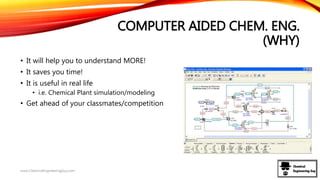
COMPUTER AIDED CHEM. ENG.
(WHY)
• It will help you to understand MORE!
• It saves you time!
• It is useful in real life
• i.e. Chemical Plant simulation/modeling
• Get ahead of your classmates/competition
www.ChemicalEngineeringGuy.com
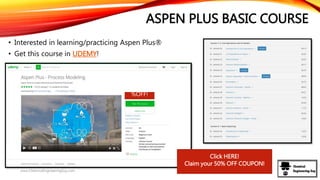
ASPEN PLUS BASIC COURSE
• Interested in learning/practicing Aspen Plus®
• Get this course in UDEMY!
Click HERE!
Claim your 50% OFF COUPON!
%OFF!
www.ChemicalEngineeringGuy.com
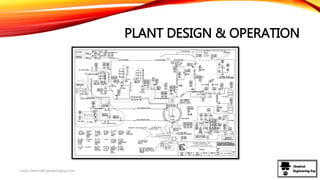
PLANT DESIGN & OPERATION
www.ChemicalEngineeringGuy.com
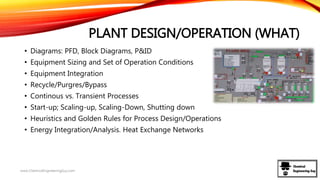
PLANT DESIGN/OPERATION (WHAT)
• Diagrams: PFD, Block Diagrams, P&ID
• Equipment Sizing and Set of Operation Conditions
• Equipment Integration
• Recycle/Purgres/Bypass
• Continous vs. Transient Processes
• Start-up; Scaling-up, Scaling-Down, Shutting down
• Heuristics and Golden Rules for Process Design/Operations
• Energy Integration/Analysis. Heat Exchange Networks
www.ChemicalEngineeringGuy.com
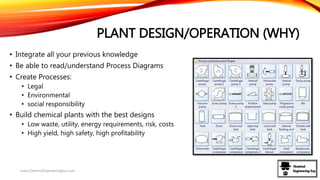
PLANT DESIGN/OPERATION (WHY)
• Integrate all your previous knowledge
• Be able to read/understand Process Diagrams
• Create Processes:
• Legal
• Environmental
• social responsibility
• Build chemical plants with the best designs
• Low waste, utility, energy requirements, risk, costs
• High yield, high safety, high profitability
www.ChemicalEngineeringGuy.com
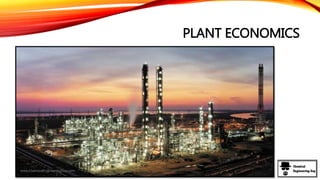
PLANT ECONOMICS
www.ChemicalEngineeringGuy.com
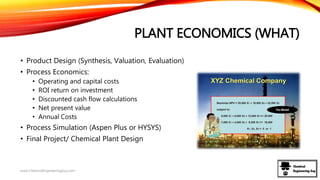
PLANT ECONOMICS (WHAT)
• Product Design (Synthesis, Valuation, Evaluation)
• Process Economics:
• Operating and capital costs
• ROI return on investment
• Discounted cash flow calculations
• Net present value
• Annual Costs
• Process Simulation (Aspen Plus or HYSYS)
• Final Project/ Chemical Plant Design
www.ChemicalEngineeringGuy.com
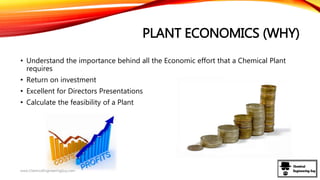
PLANT ECONOMICS (WHY)
• Understand the importance behind all the Economic effort that a Chemical Plant
requires
• Return on investment
• Excellent for Directors Presentations
• Calculate the feasibility of a Plant
www.ChemicalEngineeringGuy.com
YOU’RE DONE!
• This courses are, in general, what an average Chemical Engineer should take!
• After this, you may call yourself a Chemical Engineer!
• Now go and study!
www.ChemicalEngineeringGuy.com
CONTACT INFO
• Ready to study?
• Checkout my newsletter; enroll for extra
information, an e-book and many
coupons I give away!
GO NEWLETTER 
www.ChemicalEngineeringGuy.com
CONTACT INFO
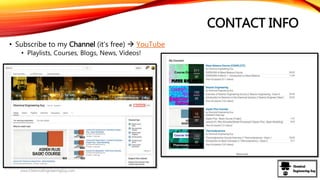
• Subscribe to my Channel (it’s free)  YouTube
• Playlists, Courses, Blogs, News, Videos!
www.ChemicalEngineeringGuy.com
CONTACT INFO
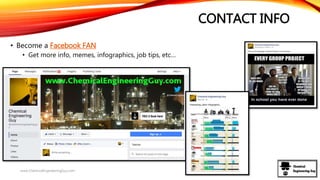
• Become a Facebook FAN
• Get more info, memes, infographics, job tips, etc…
www.ChemicalEngineeringGuy.com
CONTACT INFO
• Checkout my Courses at my SITE
ChemicalEngineeringGuy.com
www.ChemicalEngineeringGuy.com
CONTACT INFO
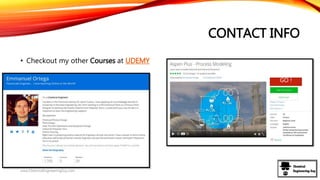
• Checkout my other Courses at UDEMY
GO !
www.ChemicalEngineeringGuy.com
THANK YOU!
Contact@ChemicalEngineeringGuy.com
Chemical.Engineering.Guy@Gmail.com
www.ChemicalEngineeringGuy.com

Chemical Engineering Syllabus Explained

  • 1.
    SYLLABUS CHEMICAL ENGINEER By Chemical EngineeringGuy www.ChemicalEngineeringGuy.com
  • 2.
  • 3.
    TOPICS •General Engineering •Theoretical Basis •AppliedOperations •Design/Operation www.ChemicalEngineeringGuy.com
  • 4.
  • 5.
    TOPICS• General Engineering •Maths: Algebra, Calculus, Diff. Equations, Etc.… • Sciences: Physics, Biology, Environmental • Chemistry: General, Analytical, Organic, Physical, • Computer Solving: Numerical Methods, Matlab, Excel • Industrial Engineering: Introduction to Engineering/Chemical Engineering, Manufacturing, Business & Marketing/Accountings • Theoretical Basis • Mass Balance • Energy Balance • Thermodynamics (Process) • Physical Chemistry / Equilibrium Thermodynamics • Transport Phenomena • Unit Operations • Momentum Operations / Fluid Mechanics • Heat Transfer • Mass Transfer/Separation Processes • Reactor Engineering • Unit Operation Lab • Design/Operation • Process Control/Automation • Computer Aided – Chemical Engineering • Plant Design/Operation • Plant Economics www.ChemicalEngineeringGuy.com
  • 6.
    TOPICS •General Engineering •Theoretical Basis •UnitOperations •Design/Operation www.ChemicalEngineeringGuy.com
  • 7.
    TOPICS• General Engineering •Maths: Algebra, Calculus, Diff. Equations, Etc.… • Sciences: Physics, Biology, Environmental • Chemistry: General, Analytical, Organic, Physical, • Computer Solving: Numerical Methods, Matlab, Excel • Industrial Engineering: Introduction to Engineering/Chemical Engineering, Manufacturing, Business & Marketing/Accountings • Theoretical Basis • Mass Balance • Energy Balance • Thermodynamics (Process) • Physical Chemistry / Equilibrium Thermodynamics • Transport Phenomena • Unit Operations • Momentum Operations / Fluid Mechanics • Heat Transfer • Mass Transfer/Separation Processes • Reactor Engineering • Unit Operation Lab • Design/Operation • Process Control/Automation • Computer Aided – Chemical Engineering • Plant Design/Operation • Plant Economics www.ChemicalEngineeringGuy.com
  • 8.
    G.E  MATH ALGEBRA/CALCULUS • Algebra… • Set and Solve Equations • Set and Solve Simulatenous Equations • Matrix Algebra • Calculus • Derivatives • Rate of changes • Integrals www.ChemicalEngineeringGuy.com
  • 9.
    G.E  MATH DIFFERENTIAL EQUATIONS • Complex Differential Equation solving • Laplace Transform • Fourier Analysis www.ChemicalEngineeringGuy.com
  • 10.
    G.E  SCIENCES PHYSICS& BIOLOGY www.ChemicalEngineeringGuy.com
  • 11.
    G.E  SCIENCES PHYSICS& BIOLOGY • Biology & Environment • Enzymes • CO2 and other pollutants • Environment (air, water, soil) • Physics • Force, Free Body Diagrams, Newton’s Laws, Friction • Pressure &Temperature • Hydrostatic and some Fluid mechanics • Electricity and Magnetism www.ChemicalEngineeringGuy.com
  • 12.
    G.E  SCIENCES PHYSICS& BIOLOGY www.ChemicalEngineeringGuy.com
  • 13.
  • 14.
    G.E  CHEMISTRY •General Chemistry • Analytical Chemistry • Organic Chemistry • Physical Chemistry • Kinetic Chemistry • Electrochemistry • Nuclear Chemistry • Product/Materials Chemistry • Polymer Chemistry www.ChemicalEngineeringGuy.com
  • 15.
    G.E  CHEMISTRY GENERAL CHEM. • Element/Component/Molecules/ions • Mass Number, Electrons/Neutrons/Protons Atomic No. • Periodic Table and its relationship • Intra/Intermolecular Bondings and Geometry • Type of Reactions • Acid & Bases; Precipitation; Redox No. and Reactions, Single/double Replacement • Basics on Equilibrium • Mixtures/Solutions • Reaction Balances • Ideal Gas Law www.ChemicalEngineeringGuy.com
  • 16.
    G.E  CHEMISTRY ORGANIC CHEM. • Carbon and its importance in Orgo • Family • Alkane, alkene, Aldehydes, Ketones, Carboxylic acids etc… • Common reactions • Hydrogenation, Dehydrogenation, Hallogenation, Oxidation, • Reaction Mechanicsm • SN1 and SN2 • E1 and E2 www.ChemicalEngineeringGuy.com
  • 17.
    G.E  CHEMISTRY ANALYTICAL. • Equilibrium • Acid-Base Reactions, Buffers • Titrations, Identification of species • Gravimetric Techniques • Cation Identification • Equipment-based Analytical techniques • Spectrometry • Colorimetry • HPLC • Paper Cromatography www.ChemicalEngineeringGuy.com
  • 18.
    G.E  CHEMISTRY PHYSICAL CHEM. • Thermochemistry • Heat and Temperature • Specific Heat & Water/Gas • Heat of reaction/solution • Volatility • Vapor Pressure • Triple point, Boiling/Condensation; Melting/Freezing • Raoult’s & Henry’s Law of mixed solutions (liquid/gas) www.ChemicalEngineeringGuy.com
  • 19.
    G.E  CHEMISTRY KINETIC CHEM. • Speed of a reaction • Rate of Reaction • Stoichiometric relationship between rates • Arrhenius Law • Temperature and Pressure in Rates of Reaction • Rate Order • Elementary Rate Law • Identification of Rate Laws • Mechanism of reaction • Catalysts, Enzymes and Inhibitors www.ChemicalEngineeringGuy.com
  • 20.
    G.E  CHEMISTRY ELECTROCHEMISTRY CHEM. • Electron • Electric Current • The Faraday Constant • Galvanic/Voltaic Cell • Electric Flux • Electromagnetism • EMF = Electromotive Force • Galvanization www.ChemicalEngineeringGuy.com
  • 21.
    G.E  CHEMISTRY NUCLEAR CHEM. • The atom • Bohr’s Model • Quantum Models • Light • Energy – Mass relationship • Nuclear Reactions • Fission • Fussion • Schroedinger Equation www.ChemicalEngineeringGuy.com
  • 22.
    G.E  CHEMISTRY PRODUCT/MATERIALS CHEM. • Commodity vs. Fine Chemistry • Common Chemicals & Materials in the industry • Chlor-Alkali • Air (Cryogenics)  Nitrogen, Argon, Oxygen, Helium • Sulfuric Acid • Metallurgy  Gold, Iron, Steel, Copper • Water Treatment • Cement and Building Materials • Pharmaceutics • Oil and Gas exploration/production/distribution • Upstream • Downstream www.ChemicalEngineeringGuy.com
  • 23.
    G.E  CHEMISTRY POLYMER CHEM. • Addition/Condensation Polymerization • Plastics • Polymers • Polyethylene • Polypropylene • Synthetic Rubber • Vulcanization www.ChemicalEngineeringGuy.com
  • 24.
    G.E  COMPUTERSOLVING www.ChemicalEngineeringGuy.com
  • 25.
    G.E  COMPUTERSOLVING MATLAB/NUMERICAL METHODS/EXCEL • Solving Matrices • Solving Complex Maths • Solving high time-consuming www.ChemicalEngineeringGuy.com
  • 26.
    G.E  COMPUTERSOLVING MATLAB/NUMERICAL METHODS/EXCEL www.ChemicalEngineeringGuy.com
  • 27.
    G.E  INDUSTRIALENG. www.ChemicalEngineeringGuy.com
  • 28.
    G.E  INDUSTRIALENG. INTRO TO CHEM. ENG • This ppt should be in your class! • About Engineering • What is an Engineer • Where does the Engineer Works • Future of the Chemical Engineer www.ChemicalEngineeringGuy.com
  • 29.
    G.E  INDUSTRIALENG. MANUFACTURING • Six Sigma • Lean Manufacturing • Manufacturing Strategies • Cycle time • Process Optimization www.ChemicalEngineeringGuy.com
  • 30.
    G.E  INDUSTRIALENG. BUSINESS/MKT/ACCNT. • Anything related to Business… • Market Research • Marketing fundamentals • Basic Finances • Entrepreneurship www.ChemicalEngineeringGuy.com
  • 31.
    G.E  INDUSTRIALENG. BUSINESS/MKT/ACCNT. www.ChemicalEngineeringGuy.com
  • 32.
    TOPICS •General Engineering •Theoretical Basis •UnitOperations •Design/Operation www.ChemicalEngineeringGuy.com
  • 33.
    TOPICS• General Engineering •Maths: Algebra, Calculus, Diff. Equations, Etc.… • Sciences: Physics, Biology, Environmental • Chemistry: General, Analytical, Organic, Physical, • Computer Solving: Numerical Methods, Matlab, Excel • Industrial Engineering: Introduction to Engineering/Chemical Engineering, Manufacturing, Business & Marketing/Accountings • Theoretical Basis • Mass Balance • Energy Balance • Thermodynamics (Process) • Physical Chemistry / Equilibrium Thermodynamics • Transport Phenomena • Unit Operations • Momentum Operations / Fluid Mechanics • Heat Transfer • Mass Transfer/Separation Processes • Reactor Engineering • Unit Operation Lab • Design/Operation • Process Control/Automation • Computer Aided – Chemical Engineering • Plant Design/Operation • Plant Economics www.ChemicalEngineeringGuy.com
  • 34.
  • 35.
    THEORETICAL BASIS • MassBalance • Energy Balance • Thermodynamics (Process) • Physical Chemistry / Equilibrium Thermodynamics • Transport Phenomena www.ChemicalEngineeringGuy.com
  • 36.
  • 37.
    MASS BALANCE (WHAT) •Introduction to Process and Many other Industrial Processes • Unit Variables • Steady vs. Unsteady State • Degrees of Freedom • Single Phase Mass Balance • Combustion • Single Reaction • Multiple Reactions • Yield/Selectivity • Multiple Phase Mass Balance • Vaporization • Humidity/Psychometrics • Extraction/Distillation/Flashing • Transient State Mass Balance • Batch Process www.ChemicalEngineeringGuy.com
  • 38.
    MASS BALANCE (WHY) •We need this for: • Balances of material • Material going in/out • Final Product Specifications • Sizing Equipment • Raw Material Cost/Price calculation • Eventually • Energy Balances • Unit Operation Design/Operation • Plant Design/Operation • Scale-up/down www.ChemicalEngineeringGuy.com
  • 39.
    MASS BALANCE ONLINECOURSE • Interested in learning more? • Checkout my Mass Balance Course Click here for a 3-Day Free Trial! www.ChemicalEngineeringGuy.com
  • 40.
  • 41.
    ENERGY BALANCE (WHAT) •Energy Balance Equation • Processes with change of Temperature (specific heat capacity) • Process with change of phase (Latent heat) • Flashing and other binary systems • Systems • Isothermal (Ti = Tf) and Adiabatic (Q=0) • Heat/Enthalpy of… • Formation, Reaction, Solution/Mixture • Reading Enthalpy Diagrams/Graphs/Tables • Humidity/Psychrometric Chart Balances • Fuels and Combustion • Low Heating Value vs. High Heating Value • Fuel Energy Output (MW/kg) • Environment • Unsteady State Energy Balance (Batch) www.ChemicalEngineeringGuy.com
  • 42.
    ENERGY BALANCE (WHY) •Calculate Energy requirement of Process/Units • Fuel consumption calculation • Unit Operation Design/Operation • Utility Requirements • Pricing/Costing of energy consumption • CO2 emissions • Temperature Calculations • Equilibrium Calculations www.ChemicalEngineeringGuy.com
  • 43.
  • 44.
    THERMODYNAMICS (WHAT) • Typeof Systems, enthalpy, Temperature, Pressure, State variables • Laws of Thermodynamics • 1st Law  Conservation (Equation Q - W = H + Ek + Ep) • Energy Balances of Common Equipments • 2nd and 3rd Law  Entropy concept • Forward Process vs. Reversible. Possible vs. Impossible • Machines • Cycle Efficiency, Carnot Cycle, Carnot Efficiency • Energy Generation Plant, Refrigeration and Heat Pump • Rankine, Carnot, Brayton, Internal Combustion, Diesel • Thermodynamic Properties  Maxwell Equations • Joule Thomson, Thermal Compression, Volumetric Expansion Coef. And Bridgman Table www.ChemicalEngineeringGuy.com
  • 45.
    THERMODYNAMICS (WHY) • EnergyBalancing • Equipment Design/Calculations • Direction of process • Substance identification and properties • General Process Flow • (Compressions/Expansions/Cooling/Heating) • Thermal Machine Input/outputs • Refrigerator/Electric Generation/Heat Pump design • Efficiency Calculations • Other Thermodynamic Properties derived from Maxwell Eqn www.ChemicalEngineeringGuy.com
  • 46.
    THERMODYNAMICS ONLINE COURSE •Interested in learning more? • Checkout my Thermodynamics Playlist www.ChemicalEngineeringGuy.com
  • 47.
    PHYSICAL CHEMISTRY /EQUILIBRIUM THERMODYNAMICS www.ChemicalEngineeringGuy.com
  • 48.
    PHYSICAL CHEMISTRY/ EQUILIBRIUM THERMODYNAMICS(WHAT) • Definitions and Introduction in Equilibrium (Phase Equilibrium) • Gibbs free Energy • Fugacity of gases • Van’t Hoff Equation & Clasius-Clapeyron Equation • Multicomponent Mixtures • Liquid-Vapor Equilibrium (LVE) • Residual Properties and Real Mixtures • Henry and Raoult Law (ideal) • The law deviations, azeotropes, activity coeff… • Ideal Solution and Real Gas (IS-RG)  Ki of substances • Real Solution and Real Gas (RS-RG)  Margules, Van Laar, Wilson, NRTL and UNIQUAC, UNIFAC • Reaction Equilibrium www.ChemicalEngineeringGuy.com
  • 49.
    PHYSICAL CHEMISTRY/EQUILIBRIUM THERMODYNAMICS (WHY) •Equilibrium Calculation • Phase identification (Mixture, Pure substance, gas, vapor, liquid, solid) • Phase Diagram construction/reading • Mass Separation Processes • Flashing • Distillation • Extraction • Crystallization • Washing/Leaching • Very useful in Petrochemicals! www.ChemicalEngineeringGuy.com
  • 50.
  • 51.
    TRANSPORT PHENOMENA (WHAT) •Relating phenomena to movement (location) • Basics  dimensional analysis, adimensional numbers • Momentum Transport (velocity)  • fluid mechanics modeling, viscosity, continuity equation, shear stress, velocity profile, laminar, turbulent flow. Reynolds number, Pipe Flow, plug flow • Heat Transport (temperature) • Conduction, Convection, Radiation. Insulation • 1-D Heat Transfer, Optimal Radius, LMTD • Overall Coefficient, heat transfer coefficient • Mass Transport (concentration)  • Gradient, concentration, diffusion, fick’s law. • Equimolar Counterdiffusion www.ChemicalEngineeringGuy.com
  • 52.
    TRANSPORT PHENOMENA (WHY) •Model a LOT of things • Velocity profiling • Friction losses due to pipe flow, • Temperature gradients • Insulation Material • Separation Processes • Flashing • Evaporation • Distillation • Extraction/Leaching www.ChemicalEngineeringGuy.com
  • 53.
    TOPICS •General Engineering •Theoretical Basis •UnitOperations •Design/Operation www.ChemicalEngineeringGuy.com
  • 54.
    TOPICS• General Engineering •Maths: Algebra, Calculus, Diff. Equations, Etc.… • Sciences: Physics, Biology, Environmental • Chemistry: General, Analytical, Organic, Physical, • Computer Solving: Numerical Methods, Matlab, Excel • Industrial Engineering: Introduction to Engineering/Chemical Engineering, Manufacturing, Business & Marketing/Accountings • Theoretical Basis • Mass Balance • Energy Balance • Thermodynamics (Process) • Physical Chemistry / Equilibrium Thermodynamics • Transport Phenomena • Unit Operations • Momentum Operations / Fluid Mechanics • Heat Transfer • Mass Transfer/Separation Processes • Reactor Engineering • Unit Operation Lab • Design/Operation • Process Control/Automation • Computer Aided – Chemical Engineering • Plant Design/Operation • Plant Economics
  • 55.
  • 56.
  • 57.
    MOMENTUM TRANSFER OPERATIONS (WHAT) •Incompressible Flow • Bernoulli Equation in Piping Systems • Friction and Pipe accessory/material • Friction Calculation, Energy Loss • Pumping, Head of a System/Pump • Mechanical Energy Equation Application • Compressible Flow • Gas Flow through nozzles • Isentropic, adiabatic, isothermal • Compression and Compression Stages • Packed & Fluidized Beds www.ChemicalEngineeringGuy.com
  • 58.
    MOMENTUM TRANSFER OPERATIONS (WHY) •Increase/Decrease Pressure • Fluid Movement/Storage • Unit Operation Design • Energy/Mass Balacnce • For Unit Operation • Optimization for processes www.ChemicalEngineeringGuy.com
  • 59.
    APPLIED FLUID DYNAMICS INCOMPRESSIBLEFLOW ONLINE COURSE • Interested in learning more? • Checkout my Fluid Dynamics Course Click here for a 3-Day Free Trial! www.ChemicalEngineeringGuy.com
  • 60.
  • 61.
    HEAT TRANSFER OPERATIONS (WHAT) •Heat Transfer Theory • Conduction/Convection/Radiation • Overall Heat Transfer Coefficient • Fauling Effects • Unit Operations • Heat Exchangers (Basic Theory) • Shell and Tube Heat Exchagner Design • Equipment Description/Function • Condensation • Evaporators • Multiple-Stage Evaporators www.ChemicalEngineeringGuy.com
  • 62.
    HEAT TRANSFER OPERATIONS(WHY) • Increase/Decrease Temperature • Evaporate material • Condense vapors • Design Equipment • Decrease Fauling • Optimize Process • (i.e. Set Temperature or vapor quality) www.ChemicalEngineeringGuy.com
  • 63.
    MASS TRANSPORT OPERATIONS/ SEPARATION PROCESSES www.ChemicalEngineeringGuy.com
  • 64.
    MASS TRANSFER OPERATIONS (WHAT) •Mass Transfer theory • Fick’s Law and Difusivity • Single-Stage Separations • Flashing & Extraction • Multiple-Stage Separations • Distillation (Binary & Multiple Component) • Absorption/Stripping (Binary and Multicomponent) • Liquid-Liquid Extractions • Reflux ratio • McThiele Diagram • Murphree Efficiency and No. Trays • Optimal Feed • Membranes/Adsorption • Solid Phase Separations • Leaching and Washing • Crystallization • Drying of solids www.ChemicalEngineeringGuy.com
  • 65.
    MASS TRANSFER OPERATIONS(WHY) • Increase/Decrease concentrations/purity of products • Get product up to specs. • Separate toxic components • Separate undesired components • Purify • Recover material www.ChemicalEngineeringGuy.com
  • 66.
  • 67.
    REACTION ENGINEERING (WHAT) •Batch vs. Continuous • Isothermal Reactor Design • CSTR  Continuous Stirred Tank R. • PFR  Plug Flow Reactor • PBR  Packed Bed Reactor • Kinetics • Non-Isothermal Design • Adiabatic • Change in Temperature www.ChemicalEngineeringGuy.com
  • 68.
    REACTION ENGINEERING (WHY) •Produce new materials • Model Reactions • Get Kinetic Models • Build Reactors • Optimize time/size and no. of cycles • Increase selectivity/yield • Decrease heating/cooling and recycle costs www.ChemicalEngineeringGuy.com
  • 69.
  • 70.
    UNIT OPERATIONS LAB(WHAT) • Lab Safety & Environment • Momentum • Pumps, Fluidized/Packed Beds, compressors. • Friction/Pump loss in pipe systems • Reactor • Batch Reactors • Continuous Stirred Tank Reactors • Plug Flow Reactors • Heat • Heat Exchanger (Shell and Tube & Double Pipe & Plate Exch.), • Evaporator/Condenser • Mass • Batch Distillation, Binary Distillation, Liquid-Liquid Extraction • Absorption, Cooling Tower, Sieve Tower, Drying • Membrane Separation and Adsorption, Osmosis, Filters • Plants • Pilot Plants (Biodiesel, Ethanol/Water distillation, www.ChemicalEngineeringGuy.com
  • 71.
    UNIT OPERATIONS LAB(WHY) • Actually know what/how they are • Recognize the unit operations in the plants • Don’t be a clown when in the industry • Design/Operation/Optimization of Unit Operations • Practice with them • Actually work with them • Understand their basic principles (mechanical and chemical) www.ChemicalEngineeringGuy.com
  • 72.
    TOPICS •General Engineering •Theoretical Basis •AppliedOperations •Design/Operation www.ChemicalEngineeringGuy.com
  • 73.
    TOPICS• General Engineering •Maths: Algebra, Calculus, Diff. Equations, Etc.… • Sciences: Physics, Biology, Environmental • Chemistry: General, Analytical, Organic, Physical, • Computer Solving: Numerical Methods, Matlab, Excel • Industrial Engineering: Introduction to Engineering/Chemical Engineering, Manufacturing, Business & Marketing/Accountings • Theoretical Basis • Mass Balance • Energy Balance • Thermodynamics (Process) • Physical Chemistry / Equilibrium Thermodynamics • Transport Phenomena • Unit Operations • Momentum Operations / Fluid Mechanics • Heat Transfer • Mass Transfer/Separation Processes • Reactor Engineering • Unit Operation Lab • Design/Operation • Process Control/Automation • Computer Aided – Chemical Engineering • Plant Design/Operation • Plant Economics www.ChemicalEngineeringGuy.com
  • 74.
  • 75.
    PROCESS CONTROL &AUTOMATION www.ChemicalEngineeringGuy.com
  • 76.
    PROCESS CONTROL/AUTOMATION (WHAT) • Dynamicbehavior • Maths  Laplace Transform, First/Second Order Process, Process Response • Linearization of Non-Linear Models (Block Math) • Feedback controllers • PID • Closed Loops • Multiple Loops • Cascade Control • Sensors/Actuators www.ChemicalEngineeringGuy.com
  • 77.
    PROCESS CONTROL/AUTOMATION (WHY) • Controlof Processes • Automate responses • Process Variable Set • Set Variables • Target Variables • Automatic control of: • Levels • material flows • heat energy • electricity, etc… www.ChemicalEngineeringGuy.com
  • 78.
    COMPUTER AIDED CHEM.ENGINEERING www.ChemicalEngineeringGuy.com
  • 79.
    COMPUTER AIDED CHEM.ENG. (WHAT) • Molecule Draw/Model • Mixture/Solution Property Modeling • Assay Model • Model Unit Operations/Processes • Process Analysis • Operation Price/Costing Analysis • Energy Input/Output Analysis • Model of Automated Processes www.ChemicalEngineeringGuy.com
  • 80.
    COMPUTER AIDED CHEM.ENG. (WHY) • It will help you to understand MORE! • It saves you time! • It is useful in real life • i.e. Chemical Plant simulation/modeling • Get ahead of your classmates/competition www.ChemicalEngineeringGuy.com
  • 81.
    ASPEN PLUS BASICCOURSE • Interested in learning/practicing Aspen Plus® • Get this course in UDEMY! Click HERE! Claim your 50% OFF COUPON! %OFF! www.ChemicalEngineeringGuy.com
  • 82.
    PLANT DESIGN &OPERATION www.ChemicalEngineeringGuy.com
  • 83.
    PLANT DESIGN/OPERATION (WHAT) •Diagrams: PFD, Block Diagrams, P&ID • Equipment Sizing and Set of Operation Conditions • Equipment Integration • Recycle/Purgres/Bypass • Continous vs. Transient Processes • Start-up; Scaling-up, Scaling-Down, Shutting down • Heuristics and Golden Rules for Process Design/Operations • Energy Integration/Analysis. Heat Exchange Networks www.ChemicalEngineeringGuy.com
  • 84.
    PLANT DESIGN/OPERATION (WHY) •Integrate all your previous knowledge • Be able to read/understand Process Diagrams • Create Processes: • Legal • Environmental • social responsibility • Build chemical plants with the best designs • Low waste, utility, energy requirements, risk, costs • High yield, high safety, high profitability www.ChemicalEngineeringGuy.com
  • 85.
  • 86.
    PLANT ECONOMICS (WHAT) •Product Design (Synthesis, Valuation, Evaluation) • Process Economics: • Operating and capital costs • ROI return on investment • Discounted cash flow calculations • Net present value • Annual Costs • Process Simulation (Aspen Plus or HYSYS) • Final Project/ Chemical Plant Design www.ChemicalEngineeringGuy.com
  • 87.
    PLANT ECONOMICS (WHY) •Understand the importance behind all the Economic effort that a Chemical Plant requires • Return on investment • Excellent for Directors Presentations • Calculate the feasibility of a Plant www.ChemicalEngineeringGuy.com
  • 88.
    YOU’RE DONE! • Thiscourses are, in general, what an average Chemical Engineer should take! • After this, you may call yourself a Chemical Engineer! • Now go and study! www.ChemicalEngineeringGuy.com
  • 89.
    CONTACT INFO • Readyto study? • Checkout my newsletter; enroll for extra information, an e-book and many coupons I give away! GO NEWLETTER  www.ChemicalEngineeringGuy.com
  • 90.
    CONTACT INFO • Subscribeto my Channel (it’s free)  YouTube • Playlists, Courses, Blogs, News, Videos! www.ChemicalEngineeringGuy.com
  • 91.
    CONTACT INFO • Becomea Facebook FAN • Get more info, memes, infographics, job tips, etc… www.ChemicalEngineeringGuy.com
  • 92.
    CONTACT INFO • Checkoutmy Courses at my SITE ChemicalEngineeringGuy.com www.ChemicalEngineeringGuy.com
  • 93.
    CONTACT INFO • Checkoutmy other Courses at UDEMY GO ! www.ChemicalEngineeringGuy.com
  • 94.