What Next for
Faster, More Inclusive and Sustainable Growth


                                                1
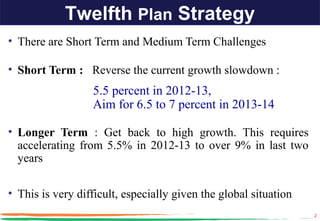
Twelfth Plan Strategy
• There are Short Term and Medium Term Challenges

• Short Term : Reverse the current growth slowdown :
                  5.5 percent in 2012-13,
                  Aim for 6.5 to 7 percent in 2013-14

• Longer Term : Get back to high growth. This requires
  accelerating from 5.5% in 2012-13 to over 9% in last two
  years

• This is very difficult, especially given the global situation
                                                                  2
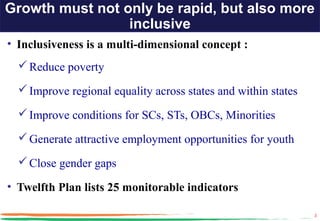
Growth must not only be rapid, but also more
                 inclusive
• Inclusiveness is a multi-dimensional concept :
   Reduce poverty

   Improve regional equality across states and within states

   Improve conditions for SCs, STs, OBCs, Minorities

   Generate attractive employment opportunities for youth

   Close gender gaps

• Twelfth Plan lists 25 monitorable indicators

                                                                3
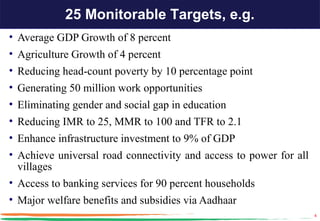
25 Monitorable Targets, e.g.
• Average GDP Growth of 8 percent
• Agriculture Growth of 4 percent
• Reducing head-count poverty by 10 percentage point
• Generating 50 million work opportunities
• Eliminating gender and social gap in education
• Reducing IMR to 25, MMR to 100 and TFR to 2.1
• Enhance infrastructure investment to 9% of GDP
• Achieve universal road connectivity and access to power for all
  villages
• Access to banking services for 90 percent households
• Major welfare benefits and subsidies via Aadhaar
                                                                    4
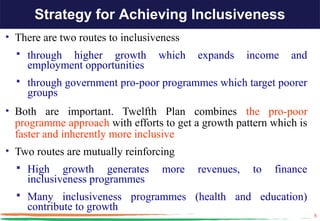
Strategy for Achieving Inclusiveness
• There are two routes to inclusiveness
     through higher growth       which   expands     income   and
      employment opportunities
     through government pro-poor programmes which target poorer
      groups
• Both are important. Twelfth Plan combines the pro-poor
  programme approach with efforts to get a growth pattern which is
  faster and inherently more inclusive
• Two routes are mutually reinforcing
   High      growth generates     more   revenues,    to   finance
      inclusiveness programmes
   Many inclusiveness programmes (health and education)
      contribute to growth
                                                                      5
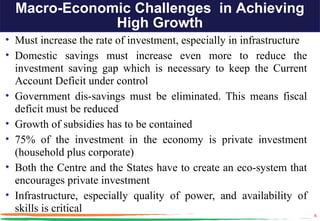
Macro-Economic Challenges in Achieving
              High Growth
• Must increase the rate of investment, especially in infrastructure
• Domestic savings must increase even more to reduce the
  investment saving gap which is necessary to keep the Current
  Account Deficit under control
• Government dis-savings must be eliminated. This means fiscal
  deficit must be reduced
• Growth of subsidies has to be contained
• 75% of the investment in the economy is private investment
  (household plus corporate)
• Both the Centre and the States have to create an eco-system that
  encourages private investment
• Infrastructure, especially quality of power, and availability of
  skills is critical                                                   6
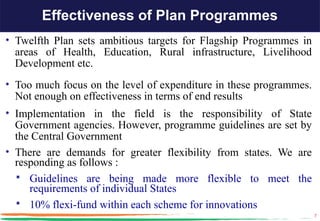
Effectiveness of Plan Programmes
• Twelfth Plan sets ambitious targets for Flagship Programmes in
  areas of Health, Education, Rural infrastructure, Livelihood
  Development etc.
• Too much focus on the level of expenditure in these programmes.
  Not enough on effectiveness in terms of end results
• Implementation in the field is the responsibility of State
  Government agencies. However, programme guidelines are set by
  the Central Government
• There are demands for greater flexibility from states. We are
  responding as follows :
   Guidelines are being made more flexible to meet the
     requirements of individual States
   10% flexi-fund within each scheme for innovations
                                                                    7
Energy
• 8 percent GDP growth requires 6 percent growth in energy supply
  from all sources
• Our fossil fuel resources are limited, and our import dependence is
  already high
• Enhanced Energy Efficiency in all sectors
• We need to push push for renewable Energy: Wind, Solar and
  Storage Hydro
• Difficult Policy Issues:
   Coal vs. Forest Cover
   Petroleum Price Distortions
   Natural Gas Exploration Framework
   All Energy Prices: Coal, Petroleum product, Natural Gas and
      Electric power are currently under priced. Fuel adjustment is
      needed
                                                                        8
Water
• Management of water resource is a major challenge.
  Estimates of water availability have been optimistic
• Twelfth Plan proposes modified AIBP and expanded
  Watershed Management Programme
• Water sector needs better Regulatory Framework
   New Groundwater Law
   Water Regulatory Authorities in each state
   National Water Framework Law
• Agriculture accounts for 80% of water use at present, must
  shift to more water efficient agriculture practices
• Manage urban and industrial water demand through water
  recycling and rationalise user charges
                                                               9
Alternative Scenarios
• 12th Plan goal of 8% inclusivve growth is not a foregone
  conclusion
• Depends on difficult policy decisions to be taken by Centre
  and States
• For the first time Plan presents three scenarios
         Strong Inclusive Growth         8%
         Insufficient Action             6 to 6.5%
         Policy logjam                   5 to 5.5%
• Anything much less than 8% will not satisfy aspirations of
  the people
                                                                10
Thank You

Overview of the 12th Five Year Plan (2012 - 2017)

  • 1.
    What Next for Faster,More Inclusive and Sustainable Growth 1
  • 2.
    Twelfth Plan Strategy •There are Short Term and Medium Term Challenges • Short Term : Reverse the current growth slowdown : 5.5 percent in 2012-13, Aim for 6.5 to 7 percent in 2013-14 • Longer Term : Get back to high growth. This requires accelerating from 5.5% in 2012-13 to over 9% in last two years • This is very difficult, especially given the global situation 2
  • 3.
    Growth must notonly be rapid, but also more inclusive • Inclusiveness is a multi-dimensional concept :  Reduce poverty  Improve regional equality across states and within states  Improve conditions for SCs, STs, OBCs, Minorities  Generate attractive employment opportunities for youth  Close gender gaps • Twelfth Plan lists 25 monitorable indicators 3
  • 4.
    25 Monitorable Targets,e.g. • Average GDP Growth of 8 percent • Agriculture Growth of 4 percent • Reducing head-count poverty by 10 percentage point • Generating 50 million work opportunities • Eliminating gender and social gap in education • Reducing IMR to 25, MMR to 100 and TFR to 2.1 • Enhance infrastructure investment to 9% of GDP • Achieve universal road connectivity and access to power for all villages • Access to banking services for 90 percent households • Major welfare benefits and subsidies via Aadhaar 4
  • 5.
    Strategy for AchievingInclusiveness • There are two routes to inclusiveness  through higher growth which expands income and employment opportunities  through government pro-poor programmes which target poorer groups • Both are important. Twelfth Plan combines the pro-poor programme approach with efforts to get a growth pattern which is faster and inherently more inclusive • Two routes are mutually reinforcing  High growth generates more revenues, to finance inclusiveness programmes  Many inclusiveness programmes (health and education) contribute to growth 5
  • 6.
    Macro-Economic Challenges inAchieving High Growth • Must increase the rate of investment, especially in infrastructure • Domestic savings must increase even more to reduce the investment saving gap which is necessary to keep the Current Account Deficit under control • Government dis-savings must be eliminated. This means fiscal deficit must be reduced • Growth of subsidies has to be contained • 75% of the investment in the economy is private investment (household plus corporate) • Both the Centre and the States have to create an eco-system that encourages private investment • Infrastructure, especially quality of power, and availability of skills is critical 6
  • 7.
    Effectiveness of PlanProgrammes • Twelfth Plan sets ambitious targets for Flagship Programmes in areas of Health, Education, Rural infrastructure, Livelihood Development etc. • Too much focus on the level of expenditure in these programmes. Not enough on effectiveness in terms of end results • Implementation in the field is the responsibility of State Government agencies. However, programme guidelines are set by the Central Government • There are demands for greater flexibility from states. We are responding as follows :  Guidelines are being made more flexible to meet the requirements of individual States  10% flexi-fund within each scheme for innovations 7
  • 8.
    Energy • 8 percentGDP growth requires 6 percent growth in energy supply from all sources • Our fossil fuel resources are limited, and our import dependence is already high • Enhanced Energy Efficiency in all sectors • We need to push push for renewable Energy: Wind, Solar and Storage Hydro • Difficult Policy Issues:  Coal vs. Forest Cover  Petroleum Price Distortions  Natural Gas Exploration Framework  All Energy Prices: Coal, Petroleum product, Natural Gas and Electric power are currently under priced. Fuel adjustment is needed 8
  • 9.
    Water • Management ofwater resource is a major challenge. Estimates of water availability have been optimistic • Twelfth Plan proposes modified AIBP and expanded Watershed Management Programme • Water sector needs better Regulatory Framework  New Groundwater Law  Water Regulatory Authorities in each state  National Water Framework Law • Agriculture accounts for 80% of water use at present, must shift to more water efficient agriculture practices • Manage urban and industrial water demand through water recycling and rationalise user charges 9
  • 10.
    Alternative Scenarios • 12thPlan goal of 8% inclusivve growth is not a foregone conclusion • Depends on difficult policy decisions to be taken by Centre and States • For the first time Plan presents three scenarios Strong Inclusive Growth 8% Insufficient Action 6 to 6.5% Policy logjam 5 to 5.5% • Anything much less than 8% will not satisfy aspirations of the people 10
  • 11.