FIVE YEAR PLANS
OF INDIA
HISTORY
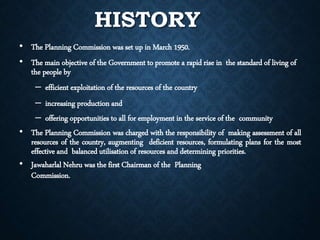
• The Planning Commission was set up in March 1950.
• The main objective of the Government to promote a rapid rise in the standard of living of
the people by
– efficient exploitation of the resources of the country
– increasing production and
– offering opportunities to all for employment in the service of the community
• The Planning Commission was charged with the responsibility of making assessment of all
resources of the country, augmenting deficient resources, formulating plans for the most
effective and balanced utilisation of resources and determining priorities.
• Jawaharlal Nehru was the first Chairman of the Planning
Commission.
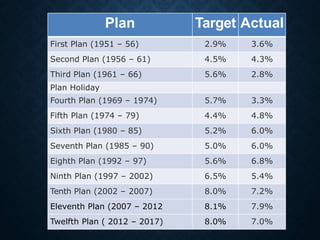
Plan Target Actual
First Plan (1951 – 56) 2.9% 3.6%
Second Plan (1956 – 61) 4.5% 4.3%
Third Plan (1961 – 66) 5.6% 2.8%
Plan Holiday
Fourth Plan (1969 – 1974) 5.7% 3.3%
Fifth Plan (1974 – 79) 4.4% 4.8%
Sixth Plan (1980 – 85) 5.2% 6.0%
Seventh Plan (1985 – 90) 5.0% 6.0%
Eighth Plan (1992 – 97) 5.6% 6.8%
Ninth Plan (1997 – 2002) 6.5% 5.4%
Tenth Plan (2002 – 2007) 8.0% 7.2%
Eleventh Plan (2007 – 2012 8.1% 7.9%
Twelfth Plan ( 2012 – 2017) 8.0% 7.0%
FIRST FIVE-YEAR PLAN (1951–1956)
• The first Indian Prime Minister, Jawaharlal Nehru presented the first five-year plan to the
Parliament of India on December 8, 1951.
• This plan was based on the Harrod-Domar model.
• Its main focus was on the agricultural development of the country.
• This plan was successful and achieved growth rate of 3.6% (more than its target)
SECOND FIVE-YEAR PLAN
(1956–1961)
• The second five-year plan focused on industry, especially heavy industry.
• The Second plan, particularly in the development of the industrial sector.
• The plan followed the Mahalanobis model, an economic development model developed
by the Indian statistician Prasanta Chandra Mahalanobis in 1953.
• The plan assumed a closed economy in which the main trading activity would be
centered on importing capital goods.
• This plan was successful and achieved a growth rate of 4.3%
• The main target of this plan was to make the economy independent and to reach the self
active position of take-off.
• The third plan stressed on agriculture and improvement in the production of wheat, but
the brief Sino-Indian War of 1962 exposed weaknesses in the economy and shifted the
focus towards the Defenceindustry.
• It was made for the duration of 1961 to 1966.
• This plan is called ‘Gadgil Yojna’ also.
• Due to china war, this plan could not achieve its growth target of 5.6%
THIRD FIVE-YEAR PLAN (1961–1966)
ROLLING PLANS (1966-69)
• In 1965–1966, India fought a [Indo-Pak] War
with Pakistan.
• Due to this war,there was a severe drought in 1965.
• The war led to inflation and the priority was
shifted to price stabilisation.
• The construction of dams continued.
• The government of India declared "Devaluation of Rupee" to increase the
exports of the country.
FOURTH FIVE-YEAR PLAN (1969–1974)
• At this time Indira Gandhi was the Prime Minister.
• There were two main objectives of this plan i.e. growth with stability and
progressive achievement of self-reliance.
• During this plan, the slogan of “Garibi Hatao” is given during the 1971 elections by
Indira Gandhi.
• The government nationalised 14 major Indianbanks and the Green Revolution in
India advanced agriculture.
• This plan failed and could achieve a growth rate of 3.3% only against the target of
5.7%.
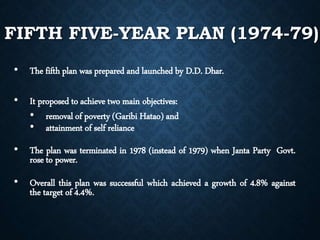
FIFTH FIVE-YEAR PLAN (1974-79)
• The fifth plan was prepared and launched by D.D. Dhar.
• It proposed to achieve two main objectives:
• removal of poverty (Garibi Hatao) and
• attainment of self reliance
• The plan was terminated in 1978 (instead of 1979) when Janta Party Govt.
rose to power.
• Overall this plan was successful which achieved a growth of 4.8% against
the target of 4.4%.
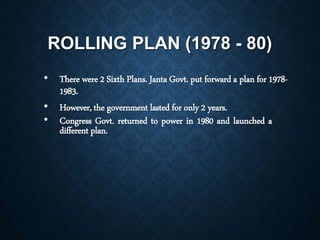
ROLLING PLAN (1978 - 80)
• There were 2 Sixth Plans. Janta Govt. put forward a plan for 1978-
1983.
• However, the government lasted for only 2 years.
• Congress Govt. returned to power in 1980 and launched a
different plan.
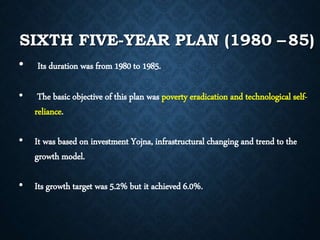
SIXTH FIVE-YEAR PLAN (1980 –85)
• Its duration was from 1980 to 1985.
• The basic objective of this plan was poverty eradication and technological self-
reliance.
• It was based on investment Yojna, infrastructural changing and trend to the
growth model.
• Its growth target was 5.2% but it achieved 6.0%.
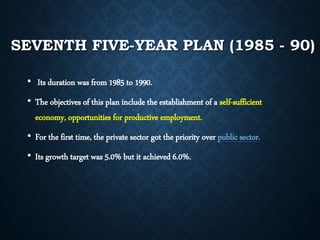
SEVENTH FIVE-YEAR PLAN (1985 - 90)
• Its duration was from 1985 to 1990.
• The objectives of this plan include the establishment of a self-sufficient
economy, opportunities for productive employment.
• For the first time, the private sector got the priority over public sector.
• Its growth target was 5.0% but it achieved 6.0%.
EIGHTH FIVE-YEAR PLAN
(1992 - 97)
• The eighth plan was postponed by two years because of political uncertainty at the Centre
Worsening Balance of Payment position and inflation during 1990-91.
• Its duration was from 1992 to 1997.
• In this plan, the top priority was given to the development of human resources i.e. employment,
education, and public health.
• During this plan, Narasimha Rao Govt. launched the New Economic Policy of India.
• This plan was successful and got an annual growth rate of 6.8% against the target of 5.6%.
NINTH FIVE YEAR PLAN (1997- 2002)
• Its duration was from 1997 to 2002.
• The main focus of this plan was “growth with justice and equity”.
• It was launched in the 50th year of independence of India.
• Its encourage social issues like women empowerment, conservation of certain
benefits for the Special Groups of the society
• This plan failed to achieve the growth target of 6.5% and grow only at the
rate of 5.4%.
TENTH FIVE YEAR PLAN (2002 - 2007)
• Its duration was from 2002 to 2007.
• This plan aims to double the Per Capita Income of India in the next 10 years.
• Providing gainful and high-quality employment at least to the addition to the labour
force
• The Tenth Plan was expected to follow a regional approach rather than sectoral
approach to bring down regional inequalities.
• It aims to reduce the poverty ratio of 15% by 2012.
• Its growth target was 8.0% but it achieved only 7.2%.
ELEVENTH FIVE YEAR PLAN
(2007 - 2012)
• It was in the period of Manmohan Singh as a prime minister.
• It was prepared by the C. Rangarajan.
• Its main theme was “faster and more inclusive growth”
• Emphasis on social sector and delivery of service therein.
• Empowerment through education and skill development.
• Reduction of gender inequality.
• Environmental sustainability.
• Its growth rate target was 8.1% but it achieved only 7.9%
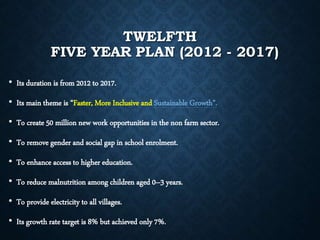
TWELFTH
FIVE YEAR PLAN (2012 - 2017)
• Its duration is from 2012 to 2017.
• Its main theme is “Faster, More Inclusive and Sustainable Growth”.
• To create 50 million new work opportunities in the non farm sector.
• To remove gender and social gap in school enrolment.
• To enhance access to higher education.
• To reduce malnutrition among children aged 0–3 years.
• To provide electricity to all villages.
• Its growth rate target is 8% but achieved only 7%.
THANK YOU
PREPARED BY
MR.MANANNANDA

Five years plan of india

  • 1.
  • 2.
    HISTORY • The PlanningCommission was set up in March 1950. • The main objective of the Government to promote a rapid rise in the standard of living of the people by – efficient exploitation of the resources of the country – increasing production and – offering opportunities to all for employment in the service of the community • The Planning Commission was charged with the responsibility of making assessment of all resources of the country, augmenting deficient resources, formulating plans for the most effective and balanced utilisation of resources and determining priorities. • Jawaharlal Nehru was the first Chairman of the Planning Commission.
  • 3.
    Plan Target Actual FirstPlan (1951 – 56) 2.9% 3.6% Second Plan (1956 – 61) 4.5% 4.3% Third Plan (1961 – 66) 5.6% 2.8% Plan Holiday Fourth Plan (1969 – 1974) 5.7% 3.3% Fifth Plan (1974 – 79) 4.4% 4.8% Sixth Plan (1980 – 85) 5.2% 6.0% Seventh Plan (1985 – 90) 5.0% 6.0% Eighth Plan (1992 – 97) 5.6% 6.8% Ninth Plan (1997 – 2002) 6.5% 5.4% Tenth Plan (2002 – 2007) 8.0% 7.2% Eleventh Plan (2007 – 2012 8.1% 7.9% Twelfth Plan ( 2012 – 2017) 8.0% 7.0%
  • 4.
    FIRST FIVE-YEAR PLAN(1951–1956) • The first Indian Prime Minister, Jawaharlal Nehru presented the first five-year plan to the Parliament of India on December 8, 1951. • This plan was based on the Harrod-Domar model. • Its main focus was on the agricultural development of the country. • This plan was successful and achieved growth rate of 3.6% (more than its target)
  • 5.
    SECOND FIVE-YEAR PLAN (1956–1961) •The second five-year plan focused on industry, especially heavy industry. • The Second plan, particularly in the development of the industrial sector. • The plan followed the Mahalanobis model, an economic development model developed by the Indian statistician Prasanta Chandra Mahalanobis in 1953. • The plan assumed a closed economy in which the main trading activity would be centered on importing capital goods. • This plan was successful and achieved a growth rate of 4.3%
  • 6.
    • The maintarget of this plan was to make the economy independent and to reach the self active position of take-off. • The third plan stressed on agriculture and improvement in the production of wheat, but the brief Sino-Indian War of 1962 exposed weaknesses in the economy and shifted the focus towards the Defenceindustry. • It was made for the duration of 1961 to 1966. • This plan is called ‘Gadgil Yojna’ also. • Due to china war, this plan could not achieve its growth target of 5.6% THIRD FIVE-YEAR PLAN (1961–1966)
  • 7.
    ROLLING PLANS (1966-69) •In 1965–1966, India fought a [Indo-Pak] War with Pakistan. • Due to this war,there was a severe drought in 1965. • The war led to inflation and the priority was shifted to price stabilisation. • The construction of dams continued. • The government of India declared "Devaluation of Rupee" to increase the exports of the country.
  • 8.
    FOURTH FIVE-YEAR PLAN(1969–1974) • At this time Indira Gandhi was the Prime Minister. • There were two main objectives of this plan i.e. growth with stability and progressive achievement of self-reliance. • During this plan, the slogan of “Garibi Hatao” is given during the 1971 elections by Indira Gandhi. • The government nationalised 14 major Indianbanks and the Green Revolution in India advanced agriculture. • This plan failed and could achieve a growth rate of 3.3% only against the target of 5.7%.
  • 9.
    FIFTH FIVE-YEAR PLAN(1974-79) • The fifth plan was prepared and launched by D.D. Dhar. • It proposed to achieve two main objectives: • removal of poverty (Garibi Hatao) and • attainment of self reliance • The plan was terminated in 1978 (instead of 1979) when Janta Party Govt. rose to power. • Overall this plan was successful which achieved a growth of 4.8% against the target of 4.4%.
  • 10.
    ROLLING PLAN (1978- 80) • There were 2 Sixth Plans. Janta Govt. put forward a plan for 1978- 1983. • However, the government lasted for only 2 years. • Congress Govt. returned to power in 1980 and launched a different plan.
  • 11.
    SIXTH FIVE-YEAR PLAN(1980 –85) • Its duration was from 1980 to 1985. • The basic objective of this plan was poverty eradication and technological self- reliance. • It was based on investment Yojna, infrastructural changing and trend to the growth model. • Its growth target was 5.2% but it achieved 6.0%.
  • 12.
    SEVENTH FIVE-YEAR PLAN(1985 - 90) • Its duration was from 1985 to 1990. • The objectives of this plan include the establishment of a self-sufficient economy, opportunities for productive employment. • For the first time, the private sector got the priority over public sector. • Its growth target was 5.0% but it achieved 6.0%.
  • 13.
    EIGHTH FIVE-YEAR PLAN (1992- 97) • The eighth plan was postponed by two years because of political uncertainty at the Centre Worsening Balance of Payment position and inflation during 1990-91. • Its duration was from 1992 to 1997. • In this plan, the top priority was given to the development of human resources i.e. employment, education, and public health. • During this plan, Narasimha Rao Govt. launched the New Economic Policy of India. • This plan was successful and got an annual growth rate of 6.8% against the target of 5.6%.
  • 14.
    NINTH FIVE YEARPLAN (1997- 2002) • Its duration was from 1997 to 2002. • The main focus of this plan was “growth with justice and equity”. • It was launched in the 50th year of independence of India. • Its encourage social issues like women empowerment, conservation of certain benefits for the Special Groups of the society • This plan failed to achieve the growth target of 6.5% and grow only at the rate of 5.4%.
  • 15.
    TENTH FIVE YEARPLAN (2002 - 2007) • Its duration was from 2002 to 2007. • This plan aims to double the Per Capita Income of India in the next 10 years. • Providing gainful and high-quality employment at least to the addition to the labour force • The Tenth Plan was expected to follow a regional approach rather than sectoral approach to bring down regional inequalities. • It aims to reduce the poverty ratio of 15% by 2012. • Its growth target was 8.0% but it achieved only 7.2%.
  • 16.
    ELEVENTH FIVE YEARPLAN (2007 - 2012) • It was in the period of Manmohan Singh as a prime minister. • It was prepared by the C. Rangarajan. • Its main theme was “faster and more inclusive growth” • Emphasis on social sector and delivery of service therein. • Empowerment through education and skill development. • Reduction of gender inequality. • Environmental sustainability. • Its growth rate target was 8.1% but it achieved only 7.9%
  • 17.
    TWELFTH FIVE YEAR PLAN(2012 - 2017) • Its duration is from 2012 to 2017. • Its main theme is “Faster, More Inclusive and Sustainable Growth”. • To create 50 million new work opportunities in the non farm sector. • To remove gender and social gap in school enrolment. • To enhance access to higher education. • To reduce malnutrition among children aged 0–3 years. • To provide electricity to all villages. • Its growth rate target is 8% but achieved only 7%.
  • 18.