

Prepared by: Sambhujyoti Das,
Quality Assurance
5 WHY
Asking “Why?” may be a favourite
technique of your three year old child in
driving you crazy, but it could lead to the
root cause of a headache (The problem).
2
Principle:
• 5 Whys is an iterative question-
asking technique;
• Explore the cause-and-effect relationships
underlying a particular problem;
• logical flow as one digs deeper into finding
the root cause(s);
The answer to each question then forms the
basis of the next question.
3
An example:……(1)
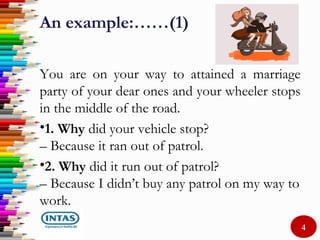
You are on your way to attained a marriage
party of your dear ones and your wheeler stops
in the middle of the road.
•1. Why did your vehicle stop?
– Because it ran out of patrol.
•2. Why did it run out of patrol?
– Because I didn’t buy any patrol on my way to
work.
4
An example:………(1) continued
• 3. Why didn’t you buy any patrol this
morning?
– Because I didn’t have any money.
• 4. Why didn’t you have any money?
– Because its month end and I exhausted my
salary.
• 5. Why did you exhausted my salary?
– Because the patrol price has increased 3rd
time within a month.
5
An example:……(2)
Different product mono-cartons in a clinic
carton (Packaging Mixup). (the problem).
1.Why ? Clinic carton of different product.
(first why);
2.Why ? Carton mixup during packaging.
(second why);
3.Why ? Incorrect product details on clinic
carton. (third why);
6
An example:……(2) continued
4. Why ? Misprinting from supplier. (fourth
why);
5. Why ? Line-clearance procedure was not
followed during plate cutting. (fifth why, a
root cause).
Fifth why suggests a broken process or an
alterable behaviour.
7
Thumb rule:
• Five iterations of asking why is generally
sufficient to get to a root.
• The questioning for this example could be
taken further to a sixth, seventh, or higher
level.
8
Benefits:
• Encourage the trouble-shooter to avoid
assumptions and logic traps.
• Trace the chain of causality in direct
increments.
• From the effect through any layers of
abstraction to a root cause that still has some
connection to the original problem.
9
Mind it:
• Last answer points to a process.
• Untrained facilitators will often observe that
answers seem to point towards classical
answers such as not enough time, not
enough investments, or not enough
manpower.
• These answers may be true, but they are out
of our control.
10
Techniques:
There are two primary techniques used to
perform 5 Whys:
•Fishbone (Ishikawa) and
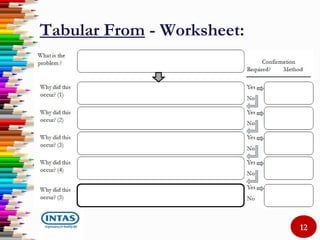
•Tabular Form.
Fishbone diagram may be helpful to identify the exact
answer of each question.
11
Tabular From - Worksheet:
12
13

Five why?????

  • 1.
    Prepared by: SambhujyotiDas, Quality Assurance 5 WHY
  • 2.
    Asking “Why?” maybe a favourite technique of your three year old child in driving you crazy, but it could lead to the root cause of a headache (The problem). 2
  • 3.
    Principle: • 5 Whys isan iterative question- asking technique; • Explore the cause-and-effect relationships underlying a particular problem; • logical flow as one digs deeper into finding the root cause(s); The answer to each question then forms the basis of the next question. 3
  • 4.
    An example:……(1) You areon your way to attained a marriage party of your dear ones and your wheeler stops in the middle of the road. •1. Why did your vehicle stop? – Because it ran out of patrol. •2. Why did it run out of patrol? – Because I didn’t buy any patrol on my way to work. 4
  • 5.
    An example:………(1) continued •3. Why didn’t you buy any patrol this morning? – Because I didn’t have any money. • 4. Why didn’t you have any money? – Because its month end and I exhausted my salary. • 5. Why did you exhausted my salary? – Because the patrol price has increased 3rd time within a month. 5
  • 6.
    An example:……(2) Different productmono-cartons in a clinic carton (Packaging Mixup). (the problem). 1.Why ? Clinic carton of different product. (first why); 2.Why ? Carton mixup during packaging. (second why); 3.Why ? Incorrect product details on clinic carton. (third why); 6
  • 7.
    An example:……(2) continued 4.Why ? Misprinting from supplier. (fourth why); 5. Why ? Line-clearance procedure was not followed during plate cutting. (fifth why, a root cause). Fifth why suggests a broken process or an alterable behaviour. 7
  • 8.
    Thumb rule: • Five iterations ofasking why is generally sufficient to get to a root. • The questioning for this example could be taken further to a sixth, seventh, or higher level. 8
  • 9.
    Benefits: • Encourage thetrouble-shooter to avoid assumptions and logic traps. • Trace the chain of causality in direct increments. • From the effect through any layers of abstraction to a root cause that still has some connection to the original problem. 9
  • 10.
    Mind it: • Lastanswer points to a process. • Untrained facilitators will often observe that answers seem to point towards classical answers such as not enough time, not enough investments, or not enough manpower. • These answers may be true, but they are out of our control. 10
  • 11.
    Techniques: There are twoprimary techniques used to perform 5 Whys: •Fishbone (Ishikawa) and •Tabular Form. Fishbone diagram may be helpful to identify the exact answer of each question. 11
  • 12.
    Tabular From -Worksheet: 12
  • 13.