Total Slides: 40
Prepared by: Sambhujyoti Das, Quality Assurance
CLEANING VALIDATION
A NEW RISK INTEGRATED APPROACH
CONTENT:
Slide No.: 02 of 40
• Definition of Cleaning Validation • Clinical Assessment
• What’s new? • Risk Assessment
• Why risk based approach is required? • Product selection criteria
• Risk based cleaning acceptance limit. • Fate of earlier approaches.
• Example for deriving acceptance limit • EU Timeline
• Hazard Assessment • Resources.
DEFINITION:
The process of removing contaminants from process equipment and monitoring the
condition of equipment such that the equipment can be safely used for subsequent
product manufacturing.
Slide No.: 02 of 40
Dustin A. Leblanc.
WHAT’S NEW:
• ICH guideline on residual solvent.
• ISPE proposal on ADE in it’s Risk MaPP guideline.
• PDA reference on Technical report number 29.
• Adoption by EU.
• EU timeline on PDE strategy implementation.
Slide No.: 04 of 40
WHY RISK BASED APPROACH IS REQUIRED?
• Single expression on quantitative health risk.
• Covering all parameters of health related risk.
• Universally accepted method.
• Useful for considering facility design and containments, level of personnel
protection required.
Slide No.: 05 of 40
RISK BASED CLEANING ACCEPTANCE LIMIT:
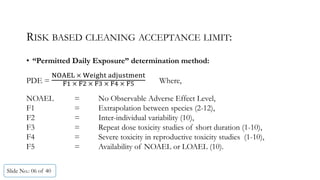
• “Permitted Daily Exposure” determination method:
PDE =
	 	 	
	 	 	 	 	 	 	 	 Where,
NOAEL = No Observable Adverse Effect Level,
F1 = Extrapolation between species (2-12),
F2 = Inter-individual variability (10),
F3 = Repeat dose toxicity studies of short duration (1-10),
F4 = Severe toxicity in reproductive toxicity studies (1-10),
F5 = Availability of NOAEL or LOAEL (10).
Slide No.: 06 of 40
RISK BASED CLEANING ACCEPTANCE LIMIT:
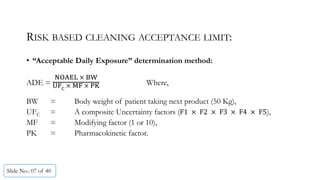
• “Acceptable Daily Exposure” determination method:
ADE =
	 	
	 	 	 	 Where,
BW = Body weight of patient taking next product (50 Kg),
UFC = A composite Uncertainty factors (F1	 	F2	 	F3	 	F4	 	F5),
MF = Modifying factor (1 or 10),
PK = Pharmacokinetic factor.
Slide No.: 07 of 40
RISK BASED CLEANING ACCEPTANCE LIMIT:
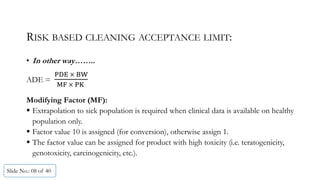
• In other way……..
ADE =
	 	
	 	 	 		
Modifying Factor (MF):
 Extrapolation to sick population is required when clinical data is available on healthy
population only.
 Factor value 10 is assigned (for conversion), otherwise assign 1.
 The factor value can be assigned for product with high toxicity (i.e. teratogenicity,
genotoxicity, carcinogenicity, etc.).
Slide No.: 08 of 40
RISK BASED CLEANING ACCEPTANCE LIMIT:
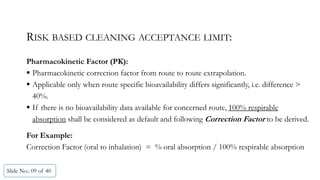
Pharmacokinetic Factor (PK):
 Pharmacokinetic correction factor from route to route extrapolation.
 Applicable only when route specific bioavailability differs significantly, i.e. difference >
40%.
 If there is no bioavailability data available for concerned route, 100% respirable
absorption shall be considered as default and following Correction Factor to be derived.
For Example:
Correction Factor (oral to inhalation) = % oral absorption / 100% respirable absorption
Slide No.: 09 of 40
RISK BASED CLEANING ACCEPTANCE LIMIT:
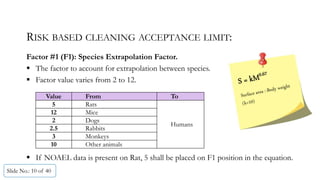
Factor #1 (F1): Species Extrapolation Factor.
 The factor to account for extrapolation between species.
 Factor value varies from 2 to 12.
 If NOAEL data is present on Rat, 5 shall be placed on F1 position in the equation.
Slide No.: 10 of 40
Value From To
5 Rats
Humans
12 Mice
2 Dogs
2.5 Rabbits
3 Monkeys
10 Other animals
RISK BASED CLEANING ACCEPTANCE LIMIT:
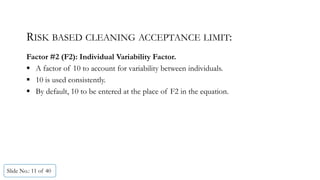
Factor #2 (F2): Individual Variability Factor.
 A factor of 10 to account for variability between individuals.
 10 is used consistently.
 By default, 10 to be entered at the place of F2 in the equation.
Slide No.: 11 of 40
RISK BASED CLEANING ACCEPTANCE LIMIT:
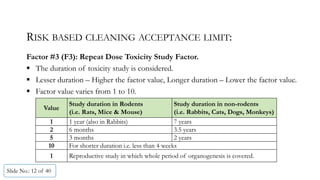
Factor #3 (F3): Repeat Dose Toxicity Study Factor.
 The duration of toxicity study is considered.
 Lesser duration – Higher the factor value, Longer duration – Lower the factor value.
 Factor value varies from 1 to 10.
Slide No.: 12 of 40
Value
Study duration in Rodents
(i.e. Rats, Mice & Mouse)
Study duration in non-rodents
(i.e. Rabbits, Cats, Dogs, Monkeys)
1 1 year (also in Rabbits) 7 years
2 6 months 3.5 years
5 3 months 2 years
10 For shorter duration i.e. less than 4 weeks
1 Reproductive study in which whole period of organogenesis is covered.
RISK BASED CLEANING ACCEPTANCE LIMIT:
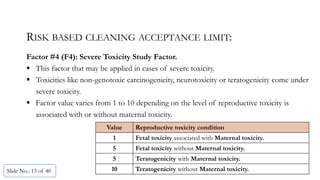
Factor #4 (F4): Severe Toxicity Study Factor.
 This factor that may be applied in cases of severe toxicity.
 Toxicities like non-genotoxic carcinogenicity, neurotoxicity or teratogenicity come under
severe toxicity.
 Factor value varies from 1 to 10 depending on the level of reproductive toxicity is
associated with or without maternal toxicity.
Slide No.: 13 of 40
Value Reproductive toxicity condition
1 Fetal toxicity associated with Maternal toxicity.
5 Fetal toxicity without Maternal toxicity.
5 Teratogenicity with Maternal toxicity.
10 Teratogenicity without Maternal toxicity.
RISK BASED CLEANING ACCEPTANCE LIMIT:
Factor #5 (F5): Database Incompleteness Factor.
 This factor may be applied if the no-effect level (NOAEL value is absent) was not
established.
 When only an LOEL is available, factor value shall be 10.
 Severity of the toxicity should be considered while assigning
factor value.
Slide No.: 14 of 40
RISK BASED CLEANING ACCEPTANCE LIMIT:
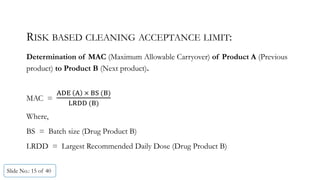
Determination of MAC (Maximum Allowable Carryover) of Product A (Previous
product) to Product B (Next product).
MAC =
	 	 	 	
	
Where,
BS = Batch size (Drug Product B)
LRDD = Largest Recommended Daily Dose (Drug Product B)
Slide No.: 15 of 40
RISK BASED CLEANING ACCEPTANCE LIMIT:
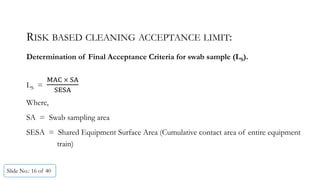
Determination of Final Acceptance Criteria for swab sample (LS).
LS =
	 	
Where,
SA = Swab sampling area
SESA = Shared Equipment Surface Area (Cumulative contact area of entire equipment
train)
Slide No.: 16 of 40
EXAMPLE FOR DERIVING ACCEPTANCE LIMIT:
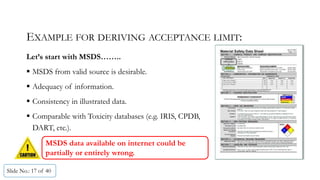
Let’s start with MSDS……..
 MSDS from valid source is desirable.
 Adequacy of information.
 Consistency in illustrated data.
 Comparable with Toxicity databases (e.g. IRIS, CPDB,
DART, etc.).
Slide No.: 17 of 40
General
Information
MSDS data available on internet could be
partially or entirely wrong.
EXAMPLE FOR DERIVING ACCEPTANCE LIMIT:
Let’s start with MSDS……..
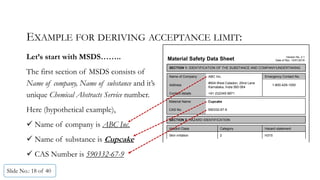
The first section of MSDS consists of
Name of company, Name of substance and it’s
unique Chemical Abstracts Service number.
Here (hypothetical example),
 Name of company is ABC Inc.
 Name of substance is Cupcake
 CAS Number is 590332-67-9
Slide No.: 18 of 40
Material Safety Data Sheet
SECTION 1: IDENTIFICATION OF THE SUBSTANCE AND COMPANY/UNDERTAKING
Version No. 2.1
Date of Rev. 15/01/2016
Name of Company ABC Inc. Emergency Contact No.
Address
#504 West Celadon, 20nd Lane
Karnataka, India 560 064
1-800-429-1000
Contact details +91 (0)2345 8871
Material Name Cupcake
CAS No. 590332-67-9
SECTION 2: HAZARD IDENTIFICATION
Hazard Class Category Hazard statement
Skin irritation 2 H315
EXAMPLE FOR DERIVING ACCEPTANCE LIMIT:
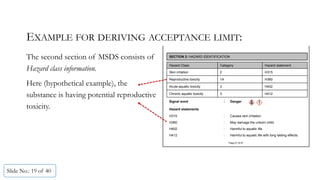
The second section of MSDS consists of
Hazard class information.
Here (hypothetical example), the
substance is having potential reproductive
toxicity.
Slide No.: 19 of 40
SECTION 2: HAZARD IDENTIFICATION
Hazard Class Category Hazard statement
Skin irritation 2 H315
Reproductive toxicity 1A H360
Acute aquatic toxicity 3 H402
Chronic aquatic toxicity 3 H412
Signal word : Danger
Hazard statements
H315 : Causes skin irritation.
H360 : May damage the unborn child.
H402 : Harmful to aquatic life.
H412 : Harmful to aquatic life with long lasting effects.
Page 01 0f 07
EXAMPLE FOR DERIVING ACCEPTANCE LIMIT:
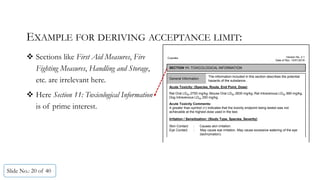
 Sections like First Aid Measures, Fire
Fighting Measures, Handling and Storage,
etc. are irrelevant here.
 Here Section 11: Toxicological Information
is of prime interest.
Slide No.: 20 of 40
Cupcake
SECTION 11: TOXICOLOGICAL INFORMATION
Version No. 2.1
Date of Rev. 15/01/2016
General Information
The information included in this section describes the potential
hazards of the substance..
Acute Toxicity: (Species, Route, End Point, Dose)
Rat Oral LD50 2750 mg/kg, Mouse Oral LD50 2830 mg/kg, Rat Intravenous LD50 990 mg/kg,
Dog Intravenous LD50 250 mg/kg.
Acute Toxicity Comments:
A greater than symbol (>) indicates that the toxicity endpoint being tested was not
achievable at the highest dose used in the test.
Irritation / Sensitization: (Study Type, Species, Severity)
Skin Contact : Causes skin irritation.
Eye Contact : May cause eye irritation. May cause excessive watering of the eye
(lachrymation).
EXAMPLE FOR DERIVING ACCEPTANCE LIMIT:
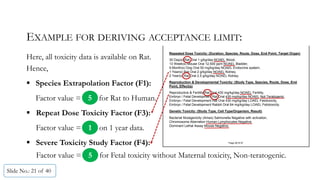
Here, all toxicity data is available on Rat.
Hence,
 Species Extrapolation Factor (F1):
Factor value = for Rat to Human.
 Repeat Dose Toxicity Factor (F3):
Factor value = on 1 year data.
 Severe Toxicity Study Factor (F4):
Slide No.: 21 of 40
Repeated Dose Toxicity: (Duration, Species, Route, Dose, End Point, Target Organ)
30 Day(s) Rat Oral 1 g/kg/day NOAEL Blood,
13 Week(s) Mouse Oral 12,500 ppm NOAEL Bladder,
9 Month(s) Dog Oral 50 mg/kg/day NOAEL Endocrine system,
1 Year(s) Rat Oral 2 g/kg/day NOAEL Kidney,
2 Year(s) Rat Oral 2.5 g/kg/day NOAEL Kidney.
Reproduction & Developmental Toxicity: (Study Type, Species, Route, Dose, End
Point, Effect(s)
Reproductive & Fertility Rat Oral 430 mg/kg/day NOAEL Fertility,
Embryo / Fetal Development Rat Oral 430 mg/kg/day NOAEL Not Teratogenic,
Embryo / Fetal Development Rat Oral 430 mg/kg/day LOAEL Fetotoxicity,
Embryo / Fetal Development Rabbit Oral 64 mg/kg/day LOAEL Fetotoxicity.
Genetic Toxicity: (Study Type, Cell Type/Organism, Result)
Bacterial Mutagenicity (Ames) Salmonella Negative with activation,
Chromosome Aberration Human Lymphocytes Negative,
Dominant Lethal Assay Mouse Negative.
Page 06 0f 07
5
1
5Factor value = for Fetal toxicity without Maternal toxicity, Non-teratogenic.
EXAMPLE FOR DERIVING ACCEPTANCE LIMIT:
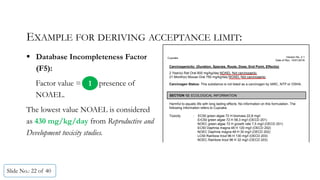
 Database Incompleteness Factor
(F5):
Factor value = presence of
NOAEL.
The lowest value NOAEL is considered
as 430 mg/kg/day from Reproductive and
Development toxicity studies.
Slide No.: 22 of 40
Cupcake Version No. 2.1
Date of Rev. 15/01/2016
Carcinogenicity: (Duration, Species, Route, Dose, End Point, Effect(s)
2 Year(s) Rat Oral 800 mg/kg/day NOAEL Not carcinogenic,
21 Month(s) Mouse Oral 750 mg/kg/day NOAEL Not carcinogenic.
Carcinogen Status: This substance is not listed as a carcinogen by IARC, NTP or OSHA.
SECTION 12: ECOLOGICAL INFORMATION
Harmful to aquatic life with long lasting effects. No information on this formulation. The
following information refers to Cupcake.
Toxicity : EC50 green algae 72 H biomass 22,8 mg/l
ErC50 green algae 72 H 58,3 mg/l (OECD 201)
NOEC green algae 72 H growth rate 7,5 mg/l (OECD 201)
EC50 Daphnia magna 48 H 120 mg/l (OECD 202)
NOEC Daphnia magna 48 H 30 mg/l (OECD 202)
LC50 Rainbow trout 96 H 130 mg/l (OECD 203)
NOEC Rainbow trout 96 H 32 mg/l (OECD 203)
1
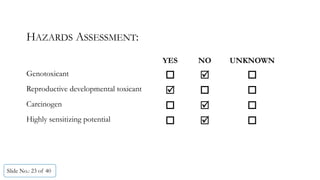
HAZARDS ASSESSMENT:
Slide No.: 23 of 40
YES NO UNKNOWN
Genotoxicant   
Reproductive developmental toxicant   
Carcinogen   
Highly sensitizing potential   
CLINICAL ASSESSMENT:
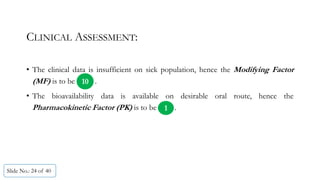
• The clinical data is insufficient on sick population, hence the Modifying Factor
(MF) is to be .
• The bioavailability data is available on desirable oral route, hence the
Pharmacokinetic Factor (PK) is to be .
Slide No.: 24 of 40
10
1
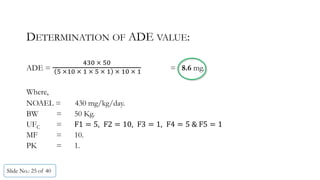
ADE =
	 	
	 	 	 	 	 	 	 	 	 	 	 	 = 8.6 mg.
Where,
NOAEL = 430 mg/kg/day.
BW = 50 Kg.
UFC = F1 5, F2 10, F3 1, F4 5	&	F5 1
MF = 10.
PK = 1.
Slide No.: 25 of 40
DETERMINATION OF ADE VALUE:
Slide No.: 26 of 40
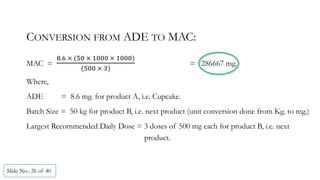
CONVERSION FROM ADE TO MAC:
MAC =
. 	 	 	 	 	 	
	 	
= 286667 mg.
Where,
ADE = 8.6 mg. for product A, i.e. Cupcake.
Batch Size = 50 kg for product B, i.e. next product (unit conversion done from Kg. to mg.)
Largest Recommended Daily Dose = 3 doses of 500 mg each for product B, i.e. next
product.
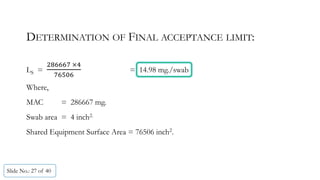
DETERMINATION OF FINAL ACCEPTANCE LIMIT:
LS =
	
= 14.98 mg./swab
Where,
MAC = 286667 mg.
Swab area = 4 inch2.
Shared Equipment Surface Area = 76506 inch2.
Slide No.: 27 of 40
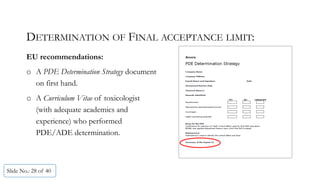
DETERMINATION OF FINAL ACCEPTANCE LIMIT:
EU recommendations:
o A PDE Determination Strategy document
on first hand.
o A Curriculum Vitae of toxicologist
(with adequate academics and
experience) who performed
PDE/ADE determination.
Slide No.: 28 of 40
POINTS TO BE NOTED:
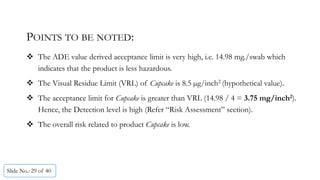
 The ADE value derived acceptance limit is very high, i.e. 14.98 mg./swab which
indicates that the product is less hazardous.
 The Visual Residue Limit (VRL) of Cupcake is 8.5 µg/inch2 (hypothetical value).
 The acceptance limit for Cupcake is greater than VRL (14.98 / 4 = 3.75 mg/inch2).
Hence, the Detection level is high (Refer “Risk Assessment” section).
 The overall risk related to product Cupcake is low.
Slide No.: 29 of 40
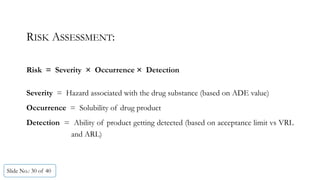
RISK ASSESSMENT:
Risk = Severity × Occurrence × Detection
Severity = Hazard associated with the drug substance (based on ADE value)
Occurrence = Solubility of drug product
Detection = Ability of product getting detected (based on acceptance limit vs VRL
and ARL)
Slide No.: 30 of 40
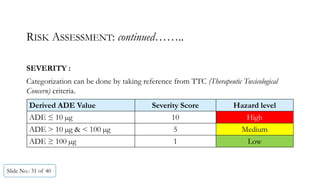
RISK ASSESSMENT: continued……..
SEVERITY :
Categorization can be done by taking reference from TTC (Therapeutic Toxicological
Concern) criteria.
Derived ADE Value Severity Score Hazard level
ADE ≤ 10 µg 10 High
ADE > 10 µg & < 100 µg 5 Medium
ADE ≥ 100 µg 1 Low
Slide No.: 31 of 40
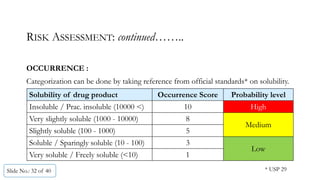
RISK ASSESSMENT: continued……..
OCCURRENCE :
Categorization can be done by taking reference from official standards* on solubility.
Solubility of drug product Occurrence Score Probability level
Insoluble / Prac. insoluble (10000 <) 10 High
Very slightly soluble (1000 - 10000) 8
Medium
Slightly soluble (100 - 1000) 5
Soluble / Sparingly soluble (10 - 100) 3
Low
Very soluble / Freely soluble (<10) 1
Slide No.: 32 of 40 * USP 29
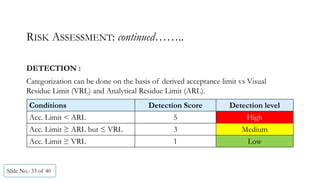
RISK ASSESSMENT: continued……..
DETECTION :
Categorization can be done on the basis of derived acceptance limit vs Visual
Residue Limit (VRL) and Analytical Residue Limit (ARL).
Conditions Detection Score Detection level
Acc. Limit < ARL 5 High
Acc. Limit ≥ ARL but ≤ VRL 3 Medium
Acc. Limit ≥ VRL 1 Low
Slide No.: 33 of 40
RISK ASSESSMENT: continued……..
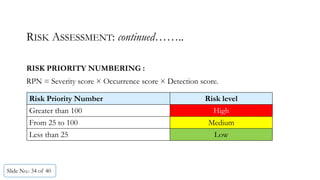
RISK PRIORITY NUMBERING :
RPN = Severity score × Occurrence score × Detection score.
Risk Priority Number Risk level
Greater than 100 High
From 25 to 100 Medium
Less than 25 Low
Slide No.: 34 of 40
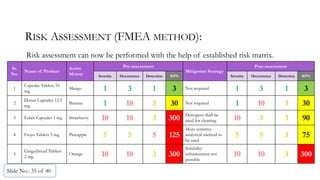
RISK ASSESSMENT (FMEA METHOD):
Risk assessment can now be performed with the help of established risk matrix.
Slide No.: 35 of 40
Sr.
No.
Name of Product
Active
Moiety
Pre-assessment
Mitigation Strategy
Post-assessment
Severity Occurrence Detection RPN Severity Occurrence Detection RPN
1
Cupcake Tablets 10
mg
Mango 1 3 1 3 Not required 1 3 1 3
2
Donut Capsules 12.5
mg
Banana 1 10 3 30 Not required 1 10 3 30
3 Eclair Capsules 1 mg Strawberry 10 10 3 300 Detergent shall be
used for cleaning 10 3 3 90
4 Froyo Tablets 5 mg Pineapple 5 5 5 125
More sensitive
analytical method to
be used
5 5 3 75
5
Gingerbread Tablets
2 mg
Orange 10 10 3 300
Solubility
enhancement not
possible
10 10 3 300
Slide No.: 36 of 40
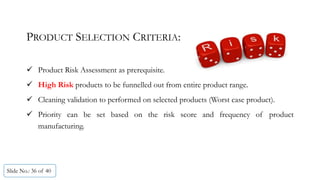
PRODUCT SELECTION CRITERIA:
 Product Risk Assessment as prerequisite.
 High Risk products to be funnelled out from entire product range.
 Cleaning validation to performed on selected products (Worst case product).
 Priority can be set based on the risk score and frequency of product
manufacturing.
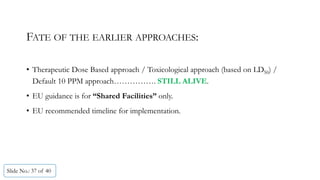
• Therapeutic Dose Based approach / Toxicological approach (based on LD50) /
Default 10 PPM approach……………. STILL ALIVE.
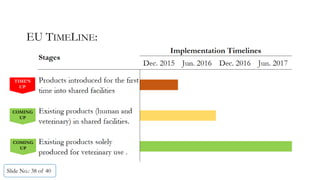
• EU guidance is for “Shared Facilities” only.
• EU recommended timeline for implementation.
Slide No.: 37 of 40
FATE OF THE EARLIER APPROACHES:
Slide No.: 38 of 40
EU TIMELINE:
TIME’S
UP
COMING
UP
COMING
UP
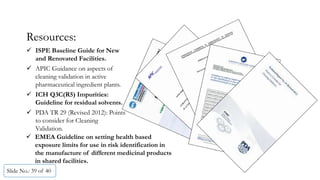
Resources:
Slide No.: 39 of 40
 ISPE Baseline Guide for New
and Renovated Facilities.
 APIC Guidance on aspects of
cleaning validation in active
pharmaceutical ingredient plants.
 ICH Q3C(R5) Impurities:
Guideline for residual solvents.
 PDA TR 29 (Revised 2012): Points
to consider for Cleaning
Validation.
 EMEA Guideline on setting health based
exposure limits for use in risk identification in
the manufacture of different medicinal products
in shared facilities.
Slide No.: 40 of 40
If you found this presentation satisfactory and interested to share your feedback,
please click on the below link. It will hardly take 3 minutes to complete.
https://www.esurveycreator.com/s/6ef5d06
Sambhujyoti Das, Quality Assurance

Cleaning validation a risk integrated approach

  • 1.
    Total Slides: 40 Preparedby: Sambhujyoti Das, Quality Assurance CLEANING VALIDATION A NEW RISK INTEGRATED APPROACH
  • 2.
    CONTENT: Slide No.: 02of 40 • Definition of Cleaning Validation • Clinical Assessment • What’s new? • Risk Assessment • Why risk based approach is required? • Product selection criteria • Risk based cleaning acceptance limit. • Fate of earlier approaches. • Example for deriving acceptance limit • EU Timeline • Hazard Assessment • Resources.
  • 3.
    DEFINITION: The process ofremoving contaminants from process equipment and monitoring the condition of equipment such that the equipment can be safely used for subsequent product manufacturing. Slide No.: 02 of 40 Dustin A. Leblanc.
  • 4.
    WHAT’S NEW: • ICHguideline on residual solvent. • ISPE proposal on ADE in it’s Risk MaPP guideline. • PDA reference on Technical report number 29. • Adoption by EU. • EU timeline on PDE strategy implementation. Slide No.: 04 of 40
  • 5.
    WHY RISK BASEDAPPROACH IS REQUIRED? • Single expression on quantitative health risk. • Covering all parameters of health related risk. • Universally accepted method. • Useful for considering facility design and containments, level of personnel protection required. Slide No.: 05 of 40
  • 6.
    RISK BASED CLEANINGACCEPTANCE LIMIT: • “Permitted Daily Exposure” determination method: PDE = Where, NOAEL = No Observable Adverse Effect Level, F1 = Extrapolation between species (2-12), F2 = Inter-individual variability (10), F3 = Repeat dose toxicity studies of short duration (1-10), F4 = Severe toxicity in reproductive toxicity studies (1-10), F5 = Availability of NOAEL or LOAEL (10). Slide No.: 06 of 40
  • 7.
    RISK BASED CLEANINGACCEPTANCE LIMIT: • “Acceptable Daily Exposure” determination method: ADE = Where, BW = Body weight of patient taking next product (50 Kg), UFC = A composite Uncertainty factors (F1 F2 F3 F4 F5), MF = Modifying factor (1 or 10), PK = Pharmacokinetic factor. Slide No.: 07 of 40
  • 8.
    RISK BASED CLEANINGACCEPTANCE LIMIT: • In other way…….. ADE = Modifying Factor (MF):  Extrapolation to sick population is required when clinical data is available on healthy population only.  Factor value 10 is assigned (for conversion), otherwise assign 1.  The factor value can be assigned for product with high toxicity (i.e. teratogenicity, genotoxicity, carcinogenicity, etc.). Slide No.: 08 of 40
  • 9.
    RISK BASED CLEANINGACCEPTANCE LIMIT: Pharmacokinetic Factor (PK):  Pharmacokinetic correction factor from route to route extrapolation.  Applicable only when route specific bioavailability differs significantly, i.e. difference > 40%.  If there is no bioavailability data available for concerned route, 100% respirable absorption shall be considered as default and following Correction Factor to be derived. For Example: Correction Factor (oral to inhalation) = % oral absorption / 100% respirable absorption Slide No.: 09 of 40
  • 10.
    RISK BASED CLEANINGACCEPTANCE LIMIT: Factor #1 (F1): Species Extrapolation Factor.  The factor to account for extrapolation between species.  Factor value varies from 2 to 12.  If NOAEL data is present on Rat, 5 shall be placed on F1 position in the equation. Slide No.: 10 of 40 Value From To 5 Rats Humans 12 Mice 2 Dogs 2.5 Rabbits 3 Monkeys 10 Other animals
  • 11.
    RISK BASED CLEANINGACCEPTANCE LIMIT: Factor #2 (F2): Individual Variability Factor.  A factor of 10 to account for variability between individuals.  10 is used consistently.  By default, 10 to be entered at the place of F2 in the equation. Slide No.: 11 of 40
  • 12.
    RISK BASED CLEANINGACCEPTANCE LIMIT: Factor #3 (F3): Repeat Dose Toxicity Study Factor.  The duration of toxicity study is considered.  Lesser duration – Higher the factor value, Longer duration – Lower the factor value.  Factor value varies from 1 to 10. Slide No.: 12 of 40 Value Study duration in Rodents (i.e. Rats, Mice & Mouse) Study duration in non-rodents (i.e. Rabbits, Cats, Dogs, Monkeys) 1 1 year (also in Rabbits) 7 years 2 6 months 3.5 years 5 3 months 2 years 10 For shorter duration i.e. less than 4 weeks 1 Reproductive study in which whole period of organogenesis is covered.
  • 13.
    RISK BASED CLEANINGACCEPTANCE LIMIT: Factor #4 (F4): Severe Toxicity Study Factor.  This factor that may be applied in cases of severe toxicity.  Toxicities like non-genotoxic carcinogenicity, neurotoxicity or teratogenicity come under severe toxicity.  Factor value varies from 1 to 10 depending on the level of reproductive toxicity is associated with or without maternal toxicity. Slide No.: 13 of 40 Value Reproductive toxicity condition 1 Fetal toxicity associated with Maternal toxicity. 5 Fetal toxicity without Maternal toxicity. 5 Teratogenicity with Maternal toxicity. 10 Teratogenicity without Maternal toxicity.
  • 14.
    RISK BASED CLEANINGACCEPTANCE LIMIT: Factor #5 (F5): Database Incompleteness Factor.  This factor may be applied if the no-effect level (NOAEL value is absent) was not established.  When only an LOEL is available, factor value shall be 10.  Severity of the toxicity should be considered while assigning factor value. Slide No.: 14 of 40
  • 15.
    RISK BASED CLEANINGACCEPTANCE LIMIT: Determination of MAC (Maximum Allowable Carryover) of Product A (Previous product) to Product B (Next product). MAC = Where, BS = Batch size (Drug Product B) LRDD = Largest Recommended Daily Dose (Drug Product B) Slide No.: 15 of 40
  • 16.
    RISK BASED CLEANINGACCEPTANCE LIMIT: Determination of Final Acceptance Criteria for swab sample (LS). LS = Where, SA = Swab sampling area SESA = Shared Equipment Surface Area (Cumulative contact area of entire equipment train) Slide No.: 16 of 40
  • 17.
    EXAMPLE FOR DERIVINGACCEPTANCE LIMIT: Let’s start with MSDS……..  MSDS from valid source is desirable.  Adequacy of information.  Consistency in illustrated data.  Comparable with Toxicity databases (e.g. IRIS, CPDB, DART, etc.). Slide No.: 17 of 40 General Information MSDS data available on internet could be partially or entirely wrong.
  • 18.
    EXAMPLE FOR DERIVINGACCEPTANCE LIMIT: Let’s start with MSDS…….. The first section of MSDS consists of Name of company, Name of substance and it’s unique Chemical Abstracts Service number. Here (hypothetical example),  Name of company is ABC Inc.  Name of substance is Cupcake  CAS Number is 590332-67-9 Slide No.: 18 of 40 Material Safety Data Sheet SECTION 1: IDENTIFICATION OF THE SUBSTANCE AND COMPANY/UNDERTAKING Version No. 2.1 Date of Rev. 15/01/2016 Name of Company ABC Inc. Emergency Contact No. Address #504 West Celadon, 20nd Lane Karnataka, India 560 064 1-800-429-1000 Contact details +91 (0)2345 8871 Material Name Cupcake CAS No. 590332-67-9 SECTION 2: HAZARD IDENTIFICATION Hazard Class Category Hazard statement Skin irritation 2 H315
  • 19.
    EXAMPLE FOR DERIVINGACCEPTANCE LIMIT: The second section of MSDS consists of Hazard class information. Here (hypothetical example), the substance is having potential reproductive toxicity. Slide No.: 19 of 40 SECTION 2: HAZARD IDENTIFICATION Hazard Class Category Hazard statement Skin irritation 2 H315 Reproductive toxicity 1A H360 Acute aquatic toxicity 3 H402 Chronic aquatic toxicity 3 H412 Signal word : Danger Hazard statements H315 : Causes skin irritation. H360 : May damage the unborn child. H402 : Harmful to aquatic life. H412 : Harmful to aquatic life with long lasting effects. Page 01 0f 07
  • 20.
    EXAMPLE FOR DERIVINGACCEPTANCE LIMIT:  Sections like First Aid Measures, Fire Fighting Measures, Handling and Storage, etc. are irrelevant here.  Here Section 11: Toxicological Information is of prime interest. Slide No.: 20 of 40 Cupcake SECTION 11: TOXICOLOGICAL INFORMATION Version No. 2.1 Date of Rev. 15/01/2016 General Information The information included in this section describes the potential hazards of the substance.. Acute Toxicity: (Species, Route, End Point, Dose) Rat Oral LD50 2750 mg/kg, Mouse Oral LD50 2830 mg/kg, Rat Intravenous LD50 990 mg/kg, Dog Intravenous LD50 250 mg/kg. Acute Toxicity Comments: A greater than symbol (>) indicates that the toxicity endpoint being tested was not achievable at the highest dose used in the test. Irritation / Sensitization: (Study Type, Species, Severity) Skin Contact : Causes skin irritation. Eye Contact : May cause eye irritation. May cause excessive watering of the eye (lachrymation).
  • 21.
    EXAMPLE FOR DERIVINGACCEPTANCE LIMIT: Here, all toxicity data is available on Rat. Hence,  Species Extrapolation Factor (F1): Factor value = for Rat to Human.  Repeat Dose Toxicity Factor (F3): Factor value = on 1 year data.  Severe Toxicity Study Factor (F4): Slide No.: 21 of 40 Repeated Dose Toxicity: (Duration, Species, Route, Dose, End Point, Target Organ) 30 Day(s) Rat Oral 1 g/kg/day NOAEL Blood, 13 Week(s) Mouse Oral 12,500 ppm NOAEL Bladder, 9 Month(s) Dog Oral 50 mg/kg/day NOAEL Endocrine system, 1 Year(s) Rat Oral 2 g/kg/day NOAEL Kidney, 2 Year(s) Rat Oral 2.5 g/kg/day NOAEL Kidney. Reproduction & Developmental Toxicity: (Study Type, Species, Route, Dose, End Point, Effect(s) Reproductive & Fertility Rat Oral 430 mg/kg/day NOAEL Fertility, Embryo / Fetal Development Rat Oral 430 mg/kg/day NOAEL Not Teratogenic, Embryo / Fetal Development Rat Oral 430 mg/kg/day LOAEL Fetotoxicity, Embryo / Fetal Development Rabbit Oral 64 mg/kg/day LOAEL Fetotoxicity. Genetic Toxicity: (Study Type, Cell Type/Organism, Result) Bacterial Mutagenicity (Ames) Salmonella Negative with activation, Chromosome Aberration Human Lymphocytes Negative, Dominant Lethal Assay Mouse Negative. Page 06 0f 07 5 1 5Factor value = for Fetal toxicity without Maternal toxicity, Non-teratogenic.
  • 22.
    EXAMPLE FOR DERIVINGACCEPTANCE LIMIT:  Database Incompleteness Factor (F5): Factor value = presence of NOAEL. The lowest value NOAEL is considered as 430 mg/kg/day from Reproductive and Development toxicity studies. Slide No.: 22 of 40 Cupcake Version No. 2.1 Date of Rev. 15/01/2016 Carcinogenicity: (Duration, Species, Route, Dose, End Point, Effect(s) 2 Year(s) Rat Oral 800 mg/kg/day NOAEL Not carcinogenic, 21 Month(s) Mouse Oral 750 mg/kg/day NOAEL Not carcinogenic. Carcinogen Status: This substance is not listed as a carcinogen by IARC, NTP or OSHA. SECTION 12: ECOLOGICAL INFORMATION Harmful to aquatic life with long lasting effects. No information on this formulation. The following information refers to Cupcake. Toxicity : EC50 green algae 72 H biomass 22,8 mg/l ErC50 green algae 72 H 58,3 mg/l (OECD 201) NOEC green algae 72 H growth rate 7,5 mg/l (OECD 201) EC50 Daphnia magna 48 H 120 mg/l (OECD 202) NOEC Daphnia magna 48 H 30 mg/l (OECD 202) LC50 Rainbow trout 96 H 130 mg/l (OECD 203) NOEC Rainbow trout 96 H 32 mg/l (OECD 203) 1
  • 23.
    HAZARDS ASSESSMENT: Slide No.:23 of 40 YES NO UNKNOWN Genotoxicant    Reproductive developmental toxicant    Carcinogen    Highly sensitizing potential   
  • 24.
    CLINICAL ASSESSMENT: • Theclinical data is insufficient on sick population, hence the Modifying Factor (MF) is to be . • The bioavailability data is available on desirable oral route, hence the Pharmacokinetic Factor (PK) is to be . Slide No.: 24 of 40 10 1
  • 25.
    ADE = = 8.6 mg. Where, NOAEL = 430 mg/kg/day. BW = 50 Kg. UFC = F1 5, F2 10, F3 1, F4 5 & F5 1 MF = 10. PK = 1. Slide No.: 25 of 40 DETERMINATION OF ADE VALUE:
  • 26.
    Slide No.: 26of 40 CONVERSION FROM ADE TO MAC: MAC = . = 286667 mg. Where, ADE = 8.6 mg. for product A, i.e. Cupcake. Batch Size = 50 kg for product B, i.e. next product (unit conversion done from Kg. to mg.) Largest Recommended Daily Dose = 3 doses of 500 mg each for product B, i.e. next product.
  • 27.
    DETERMINATION OF FINALACCEPTANCE LIMIT: LS = = 14.98 mg./swab Where, MAC = 286667 mg. Swab area = 4 inch2. Shared Equipment Surface Area = 76506 inch2. Slide No.: 27 of 40
  • 28.
    DETERMINATION OF FINALACCEPTANCE LIMIT: EU recommendations: o A PDE Determination Strategy document on first hand. o A Curriculum Vitae of toxicologist (with adequate academics and experience) who performed PDE/ADE determination. Slide No.: 28 of 40
  • 29.
    POINTS TO BENOTED:  The ADE value derived acceptance limit is very high, i.e. 14.98 mg./swab which indicates that the product is less hazardous.  The Visual Residue Limit (VRL) of Cupcake is 8.5 µg/inch2 (hypothetical value).  The acceptance limit for Cupcake is greater than VRL (14.98 / 4 = 3.75 mg/inch2). Hence, the Detection level is high (Refer “Risk Assessment” section).  The overall risk related to product Cupcake is low. Slide No.: 29 of 40
  • 30.
    RISK ASSESSMENT: Risk =Severity × Occurrence × Detection Severity = Hazard associated with the drug substance (based on ADE value) Occurrence = Solubility of drug product Detection = Ability of product getting detected (based on acceptance limit vs VRL and ARL) Slide No.: 30 of 40
  • 31.
    RISK ASSESSMENT: continued…….. SEVERITY: Categorization can be done by taking reference from TTC (Therapeutic Toxicological Concern) criteria. Derived ADE Value Severity Score Hazard level ADE ≤ 10 µg 10 High ADE > 10 µg & < 100 µg 5 Medium ADE ≥ 100 µg 1 Low Slide No.: 31 of 40
  • 32.
    RISK ASSESSMENT: continued…….. OCCURRENCE: Categorization can be done by taking reference from official standards* on solubility. Solubility of drug product Occurrence Score Probability level Insoluble / Prac. insoluble (10000 <) 10 High Very slightly soluble (1000 - 10000) 8 Medium Slightly soluble (100 - 1000) 5 Soluble / Sparingly soluble (10 - 100) 3 Low Very soluble / Freely soluble (<10) 1 Slide No.: 32 of 40 * USP 29
  • 33.
    RISK ASSESSMENT: continued…….. DETECTION: Categorization can be done on the basis of derived acceptance limit vs Visual Residue Limit (VRL) and Analytical Residue Limit (ARL). Conditions Detection Score Detection level Acc. Limit < ARL 5 High Acc. Limit ≥ ARL but ≤ VRL 3 Medium Acc. Limit ≥ VRL 1 Low Slide No.: 33 of 40
  • 34.
    RISK ASSESSMENT: continued…….. RISKPRIORITY NUMBERING : RPN = Severity score × Occurrence score × Detection score. Risk Priority Number Risk level Greater than 100 High From 25 to 100 Medium Less than 25 Low Slide No.: 34 of 40
  • 35.
    RISK ASSESSMENT (FMEAMETHOD): Risk assessment can now be performed with the help of established risk matrix. Slide No.: 35 of 40 Sr. No. Name of Product Active Moiety Pre-assessment Mitigation Strategy Post-assessment Severity Occurrence Detection RPN Severity Occurrence Detection RPN 1 Cupcake Tablets 10 mg Mango 1 3 1 3 Not required 1 3 1 3 2 Donut Capsules 12.5 mg Banana 1 10 3 30 Not required 1 10 3 30 3 Eclair Capsules 1 mg Strawberry 10 10 3 300 Detergent shall be used for cleaning 10 3 3 90 4 Froyo Tablets 5 mg Pineapple 5 5 5 125 More sensitive analytical method to be used 5 5 3 75 5 Gingerbread Tablets 2 mg Orange 10 10 3 300 Solubility enhancement not possible 10 10 3 300
  • 36.
    Slide No.: 36of 40 PRODUCT SELECTION CRITERIA:  Product Risk Assessment as prerequisite.  High Risk products to be funnelled out from entire product range.  Cleaning validation to performed on selected products (Worst case product).  Priority can be set based on the risk score and frequency of product manufacturing.
  • 37.
    • Therapeutic DoseBased approach / Toxicological approach (based on LD50) / Default 10 PPM approach……………. STILL ALIVE. • EU guidance is for “Shared Facilities” only. • EU recommended timeline for implementation. Slide No.: 37 of 40 FATE OF THE EARLIER APPROACHES:
  • 38.
    Slide No.: 38of 40 EU TIMELINE: TIME’S UP COMING UP COMING UP
  • 39.
    Resources: Slide No.: 39of 40  ISPE Baseline Guide for New and Renovated Facilities.  APIC Guidance on aspects of cleaning validation in active pharmaceutical ingredient plants.  ICH Q3C(R5) Impurities: Guideline for residual solvents.  PDA TR 29 (Revised 2012): Points to consider for Cleaning Validation.  EMEA Guideline on setting health based exposure limits for use in risk identification in the manufacture of different medicinal products in shared facilities.
  • 40.
    Slide No.: 40of 40 If you found this presentation satisfactory and interested to share your feedback, please click on the below link. It will hardly take 3 minutes to complete. https://www.esurveycreator.com/s/6ef5d06 Sambhujyoti Das, Quality Assurance