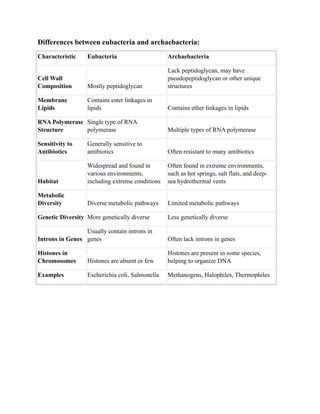
Differences between eubacteria and archaebacteria:
Characteristic Eubacteria Archaebacteria
Cell Wall
Composition Mostly peptidoglycan
Lack peptidoglycan, may have
pseudopeptidoglycan or other unique
structures
Membrane
Lipids
Contains ester linkages in
lipids Contains ether linkages in lipids
RNA Polymerase
Structure
Single type of RNA
polymerase Multiple types of RNA polymerase
Sensitivity to
Antibiotics
Generally sensitive to
antibiotics Often resistant to many antibiotics
Habitat
Widespread and found in
various environments,
including extreme conditions
Often found in extreme environments,
such as hot springs, salt flats, and deep-
sea hydrothermal vents
Metabolic
Diversity Diverse metabolic pathways Limited metabolic pathways
Genetic Diversity More genetically diverse Less genetically diverse
Introns in Genes
Usually contain introns in
genes Often lack introns in genes
Histones in
Chromosomes Histones are absent or few
Histones are present in some species,
helping to organize DNA
Examples Escherichia coli, Salmonella Methanogens, Halophiles, Thermophiles

Differences between eubacteria and archaebacteria.pdf

  • 1.
    Differences between eubacteriaand archaebacteria: Characteristic Eubacteria Archaebacteria Cell Wall Composition Mostly peptidoglycan Lack peptidoglycan, may have pseudopeptidoglycan or other unique structures Membrane Lipids Contains ester linkages in lipids Contains ether linkages in lipids RNA Polymerase Structure Single type of RNA polymerase Multiple types of RNA polymerase Sensitivity to Antibiotics Generally sensitive to antibiotics Often resistant to many antibiotics Habitat Widespread and found in various environments, including extreme conditions Often found in extreme environments, such as hot springs, salt flats, and deep- sea hydrothermal vents Metabolic Diversity Diverse metabolic pathways Limited metabolic pathways Genetic Diversity More genetically diverse Less genetically diverse Introns in Genes Usually contain introns in genes Often lack introns in genes Histones in Chromosomes Histones are absent or few Histones are present in some species, helping to organize DNA Examples Escherichia coli, Salmonella Methanogens, Halophiles, Thermophiles