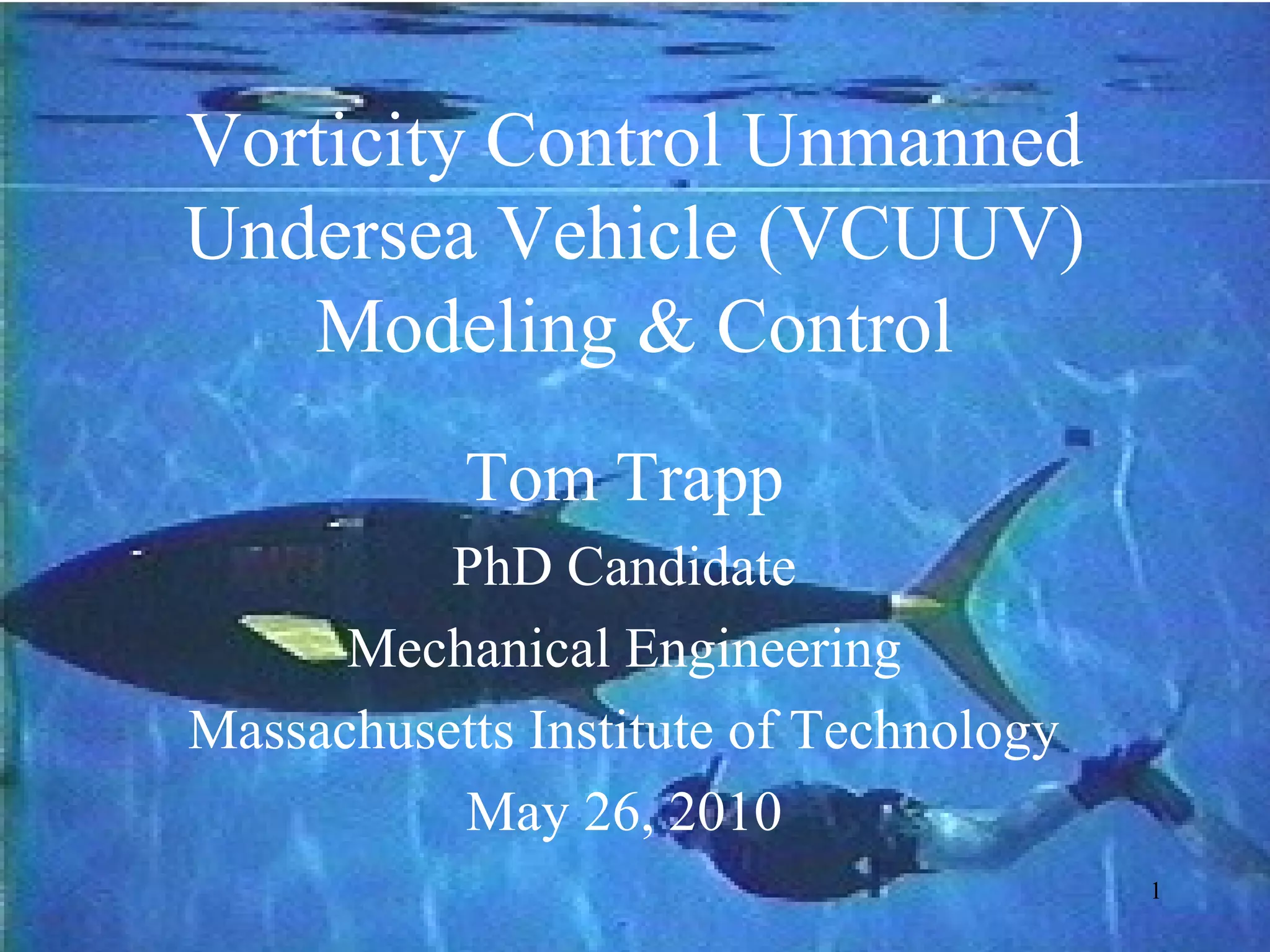
Vorticity Control Unmanned
Undersea Vehicle (VCUUV)
Modeling & Control
Tom Trapp
PhD Candidate
Mechanical Engineering
Massachusetts Institute of Technology
May 26, 2010
1
Intro Sys Model Control Results 3
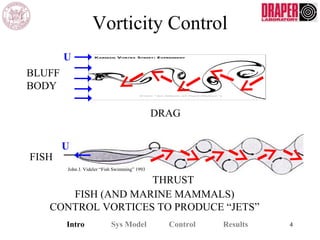
Vorticity Control
BLUFF
BODY
DRAG
John J. Videler “Fish Swimming” 1993
FISH
THRUST
FISH (AND MARINE MAMMALS)
CONTROL VORTICES TO PRODUCE “JETS”
Intro Sys Model Control Results 4
U
U
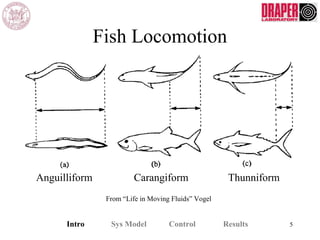
Anguilliform ThunniformCarangiform
Intro Sys Model Control Results 5
From “Life in Moving Fluids” Vogel
Fish Locomotion
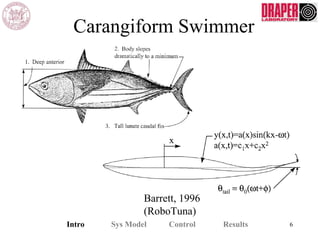
Carangiform Swimmer
6Intro Sys Model Control Results
Barrett, 1996
(RoboTuna)
7Intro Sys Model Control Results
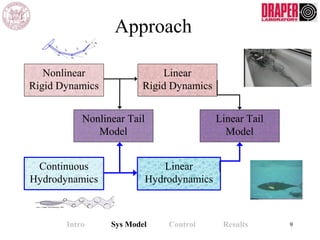
Approach
Nonlinear
Rigid Dynamics
Continuous
Hydrodynamics
Linear
Hydrodynamics
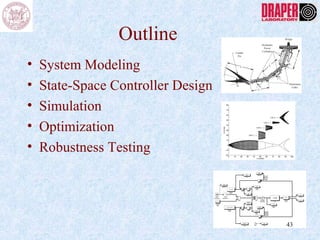
Linear
Rigid Dynamics
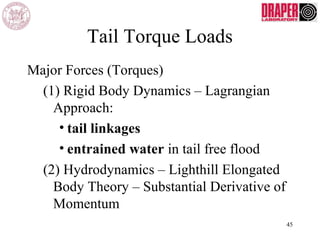
Nonlinear Tail
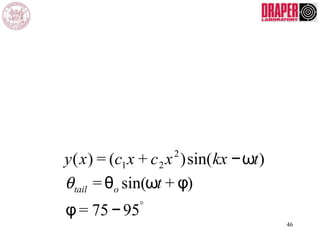
Model
Linear Tail
Model
Intro Sys Model Control Results 9
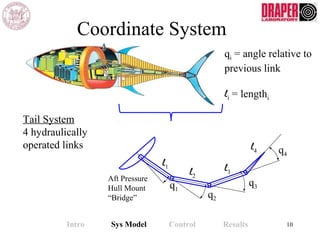
Aft Pressure
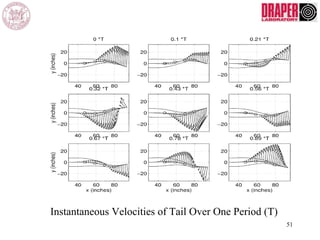
Hull Mount
“Bridge”
q1
q2
q3
q4
l1
l2
l3
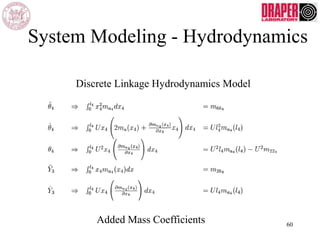
l4
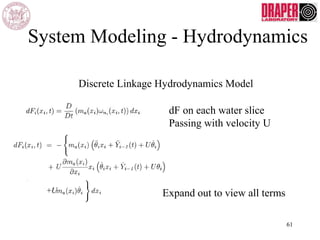
Tail System
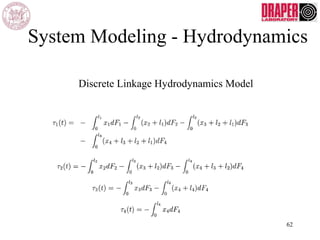
4 hydraulically
operated links
qi = angle relative to
previous link
li = lengthi
Intro Sys Model Control Results 10
Coordinate System
11
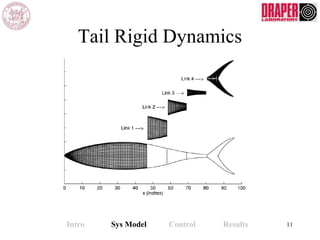
Tail Rigid Dynamics
Intro Sys Model Control Results
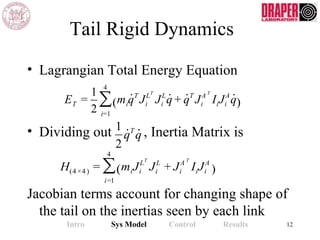
Tail Rigid Dynamics
• Lagrangian Total Energy Equation
• Dividing out , Inertia Matrix is
Jacobian terms account for changing shape of
the tail on the inertias seen by each link
ET =
1
2
mi ˙qT
Ji
LT
Ji
L
˙q + ˙qT
Ji
A T
IiJi
A
˙q( )
i=1
4
∑
H(4 ×4 ) = miJi
LT
Ji
L
+ Ji
A T
IiJi
A
( )
i=1
4
∑
1
2
˙qT
˙q
Intro Sys Model Control Results 12
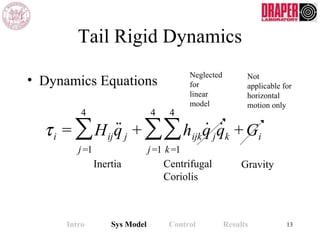
Tail Rigid Dynamics
• Dynamics Equations
τi = Hij
˙˙qj
j=1
4
∑ + hijk
˙qj
˙qk
k=1
4
∑ +Gi
j =1
4
∑
Intro Sys Model Control Results 13
Neglected
for
linear
model
Not
applicable for
horizontal
motion only
Inertia Centrifugal
Coriolis
Gravity
Hydrodynamics
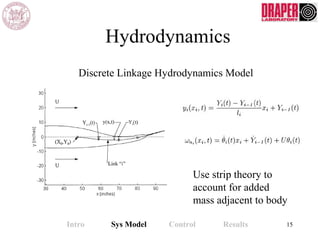
• Two Major Assumptions of EBT
1. Body Slope fore-aft is negligible [violated]
• Body slope is not extreme and EBT will slightly
overestimate added mass – acceptable engineering
approximation
1. Rigid Cylinder approx for added mass if the
undulation wavelength is at least 5 times the
section depth [good]
Intro Sys Model Control Results 14
Hydrodynamics
Discrete Linkage Hydrodynamics Model
Use strip theory to
account for added
mass adjacent to body
Intro Sys Model Control Results 15
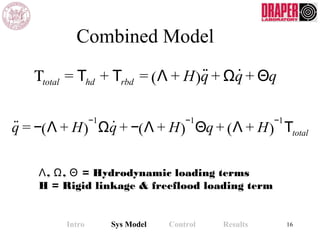
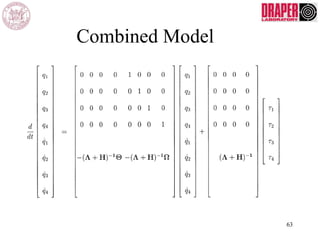
Combined Model
, , = Hydrodynamic loading termsΛ Ω Θ
H = Rigid linkage & freeflood loading term
Intro Sys Model Control Results 16
Τtotal = Τhd + Τrbd = Λ + H( )˙˙q + Ω˙q + Θq
˙˙q = − Λ + H( )
−1
Ω˙q + − Λ + H( )
−1
Θq + Λ + H( )
−1
Τtotal
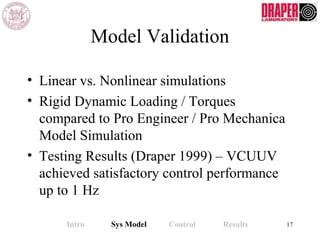
Model Validation
• Linear vs. Nonlinear simulations
• Rigid Dynamic Loading / Torques
compared to Pro Engineer / Pro Mechanica
Model Simulation
• Testing Results (Draper 1999) – VCUUV
achieved satisfactory control performance
up to 1 Hz
Intro Sys Model Control Results 17
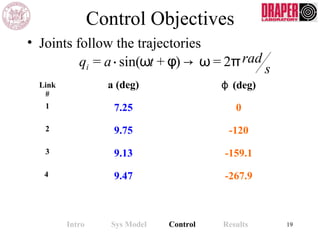
Control Objectives
• Joints follow the trajectories
Link
#
a (deg) ϕ (deg)
1 7.25 0
2 9.75 -120
3 9.13 -159.1
4 9.47 -267.9
qi = a⋅ sin(ωt + φ) → ω = 2πrad
s
Intro Sys Model Control Results 19
Controller Design
• Computed Torque Approach
• Position ±0.01 rad, Velocity ±0.1 rad/s (avg.)
• Reject noise to 20 quantization levels
• Reject 15% torque disturbance at caudal fin
• Accept ±25% model perturbations
Intro Sys Model Control Results 20
Controller Design
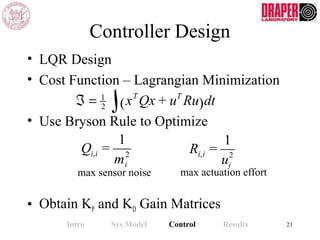
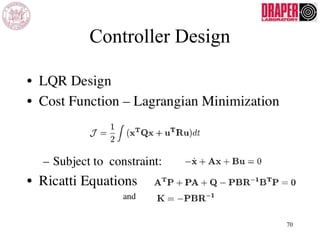
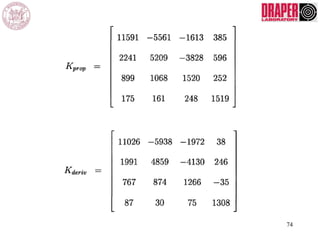
• LQR Design
• Cost Function – Lagrangian Minimization
• Use Bryson Rule to Optimize
• Obtain KP and KD Gain Matrices
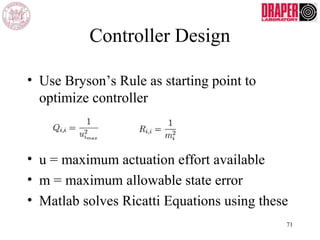
Qi,i =
1
mi
2 Ri,i =
1
ui
2
max sensor noise max actuation effort
Intro Sys Model Control Results 21
ℑ = 1
2
xT
Qx + uT
Ru( )dt∫
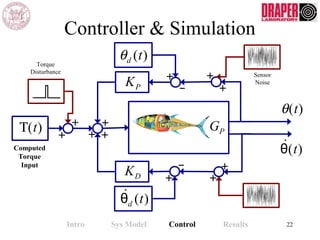
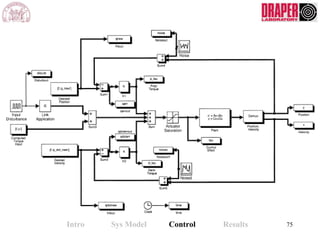
Controller & Simulation
22
˙θd (t)
θd (t)
Τ(t)
˙θ(t)
θ(t)
KD
KP
+
+
+
−
−
+
++
+
+
+
+
+
Torque
Disturbance Sensor
Noise
GP
Intro Sys Model Control Results
Computed
Torque
Input
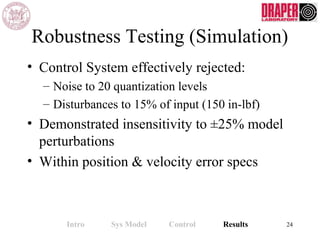
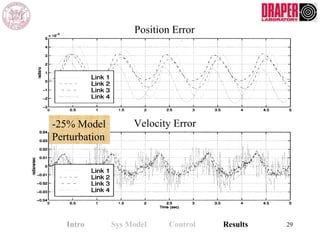
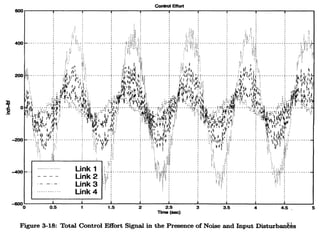
Robustness Testing (Simulation)
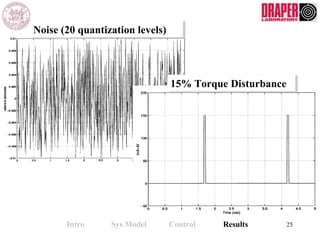
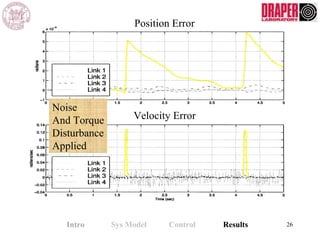
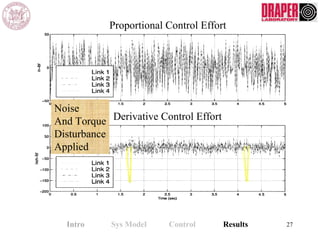
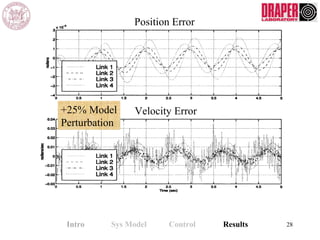
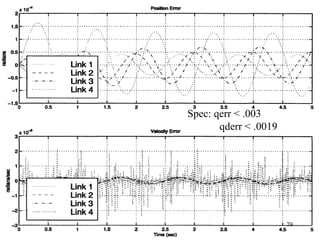
• Control System effectively rejected:
– Noise to 20 quantization levels
– Disturbances to 15% of input (150 in-lbf)
• Demonstrated insensitivity to ±25% model
perturbations
• Within position & velocity error specs
Intro Sys Model Control Results 24
Noise (20 quantization levels)Noise (20 quantization levels)
15% Torque Disturbance15% Torque Disturbance
Intro Sys Model Control Results 25
Noise
And Torque
Disturbance
Applied
Velocity Error
26Intro Sys Model Control Results
Position Error
27Intro Sys Model Control Results
Noise
And Torque
Disturbance
Applied
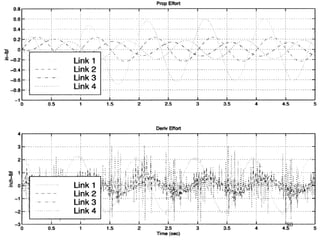
Proportional Control Effort
Derivative Control Effort
+25% Model
Perturbation
28Intro Sys Model Control Results
Velocity Error
Position Error
-25% Model
Perturbation
29Intro Sys Model Control Results
Velocity Error
Position Error
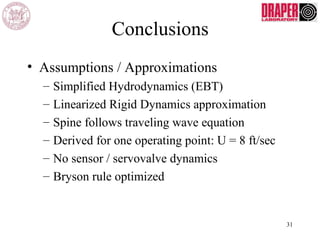
Conclusions
• Assumptions / Approximations
– Simplified Hydrodynamics (EBT)
– Linearized Rigid Dynamics approximation
– Spine follows traveling wave equation
– Derived for one operating point: U = 8 ft/sec
– No sensor / servovalve dynamics
– Bryson rule optimized
31
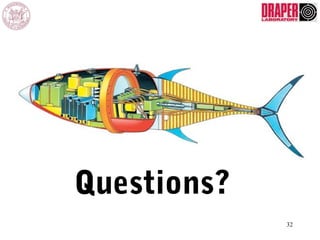
Questions?
32
Backup Slides
33
Biography
EDUCATION
• BS EE – UW Milwaukee 1988
• SM ME & NavEng – MIT 1998
• Navy Permanent Military Professor Program MIT
WORK EXPERIENCE
• Navy Nuclear Propulsion & USS AUGUSTA 1989-1995
• Submarine Repair & Overhaul 1998 - 2009
– Pearl Harbor Shipyard 1998-2001
– Commander Submarine Force Pacific Fleet 2001-2004
– General Dynamics Electric Boat 2004-2007
– Submarine Base Groton, CT 2007-2009
34
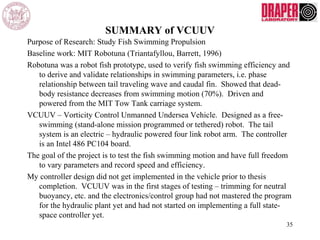
SUMMARY of VCUUV
Purpose of Research: Study Fish Swimming Propulsion
Baseline work: MIT Robotuna (Triantafyllou, Barrett, 1996)
Robotuna was a robot fish prototype, used to verify fish swimming efficiency and
to derive and validate relationships in swimming parameters, i.e. phase
relationship between tail traveling wave and caudal fin. Showed that dead-
body resistance decreases from swimming motion (70%). Driven and
powered from the MIT Tow Tank carriage system.
VCUUV – Vorticity Control Unmanned Undersea Vehicle. Designed as a free-
swimming (stand-alone mission programmed or tethered) robot. The tail
system is an electric – hydraulic powered four link robot arm. The controller
is an Intel 486 PC104 board.
The goal of the project is to test the fish swimming motion and have full freedom
to vary parameters and record speed and efficiency.
My controller design did not get implemented in the vehicle prior to thesis
completion. VCUUV was in the first stages of testing – trimming for neutral
buoyancy, etc. and the electronics/control group had not mastered the program
for the hydraulic plant yet and had not started on implementing a full state-
space controller yet.
35
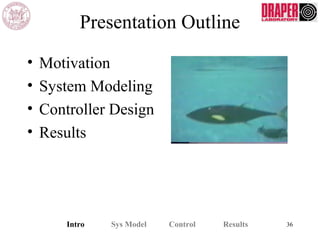
Presentation Outline
• Motivation
• System Modeling
• Controller Design
• Results
Intro Sys Model Control Results 36
Intro Sys Model Control Results 37
Intro Sys Model Control Results 38
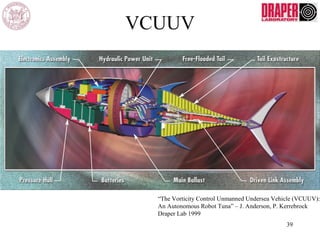
39
“The Vorticity Control Unmanned Undersea Vehicle (VCUUV):
An Autonomous Robot Tuna” – J. Anderson, P. Kerrebrock
Draper Lab 1999
VCUUV
Background
• Fish Swimming Propulsion
– Vorticity Control – Vortices formed, controlled
– Reduced Drag – up to 70% reduction over dead
body drag (RoboTuna)
• James Gray (1936) Gray’s Paradox –7x
muscular power density
• Sir James Lighthill (1970) Propulsive
Efficiency – Elongated Body Theory
• M. S. Triantafyllou (1996) MIT Robo Tuna
• Draper Lab (1999) VCUUV 40
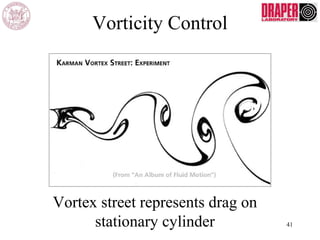
Vorticity Control
Vortex street represents drag on
stationary cylinder 41
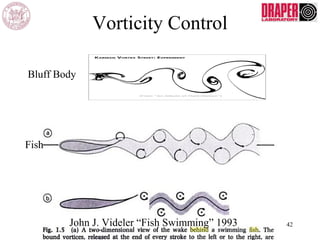
Vorticity Control
John J. Videler “Fish Swimming” 1993
Fish
Bluff Body
42
Outline
• System Modeling
• State-Space Controller Design
• Simulation
• Optimization
• Robustness Testing
43
Modeling Backup Slides
44
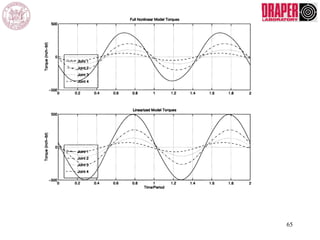
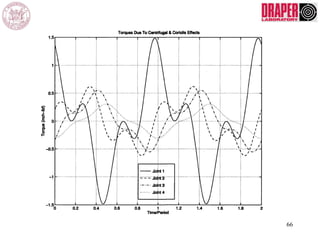
Tail Torque Loads
Major Forces (Torques)
(1) Rigid Body Dynamics – Lagrangian
Approach:
• tail linkages
• entrained water in tail free flood
(2) Hydrodynamics – Lighthill Elongated
Body Theory – Substantial Derivative of
Momentum
45
46
y(x) = (c1x + c2x2
)sin(kx −ωt)
θtail =θo sin(ωt + φ)
φ= 75 −95°
System Modeling - Tail
• Jacobian Matrices – Translation & Rotation
kinematics
• Lagrangian Dynamics – Energy Equation
• Inertia Matrix
• Nonlinear Torque Terms
• Dynamics (Torque) Equations
47
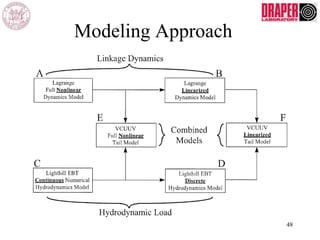
Modeling Approach
48
Caudal
Fin
Hydraulic
Cylinders
Bridge
Aluminum
Links
l1
l2
l3
l4
q1
q2
q3
q4
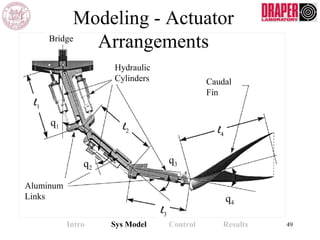
Modeling - Actuator
Arrangements
Intro Sys Model Control Results 49
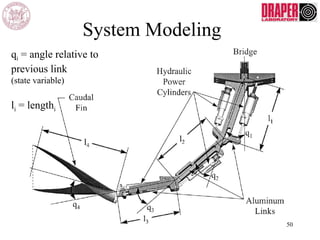
System Modeling
qi = angle relative to
previous link
(state variable)
li = lengthi
50
Instantaneous Velocities of Tail Over One Period (T)
51
System Modeling
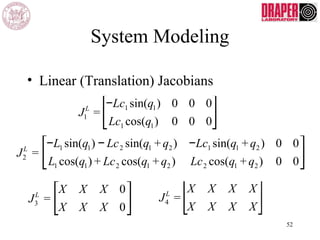
• Linear (Translation) Jacobians
J1
L
=
−Lc1 sin(q1) 0 0 0
Lc1 cos(q1) 0 0 0
⎡
⎣
⎢
⎤
⎦
⎥
J2
L
=
−L1 sin(q1) − Lc2 sin(q1 +q2) −Lc1 sin(q1 +q2) 0 0
L1 cos(q1) + Lc2 cos(q1 +q2) Lc2 cos(q1 +q2) 0 0
⎡
⎣
⎢
⎤
⎦
⎥
J3
L
=
X X X 0
X X X 0
⎡
⎣
⎢
⎤
⎦
⎥ J4
L
=
X X X X
X X X X
⎡
⎣
⎢
⎤
⎦
⎥
52
System Modeling
• Angular (Rotation) Jacobian
J1
A
= q1 0 0 0[ ]
J2
A
= q1 q2 0 0[ ]
J3
A
= q1 q2 q3 0[ ]
J4
A
= q1 q2 q3 q4[ ]
53
System Modeling
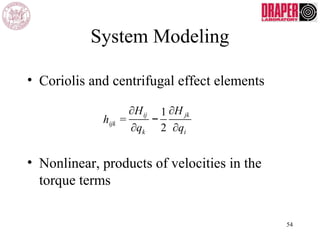
• Coriolis and centrifugal effect elements
• Nonlinear, products of velocities in the
torque terms
hijk =
∂Hij
∂qk
−
1
2
∂H jk
∂qi
54
System Modeling - Hydrodynamics
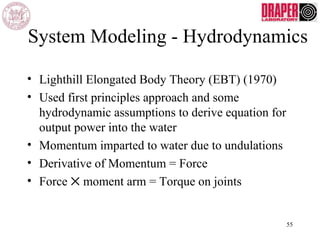
• Lighthill Elongated Body Theory (EBT) (1970)
• Used first principles approach and some
hydrodynamic assumptions to derive equation for
output power into the water
• Momentum imparted to water due to undulations
• Derivative of Momentum = Force
• Force ✕ moment arm = Torque on joints
55
System Modeling - Hydrodynamics
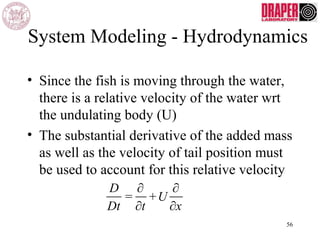
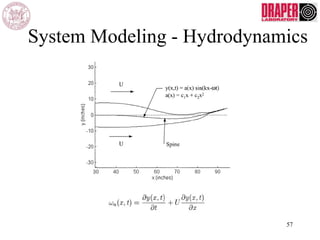
• Since the fish is moving through the water,
there is a relative velocity of the water wrt
the undulating body (U)
• The substantial derivative of the added mass
as well as the velocity of tail position must
be used to account for this relative velocity
D
Dt
=
∂
∂t
+U
∂
∂x
56
System Modeling - Hydrodynamics
57
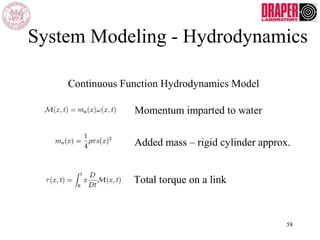
System Modeling - Hydrodynamics
Momentum imparted to water
Added mass – rigid cylinder approx.
Total torque on a link
Continuous Function Hydrodynamics Model
58
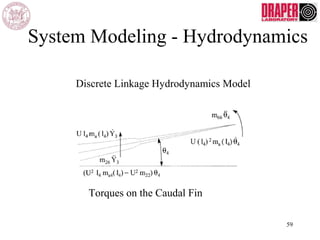
System Modeling - Hydrodynamics
Discrete Linkage Hydrodynamics Model
Torques on the Caudal Fin
59
System Modeling - Hydrodynamics
Discrete Linkage Hydrodynamics Model
Added Mass Coefficients 60
System Modeling - Hydrodynamics
dF on each water slice
Passing with velocity U
Discrete Linkage Hydrodynamics Model
+U Expand out to view all terms
61
System Modeling - Hydrodynamics
Discrete Linkage Hydrodynamics Model
62
Combined Model
63
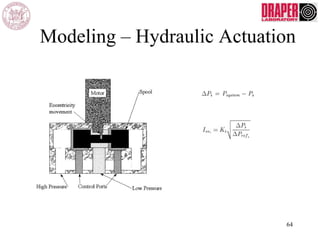
Modeling – Hydraulic Actuation
64
65
66
Controller Backup Slides
67
Controller Design
• For this MIMO system
– 4 inputs x 8 outputs = 32 dynamic relationships
– For traditional optimization, would require
analysis of 32 Bode plots, 32 Root locus
plots…
– Use LQR optimization methods
68
Controller Design
• Desired angular position and velocity are
fed into the system as infinitely fast
observer outputs
• The error signals are multiplied by gains
calculated using LQR method
69
Controller Design
70
Controller Design
• Use Bryson’s Rule as starting point to
optimize controller
• u = maximum actuation effort available
• m = maximum allowable state error
• Matlab solves Ricatti Equations using these
71
Controller Design
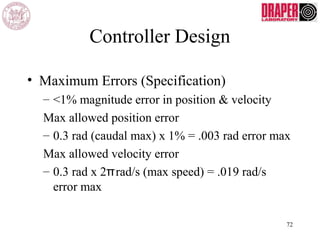
• Maximum Errors (Specification)
– <1% magnitude error in position & velocity
Max allowed position error
– 0.3 rad (caudal max) x 1% = .003 rad error max
Max allowed velocity error
– 0.3 rad x 2 rad/s (max speed) = .019 rad/sπ
error max
72
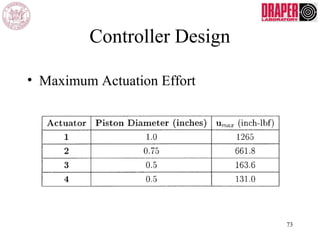
Controller Design
• Maximum Actuation Effort
73
Controller Design
74
Intro Sys Model Control Results 75
Results Backup Slides
76
Results
77
Results
78
Results
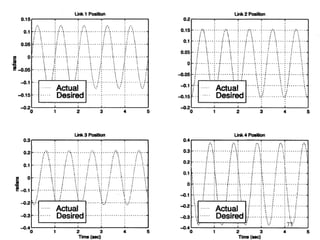
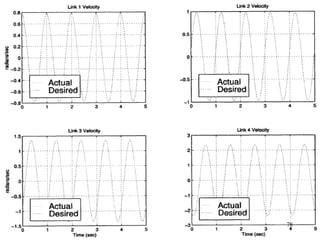
Spec: qerr < .003
qderr < .0019
79
Results
80
Results
81
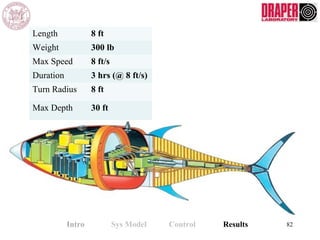
Length 8 ft
Weight 300 lb
Max Speed 8 ft/s
Duration 3 hrs (@ 8 ft/s)
Turn Radius 8 ft
Max Depth 30 ft
Intro Sys Model Control Results 82
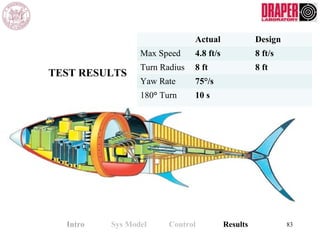
Actual Design
Max Speed 4.8 ft/s 8 ft/s
Turn Radius 8 ft 8 ft
Yaw Rate 75°/s
180° Turn 10 s
Intro Sys Model Control Results 83
TEST RESULTS
Future Work
• System Identification of VCUUV
• Fully optimize controller (Bryson)
• Controller implementation / testing in vehicle
• Kalman filter implementation
• Heading / depth control
• Model paramaters adaptive to velocity
84

Fish Propulsion

  • 1.
    Vorticity Control Unmanned UnderseaVehicle (VCUUV) Modeling & Control Tom Trapp PhD Candidate Mechanical Engineering Massachusetts Institute of Technology May 26, 2010 1
  • 2.
    Intro Sys ModelControl Results 3
  • 3.
    Vorticity Control BLUFF BODY DRAG John J.Videler “Fish Swimming” 1993 FISH THRUST FISH (AND MARINE MAMMALS) CONTROL VORTICES TO PRODUCE “JETS” Intro Sys Model Control Results 4 U U
  • 4.
    Anguilliform ThunniformCarangiform Intro SysModel Control Results 5 From “Life in Moving Fluids” Vogel Fish Locomotion
  • 5.
    Carangiform Swimmer 6Intro SysModel Control Results Barrett, 1996 (RoboTuna)
  • 6.
    7Intro Sys ModelControl Results
  • 7.
  • 8.
    Aft Pressure Hull Mount “Bridge” q1 q2 q3 q4 l1 l2 l3 l4 TailSystem 4 hydraulically operated links qi = angle relative to previous link li = lengthi Intro Sys Model Control Results 10 Coordinate System
  • 9.
    11 Tail Rigid Dynamics IntroSys Model Control Results
  • 10.
    Tail Rigid Dynamics •Lagrangian Total Energy Equation • Dividing out , Inertia Matrix is Jacobian terms account for changing shape of the tail on the inertias seen by each link ET = 1 2 mi ˙qT Ji LT Ji L ˙q + ˙qT Ji A T IiJi A ˙q( ) i=1 4 ∑ H(4 ×4 ) = miJi LT Ji L + Ji A T IiJi A ( ) i=1 4 ∑ 1 2 ˙qT ˙q Intro Sys Model Control Results 12
  • 11.
    Tail Rigid Dynamics •Dynamics Equations τi = Hij ˙˙qj j=1 4 ∑ + hijk ˙qj ˙qk k=1 4 ∑ +Gi j =1 4 ∑ Intro Sys Model Control Results 13 Neglected for linear model Not applicable for horizontal motion only Inertia Centrifugal Coriolis Gravity
  • 12.
    Hydrodynamics • Two MajorAssumptions of EBT 1. Body Slope fore-aft is negligible [violated] • Body slope is not extreme and EBT will slightly overestimate added mass – acceptable engineering approximation 1. Rigid Cylinder approx for added mass if the undulation wavelength is at least 5 times the section depth [good] Intro Sys Model Control Results 14
  • 13.
    Hydrodynamics Discrete Linkage HydrodynamicsModel Use strip theory to account for added mass adjacent to body Intro Sys Model Control Results 15
  • 14.
    Combined Model , ,= Hydrodynamic loading termsΛ Ω Θ H = Rigid linkage & freeflood loading term Intro Sys Model Control Results 16 Τtotal = Τhd + Τrbd = Λ + H( )˙˙q + Ω˙q + Θq ˙˙q = − Λ + H( ) −1 Ω˙q + − Λ + H( ) −1 Θq + Λ + H( ) −1 Τtotal
  • 15.
    Model Validation • Linearvs. Nonlinear simulations • Rigid Dynamic Loading / Torques compared to Pro Engineer / Pro Mechanica Model Simulation • Testing Results (Draper 1999) – VCUUV achieved satisfactory control performance up to 1 Hz Intro Sys Model Control Results 17
  • 16.
    Control Objectives • Jointsfollow the trajectories Link # a (deg) ϕ (deg) 1 7.25 0 2 9.75 -120 3 9.13 -159.1 4 9.47 -267.9 qi = a⋅ sin(ωt + φ) → ω = 2πrad s Intro Sys Model Control Results 19
  • 17.
    Controller Design • ComputedTorque Approach • Position ±0.01 rad, Velocity ±0.1 rad/s (avg.) • Reject noise to 20 quantization levels • Reject 15% torque disturbance at caudal fin • Accept ±25% model perturbations Intro Sys Model Control Results 20
  • 18.
    Controller Design • LQRDesign • Cost Function – Lagrangian Minimization • Use Bryson Rule to Optimize • Obtain KP and KD Gain Matrices Qi,i = 1 mi 2 Ri,i = 1 ui 2 max sensor noise max actuation effort Intro Sys Model Control Results 21 ℑ = 1 2 xT Qx + uT Ru( )dt∫
  • 19.
    Controller & Simulation 22 ˙θd(t) θd (t) Τ(t) ˙θ(t) θ(t) KD KP + + + − − + ++ + + + + + Torque Disturbance Sensor Noise GP Intro Sys Model Control Results Computed Torque Input
  • 20.
    Robustness Testing (Simulation) •Control System effectively rejected: – Noise to 20 quantization levels – Disturbances to 15% of input (150 in-lbf) • Demonstrated insensitivity to ±25% model perturbations • Within position & velocity error specs Intro Sys Model Control Results 24
  • 21.
    Noise (20 quantizationlevels)Noise (20 quantization levels) 15% Torque Disturbance15% Torque Disturbance Intro Sys Model Control Results 25
  • 22.
    Noise And Torque Disturbance Applied Velocity Error 26IntroSys Model Control Results Position Error
  • 23.
    27Intro Sys ModelControl Results Noise And Torque Disturbance Applied Proportional Control Effort Derivative Control Effort
  • 24.
    +25% Model Perturbation 28Intro SysModel Control Results Velocity Error Position Error
  • 25.
    -25% Model Perturbation 29Intro SysModel Control Results Velocity Error Position Error
  • 26.
    Conclusions • Assumptions /Approximations – Simplified Hydrodynamics (EBT) – Linearized Rigid Dynamics approximation – Spine follows traveling wave equation – Derived for one operating point: U = 8 ft/sec – No sensor / servovalve dynamics – Bryson rule optimized 31
  • 27.
  • 28.
  • 29.
    Biography EDUCATION • BS EE– UW Milwaukee 1988 • SM ME & NavEng – MIT 1998 • Navy Permanent Military Professor Program MIT WORK EXPERIENCE • Navy Nuclear Propulsion & USS AUGUSTA 1989-1995 • Submarine Repair & Overhaul 1998 - 2009 – Pearl Harbor Shipyard 1998-2001 – Commander Submarine Force Pacific Fleet 2001-2004 – General Dynamics Electric Boat 2004-2007 – Submarine Base Groton, CT 2007-2009 34
  • 30.
    SUMMARY of VCUUV Purposeof Research: Study Fish Swimming Propulsion Baseline work: MIT Robotuna (Triantafyllou, Barrett, 1996) Robotuna was a robot fish prototype, used to verify fish swimming efficiency and to derive and validate relationships in swimming parameters, i.e. phase relationship between tail traveling wave and caudal fin. Showed that dead- body resistance decreases from swimming motion (70%). Driven and powered from the MIT Tow Tank carriage system. VCUUV – Vorticity Control Unmanned Undersea Vehicle. Designed as a free- swimming (stand-alone mission programmed or tethered) robot. The tail system is an electric – hydraulic powered four link robot arm. The controller is an Intel 486 PC104 board. The goal of the project is to test the fish swimming motion and have full freedom to vary parameters and record speed and efficiency. My controller design did not get implemented in the vehicle prior to thesis completion. VCUUV was in the first stages of testing – trimming for neutral buoyancy, etc. and the electronics/control group had not mastered the program for the hydraulic plant yet and had not started on implementing a full state- space controller yet. 35
  • 31.
    Presentation Outline • Motivation •System Modeling • Controller Design • Results Intro Sys Model Control Results 36
  • 32.
    Intro Sys ModelControl Results 37
  • 33.
    Intro Sys ModelControl Results 38
  • 34.
    39 “The Vorticity ControlUnmanned Undersea Vehicle (VCUUV): An Autonomous Robot Tuna” – J. Anderson, P. Kerrebrock Draper Lab 1999 VCUUV
  • 35.
    Background • Fish SwimmingPropulsion – Vorticity Control – Vortices formed, controlled – Reduced Drag – up to 70% reduction over dead body drag (RoboTuna) • James Gray (1936) Gray’s Paradox –7x muscular power density • Sir James Lighthill (1970) Propulsive Efficiency – Elongated Body Theory • M. S. Triantafyllou (1996) MIT Robo Tuna • Draper Lab (1999) VCUUV 40
  • 36.
    Vorticity Control Vortex streetrepresents drag on stationary cylinder 41
  • 37.
    Vorticity Control John J.Videler “Fish Swimming” 1993 Fish Bluff Body 42
  • 38.
    Outline • System Modeling •State-Space Controller Design • Simulation • Optimization • Robustness Testing 43
  • 39.
  • 40.
    Tail Torque Loads MajorForces (Torques) (1) Rigid Body Dynamics – Lagrangian Approach: • tail linkages • entrained water in tail free flood (2) Hydrodynamics – Lighthill Elongated Body Theory – Substantial Derivative of Momentum 45
  • 41.
    46 y(x) = (c1x+ c2x2 )sin(kx −ωt) θtail =θo sin(ωt + φ) φ= 75 −95°
  • 42.
    System Modeling -Tail • Jacobian Matrices – Translation & Rotation kinematics • Lagrangian Dynamics – Energy Equation • Inertia Matrix • Nonlinear Torque Terms • Dynamics (Torque) Equations 47
  • 43.
  • 44.
  • 45.
    System Modeling qi =angle relative to previous link (state variable) li = lengthi 50
  • 46.
    Instantaneous Velocities ofTail Over One Period (T) 51
  • 47.
    System Modeling • Linear(Translation) Jacobians J1 L = −Lc1 sin(q1) 0 0 0 Lc1 cos(q1) 0 0 0 ⎡ ⎣ ⎢ ⎤ ⎦ ⎥ J2 L = −L1 sin(q1) − Lc2 sin(q1 +q2) −Lc1 sin(q1 +q2) 0 0 L1 cos(q1) + Lc2 cos(q1 +q2) Lc2 cos(q1 +q2) 0 0 ⎡ ⎣ ⎢ ⎤ ⎦ ⎥ J3 L = X X X 0 X X X 0 ⎡ ⎣ ⎢ ⎤ ⎦ ⎥ J4 L = X X X X X X X X ⎡ ⎣ ⎢ ⎤ ⎦ ⎥ 52
  • 48.
    System Modeling • Angular(Rotation) Jacobian J1 A = q1 0 0 0[ ] J2 A = q1 q2 0 0[ ] J3 A = q1 q2 q3 0[ ] J4 A = q1 q2 q3 q4[ ] 53
  • 49.
    System Modeling • Coriolisand centrifugal effect elements • Nonlinear, products of velocities in the torque terms hijk = ∂Hij ∂qk − 1 2 ∂H jk ∂qi 54
  • 50.
    System Modeling -Hydrodynamics • Lighthill Elongated Body Theory (EBT) (1970) • Used first principles approach and some hydrodynamic assumptions to derive equation for output power into the water • Momentum imparted to water due to undulations • Derivative of Momentum = Force • Force ✕ moment arm = Torque on joints 55
  • 51.
    System Modeling -Hydrodynamics • Since the fish is moving through the water, there is a relative velocity of the water wrt the undulating body (U) • The substantial derivative of the added mass as well as the velocity of tail position must be used to account for this relative velocity D Dt = ∂ ∂t +U ∂ ∂x 56
  • 52.
    System Modeling -Hydrodynamics 57
  • 53.
    System Modeling -Hydrodynamics Momentum imparted to water Added mass – rigid cylinder approx. Total torque on a link Continuous Function Hydrodynamics Model 58
  • 54.
    System Modeling -Hydrodynamics Discrete Linkage Hydrodynamics Model Torques on the Caudal Fin 59
  • 55.
    System Modeling -Hydrodynamics Discrete Linkage Hydrodynamics Model Added Mass Coefficients 60
  • 56.
    System Modeling -Hydrodynamics dF on each water slice Passing with velocity U Discrete Linkage Hydrodynamics Model +U Expand out to view all terms 61
  • 57.
    System Modeling -Hydrodynamics Discrete Linkage Hydrodynamics Model 62
  • 58.
  • 59.
  • 60.
  • 61.
  • 62.
  • 63.
    Controller Design • Forthis MIMO system – 4 inputs x 8 outputs = 32 dynamic relationships – For traditional optimization, would require analysis of 32 Bode plots, 32 Root locus plots… – Use LQR optimization methods 68
  • 64.
    Controller Design • Desiredangular position and velocity are fed into the system as infinitely fast observer outputs • The error signals are multiplied by gains calculated using LQR method 69
  • 65.
  • 66.
    Controller Design • UseBryson’s Rule as starting point to optimize controller • u = maximum actuation effort available • m = maximum allowable state error • Matlab solves Ricatti Equations using these 71
  • 67.
    Controller Design • MaximumErrors (Specification) – <1% magnitude error in position & velocity Max allowed position error – 0.3 rad (caudal max) x 1% = .003 rad error max Max allowed velocity error – 0.3 rad x 2 rad/s (max speed) = .019 rad/sπ error max 72
  • 68.
    Controller Design • MaximumActuation Effort 73
  • 69.
  • 70.
    Intro Sys ModelControl Results 75
  • 71.
  • 72.
  • 73.
  • 74.
    Results Spec: qerr <.003 qderr < .0019 79
  • 75.
  • 76.
  • 77.
    Length 8 ft Weight300 lb Max Speed 8 ft/s Duration 3 hrs (@ 8 ft/s) Turn Radius 8 ft Max Depth 30 ft Intro Sys Model Control Results 82
  • 78.
    Actual Design Max Speed4.8 ft/s 8 ft/s Turn Radius 8 ft 8 ft Yaw Rate 75°/s 180° Turn 10 s Intro Sys Model Control Results 83 TEST RESULTS
  • 79.
    Future Work • SystemIdentification of VCUUV • Fully optimize controller (Bryson) • Controller implementation / testing in vehicle • Kalman filter implementation • Heading / depth control • Model paramaters adaptive to velocity 84

Editor's Notes

  • #2 1st YEAR PhD STUDENT NAVY PMP PROGRAM COMPLETED WORK IN 1998 AT DRAPER LAB THESIS ADVISOR: PROF. TRIANTAFYLLOU THESIS READER: PROF. TRUMPER SUPERVISOR: Dr. JAMIE ANDERSON PROJECT MANAGER: Mr. PETER SEBELIUS GOAL OF THIS PROJECT – DESIGN &amp; BUILD FREE SWIMMING FISH PROGRAMMABLE STUDY VORTICITY CONTROL PROPULSION SIZE TO CARRY REAL WORLD PAYLOAD
  • #4 MARINE MAMMALS AND FISH USE VORTICITY CONTROL HIGH SPEEDS, RANGES, MANEUVERABILITY, STATION KEEPING THE DEMAND FOR MORE CAPABLE UUVs IS GROWING – NEED TO TAP INTO THESE MECHANISMS TO TAKE UUVs TO THE NEXT LEVEL YELLOWFIN TUNA CAN REACH SPEEDS OF 40 KNOTS - CRUISE FOR HUNDREDS OF MILES EFFICIENTLY WAYS TO STUDY FISH PROPULSION – SIMULATION – LIVE FISH – ROBOT FISH DISCUSS MORE MOTIVATION - SYSTEM MODELING - CONTROLLER DESIGN RESULTS JAMES GRAY – (1936) IN ORDER TO SWIM AT THE AMAZING SPEEDS THEY ARE KNOWN FOR, DOLPHINS WOULD NEED TO POSSESS MUSCLE POWER DENSITY 7 TIMES WHAT THEY HAVE USING HUMAN PHYSIOLOGY AS A STANDARD. “GRAY’S PARADOX” . HE HYPOTHESIZED THAT THEIR SKIN HAD SPECIAL DRAG REDUCING PROPERTIES– [DRAG REDUCTION] IT IS AMAZING WHAT FISH AND MARINE MAMMALS CAN DO – ACHIEVE VERY LARGE ACCELERATIONS, HIGH SPEEDS, CRUISE EFFICIENTLY OVER LONG RANGE, ASTOUNDING MANEUVERABILITY &amp; STATION KEEPING THIS IS UNLIKE OUR CURRENT TECHNOLOGY IN SO MANY WAYS. DOLPHINS – CRUISE AT 20 KNOTS [NOW KNOWN - 400 lbf] USING” VORTICITY CONTROL” PIKE OVER 16G’s -
  • #5 BOTH HAVE A VORTEX “STREET” BEHIND THEM 1. TOP PICTURE = VORTEX STREET BEHIND BLUFF BODY IN UNIFORM FLOW OF VELOCITY U FROM LEFT SHOWS VORTICES ROTATING CW ON TOP, CCW ON BOTTOM. CHANGE IN MOMENTUM IS IN DRAG DIRECTION 2. BOTTOM PICTURE = FISH SWIMMING TO LEFT WITH VELOCITY U SHOWS VORTICES ROTATING OPPOSITE TO BLUFF BODY WAKE VORTICES ARE PRODUCING JETS – CHANGE IN MOMENTUM IS IN THRUST DIRECTION WAKE ENERGY IS CAPTURED FOR PROPULSION
  • #6 THREE OF THE MANY TYPES OF FISH LOCOMOTION MAIN DIFFERENCE IS HOW MUCH OF THE BODY IS USED FOR UNDULATION 1. ANGUILLIFORM – MOST OF THE BODY INVOLVED IN UNDULATION. MORE THAN HALF OF A SINE WAVE IS FORMED 2. CARANGIFORM – UNDULATION LIMITED TO AFT APPROX ONE-THIRD. LESS THAN HALF OF A SINE WAVE IS FORMED 3. THUNNIFORM - ONLY AFT EXTREMITY MOTION
  • #7 1. DEEP ANTERIOR PRESENTS LARGE INERTIA IN YAW AXIS TO KEEP ANTERIOR MOTION SMALL 2. BODY SLOPE TO MINIMUM ALLOWS CAUDAL FIN TO FLAP MORE FREELY TO PERFORM PRIMARY FUNCTION (INTERACT WITH VORTICES LUNATE CAUDAL FIN ACHIEVES LARGE LIFT FORCES WHEN INTERACTING WITH SHED VORTICES, PROPELLING THE FISH EFFICIENTLY EQUATION PROPOSED BY DAVE BARRETT FROM ESTIMATE OF CARRANGIFORM SWIMMER UNDULATION FOR VCUUV, NO ANTERIOR MOTION WAS MODELED
  • #8 1. DID WORK FROM FALL 1996 TO SPRING 1998 - IRD DRAPER $1M 2. MAIN WORK – MODEL AND CONTROLLER FOR SWIMMING MOTION TAIL IS A FOUR LINK ROBOT ARM. MINIMUM DETERMINED NECESSARY TO REPLICATE WAVE A FIBERGLASS “SPINE”, FOAM “RIBS”, FIBERGLASS “SCALES” AND A NEOPRENE SKIN FOR A CONTINUOUS AND SMOOTH SHAPE OTHER WORK – EFFICIENCY STUDY ELECTRIC VS. HYDRAULIC 4. HYDRAULIC PLANT DESIGN – ACTUATOR SIZING ASSEMBLY, DESIGNED AND BUILD HYDRAULIC SUPPORT SYSTEM TO PURGE, EVACUATE, REFILL SYSTEM. CHARGE ACCUMULATOR WROTE OPERATING MANUAL FOR HYDRAULIC PLANT SERVICE AND OPERATION LEAD ACID BATTERY FOR ENERGY STORAGE - PC-104 BOARD (INTEL 486) FOR CONTROL WHY SO BIG – FIRST FREE SWIMMING REAL WORLD PAYLOAD CAPABLE PECTORAL FINS PROGRAMMED FOR DEPTH KEEPING
  • #10 SYSTEM MODELED IN TWO PARTS RIGID BODY DYNAMICS OF 4 LINK ROBOT ARM HYDRODYNAMIC LOADING (LIGHTHILL EBT)
  • #11 DEFINED COORDINATE SYSTEM
  • #12 MASS ASSIGNED TO EACH LINK INCLUDED: FREE FLOOD WATER ENTRAINED IN THE TAIL LINKAGES, ACTUATORS. HOSES, ETC.
  • #13 The dynamics are derived using an energy approach, once obtained, the 1/2q^2 term can be divided out and the inertia is left in a 4x4 matrix Linear and Angular Kinetic Energy terms
  • #15 of fish sections are approx same for a rigid cylinder of same cross section Lambda for f = 0.93Hz = 109.2” Max Depth = 19.54” 109.2/19.54 = 5.6 Linear Wave Theory is driver for Lighthill’s assumption A/Lambda small Ma = 0.25 rho *pi *s^2 Mom = Ma *w
  • #16 Individual linkages move rigidly Exterior tail structure attempts to approximate slope continuity between linkages. Use strip theory to approximate added mass (cylinders) to apply to each differential length of the VCUUV tail Assign added mass cylinders to appropriate linkages. Forces due to changing momentum of added mass Integrate Force * x *dx to find Torque on each link
  • #17 Combined model includes rigid body inertia and hydrodynamic loads. The first derivative (damping) and spring terms come from the expansion of the Material Derivative. Visualize a fish coasting with straight body at two different velocities, u and U. At the faster speed, the tail will experience higher resistance to position and velocity due to the incoming flow; showing the dynamic model needs to include spring and damping terms
  • #18 Did not implement controller. Hardware not ready. Compared Nonlinear with Linear model in simulation Validated model (Rigid Dynamics only) in Pro-Mechanica 1999 (after I left) – 1 Hz TRANSITION – NOW THAT I HAVE DESCRIBED THE MODELLING PROCESS, MOVE ON TO DESIGN APPROACH FOR THE CONTROLLER
  • #20 LINKS TRAJECTORIES DESIGNED TO PRODUCE THE TRAVELING WAVE OF THE FISH BODY
  • #23 COMPUTED TORQUE INPUT TO THE PLANT PROPORTIONAL, DERIVATIVE GAIN MATRICES FROM LQR ALGORITHM DESIRED POSITION, VELOCITY COMPARED TO ACTUAL SENSOR NOISE, DISTURBANCE INPUT TO SYSTEM AT APPROPRIATE LOCATIONS
  • #25 PREVIEW
  • #30 TRANSITION – NEXT I WILL DISCUSS MY CONCLUSIONS AND REVIEW THE ASSUMPTIONS AND SIMPLIFICATIONS OF MY MODEL AND CONTROLLER
  • #36 Purpose of Research: Study Fish Swimming Propulsion Baseline work: MIT Robotuna (Triantafyllou, Barrett, 1996) Robotuna was a robot fish prototype, used to verify fish swimming efficiency and to derive and validate relationships in swimming parameters, i.e. phase relationship between tail traveling wave and caudal fin. Showed that dead-body resistance decreases from swimming motion (70%). Driven and powered from the MIT Tow Tank carriage system. VCUUV – Vorticity Control Unmanned Undersea Vehicle. Designed as a free-swimming (stand-alone mission programmed or tethered) robot. The tail system is an electric – hydraulic powered four link robot arm. The controller is an Intel 486 PC104 board. The goal of the project is to test the fish swimming motion and have full freedom to vary parameters and record speed and efficiency. My controller design did not get implemented in the vehicle prior to thesis completion. VCUUV was in the first stages of testing – trimming for neutral buoyancy, etc. and the electronics/control group had not mastered the program for the hydraulic plant yet and had not started on implementing a full state-space controller yet.
  • #38 The vortices behind a swimming fish have the opposite rotation of that behind a stationary bluff body and represent thrust produced by the swimming motion
  • #39 The vortices behind a swimming fish have the opposite rotation of that behind a stationary bluff body and represent thrust produced by the swimming motion
  • #43 The vortices behind a swimming fish have the opposite rotation of that behind a stationary bluff body and represent thrust produced by the swimming motion
  • #46 Linkage Dynamics The Lagrange Dynamics Model was derived using Energy Methods. The state variables are the individual (relative) angles of each link (relative to the previous link). The base reference is the pivot attachment of the first link to the body, called the bridge. The full nonlinear model includes all second-order Forces including centrifugal and coriolis effects. An attempt to linearize the system was made so that state-space control methods could be used. When the linkage dynamics model was linearized, centrifugal and coriolis efffects were neglected. Centrifugal and Coriolis effects are velocity-squared terms in a relatively slow moving inertia dominated system. A simulation was run in Matlab to verify the centrifugal and coriolis effects were less than 1% of the torque loads on the joints. Hydrodynamics The Lighthill approach for Elongated Body Theory (EBT) was used to model the tail hydrodynamics (1960) Lighthill suggested calculating the forces on a fish tail using the time-derivative of momentum of the surrounding water. First, a traveling wave description of the tail motion is assumed y = a*cos(kx-wt) The caudal fin is separate and out of phase with the tail (Barrett) The fish is assumed traveling through the water with speed U The material derivative of the motion of the y-coordinate of the tail is calculated w(x,t) = D/Dt {y(x,t)} The added mass is also changing in space and time as the fish moves through the water. The material derivative of Momentum is calculated D/Dt (M) = D/Dt {w(x,t)*y(x,t)} Each link is then assigned a section of the tail and the forces are then used to derive torques at each of the linkage joints. To discretize the lighthill model, the tail is modeled as four rigid body linear sections. Small angle approximation is used. The Lighthill approach is used again with the four link discrete approach. The two models are compared for to test the accuracy of the discrete model. The discrete model shows about 30% higher torques (AS EXPECTED)??? and is more conservative.
  • #49 Linkage Dynamics The Lagrange Dynamics Model was derived using Energy Methods. The state variables are the individual (relative) angles of each link (relative to the previous link). The base reference is the pivot attachment of the first link to the body, called the bridge. The full nonlinear model includes all second-order Forces including centrifugal and coriolis effects. An attempt to linearize the system was made so that state-space control methods could be used. When the linkage dynamics model was linearized, centrifugal and coriolis efffects were neglected. Centrifugal and Coriolis effects are velocity-squared terms in a relatively slow moving inertia dominated system. A simulation was run in Matlab to verify the centrifugal and coriolis effects were less than 1% of the torque loads on the joints. Hydrodynamics The Lighthill approach for Elongated Body Theory (EBT) was used to model the tail hydrodynamics (1960) Lighthill suggested calculating the forces on a fish tail using the time-derivative of momentum of the surrounding water. First, a traveling wave description of the tail motion is assumed y = a*cos(kx-wt) The caudal fin is separate and out of phase with the tail (Barrett) The fish is assumed traveling through the water with speed U The material derivative of the motion of the y-coordinate of the tail is calculated w(x,t) = D/Dt {y(x,t)} The added mass is also changing in space and time as the fish moves through the water. The material derivative of Momentum is calculated D/Dt (M) = D/Dt {w(x,t)*y(x,t)} Each link is then assigned a section of the tail and the forces are then used to derive torques at each of the linkage joints. To discretize the lighthill model, the tail is modeled as four rigid body linear sections. Small angle approximation is used. The Lighthill approach is used again with the four link discrete approach. The two models are compared for to test the accuracy of the discrete model. The discrete model shows about 30% higher torques (AS EXPECTED)??? and is more conservative.
  • #50 To illustrate the actuator (hydraulic cylinder) arrangements
  • #53 The translation of each link is described by it’s center of gravity (Lc). These values were determined from the Pro-Mechanica model The translation of each link after the first includes the translation of the end of the link before it and the the translation in the absolute reference frame (from the bridge mount) includes the sum of the angles of all previous links
  • #54 The angular Jacobian simply reflects that the angular position &amp; velocity of each link are additive to each following link.
  • #76 TRANSITION – THIS CONCLUDES THE CONTROLLER DESIGN PART OF THE PRESENTATION I WILL NOW DISCUSS THE RESULTS OF ROBUSTNESS TESTING (PREVIEW FIRST)
  • #83 The Goal of this slide is to give a quick visual of the size and basic specs TRANSITION – THE FIRST AND MOST CHALLENGING STEP WAS TO MODEL THE DYNAMICS OF THE SWIMMING MOTION – BOTH RIGID DYNAMICS AND HYDRODYAMICS
  • #84 The Goal of this slide is to give a quick visual of the size and basic specs TRANSITION – THE FIRST AND MOST CHALLENGING STEP WAS TO MODEL THE DYNAMICS OF THE SWIMMING MOTION – BOTH RIGID DYNAMICS AND HYDRODYAMICS