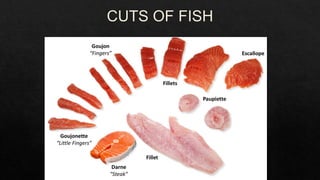
DARNE – Steak or slice of a round fish cut on the bone. 2-3 cm thick with
bone.
TRONCON – Steak or slice of a flat fish cut on the bone.
PAUPIETTE – Thin slice of a fish fillet which is usually stuffed and rolled
like a cylinder.
FILLET – Usually a boneless cut of fish from one entire side of a fish.
GOUJONS – Fillet of fish cut into strips of 6 cm x 1cm x 1 cm about the
size of a finger.
GOUJONETTES – Thinner and smaller version of fish fingers. Cocktail
size fish fingers.
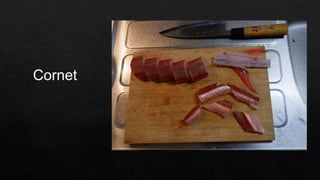
CORNET – Thin slice of a fish fillet usually triangular in shape which is
rolled to form a cone.
PLIE– Fillet which is flattened and folded into two.
SUPREME – A large fillet of fish cut on the slant from a large round or flat
fish.
MEDALLIONS – A boneless round shaped steak or slice of fish fillet usually
Troncon
Cornet
FISH FLAVOR
The perishability of fish and shellfish demands
the freshest selection for the best results. Very
fresh fish have flavors of grass and sea. Ocean
fish generally are milder in flavor than their
freshwater counterparts. Lean fish have a
milder flavor than fatty fish, and freshwater
bottom feeders including catfish have stronger
flavors due to their diet. White fleshed fish like
cod and sole have a milder taste than darker
colored fish like tuna which possesses a more
The strong odor often associated with fish is found in the
finned ocean varieties and to a lesser extent in mollusks
and crustaceans. Saltwater fish possess molecules called
Trimethylamine N-oxide (TMAO) on their skin to help
them balance the salt and water in their bodies. When the
fish die enzymes go to work breaking down TMAO to the
odorous molecule Trimethylamine (TMA). Removing the
skin, rinsing the fish before use, and keeping the fish iced
are all ways to counteract the smell.
Heat transforms the flavor of fish and the longer it is
cooked the stronger its taste. Frying and grilling
create Maillard browning that mutes some of the
fishy flavor. Marinating, brining, and poaching in
court bouillon also counteracts these strong tastes.
Aromatic vegetables, herbs and spices provide
balance too.
FISH TEXTURE
Unlike meats, that require several days to
soften after the effects of rigor mortis set in,
fresh killed fish require a matter of hours to
soften their texture. And unlike meats, fish are
not aged for extended periods as they are best
served as fresh as possible. Salting or lightly
brining the fish before cooking helps to firm the
proteins and add moisture. But the best way to
control fish texture is by avoiding overcooking.
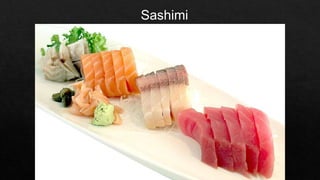
RAW PREPARATIONS
Because of the naturally tender characteristics of
fish and seafood, many varieties are served in raw
preparations including sashimi, sushi, and tartare.
Ceviche is a popular raw dish that uses citric acids
to marinade and “cold cook” the fish. Salted, cured
or pickled fish are other international favorites. Raw
clams and oysters on the half shell are popular too.
All of these require the freshest fish of the highest
quality and careful handling that include strict
temperature control and high sanitation standards.
Salmon Tartare
Scallop Ceviche
Sashimi
FISH COOKERY
There are hundreds of different types of fish with about 3 dozen
regularly found in American markets. Since there are many more
varieties of fish than meats or poultry, it's much harder to
generalize about basic cooking techniques. The challenge is
compounded by the fact that since they cook so quickly it is easy
to ruin the texture, flavor, and moistness of the fish in a matter of
seconds. Some fish like snapper are more forgiving if overcooked
a little, others like tuna become very dry if cooked beyond a
medium doneness, and still others like shark must be fully cooked
to a higher temperature to soften their connective tissue. It is
important to become familiar with the individual characteristics of
common fish varieties so that the appropriate methods and
cooking times can be chosen to maximize their quality.
Fish proteins coagulate at a lower temperature,
generally between 120-130˚F/50-55˚C. Fats and
gelatin in the muscles also melt at a lower point too.
Fish proteins start to dry out and lose moisture at
140˚F/60˚C and will be very dry at 160˚F/71˚C. In a
few cartilaginous fish, like shark and skate, cooking
to 140˚F/60˚C is needed to soften their connective
tissue. Some fish including tuna and swordfish are
better when cooked to medium-rare while other fish
like Chilean sea bass should be fully cooked
otherwise it will be rubbery. Fatty fish take longer to
cook than lean fish.
One important aspect that affects cooking time is the
thickness of the cut of fish. A general rule of thumb is
to allow approximately 10 minutes per 1 inch/2 cm of
thickness when cooking but this is a very imprecise
method. It is better to master the touch method for
smaller cuts of fish and seafood and to know the
texture and signs of fish that is cooked properly but
not overdone. An instant-read thermometer is also a
valuable tool for cooking whole fish and larger cuts of
fish.
SHELLFISH COOKERY
Most shellfish can be cooked using any of the basic
techniques for fish while observing similar guidelines.
Shellfish generally has more connective tissue and
therefore will firm up when cooked. Small crustaceans
and mollusks will be tenderer than larger ones. In all
cases using slower and gentler cooking methods with
a minimal amount of time will result in a moist and
tender outcome.
•Crustaceans should be cooked minimally because they
can get dry and rubbery if overcooked.
•Shrimp are commonly prepared by steaming, simmering,
sautéing, grilling and poaching.
•Lobsters can be poached, steamed, grilled, broiled and
sautéed.
•Because most crab meat is cleaned and cooked they can
be used in a variety of preparations from simply heating
the crab legs, or prepared in stuffing and crab cakes.
Fresh crab can be steamed or in the case of soft-shell
crabs sautéed or deep fried.
•Mollusks will be chewy but tender when minimally
cooked but can toughen when cooked too long. Similar to
•Clams are used in chowders, soups, and stews.
Smaller clams can be eaten raw or steamed. Larger
clams can be stewed, braised or deep-fried. The large
geoduck is usually pounded to tenderize it and sliced
thin.
•Mussels are commonly steamed or stewed and can
also be fried
•Oysters are eaten raw but can also be used in soups,
stews, deep-fried or baked.
•Octopus flesh is tenderized through pounding or
tumbling. It is also tenderized through braising,
simmering or steaming. Octopus can also be eaten raw
•Squid, also called calamari, can be tenderized by
scoring the connective tissue of the body. It is often
deep-fried but can also be stewed or braised. Quick
cooking is best because squid can become quite
tough and will need to be cooked a long time to
tenderize.
•Cuttlefish can be treated similar to squid in cooking
and handling techniques.
•Conch meat has a mild, sweet clam-like flavor but is
extremely tough and must be pounded, chopped, or
marinated in lime juice to tenderize it before cooking.
Some common preparations include fritters, chowder,
steaks and marinated raw salads.
•Sea urchin is eaten raw in ceviche-style
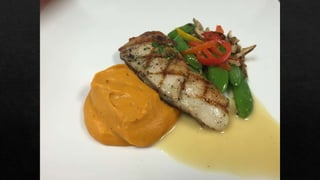
Grill/Broil
Follow the basic rules for grilling meats and poultry but use a
slightly lower temperature. Season and oil the fish before
beginning. Use firm fish and shellfish that can hold up to the
heat and won’t fall apart once on the grill. Grill baskets can
be used for delicate fillets or whole fish to ease the turning
process or can be placed on sizzler platters and set under a
broiler to cook. Shrimp, lobster, and scallops do well on the
grill because they have stronger connective tissue. Check for
doneness by the touch method for smaller fillets and steaks,
and for whole fish use a thermometer.
GRILLING & BROILING TECHNIQUES
Grilling and broiling use radiant heat at temperatures
in excess of 500 °F/260˚C. Although the terms are
used interchangeably, grilling by definition uses a
heat source from below while broiling uses upper
heat. Grilling over wood or charcoal produces the
best flavor, but natural gas can produce an
acceptable product too. Pan-Grilling creates a grill
effect although not as flavorful as a true grill.
Grilling/Broiling Method
• Preheat grill or broiler; clean and season the grates.
• To ensure an even cooking process, cut fish fillets and steaks to a uniform
thickness.
• Salt the fish and allow to rest for 15-30 minutes to draw out excess moisture.
• Pat the fish dry with a towel to remove excess surface moisture and oil the fish.
• Depending on the delicacy, size, and heat source, grill directly on the grate;
place in a basket, or on a broiler platter.
• For smaller cuts use the touch method to determine doneness, for larger fish
use an instant-read thermometer.
Roast/Bake
A simple but effective way to cook fish, baking or roasting can
be used as a stand-alone method or to finish fish after pan-
searing on the stove top. Since the fish usually does not gain
much color in the process, paprika is sometimes sprinkled on
the surface. Herbs, spices, bread crumbs or nut crusts will
also enhance the color, flavor, and texture of the fish.
Convection ovens will produce more browning, or an initial
pan-sear on the stove can also do the trick. The fish can be
portion cut or cooked whole for a more rustic presentation.
Large fish are often scored in the thickest part to accelerate
cooking and ensure that the thinner tail section does not
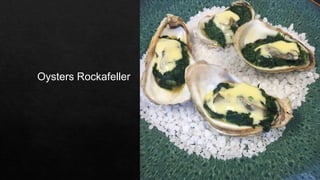
Oysters Rockafeller
Roasting Method
•Pre-heat oven to desired temperature, for smaller
fish or fillets 425-130˚F/50-55˚C
•Prep fish and place on a sheet pan
•Season and brush with oil
•Place in oven and cook to the appropriate degree
of doneness
•Serve with a prepared sauce
Sauté
A popular method for cooking fish and
shellfish, the fish can be dredged in flour just
prior to cooking which adds texture, provides
colors, and helps keep the fish moist.
Sautéed fish a la Meuniere is a classic
French technique garnished with brown
butter, lemon and chopped parsley.
Skinless – This method is
often used for cooking fish a
la Meuniere, amandine, or
with other ingredients
including capers, tomatoes,
or cucumbers.
To properly sauté make sure
the pan is heated
appropriately. The fish should
sizzle when added to the hot
pan. In the case of sole fillets
they will only need a minute
or two on each side to cook
and should be lightly browned
when done.
Skin-On – Fish that
have tender skins,
including snapper,
salmon and trout can be
sautéed with the skin
intact providing a crisp
texture that enhances
the presentation. The
technique must be
properly executed and
served immediately
otherwise the skin will be
soggy and unpalatable.
1.Pat the fish dry with paper towels.
2.Liberally season fish with salt and pepper.
3.Brush with oil or clarified butter.
4.Heat a well-seasoned sauté pan, add oil or clarified butter, and
place the fish skin-side down to begin the searing process. Press
lightly on the fillet with a fish spatula to flatten and evenly crisp
the skin.
5.Turn the fish and continue to sauté while basting the skin with
some of the butter in the pan.
6.If the fillet is large, place the pan in a hot oven to finish.
7.For plating always serve the fish skin-side up to preserve the
crispness of the texture.
8.Serve with a prepared sauce.
Pan-Fry
By adding more oil to the pan and lowering the
heat, fish can be coated with flour, breadcrumbs, or
cornmeal and pan-fried to create a crisp texture.
Deep-Fry
Deep-frying, immersing food in in hot oil is popular in
many cultures for preparing all types of fish and
shellfish including shrimp, oysters, clams, and
scallops. Breading or batter provides a crisp texture
and the oil adds a savory quality to the palate. The
method is best for small tender portions of food that
cook in a matter of minutes.
Breaded
For breaded foods a three-stage breading process is
used consisting of flour, egg wash and breadcrumbs. It
is a convenient technique because the product can be
prepared in advance and kept in a cold or frozen state.
Foods are fried at a temperature of 350˚F/177˚C. For
ease in dropping and removing foods from the deep-
fryer use the “basket method”. A prepared sauce is
served with the fish.
Batter-Fried
Batters are prepared with flour or other refined starches,
water, beer or milk and eggs. Japanese tempura is a
batter that is very light in color and texture. Beer batter is
often used in fish fries. The batter is prepared in advance
and the product is dipped in the batter just prior to
dropping into the frying oil. For batter-fried foods, use the
“swimming method” for deep-frying without a basket
otherwise the batter will cling to a basket making it difficult
to remove from the fryer. Serve with a prepared sauce as
an accompaniment.
Simmer/Boil
Moist heat cooking methods are often used for many
preparations. They are simple methods that can bring out
the flavor and subtle texture of fish and seafood. Boiling
is a crude method that can often overcook and damage
the delicate textures of fish and seafood but simmering is
a more gentle approach that will preserve the quality of
the product and the temperature is much easier to
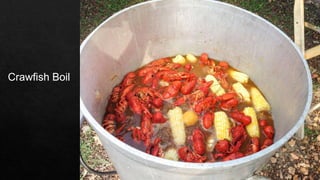
control. Although crawfish boils in the southern US and
fish boils in the New England and Midwest states are still
used to prepare these delicious one pot dinners, more
chefs are becoming attuned to lower temperature
cooking for fish and shellfish.
Crawfish Boil
Whether simmering or boiling the cooking liquid is
salted and enhanced by the addition of aromatic
vegetables, lemon, herbs and spices and often
combined with vegetables including potatoes,
onions, carrots and corn. This method can be
adopted for all types of shellfish including crabs,
lobster, clams and shrimp.
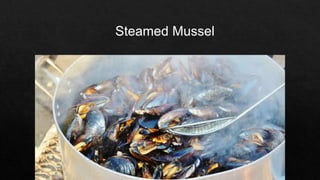
Steam
Steaming is a healthy cooking method that brings out the
natural characteristics of fish and shellfish. Because it is a
naked method the product must be of the highest quality
otherwise any off flavors will be readily evident. Steaming is
a particularly popular method for cooking mussels and
clams. Shell-on shrimp, crab, and lobster are also well-
suited for this method. Steaming can be done in a chamber,
a bamboo steamer, on a rack in a sealed pot, or by simply
laying it in a sealed pan with a small amount of liquid. The
preparation is enhanced through the use of aromatics,
herbs, spices, butter and other flavorings.
Steamed Mussel
En Papillote
The classic technique of cooking en papillote is
achieved by wrapping fish in a folded pouch of
parchment paper with vegetables, herbs and spices.
Although it is cooked in a dry oven it is actually a moist-
heat method because the paper seals in the vapors
and steams the fish.
Encasing the fish allows it to take on the character of
the vegetables and seasonings surrounding it. Similar
results can be achieved through the use of grape or
banana leaves, corn husks, salt crusts, pastry, or foil.
By wrapping in leaves, the technique can be adapted
Salmon En Papillote
Poach
Two classic styles of poaching are
submerge, also called deep poaching, and
shallow poaching. Butter or oil poaching is
a contemporary version of poaching and is
similar to a confit in its method.
Submerge Poach
Sometimes call deep-poaching, this method is
commonly used for whole fish and prepared by
submerging the product completely in a court
bouillon. The classic French dish “Truite au Bleu”
is prepared in this fashion which requires a
freshly killed and gutted trout. A sauce is
prepared separately. If the whole fish are large,
they are sometimes wrapped in cheesecloth to
hold them together.
Shallow Poach
Shallow poaching is used for smaller cuts of fish
that are folded or rolled into paupiettes. Mousseline
forcemeat can be used as a filling for the
paupiettes. A small amount to liquid, usually in the
form of wine or stock is added to the pan along with
shallots, garlic and a little butter. The fish is gently
cooked either on the stove top or transferred to an
oven. A sauce is prepared from the caisson
(cooking liquid) in the pan.
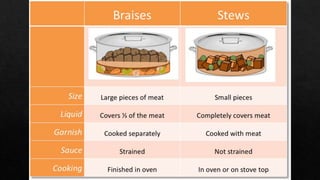
Stew/Braise
Traditionally braises and stews are slow
methods for cooking tough cuts of meats and
poultry that can often take hours to complete.
Adapting these methods for fish and seafood
requires the cooking time to be shortened
dramatically to create an optimal dish.
SOUS VIDE COOKING
Sous vide is a French term for “under vacuum”
which is also known as reduced oxygen packaging
(ROP). Food is vacuum-sealed and cook in water at
a low-temperature; typically, 130–160°F/ 55–71°C.
Sous vide cooking can be used for many types of
food including meats, poultry, fish and shellfish as
well as vegetables, fruits, and even sauces.
Because of the low temperature, cooking times can
be an hour for tender proteins like chicken breast, or
24-72 hours for tough cuts, like beef brisket. Low
temperature cooking, in a low oxygen environment,
FISH AND SHELLFISHS COOKING METHODS.pptx

FISH AND SHELLFISHS COOKING METHODS.pptx

  • 3.
    DARNE – Steakor slice of a round fish cut on the bone. 2-3 cm thick with bone. TRONCON – Steak or slice of a flat fish cut on the bone. PAUPIETTE – Thin slice of a fish fillet which is usually stuffed and rolled like a cylinder. FILLET – Usually a boneless cut of fish from one entire side of a fish. GOUJONS – Fillet of fish cut into strips of 6 cm x 1cm x 1 cm about the size of a finger. GOUJONETTES – Thinner and smaller version of fish fingers. Cocktail size fish fingers. CORNET – Thin slice of a fish fillet usually triangular in shape which is rolled to form a cone. PLIE– Fillet which is flattened and folded into two. SUPREME – A large fillet of fish cut on the slant from a large round or flat fish. MEDALLIONS – A boneless round shaped steak or slice of fish fillet usually
  • 4.
  • 5.
  • 8.
    FISH FLAVOR The perishabilityof fish and shellfish demands the freshest selection for the best results. Very fresh fish have flavors of grass and sea. Ocean fish generally are milder in flavor than their freshwater counterparts. Lean fish have a milder flavor than fatty fish, and freshwater bottom feeders including catfish have stronger flavors due to their diet. White fleshed fish like cod and sole have a milder taste than darker colored fish like tuna which possesses a more
  • 9.
    The strong odoroften associated with fish is found in the finned ocean varieties and to a lesser extent in mollusks and crustaceans. Saltwater fish possess molecules called Trimethylamine N-oxide (TMAO) on their skin to help them balance the salt and water in their bodies. When the fish die enzymes go to work breaking down TMAO to the odorous molecule Trimethylamine (TMA). Removing the skin, rinsing the fish before use, and keeping the fish iced are all ways to counteract the smell.
  • 10.
    Heat transforms theflavor of fish and the longer it is cooked the stronger its taste. Frying and grilling create Maillard browning that mutes some of the fishy flavor. Marinating, brining, and poaching in court bouillon also counteracts these strong tastes. Aromatic vegetables, herbs and spices provide balance too.
  • 11.
    FISH TEXTURE Unlike meats,that require several days to soften after the effects of rigor mortis set in, fresh killed fish require a matter of hours to soften their texture. And unlike meats, fish are not aged for extended periods as they are best served as fresh as possible. Salting or lightly brining the fish before cooking helps to firm the proteins and add moisture. But the best way to control fish texture is by avoiding overcooking.
  • 12.
    RAW PREPARATIONS Because ofthe naturally tender characteristics of fish and seafood, many varieties are served in raw preparations including sashimi, sushi, and tartare. Ceviche is a popular raw dish that uses citric acids to marinade and “cold cook” the fish. Salted, cured or pickled fish are other international favorites. Raw clams and oysters on the half shell are popular too. All of these require the freshest fish of the highest quality and careful handling that include strict temperature control and high sanitation standards.
  • 13.
  • 14.
  • 15.
    FISH COOKERY There arehundreds of different types of fish with about 3 dozen regularly found in American markets. Since there are many more varieties of fish than meats or poultry, it's much harder to generalize about basic cooking techniques. The challenge is compounded by the fact that since they cook so quickly it is easy to ruin the texture, flavor, and moistness of the fish in a matter of seconds. Some fish like snapper are more forgiving if overcooked a little, others like tuna become very dry if cooked beyond a medium doneness, and still others like shark must be fully cooked to a higher temperature to soften their connective tissue. It is important to become familiar with the individual characteristics of common fish varieties so that the appropriate methods and cooking times can be chosen to maximize their quality.
  • 16.
    Fish proteins coagulateat a lower temperature, generally between 120-130˚F/50-55˚C. Fats and gelatin in the muscles also melt at a lower point too. Fish proteins start to dry out and lose moisture at 140˚F/60˚C and will be very dry at 160˚F/71˚C. In a few cartilaginous fish, like shark and skate, cooking to 140˚F/60˚C is needed to soften their connective tissue. Some fish including tuna and swordfish are better when cooked to medium-rare while other fish like Chilean sea bass should be fully cooked otherwise it will be rubbery. Fatty fish take longer to cook than lean fish.
  • 17.
    One important aspectthat affects cooking time is the thickness of the cut of fish. A general rule of thumb is to allow approximately 10 minutes per 1 inch/2 cm of thickness when cooking but this is a very imprecise method. It is better to master the touch method for smaller cuts of fish and seafood and to know the texture and signs of fish that is cooked properly but not overdone. An instant-read thermometer is also a valuable tool for cooking whole fish and larger cuts of fish.
  • 18.
    SHELLFISH COOKERY Most shellfishcan be cooked using any of the basic techniques for fish while observing similar guidelines. Shellfish generally has more connective tissue and therefore will firm up when cooked. Small crustaceans and mollusks will be tenderer than larger ones. In all cases using slower and gentler cooking methods with a minimal amount of time will result in a moist and tender outcome.
  • 19.
    •Crustaceans should becooked minimally because they can get dry and rubbery if overcooked. •Shrimp are commonly prepared by steaming, simmering, sautéing, grilling and poaching. •Lobsters can be poached, steamed, grilled, broiled and sautéed. •Because most crab meat is cleaned and cooked they can be used in a variety of preparations from simply heating the crab legs, or prepared in stuffing and crab cakes. Fresh crab can be steamed or in the case of soft-shell crabs sautéed or deep fried. •Mollusks will be chewy but tender when minimally cooked but can toughen when cooked too long. Similar to
  • 20.
    •Clams are usedin chowders, soups, and stews. Smaller clams can be eaten raw or steamed. Larger clams can be stewed, braised or deep-fried. The large geoduck is usually pounded to tenderize it and sliced thin. •Mussels are commonly steamed or stewed and can also be fried •Oysters are eaten raw but can also be used in soups, stews, deep-fried or baked. •Octopus flesh is tenderized through pounding or tumbling. It is also tenderized through braising, simmering or steaming. Octopus can also be eaten raw
  • 21.
    •Squid, also calledcalamari, can be tenderized by scoring the connective tissue of the body. It is often deep-fried but can also be stewed or braised. Quick cooking is best because squid can become quite tough and will need to be cooked a long time to tenderize. •Cuttlefish can be treated similar to squid in cooking and handling techniques. •Conch meat has a mild, sweet clam-like flavor but is extremely tough and must be pounded, chopped, or marinated in lime juice to tenderize it before cooking. Some common preparations include fritters, chowder, steaks and marinated raw salads. •Sea urchin is eaten raw in ceviche-style
  • 22.
    Grill/Broil Follow the basicrules for grilling meats and poultry but use a slightly lower temperature. Season and oil the fish before beginning. Use firm fish and shellfish that can hold up to the heat and won’t fall apart once on the grill. Grill baskets can be used for delicate fillets or whole fish to ease the turning process or can be placed on sizzler platters and set under a broiler to cook. Shrimp, lobster, and scallops do well on the grill because they have stronger connective tissue. Check for doneness by the touch method for smaller fillets and steaks, and for whole fish use a thermometer.
  • 24.
    GRILLING & BROILINGTECHNIQUES Grilling and broiling use radiant heat at temperatures in excess of 500 °F/260˚C. Although the terms are used interchangeably, grilling by definition uses a heat source from below while broiling uses upper heat. Grilling over wood or charcoal produces the best flavor, but natural gas can produce an acceptable product too. Pan-Grilling creates a grill effect although not as flavorful as a true grill.
  • 25.
    Grilling/Broiling Method • Preheatgrill or broiler; clean and season the grates. • To ensure an even cooking process, cut fish fillets and steaks to a uniform thickness. • Salt the fish and allow to rest for 15-30 minutes to draw out excess moisture. • Pat the fish dry with a towel to remove excess surface moisture and oil the fish. • Depending on the delicacy, size, and heat source, grill directly on the grate; place in a basket, or on a broiler platter. • For smaller cuts use the touch method to determine doneness, for larger fish use an instant-read thermometer.
  • 27.
    Roast/Bake A simple buteffective way to cook fish, baking or roasting can be used as a stand-alone method or to finish fish after pan- searing on the stove top. Since the fish usually does not gain much color in the process, paprika is sometimes sprinkled on the surface. Herbs, spices, bread crumbs or nut crusts will also enhance the color, flavor, and texture of the fish. Convection ovens will produce more browning, or an initial pan-sear on the stove can also do the trick. The fish can be portion cut or cooked whole for a more rustic presentation. Large fish are often scored in the thickest part to accelerate cooking and ensure that the thinner tail section does not
  • 28.
  • 29.
    Roasting Method •Pre-heat ovento desired temperature, for smaller fish or fillets 425-130˚F/50-55˚C •Prep fish and place on a sheet pan •Season and brush with oil •Place in oven and cook to the appropriate degree of doneness •Serve with a prepared sauce
  • 31.
    Sauté A popular methodfor cooking fish and shellfish, the fish can be dredged in flour just prior to cooking which adds texture, provides colors, and helps keep the fish moist. Sautéed fish a la Meuniere is a classic French technique garnished with brown butter, lemon and chopped parsley.
  • 32.
    Skinless – Thismethod is often used for cooking fish a la Meuniere, amandine, or with other ingredients including capers, tomatoes, or cucumbers. To properly sauté make sure the pan is heated appropriately. The fish should sizzle when added to the hot pan. In the case of sole fillets they will only need a minute or two on each side to cook and should be lightly browned when done.
  • 33.
    Skin-On – Fishthat have tender skins, including snapper, salmon and trout can be sautéed with the skin intact providing a crisp texture that enhances the presentation. The technique must be properly executed and served immediately otherwise the skin will be soggy and unpalatable.
  • 34.
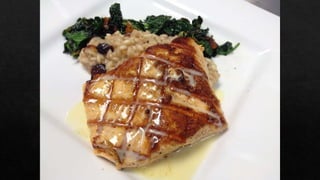
    1.Pat the fishdry with paper towels. 2.Liberally season fish with salt and pepper. 3.Brush with oil or clarified butter. 4.Heat a well-seasoned sauté pan, add oil or clarified butter, and place the fish skin-side down to begin the searing process. Press lightly on the fillet with a fish spatula to flatten and evenly crisp the skin. 5.Turn the fish and continue to sauté while basting the skin with some of the butter in the pan. 6.If the fillet is large, place the pan in a hot oven to finish. 7.For plating always serve the fish skin-side up to preserve the crispness of the texture. 8.Serve with a prepared sauce.
  • 35.
    Pan-Fry By adding moreoil to the pan and lowering the heat, fish can be coated with flour, breadcrumbs, or cornmeal and pan-fried to create a crisp texture.
  • 36.
    Deep-Fry Deep-frying, immersing foodin in hot oil is popular in many cultures for preparing all types of fish and shellfish including shrimp, oysters, clams, and scallops. Breading or batter provides a crisp texture and the oil adds a savory quality to the palate. The method is best for small tender portions of food that cook in a matter of minutes.
  • 37.
    Breaded For breaded foodsa three-stage breading process is used consisting of flour, egg wash and breadcrumbs. It is a convenient technique because the product can be prepared in advance and kept in a cold or frozen state. Foods are fried at a temperature of 350˚F/177˚C. For ease in dropping and removing foods from the deep- fryer use the “basket method”. A prepared sauce is served with the fish.
  • 38.
    Batter-Fried Batters are preparedwith flour or other refined starches, water, beer or milk and eggs. Japanese tempura is a batter that is very light in color and texture. Beer batter is often used in fish fries. The batter is prepared in advance and the product is dipped in the batter just prior to dropping into the frying oil. For batter-fried foods, use the “swimming method” for deep-frying without a basket otherwise the batter will cling to a basket making it difficult to remove from the fryer. Serve with a prepared sauce as an accompaniment.
  • 39.
    Simmer/Boil Moist heat cookingmethods are often used for many preparations. They are simple methods that can bring out the flavor and subtle texture of fish and seafood. Boiling is a crude method that can often overcook and damage the delicate textures of fish and seafood but simmering is a more gentle approach that will preserve the quality of the product and the temperature is much easier to control. Although crawfish boils in the southern US and fish boils in the New England and Midwest states are still used to prepare these delicious one pot dinners, more chefs are becoming attuned to lower temperature cooking for fish and shellfish.
  • 40.
  • 41.
    Whether simmering orboiling the cooking liquid is salted and enhanced by the addition of aromatic vegetables, lemon, herbs and spices and often combined with vegetables including potatoes, onions, carrots and corn. This method can be adopted for all types of shellfish including crabs, lobster, clams and shrimp.
  • 42.
    Steam Steaming is ahealthy cooking method that brings out the natural characteristics of fish and shellfish. Because it is a naked method the product must be of the highest quality otherwise any off flavors will be readily evident. Steaming is a particularly popular method for cooking mussels and clams. Shell-on shrimp, crab, and lobster are also well- suited for this method. Steaming can be done in a chamber, a bamboo steamer, on a rack in a sealed pot, or by simply laying it in a sealed pan with a small amount of liquid. The preparation is enhanced through the use of aromatics, herbs, spices, butter and other flavorings.
  • 43.
  • 44.
    En Papillote The classictechnique of cooking en papillote is achieved by wrapping fish in a folded pouch of parchment paper with vegetables, herbs and spices. Although it is cooked in a dry oven it is actually a moist- heat method because the paper seals in the vapors and steams the fish. Encasing the fish allows it to take on the character of the vegetables and seasonings surrounding it. Similar results can be achieved through the use of grape or banana leaves, corn husks, salt crusts, pastry, or foil. By wrapping in leaves, the technique can be adapted
  • 45.
  • 46.
    Poach Two classic stylesof poaching are submerge, also called deep poaching, and shallow poaching. Butter or oil poaching is a contemporary version of poaching and is similar to a confit in its method.
  • 47.
    Submerge Poach Sometimes calldeep-poaching, this method is commonly used for whole fish and prepared by submerging the product completely in a court bouillon. The classic French dish “Truite au Bleu” is prepared in this fashion which requires a freshly killed and gutted trout. A sauce is prepared separately. If the whole fish are large, they are sometimes wrapped in cheesecloth to hold them together.
  • 48.
    Shallow Poach Shallow poachingis used for smaller cuts of fish that are folded or rolled into paupiettes. Mousseline forcemeat can be used as a filling for the paupiettes. A small amount to liquid, usually in the form of wine or stock is added to the pan along with shallots, garlic and a little butter. The fish is gently cooked either on the stove top or transferred to an oven. A sauce is prepared from the caisson (cooking liquid) in the pan.
  • 49.
    Stew/Braise Traditionally braises andstews are slow methods for cooking tough cuts of meats and poultry that can often take hours to complete. Adapting these methods for fish and seafood requires the cooking time to be shortened dramatically to create an optimal dish.
  • 51.
    SOUS VIDE COOKING Sousvide is a French term for “under vacuum” which is also known as reduced oxygen packaging (ROP). Food is vacuum-sealed and cook in water at a low-temperature; typically, 130–160°F/ 55–71°C. Sous vide cooking can be used for many types of food including meats, poultry, fish and shellfish as well as vegetables, fruits, and even sauces. Because of the low temperature, cooking times can be an hour for tender proteins like chicken breast, or 24-72 hours for tough cuts, like beef brisket. Low temperature cooking, in a low oxygen environment,