Monetary & Fiscal Policy
Monetary Policy Refers to measures designed to influence the cost and availability of money for the purpose of influencing the working of the economy.
Two broad views: Broad sense :  all measures undertaken by government to affect  expenditure   or  use  of money by the public. May include non-monetary measures taken by the government, for e.g. wages and price controls, budgetary operations, etc., which indirectly influence the monetary situation in the economy.
Narrow sense :  refers to the regulation of the supply of money (currency and bank deposits) through discretionary actions of the central banking authorities.
Instruments of Monetary Policy Quantitative Credit Control : they are so called because they control the  quantity  of money, e.g., bank rate, open market operations, changes in reserve requirements.
Qualitative Controls :  they are  employed  to limit the  amount  of money available for certain  specific  purposes even though plenty of money may be available for other purposes, i.e. they control the  quantity  as well as  direction  of money flow; consumer credit control, margin requirements, moral suasion, etc.
Quantitative Controls
Bank Rate or Discount Rate It is the rate of interest the central bank charges its member banks. By changing the discount rates, the central bank controls the level of bank reserves and the money supply. Method : Discount rate affects bank interest rates.
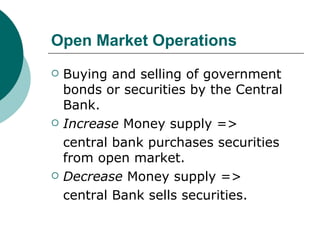
Open Market Operations Buying and selling of government bonds or securities by the Central Bank. Increase  Money supply =>  central bank purchases securities from open market. Decrease  Money supply =>  central Bank sells securities.
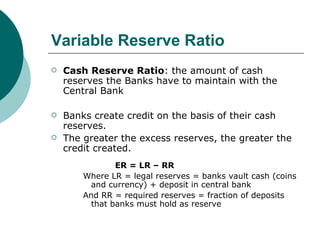
Variable Reserve Ratio Cash Reserve Ratio : the amount of cash reserves the Banks have to maintain with the Central Bank Banks create credit on the basis of their cash reserves. The greater the excess reserves, the greater the credit created. ER = LR – RR Where LR = legal reserves = banks vault cash (coins and currency) + deposit in central bank And RR = required reserves = fraction of deposits that banks must hold as reserve
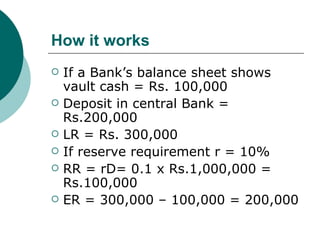
How it works If a Bank’s balance sheet shows vault cash = Rs. 100,000 Deposit in central Bank = Rs.200,000 LR = Rs. 300,000 If reserve requirement r = 10% RR = rD= 0.1 x Rs.1,000,000 = Rs.100,000 ER = 300,000 – 100,000 = 200,000
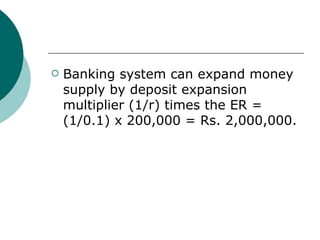
Banking system can expand money supply by deposit expansion multiplier (1/r) times the ER = (1/0.1) x 200,000 = Rs. 2,000,000.
Qualitative Controls
Margin Requirements Margin : Difference between ‘loan value’ and ‘market value’ of securities. By prescribing the Margin requirement the Central Bank sets the limit to the amount of loan extendable against the securities offered as collateral.
Consumer Credit This method helps to regulate the terms and conditions for the purchase of durable consumer goods. Changing minimum down payment. Changing maturity period of consumer credit. Changing cost of consumer credit (i)
Directives of Central Bank May be in the form of written orders, appeals or directives from the Central Bank to Commercial Banks. To control lending policies. To divert credit from less to more urgent/productive uses. To prohibit lending for certain purposes. To fix maximum limits of credit for certain purposes.
Rationing of Credit Fixes the limit upon its re-discounting facility for a particular bank Fixes a quota for every affiliated bank for financial accommodation from the Central Bank.
Other Methods Moral Suasion : involves advice, request and persuasion with the commercial banks to co-operate with the Central Bank. Publicity : Central Bank gives wide publicity to what is good/bad in the credit system of the country. Direct Action : use of coercive measures against those Banks who do not comply with instructions of the Central Bank.
Monetary Policy during Inflation
Inflation – characteristics High MEC => rising P, O, Y, E General wave of optimism  Business activity expands rapidly More cash is released by banks making additions to consumers’ income and outlay.
Aims of the Monetary Policy Slow down the rate of expansion of money => affect the velocity of circulation of money Reduce volume of liquid assets Reduce consumption & investment by means of higher interest rates.
Measures  Interest rates can be raised as high as monetary authorities wish Open market operations curtail liquidity of bank and non-bank groups Margin requirements and consumer credit controls can also be tightened.
Monetary Policy during Depression
Depression - features Low MEC => falling prices, incomes, output & employment  Low interest rates High liquidity preference.
Monetary Policy – objectives To offset decline in velocity of money To satisfy demand for precautionary & speculative motive To strengthen the cash position of banks & non-bank groups Stimulate lending for investment & consumption purpose Bring down structure of interest rates to encourage investment.
Cheap Money Policy Bring down the interest rate Increases aggregate demand Using excessive savings for development  Stimulating confidence in security market
Drawbacks Interest rates are already low and cannot be depressed further Injections of cash & other liquid securities absorbed by firms, banks & individuals to enhance their liquidity position; in changing from risky & illiquid assets to less risky & more liquid assets
Fiscal Policy
The purposeful manipulation of public expenditure and taxes is referred to as Fiscal Policy.
Changes in government expenditure and taxation designed to influence the pattern and level of activity. Harvey & Johnson
We define Fiscal Policy to include any design to change price level, composition or timing of government expenditure or to vary the burden, structure or frequency of the tax payment. G.K. Shaw
J.M. Keynes Monetary policy went into disrepute in late 1920. Upto 1920s classical economists were concerned with monetary policy alone to attain the goals of macroeconomic policy.  Fiscal policy was discovered by Keynes in 1930s => most powerful instrument for affecting the volume of aggregate  effective demand  or  desired expenditure  and thus the level of  national income ,  employment  and  price level .  Applied his fiscal policy prescription in the context of the great depression of 1930s.
His fiscal policy was concerned with short run economic stability and tackling cyclical fluctuations.  Changes in taxes and expenditure that aim at the short-run objectives of full employment and stability in prices are called fiscal policy.
Objectives  Optimum allocation of economic resources Equitable distribution of income and wealth Maintain price stability Promotion and maintenance of full employment
Instruments of Fiscal Policy Taxes  Expenditure Public debt Budget
Taxation  Fiscal policy, especially tax policy, can be used to enhance growth, by encouraging the efficient use of any given amount of scarce resources.
Public expenditure   Public expenditure embraces all the public sector spending including that of central governments, state governments, local authorities and public corporations. The pattern of public expenditure is influenced by interest groups and by economic, political, demographic, sociological and technological factors.  In addition, international demonstration effect induces developing countries like India to follow spending patterns of advanced countries.
Fiscal Policy during Inflation & Deflation During  Inflation : Aims at controlling excessive aggregate spending. During  Depression : aims at making up deficiency in effective demand; and avoiding unemployment.
Contra Cyclical Budgetary Policy  => manipulation and managing the budget to iron out cyclical fluctuations. Unbalanced Budget  during  depression  implies deficit spending by increasing government outlays (expansionary), while during  inflation  implies surplus budget by curtailing government expenditures (deflationary).
Taxation  => determine the size of disposable income => reduces the inflationary gap, given the supply of goods & services. Public Debt  => refers to public borrowing and repayment. Public Works  => stabilizing expenditures of the pump priming & compensatory nature.
Built-in Stabilizers : both taxes and transfer payments may vary with changes in income levels. Stabilizer – counteracts fluctuations in economics activities Built-in – come into play automatically when income level changes
Limitations Effectiveness depends upon the size and timing of the measure adopted. Political and administrative delays Success depends upon redistribution of income and a chain of economic and psychological reactions of the people.

10 monetary & fiscal policy2

  • 1.
  • 2.
    Monetary Policy Refersto measures designed to influence the cost and availability of money for the purpose of influencing the working of the economy.
  • 3.
    Two broad views:Broad sense : all measures undertaken by government to affect expenditure or use of money by the public. May include non-monetary measures taken by the government, for e.g. wages and price controls, budgetary operations, etc., which indirectly influence the monetary situation in the economy.
  • 4.
    Narrow sense : refers to the regulation of the supply of money (currency and bank deposits) through discretionary actions of the central banking authorities.
  • 5.
    Instruments of MonetaryPolicy Quantitative Credit Control : they are so called because they control the quantity of money, e.g., bank rate, open market operations, changes in reserve requirements.
  • 6.
    Qualitative Controls : they are employed to limit the amount of money available for certain specific purposes even though plenty of money may be available for other purposes, i.e. they control the quantity as well as direction of money flow; consumer credit control, margin requirements, moral suasion, etc.
  • 7.
  • 8.
    Bank Rate orDiscount Rate It is the rate of interest the central bank charges its member banks. By changing the discount rates, the central bank controls the level of bank reserves and the money supply. Method : Discount rate affects bank interest rates.
  • 9.
    Open Market OperationsBuying and selling of government bonds or securities by the Central Bank. Increase Money supply => central bank purchases securities from open market. Decrease Money supply => central Bank sells securities.
  • 10.
    Variable Reserve RatioCash Reserve Ratio : the amount of cash reserves the Banks have to maintain with the Central Bank Banks create credit on the basis of their cash reserves. The greater the excess reserves, the greater the credit created. ER = LR – RR Where LR = legal reserves = banks vault cash (coins and currency) + deposit in central bank And RR = required reserves = fraction of deposits that banks must hold as reserve
  • 11.
    How it worksIf a Bank’s balance sheet shows vault cash = Rs. 100,000 Deposit in central Bank = Rs.200,000 LR = Rs. 300,000 If reserve requirement r = 10% RR = rD= 0.1 x Rs.1,000,000 = Rs.100,000 ER = 300,000 – 100,000 = 200,000
  • 12.
    Banking system canexpand money supply by deposit expansion multiplier (1/r) times the ER = (1/0.1) x 200,000 = Rs. 2,000,000.
  • 13.
  • 14.
    Margin Requirements Margin: Difference between ‘loan value’ and ‘market value’ of securities. By prescribing the Margin requirement the Central Bank sets the limit to the amount of loan extendable against the securities offered as collateral.
  • 15.
    Consumer Credit Thismethod helps to regulate the terms and conditions for the purchase of durable consumer goods. Changing minimum down payment. Changing maturity period of consumer credit. Changing cost of consumer credit (i)
  • 16.
    Directives of CentralBank May be in the form of written orders, appeals or directives from the Central Bank to Commercial Banks. To control lending policies. To divert credit from less to more urgent/productive uses. To prohibit lending for certain purposes. To fix maximum limits of credit for certain purposes.
  • 17.
    Rationing of CreditFixes the limit upon its re-discounting facility for a particular bank Fixes a quota for every affiliated bank for financial accommodation from the Central Bank.
  • 18.
    Other Methods MoralSuasion : involves advice, request and persuasion with the commercial banks to co-operate with the Central Bank. Publicity : Central Bank gives wide publicity to what is good/bad in the credit system of the country. Direct Action : use of coercive measures against those Banks who do not comply with instructions of the Central Bank.
  • 19.
  • 20.
    Inflation – characteristicsHigh MEC => rising P, O, Y, E General wave of optimism Business activity expands rapidly More cash is released by banks making additions to consumers’ income and outlay.
  • 21.
    Aims of theMonetary Policy Slow down the rate of expansion of money => affect the velocity of circulation of money Reduce volume of liquid assets Reduce consumption & investment by means of higher interest rates.
  • 22.
    Measures Interestrates can be raised as high as monetary authorities wish Open market operations curtail liquidity of bank and non-bank groups Margin requirements and consumer credit controls can also be tightened.
  • 23.
  • 24.
    Depression - featuresLow MEC => falling prices, incomes, output & employment Low interest rates High liquidity preference.
  • 25.
    Monetary Policy –objectives To offset decline in velocity of money To satisfy demand for precautionary & speculative motive To strengthen the cash position of banks & non-bank groups Stimulate lending for investment & consumption purpose Bring down structure of interest rates to encourage investment.
  • 26.
    Cheap Money PolicyBring down the interest rate Increases aggregate demand Using excessive savings for development Stimulating confidence in security market
  • 27.
    Drawbacks Interest ratesare already low and cannot be depressed further Injections of cash & other liquid securities absorbed by firms, banks & individuals to enhance their liquidity position; in changing from risky & illiquid assets to less risky & more liquid assets
  • 28.
  • 29.
    The purposeful manipulationof public expenditure and taxes is referred to as Fiscal Policy.
  • 30.
    Changes in governmentexpenditure and taxation designed to influence the pattern and level of activity. Harvey & Johnson
  • 31.
    We define FiscalPolicy to include any design to change price level, composition or timing of government expenditure or to vary the burden, structure or frequency of the tax payment. G.K. Shaw
  • 32.
    J.M. Keynes Monetarypolicy went into disrepute in late 1920. Upto 1920s classical economists were concerned with monetary policy alone to attain the goals of macroeconomic policy. Fiscal policy was discovered by Keynes in 1930s => most powerful instrument for affecting the volume of aggregate effective demand or desired expenditure and thus the level of national income , employment and price level . Applied his fiscal policy prescription in the context of the great depression of 1930s.
  • 33.
    His fiscal policywas concerned with short run economic stability and tackling cyclical fluctuations. Changes in taxes and expenditure that aim at the short-run objectives of full employment and stability in prices are called fiscal policy.
  • 34.
    Objectives Optimumallocation of economic resources Equitable distribution of income and wealth Maintain price stability Promotion and maintenance of full employment
  • 35.
    Instruments of FiscalPolicy Taxes Expenditure Public debt Budget
  • 36.
    Taxation Fiscalpolicy, especially tax policy, can be used to enhance growth, by encouraging the efficient use of any given amount of scarce resources.
  • 37.
    Public expenditure Public expenditure embraces all the public sector spending including that of central governments, state governments, local authorities and public corporations. The pattern of public expenditure is influenced by interest groups and by economic, political, demographic, sociological and technological factors. In addition, international demonstration effect induces developing countries like India to follow spending patterns of advanced countries.
  • 38.
    Fiscal Policy duringInflation & Deflation During Inflation : Aims at controlling excessive aggregate spending. During Depression : aims at making up deficiency in effective demand; and avoiding unemployment.
  • 39.
    Contra Cyclical BudgetaryPolicy => manipulation and managing the budget to iron out cyclical fluctuations. Unbalanced Budget during depression implies deficit spending by increasing government outlays (expansionary), while during inflation implies surplus budget by curtailing government expenditures (deflationary).
  • 40.
    Taxation =>determine the size of disposable income => reduces the inflationary gap, given the supply of goods & services. Public Debt => refers to public borrowing and repayment. Public Works => stabilizing expenditures of the pump priming & compensatory nature.
  • 41.
    Built-in Stabilizers :both taxes and transfer payments may vary with changes in income levels. Stabilizer – counteracts fluctuations in economics activities Built-in – come into play automatically when income level changes
  • 42.
    Limitations Effectiveness dependsupon the size and timing of the measure adopted. Political and administrative delays Success depends upon redistribution of income and a chain of economic and psychological reactions of the people.