CAUSE AND EFFECT
DIAGRAM
OVERVIEW
BYTANMAY LATURKAR
CAUSE AND EFFECT
DIAGRAM
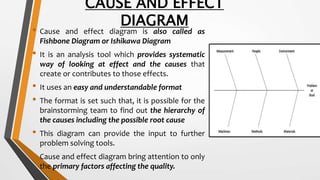
• Cause and effect diagram is also called as
Fishbone Diagram or Ishikawa Diagram
• It is an analysis tool which provides systematic
way of looking at effect and the causes that
create or contributes to those effects.
• It uses an easy and understandable format
• The format is set such that, it is possible for the
brainstorming team to find out the hierarchy of
the causes including the possible root cause
• This diagram can provide the input to further
problem solving tools.
• Cause and effect diagram bring attention to only
the primary factors affecting the quality.
WHEN TO USE A FISHBONE
DIAGRAM
• Fishbone diagram can be used very effectively
during the brainstorming sessions
• While designing a new product or planning a new
process
• While identifying the major problems or issues to
determine the root cause
• While investigating all the possible reasons as to
why a process not performing to its maximum
efficiency
5M and 1E
• 5M and 1E or 6M are the major bifurcations of all the problems that might
occur in a process.
1. MAN
• Man is the First ‘M’ of the five
• It is any person who is involved in the process or may contribute to the final output
• This parameter needs to be considered because no process is complete without
human interference
• Under this main category the sub categories are generally created
• So under this category following can be some sub categories
• Poor communication
• Lack of training
• Lack of awareness while doing the process etc.
• Method is a way in which a particular process
is being performed
• Following all the specific requirements of a
process is very important for a process to be
working efficiently
• Following can be the sub categories under
the method
• Policies
• Procedures
• Following of rules
• Following of set practices
• This ‘M’ involves all the machines,
equipment and tools that are involved in
the process
• This involves checking and discussing if al
the components are working properly or
not, is there issue with any machine, etc.
• The machines are an integral part of any
manufacturing process thus may
contribute to many causes
METHOD MACHINES
• This constitutes of every kind of material
involved in the process right from the start to
end
• This involves
• Raw materials
• Parts
• Spare Parts
• Packaging material
• Outsources assemblies etc.
• It includes the data that is used to access the
performance of the process
• The measurements can be of many different
types like measuring the dimensions of the
product or measuring the RPM of the machine.
• The measurements provide the numerical
data for comparison of the causes with the
standard parameters
MATERIAL MEASUREMENTS
• The environment is also called the Mother Nature in 6M list
• It is the environmental condition in which the process occur
• The changing environmental factors can have different effect on the Man
working, the Material used and the Machines implemented
• The sub categories may involve
• Location
• Temperature
• Culture
• Time
ENVIROMENT
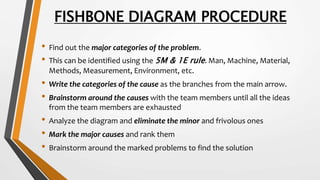
FISHBONE DIAGRAM PROCEDURE
• Find out the major categories of the problem.
• This can be identified using the 5M & 1E rule. Man, Machine, Material,
Methods, Measurement, Environment, etc.
• Write the categories of the cause as the branches from the main arrow.
• Brainstorm around the causes with the team members until all the ideas
from the team members are exhausted
• Analyze the diagram and eliminate the minor and frivolous ones
• Mark the major causes and rank them
• Brainstorm around the marked problems to find the solution
BENIFITS
• Cause and Effect diagram breaks the process into bite sized
pieces to find out the root cause
• It Fosters team work
• Develops common understanding of factors causing the
problem
• As everyone gets insight of cause and effect, finding the
solution becomes easy.
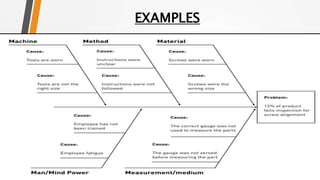
EXAMPLES
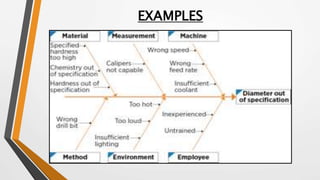
EXAMPLES

Cause and Effect Diagram

  • 1.
  • 2.
    CAUSE AND EFFECT DIAGRAM •Cause and effect diagram is also called as Fishbone Diagram or Ishikawa Diagram • It is an analysis tool which provides systematic way of looking at effect and the causes that create or contributes to those effects. • It uses an easy and understandable format • The format is set such that, it is possible for the brainstorming team to find out the hierarchy of the causes including the possible root cause • This diagram can provide the input to further problem solving tools. • Cause and effect diagram bring attention to only the primary factors affecting the quality.
  • 3.
    WHEN TO USEA FISHBONE DIAGRAM • Fishbone diagram can be used very effectively during the brainstorming sessions • While designing a new product or planning a new process • While identifying the major problems or issues to determine the root cause • While investigating all the possible reasons as to why a process not performing to its maximum efficiency
  • 4.
    5M and 1E •5M and 1E or 6M are the major bifurcations of all the problems that might occur in a process. 1. MAN • Man is the First ‘M’ of the five • It is any person who is involved in the process or may contribute to the final output • This parameter needs to be considered because no process is complete without human interference • Under this main category the sub categories are generally created • So under this category following can be some sub categories • Poor communication • Lack of training • Lack of awareness while doing the process etc.
  • 5.
    • Method isa way in which a particular process is being performed • Following all the specific requirements of a process is very important for a process to be working efficiently • Following can be the sub categories under the method • Policies • Procedures • Following of rules • Following of set practices • This ‘M’ involves all the machines, equipment and tools that are involved in the process • This involves checking and discussing if al the components are working properly or not, is there issue with any machine, etc. • The machines are an integral part of any manufacturing process thus may contribute to many causes METHOD MACHINES
  • 6.
    • This constitutesof every kind of material involved in the process right from the start to end • This involves • Raw materials • Parts • Spare Parts • Packaging material • Outsources assemblies etc. • It includes the data that is used to access the performance of the process • The measurements can be of many different types like measuring the dimensions of the product or measuring the RPM of the machine. • The measurements provide the numerical data for comparison of the causes with the standard parameters MATERIAL MEASUREMENTS
  • 7.
    • The environmentis also called the Mother Nature in 6M list • It is the environmental condition in which the process occur • The changing environmental factors can have different effect on the Man working, the Material used and the Machines implemented • The sub categories may involve • Location • Temperature • Culture • Time ENVIROMENT
  • 8.
    FISHBONE DIAGRAM PROCEDURE •Find out the major categories of the problem. • This can be identified using the 5M & 1E rule. Man, Machine, Material, Methods, Measurement, Environment, etc. • Write the categories of the cause as the branches from the main arrow. • Brainstorm around the causes with the team members until all the ideas from the team members are exhausted • Analyze the diagram and eliminate the minor and frivolous ones • Mark the major causes and rank them • Brainstorm around the marked problems to find the solution
  • 9.
    BENIFITS • Cause andEffect diagram breaks the process into bite sized pieces to find out the root cause • It Fosters team work • Develops common understanding of factors causing the problem • As everyone gets insight of cause and effect, finding the solution becomes easy.
  • 10.
  • 11.