NewGenLib 3.0 Verus Solutions, Hyderabad.
Salient features
Salient features Functional modules are  completely web based.  Uses Java Web Start ™  Technology Compatibility  - Complies with international standards Affordable  - Uses open source components Scalable, manageable and efficient
Salient features OS independent  - Windows and Linux flavors available Internationalized application  (I18N) Unicode 3.0 complaint Arabic version available Easy extensibility to support other languages Data entry, storage, retrieval in any (Unicode 3.0) language
Salient features RFID integration Networking –  Hierarchical and Distributed networks Automated email/instant messaging integrated into different functions of the software Customizable OPAC interface Form letters are configurable and use XML-based OpenOffice templates
Salient features Extensive use of set up parameters enabling easy configuration of  the software to suit specific needs, e.g., in defining patron privileges Supports multi-user and multiple security levels Allows digital attachments to metadata
International Standards
Standards supported MARC21 – Bibliographic data Bibliographic record data structures designed for MARC21 formats Import and Export in ISO 2709 Import and Export in MARCXML MARC21 – Authority files Authority files data structures designed for MARC21 formats Import available in ISO 2709
Standards supported MARC21 – Holdings Holdings data structures designed for MARC21 Holdings. Z39.76 – Holdings statement display MODS 3.0 Bibliographic records can be exported in MODS 3.0 AGRIS AP Bibliographic records can be exported in AGRIS AP
Standards supported ISBD Record display and punctuations as per ISBD OAI – PMH Allows harvesting (manual) from external repositories Create Open archive collections, and items, search the repositories and also act as data provider Metadata formats: MARC XML, DUBLIN CORE, MODS 3.0 and AGRIS AP
Standards supported SRU/W Federated search engines can search bibliographic databases using this protocol Query language: CQL (Common Query Language), bench marking Level 1 compliance Profiles used: BATH, and DUBLIN CORE Metadata standards: MARC XML and MODS 3.0
Architecture and Technology
 
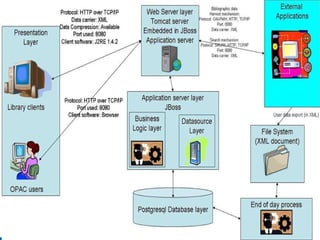
Technologies used Presentation layer SWING based GUI client - Java Runtime Environment 1.6 (Free ware). Java Web Start based Applet JDOM for XML messaging (open source) Java Help 2.0 for help (free ware) Jasper Reports (open source) Hibernate (open source)
Technologies used Presentation layer (Contd) Java Mail (Free Ware) Jakarta POI (open source) Open Office 2.0 – form letters (open source)
Technologies used Application server layer Servlets and JSPs - Tomcat web server (open source)  Struts frame work Spring framework Tomcat 6.0 JDOM (open source) XCQL – CQL parser(open source)
Technologies used Database EJB - Entity beans (Container Managed Persistence) and SQL used: Porting from one database to another is much easier Postgresql 8.3 (open source) database server is the default database Search engine for rapid bibliographic and authority database searches Lucene and Solr
Digital Libraries
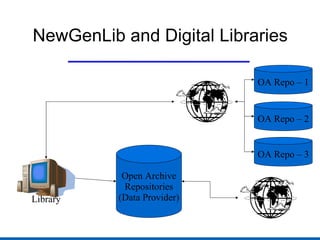
NewGenLib and Digital Libraries Library Open Archive Repositories (Data Provider) OA Repo – 1 OA Repo – 2 OA Repo – 3
Networking
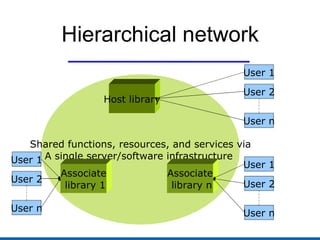
Hierarchical network Shared functions, resources, and services via A single server/software infrastructure  Host library User 1 User 2 User n Associate library n User 1 User 2 User n Associate library 1 User 1 User 2 User n
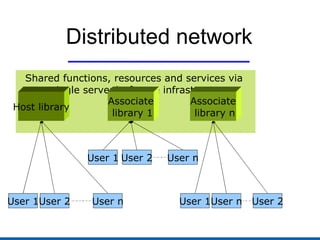
Distributed network Shared functions, resources and services via  a single server/software infrastructure Host library User 1 User 2 User n Associate library n User 1 User 2 User n Associate library 1 User 1 User 2 User n
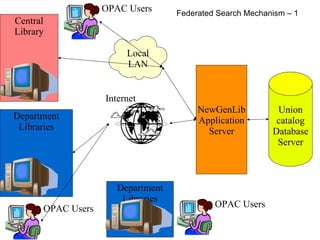
NewGenLib Application Server Central Library Department Libraries Union catalog Database Server Department Libraries Local LAN OPAC Users OPAC Users OPAC Users Internet Federated Search Mechanism – 1
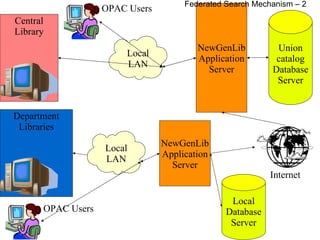
Internet NewGenLib Application Server Central Library Department Libraries Union catalog Database Server Local LAN OPAC Users OPAC Users Local LAN NewGenLib Application Server Local Database Server Federated Search Mechanism – 2
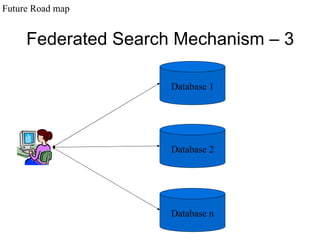
Federated Search Mechanism – 3 Future Road map Database 1 Database 2 Database n
Functional Modules
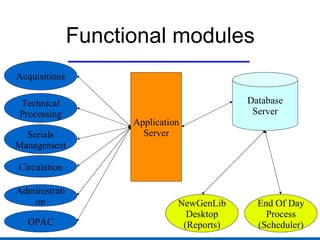
Functional modules Application Server Acquisitions Technical Processing Serials Management Circulation Administration OPAC Database Server NewGenLib Desktop (Reports) End Of Day Process (Scheduler)
Document Delivery System (Direct Consortia Borrowing)
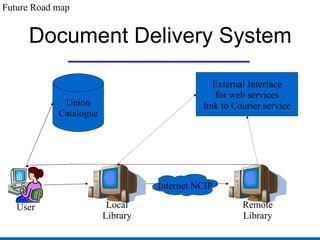
Document Delivery System User Union Catalogue Local Library Remote Library Internet NCIP External Interface for web services link to Courier service Future Road map
Customer Support
Customer Support On-site training programs On-site tech personnel support for large installations Telephone support Conventional telephone VOIP Frequently asked questions database On line Bug Tracking System
Customer Support Email based support Free maintenance for one year Annual Maintenance @ 15% from second year
Client list (Segment wise) Over 200 installations Universities and Deemed universities International research organizations Public libraries Academic libraries (other than universities) Political parties Corporates Others More than 2,500 libraries across 30 countries are using NewGenLib Open Source
Thank you

NewGenLib 3.0 Presentation

  • 1.
    NewGenLib 3.0 VerusSolutions, Hyderabad.
  • 2.
  • 3.
    Salient features Functionalmodules are completely web based. Uses Java Web Start ™ Technology Compatibility - Complies with international standards Affordable - Uses open source components Scalable, manageable and efficient
  • 4.
    Salient features OSindependent - Windows and Linux flavors available Internationalized application (I18N) Unicode 3.0 complaint Arabic version available Easy extensibility to support other languages Data entry, storage, retrieval in any (Unicode 3.0) language
  • 5.
    Salient features RFIDintegration Networking – Hierarchical and Distributed networks Automated email/instant messaging integrated into different functions of the software Customizable OPAC interface Form letters are configurable and use XML-based OpenOffice templates
  • 6.
    Salient features Extensiveuse of set up parameters enabling easy configuration of the software to suit specific needs, e.g., in defining patron privileges Supports multi-user and multiple security levels Allows digital attachments to metadata
  • 7.
  • 8.
    Standards supported MARC21– Bibliographic data Bibliographic record data structures designed for MARC21 formats Import and Export in ISO 2709 Import and Export in MARCXML MARC21 – Authority files Authority files data structures designed for MARC21 formats Import available in ISO 2709
  • 9.
    Standards supported MARC21– Holdings Holdings data structures designed for MARC21 Holdings. Z39.76 – Holdings statement display MODS 3.0 Bibliographic records can be exported in MODS 3.0 AGRIS AP Bibliographic records can be exported in AGRIS AP
  • 10.
    Standards supported ISBDRecord display and punctuations as per ISBD OAI – PMH Allows harvesting (manual) from external repositories Create Open archive collections, and items, search the repositories and also act as data provider Metadata formats: MARC XML, DUBLIN CORE, MODS 3.0 and AGRIS AP
  • 11.
    Standards supported SRU/WFederated search engines can search bibliographic databases using this protocol Query language: CQL (Common Query Language), bench marking Level 1 compliance Profiles used: BATH, and DUBLIN CORE Metadata standards: MARC XML and MODS 3.0
  • 12.
  • 13.
  • 14.
    Technologies used Presentationlayer SWING based GUI client - Java Runtime Environment 1.6 (Free ware). Java Web Start based Applet JDOM for XML messaging (open source) Java Help 2.0 for help (free ware) Jasper Reports (open source) Hibernate (open source)
  • 15.
    Technologies used Presentationlayer (Contd) Java Mail (Free Ware) Jakarta POI (open source) Open Office 2.0 – form letters (open source)
  • 16.
    Technologies used Applicationserver layer Servlets and JSPs - Tomcat web server (open source) Struts frame work Spring framework Tomcat 6.0 JDOM (open source) XCQL – CQL parser(open source)
  • 17.
    Technologies used DatabaseEJB - Entity beans (Container Managed Persistence) and SQL used: Porting from one database to another is much easier Postgresql 8.3 (open source) database server is the default database Search engine for rapid bibliographic and authority database searches Lucene and Solr
  • 18.
  • 19.
    NewGenLib and DigitalLibraries Library Open Archive Repositories (Data Provider) OA Repo – 1 OA Repo – 2 OA Repo – 3
  • 20.
  • 21.
    Hierarchical network Sharedfunctions, resources, and services via A single server/software infrastructure Host library User 1 User 2 User n Associate library n User 1 User 2 User n Associate library 1 User 1 User 2 User n
  • 22.
    Distributed network Sharedfunctions, resources and services via a single server/software infrastructure Host library User 1 User 2 User n Associate library n User 1 User 2 User n Associate library 1 User 1 User 2 User n
  • 23.
    NewGenLib Application ServerCentral Library Department Libraries Union catalog Database Server Department Libraries Local LAN OPAC Users OPAC Users OPAC Users Internet Federated Search Mechanism – 1
  • 24.
    Internet NewGenLib ApplicationServer Central Library Department Libraries Union catalog Database Server Local LAN OPAC Users OPAC Users Local LAN NewGenLib Application Server Local Database Server Federated Search Mechanism – 2
  • 25.
    Federated Search Mechanism– 3 Future Road map Database 1 Database 2 Database n
  • 26.
  • 27.
    Functional modules ApplicationServer Acquisitions Technical Processing Serials Management Circulation Administration OPAC Database Server NewGenLib Desktop (Reports) End Of Day Process (Scheduler)
  • 28.
    Document Delivery System(Direct Consortia Borrowing)
  • 29.
    Document Delivery SystemUser Union Catalogue Local Library Remote Library Internet NCIP External Interface for web services link to Courier service Future Road map
  • 30.
  • 31.
    Customer Support On-sitetraining programs On-site tech personnel support for large installations Telephone support Conventional telephone VOIP Frequently asked questions database On line Bug Tracking System
  • 32.
    Customer Support Emailbased support Free maintenance for one year Annual Maintenance @ 15% from second year
  • 33.
    Client list (Segmentwise) Over 200 installations Universities and Deemed universities International research organizations Public libraries Academic libraries (other than universities) Political parties Corporates Others More than 2,500 libraries across 30 countries are using NewGenLib Open Source
  • 34.