First Aid In Pharmacy Practice
Dr. Asra Hameed
Pharm.D (5th prof, AFN),JUW
asra_hameed1@hotmail.com
Trainee at CDL, DRAP
Pharmacy Practice
Develops the
professional roles
of Pharmacists
Asra Hameed (trainee at CDL)
Community Pharmacy
• Most accessible to the public
• Supply medicines in accordance with a prescription
• Sell legally permitted drugs without a prescription (OTC)
• Counselling of patients at the time of dispensing
• Drug information to health professionals, patients and public
• Participation in health-promotion programs
Asra Hameed (trainee at CDL)
First Aid
• Provision of initial care for an illness or injury
• Performed by a layperson to a sick or injured casualty
• Until definitive medical treatment can be accessible
• Consists of a series of simple and potentially life-saving skills
• Perform with minimal equipment
• Definition: "measures to be taken immediately after
an accident not with an idea to cure but in order
to prevent further harm being done"
Asra Hameed (trainee at CDL)
Responsibilities
• Preserve life and provide initial emergency care
• Provide treatment to sick or injured people
• Protect the unconscious
• Prevent the victim's condition from worsening
• Promote the recovery of the sufferer.
Asra Hameed (trainee at CDL)
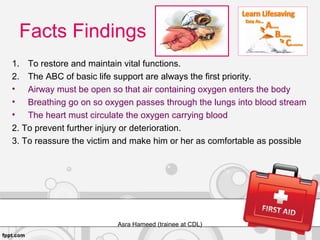
Facts Findings
1. To restore and maintain vital functions.
2. The ABC of basic life support are always the first priority.
• Airway must be open so that air containing oxygen enters the body
• Breathing go on so oxygen passes through the lungs into blood stream
• The heart must circulate the oxygen carrying blood
2. To prevent further injury or deterioration.
3. To reassure the victim and make him or her as comfortable as possible
Asra Hameed (trainee at CDL)
Four Basic Rules
Asra Hameed (trainee at CDL)
1. Call for help immediately2. Bring help to the victim
4. Do no further harm3. Check the ABCs
Pharmacist and First Aid
• First aid is an essential life skill, especially for healthcare
professionals who have regular contact with people in the
local community.
• Pharmacists are faced with all sorts of health questions and
the public will expect them to know the answers.
Asra Hameed (trainee at CDL)
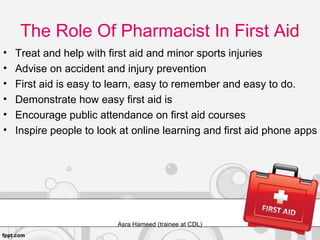
The Role Of Pharmacist In First Aid
• Treat and help with first aid and minor sports injuries
• Advise on accident and injury prevention
• First aid is easy to learn, easy to remember and easy to do.
• Demonstrate how easy first aid is
• Encourage public attendance on first aid courses
• Inspire people to look at online learning and first aid phone apps
Asra Hameed (trainee at CDL)
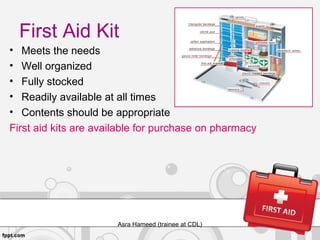
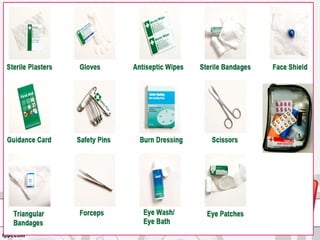
First Aid Kit
• Meets the needs
• Well organized
• Fully stocked
• Readily available at all times
• Contents should be appropriate
First aid kits are available for purchase on pharmacy
Asra Hameed (trainee at CDL)
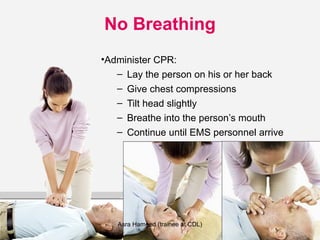
No Breathing
•Administer CPR:
– Lay the person on his or her back
– Give chest compressions
– Tilt head slightly
– Breathe into the person’s mouth
– Continue until EMS personnel arrive
Asra Hameed (trainee at CDL)
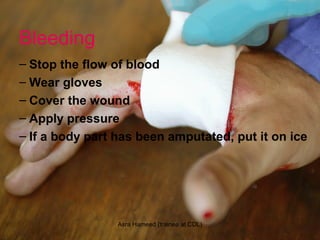
Bleeding
– Stop the flow of blood
– Wear gloves
– Cover the wound
– Apply pressure
– If a body part has been amputated, put it on ice
Asra Hameed (trainee at CDL)
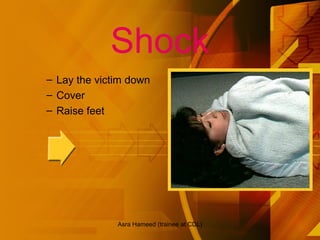
Shock
– Lay the victim down
– Cover
– Raise feet
Asra Hameed (trainee at CDL)
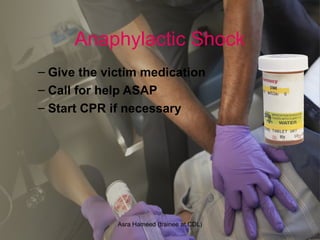
Anaphylactic Shock
– Give the victim medication
– Call for help ASAP
– Start CPR if necessary
Asra Hameed (trainee at CDL)
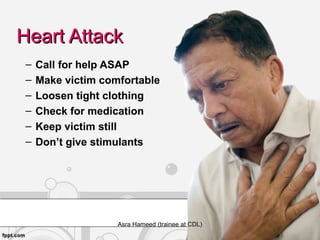
Heart AttackHeart Attack
– Call for help ASAP
– Make victim comfortable
– Loosen tight clothing
– Check for medication
– Keep victim still
– Don’t give stimulants
Asra Hameed (trainee at CDL)
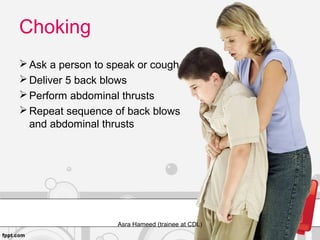
Choking
Ask a person to speak or cough
Deliver 5 back blows
Perform abdominal thrusts
Repeat sequence of back blows
and abdominal thrusts
Asra Hameed (trainee at CDL)
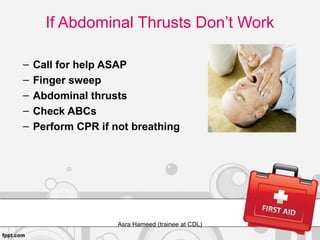
If Abdominal Thrusts Don’t Work
– Call for help ASAP
– Finger sweep
– Abdominal thrusts
– Check ABCs
– Perform CPR if not breathing
Asra Hameed (trainee at CDL)
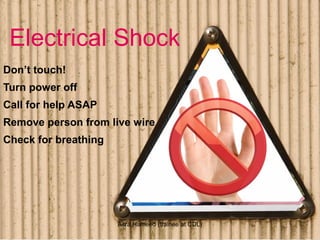
Electrical Shock
Don’t touch!
Turn power off
Call for help ASAP
Remove person from live wire
Check for breathing
Asra Hameed (trainee at CDL)
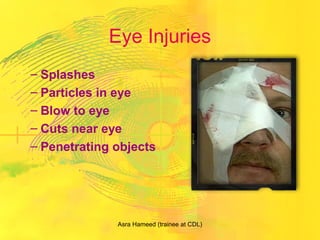
Eye Injuries
– Splashes
– Particles in eye
– Blow to eye
– Cuts near eye
– Penetrating objects
Asra Hameed (trainee at CDL)
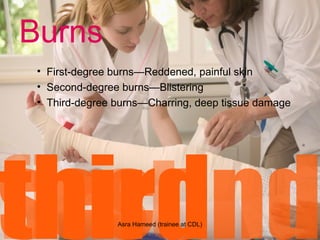
Burns
• First-degree burns—Reddened, painful skin
• Second-degree burns—Blistering
• Third-degree burns—Charring, deep tissue damage
Asra Hameed (trainee at CDL)
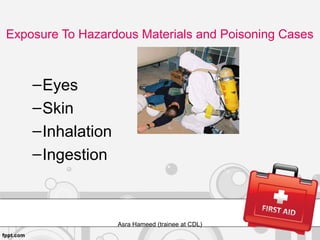
Exposure To Hazardous Materials and Poisoning Cases
–Eyes
–Skin
–Inhalation
–Ingestion
Asra Hameed (trainee at CDL)
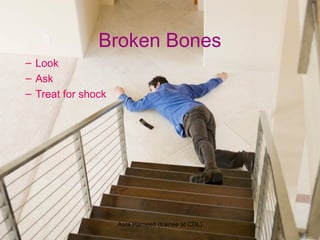
Broken Bones
– Look
– Ask
– Treat for shock
Asra Hameed (trainee at CDL)
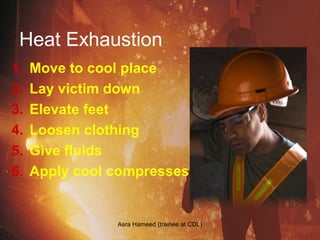
Heat Exhaustion
1. Move to cool place
2. Lay victim down
3. Elevate feet
4. Loosen clothing
5. Give fluids
6. Apply cool compresses
Asra Hameed (trainee at CDL)
Heatstroke
– Call for help ASAP
– Cool the person down
– Monitor
Asra Hameed (trainee at CDL)
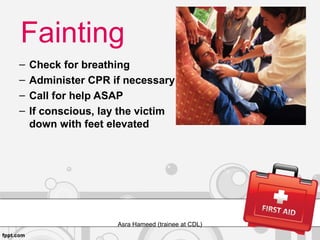
Fainting
– Check for breathing
– Administer CPR if necessary
– Call for help ASAP
– If conscious, lay the victim
down with feet elevated
Asra Hameed (trainee at CDL)
Epileptic Seizures
– Remove victim from hazards
– Check for breathing
– Nothing in the mouth
– Keep comfortable
– Call for help ASAP
Asra Hameed (trainee at CDL)
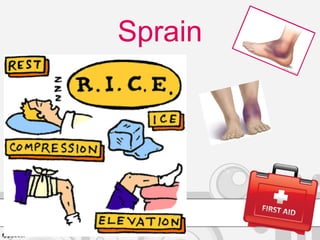
Sprain
Key Points to Remember
•Medical emergencies can happen anytime.
•Act quickly, calmly, and correctly.
•Consider being certified in first aid
and CPR.
Asra Hameed (trainee at CDL)
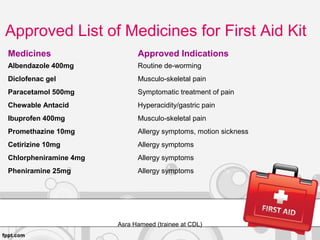
Approved List of Medicines for First Aid Kit
Medicines Approved Indications
Albendazole 400mg Routine de-worming
Diclofenac gel Musculo-skeletal pain
Paracetamol 500mg Symptomatic treatment of pain
Chewable Antacid Hyperacidity/gastric pain
Ibuprofen 400mg Musculo-skeletal pain
Promethazine 10mg Allergy symptoms, motion sickness
Cetirizine 10mg Allergy symptoms
Chlorpheniramine 4mg Allergy symptoms
Pheniramine 25mg Allergy symptoms
Asra Hameed (trainee at CDL)
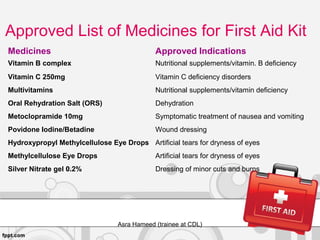
Medicines Approved Indications
Vitamin B complex Nutritional supplements/vitamin. B deficiency
Vitamin C 250mg Vitamin C deficiency disorders
Multivitamins Nutritional supplements/vitamin deficiency
Oral Rehydration Salt (ORS) Dehydration
Metoclopramide 10mg Symptomatic treatment of nausea and vomiting
Povidone Iodine/Betadine Wound dressing
Hydroxypropyl Methylcellulose Eye Drops Artificial tears for dryness of eyes
Methylcellulose Eye Drops Artificial tears for dryness of eyes
Silver Nitrate gel 0.2% Dressing of minor cuts and burns
Asra Hameed (trainee at CDL)
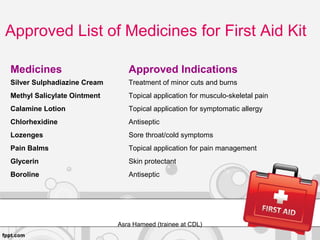
Approved List of Medicines for First Aid Kit
Medicines Approved Indications
Silver Sulphadiazine Cream Treatment of minor cuts and burns
Methyl Salicylate Ointment Topical application for musculo-skeletal pain
Calamine Lotion Topical application for symptomatic allergy
Chlorhexidine Antiseptic
Lozenges Sore throat/cold symptoms
Pain Balms Topical application for pain management
Glycerin Skin protectant
Boroline Antiseptic
Asra Hameed (trainee at CDL)
Approved List of Medicines for First Aid Kit
Significance Of First Aid In Community Pharmacy
(Conclusion)
• To save the life in case of emergency
• To minimize the risk of further damage
• First aid also leads to serve humanity
• First aid gives secure environment
• First aid facilities also provide self confidence
• Last but not the least, who safe one life in case of
emergency, safe the life of mankind
Asra Hameed (trainee at CDL)
Thank you
Asra Hameed (trainee at CDL)

First aid ppt

  • 1.
    First Aid InPharmacy Practice Dr. Asra Hameed Pharm.D (5th prof, AFN),JUW asra_hameed1@hotmail.com Trainee at CDL, DRAP
  • 2.
    Pharmacy Practice Develops the professionalroles of Pharmacists Asra Hameed (trainee at CDL)
  • 3.
    Community Pharmacy • Mostaccessible to the public • Supply medicines in accordance with a prescription • Sell legally permitted drugs without a prescription (OTC) • Counselling of patients at the time of dispensing • Drug information to health professionals, patients and public • Participation in health-promotion programs Asra Hameed (trainee at CDL)
  • 4.
    First Aid • Provisionof initial care for an illness or injury • Performed by a layperson to a sick or injured casualty • Until definitive medical treatment can be accessible • Consists of a series of simple and potentially life-saving skills • Perform with minimal equipment • Definition: "measures to be taken immediately after an accident not with an idea to cure but in order to prevent further harm being done" Asra Hameed (trainee at CDL)
  • 5.
    Responsibilities • Preserve lifeand provide initial emergency care • Provide treatment to sick or injured people • Protect the unconscious • Prevent the victim's condition from worsening • Promote the recovery of the sufferer. Asra Hameed (trainee at CDL)
  • 6.
    Facts Findings 1. Torestore and maintain vital functions. 2. The ABC of basic life support are always the first priority. • Airway must be open so that air containing oxygen enters the body • Breathing go on so oxygen passes through the lungs into blood stream • The heart must circulate the oxygen carrying blood 2. To prevent further injury or deterioration. 3. To reassure the victim and make him or her as comfortable as possible Asra Hameed (trainee at CDL)
  • 7.
    Four Basic Rules AsraHameed (trainee at CDL) 1. Call for help immediately2. Bring help to the victim 4. Do no further harm3. Check the ABCs
  • 8.
    Pharmacist and FirstAid • First aid is an essential life skill, especially for healthcare professionals who have regular contact with people in the local community. • Pharmacists are faced with all sorts of health questions and the public will expect them to know the answers. Asra Hameed (trainee at CDL)
  • 9.
    The Role OfPharmacist In First Aid • Treat and help with first aid and minor sports injuries • Advise on accident and injury prevention • First aid is easy to learn, easy to remember and easy to do. • Demonstrate how easy first aid is • Encourage public attendance on first aid courses • Inspire people to look at online learning and first aid phone apps Asra Hameed (trainee at CDL)
  • 10.
    First Aid Kit •Meets the needs • Well organized • Fully stocked • Readily available at all times • Contents should be appropriate First aid kits are available for purchase on pharmacy Asra Hameed (trainee at CDL)
  • 11.
  • 13.
    No Breathing •Administer CPR: –Lay the person on his or her back – Give chest compressions – Tilt head slightly – Breathe into the person’s mouth – Continue until EMS personnel arrive Asra Hameed (trainee at CDL)
  • 14.
    Bleeding – Stop theflow of blood – Wear gloves – Cover the wound – Apply pressure – If a body part has been amputated, put it on ice Asra Hameed (trainee at CDL)
  • 15.
    Shock – Lay thevictim down – Cover – Raise feet Asra Hameed (trainee at CDL)
  • 16.
    Anaphylactic Shock – Givethe victim medication – Call for help ASAP – Start CPR if necessary Asra Hameed (trainee at CDL)
  • 17.
    Heart AttackHeart Attack –Call for help ASAP – Make victim comfortable – Loosen tight clothing – Check for medication – Keep victim still – Don’t give stimulants Asra Hameed (trainee at CDL)
  • 18.
    Choking Ask a personto speak or cough Deliver 5 back blows Perform abdominal thrusts Repeat sequence of back blows and abdominal thrusts Asra Hameed (trainee at CDL)
  • 19.
    If Abdominal ThrustsDon’t Work – Call for help ASAP – Finger sweep – Abdominal thrusts – Check ABCs – Perform CPR if not breathing Asra Hameed (trainee at CDL)
  • 20.
    Electrical Shock Don’t touch! Turnpower off Call for help ASAP Remove person from live wire Check for breathing Asra Hameed (trainee at CDL)
  • 21.
    Eye Injuries – Splashes –Particles in eye – Blow to eye – Cuts near eye – Penetrating objects Asra Hameed (trainee at CDL)
  • 22.
    Burns • First-degree burns—Reddened,painful skin • Second-degree burns—Blistering • Third-degree burns—Charring, deep tissue damage Asra Hameed (trainee at CDL)
  • 23.
    Exposure To HazardousMaterials and Poisoning Cases –Eyes –Skin –Inhalation –Ingestion Asra Hameed (trainee at CDL)
  • 24.
    Broken Bones – Look –Ask – Treat for shock Asra Hameed (trainee at CDL)
  • 25.
    Heat Exhaustion 1. Moveto cool place 2. Lay victim down 3. Elevate feet 4. Loosen clothing 5. Give fluids 6. Apply cool compresses Asra Hameed (trainee at CDL)
  • 26.
    Heatstroke – Call forhelp ASAP – Cool the person down – Monitor Asra Hameed (trainee at CDL)
  • 27.
    Fainting – Check forbreathing – Administer CPR if necessary – Call for help ASAP – If conscious, lay the victim down with feet elevated Asra Hameed (trainee at CDL)
  • 28.
    Epileptic Seizures – Removevictim from hazards – Check for breathing – Nothing in the mouth – Keep comfortable – Call for help ASAP Asra Hameed (trainee at CDL)
  • 29.
  • 30.
    Key Points toRemember •Medical emergencies can happen anytime. •Act quickly, calmly, and correctly. •Consider being certified in first aid and CPR. Asra Hameed (trainee at CDL)
  • 31.
    Approved List ofMedicines for First Aid Kit Medicines Approved Indications Albendazole 400mg Routine de-worming Diclofenac gel Musculo-skeletal pain Paracetamol 500mg Symptomatic treatment of pain Chewable Antacid Hyperacidity/gastric pain Ibuprofen 400mg Musculo-skeletal pain Promethazine 10mg Allergy symptoms, motion sickness Cetirizine 10mg Allergy symptoms Chlorpheniramine 4mg Allergy symptoms Pheniramine 25mg Allergy symptoms Asra Hameed (trainee at CDL)
  • 32.
    Medicines Approved Indications VitaminB complex Nutritional supplements/vitamin. B deficiency Vitamin C 250mg Vitamin C deficiency disorders Multivitamins Nutritional supplements/vitamin deficiency Oral Rehydration Salt (ORS) Dehydration Metoclopramide 10mg Symptomatic treatment of nausea and vomiting Povidone Iodine/Betadine Wound dressing Hydroxypropyl Methylcellulose Eye Drops Artificial tears for dryness of eyes Methylcellulose Eye Drops Artificial tears for dryness of eyes Silver Nitrate gel 0.2% Dressing of minor cuts and burns Asra Hameed (trainee at CDL) Approved List of Medicines for First Aid Kit
  • 33.
    Medicines Approved Indications SilverSulphadiazine Cream Treatment of minor cuts and burns Methyl Salicylate Ointment Topical application for musculo-skeletal pain Calamine Lotion Topical application for symptomatic allergy Chlorhexidine Antiseptic Lozenges Sore throat/cold symptoms Pain Balms Topical application for pain management Glycerin Skin protectant Boroline Antiseptic Asra Hameed (trainee at CDL) Approved List of Medicines for First Aid Kit
  • 34.
    Significance Of FirstAid In Community Pharmacy (Conclusion) • To save the life in case of emergency • To minimize the risk of further damage • First aid also leads to serve humanity • First aid gives secure environment • First aid facilities also provide self confidence • Last but not the least, who safe one life in case of emergency, safe the life of mankind Asra Hameed (trainee at CDL)
  • 35.
    Thank you Asra Hameed(trainee at CDL)

Editor's Notes

  • #3 Pharmacy practice is the discipline of pharmacy which involves developing the professional roles of pharmacists.
  • #4 Community pharmacists are the health professionals most accessible to the public. They supply medicines in accordance with a prescription or, when legally permitted, sell them without a prescription. In addition to ensuring an accurate supply of appropriate products, their professional activities also cover counselling of patients at the time of dispensing of prescription and non-prescription drugs, drug information to health professionals, patients and the general public, and participation in health-promotion programmes. They maintain links with other health professionals in primary health care.
  • #5 First aid is the provision of initial care for an illness or injury. It is usually performed by a layperson to a sick or injured casualty until definitive medical treatment can be accessible. Certain self-limiting illnesses or minor injuries may not require further medical care past the first aid intervention. Generally, it consists of a series of simple and, in some cases, potentially life-saving techniques that an individual can be trained to perform with minimal equipment. The Encyclopaedia Britannica states First Aid as "measures to be taken immediately after an accident not with an idea to cure but in order to prevent further harm being done". It uses the available human and material resources at the site of accident to provide initial care to the victim of injury or sudden illness until more advance care is provided.
  • #8 Slide Show Notes Every medical emergency is different, of course, but there are four basic rules that apply to all medical emergencies. One, call for medical help immediately. An employee on the scene should Call for help ASAP while another certified in first aid and CPR tends to the victim. If you make the call, explain the kind of injury and where the victim is located. Two, bring help to the victim, don’t bring the victim to help. In other words, victims should not be moved unless they are in imminent danger where they are. Three, check the ABCs. “A” stands for airway. “B” stands for breathing. And “C” stands for circulation. That means check to make sure the throat is clear, the victim is breathing, and the victim has a pulse. A first-aid certified employee may be called upon to perform rescue breathing or CPR to keep the victim alive until EMS (emergency medical services) personnel arrive. And four, do no further harm. Be careful not to cause additional injuries in your attempt to help a victim.
  • #10 The importance of educating a pharmacist about first aid to help reduce the complications and mortality rate of casualties has been widely supported by respondents. Community pharmacy staffs are ideally placed to treat and help with first aid and minor sports injuries as well as advise on accident and injury prevention. First aid is easy to learn, easy to remember and easy to do. Pharmacists have the opportunity not only to demonstrate how easy first aid is, but also to advocate for the public to learn more themselves. They could use the contact they have with the public to encourage attendance on first aid courses and for people to look at online learning and first aid phone apps. An enhanced access to training sessions and coursework in first aid would largely remedy the gaps in first aid information among the pharmacists. Also, the Ministry Of Health should be further interested in educating pharmacists about first aid. A pharmacist who provides first aid should be suitably trained and competent to do so.
  • #11 It is important that households and workplaces have a first aid kit that meets their needs and is well organised, fully stocked and readily available at all times. The contents should be appropriate to cope with a range of emergency situations, depending on the setting. It’s a good idea to have a number of kits handy in different places, such as in the home, car or office. First aid kits are available for purchase from a variety of providers on local pharmacy. Specialty kits are also available to meet specific needs.
  • #14 Slide Show Notes Now let’s look at some specific medical emergencies. When a person is unconscious and not breathing, irreversible brain damage occurs within 3 minutes. You have to act very fast. Someone trained in cardiopulmonary resuscitation, or CPR, should lay the person on his or her back while someone else calls 911. Loosen the clothes around the neck and make sure nothing is blocking the mouth or throat. First, give 30 chest compressions by placing both hands in the center of the victim’s chest with one hand on top of the other and pressing down with the heel of your hand 1½ to 2 inches. Press quickly at a rate of about 100 compressions a minute. Next, open the airway by tilting the head slightly and lifting under the chin. Do not move the victim’s head back if you suspect a neck injury. Form a seal around the mouth and pinch the nose. Use a pocket mask if you are trained in its proper use. Breathe two slow breaths into the person’s mouth—enough to make the chest rise and fall. Then, continue chest compressions. Once you begin CPR, continue until EMS personnel arrive.
  • #15 Slide Show Notes Heavy bleeding is another serious medical emergency. If a co-worker is bleeding heavily, you have to stop the flow of blood while you wait for EMS personnel to arrive. Because of the risk of bloodborne diseases, you must wear gloves (from the first-aid kit, if possible) when administering first aid for bleeding. Next, cover the wound with a clean bandage from the first-aid kit. Then apply pressure with your hand directly over the wound. Do the same thing if a finger, hand, or other body part has been amputated. While you are applying pressure to the wound, have someone else place the amputated part in a plastic bag with ice. Make sure to wrap the severed part so that it doesn’t directly touch the ice. Give the package to EMS personnel or rush it to the hospital. In many cases, severed limbs can be reattached. Do you know where the nearest first-aid kit is located in your work area? You should. You should also know what materials the kit contains. Tell trainees where to find first-aid kits in their work areas. Show them a kit so that they become familiar with first-aid materials in the kit.
  • #16 Slide Show Notes In cases where a person has lost a lot of blood, a condition known as shock can develop. Shock is the body’s way of reacting to severe injury. A person in shock may appear stunned or confused. To treat shock: Lay the victim down, Cover the victim to keep him or her warm, and Raise the feet slightly above heart level.
  • #17 Slide Show Notes Another type of shock is called anaphylactic shock. Anaphylactic shock is a severe allergic reaction to insect bites, medicines, or certain foods. Symptoms include hives, overall weakness, and swelling of the throat. Ask if the person has medication. If so, give it to him or her right away. People with severe allergies also usually wear a medic alert tag, so look for that, too, in order to help give EMS workers the best possible information. Anaphylactic shock can be deadly, so call for help fast, and Be prepared to start CPR.
  • #18 Slide Show Notes Signs that someone is having a heart attack include shortness of breath or difficulty breathing; anxiety; pressure, squeezing, fullness, or pain in the center of the chest, radiating down either arm, or in the jaw; ashen color to skin, and perspiration, nausea, or vomiting. First aid for heart attacks begins with calling 911, Then make the victim comfortable, either lying down or sitting, Loosen tight clothing at the waist and neck, Ask the victim if he or she has heart medication, Don’t let the victim move around, and Finally, don’t give the person any stimulants like coffee or tea. If the heart stops beating, begin CPR. However, if the heart is beating and the person is breathing, CPR is not necessary. Just keep him or her comfortable until EMS personnel arrive.
  • #19 Slide Show Notes A person can choke to death in a couple of minutes. The fastest way to find out if someone is choking is to ask, “Are you choking?” If the person can cough or talk, he or she is not choking. But if the person can’t talk or cough, first deliver 5 back blows between the person’s shoulder blades with the heel of your hand. If the back blows don’t clear the object from the throat, perform abdominal thrusts: Stand behind the victim and wrap your arms around the waist. Make a fist with one hand. Place your fist, thumb-side in, against the victim’s stomach—above the navel but below the ribs. Grab your fist with your other hand. Pull in and up sharply and repeat if necessary to dislodge whatever is stuck in the throat. Repeat the sequence of 5 back blows and 5 abdominal thrusts until the object is cleared. Do you know how to perform abdominal thrusts? Everybody should. It’s simple, and it can save a life. Demonstrate abdominal thrusts without using force on a volunteer from the group, and then give trainees the chance to practice it on one another.
  • #20 Slide Show Notes If the sequence of back blows and abdominal thrusts does not clear the object, and the victim becomes unconscious: further quick action is needed. Try a “finger sweep” if the object in the throat is clearly visible and accessible with your fingers. Use gloves if possible. Use your index and middle finger to grasp the object. Don’t try the finger sweep if there’s a chance you’ll push the object further down the throat. Lay the person down on his or her back, and perform 5 abdominal thrusts by placing your hands one on top of the other and push the heel of your hand in and up sharply on the abdomen just below the rib cage. Once the object is cleared, check the “ABCs” (airway, breathing, and circulation). If the person is not breathing, perform CPR until medical help arrives.
  • #21 Slide Show Notes The first rule of dealing with electrical shock is not to touch a person who is in contact with a live electrical current. If you do, the current can pass right through the person to you and cause the same injury. So the first thing you should do is to turn off the power to the electrical equipment involved. Then call for help. Electrical shocks can be life threatening. You want to get EMS personnel on the scene quickly in case the victim has stopped breathing. If you have to remove a person from a live wire, be very careful so you don’t get a shock, too. Stand on something that’s an insulator, like a rubber mat; wear rubber gloves; and use a dry stick, wooden broom handle, or board to push the person away from the wire. Don’t use anything metal, wet, or damp. Once the victim is safe, check for breathing. Begin CPR if the person is not breathing.
  • #22 Slide Show Notes Eye injuries are a common workplace medical emergency. Eye protection can prevent most injuries. But just in case, you should be familiar with first aid for different kinds of eye injuries. For chemical splashes, flush eyes for at least 15 minutes with water, and then close the eyes and cover them with a clean cloth. Get immediate medical attention. For solids (particles, dust, powders, etc.) in the eye, flush with water until particle comes out. If it won’t come out, cover the eye and seek medical attention. Don’t let the victim rub the eye. For a blow to the eye, apply cold compresses for 15 minutes to reduce pain and swelling. Get medical attention. For cuts near the eye, bandage loosely and get medical attention. Don’t let the victim rub the eye. For objects that penetrate the eye, don’t try to remove, move, or put any pressure on the object. Immobilize it by placing a paper cup or soft, bulky dressing around it, secured with tape. Bandage the other eye so that the victim will keep the injured eye still. Get immediate medical attention.
  • #23 Slide Show Notes Burns are another common workplace hazard. You can be burned by hot surfaces, hot materials, or by the properties of certain materials. First aid for burns depends on the degree of the burn. First-degree burns are the least severe. They just involve the top layer of skin, which becomes reddened and painful. Second-degree burns are more serious and include blistering in addition to reddened skin and pain. First- and second-degree burns may be treated with cold, running water for relief of pain. Then cover the burned area with a moist, sterile dressing. Don’t break blisters on second-degree burns. Third-degree burns are the most serious and can even be life threatening. With third-degree burns the skin is destroyed, you see charring and deep tissue damage. You may even see exposed bones. For third-degree burns, Call for help ASAP immediately, and keep the victim comfortable until help arrives. Always get immediate medical attention for all burns, especially those that are severe and those that cover large areas of the body.
  • #24 Slide Show Notes Unprotected exposure to hazardous materials can sicken or even kill a person. These are the basic first-aid procedures for these exposures. For exposures to the eyes, flush with water for 15 minutes and get medical attention. For exposures to the skin, flush with water for 15 minutes and get medical attention for burns and other damage. For inhalation of vapors or gases, move the victim to fresh air immediately. Administer CPR, if necessary. For ingestion, have a co-worker Call for help ASAP. Another employee can also call your local poison center for more first-aid information, if necessary. Then follow the first-aid instructions in the material safety data sheet, or MSDS. The MSDS is an excellent source of first-aid information. Be sure you know where MSDSs are located and how to find the necessary first-aid information. Tell trainees where to find MSDSs. Then, using sample MSDSs for materials in your workplace, show trainees how to find relevant first-aid information.
  • #25 Slide Show Notes The rule for treating people who may have broken bones is never to move them unless it’s necessary for their safety. Neck and back injuries are especially risky. The wrong move could cause paralysis or death. If you suspect broken bones, call for emergency medical assistance, and instruct the victim not to move. Then look for swelling and deformity. Ask the victim to rate the pain, explain how the injury happened, and if he or she can move the injured limb. Treat for shock if the person shows symptoms. If it seems that a person might have a broken bone, apply ice wrapped in a towel or cloth to the area, and keep the victim comfortable until help arrives.
  • #26 Slide Show Notes Working in a hot environment or on a hot day can be very stressful for your body, especially if you’re not used to the heat. Heat exhaustion may start out as discomfort and fatigue but can quickly develop into something more serious. Symptoms of heat exhaustion include pale or flushed appearance, weakness, heavy sweating, headache, moist and clammy skin, dizziness, and sometimes, nausea or a slight fever. First aid for heat exhaustion involves these steps: Move the victim to a cool place; Have the person lie down; Elevate feet 8 to 10 inches; Loosen clothing; Give the victim water and encourage him or her to drink slowly; and Apply cool compresses to the head and body. Do not administer “salt tablets,” as these are a high blood pressure risk.
  • #27 Slide Show Notes If a person suffering from heat exhaustion is not treated promptly, it can turn into heatstroke. Heatstroke is a life-threatening condition in which the body gets so hot that it can’t cool down. Signs of heatstroke include very hot and dry skin, extreme tiredness, and confusion. You have to act fast in cases of heatstroke. Immediately Call for help ASAP. While you’re waiting for help to arrive, cool the person down by hosing his or her body with cool water or by fanning the body. Monitor the victim to make sure the airway remains open, the person is breathing, and the person has a pulse. If you work in a hot environment or if you exercise or work outdoors on hot days, you should recognize the symptoms of heatstroke and take precautions to prevent overheating. Describe precautions for preventing heatstroke, such as drinking lots of fluids, pacing yourself while you work, taking rest breaks in a cool place, and so on.
  • #28 Slide Show Notes Fainting can occur when blood pools in the legs, reducing the blood flow to the brain. People may faint when they are standing for a long time in the heat. Fainting can also be brought on by stress. Check a person who has fainted for breathing. If the person is not breathing, begin CPR. If the person does not regain consciousness within a few minutes after fainting, call for emergency medical assistance and continue to monitor breathing. Otherwise, if the person quickly regains consciousness, have the person lie down with feet slightly elevated. Loosen any tight clothing. Then allow the person to rest for 10 or 15 minutes until normal blood flow is restored, and the person feels all right again.
  • #29 Slide Show Notes A person having an epileptic seizure may fall to the ground and have convulsions. If a person appears to be having a seizure: Remove victim from any dangerous objects or hazardous situations; Check for breathing; Don’t put anything in the victim’s mouth; Try to keep the person as comfortable as possible; and Call for emergency medical assistance if the seizure lasts more than 5 minutes without signs of slowing down, if the person has trouble breathing afterwards, or if the person is in pain or other injury is present.
  • #30 Injuries such as sprains, strains and fractures can happen easily after accidents or falls, or during sport or other physical activities. When an injury happens, there can be some internal bleeding and swelling in the injured area. Too much swelling can cause more damage. Use RICER first aid in the first 48 hours after a sprain, strain or fracture. It can limit swelling and help speed up recovery. R – RestAfter injury, stop your child playing or moving. Movement can increase bleeding and swelling and slow healing. Call 000 if you think it’s a fracture. I – IceUse an ice pack to reduce pain and swelling around the injury. Apply ice for 15-20 minutes every 2 hours for up to 72 hours after injury. C – CompressionBandage the area firmly (but not too tightly) around, above and below the wound. Overlap each layer by half. Immobilise limb if you think it’s a fracture. E – ElevationKeep the injured area elevated. Keep legs above hips by putting the leg on a chair, pillow or stool. Use a sling for arm injuries. R – ReferralHave the injury checked by a doctor. The doctor might ask for X-rays, ultrasounds or CT scans to diagnose the injury and plan treatment.  In the first 48-72 hours after an injury, don’t use treatments such as heat or hot rubs. Also avoid moderate or intense activity and massage.
  • #31 Slide Show Notes Here are the main points to remember about basic first aid: Medical emergencies can happen anytime on the job. When a co-worker is injured, you have to act quickly, calmly, and correctly. The best way to prepare for workplace medical emergencies is to be certified in first aid and CPR.
  • #35 Increasing the lectures or workshops regarding first aid, whether in colleges, universities or academic institutions especially in faculties of pharmacy, will be very helpful to increase enlightenment and information about first aid because educating even a few people in first aid improves the safety of everyone they come in contact with.