
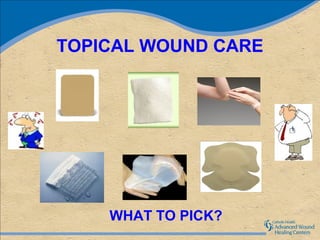

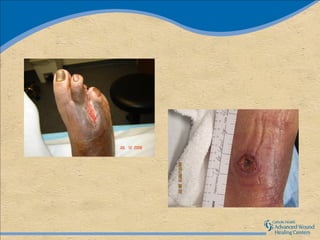

TOPICAL WOUND CARE


    WHAT TO PICK?
PHASES OF WOUND HEALING
1) Inflammatory (0 – 4 days). Vasoconstriction, clot
    formation and hemostasis.

2) Proliferative (2-3 days to 30 days). Fibroblasts lay
   framework for ECM and new granulation.
   Angiogenesis connects new granulation and
   epithelialization progresses across wound base.

3) Remodeling (3 weeks to 2 years). Completion of
   wound contraction with crosslinking of collagen and
   reduction in scar size. Tensile strength ultimately
   becomes appro. 80% of original.
WOUND CARE FUNDAMENTALS
 Maintain  moist wound environment
 Remove eschar, debris and necrotic tissue from
  wound bed
 Control exudate
 Prevent trauma and further wounding
 Identify and treat infection
 Manage edema
 “Back to basics”
MOIST WOUND CARE
 Moist wound environment facilitates healing
 Wounds that are too wet or too dry cannot
  progress through normal phases of healing
 Products to absorb and dry if too wet
 Products to maintain and add moisture if too dry
 Should be a part of essentially every wound care
  regimen
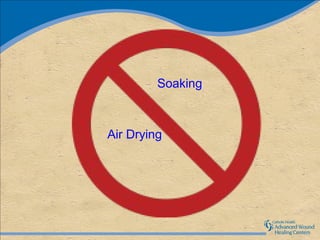
 No air drying or soaking!
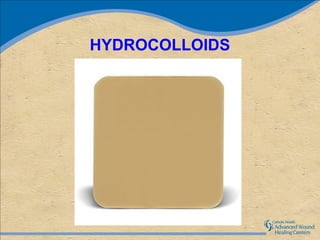
HYDROCOLLOIDS
HYDROCOLLOIDS
 Impermeable    to bacteria
 Facilitates autolytic debridement
 Self adhesive
 As exudate is absorbed, forms a colloidal gel
 Not for use in heavily exudating wounds
 Common uses are pressure ulcers, burns
 Ex: Duoderm, Tegaderm, Replicare, Restore
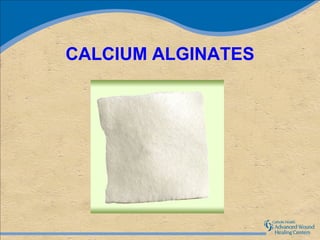
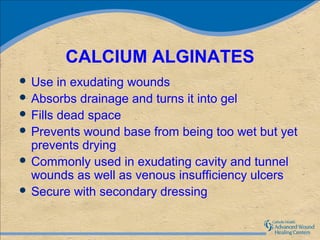
CALCIUM ALGINATES
CALCIUM ALGINATES
 Use   in exudating wounds
 Absorbs drainage and turns it into gel
 Fills dead space
 Prevents wound base from being too wet but yet
  prevents drying
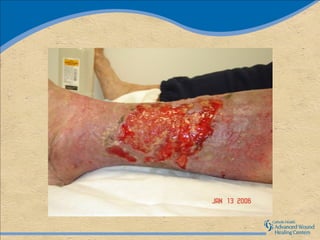
 Commonly used in exudating cavity and tunnel
  wounds as well as venous insufficiency ulcers
 Secure with secondary dressing
HYDROGELS
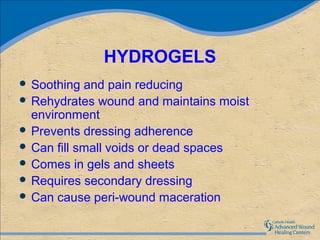
HYDROGELS
 Soothing  and pain reducing
 Rehydrates wound and maintains moist
  environment
 Prevents dressing adherence
 Can fill small voids or dead spaces
 Comes in gels and sheets
 Requires secondary dressing
 Can cause peri-wound maceration
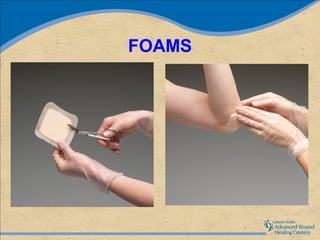
FOAMS
FOAMS
 Highly Absorptive
 Non-adherent
 Conformable
 Protects wound and peri-wound from trauma
 Thermal insulation
 Common uses are pressure (decubitus) ulcers
 Can use under compression for venous ulcers
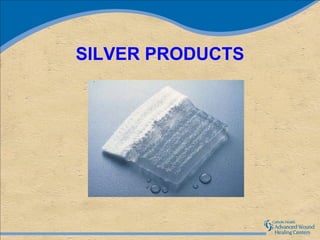
SILVER PRODUCTS
SILVER PRODUCTS
 Documented    antimicrobial activity thru history
 Effective against MRSA and VRE
 Available in a wide variety of dressing substrates
 Products containing silver that also absorb
  drainage, ie, silver alginates, tend to perform the
  best
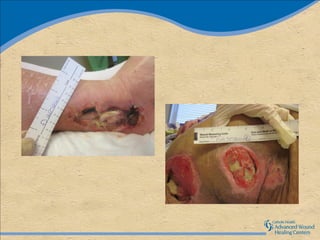
 Common uses are CVI and diabetic ulcers
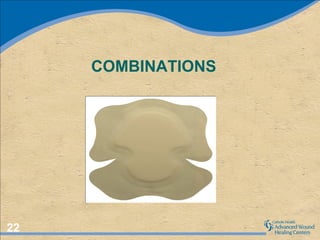
COMBINATIONS


22
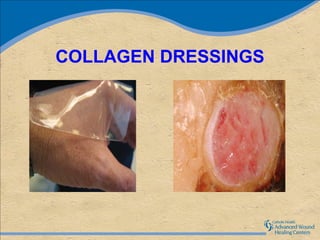
COLLAGEN DRESSINGS

 Stimulate and recruit cells for healing
 Provide gridwork or matrix for new tissue
 Available as synthetic or bioengineered
 Common uses are in well granulated wounds.
  Not of value over eschar or slough
COLLAGEN DRESSINGS
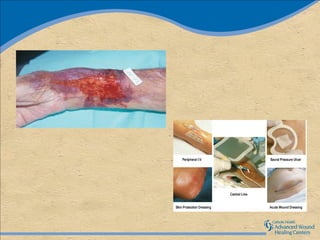
FILM DRESSINGS
 Semi-permeable
 Waterproof   (also retain moisture)
 Transparent for visualization
 Can tear fragile skin
 Not for infected or exudating wounds
 Common uses are lacerations, skin tears and IV
  sites.
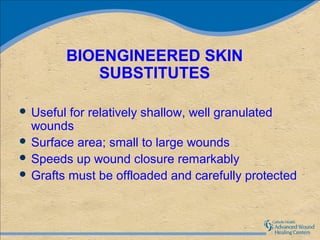
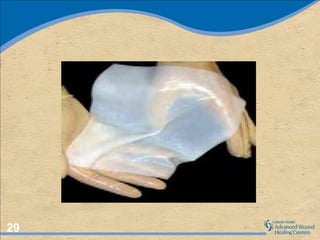
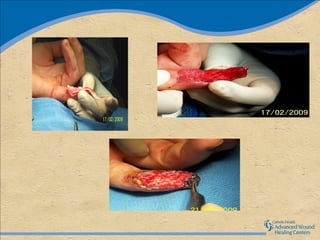
BIOENGINEERED SKIN
           SUBSTITUTES

 Useful for relatively shallow, well granulated
  wounds
 Surface area; small to large wounds
 Speeds up wound closure remarkably
 Grafts must be offloaded and carefully protected
29
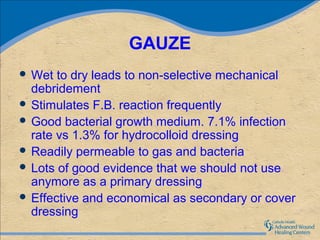
GAUZE
 Wet  to dry leads to non-selective mechanical
  debridement
 Stimulates F.B. reaction frequently
 Good bacterial growth medium. 7.1% infection
  rate vs 1.3% for hydrocolloid dressing
 Readily permeable to gas and bacteria
 Lots of good evidence that we should not use
  anymore as a primary dressing
 Effective and economical as secondary or cover
  dressing
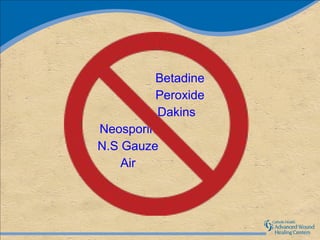
Betadine
         Peroxide
          Dakins
Neosporin
N.S Gauze
    Air
Soaking


Air Drying
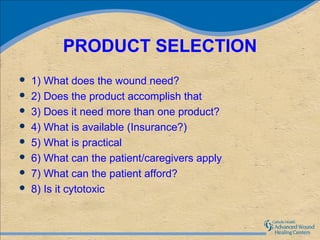
PRODUCT SELECTION
   1) What does the wound need?
   2) Does the product accomplish that
   3) Does it need more than one product?
   4) What is available (Insurance?)
   5) What is practical
   6) What can the patient/caregivers apply
   7) What can the patient afford?
   8) Is it cytotoxic
THANK YOU !


QUESTIONS ???

Advanced wound healing Centers

  • 2.
    TOPICAL WOUND CARE WHAT TO PICK?
  • 4.
    PHASES OF WOUNDHEALING 1) Inflammatory (0 – 4 days). Vasoconstriction, clot formation and hemostasis. 2) Proliferative (2-3 days to 30 days). Fibroblasts lay framework for ECM and new granulation. Angiogenesis connects new granulation and epithelialization progresses across wound base. 3) Remodeling (3 weeks to 2 years). Completion of wound contraction with crosslinking of collagen and reduction in scar size. Tensile strength ultimately becomes appro. 80% of original.
  • 5.
    WOUND CARE FUNDAMENTALS Maintain moist wound environment  Remove eschar, debris and necrotic tissue from wound bed  Control exudate  Prevent trauma and further wounding  Identify and treat infection  Manage edema  “Back to basics”
  • 6.
    MOIST WOUND CARE Moist wound environment facilitates healing  Wounds that are too wet or too dry cannot progress through normal phases of healing  Products to absorb and dry if too wet  Products to maintain and add moisture if too dry  Should be a part of essentially every wound care regimen  No air drying or soaking!
  • 7.
  • 8.
    HYDROCOLLOIDS  Impermeable to bacteria  Facilitates autolytic debridement  Self adhesive  As exudate is absorbed, forms a colloidal gel  Not for use in heavily exudating wounds  Common uses are pressure ulcers, burns  Ex: Duoderm, Tegaderm, Replicare, Restore
  • 10.
  • 11.
    CALCIUM ALGINATES  Use in exudating wounds  Absorbs drainage and turns it into gel  Fills dead space  Prevents wound base from being too wet but yet prevents drying  Commonly used in exudating cavity and tunnel wounds as well as venous insufficiency ulcers  Secure with secondary dressing
  • 13.
  • 14.
    HYDROGELS  Soothing and pain reducing  Rehydrates wound and maintains moist environment  Prevents dressing adherence  Can fill small voids or dead spaces  Comes in gels and sheets  Requires secondary dressing  Can cause peri-wound maceration
  • 16.
  • 17.
    FOAMS  Highly Absorptive Non-adherent  Conformable  Protects wound and peri-wound from trauma  Thermal insulation  Common uses are pressure (decubitus) ulcers  Can use under compression for venous ulcers
  • 19.
  • 20.
    SILVER PRODUCTS  Documented antimicrobial activity thru history  Effective against MRSA and VRE  Available in a wide variety of dressing substrates  Products containing silver that also absorb drainage, ie, silver alginates, tend to perform the best  Common uses are CVI and diabetic ulcers
  • 22.
  • 23.
    COLLAGEN DRESSINGS  Stimulateand recruit cells for healing  Provide gridwork or matrix for new tissue  Available as synthetic or bioengineered  Common uses are in well granulated wounds. Not of value over eschar or slough
  • 25.
  • 26.
    FILM DRESSINGS  Semi-permeable Waterproof (also retain moisture)  Transparent for visualization  Can tear fragile skin  Not for infected or exudating wounds  Common uses are lacerations, skin tears and IV sites.
  • 28.
    BIOENGINEERED SKIN SUBSTITUTES  Useful for relatively shallow, well granulated wounds  Surface area; small to large wounds  Speeds up wound closure remarkably  Grafts must be offloaded and carefully protected
  • 29.
  • 31.
    GAUZE  Wet to dry leads to non-selective mechanical debridement  Stimulates F.B. reaction frequently  Good bacterial growth medium. 7.1% infection rate vs 1.3% for hydrocolloid dressing  Readily permeable to gas and bacteria  Lots of good evidence that we should not use anymore as a primary dressing  Effective and economical as secondary or cover dressing
  • 33.
    Betadine Peroxide Dakins Neosporin N.S Gauze Air
  • 34.
  • 35.
    PRODUCT SELECTION  1) What does the wound need?  2) Does the product accomplish that  3) Does it need more than one product?  4) What is available (Insurance?)  5) What is practical  6) What can the patient/caregivers apply  7) What can the patient afford?  8) Is it cytotoxic
  • 36.