MEDICATION EDUCATION 101
By DIEN VU
11/12/2015
What is a medication?
• There are 2 types of Medications
– Prescription (Rx-only)
– Over-The-Counter (OTC)
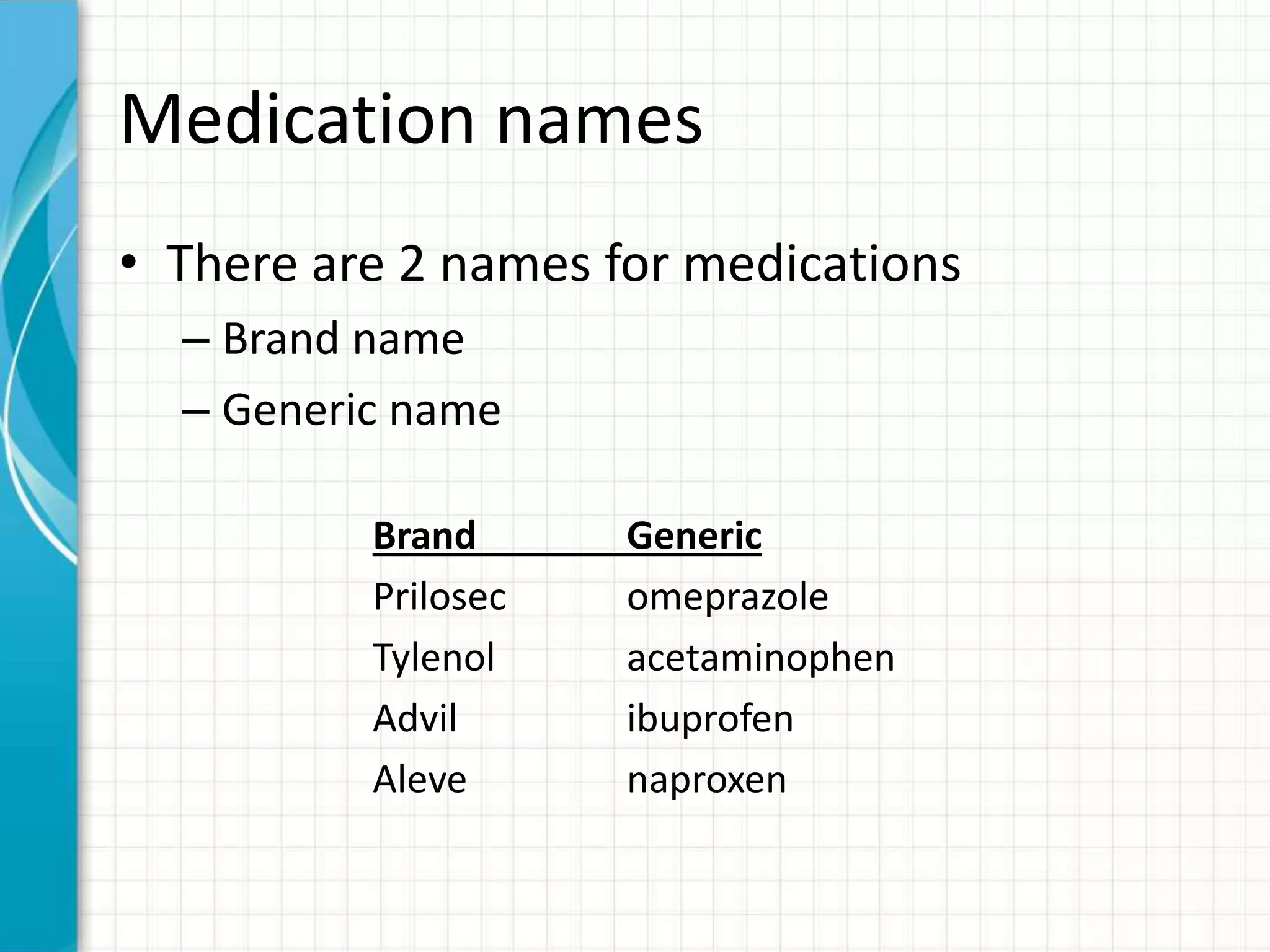
Medication names
• There are 2 names for medications
– Brand name
– Generic name
Brand Generic
Prilosec omeprazole
Tylenol acetaminophen
Advil ibuprofen
Aleve naproxen
Tips for safe medication use
• Use as directed
• Do not use expired medicines
• Do not use medication that looks abnormal
• Try not to miss a dose
• Take medication on time
• Wash your hands after using a cream
Tips for safe medication use
• Try to read the drug information leaflet given to
you at the pharmacy
• Inspect your medicine before leaving the
pharmacy
• Buying medication online
• Dispose of properly to avoid accidental or
misuse
Side-effect?
• What is a side-effect?
• Is the side-effect minor or tolerable?
• Is the side-effect too much to bear?
• Some common side effects: dizziness,
drowsiness, constipation, diarrhea, nausea,
upset stomach, skin irritation, etc
Questions you should ask about your
new medications
1. What is this prescription for?
2. How will this medicine help me?
3. What are the side effects?
4. How do I take this medicine?
5. How expensive is the medication? Will my insurance
plan cover it?
6. Are there non-drug options I can try?
7. Why is this new drug better than the one I was
taking?
8. How long do I take it?
9. Do I take it with or without food?
How do you store your medication?
1. Bathroom cabinet?
2. Above the kitchen stove?
3. On the window shelf under direct sunlight?
4. In the car’s glove compartment?
5. Next to your bed?
6. In high drawer or cabinet in bedroom?
7. In the fridge?
8. In the freezer?
9. Different medicines in the same bottle?
Do you know that…
• You should NOT put a refrigerated medication
in a freezer because you think it might extend
the life of medication.
• Storing in inappropriate conditions might
break down the drug and make it less
effective.
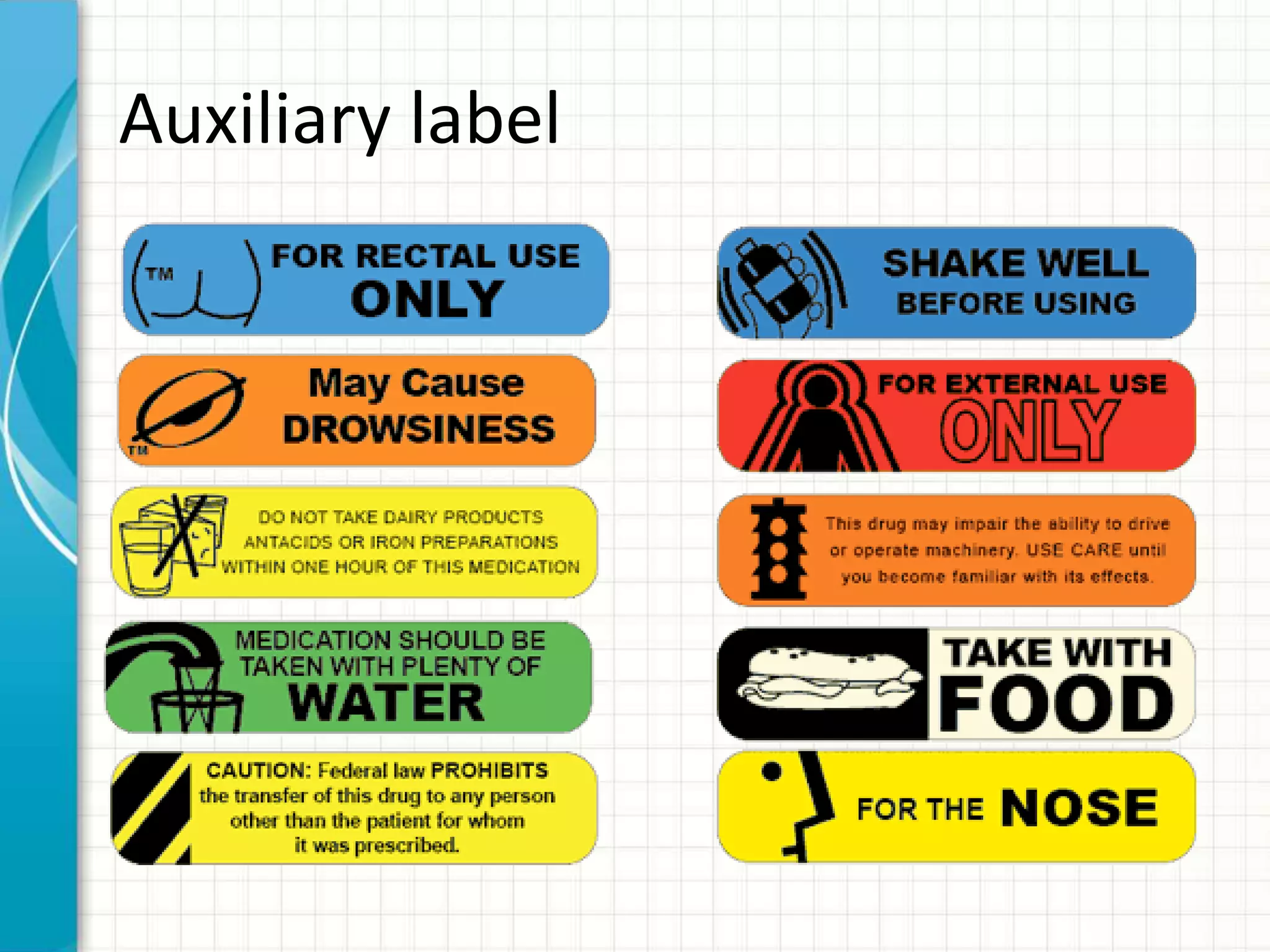
Auxiliary label
Auxiliary label
What if you travel with a refrigerated
medication?
• Example: Insulin
• Have a small container with ice pack/
freezer pack and medication inside
• At the airport
– You may bring medically necessary liquids, medications and
creams in excess of 3.4 ounces or 100 milliliters in your carry-
on bag.
– Other supplies associated with medically necessary liquids
such as IV bags, pumps and syringes must undergo X-ray
screening.
https://www.tsa.gov/travel/special-procedures
Safe disposal of medications
– Dispose unused or expired medications
– It could be harmful if medication is taken by someone
else. (e.g. grandchildren, pets)
– Do not give away to friends
– Environmental pollution
– Peel off label to protect your identity and privacy
http://www.fda.gov/ForConsumers/ConsumerUpdates/ucm101653.htm
How to dispose medications?
– Mix with coffee grounds or cat litters
• Place in a sealed bag to prevent leaking
• Toss in trash
– Special instruction: flush in toilet
• Ex: Fentanyl patch
– Bring to pharmacy on “Take-back” program offer
– Bring to Hudson police station
• Medication drop-off box
http://www.fda.gov/ForConsumers/ConsumerUpdates/ucm101653.htm
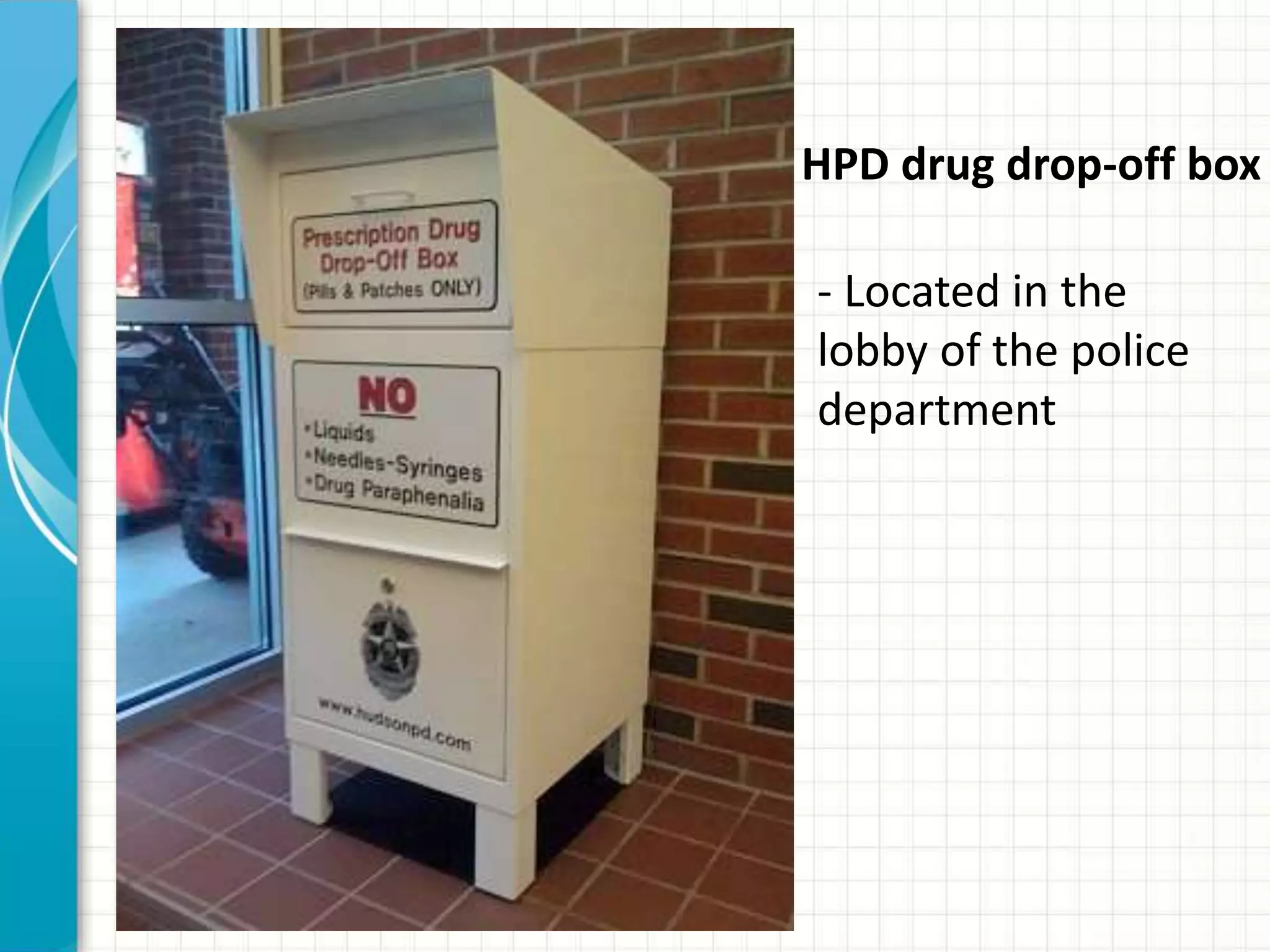
HPD drug drop-off box
- Located in the
lobby of the police
department
How to dispose sharps?
• Sharps example: needle, broken ampule glass
• Household sharps maybe disposed in solid
waste if:
– Puncture-resistant containers
– Containers are sealed and labeled “not recycling”
• Sharp containers
– Can be bought at retailers
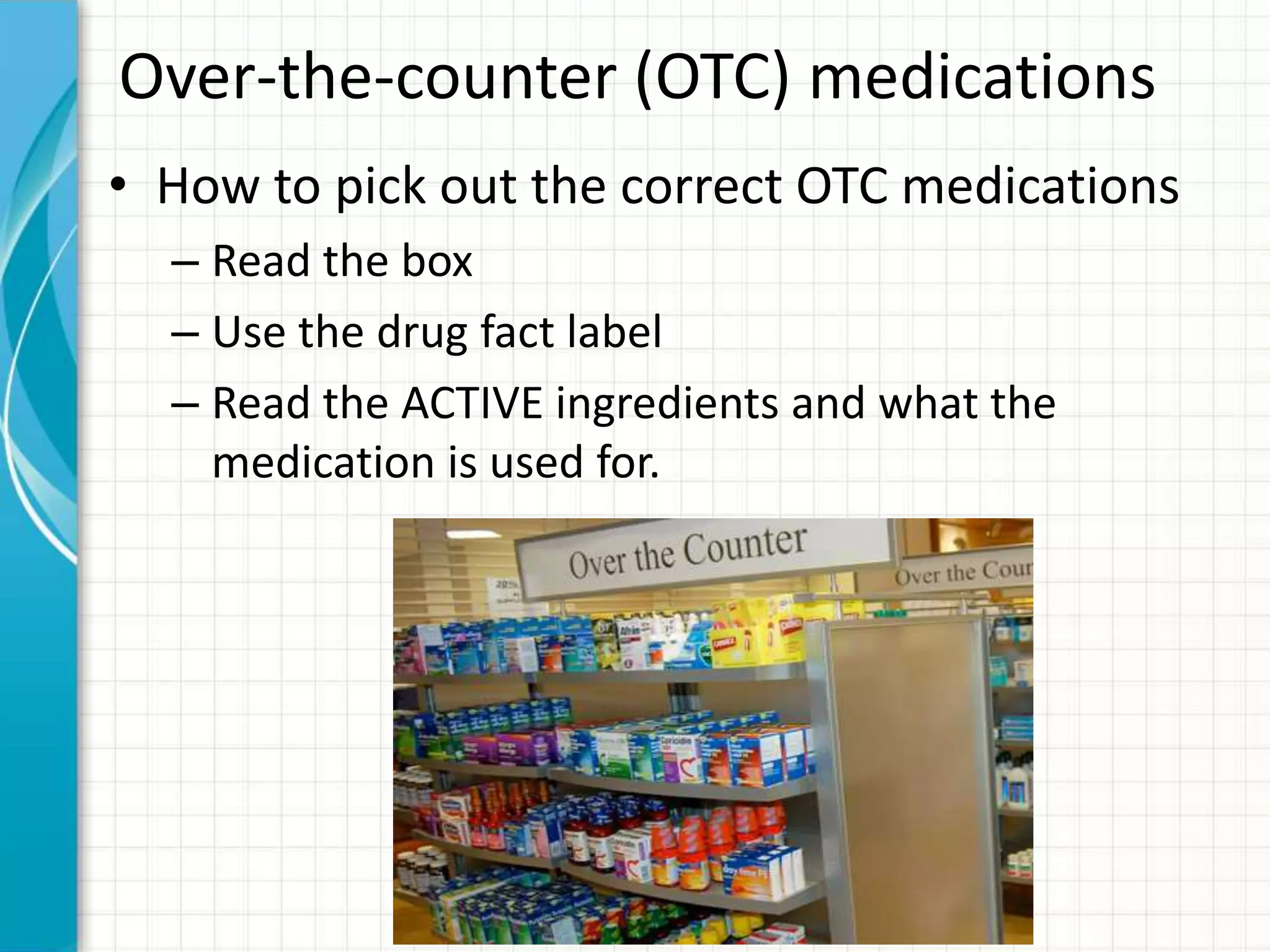
Over-the-counter (OTC) medications
• How to pick out the correct OTC medications
– Read the box
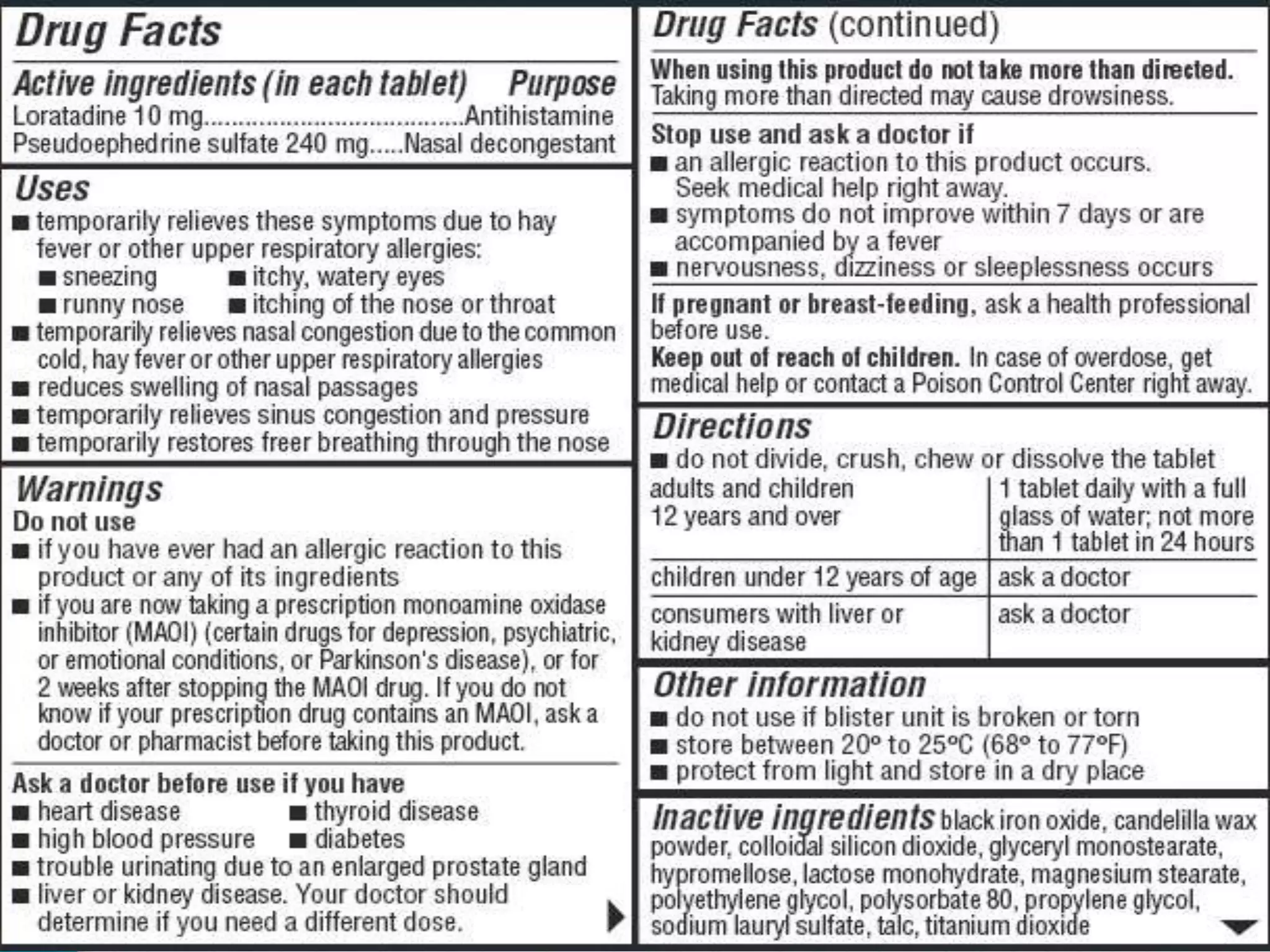
– Use the drug fact label
– Read the ACTIVE ingredients and what the
medication is used for.
How to pick OTC medications
• Use the drug fact label
• Consult a pharmacist
– They can recommend the best options as well as
alternatives or lifestyle changes and non-drug
options.
• Use generic versions
• Stick to the one that worked for you in the past
How to manage multiple medications?
• Pill box
How to manage multiple medications?
• Bubble wrap / Blister pack
• Alarm
– Phone, Watch, Table alarm
• Time sheet (check off)
• Relate to an event like “I always take my vitamin
D before I go to church every Sunday”
How to manage multiple medications?
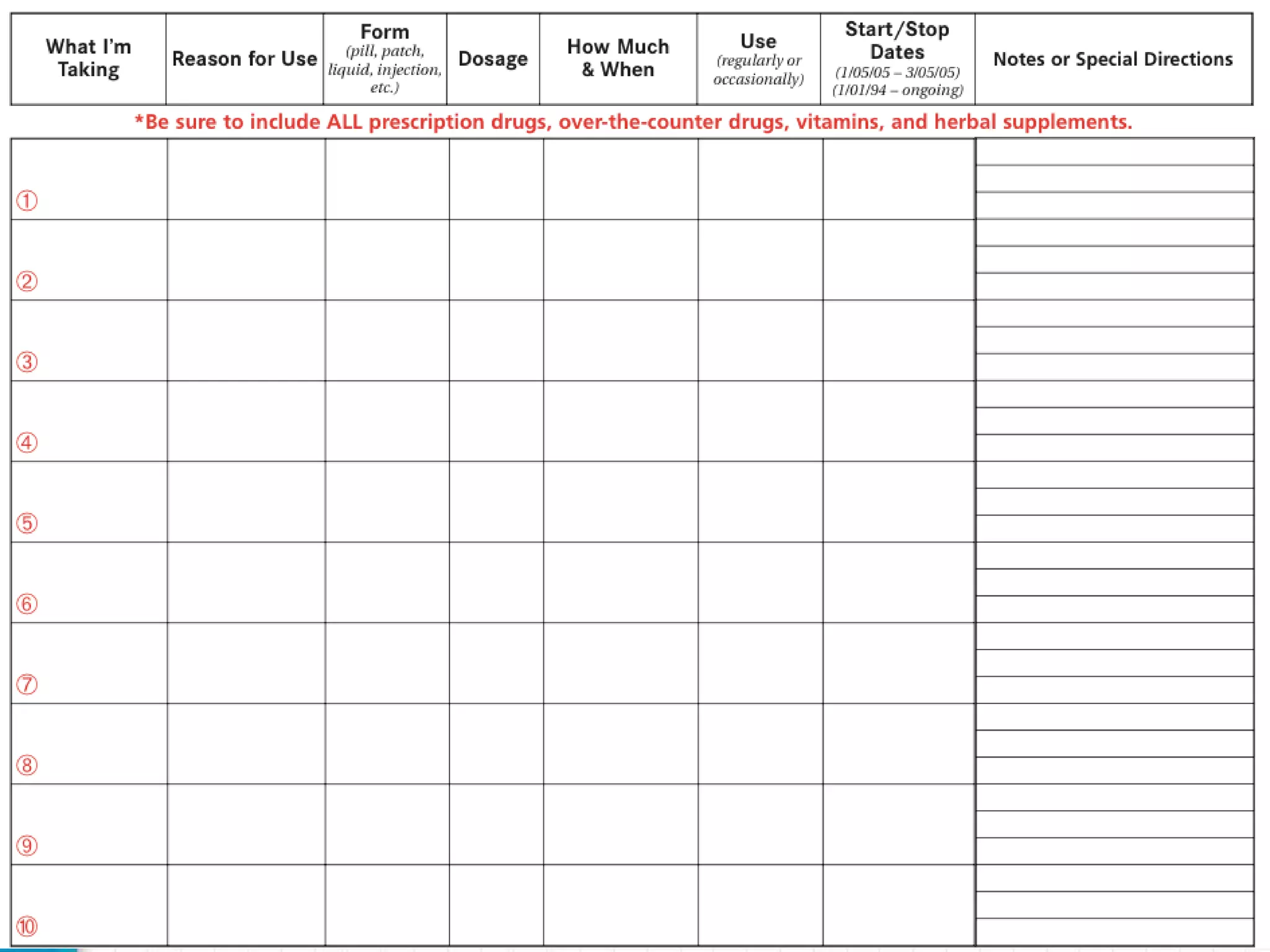
Personal medication records
• The records help you keep track of your
multiple medications
• Keep on you
• Keep it updated
• Make your own record
– Some sample online forms
Medication Therapy Management
• Do you have difficulty in keeping track of your
medications?
• Your pharmacist can help review all your medications
to ensure:
– Full review of all your medications
– Best outcomes for your health
– Reduce side-effects
• Eligibility
– If you have a Medicare Part D plan, you are eligible for an
MTM session with your pharmacist
https://www.cms.gov/medicare/prescription-drug-
Know your pharmacist
Know your medication
• Only about 35% of consumers know their
pharmacist’s name.
• Pharmacist is one of the easiest members of
your healthcare team to reach.
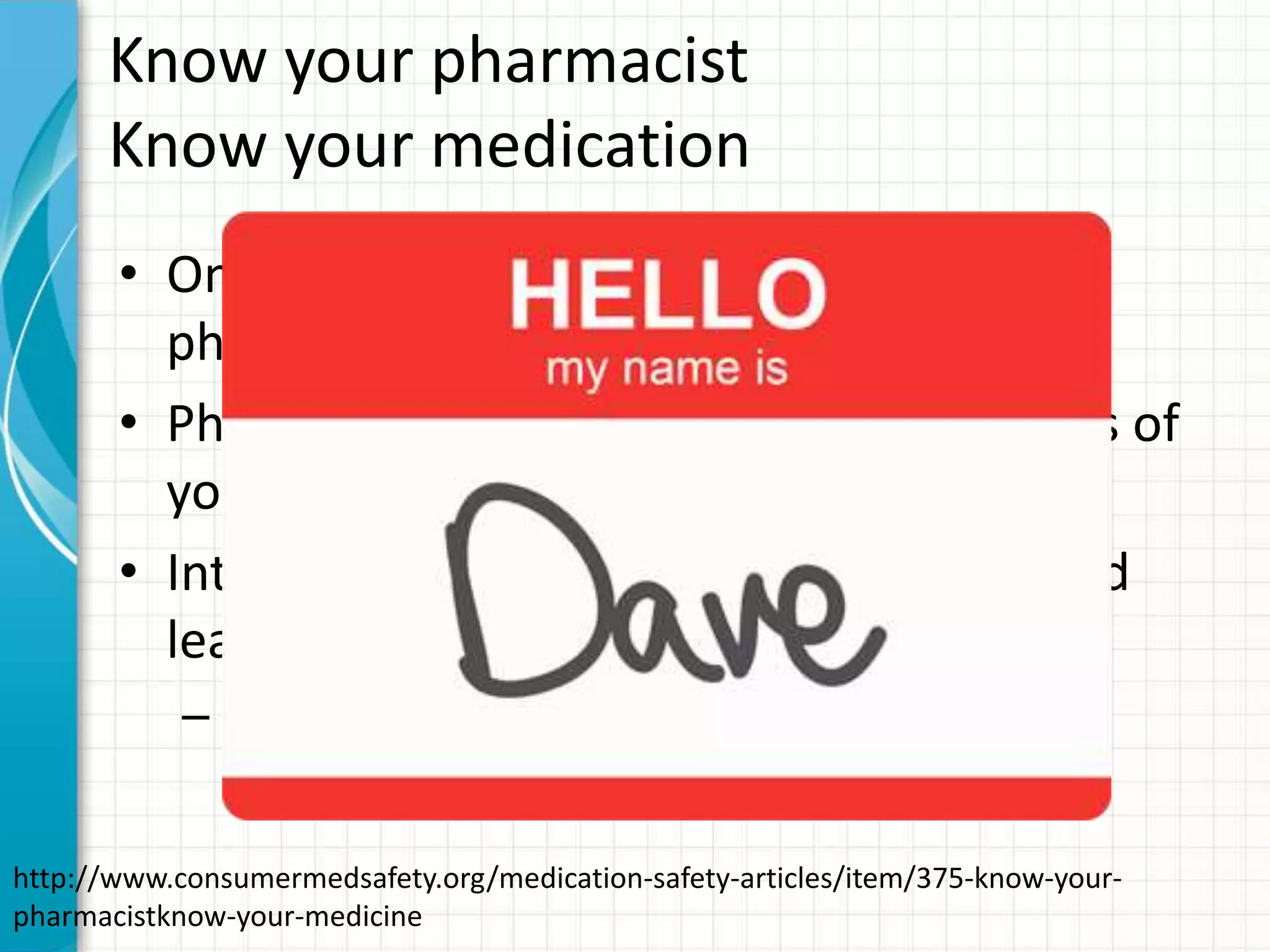
• Introduce yourself to your pharmacist and
learn his or her first name.
– No appointment or co-pay needed
http://www.consumermedsafety.org/medication-safety-articles/item/375-know-your-
pharmacistknow-your-medicine
QUESTION ?
THANK YOU!

Medication Safety Presentation

  • 1.
    MEDICATION EDUCATION 101 ByDIEN VU 11/12/2015
  • 2.
    What is amedication? • There are 2 types of Medications – Prescription (Rx-only) – Over-The-Counter (OTC)
  • 3.
    Medication names • Thereare 2 names for medications – Brand name – Generic name Brand Generic Prilosec omeprazole Tylenol acetaminophen Advil ibuprofen Aleve naproxen
  • 5.
    Tips for safemedication use • Use as directed • Do not use expired medicines • Do not use medication that looks abnormal • Try not to miss a dose • Take medication on time • Wash your hands after using a cream
  • 6.
    Tips for safemedication use • Try to read the drug information leaflet given to you at the pharmacy • Inspect your medicine before leaving the pharmacy • Buying medication online • Dispose of properly to avoid accidental or misuse
  • 7.
    Side-effect? • What isa side-effect? • Is the side-effect minor or tolerable? • Is the side-effect too much to bear? • Some common side effects: dizziness, drowsiness, constipation, diarrhea, nausea, upset stomach, skin irritation, etc
  • 8.
    Questions you shouldask about your new medications 1. What is this prescription for? 2. How will this medicine help me? 3. What are the side effects? 4. How do I take this medicine? 5. How expensive is the medication? Will my insurance plan cover it? 6. Are there non-drug options I can try? 7. Why is this new drug better than the one I was taking? 8. How long do I take it? 9. Do I take it with or without food?
  • 9.
    How do youstore your medication? 1. Bathroom cabinet? 2. Above the kitchen stove? 3. On the window shelf under direct sunlight? 4. In the car’s glove compartment? 5. Next to your bed? 6. In high drawer or cabinet in bedroom? 7. In the fridge? 8. In the freezer? 9. Different medicines in the same bottle?
  • 10.
    Do you knowthat… • You should NOT put a refrigerated medication in a freezer because you think it might extend the life of medication. • Storing in inappropriate conditions might break down the drug and make it less effective.
  • 11.
  • 12.
  • 13.
    What if youtravel with a refrigerated medication? • Example: Insulin • Have a small container with ice pack/ freezer pack and medication inside • At the airport – You may bring medically necessary liquids, medications and creams in excess of 3.4 ounces or 100 milliliters in your carry- on bag. – Other supplies associated with medically necessary liquids such as IV bags, pumps and syringes must undergo X-ray screening. https://www.tsa.gov/travel/special-procedures
  • 14.
    Safe disposal ofmedications – Dispose unused or expired medications – It could be harmful if medication is taken by someone else. (e.g. grandchildren, pets) – Do not give away to friends – Environmental pollution – Peel off label to protect your identity and privacy http://www.fda.gov/ForConsumers/ConsumerUpdates/ucm101653.htm
  • 15.
    How to disposemedications? – Mix with coffee grounds or cat litters • Place in a sealed bag to prevent leaking • Toss in trash – Special instruction: flush in toilet • Ex: Fentanyl patch – Bring to pharmacy on “Take-back” program offer – Bring to Hudson police station • Medication drop-off box http://www.fda.gov/ForConsumers/ConsumerUpdates/ucm101653.htm
  • 16.
    HPD drug drop-offbox - Located in the lobby of the police department
  • 17.
    How to disposesharps? • Sharps example: needle, broken ampule glass • Household sharps maybe disposed in solid waste if: – Puncture-resistant containers – Containers are sealed and labeled “not recycling” • Sharp containers – Can be bought at retailers
  • 18.
    Over-the-counter (OTC) medications •How to pick out the correct OTC medications – Read the box – Use the drug fact label – Read the ACTIVE ingredients and what the medication is used for.
  • 21.
    How to pickOTC medications • Use the drug fact label • Consult a pharmacist – They can recommend the best options as well as alternatives or lifestyle changes and non-drug options. • Use generic versions • Stick to the one that worked for you in the past
  • 22.
    How to managemultiple medications? • Pill box
  • 23.
    How to managemultiple medications? • Bubble wrap / Blister pack
  • 24.
    • Alarm – Phone,Watch, Table alarm • Time sheet (check off) • Relate to an event like “I always take my vitamin D before I go to church every Sunday” How to manage multiple medications?
  • 25.
    Personal medication records •The records help you keep track of your multiple medications • Keep on you • Keep it updated • Make your own record – Some sample online forms
  • 27.
    Medication Therapy Management •Do you have difficulty in keeping track of your medications? • Your pharmacist can help review all your medications to ensure: – Full review of all your medications – Best outcomes for your health – Reduce side-effects • Eligibility – If you have a Medicare Part D plan, you are eligible for an MTM session with your pharmacist https://www.cms.gov/medicare/prescription-drug-
  • 28.
    Know your pharmacist Knowyour medication • Only about 35% of consumers know their pharmacist’s name. • Pharmacist is one of the easiest members of your healthcare team to reach. • Introduce yourself to your pharmacist and learn his or her first name. – No appointment or co-pay needed http://www.consumermedsafety.org/medication-safety-articles/item/375-know-your- pharmacistknow-your-medicine
  • 29.

Editor's Notes

  • #2 Thank everyone for coming over My name is Dien. I am a senior from MCPHS university of pharmacy. I will graduate next year to become a pharmacist Today I’m going to talk about medication
  • #3 Ask audience “what do you think is a medication?
  • #4 Brand name are patent-protected for a period after which generics are released. There are some new medication that is brand name only, such as Crestor Brand name are more expensive than generics. Because they are the creator of the recipe. After the patent expired, they sell their recipe to generic company to produce for much cheaper price. For some medications such as thyroid meds, brand name works better for some patients while generics do not. Did you know that if your doctor prescribed a Brand name, you can switch to Generic will cost you less. Or you can stay with the brand name if you think it works better for you and you can afford it. It is up to your reference
  • #5 Here are some examples you can find at the counters. On the box, you can see two different names. One is brand name such as Prilosec, and the according generic name Omeprazole, which is also the active ingredient.
  • #6 Use as directed For example if it says to take 2 tablets, then you take exactly two tablets, do not take 3 if you think it does not work, you expose yourself to more side-effect and overdose. The opposite is true. Do not take only 1 tablet to last you a couple more day until your insurance goes through, because that would be under-dose and the drug is not going to work Do not use expired medicines Some particular medications are dangerous to take when expired because the chemical structures have been broken down Do not use medication that looks abnormal Such as tablets are wet, mushy, smell different. Cream looks inconsistent. Antibiotic liquid has caked at the bottom and will not get loosed Try not to miss a dose If you forgot to take a medication, call your pharmacist to ask what to do. They might tell you to double up, or just skip to the next dose depends on what medications Take medication on time Some medication such as birth control has a very short window.
  • #7 Wash your hands after using a cream Especially hormone like Testosterone. You don’t want it to get to your children or pet. Read the drug information leaflet given to you at dispense. Learn the medication and how they work yourself. They are very informative. With drug information, side effects, etc Inspect your medicine Make sure that it is what you expected. If it is a liquid and you receive a capsule, then you should question your pharmacy Also if the pill color change or the shape change, you should also ask why. Most of the time it the different company, but it is always safe to ask Avoid online pharmacies FDA has warned about fraud from websites operating outside the law. Fraudulent websites are good at making them look real. Avoid purchasing drugs outside the US due to unsafe and ineffective drugs You can compromise your personal info including names, addresses, SSN, credit card numbers How can you tell if the pharmacy is legit? Call and ask your insurance company Call and ask your state board of pharmacy VIPPS = verified internet pharmacy practice site Dispose of properly to avoid accidental or misuse I will revisit this at my later slide
  • #8 Ask audience what is side effect, and what they do with side effect Call your doctor and your pharmacist to consult Your doctor might stop the medication or switch to a different drug of the same class Change the time taken of medication (bedtime → sleep off the drowsiness) Space out medications to avoid additive effects or drug interactions
  • #9 Try to know what you are taking. I understand that you might have 10 different medications, it’s hard to keep track, But at least know what you are taking, but not just taking it blindly as your doctor wants you to Blood pressure, high cholesterol, etc We just visited some of the common side-effect earlier. Take note of what you experience and report to your doctor right away. So they know and can help you There could be a new symptom arise from taking a medication and then you take another med to treat the symptoms. It is a snowball effect Some medication have special instruction on how to take it. Ex: your Fosamax (alendronate) require you to drink 1 big glass of water only and remain upright for 30 minutes. TO increase absorption Ex: Cholesterol med should be taken at bedtime where your cholesterol level is the highest Yes all of us are concerned about how expensive medications can be. Check with your pharmacy for the price. Don’t forget to ask for plarmacy discount plan (RiteAid has Rite Aid saving card) and ask for Coupons. Update your new insurance plan to the pharmacy. Headahce → take a hot shower, sit down and relax, listen to music 7. You all know that pharmacy switches your medications all the time to a different generics. In this case, they work the same 8. Antibiotic: Take for full course. Do not stop in middle 9. Some medication are okay to take with food (NSAID side effect – upset stomach)
  • #10 Ask audience which one do you think is the best option? Moisture → mushy, breakdown med Heat can breakdown med Sunlight can breakdown med Heat can breakdown med Next to your bed – perfect height for toddler, especially dangerous for non-safety caps or pillbox. Unless its LOCKED If store in a cool, dry place = bedroom drawer, preferably locked, to avoid access from children who abuse medications, or pets If store in a fridge = best to have a separate fridge cabinet or bin only for meds storage If store in a freezer = have a separate freezer cabinet or bin on for for meds storage 8. Danger of taking wrong medications
  • #12 These labels can be very helpful to give you the answer you are looking for
  • #13 Sometimes it can be frustrated to reach your doctor or your pharmacist because the store is busy. You can find your answers by reading these mini-instructions and warnings For rectal use, so you don’t want to swallow this May cause drowsiness, you might want to take it at bedtime to sleep of the drowsiness Threre are many more. These are just 10 examples
  • #14 Walk through If you have any question, call the airport to ask
  • #15 Do not give away to friend. Something that works for you could be dangerous for someone else When in doubt, Ask your pharmacist Environmental poluution. Do not flush down toilet unless youre given special instruction Tip: Freeze bottle for ~10 mins to peel off easier
  • #17 Collect pill and patches only For pill can be Rx or OTC No liquids, no needle/syringe, no drug paraphenalia
  • #19 Ask audience how do they pick OTC Go into detail with picture example in the next slides
  • #20 1 brand name with 3 different medications They all look similar. So it’s time to flip the box over and read
  • #21 That was the front of the box. Now, this is the back of the box. So what do you need to know? Let’s walk through slowly Active Ingredient Loratadine – Antihistamine – For Allergy such as runny nose, sneezing, itchy watery eye Pseudophed – Nsal decongestant – For stuffy nose Uses Walkthrough Warning If you do not know, ask your pharmacist or doctor Pseudophed can raise your BP Pseudophed can increase your blood sugar Certain thyroid medication can increase sensitivity to Pseudophed Men with BPH should avoid Pseudophed because it prevent prostate from relaxing and further exacerbating urine flow Direction Extended released formulation, therefore, do not divide, or crush …. Inactive ingredient If you are allergic to a certain ingredient, you can look up at this place.
  • #22 Consult a pharmacist Ex: Headache → Rx = Tylenol, Advil Non-Rx = Sit down, relax, take a hot shower Ex: Motion sickness → Rx: Meclizine, Dramamine Non-Rx: stop the car, look straight ahead, don’t smoke inside car. Generics (Rite Aid, CVS generics)
  • #23 Easy and Affordable One of the most popular recommendation from a pharmacist and doctor How to fill a pill box Get someone to help you if you cant see well, such as pharmacist Open all the tops, you fill and close as you move on to the next day. This one is my favorite as it has the pill cutter on it too Remember that pillbox can be easily opened by toddler and children → Stored in high drawer or inside locked cabinet
  • #24 Another easy way for you to take your medication. It is bulky but it plans for the whole month. It labels Day 1 through Day 31. Lets say you receive the pack on Day 14, So you do not start at Day 1 on the pack, but start at Day 14 on the pack then go along til you finish Usually its 1 pack for 1 medication (left picture) Some medication will have AM (morning) and PM (evening), so that medication will have 2 packs
  • #25 Alarm is also a good way to remind you. Phone alarms allows you to set multiple alarm entry such as 9AM 11AM 3PM Watch alarms allows only 1 Most tablet alarms allows only 1 These alarms are convenient for ONCE DAILY pill Time sheet Check off to remind you Best to combine Alarm and Time sheet together Relate to an event
  • #27 This is a sample of the personal medication record. It is your own records of what you take. There are about 10 entries for 10 medications on this form. How to use this form? Write down the name of medication, the use, the form, the dose, how to take, etc If you don’t know how to fill, or cant read, ask someone to help you such as the pharmacist
  • #28 This is a new services offered to all Medicare part D customers
  • #30 Microsoft Confidential