TRANSPORTATION
SYSTEM IN
BUILDING
KEDHEESWARAN K M.Arch
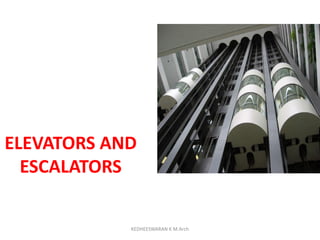
ELEVATORS AND
ESCALATORS
KEDHEESWARAN K M.Arch
History of Lifts
• Roman architect Vitruvius, reported that
Archimedes built his first elevator in 236
BC.[13] Elevators were mentioned as cabs on
a hemp rope and powered by hand or by
animals.
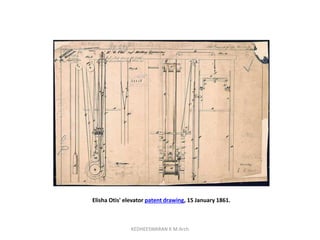
• In 1852, Elisha Otis introduced the safety elevator, which
prevented the fall of the cab if the cable broke. The design
of the Otis safety elevator is somewhat similar to one type
still used today.
• On March 23, 1857 the first Otis passenger elevator was
installed at 488 Broadway in New York City
• The Equitable Life Building completed in 1870 in New York
City was the first office building to have passenger
elevators.[20]
KEDHEESWARAN K M.Arch
Elisha Otis' elevator patent drawing, 15 January 1861.
KEDHEESWARAN K M.Arch
1.1 Definition of Lifts
• A vertical transport equipment that efficiently moves people between floors
(levels, deck) of a building, vessel or other structure.
• Generally powered by electric motor that drive by traction cable and
counterweight systems like a hoist or hydraulic pump.
KEDHEESWARAN K M.Arch
Importance of Lifts
• Rapid development : buildings design nowadays built vertically /higher because
of high land cost.
• Basic needs : to bring building user from one level to higher level in building
• Comfort needs : working efficiency for office building or large organization.
• UBBL( Unified Building Bye-Laws) : building with more than 6 storey must
provide lifts system.
• Fire requirements : provide fire lift to be used during fire.
KEDHEESWARAN K M.Arch
1.2 Lift Categories According to the Function
• Trade Lift
- Crucial to the good performance to clients of the building.
- Between 6 – 23 people.
- Speed of elevator 200 – 2000 ft/ min.
- Examples : offices, shopping mall and hotels
KEDHEESWARAN K M.Arch
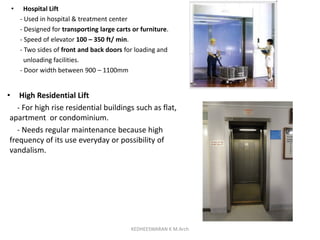
• Hospital Lift
- Used in hospital & treatment center
- Designed for transporting large carts or furniture.
- Speed of elevator 100 – 350 ft/ min.
- Two sides of front and back doors for loading and
unloading facilities.
- Door width between 900 – 1100mm
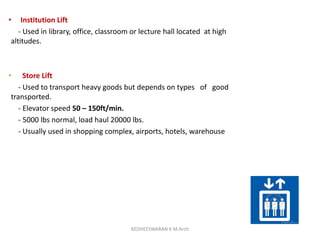
• High Residential Lift
- For high rise residential buildings such as flat,
apartment or condominium.
- Needs regular maintenance because high
frequency of its use everyday or possibility of
vandalism.
KEDHEESWARAN K M.Arch
• Institution Lift
- Used in library, office, classroom or lecture hall located at high
altitudes.
• Store Lift
- Used to transport heavy goods but depends on types of good
transported.
- Elevator speed 50 – 150ft/min.
- 5000 lbs normal, load haul 20000 lbs.
- Usually used in shopping complex, airports, hotels, warehouse
KEDHEESWARAN K M.Arch
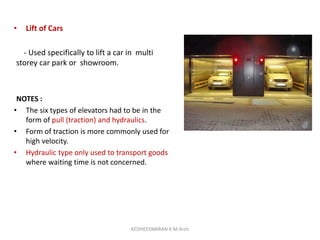
• Lift of Cars
- Used specifically to lift a car in multi
storey car park or showroom.
NOTES :
• The six types of elevators had to be in the
form of pull (traction) and hydraulics.
• Form of traction is more commonly used for
high velocity.
• Hydraulic type only used to transport goods
where waiting time is not concerned.
KEDHEESWARAN K M.Arch
1.3 Characteristic of Lifts
1. Lift needed for the building more than 6 storey.
2. Installation must be in accordance with the regulation in UBBL.
3. Suitable speed 100 – 150ft/min. Too fast will result in a nervous
breakdown to the user. If too slow will cause lack of function.
USER REQUIREMENTS :
• Good System – quiet equipment, smooth journey, good condition and
safe at every moment.
• Waiting time – minimum waiting time at any level.
• Aesthetics – Button panel clear and easily reached at appropriate
level. Complete instruction. Decorative lighting and comfortable.
• Movement of door – door movement is quiet and fast.
KEDHEESWARAN K M.Arch
1.4 Components & Installation of Lifts
Lift sub-system
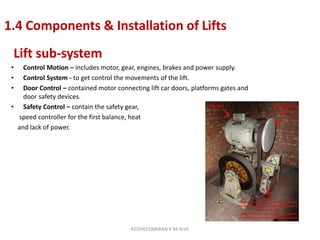
• Control Motion – includes motor, gear, engines, brakes and power supply.
• Control System - to get control the movements of the lift.
• Door Control – contained motor connecting lift car doors, platforms gates and
door safety devices.
• Safety Control – contain the safety gear,
speed controller for the first balance, heat
and lack of power.
KEDHEESWARAN K M.Arch
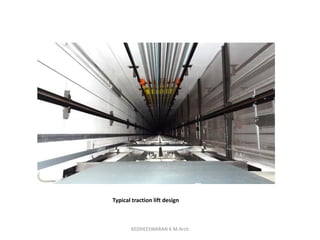
Typical traction lift design
KEDHEESWARAN K M.Arch
Lift Components
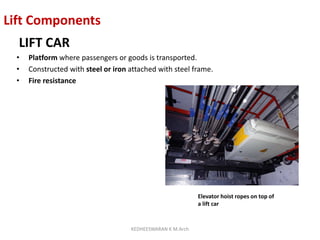
LIFT CAR
• Platform where passengers or goods is transported.
• Constructed with steel or iron attached with steel frame.
• Fire resistance
Elevator hoist ropes on top of
a lift car
KEDHEESWARAN K M.Arch
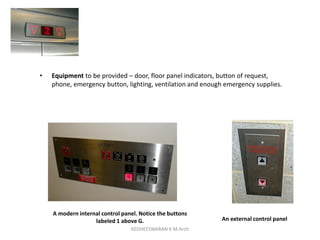
• Equipment to be provided – door, floor panel indicators, button of request,
phone, emergency button, lighting, ventilation and enough emergency supplies.
An external control panel
A modern internal control panel. Notice the buttons
labeled 1 above G.
KEDHEESWARAN K M.Arch
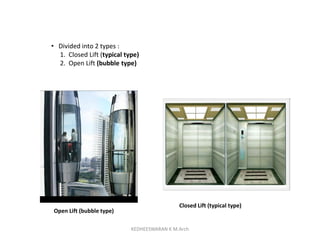
Open Lift (bubble type)
• Divided into 2 types :
1. Closed Lift (typical type)
2. Open Lift (bubble type)
Closed Lift (typical type)
KEDHEESWARAN K M.Arch
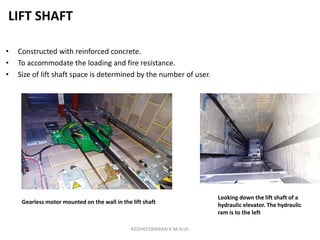
LIFT SHAFT
• Constructed with reinforced concrete.
• To accommodate the loading and fire resistance.
• Size of lift shaft space is determined by the number of user.
Looking down the lift shaft of a
hydraulic elevator. The hydraulic
ram is to the left
Gearless motor mounted on the wall in the lift shaft
KEDHEESWARAN K M.Arch
GOVERNOR
• Usually placed at the top of lift shaft.
• Placed in room equipped with a lifting
beam for maintenance purposes.
• Have electric motor, safety gear, guard
rail, diaphragm motion and gear.
KEDHEESWARAN K M.Arch
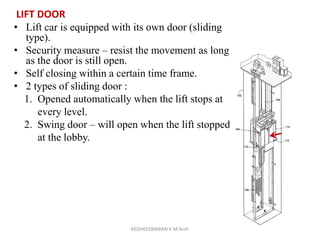
LIFT DOOR
• Lift car is equipped with its own door (sliding
type).
• Security measure – resist the movement as long
as the door is still open.
• Self closing within a certain time frame.
• 2 types of sliding door :
1. Opened automatically when the lift stops at
every level.
2. Swing door – will open when the lift stopped
at the lobby.
KEDHEESWARAN K M.Arch
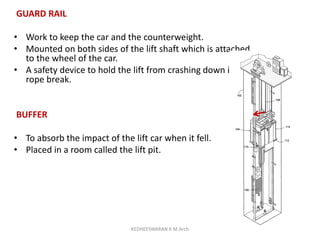
GUARD RAIL
• Work to keep the car and the counterweight.
• Mounted on both sides of the lift shaft which is attached
to the wheel of the car.
• A safety device to hold the lift from crashing down if the
rope break.
BUFFER
• To absorb the impact of the lift car when it fell.
• Placed in a room called the lift pit.
KEDHEESWARAN K M.Arch
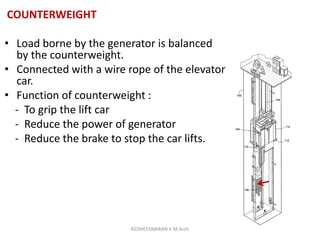
COUNTERWEIGHT
• Load borne by the generator is balanced
by the counterweight.
• Connected with a wire rope of the elevator
car.
• Function of counterweight :
- To grip the lift car
- Reduce the power of generator
- Reduce the brake to stop the car lifts.
KEDHEESWARAN K M.Arch
1.5 Selection Factor
GENERAL REQUIREMENTS
• Utility – The function must be identified whether for commercial,
office of hospital.
• Capacity & number of lifts – depends on the access building pattern
and building size.
• Speed – depends on the number of stops, numbers of user and
transport cost.
• Type & size of lift gate – depends on the use or function.
PHYSICAL REQUIREMENTS
• Size of lift shaft – depends on lift cargo capacity
• Depth of lift shaft – depends on the speed of elevator
• Area of space in lift – depends on speed of elevators.
• Mechanical room size – depends on type and size of the lift
equipment.
KEDHEESWARAN K M.Arch
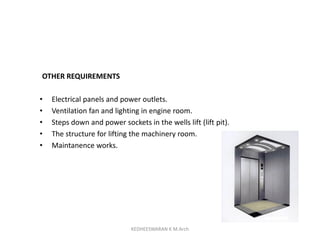
OTHER REQUIREMENTS
• Electrical panels and power outlets.
• Ventilation fan and lighting in engine room.
• Steps down and power sockets in the wells lift (lift pit).
• The structure for lifting the machinery room.
• Maintanence works.
KEDHEESWARAN K M.Arch
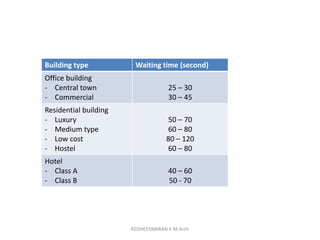
Building type Waiting time (second)
Office building
- Central town
- Commercial
25 – 30
30 – 45
Residential building
- Luxury
- Medium type
- Low cost
- Hostel
50 – 70
60 – 80
80 – 120
60 – 80
Hotel
- Class A
- Class B
40 – 60
50 - 70
KEDHEESWARAN K M.Arch
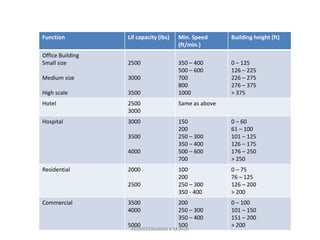
Function Lif capacity (lbs) Min. Speed
(ft/min.)
Building height (ft)
Office Building
Small size
Medium size
High scale
2500
3000
3500
350 – 400
500 – 600
700
800
1000
0 – 125
126 – 225
226 – 275
276 – 375
> 375
Hotel 2500
3000
Same as above
Hospital 3000
3500
4000
150
200
250 – 300
350 – 400
500 – 600
700
0 – 60
61 – 100
101 – 125
126 – 175
176 – 250
> 250
Residential 2000
2500
100
200
250 – 300
350 - 400
0 – 75
76 – 125
126 – 200
> 200
Commercial 3500
4000
5000
200
250 – 300
350 – 400
500
0 – 100
101 – 150
151 – 200
> 200
KEDHEESWARAN K M.Arch
1.6 Location & Lift Arrangement
LIFT ARRANGEMENT
• To ensure there is no interference between passengers who
wish to get into the lift.
• Should be carefully planned so can easily get into lobby and
travel distance is reasonable.
• Maximum travel distance 150 – 200ft
• System layout depends on the number of elevator cars that use
the elevator
• Normally the elevator is set in the layout or zoned.
BENEFIT
• If there is high traffic , the usage is at optimum level
• Waiting time will be shorten.
KEDHEESWARAN K M.Arch
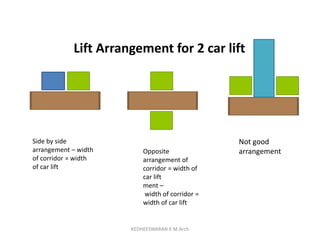
Lift Arrangement for 2 car lift
Side by side
arrangement – width
of corridor = width
of car lift
Opposite
arrangement of
corridor = width of
car lift
ment –
width of corridor =
width of car lift
Not good
arrangement
KEDHEESWARAN K M.Arch
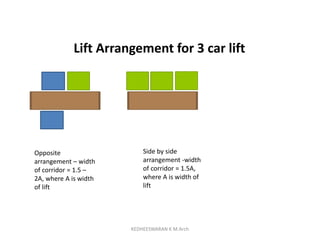
Lift Arrangement for 3 car lift
Opposite
arrangement – width
of corridor = 1.5 –
2A, where A is width
of lift
Side by side
arrangement -width
of corridor = 1.5A,
where A is width of
lift
KEDHEESWARAN K M.Arch
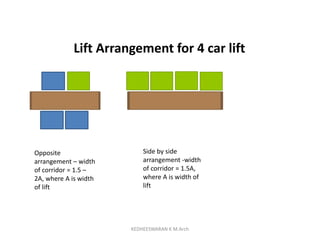
Lift Arrangement for 4 car lift
Opposite
arrangement – width
of corridor = 1.5 –
2A, where A is width
of lift
Side by side
arrangement -width
of corridor = 1.5A,
where A is width of
lift
KEDHEESWARAN K M.Arch
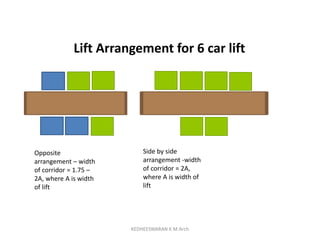
Lift Arrangement for 6 car lift
Opposite
arrangement – width
of corridor = 1.75 –
2A, where A is width
of lift
Side by side
arrangement -width
of corridor = 2A,
where A is width of
lift
KEDHEESWARAN K M.Arch
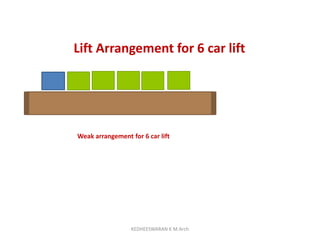
Lift Arrangement for 6 car lift
Weak arrangement for 6 car lift
KEDHEESWARAN K M.Arch
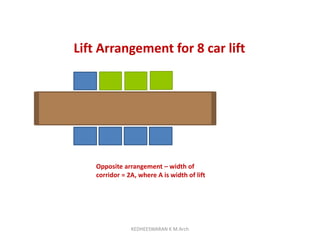
Lift Arrangement for 8 car lift
Opposite arrangement – width of
corridor = 2A, where A is width of lift
KEDHEESWARAN K M.Arch
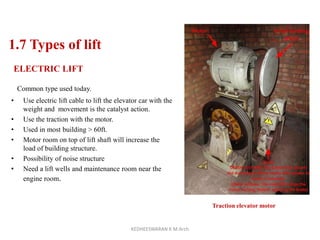
1.7 Types of lift
ELECTRIC LIFT
Common type used today.
• Use electric lift cable to lift the elevator car with the
weight and movement is the catalyst action.
• Use the traction with the motor.
• Used in most building > 60ft.
• Motor room on top of lift shaft will increase the
load of building structure.
• Possibility of noise structure
• Need a lift wells and maintenance room near the
engine room.
Traction elevator motor
KEDHEESWARAN K M.Arch
HYDRAULIC LIFT
• Use hydraulics principles – moves by the action of steel
plunger lift which installed under the car.
• Not suitable for building > 60ft (low rise) – insufficient
space or roof rooms too small to put the machinery.
• Transport load not > 100,000 pound.
• Speed – not > 200ft/min.
• Installation does not increase the building structures
because lifting weight is not used.
• Machinery room located at ground floor
• Shaft area is smaller than electric lift.
KEDHEESWARAN K M.Arch
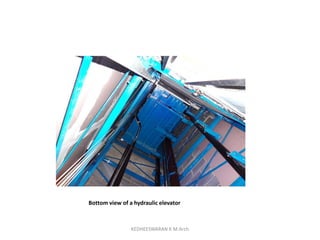
Bottom view of a hydraulic elevator
KEDHEESWARAN K M.Arch
HANDICAPPED LIFT
• For people with disability who use wheelchair.
• Or with disabilities who are unable to use ordinary crowded lift
of fast services.
• Mounted on the stair parallel to the ladder
FIRE LIFT
• Buildings over than 60ft high are required to provide fire lift.
• This lift controlled by a system back on in emergencies.
KEDHEESWARAN K M.Arch
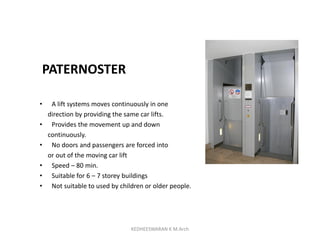
PATERNOSTER
• A lift systems moves continuously in one
direction by providing the same car lifts.
• Provides the movement up and down
continuously.
• No doors and passengers are forced into
or out of the moving car lift
• Speed – 80 min.
• Suitable for 6 – 7 storey buildings
• Not suitable to used by children or older people.
KEDHEESWARAN K M.Arch
HIGH RISE LIFT
• Service requirement for high rise building is
critical to balance the upper and lower level
services.
• The concept of zone system and sky lobby can
be used.
• Usually divided into zones where high level car
will not stop or pick passengers at lower level.
• Zone which too low will takes passengers down
to lower levels such as 5 – 10 levels below.
KEDHEESWARAN K M.Arch
DOUBLE DECKER LIFT
• Carry passengers without raising double the lift shaft.
• Have two platforms which are increased.
• High transport capacity and reduce floor space
• Number of stops can reduced to 50% - reducing waiting
time and shorter car lift trips.
• Can be used in building which has a same height in every
level.
• The main lobby has two levels.
• Must have clear indication of the use in the main lobby to
avoid confusion.
KEDHEESWARAN K M.Arch
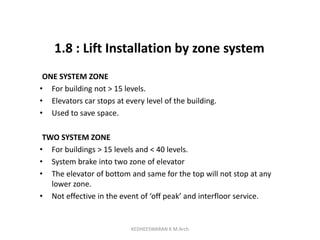
1.8 : Lift Installation by zone system
ONE SYSTEM ZONE
• For building not > 15 levels.
• Elevators car stops at every level of the building.
• Used to save space.
TWO SYSTEM ZONE
• For buildings > 15 levels and < 40 levels.
• System brake into two zone of elevator
• The elevator of bottom and same for the top will not stop at any
lower zone.
• Not effective in the event of ‘off peak’ and interfloor service.
KEDHEESWARAN K M.Arch
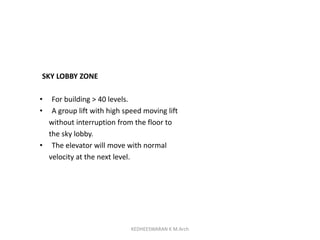
SKY LOBBY ZONE
• For building > 40 levels.
• A group lift with high speed moving lift
without interruption from the floor to
the sky lobby.
• The elevator will move with normal
velocity at the next level.
KEDHEESWARAN K M.Arch
DESIGN OF LIFT
KEDHEESWARAN K M.Arch
For design of lifts factors to be considered are –
1. Population or no. of people who require lift service.
2. Handling capacity or maximum flow rate required by the people.
3. Interval or quality of service required.
KEDHEESWARAN K M.Arch
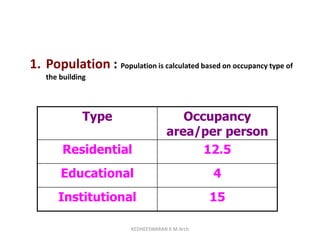
1. Population : Population is calculated based on occupancy type of
the building
Type Occupancy
area/per person
Residential 12.5
Educational 4
Institutional 15
KEDHEESWARAN K M.Arch
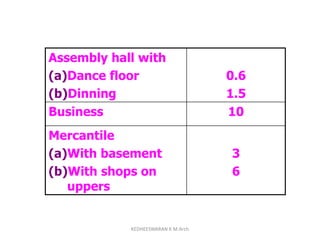
Assembly hall with
(a)Dance floor
(b)Dinning
0.6
1.5
Business 10
Mercantile
(a)With basement
(b)With shops on
uppers
3
6
KEDHEESWARAN K M.Arch
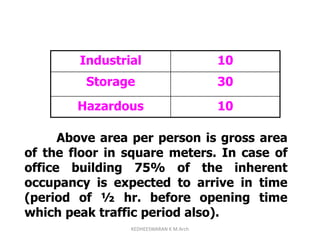
Industrial 10
Storage 30
Hazardous 10
Above area per person is gross area
of the floor in square meters. In case of
office building 75% of the inherent
occupancy is expected to arrive in time
(period of ½ hr. before opening time
which peak traffic period also).
KEDHEESWARAN K M.Arch
Floating population may also be
there to counterfeit the effect of late
coming persons. 100% population as
calculated from floor occupancy basis to
be adopted as total population to be
served, during peak hours.
KEDHEESWARAN K M.Arch
2. Quantity of Service :
The quantity of service is a measure of the passenger handling capacity of a
vertical transport system. It is measured in terms of the total number of
passengers handled during each five minutes peak period of the day.
KEDHEESWARAN K M.Arch
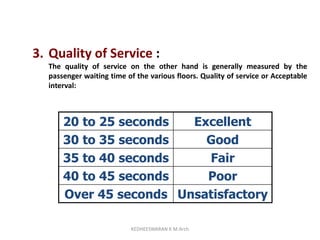
3. Quality of Service :
The quality of service on the other hand is generally measured by the
passenger waiting time of the various floors. Quality of service or Acceptable
interval:
20 to 25 seconds Excellent
30 to 35 seconds Good
35 to 40 seconds Fair
40 to 45 seconds Poor
Over 45 seconds Unsatisfactory
KEDHEESWARAN K M.Arch
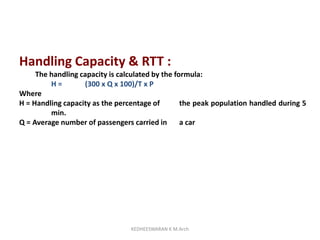
Handling Capacity & RTT :
The handling capacity is calculated by the formula:
H = (300 x Q x 100)/T x P
Where
H = Handling capacity as the percentage of the peak population handled during 5
min.
Q = Average number of passengers carried in a car
KEDHEESWARAN K M.Arch
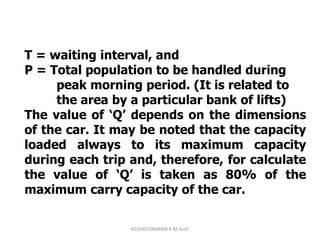
T = waiting interval, and
P = Total population to be handled during
peak morning period. (It is related to
the area by a particular bank of lifts)
The value of ‘Q’ depends on the dimensions
of the car. It may be noted that the capacity
loaded always to its maximum capacity
during each trip and, therefore, for calculate
the value of ‘Q’ is taken as 80% of the
maximum carry capacity of the car.
KEDHEESWARAN K M.Arch
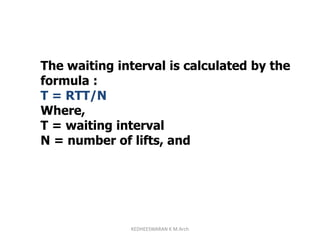
The waiting interval is calculated by the
formula :
T = RTT/N
Where,
T = waiting interval
N = number of lifts, and
KEDHEESWARAN K M.Arch
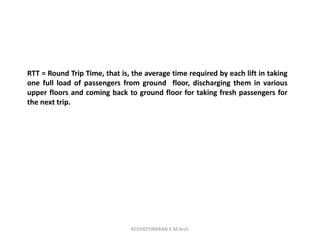
RTT = Round Trip Time, that is, the average time required by each lift in taking
one full load of passengers from ground floor, discharging them in various
upper floors and coming back to ground floor for taking fresh passengers for
the next trip.
KEDHEESWARAN K M.Arch
RTT is the sum of the time required in the following process :
a) Entry of the passengers on the ground floor,
b) Exit of the passengers on each floor of discharge,
c) Door closing time before each floor of discharge,
d) Door opening time on each discharging operation,
e) Acceleration periods,
f) Stopping and leveling periods,
g) Period of full rated speeds between stops going up, and
h) Period of full rated speeds between stops going down.
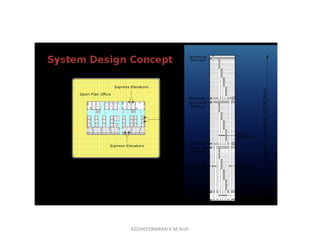
It is observed that the handling capacity is inversely proportional to the waiting
time which in turn is proportional to RTT.
KEDHEESWARAN K M.Arch
The round trip time can be decreased not only by increasing the speed of the
lift but also by improving the design of the equipment related to opening and
closing of the landing and car doors, acceleration, deceleration, levelling and
passenger movement.
KEDHEESWARAN K M.Arch
a) The most important factor in shortening the time consumed between the entry
and the exit of the passengers to the lift car is the correct design of the door
and the proper car width, for comfortable entry and exit for passengers, it has
been found that most suitable door width is 1000 mm and that of car width is
2000.
b) The utilization of centre opening doors also favors the door opening and
closing time periods.
KEDHEESWARAN K M.Arch
Capacity :
Minimum size of car recommended
for a single purpose building is one
suitable duty load of 884 Kg. For large
building car 2040 Kg. according to
requirement.
KEDHEESWARAN K M.Arch
Layout :
The width of car is determined by
the width of entrance, and the depth of
car is regulated by loading per sq.mtr.
Permissible. Centre opening door are the
most practicable and most efficiency
entrance with for passenger lifts.
KEDHEESWARAN K M.Arch
Speed :
It is dependent upon quality of service
required and the quality of service desired.
Therefore, no set formulae for indicating
the speed can be given.
Recommended Speeds :
The following are general guidelines :
KEDHEESWARAN K M.Arch
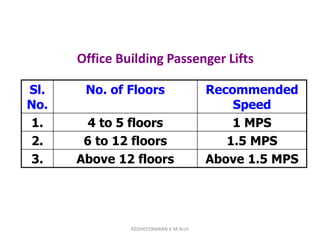
Office Building Passenger Lifts
Sl.
No.
No. of Floors Recommended
Speed
1. 4 to 5 floors 1 MPS
2. 6 to 12 floors 1.5 MPS
3. Above 12 floors Above 1.5 MPS
KEDHEESWARAN K M.Arch
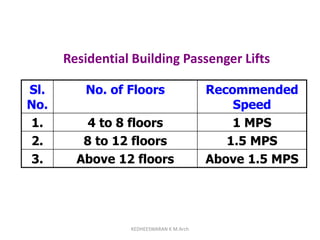
Residential Building Passenger Lifts
Sl.
No.
No. of Floors Recommended
Speed
1. 4 to 8 floors 1 MPS
2. 8 to 12 floors 1.5 MPS
3. Above 12 floors Above 1.5 MPS
KEDHEESWARAN K M.Arch
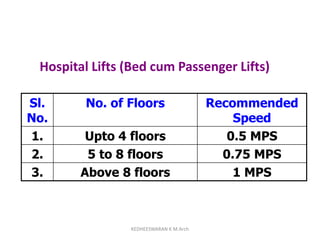
Hospital Lifts (Bed cum Passenger Lifts)
Sl.
No.
No. of Floors Recommended
Speed
1. Upto 4 floors 0.5 MPS
2. 5 to 8 floors 0.75 MPS
3. Above 8 floors 1 MPS
KEDHEESWARAN K M.Arch
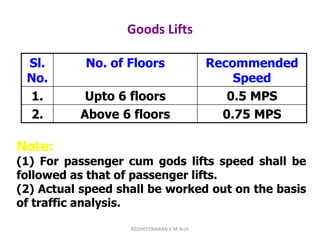
Goods Lifts
Sl.
No.
No. of Floors Recommended
Speed
1. Upto 6 floors 0.5 MPS
2. Above 6 floors 0.75 MPS
Note:
(1) For passenger cum gods lifts speed shall be
followed as that of passenger lifts.
(2) Actual speed shall be worked out on the basis
of traffic analysis.
KEDHEESWARAN K M.Arch
Calculation of R.T.T.
The most probable number of floors on
which lift may have to be stopped is given
by statistical formula:
Sn = n [ 1-(n-1)/n)Np]
KEDHEESWARAN K M.Arch
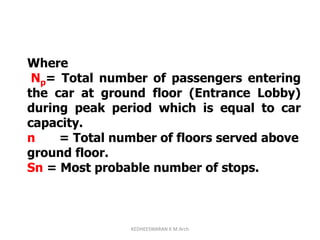
Where
Np= Total number of passengers entering
the car at ground floor (Entrance Lobby)
during peak period which is equal to car
capacity.
n = Total number of floors served above
ground floor.
Sn = Most probable number of stops.
KEDHEESWARAN K M.Arch
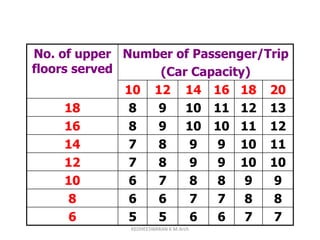
No. of upper
floors served
Number of Passenger/Trip
(Car Capacity)
10 12 14 16 18 20
18 8 9 10 11 12 13
16 8 9 10 10 11 12
14 7 8 9 9 10 11
12 7 8 9 9 10 10
10 6 7 8 8 9 9
8 6 6 7 7 8 8
6 5 5 6 6 7 7
KEDHEESWARAN K M.Arch
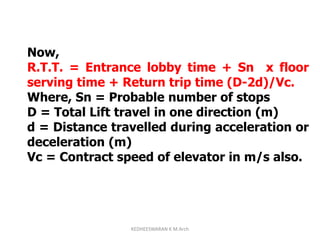
Now,
R.T.T. = Entrance lobby time + Sn x floor
serving time + Return trip time (D-2d)/Vc.
Where, Sn = Probable number of stops
D = Total Lift travel in one direction (m)
d = Distance travelled during acceleration or
deceleration (m)
Vc = Contract speed of elevator in m/s also.
KEDHEESWARAN K M.Arch
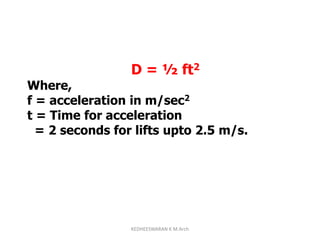
D = ½ ft2
Where,
f = acceleration in m/sec2
t = Time for acceleration
= 2 seconds for lifts upto 2.5 m/s.
KEDHEESWARAN K M.Arch
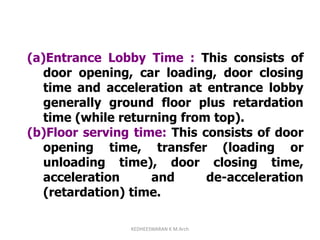
(a)Entrance Lobby Time : This consists of
door opening, car loading, door closing
time and acceleration at entrance lobby
generally ground floor plus retardation
time (while returning from top).
(b)Floor serving time: This consists of door
opening time, transfer (loading or
unloading time), door closing time,
acceleration and de-acceleration
(retardation) time.
KEDHEESWARAN K M.Arch
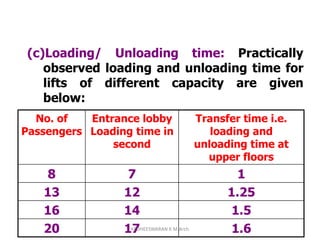
(c)Loading/ Unloading time: Practically
observed loading and unloading time for
lifts of different capacity are given
below:
No. of
Passengers
Entrance lobby
Loading time in
second
Transfer time i.e.
loading and
unloading time at
upper floors
8 7 1
13 12 1.25
16 14 1.5
20 17 1.6KEDHEESWARAN K M.Arch
Actually average time required for
entrance of each passenger in car depends
upon total number of persons entering the
car and already available in car. It may be
one second per person when car is
partially loaded and 0.75 second when it is
completely empty. Time for emptying car
is less and equal to 0.75 second for single
person but there is a tendency that all
persons vacate the car simultaneously
after opening if the doors.
KEDHEESWARAN K M.Arch
(d)Door Opening and closing time: Door
closing time is more as compared to door
opening time. This is due to fact that
when all persons have entered in the car,
it takes time for people to select and
press the push button for summoning the
lift to various destinations.
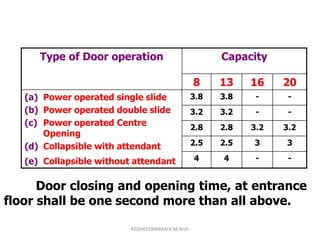
Total time for door opening and closing
operation can be taken as given below:
KEDHEESWARAN K M.Arch
Type of Door operation Capacity
8 13 16 20
(a) Power operated single slide
(b) Power operated double slide
(c) Power operated Centre
Opening
(d) Collapsible with attendant
(e) Collapsible without attendant
3.8 3.8 - -
3.2 3.2 - -
2.8 2.8 3.2 3.2
2.5 2.5 3 3
4 4 - -
Door closing and opening time, at entrance
floor shall be one second more than all above.
KEDHEESWARAN K M.Arch
(e)Distance travelled by lift during
acceleration or retardation is assumed to
be equal. This can be calculated by using
formula.
d = ut + ½ ft2
Where U is initial speed = 0, f is
acceleration or retardation rate and t is
the time elapsed. It is assumed that
during each cycle, lifts acceleration and
retardation time is about 2 second.
KEDHEESWARAN K M.Arch
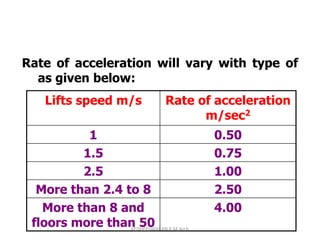
Rate of acceleration will vary with type of
as given below:
Lifts speed m/s Rate of acceleration
m/sec2
1 0.50
1.5 0.75
2.5 1.00
More than 2.4 to 8 2.50
More than 8 and
floors more than 50
4.00
KEDHEESWARAN K M.Arch
ELEVATORS
• An elevator is a type of vertical transport equipment.
• Elevators are generally powered by electric motors that either drive
traction cables or counterweight systems like a hoist, or pump
hydraulic fluid to raise a cylindrical piston like a jack.
• Because of wheelchair access laws, elevators are often a legal
requirement in new multistory buildings, especially where wheelchair
ramps would be impractical.
• A modern day lift consists of a cab mounted on a platform within an
enclosed space called a shaft or sometimes a “ hoistway “.
• Hydraulic lifts use the principles of hydraulics to pressurize an above
ground or in-ground piston to raise and lower the car.
• Roped hydraulics use a combination of both ropes and hydraulic
power to raise and lower cars.
• Hydraulic lifts are cheaper, but installing cylinders greater than a
certain length becomes impractical for very high lift hoistways.
Hydraulic lifts are usually slower than traction lifts.
KEDHEESWARAN K M.Arch
Machine room-less (MRL) elevators
• Machine room-less elevators are designed so that most of the
components fit within the shaft containing the elevator car; and a
small cabinet houses the elevator controller. Other than the
machinery being in the hoistway, the equipment is similar to a normal
traction elevator.
• Benefits
• creates more usable space
 use less energy (70-80% less than hydraulic elevators)
 uses no oil
 slightly lower cost than other elevators
 can operate at faster speeds than hydraulics but not normal traction
 Units.
KEDHEESWARAN K M.Arch
Types of hoist mechanisms
• There are at least four means of moving an elevator:
1. Traction elevators
• Geared and gearless traction elevators
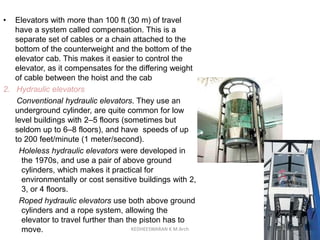
Geared traction machines are driven by AC or DC electric motors.
Geared machines use gears to control mechanical movement of
elevator cars by "rolling" steel hoist ropes over a drive sheave which
is attached to a gearbox driven by a high speed motor. These
machines are generally the best option for basement or overhead
traction use for speeds up to 500 ft/min (2.5 m/s).
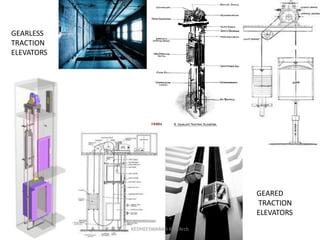
• Gearless traction machines are low speed, high torque electric
motors powered either by AC or DC. In this case, the drive sheave is
directly attached to the end of the motor. Gearless traction elevators
can reach speeds of up to 2,000 ft/min (10 m/s), or even higher. A
brake is mounted between the motor and drive sheave to hold the
elevator stationary at a floor.
KEDHEESWARAN K M.Arch
GEARLESS
TRACTION
ELEVATORS
GEARED
TRACTION
ELEVATORS
KEDHEESWARAN K M.Arch
• Elevators with more than 100 ft (30 m) of travel
have a system called compensation. This is a
separate set of cables or a chain attached to the
bottom of the counterweight and the bottom of the
elevator cab. This makes it easier to control the
elevator, as it compensates for the differing weight
of cable between the hoist and the cab
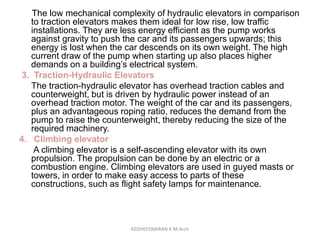
2. Hydraulic elevators
Conventional hydraulic elevators. They use an
underground cylinder, are quite common for low
level buildings with 2–5 floors (sometimes but
seldom up to 6–8 floors), and have speeds of up
to 200 feet/minute (1 meter/second).
Holeless hydraulic elevators were developed in
the 1970s, and use a pair of above ground
cylinders, which makes it practical for
environmentally or cost sensitive buildings with 2,
3, or 4 floors.
Roped hydraulic elevators use both above ground
cylinders and a rope system, allowing the
elevator to travel further than the piston has to
move. KEDHEESWARAN K M.Arch
The low mechanical complexity of hydraulic elevators in comparison
to traction elevators makes them ideal for low rise, low traffic
installations. They are less energy efficient as the pump works
against gravity to push the car and its passengers upwards; this
energy is lost when the car descends on its own weight. The high
current draw of the pump when starting up also places higher
demands on a building’s electrical system.
3. Traction-Hydraulic Elevators
The traction-hydraulic elevator has overhead traction cables and
counterweight, but is driven by hydraulic power instead of an
overhead traction motor. The weight of the car and its passengers,
plus an advantageous roping ratio, reduces the demand from the
pump to raise the counterweight, thereby reducing the size of the
required machinery.
4. Climbing elevator
A climbing elevator is a self-ascending elevator with its own
propulsion. The propulsion can be done by an electric or a
combustion engine. Climbing elevators are used in guyed masts or
towers, in order to make easy access to parts of these
constructions, such as flight safety lamps for maintenance.
KEDHEESWARAN K M.Arch
Elevator air conditioning
Concept
Elevator air conditioning is fast becoming a popular concept
around the world. The primary reason for installing an elevator air
conditioner is the comfort that it provides while traveling in the
elevator. It stabilizes the condition of the air inside the lift car.
Health
One of the benefits of installing an elevator air conditioner is the
clean air it provides. Air was typically drawn from the elevator shaft
or hoistway into the car using a motorized fan. This air could contain
dust mites, germs and bacteria. With an elevator air conditioner, the
air is much cleaner because it is recirculated within the car itself and
is usually filtered to remove contaminants. A poorly maintained air-
conditioning system may promote the growth and spread of
microorganisms, but as long as the air conditioner is kept clean,
these health hazards can be avoided.
KEDHEESWARAN K M.Arch
Drawbacks
Heat generated from the cooling process is dissipated
into the hoistway. The elevator cab (or car) is not air-
tight, and some of this heat will reenter the car and
reduce the overall cooling effect, which may be less
than ideal.
Energy
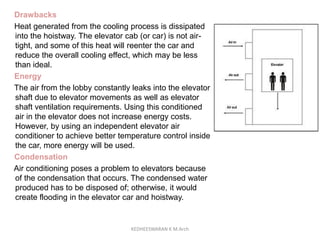
The air from the lobby constantly leaks into the elevator
shaft due to elevator movements as well as elevator
shaft ventilation requirements. Using this conditioned
air in the elevator does not increase energy costs.
However, by using an independent elevator air
conditioner to achieve better temperature control inside
the car, more energy will be used.
Condensation
Air conditioning poses a problem to elevators because
of the condensation that occurs. The condensed water
produced has to be disposed of; otherwise, it would
create flooding in the elevator car and hoistway.
KEDHEESWARAN K M.Arch
• The following are suggested inside dimensions and rated capacities:
• Office buildings: 6 feet 8 inches wide by 5 feet 5 inches deep; 3,500 pounds.
• Apartment buildings: 6 feet 8 inches wide by 4 feet 3 inches deep; 2,500
pounds
• Hotels/motels: 6 feet 8 inches wide by 5 feet 5 inches deep; 3,500 pounds.
• Service elevators: 5 feet 4 inches wide by 8 feet 5 inches deep; 4,500 pounds.
• Hospital passenger elevators: 6 feet 8 inches wide by 5 feet 5 inches deep;
3,500 pounds.
• Hospital vehicle elevators: 5 feet 9 inches wide by 10 feet deep; 6,000 pounds.
Office buildings:
• 1. One elevator is required for every 45,000 net usable square feet. The ratio of the
number of floors to the
• number of elevators should be two to one or two and a half to one, depending on the
occupancy of the building.
• The more dense the population, the more elevators needed.
• 2. The number of elevators in a single group should not exceed eight and no single
group should serve more
• than 16 levels.
• 3. In buildings of four to eight floors, a separate service elevator should be
considered. Over nine floors, a
• service elevator is virtually required.KEDHEESWARAN K M.Arch
Hotels/motels:
• 1. Provide one elevator for every 75 rooms with a minimum of one elevator up to
three floors. Do not exceed
• 150 feet from farthest room to elevator.
• 2. When room service is provided, allow for one separate service elevator for
every two passenger elevators.
• 3. Special-functions, meeting rooms, or lobby areas above entry level can
increase the number of elevators.
Apartment / Condominium/Dormitory
• 1. One elevator for every 90 units with a maximum distance of 150 feet from
elevators to the most distant unit.
• 2. Urban locations or high-price units might require one elevator for every 60
units.
• 3. Make one elevator oversize (at least 3,500 pounds) to accommodate furniture.
In buildings 10 floors or more,
• consider a separate service elevator.
KEDHEESWARAN K M.Arch
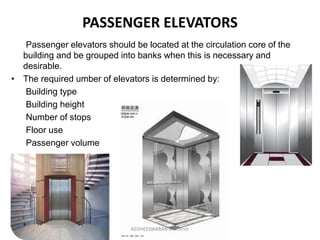
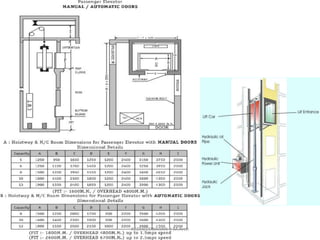
PASSENGER ELEVATORS
Passenger elevators should be located at the circulation core of the
building and be grouped into banks when this is necessary and
desirable.
• The required umber of elevators is determined by:
Building type
Building height
Number of stops
Floor use
Passenger volume
KEDHEESWARAN K M.Arch
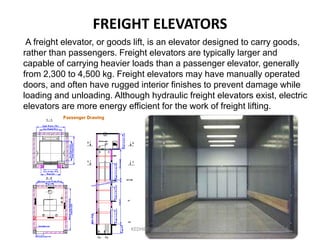
FREIGHT ELEVATORS
A freight elevator, or goods lift, is an elevator designed to carry goods,
rather than passengers. Freight elevators are typically larger and
capable of carrying heavier loads than a passenger elevator, generally
from 2,300 to 4,500 kg. Freight elevators may have manually operated
doors, and often have rugged interior finishes to prevent damage while
loading and unloading. Although hydraulic freight elevators exist, electric
elevators are more energy efficient for the work of freight lifting.
KEDHEESWARAN K M.Arch
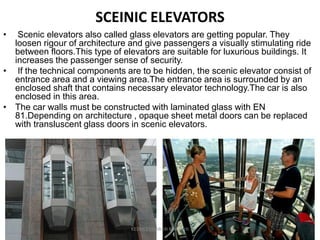
SCEINIC ELEVATORS
• Scenic elevators also called glass elevators are getting popular. They
loosen rigour of architecture and give passengers a visually stimulating ride
between floors.This type of elevators are suitable for luxurious buildings. It
increases the passenger sense of security.
• If the technical components are to be hidden, the scenic elevator consist of
entrance area and a viewing area.The entrance area is surrounded by an
enclosed shaft that contains necessary elevator technology.The car is also
enclosed in this area.
• The car walls must be constructed with laminated glass with EN
81.Depending on architecture , opaque sheet metal doors can be replaced
with transluscent glass doors in scenic elevators.
KEDHEESWARAN K M.Arch
• Dumbwaiter - Dumbwaiters are small freight elevators that are
intended to carry food rather than passengers. They often link
kitchens with rooms on other floors.
• Paternoster -A special type of elevator is the paternoster, a
constantly moving chain of boxes. A similar concept, called
the manlift or humanlift, moves only a small platform, which the rider
mounts while using a handhold and was once seen in multi-story
industrial plants.
• Scissor lift -The scissor lift is yet another type of lift. As most of
these lifts are self-contained, these lifts can be easily moved to
where they are needed.
• Rack-and-pinion lift -The rack-and-pinion lift is another type of lift.
These lifts are powered by a motor driving a pinion gear. Because
they can be installed on a building or structure's exterior and there is
no machine room or hoistway required, they are the most used type
of lift for buildings under construction
KEDHEESWARAN K M.Arch
CONSTRUCTION
• ELEVATOR SHAFT – contain building components necessary for the
operation of elevator. Its dimension depends upon elevator model, door
design and type of drive. They must have ventilation and smoke extracting
openings. The cross section of these openings is generally 2.5% of the
shaft floor area, with minimum cross section stipulated as 0.1m.sq.
• SHAFT PIT – the bottom end of the shaft is called pit. The depth of the
pit is measured from the top edge of the finished floor at the lowest
elevator stop to the top edge of the finished floor of the pit floor. The
minimum depth of pit is determined by:
space required for construction
over run and safety space stipulated by regulations
The pit sits directly on the foundation. Shaft pits that are 1 to 2.5m deep
must be equipped with a removable access ladder. Pits with a depth
greater than 2.5m must have a secure access door to a building floor.
KEDHEESWARAN K M.Arch
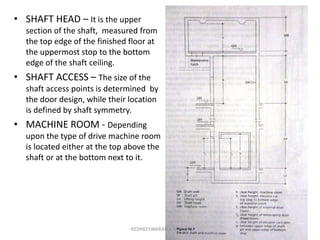
• SHAFT HEAD – It is the upper
section of the shaft, measured from
the top edge of the finished floor at
the uppermost stop to the bottom
edge of the shaft ceiling.
• SHAFT ACCESS – The size of the
shaft access points is determined by
the door design, while their location
is defined by shaft symmetry.
• MACHINE ROOM - Depending
upon the type of drive machine room
is located either at the top above the
shaft or at the bottom next to it.
KEDHEESWARAN K M.Arch
ELEVATOR CARS
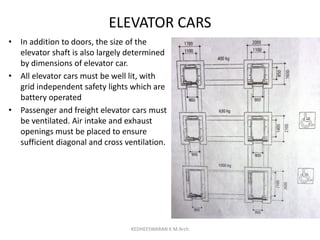
• In addition to doors, the size of the
elevator shaft is also largely determined
by dimensions of elevator car.
• All elevator cars must be well lit, with
grid independent safety lights which are
battery operated
• Passenger and freight elevator cars must
be ventilated. Air intake and exhaust
openings must be placed to ensure
sufficient diagonal and cross ventilation.
KEDHEESWARAN K M.Arch
ESCALATORS
KEDHEESWARAN K M.Arch
ESCALATORS
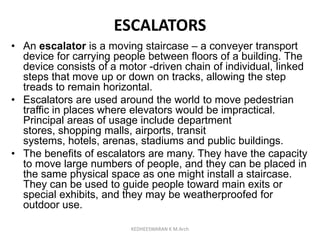
• An escalator is a moving staircase – a conveyer transport
device for carrying people between floors of a building. The
device consists of a motor -driven chain of individual, linked
steps that move up or down on tracks, allowing the step
treads to remain horizontal.
• Escalators are used around the world to move pedestrian
traffic in places where elevators would be impractical.
Principal areas of usage include department
stores, shopping malls, airports, transit
systems, hotels, arenas, stadiums and public buildings.
• The benefits of escalators are many. They have the capacity
to move large numbers of people, and they can be placed in
the same physical space as one might install a staircase.
They can be used to guide people toward main exits or
special exhibits, and they may be weatherproofed for
outdoor use.
KEDHEESWARAN K M.Arch
INCLINE AND TRANSPORTATION HEIGHT
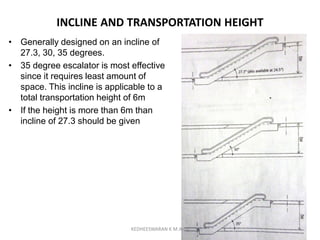
• Generally designed on an incline of
27.3, 30, 35 degrees.
• 35 degree escalator is most effective
since it requires least amount of
space. This incline is applicable to a
total transportation height of 6m
• If the height is more than 6m than
incline of 27.3 should be given
KEDHEESWARAN K M.Arch
ESCALATOR CAPACITY
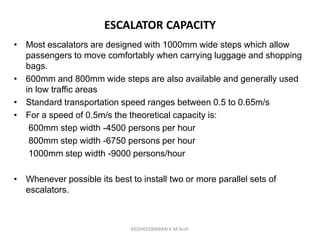
• Most escalators are designed with 1000mm wide steps which allow
passengers to move comfortably when carrying luggage and shopping
bags.
• 600mm and 800mm wide steps are also available and generally used
in low traffic areas
• Standard transportation speed ranges between 0.5 to 0.65m/s
• For a speed of 0.5m/s the theoretical capacity is:
600mm step width -4500 persons per hour
800mm step width -6750 persons per hour
1000mm step width -9000 persons/hour
• Whenever possible its best to install two or more parallel sets of
escalators.
KEDHEESWARAN K M.Arch
TYPES
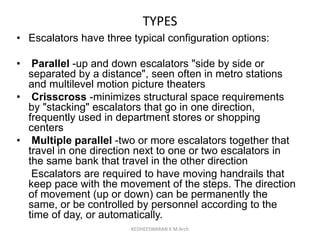
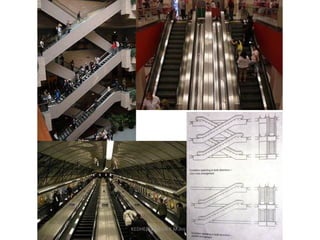
• Escalators have three typical configuration options:
• Parallel -up and down escalators "side by side or
separated by a distance", seen often in metro stations
and multilevel motion picture theaters
• Crisscross -minimizes structural space requirements
by "stacking" escalators that go in one direction,
frequently used in department stores or shopping
centers
• Multiple parallel -two or more escalators together that
travel in one direction next to one or two escalators in
the same bank that travel in the other direction
Escalators are required to have moving handrails that
keep pace with the movement of the steps. The direction
of movement (up or down) can be permanently the
same, or be controlled by personnel according to the
time of day, or automatically.
KEDHEESWARAN K M.Arch
COMPONENTS
COMPONENTS
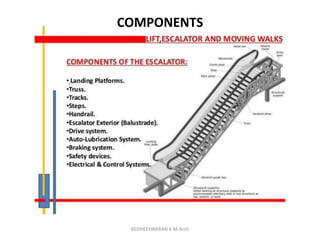
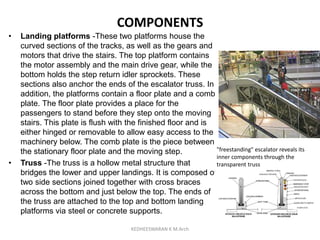
• Landing platforms -These two platforms house the
curved sections of the tracks, as well as the gears and
motors that drive the stairs. The top platform contains
the motor assembly and the main drive gear, while the
bottom holds the step return idler sprockets. These
sections also anchor the ends of the escalator truss. In
addition, the platforms contain a floor plate and a comb
plate. The floor plate provides a place for the
passengers to stand before they step onto the moving
stairs. This plate is flush with the finished floor and is
either hinged or removable to allow easy access to the
machinery below. The comb plate is the piece between
the stationary floor plate and the moving step.
• Truss -The truss is a hollow metal structure that
bridges the lower and upper landings. It is composed of
two side sections joined together with cross braces
across the bottom and just below the top. The ends of
the truss are attached to the top and bottom landing
platforms via steel or concrete supports.
"freestanding" escalator reveals its
inner components through the
transparent truss
KEDHEESWARAN K M.Arch
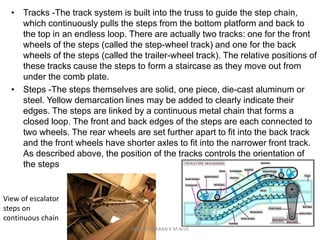
• Tracks -The track system is built into the truss to guide the step chain,
which continuously pulls the steps from the bottom platform and back to
the top in an endless loop. There are actually two tracks: one for the front
wheels of the steps (called the step-wheel track) and one for the back
wheels of the steps (called the trailer-wheel track). The relative positions of
these tracks cause the steps to form a staircase as they move out from
under the comb plate.
• Steps -The steps themselves are solid, one piece, die-cast aluminum or
steel. Yellow demarcation lines may be added to clearly indicate their
edges. The steps are linked by a continuous metal chain that forms a
closed loop. The front and back edges of the steps are each connected to
two wheels. The rear wheels are set further apart to fit into the back track
and the front wheels have shorter axles to fit into the narrower front track.
As described above, the position of the tracks controls the orientation of
the steps
View of escalator
steps on
continuous chain
KEDHEESWARAN K M.Arch
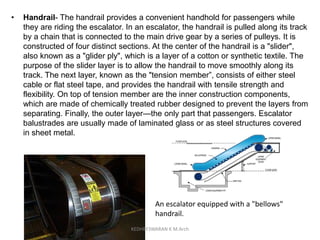
• Handrail- The handrail provides a convenient handhold for passengers while
they are riding the escalator. In an escalator, the handrail is pulled along its track
by a chain that is connected to the main drive gear by a series of pulleys. It is
constructed of four distinct sections. At the center of the handrail is a "slider",
also known as a "glider ply", which is a layer of a cotton or synthetic textile. The
purpose of the slider layer is to allow the handrail to move smoothly along its
track. The next layer, known as the "tension member”, consists of either steel
cable or flat steel tape, and provides the handrail with tensile strength and
flexibility. On top of tension member are the inner construction components,
which are made of chemically treated rubber designed to prevent the layers from
separating. Finally, the outer layer—the only part that passengers. Escalator
balustrades are usually made of laminated glass or as steel structures covered
in sheet metal.
An escalator equipped with a "bellows"
handrail.
KEDHEESWARAN K M.Arch

building services -Lift's and escalators

  • 1.
  • 2.
  • 3.
    History of Lifts •Roman architect Vitruvius, reported that Archimedes built his first elevator in 236 BC.[13] Elevators were mentioned as cabs on a hemp rope and powered by hand or by animals. • In 1852, Elisha Otis introduced the safety elevator, which prevented the fall of the cab if the cable broke. The design of the Otis safety elevator is somewhat similar to one type still used today. • On March 23, 1857 the first Otis passenger elevator was installed at 488 Broadway in New York City • The Equitable Life Building completed in 1870 in New York City was the first office building to have passenger elevators.[20] KEDHEESWARAN K M.Arch
  • 4.
    Elisha Otis' elevatorpatent drawing, 15 January 1861. KEDHEESWARAN K M.Arch
  • 5.
    1.1 Definition ofLifts • A vertical transport equipment that efficiently moves people between floors (levels, deck) of a building, vessel or other structure. • Generally powered by electric motor that drive by traction cable and counterweight systems like a hoist or hydraulic pump. KEDHEESWARAN K M.Arch
  • 6.
    Importance of Lifts •Rapid development : buildings design nowadays built vertically /higher because of high land cost. • Basic needs : to bring building user from one level to higher level in building • Comfort needs : working efficiency for office building or large organization. • UBBL( Unified Building Bye-Laws) : building with more than 6 storey must provide lifts system. • Fire requirements : provide fire lift to be used during fire. KEDHEESWARAN K M.Arch
  • 7.
    1.2 Lift CategoriesAccording to the Function • Trade Lift - Crucial to the good performance to clients of the building. - Between 6 – 23 people. - Speed of elevator 200 – 2000 ft/ min. - Examples : offices, shopping mall and hotels KEDHEESWARAN K M.Arch
  • 8.
    • Hospital Lift -Used in hospital & treatment center - Designed for transporting large carts or furniture. - Speed of elevator 100 – 350 ft/ min. - Two sides of front and back doors for loading and unloading facilities. - Door width between 900 – 1100mm • High Residential Lift - For high rise residential buildings such as flat, apartment or condominium. - Needs regular maintenance because high frequency of its use everyday or possibility of vandalism. KEDHEESWARAN K M.Arch
  • 9.
    • Institution Lift -Used in library, office, classroom or lecture hall located at high altitudes. • Store Lift - Used to transport heavy goods but depends on types of good transported. - Elevator speed 50 – 150ft/min. - 5000 lbs normal, load haul 20000 lbs. - Usually used in shopping complex, airports, hotels, warehouse KEDHEESWARAN K M.Arch
  • 10.
    • Lift ofCars - Used specifically to lift a car in multi storey car park or showroom. NOTES : • The six types of elevators had to be in the form of pull (traction) and hydraulics. • Form of traction is more commonly used for high velocity. • Hydraulic type only used to transport goods where waiting time is not concerned. KEDHEESWARAN K M.Arch
  • 11.
    1.3 Characteristic ofLifts 1. Lift needed for the building more than 6 storey. 2. Installation must be in accordance with the regulation in UBBL. 3. Suitable speed 100 – 150ft/min. Too fast will result in a nervous breakdown to the user. If too slow will cause lack of function. USER REQUIREMENTS : • Good System – quiet equipment, smooth journey, good condition and safe at every moment. • Waiting time – minimum waiting time at any level. • Aesthetics – Button panel clear and easily reached at appropriate level. Complete instruction. Decorative lighting and comfortable. • Movement of door – door movement is quiet and fast. KEDHEESWARAN K M.Arch
  • 12.
    1.4 Components &Installation of Lifts Lift sub-system • Control Motion – includes motor, gear, engines, brakes and power supply. • Control System - to get control the movements of the lift. • Door Control – contained motor connecting lift car doors, platforms gates and door safety devices. • Safety Control – contain the safety gear, speed controller for the first balance, heat and lack of power. KEDHEESWARAN K M.Arch
  • 13.
    Typical traction liftdesign KEDHEESWARAN K M.Arch
  • 14.
    Lift Components LIFT CAR •Platform where passengers or goods is transported. • Constructed with steel or iron attached with steel frame. • Fire resistance Elevator hoist ropes on top of a lift car KEDHEESWARAN K M.Arch
  • 15.
    • Equipment tobe provided – door, floor panel indicators, button of request, phone, emergency button, lighting, ventilation and enough emergency supplies. An external control panel A modern internal control panel. Notice the buttons labeled 1 above G. KEDHEESWARAN K M.Arch
  • 16.
    Open Lift (bubbletype) • Divided into 2 types : 1. Closed Lift (typical type) 2. Open Lift (bubble type) Closed Lift (typical type) KEDHEESWARAN K M.Arch
  • 17.
    LIFT SHAFT • Constructedwith reinforced concrete. • To accommodate the loading and fire resistance. • Size of lift shaft space is determined by the number of user. Looking down the lift shaft of a hydraulic elevator. The hydraulic ram is to the left Gearless motor mounted on the wall in the lift shaft KEDHEESWARAN K M.Arch
  • 18.
    GOVERNOR • Usually placedat the top of lift shaft. • Placed in room equipped with a lifting beam for maintenance purposes. • Have electric motor, safety gear, guard rail, diaphragm motion and gear. KEDHEESWARAN K M.Arch
  • 19.
    LIFT DOOR • Liftcar is equipped with its own door (sliding type). • Security measure – resist the movement as long as the door is still open. • Self closing within a certain time frame. • 2 types of sliding door : 1. Opened automatically when the lift stops at every level. 2. Swing door – will open when the lift stopped at the lobby. KEDHEESWARAN K M.Arch
  • 20.
    GUARD RAIL • Workto keep the car and the counterweight. • Mounted on both sides of the lift shaft which is attached to the wheel of the car. • A safety device to hold the lift from crashing down if the rope break. BUFFER • To absorb the impact of the lift car when it fell. • Placed in a room called the lift pit. KEDHEESWARAN K M.Arch
  • 21.
    COUNTERWEIGHT • Load borneby the generator is balanced by the counterweight. • Connected with a wire rope of the elevator car. • Function of counterweight : - To grip the lift car - Reduce the power of generator - Reduce the brake to stop the car lifts. KEDHEESWARAN K M.Arch
  • 22.
    1.5 Selection Factor GENERALREQUIREMENTS • Utility – The function must be identified whether for commercial, office of hospital. • Capacity & number of lifts – depends on the access building pattern and building size. • Speed – depends on the number of stops, numbers of user and transport cost. • Type & size of lift gate – depends on the use or function. PHYSICAL REQUIREMENTS • Size of lift shaft – depends on lift cargo capacity • Depth of lift shaft – depends on the speed of elevator • Area of space in lift – depends on speed of elevators. • Mechanical room size – depends on type and size of the lift equipment. KEDHEESWARAN K M.Arch
  • 23.
    OTHER REQUIREMENTS • Electricalpanels and power outlets. • Ventilation fan and lighting in engine room. • Steps down and power sockets in the wells lift (lift pit). • The structure for lifting the machinery room. • Maintanence works. KEDHEESWARAN K M.Arch
  • 24.
    Building type Waitingtime (second) Office building - Central town - Commercial 25 – 30 30 – 45 Residential building - Luxury - Medium type - Low cost - Hostel 50 – 70 60 – 80 80 – 120 60 – 80 Hotel - Class A - Class B 40 – 60 50 - 70 KEDHEESWARAN K M.Arch
  • 25.
    Function Lif capacity(lbs) Min. Speed (ft/min.) Building height (ft) Office Building Small size Medium size High scale 2500 3000 3500 350 – 400 500 – 600 700 800 1000 0 – 125 126 – 225 226 – 275 276 – 375 > 375 Hotel 2500 3000 Same as above Hospital 3000 3500 4000 150 200 250 – 300 350 – 400 500 – 600 700 0 – 60 61 – 100 101 – 125 126 – 175 176 – 250 > 250 Residential 2000 2500 100 200 250 – 300 350 - 400 0 – 75 76 – 125 126 – 200 > 200 Commercial 3500 4000 5000 200 250 – 300 350 – 400 500 0 – 100 101 – 150 151 – 200 > 200 KEDHEESWARAN K M.Arch
  • 26.
    1.6 Location &Lift Arrangement LIFT ARRANGEMENT • To ensure there is no interference between passengers who wish to get into the lift. • Should be carefully planned so can easily get into lobby and travel distance is reasonable. • Maximum travel distance 150 – 200ft • System layout depends on the number of elevator cars that use the elevator • Normally the elevator is set in the layout or zoned. BENEFIT • If there is high traffic , the usage is at optimum level • Waiting time will be shorten. KEDHEESWARAN K M.Arch
  • 27.
    Lift Arrangement for2 car lift Side by side arrangement – width of corridor = width of car lift Opposite arrangement of corridor = width of car lift ment – width of corridor = width of car lift Not good arrangement KEDHEESWARAN K M.Arch
  • 28.
    Lift Arrangement for3 car lift Opposite arrangement – width of corridor = 1.5 – 2A, where A is width of lift Side by side arrangement -width of corridor = 1.5A, where A is width of lift KEDHEESWARAN K M.Arch
  • 29.
    Lift Arrangement for4 car lift Opposite arrangement – width of corridor = 1.5 – 2A, where A is width of lift Side by side arrangement -width of corridor = 1.5A, where A is width of lift KEDHEESWARAN K M.Arch
  • 30.
    Lift Arrangement for6 car lift Opposite arrangement – width of corridor = 1.75 – 2A, where A is width of lift Side by side arrangement -width of corridor = 2A, where A is width of lift KEDHEESWARAN K M.Arch
  • 31.
    Lift Arrangement for6 car lift Weak arrangement for 6 car lift KEDHEESWARAN K M.Arch
  • 32.
    Lift Arrangement for8 car lift Opposite arrangement – width of corridor = 2A, where A is width of lift KEDHEESWARAN K M.Arch
  • 33.
    1.7 Types oflift ELECTRIC LIFT Common type used today. • Use electric lift cable to lift the elevator car with the weight and movement is the catalyst action. • Use the traction with the motor. • Used in most building > 60ft. • Motor room on top of lift shaft will increase the load of building structure. • Possibility of noise structure • Need a lift wells and maintenance room near the engine room. Traction elevator motor KEDHEESWARAN K M.Arch
  • 34.
    HYDRAULIC LIFT • Usehydraulics principles – moves by the action of steel plunger lift which installed under the car. • Not suitable for building > 60ft (low rise) – insufficient space or roof rooms too small to put the machinery. • Transport load not > 100,000 pound. • Speed – not > 200ft/min. • Installation does not increase the building structures because lifting weight is not used. • Machinery room located at ground floor • Shaft area is smaller than electric lift. KEDHEESWARAN K M.Arch
  • 35.
    Bottom view ofa hydraulic elevator KEDHEESWARAN K M.Arch
  • 36.
    HANDICAPPED LIFT • Forpeople with disability who use wheelchair. • Or with disabilities who are unable to use ordinary crowded lift of fast services. • Mounted on the stair parallel to the ladder FIRE LIFT • Buildings over than 60ft high are required to provide fire lift. • This lift controlled by a system back on in emergencies. KEDHEESWARAN K M.Arch
  • 37.
    PATERNOSTER • A liftsystems moves continuously in one direction by providing the same car lifts. • Provides the movement up and down continuously. • No doors and passengers are forced into or out of the moving car lift • Speed – 80 min. • Suitable for 6 – 7 storey buildings • Not suitable to used by children or older people. KEDHEESWARAN K M.Arch
  • 38.
    HIGH RISE LIFT •Service requirement for high rise building is critical to balance the upper and lower level services. • The concept of zone system and sky lobby can be used. • Usually divided into zones where high level car will not stop or pick passengers at lower level. • Zone which too low will takes passengers down to lower levels such as 5 – 10 levels below. KEDHEESWARAN K M.Arch
  • 39.
    DOUBLE DECKER LIFT •Carry passengers without raising double the lift shaft. • Have two platforms which are increased. • High transport capacity and reduce floor space • Number of stops can reduced to 50% - reducing waiting time and shorter car lift trips. • Can be used in building which has a same height in every level. • The main lobby has two levels. • Must have clear indication of the use in the main lobby to avoid confusion. KEDHEESWARAN K M.Arch
  • 40.
    1.8 : LiftInstallation by zone system ONE SYSTEM ZONE • For building not > 15 levels. • Elevators car stops at every level of the building. • Used to save space. TWO SYSTEM ZONE • For buildings > 15 levels and < 40 levels. • System brake into two zone of elevator • The elevator of bottom and same for the top will not stop at any lower zone. • Not effective in the event of ‘off peak’ and interfloor service. KEDHEESWARAN K M.Arch
  • 41.
    SKY LOBBY ZONE •For building > 40 levels. • A group lift with high speed moving lift without interruption from the floor to the sky lobby. • The elevator will move with normal velocity at the next level. KEDHEESWARAN K M.Arch
  • 42.
  • 43.
  • 44.
    For design oflifts factors to be considered are – 1. Population or no. of people who require lift service. 2. Handling capacity or maximum flow rate required by the people. 3. Interval or quality of service required. KEDHEESWARAN K M.Arch
  • 45.
    1. Population :Population is calculated based on occupancy type of the building Type Occupancy area/per person Residential 12.5 Educational 4 Institutional 15 KEDHEESWARAN K M.Arch
  • 46.
    Assembly hall with (a)Dancefloor (b)Dinning 0.6 1.5 Business 10 Mercantile (a)With basement (b)With shops on uppers 3 6 KEDHEESWARAN K M.Arch
  • 47.
    Industrial 10 Storage 30 Hazardous10 Above area per person is gross area of the floor in square meters. In case of office building 75% of the inherent occupancy is expected to arrive in time (period of ½ hr. before opening time which peak traffic period also). KEDHEESWARAN K M.Arch
  • 48.
    Floating population mayalso be there to counterfeit the effect of late coming persons. 100% population as calculated from floor occupancy basis to be adopted as total population to be served, during peak hours. KEDHEESWARAN K M.Arch
  • 49.
    2. Quantity ofService : The quantity of service is a measure of the passenger handling capacity of a vertical transport system. It is measured in terms of the total number of passengers handled during each five minutes peak period of the day. KEDHEESWARAN K M.Arch
  • 50.
    3. Quality ofService : The quality of service on the other hand is generally measured by the passenger waiting time of the various floors. Quality of service or Acceptable interval: 20 to 25 seconds Excellent 30 to 35 seconds Good 35 to 40 seconds Fair 40 to 45 seconds Poor Over 45 seconds Unsatisfactory KEDHEESWARAN K M.Arch
  • 51.
    Handling Capacity &RTT : The handling capacity is calculated by the formula: H = (300 x Q x 100)/T x P Where H = Handling capacity as the percentage of the peak population handled during 5 min. Q = Average number of passengers carried in a car KEDHEESWARAN K M.Arch
  • 52.
    T = waitinginterval, and P = Total population to be handled during peak morning period. (It is related to the area by a particular bank of lifts) The value of ‘Q’ depends on the dimensions of the car. It may be noted that the capacity loaded always to its maximum capacity during each trip and, therefore, for calculate the value of ‘Q’ is taken as 80% of the maximum carry capacity of the car. KEDHEESWARAN K M.Arch
  • 53.
    The waiting intervalis calculated by the formula : T = RTT/N Where, T = waiting interval N = number of lifts, and KEDHEESWARAN K M.Arch
  • 54.
    RTT = RoundTrip Time, that is, the average time required by each lift in taking one full load of passengers from ground floor, discharging them in various upper floors and coming back to ground floor for taking fresh passengers for the next trip. KEDHEESWARAN K M.Arch
  • 55.
    RTT is thesum of the time required in the following process : a) Entry of the passengers on the ground floor, b) Exit of the passengers on each floor of discharge, c) Door closing time before each floor of discharge, d) Door opening time on each discharging operation, e) Acceleration periods, f) Stopping and leveling periods, g) Period of full rated speeds between stops going up, and h) Period of full rated speeds between stops going down. It is observed that the handling capacity is inversely proportional to the waiting time which in turn is proportional to RTT. KEDHEESWARAN K M.Arch
  • 56.
    The round triptime can be decreased not only by increasing the speed of the lift but also by improving the design of the equipment related to opening and closing of the landing and car doors, acceleration, deceleration, levelling and passenger movement. KEDHEESWARAN K M.Arch
  • 57.
    a) The mostimportant factor in shortening the time consumed between the entry and the exit of the passengers to the lift car is the correct design of the door and the proper car width, for comfortable entry and exit for passengers, it has been found that most suitable door width is 1000 mm and that of car width is 2000. b) The utilization of centre opening doors also favors the door opening and closing time periods. KEDHEESWARAN K M.Arch
  • 58.
    Capacity : Minimum sizeof car recommended for a single purpose building is one suitable duty load of 884 Kg. For large building car 2040 Kg. according to requirement. KEDHEESWARAN K M.Arch
  • 59.
    Layout : The widthof car is determined by the width of entrance, and the depth of car is regulated by loading per sq.mtr. Permissible. Centre opening door are the most practicable and most efficiency entrance with for passenger lifts. KEDHEESWARAN K M.Arch
  • 60.
    Speed : It isdependent upon quality of service required and the quality of service desired. Therefore, no set formulae for indicating the speed can be given. Recommended Speeds : The following are general guidelines : KEDHEESWARAN K M.Arch
  • 61.
    Office Building PassengerLifts Sl. No. No. of Floors Recommended Speed 1. 4 to 5 floors 1 MPS 2. 6 to 12 floors 1.5 MPS 3. Above 12 floors Above 1.5 MPS KEDHEESWARAN K M.Arch
  • 62.
    Residential Building PassengerLifts Sl. No. No. of Floors Recommended Speed 1. 4 to 8 floors 1 MPS 2. 8 to 12 floors 1.5 MPS 3. Above 12 floors Above 1.5 MPS KEDHEESWARAN K M.Arch
  • 63.
    Hospital Lifts (Bedcum Passenger Lifts) Sl. No. No. of Floors Recommended Speed 1. Upto 4 floors 0.5 MPS 2. 5 to 8 floors 0.75 MPS 3. Above 8 floors 1 MPS KEDHEESWARAN K M.Arch
  • 64.
    Goods Lifts Sl. No. No. ofFloors Recommended Speed 1. Upto 6 floors 0.5 MPS 2. Above 6 floors 0.75 MPS Note: (1) For passenger cum gods lifts speed shall be followed as that of passenger lifts. (2) Actual speed shall be worked out on the basis of traffic analysis. KEDHEESWARAN K M.Arch
  • 65.
    Calculation of R.T.T. Themost probable number of floors on which lift may have to be stopped is given by statistical formula: Sn = n [ 1-(n-1)/n)Np] KEDHEESWARAN K M.Arch
  • 66.
    Where Np= Total numberof passengers entering the car at ground floor (Entrance Lobby) during peak period which is equal to car capacity. n = Total number of floors served above ground floor. Sn = Most probable number of stops. KEDHEESWARAN K M.Arch
  • 67.
    No. of upper floorsserved Number of Passenger/Trip (Car Capacity) 10 12 14 16 18 20 18 8 9 10 11 12 13 16 8 9 10 10 11 12 14 7 8 9 9 10 11 12 7 8 9 9 10 10 10 6 7 8 8 9 9 8 6 6 7 7 8 8 6 5 5 6 6 7 7 KEDHEESWARAN K M.Arch
  • 68.
    Now, R.T.T. = Entrancelobby time + Sn x floor serving time + Return trip time (D-2d)/Vc. Where, Sn = Probable number of stops D = Total Lift travel in one direction (m) d = Distance travelled during acceleration or deceleration (m) Vc = Contract speed of elevator in m/s also. KEDHEESWARAN K M.Arch
  • 69.
    D = ½ft2 Where, f = acceleration in m/sec2 t = Time for acceleration = 2 seconds for lifts upto 2.5 m/s. KEDHEESWARAN K M.Arch
  • 70.
    (a)Entrance Lobby Time: This consists of door opening, car loading, door closing time and acceleration at entrance lobby generally ground floor plus retardation time (while returning from top). (b)Floor serving time: This consists of door opening time, transfer (loading or unloading time), door closing time, acceleration and de-acceleration (retardation) time. KEDHEESWARAN K M.Arch
  • 71.
    (c)Loading/ Unloading time:Practically observed loading and unloading time for lifts of different capacity are given below: No. of Passengers Entrance lobby Loading time in second Transfer time i.e. loading and unloading time at upper floors 8 7 1 13 12 1.25 16 14 1.5 20 17 1.6KEDHEESWARAN K M.Arch
  • 72.
    Actually average timerequired for entrance of each passenger in car depends upon total number of persons entering the car and already available in car. It may be one second per person when car is partially loaded and 0.75 second when it is completely empty. Time for emptying car is less and equal to 0.75 second for single person but there is a tendency that all persons vacate the car simultaneously after opening if the doors. KEDHEESWARAN K M.Arch
  • 73.
    (d)Door Opening andclosing time: Door closing time is more as compared to door opening time. This is due to fact that when all persons have entered in the car, it takes time for people to select and press the push button for summoning the lift to various destinations. Total time for door opening and closing operation can be taken as given below: KEDHEESWARAN K M.Arch
  • 74.
    Type of Dooroperation Capacity 8 13 16 20 (a) Power operated single slide (b) Power operated double slide (c) Power operated Centre Opening (d) Collapsible with attendant (e) Collapsible without attendant 3.8 3.8 - - 3.2 3.2 - - 2.8 2.8 3.2 3.2 2.5 2.5 3 3 4 4 - - Door closing and opening time, at entrance floor shall be one second more than all above. KEDHEESWARAN K M.Arch
  • 75.
    (e)Distance travelled bylift during acceleration or retardation is assumed to be equal. This can be calculated by using formula. d = ut + ½ ft2 Where U is initial speed = 0, f is acceleration or retardation rate and t is the time elapsed. It is assumed that during each cycle, lifts acceleration and retardation time is about 2 second. KEDHEESWARAN K M.Arch
  • 76.
    Rate of accelerationwill vary with type of as given below: Lifts speed m/s Rate of acceleration m/sec2 1 0.50 1.5 0.75 2.5 1.00 More than 2.4 to 8 2.50 More than 8 and floors more than 50 4.00 KEDHEESWARAN K M.Arch
  • 77.
    ELEVATORS • An elevatoris a type of vertical transport equipment. • Elevators are generally powered by electric motors that either drive traction cables or counterweight systems like a hoist, or pump hydraulic fluid to raise a cylindrical piston like a jack. • Because of wheelchair access laws, elevators are often a legal requirement in new multistory buildings, especially where wheelchair ramps would be impractical. • A modern day lift consists of a cab mounted on a platform within an enclosed space called a shaft or sometimes a “ hoistway “. • Hydraulic lifts use the principles of hydraulics to pressurize an above ground or in-ground piston to raise and lower the car. • Roped hydraulics use a combination of both ropes and hydraulic power to raise and lower cars. • Hydraulic lifts are cheaper, but installing cylinders greater than a certain length becomes impractical for very high lift hoistways. Hydraulic lifts are usually slower than traction lifts. KEDHEESWARAN K M.Arch
  • 78.
    Machine room-less (MRL)elevators • Machine room-less elevators are designed so that most of the components fit within the shaft containing the elevator car; and a small cabinet houses the elevator controller. Other than the machinery being in the hoistway, the equipment is similar to a normal traction elevator. • Benefits • creates more usable space  use less energy (70-80% less than hydraulic elevators)  uses no oil  slightly lower cost than other elevators  can operate at faster speeds than hydraulics but not normal traction  Units. KEDHEESWARAN K M.Arch
  • 79.
    Types of hoistmechanisms • There are at least four means of moving an elevator: 1. Traction elevators • Geared and gearless traction elevators Geared traction machines are driven by AC or DC electric motors. Geared machines use gears to control mechanical movement of elevator cars by "rolling" steel hoist ropes over a drive sheave which is attached to a gearbox driven by a high speed motor. These machines are generally the best option for basement or overhead traction use for speeds up to 500 ft/min (2.5 m/s). • Gearless traction machines are low speed, high torque electric motors powered either by AC or DC. In this case, the drive sheave is directly attached to the end of the motor. Gearless traction elevators can reach speeds of up to 2,000 ft/min (10 m/s), or even higher. A brake is mounted between the motor and drive sheave to hold the elevator stationary at a floor. KEDHEESWARAN K M.Arch
  • 80.
  • 81.
    • Elevators withmore than 100 ft (30 m) of travel have a system called compensation. This is a separate set of cables or a chain attached to the bottom of the counterweight and the bottom of the elevator cab. This makes it easier to control the elevator, as it compensates for the differing weight of cable between the hoist and the cab 2. Hydraulic elevators Conventional hydraulic elevators. They use an underground cylinder, are quite common for low level buildings with 2–5 floors (sometimes but seldom up to 6–8 floors), and have speeds of up to 200 feet/minute (1 meter/second). Holeless hydraulic elevators were developed in the 1970s, and use a pair of above ground cylinders, which makes it practical for environmentally or cost sensitive buildings with 2, 3, or 4 floors. Roped hydraulic elevators use both above ground cylinders and a rope system, allowing the elevator to travel further than the piston has to move. KEDHEESWARAN K M.Arch
  • 82.
    The low mechanicalcomplexity of hydraulic elevators in comparison to traction elevators makes them ideal for low rise, low traffic installations. They are less energy efficient as the pump works against gravity to push the car and its passengers upwards; this energy is lost when the car descends on its own weight. The high current draw of the pump when starting up also places higher demands on a building’s electrical system. 3. Traction-Hydraulic Elevators The traction-hydraulic elevator has overhead traction cables and counterweight, but is driven by hydraulic power instead of an overhead traction motor. The weight of the car and its passengers, plus an advantageous roping ratio, reduces the demand from the pump to raise the counterweight, thereby reducing the size of the required machinery. 4. Climbing elevator A climbing elevator is a self-ascending elevator with its own propulsion. The propulsion can be done by an electric or a combustion engine. Climbing elevators are used in guyed masts or towers, in order to make easy access to parts of these constructions, such as flight safety lamps for maintenance. KEDHEESWARAN K M.Arch
  • 83.
    Elevator air conditioning Concept Elevatorair conditioning is fast becoming a popular concept around the world. The primary reason for installing an elevator air conditioner is the comfort that it provides while traveling in the elevator. It stabilizes the condition of the air inside the lift car. Health One of the benefits of installing an elevator air conditioner is the clean air it provides. Air was typically drawn from the elevator shaft or hoistway into the car using a motorized fan. This air could contain dust mites, germs and bacteria. With an elevator air conditioner, the air is much cleaner because it is recirculated within the car itself and is usually filtered to remove contaminants. A poorly maintained air- conditioning system may promote the growth and spread of microorganisms, but as long as the air conditioner is kept clean, these health hazards can be avoided. KEDHEESWARAN K M.Arch
  • 84.
    Drawbacks Heat generated fromthe cooling process is dissipated into the hoistway. The elevator cab (or car) is not air- tight, and some of this heat will reenter the car and reduce the overall cooling effect, which may be less than ideal. Energy The air from the lobby constantly leaks into the elevator shaft due to elevator movements as well as elevator shaft ventilation requirements. Using this conditioned air in the elevator does not increase energy costs. However, by using an independent elevator air conditioner to achieve better temperature control inside the car, more energy will be used. Condensation Air conditioning poses a problem to elevators because of the condensation that occurs. The condensed water produced has to be disposed of; otherwise, it would create flooding in the elevator car and hoistway. KEDHEESWARAN K M.Arch
  • 85.
    • The followingare suggested inside dimensions and rated capacities: • Office buildings: 6 feet 8 inches wide by 5 feet 5 inches deep; 3,500 pounds. • Apartment buildings: 6 feet 8 inches wide by 4 feet 3 inches deep; 2,500 pounds • Hotels/motels: 6 feet 8 inches wide by 5 feet 5 inches deep; 3,500 pounds. • Service elevators: 5 feet 4 inches wide by 8 feet 5 inches deep; 4,500 pounds. • Hospital passenger elevators: 6 feet 8 inches wide by 5 feet 5 inches deep; 3,500 pounds. • Hospital vehicle elevators: 5 feet 9 inches wide by 10 feet deep; 6,000 pounds. Office buildings: • 1. One elevator is required for every 45,000 net usable square feet. The ratio of the number of floors to the • number of elevators should be two to one or two and a half to one, depending on the occupancy of the building. • The more dense the population, the more elevators needed. • 2. The number of elevators in a single group should not exceed eight and no single group should serve more • than 16 levels. • 3. In buildings of four to eight floors, a separate service elevator should be considered. Over nine floors, a • service elevator is virtually required.KEDHEESWARAN K M.Arch
  • 86.
    Hotels/motels: • 1. Provideone elevator for every 75 rooms with a minimum of one elevator up to three floors. Do not exceed • 150 feet from farthest room to elevator. • 2. When room service is provided, allow for one separate service elevator for every two passenger elevators. • 3. Special-functions, meeting rooms, or lobby areas above entry level can increase the number of elevators. Apartment / Condominium/Dormitory • 1. One elevator for every 90 units with a maximum distance of 150 feet from elevators to the most distant unit. • 2. Urban locations or high-price units might require one elevator for every 60 units. • 3. Make one elevator oversize (at least 3,500 pounds) to accommodate furniture. In buildings 10 floors or more, • consider a separate service elevator. KEDHEESWARAN K M.Arch
  • 87.
    PASSENGER ELEVATORS Passenger elevatorsshould be located at the circulation core of the building and be grouped into banks when this is necessary and desirable. • The required umber of elevators is determined by: Building type Building height Number of stops Floor use Passenger volume KEDHEESWARAN K M.Arch
  • 88.
  • 89.
    FREIGHT ELEVATORS A freightelevator, or goods lift, is an elevator designed to carry goods, rather than passengers. Freight elevators are typically larger and capable of carrying heavier loads than a passenger elevator, generally from 2,300 to 4,500 kg. Freight elevators may have manually operated doors, and often have rugged interior finishes to prevent damage while loading and unloading. Although hydraulic freight elevators exist, electric elevators are more energy efficient for the work of freight lifting. KEDHEESWARAN K M.Arch
  • 90.
    SCEINIC ELEVATORS • Scenicelevators also called glass elevators are getting popular. They loosen rigour of architecture and give passengers a visually stimulating ride between floors.This type of elevators are suitable for luxurious buildings. It increases the passenger sense of security. • If the technical components are to be hidden, the scenic elevator consist of entrance area and a viewing area.The entrance area is surrounded by an enclosed shaft that contains necessary elevator technology.The car is also enclosed in this area. • The car walls must be constructed with laminated glass with EN 81.Depending on architecture , opaque sheet metal doors can be replaced with transluscent glass doors in scenic elevators. KEDHEESWARAN K M.Arch
  • 91.
    • Dumbwaiter -Dumbwaiters are small freight elevators that are intended to carry food rather than passengers. They often link kitchens with rooms on other floors. • Paternoster -A special type of elevator is the paternoster, a constantly moving chain of boxes. A similar concept, called the manlift or humanlift, moves only a small platform, which the rider mounts while using a handhold and was once seen in multi-story industrial plants. • Scissor lift -The scissor lift is yet another type of lift. As most of these lifts are self-contained, these lifts can be easily moved to where they are needed. • Rack-and-pinion lift -The rack-and-pinion lift is another type of lift. These lifts are powered by a motor driving a pinion gear. Because they can be installed on a building or structure's exterior and there is no machine room or hoistway required, they are the most used type of lift for buildings under construction KEDHEESWARAN K M.Arch
  • 92.
    CONSTRUCTION • ELEVATOR SHAFT– contain building components necessary for the operation of elevator. Its dimension depends upon elevator model, door design and type of drive. They must have ventilation and smoke extracting openings. The cross section of these openings is generally 2.5% of the shaft floor area, with minimum cross section stipulated as 0.1m.sq. • SHAFT PIT – the bottom end of the shaft is called pit. The depth of the pit is measured from the top edge of the finished floor at the lowest elevator stop to the top edge of the finished floor of the pit floor. The minimum depth of pit is determined by: space required for construction over run and safety space stipulated by regulations The pit sits directly on the foundation. Shaft pits that are 1 to 2.5m deep must be equipped with a removable access ladder. Pits with a depth greater than 2.5m must have a secure access door to a building floor. KEDHEESWARAN K M.Arch
  • 93.
    • SHAFT HEAD– It is the upper section of the shaft, measured from the top edge of the finished floor at the uppermost stop to the bottom edge of the shaft ceiling. • SHAFT ACCESS – The size of the shaft access points is determined by the door design, while their location is defined by shaft symmetry. • MACHINE ROOM - Depending upon the type of drive machine room is located either at the top above the shaft or at the bottom next to it. KEDHEESWARAN K M.Arch
  • 94.
    ELEVATOR CARS • Inaddition to doors, the size of the elevator shaft is also largely determined by dimensions of elevator car. • All elevator cars must be well lit, with grid independent safety lights which are battery operated • Passenger and freight elevator cars must be ventilated. Air intake and exhaust openings must be placed to ensure sufficient diagonal and cross ventilation. KEDHEESWARAN K M.Arch
  • 95.
  • 96.
    ESCALATORS • An escalatoris a moving staircase – a conveyer transport device for carrying people between floors of a building. The device consists of a motor -driven chain of individual, linked steps that move up or down on tracks, allowing the step treads to remain horizontal. • Escalators are used around the world to move pedestrian traffic in places where elevators would be impractical. Principal areas of usage include department stores, shopping malls, airports, transit systems, hotels, arenas, stadiums and public buildings. • The benefits of escalators are many. They have the capacity to move large numbers of people, and they can be placed in the same physical space as one might install a staircase. They can be used to guide people toward main exits or special exhibits, and they may be weatherproofed for outdoor use. KEDHEESWARAN K M.Arch
  • 97.
    INCLINE AND TRANSPORTATIONHEIGHT • Generally designed on an incline of 27.3, 30, 35 degrees. • 35 degree escalator is most effective since it requires least amount of space. This incline is applicable to a total transportation height of 6m • If the height is more than 6m than incline of 27.3 should be given KEDHEESWARAN K M.Arch
  • 98.
    ESCALATOR CAPACITY • Mostescalators are designed with 1000mm wide steps which allow passengers to move comfortably when carrying luggage and shopping bags. • 600mm and 800mm wide steps are also available and generally used in low traffic areas • Standard transportation speed ranges between 0.5 to 0.65m/s • For a speed of 0.5m/s the theoretical capacity is: 600mm step width -4500 persons per hour 800mm step width -6750 persons per hour 1000mm step width -9000 persons/hour • Whenever possible its best to install two or more parallel sets of escalators. KEDHEESWARAN K M.Arch
  • 99.
    TYPES • Escalators havethree typical configuration options: • Parallel -up and down escalators "side by side or separated by a distance", seen often in metro stations and multilevel motion picture theaters • Crisscross -minimizes structural space requirements by "stacking" escalators that go in one direction, frequently used in department stores or shopping centers • Multiple parallel -two or more escalators together that travel in one direction next to one or two escalators in the same bank that travel in the other direction Escalators are required to have moving handrails that keep pace with the movement of the steps. The direction of movement (up or down) can be permanently the same, or be controlled by personnel according to the time of day, or automatically. KEDHEESWARAN K M.Arch
  • 100.
  • 101.
  • 102.
    COMPONENTS • Landing platforms-These two platforms house the curved sections of the tracks, as well as the gears and motors that drive the stairs. The top platform contains the motor assembly and the main drive gear, while the bottom holds the step return idler sprockets. These sections also anchor the ends of the escalator truss. In addition, the platforms contain a floor plate and a comb plate. The floor plate provides a place for the passengers to stand before they step onto the moving stairs. This plate is flush with the finished floor and is either hinged or removable to allow easy access to the machinery below. The comb plate is the piece between the stationary floor plate and the moving step. • Truss -The truss is a hollow metal structure that bridges the lower and upper landings. It is composed of two side sections joined together with cross braces across the bottom and just below the top. The ends of the truss are attached to the top and bottom landing platforms via steel or concrete supports. "freestanding" escalator reveals its inner components through the transparent truss KEDHEESWARAN K M.Arch
  • 103.
    • Tracks -Thetrack system is built into the truss to guide the step chain, which continuously pulls the steps from the bottom platform and back to the top in an endless loop. There are actually two tracks: one for the front wheels of the steps (called the step-wheel track) and one for the back wheels of the steps (called the trailer-wheel track). The relative positions of these tracks cause the steps to form a staircase as they move out from under the comb plate. • Steps -The steps themselves are solid, one piece, die-cast aluminum or steel. Yellow demarcation lines may be added to clearly indicate their edges. The steps are linked by a continuous metal chain that forms a closed loop. The front and back edges of the steps are each connected to two wheels. The rear wheels are set further apart to fit into the back track and the front wheels have shorter axles to fit into the narrower front track. As described above, the position of the tracks controls the orientation of the steps View of escalator steps on continuous chain KEDHEESWARAN K M.Arch
  • 104.
    • Handrail- Thehandrail provides a convenient handhold for passengers while they are riding the escalator. In an escalator, the handrail is pulled along its track by a chain that is connected to the main drive gear by a series of pulleys. It is constructed of four distinct sections. At the center of the handrail is a "slider", also known as a "glider ply", which is a layer of a cotton or synthetic textile. The purpose of the slider layer is to allow the handrail to move smoothly along its track. The next layer, known as the "tension member”, consists of either steel cable or flat steel tape, and provides the handrail with tensile strength and flexibility. On top of tension member are the inner construction components, which are made of chemically treated rubber designed to prevent the layers from separating. Finally, the outer layer—the only part that passengers. Escalator balustrades are usually made of laminated glass or as steel structures covered in sheet metal. An escalator equipped with a "bellows" handrail. KEDHEESWARAN K M.Arch