Welcome to the Seminar of
 Technology has made security systems more
affordable, more competent, and more accessible to
every one. Early security systems were awkward devices
that were hard to install and were very limited in abilities.
 Basically, there was only one thing an early security
system could do, emit an ear-piercing wail and perhaps
turn on a light or two.
 As technology advanced, security systems became
smarter and more reliable. Home security technology has
made it virtually impossible for any danger to approach
or make it in your home without you and the proper
emergency response teams knowing about it.
 Without you being home or without you having to press
one button, the control panels can be programmed to
alert you and the police or medical or fire units, as well as
activate various response methods such as sprinkler
systems or lights and alarms.
 Security cameras and recorders, environment
sensors, motion detectors, and advanced control panels
allow you and local emergency units to have the
immediate knowledge of an intrusion or danger to health
and happiness. In fact, newer systems not only supply the
knowledge of danger, but also allow you to control the
response.
 Security systems are putting security more and more into
the hands of the homeowner. The most basic way is
through the progression and simplification of the home
security systems. No longer is a professional needed to
install the system. Because technology has simplified the
system, any homeowner can easily and quickly install a
security unit and control the unit from home or away.
 Modern adjustments to security technology provide
owners with more access and flexibility with their systems.
you can gain access to your unit through the Internet or
cell phone. You can control your system at home or from
anywhere in the world.
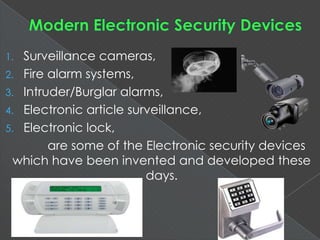
1. Surveillance cameras,
2. Fire alarm systems,
3. Intruder/Burglar alarms,
4. Electronic article surveillance,
5. Electronic lock,
are some of the Electronic security devices
which have been invented and developed these
days.
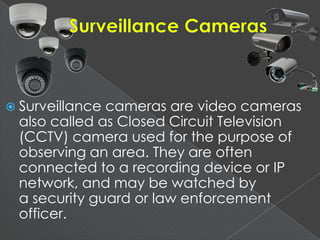
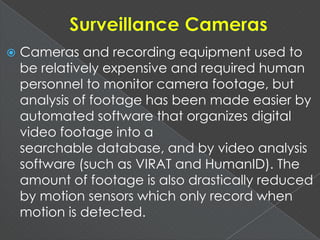
 Surveillance cameras are video cameras
also called as Closed Circuit Television
(CCTV) camera used for the purpose of
observing an area. They are often
connected to a recording device or IP
network, and may be watched by
a security guard or law enforcement
officer.
 Cameras and recording equipment used to
be relatively expensive and required human
personnel to monitor camera footage, but
analysis of footage has been made easier by
automated software that organizes digital
video footage into a
searchable database, and by video analysis
software (such as VIRAT and HumanID). The
amount of footage is also drastically reduced
by motion sensors which only record when
motion is detected.
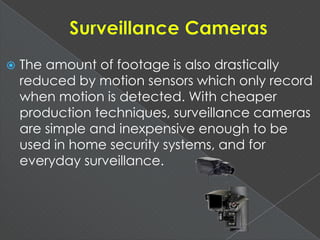
 The amount of footage is also drastically
reduced by motion sensors which only record
when motion is detected. With cheaper
production techniques, surveillance cameras
are simple and inexpensive enough to be
used in home security systems, and for
everyday surveillance.
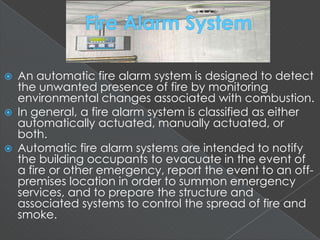
 An automatic fire alarm system is designed to detect
the unwanted presence of fire by monitoring
environmental changes associated with combustion.
 In general, a fire alarm system is classified as either
automatically actuated, manually actuated, or
both.
 Automatic fire alarm systems are intended to notify
the building occupants to evacuate in the event of
a fire or other emergency, report the event to an off-
premises location in order to summon emergency
services, and to prepare the structure and
associated systems to control the spread of fire and
smoke.
 Fire alarm control panel (FACP): This
component, the hub of the system, monitors
inputs and system integrity, controls outputs and
relays information.
 Primary Power supply: Commonly the non-
switched 120 or 240 Volt Alternating Current
source supplied from a commercial power utility.
 Secondary (backup) Power supplies: This
component, commonly consisting of sealed
lead-acid storage batteries or other emergency
sources including generators, is used to supply
energy in the event of a primary power failure.
 Initiating Devices: This component acts as an input to the
fire alarm control unit and are either manually or
automatically actuated.
 Notification appliances: This component uses energy
supplied from the fire alarm system or other stored energy
source, to inform the proximate persons of the need to
take action, usually to evacuate.
 Building Safety Interfaces: This interface allows the fire
alarm system to control aspects of the built environment
and to prepare the building for fire, and to control the
spread of smoke fumes and fire by influencing air
movement, lighting, process control, human transport
and exit.
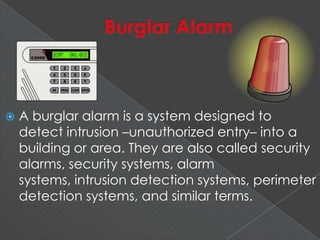
 A burglar alarm is a system designed to
detect intrusion –unauthorized entry– into a
building or area. They are also called security
alarms, security systems, alarm
systems, intrusion detection systems, perimeter
detection systems, and similar terms.
 Burglar alarms are used in
residential, commercial, industrial, and
military properties for protection
against burglary (theft) or property
damage, as well as personal protection
against intruders. Car alarms likewise
protect vehicles and their
contents. Prisons also use security systems
for control of inmates.
 Some alarm systems serve a single purpose of
burglary protection; combination systems
provide both fire and intrusion protection.
Intrusion alarm systems may also be combined
with closed-circuit television surveillance systems
to automatically record the activities of
intruders, and may interface to access control
systems for electrically locked doors. Systems
range from small, self-contained noisemakers, to
complicated, multi-area systems with computer
monitoring and control.
The most basic alarm consists of one or more sensors to detect
intruders, and an alerting device to indicate the intrusion.
However, a typical premises security alarm employs the
following components:
 Premises control unit (PCU), or panel: The "brain" of the
system, it reads sensor inputs, tracks arm/disarm status, and
signals intrusions. In modern systems, this is typically one or
more computer circuit boards inside a metal
enclosure, along with a power supply.
 Sensors: Devices which detect intrusions. Sensors may
placed at the perimeter of the protected area, within it, or
both. Sensors can detect intruders by a variety of
methods, such as monitoring doors and windows for
opening, or by monitoring unoccupied interiors for
motions, sound, vibration, or other disturbances.
 Alerting devices: These indicate an alarm condition. Most
commonly, these are bells, sirens, and/or flashing lights.
Alerting devices serve the dual purposes of warning
occupants of intrusion, and potentially scaring off burglars.
 Keypads: Small devices, typically wall-
mounted, which function as the human-
machine interface to the system. In addition to
buttons, keypads typically feature indicator
lights, a small mulch-character display, or both.
 Interconnections between components. This
may consist of direct wiring to the control unit, or
wireless links with local power supplies.
 Security devices: Devices to detect thieves such
as spotlights, cameras & lasers.
1. Passive infrared detectors
2. Ultrasonic detectors
3. Microwave detectors
4. Glass break detection
5. Smoke, heat, and carbon monoxide detectors
6. Vibration (shaker) or inertia sensors
7. Passive magnetic field detection
8. E-field
9. Microwave barriers
10. Microphonic systems
11. Taut wire fence systems
12. Fibre optic cable
13. H-field
 Electronic article surveillance (EAS) is a technological method for
preventing shoplifting from retail stores or pilferage of books from
libraries. Special tags are fixed to merchandise or books. These tags
are removed or deactivated by the clerks when the item is properly
bought or checked out. At the exits of the store, a detection system
sounds an alarm or otherwise alerts the staff when it senses active
tags.
 Some stores also have detection systems at the entrance to the
bathrooms that sound an alarm if someone tries to take unpaid
merchandise with them into the bathroom.
 Some stores with EAS have keypads by the detection systems with
monitors that beep showing the response time on the screen when
the alarm sounds to ensure that employees respond to the alarm.
The keypad keeps beeping until an employee responds to it.
 For high-value goods that are to be manipulated by the
patrons, wired alarm clips may be used instead of tags.
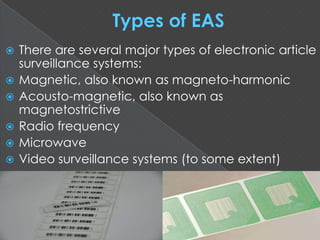
 There are several major types of electronic article
surveillance systems:
 Magnetic, also known as magneto-harmonic
 Acousto-magnetic, also known as
magnetostrictive
 Radio frequency
 Microwave
 Video surveillance systems (to some extent)
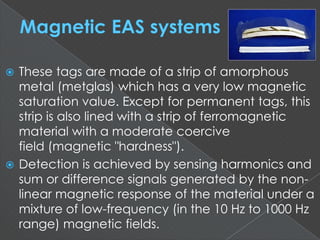
 These tags are made of a strip of amorphous
metal (metglas) which has a very low magnetic
saturation value. Except for permanent tags, this
strip is also lined with a strip of ferromagnetic
material with a moderate coercive
field (magnetic "hardness").
 Detection is achieved by sensing harmonics and
sum or difference signals generated by the non-
linear magnetic response of the material under a
mixture of low-frequency (in the 10 Hz to 1000 Hz
range) magnetic fields.
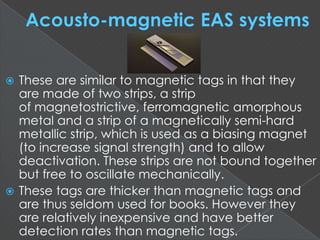
 These are similar to magnetic tags in that they
are made of two strips, a strip
of magnetostrictive, ferromagnetic amorphous
metal and a strip of a magnetically semi-hard
metallic strip, which is used as a biasing magnet
(to increase signal strength) and to allow
deactivation. These strips are not bound together
but free to oscillate mechanically.
 These tags are thicker than magnetic tags and
are thus seldom used for books. However they
are relatively inexpensive and have better
detection rates than magnetic tags.
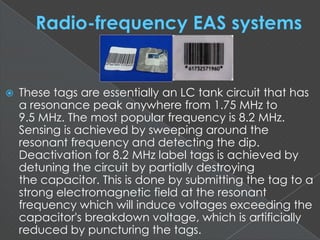
 These tags are essentially an LC tank circuit that has
a resonance peak anywhere from 1.75 MHz to
9.5 MHz. The most popular frequency is 8.2 MHz.
Sensing is achieved by sweeping around the
resonant frequency and detecting the dip.
Deactivation for 8.2 MHz label tags is achieved by
detuning the circuit by partially destroying
the capacitor. This is done by submitting the tag to a
strong electromagnetic field at the resonant
frequency which will induce voltages exceeding the
capacitor's breakdown voltage, which is artificially
reduced by puncturing the tags.
 These permanent tags are made of a non-
linear element (a diode) coupled to one
microwave and one electrostatic antenna. At
the exit, one antenna emits a low-frequency
(about 100 kHz) field, and another one emits
a microwave field. The tag acts as a mixer
reemitting a combination of signals from both
fields. This modulated signal triggers the
alarm. These tags are permanent and
somewhat costly. They are mostly used in
clothing stores.
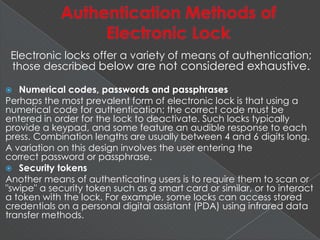
 An electronic lock (or electric lock) is a locking
device which operates by means of electric current.
Electric locks are sometimes stand-alone with an
electronic control assembly mounted directly to the
lock.
 More often electric locks are connected to
an access control system.
 The advantages of an electric lock connected to an
access control system include: key control, where
keys can be added and removed without re-keying
the lock cylinder; fine access control, where time
and place are factors; and transaction
logging, where activity is recorded.
Electronic locks offer a variety of means of authentication;
those described below are not considered exhaustive.
 Numerical codes, passwords and passphrases
Perhaps the most prevalent form of electronic lock is that using a
numerical code for authentication; the correct code must be
entered in order for the lock to deactivate. Such locks typically
provide a keypad, and some feature an audible response to each
press. Combination lengths are usually between 4 and 6 digits long.
A variation on this design involves the user entering the
correct password or passphrase.
 Security tokens
Another means of authenticating users is to require them to scan or
"swipe" a security token such as a smart card or similar, or to interact
a token with the lock. For example, some locks can access stored
credentials on a personal digital assistant (PDA) using infrared data
transfer methods.
 Biometrics
As biometrics become more and more prominent as a
recognized means of positive identification, their use in
security systems increases. Some new electronic locks
take advantage of technologies such as fingerprint
scanning, retinal scanning and iris
scanning, and voiceprint identification to authenticate
users.
 RFID
Radio-frequency identification (RFID) is the use of an
object (typically referred to as an RFID tag) applied to or
incorporated into a product, animal, or person for the
purpose of identification and tracking using radio waves.
Some tags can be read from several meters away and
beyond the line of sight of the reader. This technology is
also used in modern electronic locks.
Thank you for your Attention !
We Hope this Seminar made you aware about
the Electronic Security System

Electronic security system

  • 1.
    Welcome to theSeminar of
  • 2.
     Technology hasmade security systems more affordable, more competent, and more accessible to every one. Early security systems were awkward devices that were hard to install and were very limited in abilities.  Basically, there was only one thing an early security system could do, emit an ear-piercing wail and perhaps turn on a light or two.  As technology advanced, security systems became smarter and more reliable. Home security technology has made it virtually impossible for any danger to approach or make it in your home without you and the proper emergency response teams knowing about it.
  • 3.
     Without youbeing home or without you having to press one button, the control panels can be programmed to alert you and the police or medical or fire units, as well as activate various response methods such as sprinkler systems or lights and alarms.  Security cameras and recorders, environment sensors, motion detectors, and advanced control panels allow you and local emergency units to have the immediate knowledge of an intrusion or danger to health and happiness. In fact, newer systems not only supply the knowledge of danger, but also allow you to control the response.
  • 4.
     Security systemsare putting security more and more into the hands of the homeowner. The most basic way is through the progression and simplification of the home security systems. No longer is a professional needed to install the system. Because technology has simplified the system, any homeowner can easily and quickly install a security unit and control the unit from home or away.  Modern adjustments to security technology provide owners with more access and flexibility with their systems. you can gain access to your unit through the Internet or cell phone. You can control your system at home or from anywhere in the world.
  • 5.
    1. Surveillance cameras, 2.Fire alarm systems, 3. Intruder/Burglar alarms, 4. Electronic article surveillance, 5. Electronic lock, are some of the Electronic security devices which have been invented and developed these days.
  • 6.
     Surveillance camerasare video cameras also called as Closed Circuit Television (CCTV) camera used for the purpose of observing an area. They are often connected to a recording device or IP network, and may be watched by a security guard or law enforcement officer.
  • 7.
     Cameras andrecording equipment used to be relatively expensive and required human personnel to monitor camera footage, but analysis of footage has been made easier by automated software that organizes digital video footage into a searchable database, and by video analysis software (such as VIRAT and HumanID). The amount of footage is also drastically reduced by motion sensors which only record when motion is detected.
  • 8.
     The amountof footage is also drastically reduced by motion sensors which only record when motion is detected. With cheaper production techniques, surveillance cameras are simple and inexpensive enough to be used in home security systems, and for everyday surveillance.
  • 9.
     An automaticfire alarm system is designed to detect the unwanted presence of fire by monitoring environmental changes associated with combustion.  In general, a fire alarm system is classified as either automatically actuated, manually actuated, or both.  Automatic fire alarm systems are intended to notify the building occupants to evacuate in the event of a fire or other emergency, report the event to an off- premises location in order to summon emergency services, and to prepare the structure and associated systems to control the spread of fire and smoke.
  • 10.
     Fire alarmcontrol panel (FACP): This component, the hub of the system, monitors inputs and system integrity, controls outputs and relays information.  Primary Power supply: Commonly the non- switched 120 or 240 Volt Alternating Current source supplied from a commercial power utility.  Secondary (backup) Power supplies: This component, commonly consisting of sealed lead-acid storage batteries or other emergency sources including generators, is used to supply energy in the event of a primary power failure.
  • 11.
     Initiating Devices:This component acts as an input to the fire alarm control unit and are either manually or automatically actuated.  Notification appliances: This component uses energy supplied from the fire alarm system or other stored energy source, to inform the proximate persons of the need to take action, usually to evacuate.  Building Safety Interfaces: This interface allows the fire alarm system to control aspects of the built environment and to prepare the building for fire, and to control the spread of smoke fumes and fire by influencing air movement, lighting, process control, human transport and exit.
  • 12.
     A burglaralarm is a system designed to detect intrusion –unauthorized entry– into a building or area. They are also called security alarms, security systems, alarm systems, intrusion detection systems, perimeter detection systems, and similar terms.
  • 13.
     Burglar alarmsare used in residential, commercial, industrial, and military properties for protection against burglary (theft) or property damage, as well as personal protection against intruders. Car alarms likewise protect vehicles and their contents. Prisons also use security systems for control of inmates.
  • 14.
     Some alarmsystems serve a single purpose of burglary protection; combination systems provide both fire and intrusion protection. Intrusion alarm systems may also be combined with closed-circuit television surveillance systems to automatically record the activities of intruders, and may interface to access control systems for electrically locked doors. Systems range from small, self-contained noisemakers, to complicated, multi-area systems with computer monitoring and control.
  • 15.
    The most basicalarm consists of one or more sensors to detect intruders, and an alerting device to indicate the intrusion. However, a typical premises security alarm employs the following components:  Premises control unit (PCU), or panel: The "brain" of the system, it reads sensor inputs, tracks arm/disarm status, and signals intrusions. In modern systems, this is typically one or more computer circuit boards inside a metal enclosure, along with a power supply.  Sensors: Devices which detect intrusions. Sensors may placed at the perimeter of the protected area, within it, or both. Sensors can detect intruders by a variety of methods, such as monitoring doors and windows for opening, or by monitoring unoccupied interiors for motions, sound, vibration, or other disturbances.  Alerting devices: These indicate an alarm condition. Most commonly, these are bells, sirens, and/or flashing lights. Alerting devices serve the dual purposes of warning occupants of intrusion, and potentially scaring off burglars.
  • 16.
     Keypads: Smalldevices, typically wall- mounted, which function as the human- machine interface to the system. In addition to buttons, keypads typically feature indicator lights, a small mulch-character display, or both.  Interconnections between components. This may consist of direct wiring to the control unit, or wireless links with local power supplies.  Security devices: Devices to detect thieves such as spotlights, cameras & lasers.
  • 17.
    1. Passive infrareddetectors 2. Ultrasonic detectors 3. Microwave detectors 4. Glass break detection 5. Smoke, heat, and carbon monoxide detectors 6. Vibration (shaker) or inertia sensors 7. Passive magnetic field detection 8. E-field 9. Microwave barriers 10. Microphonic systems 11. Taut wire fence systems 12. Fibre optic cable 13. H-field
  • 18.
     Electronic articlesurveillance (EAS) is a technological method for preventing shoplifting from retail stores or pilferage of books from libraries. Special tags are fixed to merchandise or books. These tags are removed or deactivated by the clerks when the item is properly bought or checked out. At the exits of the store, a detection system sounds an alarm or otherwise alerts the staff when it senses active tags.  Some stores also have detection systems at the entrance to the bathrooms that sound an alarm if someone tries to take unpaid merchandise with them into the bathroom.  Some stores with EAS have keypads by the detection systems with monitors that beep showing the response time on the screen when the alarm sounds to ensure that employees respond to the alarm. The keypad keeps beeping until an employee responds to it.  For high-value goods that are to be manipulated by the patrons, wired alarm clips may be used instead of tags.
  • 19.
     There areseveral major types of electronic article surveillance systems:  Magnetic, also known as magneto-harmonic  Acousto-magnetic, also known as magnetostrictive  Radio frequency  Microwave  Video surveillance systems (to some extent)
  • 20.
     These tagsare made of a strip of amorphous metal (metglas) which has a very low magnetic saturation value. Except for permanent tags, this strip is also lined with a strip of ferromagnetic material with a moderate coercive field (magnetic "hardness").  Detection is achieved by sensing harmonics and sum or difference signals generated by the non- linear magnetic response of the material under a mixture of low-frequency (in the 10 Hz to 1000 Hz range) magnetic fields.
  • 21.
     These aresimilar to magnetic tags in that they are made of two strips, a strip of magnetostrictive, ferromagnetic amorphous metal and a strip of a magnetically semi-hard metallic strip, which is used as a biasing magnet (to increase signal strength) and to allow deactivation. These strips are not bound together but free to oscillate mechanically.  These tags are thicker than magnetic tags and are thus seldom used for books. However they are relatively inexpensive and have better detection rates than magnetic tags.
  • 22.
     These tagsare essentially an LC tank circuit that has a resonance peak anywhere from 1.75 MHz to 9.5 MHz. The most popular frequency is 8.2 MHz. Sensing is achieved by sweeping around the resonant frequency and detecting the dip. Deactivation for 8.2 MHz label tags is achieved by detuning the circuit by partially destroying the capacitor. This is done by submitting the tag to a strong electromagnetic field at the resonant frequency which will induce voltages exceeding the capacitor's breakdown voltage, which is artificially reduced by puncturing the tags.
  • 23.
     These permanenttags are made of a non- linear element (a diode) coupled to one microwave and one electrostatic antenna. At the exit, one antenna emits a low-frequency (about 100 kHz) field, and another one emits a microwave field. The tag acts as a mixer reemitting a combination of signals from both fields. This modulated signal triggers the alarm. These tags are permanent and somewhat costly. They are mostly used in clothing stores.
  • 24.
     An electroniclock (or electric lock) is a locking device which operates by means of electric current. Electric locks are sometimes stand-alone with an electronic control assembly mounted directly to the lock.  More often electric locks are connected to an access control system.  The advantages of an electric lock connected to an access control system include: key control, where keys can be added and removed without re-keying the lock cylinder; fine access control, where time and place are factors; and transaction logging, where activity is recorded.
  • 25.
    Electronic locks offera variety of means of authentication; those described below are not considered exhaustive.  Numerical codes, passwords and passphrases Perhaps the most prevalent form of electronic lock is that using a numerical code for authentication; the correct code must be entered in order for the lock to deactivate. Such locks typically provide a keypad, and some feature an audible response to each press. Combination lengths are usually between 4 and 6 digits long. A variation on this design involves the user entering the correct password or passphrase.  Security tokens Another means of authenticating users is to require them to scan or "swipe" a security token such as a smart card or similar, or to interact a token with the lock. For example, some locks can access stored credentials on a personal digital assistant (PDA) using infrared data transfer methods.
  • 26.
     Biometrics As biometricsbecome more and more prominent as a recognized means of positive identification, their use in security systems increases. Some new electronic locks take advantage of technologies such as fingerprint scanning, retinal scanning and iris scanning, and voiceprint identification to authenticate users.  RFID Radio-frequency identification (RFID) is the use of an object (typically referred to as an RFID tag) applied to or incorporated into a product, animal, or person for the purpose of identification and tracking using radio waves. Some tags can be read from several meters away and beyond the line of sight of the reader. This technology is also used in modern electronic locks.
  • 27.
    Thank you foryour Attention ! We Hope this Seminar made you aware about the Electronic Security System