By:
Gaurav Deshmukh
Jaiprakash Mehta
Kisalaya Prasad
Sambhav Jalori
• Fire causes severe damages
• Prevention of accidents is crucial
• Fire detection using computer vision
• Part of a larger surveillance system
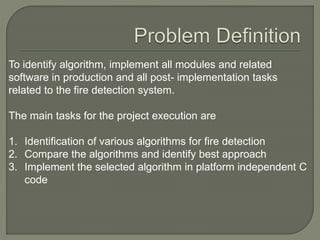
To identify algorithm, implement all modules and related
software in production and all post- implementation tasks
related to the fire detection system.
The main tasks for the project execution are
1. Identification of various algorithms for fire detection
2. Compare the algorithms and identify best approach
3. Implement the selected algorithm in platform independent C
code
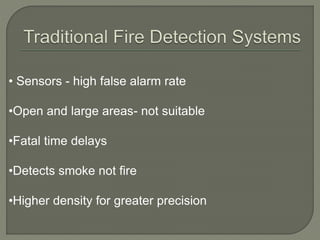
• Sensors - high false alarm rate
•Open and large areas- not suitable
•Fatal time delays
•Detects smoke not fire
•Higher density for greater precision
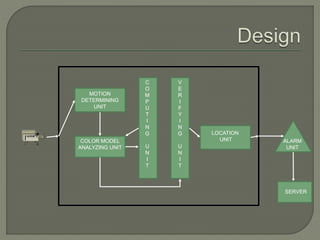
MOTION
DETERMINING
UNIT
COLOR MODEL
ANALYZING UNIT
C
O
M
P
U
T
I
N
G
U
N
I
T
V
E
R
I
F
Y
I
N
G
U
N
I
T
LOCATION
UNIT ALARM
UNIT
SERVER
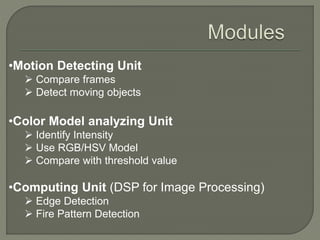
•Motion Detecting Unit
 Compare frames

 Detect moving objects
•Color Model analyzing Unit
 Identify Intensity
 Use RGB/HSV Model
 Compare with threshold value
•Computing Unit (DSP for Image Processing)
 Edge Detection
 Fire Pattern Detection
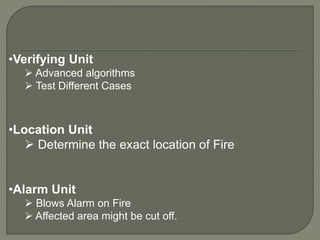
•Verifying Unit
 Advanced algorithms
 Test Different Cases
•Location Unit
 Determine the exact location of Fire
•Alarm Unit
 Blows Alarm on Fire
 Affected area might be cut off.
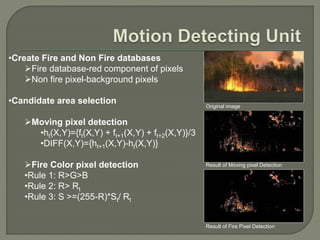
•Create Fire and Non Fire databases
Fire database-red component of pixels
Non fire pixel-background pixels
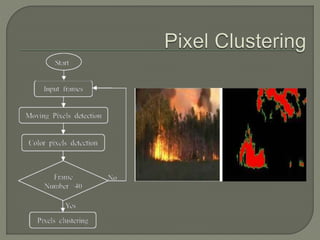
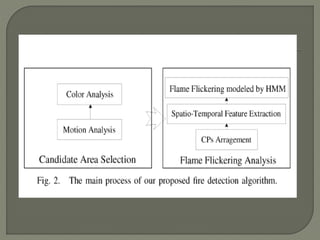
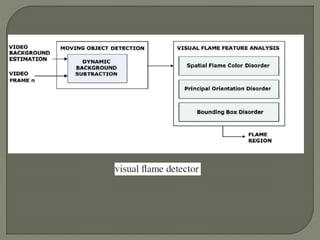
•Candidate area selection
Moving pixel detection
•ht(X,Y)={ft(X,Y) + ft+1(X,Y) + ft+2(X,Y)}/3
•DIFF(X,Y)={ht+1(X,Y)-ht(X,Y)}
Fire Color pixel detection
•Rule 1: R>G>B
•Rule 2: R> Rt
•Rule 3: S >=(255-R)*St/ Rt
Original image
Result of Moving pixel Detection
Result of Fire Pixel Detection
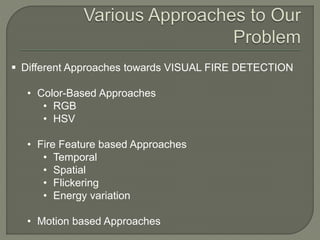
 Different Approaches towards VISUAL FIRE DETECTION
• Color-Based Approaches
• RGB
• HSV
• Fire Feature based Approaches
• Temporal
• Spatial
• Flickering
• Energy variation
• Motion based Approaches
 Fuzzy logic : a very efficient method for handling
imprecision: an intrinsic property of Fire.
 Combines the capabilities of automata with fuzzy
logic.
 Fits best in applications where the variables are
continuous and/or mathematical models are difficult
to define.
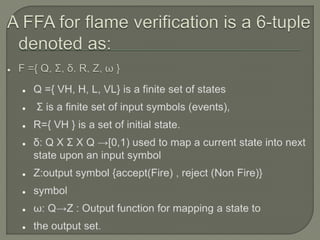
 Variance of visual features extracted and probability
membership functions generated for states.
To assign MV of current state to next state, weighted
average of transition functions taken.
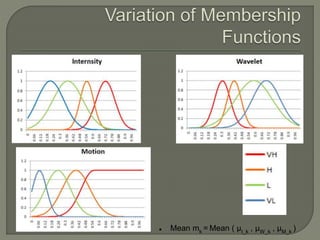
 Fuzzy membership functions can have different shapes
depending on the application and user preference.
 Mean mk = Mean ( μI_k , μW_k , μM_k )
 FFA can model vague and uncertain information of
flames.
 More robust to fast expanding flames with dynamic
colors.
 Flexible choice of model architecture & membership
functions of features.
 Evaluate Matrices-Fire and Non Fire database
 Evaluates similarity
 Apply viterbi algorithm-evaluate similarity
 Compare fire HMM with non fire HMM
 If Fire HMM>Non Fire HMM then
 Fire
 Else
 Not Fire
 Π - Initial state distribution
 A ij –State transition probability matrix
 B ij – Symbol probability distribution matrix
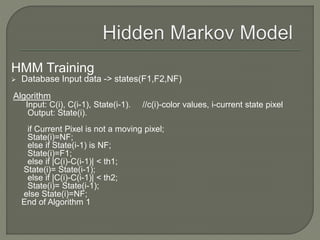
HMM Training
 Database Input data -> states(F1,F2,NF)
Algorithm
Input: C(i), C(i-1), State(i-1). //c(i)-color values, i-current state pixel
Output: State(i).
if Current Pixel is not a moving pixel;
State(i)=NF;
else if State(i-1) is NF;
State(i)=F1;
else if |C(i)-C(i-1)| < th1;
State(i)= State(i-1);
else if |C(i)-C(i-1)| < th2;
State(i)= State(i-1);
else State(i)=NF;
End of Algorithm 1
Previous work
 Color Information
 Shape Information
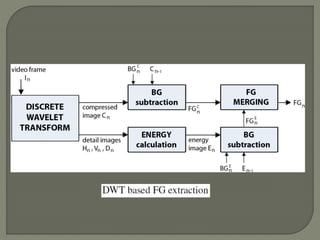
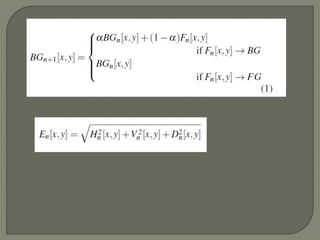
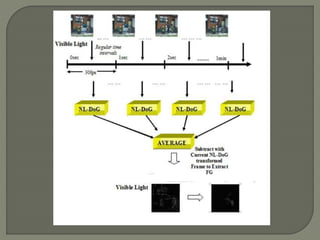
Wavelet Transformation
These approaches focus on spatial information
Markov Model
 Describes Temporal changes
 Uses Flickering characteristic of fire
 Fixed detecting point at the boundary of flame
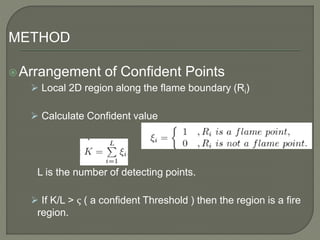
METHOD
Arrangement of Confident Points
 Local 2D region along the flame boundary (Ri)
 Calculate Confident value
L is the number of detecting points.
 If K/L > ς ( a confident Threshold ) then the region is a fire
region.
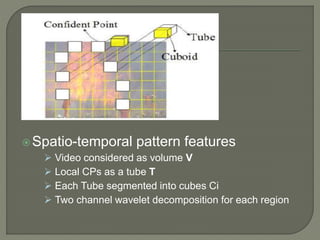
Spatio-temporal pattern features
 Video considered as volume V
 Local CPs as a tube T
 Each Tube segmented into cubes Ci
 Two channel wavelet decomposition for each region
Flame Flickering model by HMM
 Tubes from fire video samples are chosen
 Observation sequences are trained
Three hidden states by k-means clustering
 High Frequency state
 Medium Frequency state
 Low Frequency state
 Mixture of Gaussian
Computational cost is low
Provides Real time fire detection
Low false alarm rate
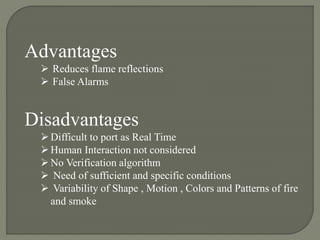
Advantages
 Reduces flame reflections
 False Alarms
Disadvantages
Difficult to port as Real Time
Human Interaction not considered
No Verification algorithm
 Need of sufficient and specific conditions
 Variability of Shape , Motion , Colors and Patterns of fire
and smoke
• Texas Instrument’s Da Vinci Platform
 C28x DSP core with floating point unit
 ARM Cortex-M3 processor
• OpenCV library for testing
•Camera to provide real time feed (min. 12 fps)
• Can be used in conjunction with existing surveillance
systems.
• To be developed as a part of a larger surveillance
system to be developed by Tata Elxsi Ltd.
• Initial promise with high success rates of up to 99%
and only 0.3% failure rates.
• Cheaper alternative to the current sensor based
devices.
• Can be integrated with current CCTV systems.
• http://en.wikipedia.org/wiki/Image_processing
• http://www.imageprocessingbasics.com/
• http://ieeexplore.ieee.org
• IEEE Papers referred :
• Fire-Flame Detection based on Fuzzy Finite Automation
SunJae Ham, ByoungChul Ko, JaeYeal Nam
• A Novel Way for Fire Detection in The Video Using Hidden Markov Model
Jian Ding and Mao Ye
• Wavelet based multi-modal Fire Detection
Steven Verstock, Ioannis Kypraios, Pieterjan De Potter, Chris Poppe, Rik
Van de Walle
• Fire Detection Based on hidden Markov Models
Zhu Teng, Jeong-Hyun Kim,Dong-Joong Kang
FIRE DETECTION USING VIDEO ANALYTICS

FIRE DETECTION USING VIDEO ANALYTICS

  • 1.
  • 2.
    • Fire causessevere damages • Prevention of accidents is crucial • Fire detection using computer vision • Part of a larger surveillance system
  • 3.
    To identify algorithm,implement all modules and related software in production and all post- implementation tasks related to the fire detection system. The main tasks for the project execution are 1. Identification of various algorithms for fire detection 2. Compare the algorithms and identify best approach 3. Implement the selected algorithm in platform independent C code
  • 4.
    • Sensors -high false alarm rate •Open and large areas- not suitable •Fatal time delays •Detects smoke not fire •Higher density for greater precision
  • 5.
  • 6.
    •Motion Detecting Unit Compare frames  Detect moving objects •Color Model analyzing Unit  Identify Intensity  Use RGB/HSV Model  Compare with threshold value •Computing Unit (DSP for Image Processing)  Edge Detection  Fire Pattern Detection
  • 7.
    •Verifying Unit  Advancedalgorithms  Test Different Cases •Location Unit  Determine the exact location of Fire •Alarm Unit  Blows Alarm on Fire  Affected area might be cut off.
  • 8.
    •Create Fire andNon Fire databases Fire database-red component of pixels Non fire pixel-background pixels •Candidate area selection Moving pixel detection •ht(X,Y)={ft(X,Y) + ft+1(X,Y) + ft+2(X,Y)}/3 •DIFF(X,Y)={ht+1(X,Y)-ht(X,Y)} Fire Color pixel detection •Rule 1: R>G>B •Rule 2: R> Rt •Rule 3: S >=(255-R)*St/ Rt Original image Result of Moving pixel Detection Result of Fire Pixel Detection
  • 10.
     Different Approachestowards VISUAL FIRE DETECTION • Color-Based Approaches • RGB • HSV • Fire Feature based Approaches • Temporal • Spatial • Flickering • Energy variation • Motion based Approaches
  • 12.
     Fuzzy logic: a very efficient method for handling imprecision: an intrinsic property of Fire.  Combines the capabilities of automata with fuzzy logic.  Fits best in applications where the variables are continuous and/or mathematical models are difficult to define.
  • 14.
     Variance ofvisual features extracted and probability membership functions generated for states. To assign MV of current state to next state, weighted average of transition functions taken.  Fuzzy membership functions can have different shapes depending on the application and user preference.
  • 15.
     Mean mk= Mean ( μI_k , μW_k , μM_k )
  • 16.
     FFA canmodel vague and uncertain information of flames.  More robust to fast expanding flames with dynamic colors.  Flexible choice of model architecture & membership functions of features.
  • 18.
     Evaluate Matrices-Fireand Non Fire database  Evaluates similarity  Apply viterbi algorithm-evaluate similarity  Compare fire HMM with non fire HMM  If Fire HMM>Non Fire HMM then  Fire  Else  Not Fire  Π - Initial state distribution  A ij –State transition probability matrix  B ij – Symbol probability distribution matrix
  • 19.
    HMM Training  DatabaseInput data -> states(F1,F2,NF) Algorithm Input: C(i), C(i-1), State(i-1). //c(i)-color values, i-current state pixel Output: State(i). if Current Pixel is not a moving pixel; State(i)=NF; else if State(i-1) is NF; State(i)=F1; else if |C(i)-C(i-1)| < th1; State(i)= State(i-1); else if |C(i)-C(i-1)| < th2; State(i)= State(i-1); else State(i)=NF; End of Algorithm 1
  • 20.
    Previous work  ColorInformation  Shape Information Wavelet Transformation These approaches focus on spatial information Markov Model  Describes Temporal changes  Uses Flickering characteristic of fire  Fixed detecting point at the boundary of flame
  • 21.
    METHOD Arrangement of ConfidentPoints  Local 2D region along the flame boundary (Ri)  Calculate Confident value L is the number of detecting points.  If K/L > ς ( a confident Threshold ) then the region is a fire region.
  • 22.
    Spatio-temporal pattern features Video considered as volume V  Local CPs as a tube T  Each Tube segmented into cubes Ci  Two channel wavelet decomposition for each region
  • 23.
    Flame Flickering modelby HMM  Tubes from fire video samples are chosen  Observation sequences are trained Three hidden states by k-means clustering  High Frequency state  Medium Frequency state  Low Frequency state  Mixture of Gaussian
  • 25.
    Computational cost islow Provides Real time fire detection Low false alarm rate
  • 31.
    Advantages  Reduces flamereflections  False Alarms Disadvantages Difficult to port as Real Time Human Interaction not considered No Verification algorithm  Need of sufficient and specific conditions  Variability of Shape , Motion , Colors and Patterns of fire and smoke
  • 32.
    • Texas Instrument’sDa Vinci Platform  C28x DSP core with floating point unit  ARM Cortex-M3 processor • OpenCV library for testing •Camera to provide real time feed (min. 12 fps)
  • 33.
    • Can beused in conjunction with existing surveillance systems. • To be developed as a part of a larger surveillance system to be developed by Tata Elxsi Ltd.
  • 34.
    • Initial promisewith high success rates of up to 99% and only 0.3% failure rates. • Cheaper alternative to the current sensor based devices. • Can be integrated with current CCTV systems.
  • 35.
    • http://en.wikipedia.org/wiki/Image_processing • http://www.imageprocessingbasics.com/ •http://ieeexplore.ieee.org • IEEE Papers referred : • Fire-Flame Detection based on Fuzzy Finite Automation SunJae Ham, ByoungChul Ko, JaeYeal Nam • A Novel Way for Fire Detection in The Video Using Hidden Markov Model Jian Ding and Mao Ye • Wavelet based multi-modal Fire Detection Steven Verstock, Ioannis Kypraios, Pieterjan De Potter, Chris Poppe, Rik Van de Walle • Fire Detection Based on hidden Markov Models Zhu Teng, Jeong-Hyun Kim,Dong-Joong Kang