



Design and Analysis of Intelligent Fire DetectionDesign and Analysis of Intelligent Fire Detection
System using Artificial Neural NetworkSystem using Artificial Neural Network
Presented By
Abhijeet Agarwal
Project ObjectivesProject Objectives
§ The objective of this paper is to describe an intelligent fire detection
system.
§ In this paper a fire detection system based on Artificial Neural
Network (ANN) are designed.
§ It uses the fire temperature, smoke concentration and CO
concentration in the initial fire stage as a system input with a
neural network simulation model.
MotivationMotivation
§Currently the majority of automatic fire alarm systems use a single
passive sensor alarm system which has some unavoidable
problems.
§In domestic fire alarm system some devices using photosensitive
detectors are affected by sunlight and lighting. Smoke detectors can
be affected by various gases. Due to which we often get false fire
alarm.
§Thus traditional fire detection systems are unable to meet the
needs of real fire alarm.
§In view of the above ANN based fire alarm system is more
compatible than traditional fire alarm system. It increases early fire
detection capability and reduces the false fire alarms.
IntroductionIntroduction
§ Fires are chemical and physical processes accompanied by smoke,
light and heat.
§ Fire detection system access fire information and turn this
information into electrical signals for processing.
§ An Artificial Neural Network (ANN) is an information processing
paradigm that process the information.
§ Besides this the neural networks have been successfully used to
resolve many complex practical problems in pattern recognition,
system identification, signal processing and forecasting due to its
intelligent features.
§ Software Used : MATLAB
§
§
Assumption for Model DevelopmentAssumption for Model Development
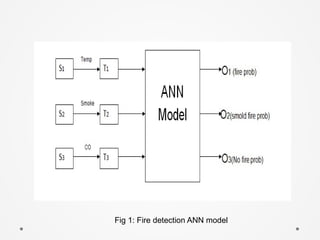
Fig 1: Fire detection ANN model
 
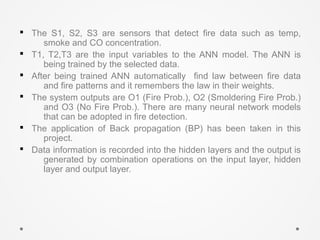
§ The S1, S2, S3 are sensors that detect fire data such as temp,
smoke and CO concentration.
§ T1, T2,T3 are the input variables to the ANN model. The ANN is
being trained by the selected data.
§ After being trained ANN automatically find law between fire data
and fire patterns and it remembers the law in their weights.
§ The system outputs are O1 (Fire Prob.), O2 (Smoldering Fire Prob.)
and O3 (No Fire Prob.). There are many neural network models
that can be adopted in fire detection.
§ The application of Back propagation (BP) has been taken in this
project.
§ Data information is recorded into the hidden layers and the output is
generated by combination operations on the input layer, hidden
layer and output layer.
Simulation of input dataSimulation of input data
§ The current model uses the BP network input layer neurons to
represent the temperature, smoke density, and CO concentration
as the input signals.
§ The output layer gives the probabilities of the three fire states for
fire, smoldering fires and no fire.
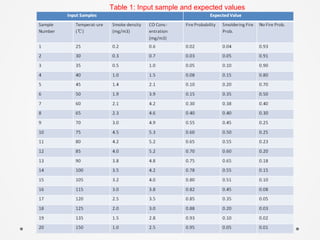
§ This analysis used 20 typical group samples listed in table1 for the
BP network training.
Table 1: Input sample and expected values
Simulation results analysisSimulation results analysis
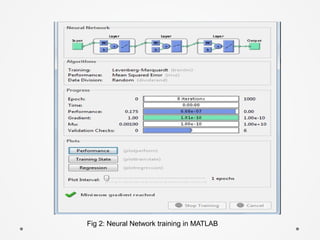
Fig 2: Neural Network training in MATLAB
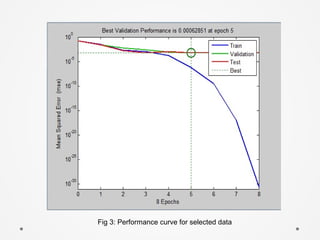
Fig 3: Performance curve for selected data
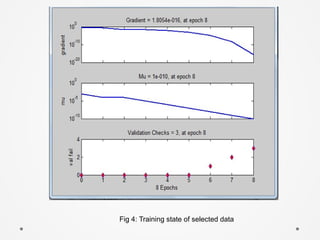
Fig 4: Training state of selected data
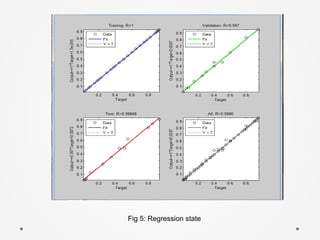
Fig 5: Regression state
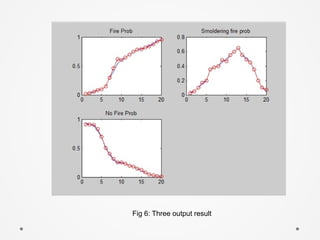
Fig 6: Three output result
Comparison of Simulated results with expected valuesComparison of Simulated results with expected values
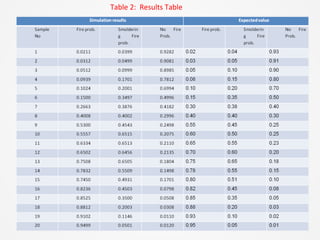
§ The comparison of simulated results and expected values are
shown in the table 2.
§ Comparison of the simulation results and the expected values
shows that the average fire identification error probability is
1.9%.
§ The average error probability for detecting smoldering fires is
1.6%.
§ The average error probability of no fire identification is 1.0%.
§ Thus the fire detection neural network after training has a high
accuracy recognition rate for fires which will greatly reduce
false alarms and leak checks and improve the reliability and
credibility of automatic fire alarm systems.
Table 2: Results Table
ConclusionsConclusions
§ The fire detection neural network has a fire prediction error rate for three fire
states are very less. The high recognition rate of this neural network will
greatly reduce the risk of false alarms and leak-checks of fire alarm
system.
§ This neural network based fire alarm system can analyze many types of
sensor data at the same time and can improve the ability of systems to
adapt in their environment and correct for interference to accurately
predict fires.
§ The study also describes how neural networks can combine sensor data in
an Intelligent automatic fire alarm system to effectively identify fires,
which has great significance for safety.
§ The simulation results are satisfying and show the very less difference
between simulated results and expected values. Hence it shows that the
ANN fire alarm sensitivity is high.
??
ThanksThanks

Fire Detection by Artificial Neural Network

  • 1.
    Design and Analysisof Intelligent Fire DetectionDesign and Analysis of Intelligent Fire Detection System using Artificial Neural NetworkSystem using Artificial Neural Network Presented By Abhijeet Agarwal
  • 2.
    Project ObjectivesProject Objectives §The objective of this paper is to describe an intelligent fire detection system. § In this paper a fire detection system based on Artificial Neural Network (ANN) are designed. § It uses the fire temperature, smoke concentration and CO concentration in the initial fire stage as a system input with a neural network simulation model.
  • 3.
    MotivationMotivation §Currently the majorityof automatic fire alarm systems use a single passive sensor alarm system which has some unavoidable problems. §In domestic fire alarm system some devices using photosensitive detectors are affected by sunlight and lighting. Smoke detectors can be affected by various gases. Due to which we often get false fire alarm. §Thus traditional fire detection systems are unable to meet the needs of real fire alarm. §In view of the above ANN based fire alarm system is more compatible than traditional fire alarm system. It increases early fire detection capability and reduces the false fire alarms.
  • 4.
    IntroductionIntroduction § Fires arechemical and physical processes accompanied by smoke, light and heat. § Fire detection system access fire information and turn this information into electrical signals for processing. § An Artificial Neural Network (ANN) is an information processing paradigm that process the information. § Besides this the neural networks have been successfully used to resolve many complex practical problems in pattern recognition, system identification, signal processing and forecasting due to its intelligent features. § Software Used : MATLAB § §
  • 5.
    Assumption for ModelDevelopmentAssumption for Model Development Fig 1: Fire detection ANN model
  • 6.
      § The S1,S2, S3 are sensors that detect fire data such as temp, smoke and CO concentration. § T1, T2,T3 are the input variables to the ANN model. The ANN is being trained by the selected data. § After being trained ANN automatically find law between fire data and fire patterns and it remembers the law in their weights. § The system outputs are O1 (Fire Prob.), O2 (Smoldering Fire Prob.) and O3 (No Fire Prob.). There are many neural network models that can be adopted in fire detection. § The application of Back propagation (BP) has been taken in this project. § Data information is recorded into the hidden layers and the output is generated by combination operations on the input layer, hidden layer and output layer.
  • 7.
    Simulation of inputdataSimulation of input data § The current model uses the BP network input layer neurons to represent the temperature, smoke density, and CO concentration as the input signals. § The output layer gives the probabilities of the three fire states for fire, smoldering fires and no fire. § This analysis used 20 typical group samples listed in table1 for the BP network training.
  • 8.
    Table 1: Inputsample and expected values
  • 9.
    Simulation results analysisSimulationresults analysis Fig 2: Neural Network training in MATLAB
  • 10.
    Fig 3: Performancecurve for selected data
  • 11.
    Fig 4: Trainingstate of selected data
  • 12.
  • 13.
    Fig 6: Threeoutput result
  • 14.
    Comparison of Simulatedresults with expected valuesComparison of Simulated results with expected values § The comparison of simulated results and expected values are shown in the table 2. § Comparison of the simulation results and the expected values shows that the average fire identification error probability is 1.9%. § The average error probability for detecting smoldering fires is 1.6%. § The average error probability of no fire identification is 1.0%. § Thus the fire detection neural network after training has a high accuracy recognition rate for fires which will greatly reduce false alarms and leak checks and improve the reliability and credibility of automatic fire alarm systems.
  • 15.
  • 16.
    ConclusionsConclusions § The firedetection neural network has a fire prediction error rate for three fire states are very less. The high recognition rate of this neural network will greatly reduce the risk of false alarms and leak-checks of fire alarm system. § This neural network based fire alarm system can analyze many types of sensor data at the same time and can improve the ability of systems to adapt in their environment and correct for interference to accurately predict fires. § The study also describes how neural networks can combine sensor data in an Intelligent automatic fire alarm system to effectively identify fires, which has great significance for safety. § The simulation results are satisfying and show the very less difference between simulated results and expected values. Hence it shows that the ANN fire alarm sensitivity is high.
  • 17.
  • 18.