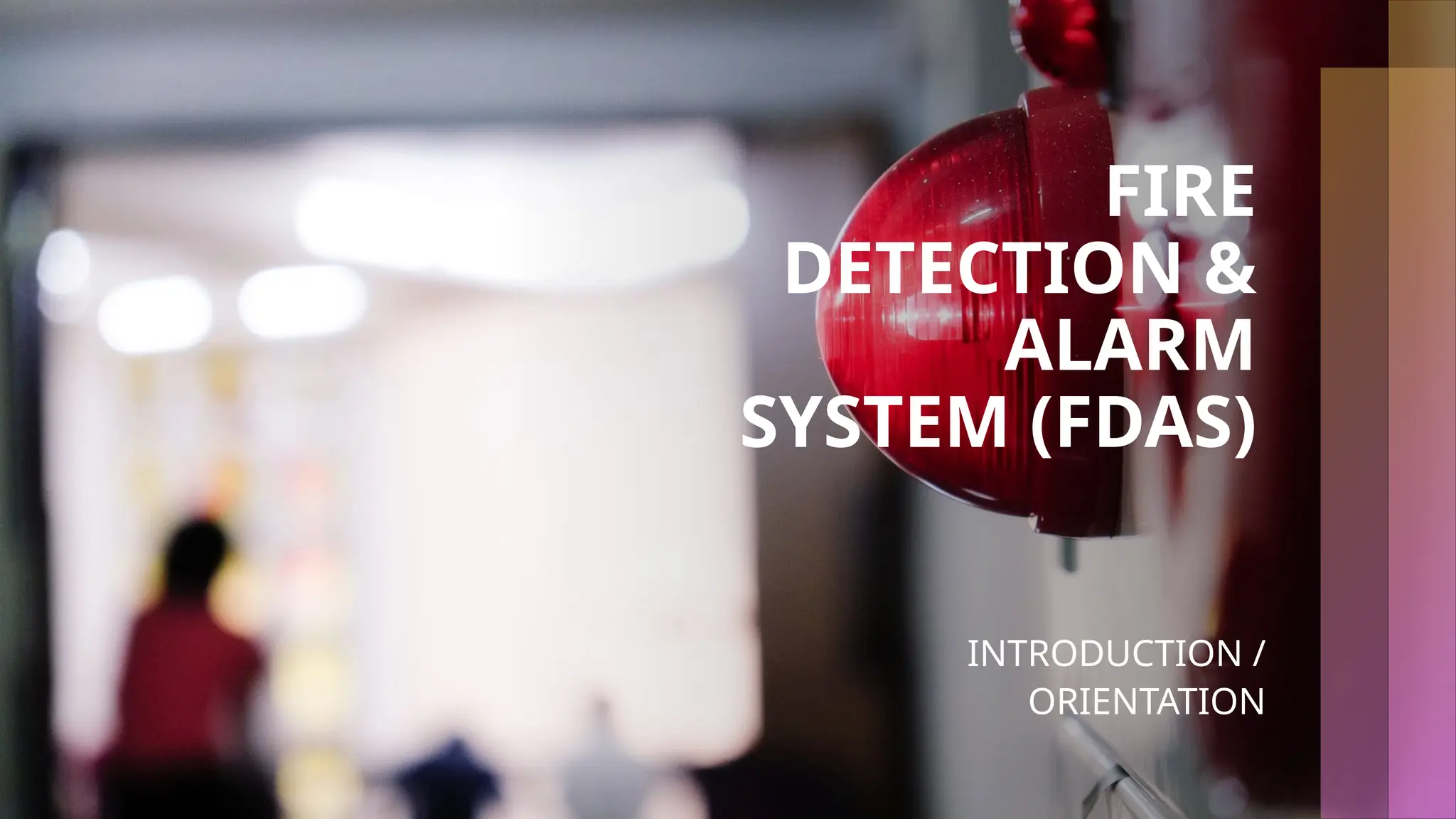
FIRE
DETECTION &
ALARM
SYSTEM (FDAS)
INTRODUCTION /
ORIENTATION
 Who is familiar with the FDAS system?
 What does FDAS stands for?
Why are fire detection and alarm system required?
 What are the 4 purpose of our FDAS?
 What are the essential capabilities of FDAS?
IS IT REQUIRED TO HAVE THE FDAS
INSTALLED IN THE BUILDING?
• Yes, because it will safeguard life and property from fire and
explosion hazards.
• Yes, because it is one of the most important measures you can take
to manage your fire risk.
• Yes, since it is a regulatory requirements as mandated in RA 9514
under Division 2, G: General Requirements and Division 6, Section
4 PURPOSE OF FDAS
1. Detect Fire
 It is designed to detect fire.
2. Alert Occupants
 It will alert occupants of the building using the audible and visible alarms
3. Manage Risk
 It will protect us by reacting to potential risk using control measures.
 through Fire Matrix, includes automatically shutting doors, powering off ventilation
and air conditioning or redirecting elevators.
4. Notify Authorities
 To ensure fire department is en route as quickly as possible
ESSENTIAL CAPABILITIES
OF FDAS
1. ALARM
In the event that there is an immediate threat to life, property, or mission, the fire alarm
system will sound the alarm, notifying occupants to escape, and letting the authorities
know they need to respond
2. TROUBLE
A trouble condition means that something is wrong with the system itself
 Fire alarm systems necessarily employ a trouble condition to alert you or your building
manager that while there may not be an immediate danger, you’ll need immediate
inspection and repair of your system.
3. SUPERVISORY
 means that the system the fire alarm monitors has some sort of issue
FIRE DETECTION AND ALARM
SYSTEM (FDAS)
• is an electrical system that includes
fire detection control and indicating equipment that which when
arranged in a specified configuration, is capable of detecting and
indicating a fire and providing signals to ancillary control equipment
for appropriate action in accordance with the
systems interface matrix.
• is a system that detects fire and alerts occupants within a centrally
monitored and controlled area.
• is your/our first line of defense against the danger of fire
BASIC FIRE ALARM SYSTEM
COMPONENT
• Fire Alarm initiating devices
• Fire notification devices
• Fire Alarm Control Panel
• Primary Power Supply
• Back-up power supply
BASIC FIRE ALARM SYSTEM
COMPONENT
• Fire Alarm initiating devices
 The role of the alarm initiating devices in a fire alarm system is to activate the system
when a fire occurs.
There are two types of fire alarm initiating devices:
1. Manual initiating devices
 includes pull stations, break glass station or buttons
 Manual initiating devices need to be well marked and accessible to make it easy to identify
and use.
2. Automatic initiating devices
 includes heat detectors, smoke detectors, flame detectors, CO detectors and etc.
BASIC FIRE ALARM SYSTEM
COMPONENT
• Fire Notification devices
 The role of notification devices in an alarm system is to notify
building occupants when a fire is detected.
Some fire alarm notification devices include:
 Bells
 Strobes
 Hornes
 Chimes
BASIC FIRE ALARM SYSTEM
COMPONENT
• Fire Notification devices
 The role of notification devices in an alarm system is to notify
building occupants when a fire is detected.
Some fire alarm notification devices include:
 Bells
 Strobes
 Hornes
 Chimes
BASIC FIRE ALARM SYSTEM
COMPONENT
• Fire Alarm Control Panel
 The fire alarm control panel is the central hub of the fire alarm and
detection system
 The control panel acts as the brain of the alarm system by
monitoring and managing the initiation devices
 When an initiation device is triggered, a signal is sent to the control
panel and the control panel activates the notification devices
The status of the system is displayed on the control panel and allows
you to see when an issue is detected and allows you to control it
manually.
BASIC FIRE ALARM SYSTEM
COMPONENT
• Primary Power Supply
 The primary power supply is typically 120- or 240-volt AC power sources.
• Back-up Power Supply
 In the event of a power failure, the fire alarm system still needs to work in
order to alert people if a fire occurs
 A backup power supply is an important part of any fire alarm and
detection system
 The backup power supply includes 6- or 12-volt batteries to keep the
system running when a power failure happens.
Initiating Devices
Notification Devices
FACP
• Smoke Detectors
Types:
1. Ionization
2. Light Obscuring
3. Light Scattering
* Gas Detectors
Heat Detectors
• Can work on ROR
• On pre set temp value
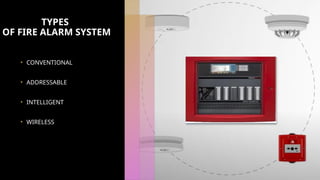
TYPES
OF FIRE ALARM SYSTEM
• CONVENTIONAL
• ADDRESSABLE
• INTELLIGENT
• WIRELESS
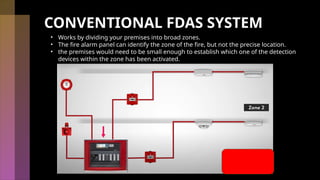
CONVENTIONAL FDAS SYSTEM
• Works by dividing your premises into broad zones.
• The fire alarm panel can identify the zone of the fire, but not the precise location.
• the premises would need to be small enough to establish which one of the detection
devices within the zone has been activated.
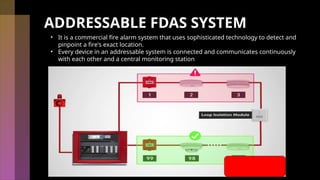
ADDRESSABLE FDAS SYSTEM
• It is a commercial fire alarm system that uses sophisticated technology to detect and
pinpoint a fire's exact location.
• Every device in an addressable system is connected and communicates continuously
with each other and a central monitoring station
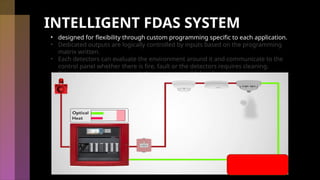
INTELLIGENT FDAS SYSTEM
• designed for flexibility through custom programming specific to each application.
• Dedicated outputs are logically controlled by inputs based on the programming
matrix written.
• Each detectors can evaluate the environment around it and communicate to the
control panel whether there is fire, fault or the detectors requires cleaning.
• Primary purpose is to prevent the occurrence of false alarms.
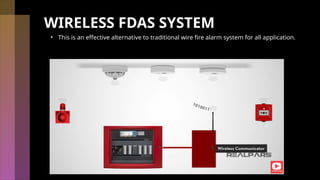
WIRELESS FDAS SYSTEM
• This is an effective alternative to traditional wire fire alarm system for all application.
THANK YOU

Fire Detection and Alarm System Orientation.pptx

  • 1.
  • 2.
     Who isfamiliar with the FDAS system?  What does FDAS stands for? Why are fire detection and alarm system required?  What are the 4 purpose of our FDAS?  What are the essential capabilities of FDAS?
  • 3.
    IS IT REQUIREDTO HAVE THE FDAS INSTALLED IN THE BUILDING? • Yes, because it will safeguard life and property from fire and explosion hazards. • Yes, because it is one of the most important measures you can take to manage your fire risk. • Yes, since it is a regulatory requirements as mandated in RA 9514 under Division 2, G: General Requirements and Division 6, Section
  • 4.
    4 PURPOSE OFFDAS 1. Detect Fire  It is designed to detect fire. 2. Alert Occupants  It will alert occupants of the building using the audible and visible alarms 3. Manage Risk  It will protect us by reacting to potential risk using control measures.  through Fire Matrix, includes automatically shutting doors, powering off ventilation and air conditioning or redirecting elevators. 4. Notify Authorities  To ensure fire department is en route as quickly as possible
  • 5.
    ESSENTIAL CAPABILITIES OF FDAS 1.ALARM In the event that there is an immediate threat to life, property, or mission, the fire alarm system will sound the alarm, notifying occupants to escape, and letting the authorities know they need to respond 2. TROUBLE A trouble condition means that something is wrong with the system itself  Fire alarm systems necessarily employ a trouble condition to alert you or your building manager that while there may not be an immediate danger, you’ll need immediate inspection and repair of your system. 3. SUPERVISORY  means that the system the fire alarm monitors has some sort of issue
  • 6.
    FIRE DETECTION ANDALARM SYSTEM (FDAS) • is an electrical system that includes fire detection control and indicating equipment that which when arranged in a specified configuration, is capable of detecting and indicating a fire and providing signals to ancillary control equipment for appropriate action in accordance with the systems interface matrix. • is a system that detects fire and alerts occupants within a centrally monitored and controlled area. • is your/our first line of defense against the danger of fire
  • 7.
    BASIC FIRE ALARMSYSTEM COMPONENT • Fire Alarm initiating devices • Fire notification devices • Fire Alarm Control Panel • Primary Power Supply • Back-up power supply
  • 8.
    BASIC FIRE ALARMSYSTEM COMPONENT • Fire Alarm initiating devices  The role of the alarm initiating devices in a fire alarm system is to activate the system when a fire occurs. There are two types of fire alarm initiating devices: 1. Manual initiating devices  includes pull stations, break glass station or buttons  Manual initiating devices need to be well marked and accessible to make it easy to identify and use. 2. Automatic initiating devices  includes heat detectors, smoke detectors, flame detectors, CO detectors and etc.
  • 9.
    BASIC FIRE ALARMSYSTEM COMPONENT • Fire Notification devices  The role of notification devices in an alarm system is to notify building occupants when a fire is detected. Some fire alarm notification devices include:  Bells  Strobes  Hornes  Chimes
  • 10.
    BASIC FIRE ALARMSYSTEM COMPONENT • Fire Notification devices  The role of notification devices in an alarm system is to notify building occupants when a fire is detected. Some fire alarm notification devices include:  Bells  Strobes  Hornes  Chimes
  • 11.
    BASIC FIRE ALARMSYSTEM COMPONENT • Fire Alarm Control Panel  The fire alarm control panel is the central hub of the fire alarm and detection system  The control panel acts as the brain of the alarm system by monitoring and managing the initiation devices  When an initiation device is triggered, a signal is sent to the control panel and the control panel activates the notification devices The status of the system is displayed on the control panel and allows you to see when an issue is detected and allows you to control it manually.
  • 12.
    BASIC FIRE ALARMSYSTEM COMPONENT • Primary Power Supply  The primary power supply is typically 120- or 240-volt AC power sources. • Back-up Power Supply  In the event of a power failure, the fire alarm system still needs to work in order to alert people if a fire occurs  A backup power supply is an important part of any fire alarm and detection system  The backup power supply includes 6- or 12-volt batteries to keep the system running when a power failure happens.
  • 13.
    Initiating Devices Notification Devices FACP •Smoke Detectors Types: 1. Ionization 2. Light Obscuring 3. Light Scattering * Gas Detectors Heat Detectors • Can work on ROR • On pre set temp value
  • 14.
    TYPES OF FIRE ALARMSYSTEM • CONVENTIONAL • ADDRESSABLE • INTELLIGENT • WIRELESS
  • 15.
    CONVENTIONAL FDAS SYSTEM •Works by dividing your premises into broad zones. • The fire alarm panel can identify the zone of the fire, but not the precise location. • the premises would need to be small enough to establish which one of the detection devices within the zone has been activated.
  • 16.
    ADDRESSABLE FDAS SYSTEM •It is a commercial fire alarm system that uses sophisticated technology to detect and pinpoint a fire's exact location. • Every device in an addressable system is connected and communicates continuously with each other and a central monitoring station
  • 17.
    INTELLIGENT FDAS SYSTEM •designed for flexibility through custom programming specific to each application. • Dedicated outputs are logically controlled by inputs based on the programming matrix written. • Each detectors can evaluate the environment around it and communicate to the control panel whether there is fire, fault or the detectors requires cleaning. • Primary purpose is to prevent the occurrence of false alarms.
  • 18.
    WIRELESS FDAS SYSTEM •This is an effective alternative to traditional wire fire alarm system for all application.
  • 19.