1
basic fire safety
this slideshow will give you an understanding of:
• the nature of fire
• fire hazards and risk
• fire prevention
• our fire procedures
• how to select and use a portable fire
extinguisher safely
fire prevention….
• be mindful of fire safety
• don’t block fire exits, call points or
extinguishers
• observe the no smoking policy
• don’t wedge fire doors open
fire procedure….
on hearing alarm….
• leave the building immediately
• use the nearest exit
• walk quickly but don’t run.
• close doors behind you
• do not delay your exit to collect your belongings
• attend the fire assembly point
• do not return until told to do so
there are audible and visual fire alarms at
priory street centre
exit routes are signposted and the assembly
point is outside the front of the building
on finding a fire….
• sound the fire alarm
• fight the fire if you are competent and you consider it
safe to do so
• evacuate as per normal fire procedure
• inform the fire officers
fire officers are…
Matthew Langhorn, John Stevens and Kenny Lieske
or reception (if no fire officers are on site)
call points are located throughout the building
(usually next to an exit)
written fire action instructions are also located
next to exits
sources of ignition….
• smoking and naked flames
• electrical faults
• heaters
• contractors tools and
equipment
• arson
fuels….
• paper & boxes etc.
• expanded polystyrene beads
• plastics
• solvents
• carpets
• furniture
• waste materials
in order to understand
how fire extinguishers
work…you need to
know a little bit about
fire
what is fire….
fire [ˈfi(-ə)r ] noun 
1. fire is a rapid oxidation process that creates light, heat, and smoke,
and varies in intensity. it is commonly used to describe either a fuel in
a state of combustion (e.g., a campfire, or a lit fireplace or stove) or a
violent, destructive and uncontrolled burning (e.g., in buildings)
fire needs three things thrive:
oxygen
heat
fuel
fire triangle….
fire extinguishers work by removing one or more of these elements
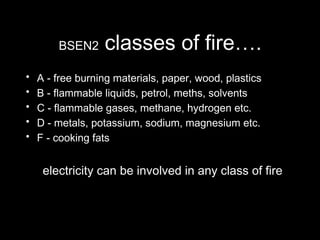
BSEN2 classes of fire….
• A - free burning materials, paper, wood, plastics
• B - flammable liquids, petrol, meths, solvents
• C - flammable gases, methane, hydrogen etc.
• D - metals, potassium, sodium, magnesium etc.
• F - cooking fats
electricity can be involved in any class of fire
types of extinguisher
water
water
can be used to extinguish free burning materials,
paper, wood, plastics but do not use on live electrical
equipment, flammable liquid, chemical or metal fires
types of extinguisher
CO2
2
can be used on live electrical equipment and to extinguish
flammable liquids.
do not touch the black horn when operating this extinguisher
types of extinguisher
powder
powder
can be used on live electrical equipment and to
extinguish flammable liquids and gaseous fires.
types of extinguisher
fire blanket
fire blanket
fire blankets should be used to extinguish fires
involving cooking fats
using an extinguisher….
• pull the pin
• aim at the base of the fire from a
safe distance
• squeeze the handle
• sweep from side to side
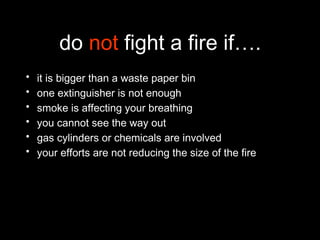
do not fight a fire if….
• it is bigger than a waste paper bin
• one extinguisher is not enough
• smoke is affecting your breathing
• you cannot see the way out
• gas cylinders or chemicals are involved
• your efforts are not reducing the size of the fire

Fire

  • 1.
  • 2.
    this slideshow willgive you an understanding of: • the nature of fire • fire hazards and risk • fire prevention • our fire procedures • how to select and use a portable fire extinguisher safely
  • 3.
  • 4.
    • be mindfulof fire safety • don’t block fire exits, call points or extinguishers • observe the no smoking policy • don’t wedge fire doors open
  • 5.
  • 6.
    on hearing alarm…. •leave the building immediately • use the nearest exit • walk quickly but don’t run. • close doors behind you • do not delay your exit to collect your belongings • attend the fire assembly point • do not return until told to do so
  • 7.
    there are audibleand visual fire alarms at priory street centre exit routes are signposted and the assembly point is outside the front of the building
  • 8.
    on finding afire…. • sound the fire alarm • fight the fire if you are competent and you consider it safe to do so • evacuate as per normal fire procedure • inform the fire officers fire officers are… Matthew Langhorn, John Stevens and Kenny Lieske or reception (if no fire officers are on site)
  • 9.
    call points arelocated throughout the building (usually next to an exit) written fire action instructions are also located next to exits
  • 10.
  • 11.
    • smoking andnaked flames • electrical faults • heaters • contractors tools and equipment • arson
  • 12.
  • 13.
    • paper &boxes etc. • expanded polystyrene beads • plastics • solvents • carpets • furniture • waste materials
  • 14.
    in order tounderstand how fire extinguishers work…you need to know a little bit about fire
  • 15.
    what is fire…. fire[ˈfi(-ə)r ] noun  1. fire is a rapid oxidation process that creates light, heat, and smoke, and varies in intensity. it is commonly used to describe either a fuel in a state of combustion (e.g., a campfire, or a lit fireplace or stove) or a violent, destructive and uncontrolled burning (e.g., in buildings) fire needs three things thrive: oxygen heat fuel
  • 16.
    fire triangle…. fire extinguisherswork by removing one or more of these elements
  • 17.
    BSEN2 classes offire…. • A - free burning materials, paper, wood, plastics • B - flammable liquids, petrol, meths, solvents • C - flammable gases, methane, hydrogen etc. • D - metals, potassium, sodium, magnesium etc. • F - cooking fats electricity can be involved in any class of fire
  • 18.
    types of extinguisher water water canbe used to extinguish free burning materials, paper, wood, plastics but do not use on live electrical equipment, flammable liquid, chemical or metal fires
  • 19.
    types of extinguisher CO2 2 canbe used on live electrical equipment and to extinguish flammable liquids. do not touch the black horn when operating this extinguisher
  • 20.
    types of extinguisher powder powder canbe used on live electrical equipment and to extinguish flammable liquids and gaseous fires.
  • 21.
    types of extinguisher fireblanket fire blanket fire blankets should be used to extinguish fires involving cooking fats
  • 22.
    using an extinguisher…. •pull the pin • aim at the base of the fire from a safe distance • squeeze the handle • sweep from side to side
  • 23.
    do not fighta fire if…. • it is bigger than a waste paper bin • one extinguisher is not enough • smoke is affecting your breathing • you cannot see the way out • gas cylinders or chemicals are involved • your efforts are not reducing the size of the fire